State’s Money Woes Earn National Spotlight

The cover of the national magazine depicts a waterfront home in Mystic Seaport, under the headline that reads “The fiscal mess in America’s richest state.”  Connecticut, without an approved state budget for all of July and August and nearly half of September, is earning some notice.  And it is not particularly friendly. The article, in the September issue of Governing, begins with the question, “How could the nation’s wealthiest state become a fiscal basket case?”  The answer is complex, and the magazine devotes a full six pages to walking through how the state got into this mess, and how it might navigate its way out.
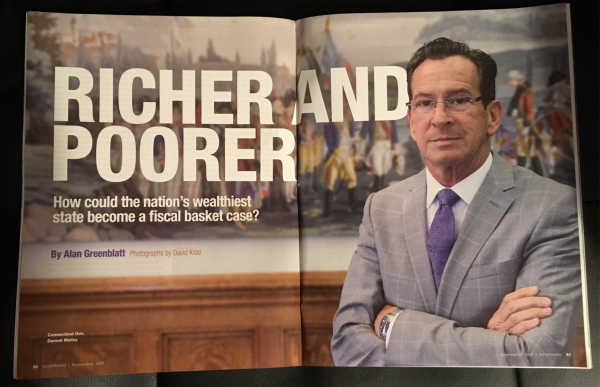
Along the way, the magazine suggest that the state “may be too rich for its own good,” pointing out that “long blessed with a disproportionate number of high-income residents, the state has entertained lavish spending habits for decades.” It also cites statistics that underscore the problems and challenges:

  • Over the past 20 years, job creation numbers have ranked in the bottom five among the 50 states
  • Connecticut has the nation’s second-highest rate of income inequality, after New York
  • The state has lost population for three years running
  • Last year, Greater Hartford ranked fourth and New Haven fifth in population loss among the nation’s 100 largest metro areas

The ineffective state spending cap, approved by voters more than 20 years ago but routinely circumvented since, is cited as a contributor to the fiscal cliff the state sits on, along with an overreliance on the income tax, political infighting, increased taxes, the lack of regionalism and a host of other decisions made by Governors and legislatures for decades.

One glaring example cited:  “Connecticut, which is home to 3.6 million people, has 111 police dispatch centers.  By comparison, Houston, which as 2.3 million residents, has just one emergency dispatch center, which handles fire as well as police.”

With a circulation of 85,000 in print and a widely viewed website, Governing is described as "the nation's leading media platform covering politics, policy and management for state and local government leaders." It is among the most widely read and most influential among government leaders - with an audience that also includes "journalists, academics, advocates and activists."

The article did point to some silver linings, past and present.  “Connecticut clearly has the means to change course. Not only is its median income still high, but the state boasts assets such as proximity to Boston and New York, amiable coastlines and river valleys, and notable institutions of higher education.  In addition to the continuing presence of a thriving financial sector, Connecticut is home to aerospace and defense contractors and other advanced manufacturers who can’t hire help fast enough, as well as a growing medical and life sciences sector.”

On the other hand, the publication points out, “Connecticut is 80 percent white, but its population of white children under the age of 10 is falling faster than in any other state.  Racial and ethnic minorities already make up more than 50 percent of infants and toddlers and are about to become a majority of 3- and 4-year olds.”  There is, the publication adds, “a pronounced achievement gap among racial groups and by geography.”

The conclusion reached by the Governing article?  “Connecticut is not in a death spiral but it has failed to position itself to react to changing demographics and location preferences… it’s clear that what’s worked so well for Connecticut in the past isn’t working now.”

Summed up House Speaker Joe Aresimowicz, one of many political leaders, including the Governor and legislators from both political parties, as well as city officials and economic analysts, who were interviewed for the article: “We are the land of steady habits and the world has changed around us.”
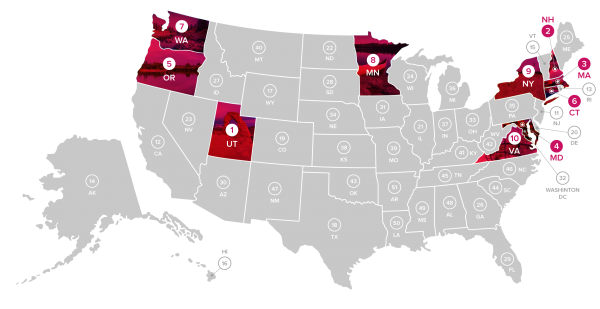
How Connected is Connecticut? State Ranks 6th in the USA

Internet access is as good in Connecticut as just about anywhere else in the country.  A new report on the Top Connected States in America ranks Connecticut as the 6th most connected state in the nation. The analysis, by USDish.com, found that the top 10 states showing excellent connectivity to broadband all value connecting rural citizens to the resources they need to succeed economically, both in school and at work. “Overall we found that the most important factor in these states’ ability to connect rural citizens to the internet were the use of government funded broadband task forces, infrastructure maintenance, and local support. The states that listened to the community were more likely to connect them to proper resources and economic growth flourished.”

While Connecticut ranked 6th overall, the state’s ranking varied in each of the categories of the analysis:  Connecticut ranked 10th in Access, 1st in Rural Access, 12th in Speed, and 21st in Support (by government).

Analysts compiled and ranked the report using data from the American Community Survey, conducted by the U.S. Census Bureau, the EducationSuperHighway non-profit, Fastmetrics, the National Conference of State Legislatures (NCSL) and the Institute for Local Self-Reliance.

Connecticut ranked 10th in Access, 1st in Rural Access, 12th in Speed, and 21st in Support.  The top five states for Rural Access were all in the Northeast – Connecticut, Massachusetts, New Hampshire, New Jersey, and Rhode Island. “Perhaps the emphasis on education and communication makes it easier to access the internet as a student, even in a rural area like Connecticut,” the analysis stated.

The analysis points out that a main reason why people don’t have access to broadband internet is due to a lack of income. Cited is a Pew Research poll that found 23 percent of people making under $30,000 per year don’t use the internet, possibly because of the high price for something they don’t consider a basic need. Most rural schools across the country still lack access to fiber and pay more than twice as much for bandwidth.

In contrast, Minnesota, New Hampshire, Oregon, and Maryland all have state government broadband task forces which promote the expansion of internet access throughout their rural areas, the analysis points out.

For internet access per state, the USDish team analyzed the percentage of school districts meeting a minimum of 100 Kbps per student.  They also examined the percentage of those with an internet subscription, and the total percentage of users with any access to the internet at all, be it in the form of a community library, town hall, or school.

Speed was analyzed by the average Mbps per state, and they evaluated states on whether they had a stimulus project, broadband task force, or whether the state had barriers preventing them from expanding the connectivity of those living in the area (i.e. laws, infrastructure support, prohibitions, etc.). As for rural area access, data on the number of households that had broadband internet in both urban and rural areas was used.  USDish.com is an authorized retailer of DISH Network.

Former CT Sportscaster Handling Weather Reporting Duties During Hurricane in Houston

Khambrel Marshall, who once delivered the evening sports news on Hartford’s Channel 3, has accomplished the rare broadcast trifecta – he has been a sports anchor, news anchor, and weather reporter during his career – all in some of the nation’s largest media markets.  It is a career with heightened visibility in recent days, as a Hurricane Harvey barrelled in on Houston, where Marshall is an on-air member of the NBC affiliate’s “Severe Weather” team, as well as the host of a weekly public affairs program on KPRC-TV. Joining the WFSB sports team in 1980 at age 27, Marshall spend five years at channel 3, moving from the nation’s number 23 TV market to number 13 when he relocated to Miami in 1985.  At the time, he became the first black sports anchor in South Florida, according to published reports.  He had received his broadcasting degree from Arizona State University while working in his first job in television as weekend sports anchor in Phoenix, prior to arriving in Hartford. He remained in sports until news captured his attention while he was sports director in Miami and was called upon to anchor during Hurricane Andrew.

In a 1980 interview published in Hartford Sports Extra, Marshall said “I’m an honest person.  And I have a great rapport with people.”  That has been evident at each stop in his career, because, Marshall explained three decades ago, “I like to rub elbows. I really like to meet the folks.”  He was one of 12 recipients to receive the National Community Service Award from the Westinghouse Corporation and was named "Outstanding Young Floridian" by the Fort Lauderdale Jaycees for his humanitarian efforts in the wake of Hurricane Andrew.

Marshall later joined KPRC in Houston in 1999 as a news anchor after 13 years in Miami.  He left the air in 2006 to accept a producer's position.  He then returned as a member of the station’s "Severe Weather Team."  He also airs a weekly public affairs program, Houston Newsmakers, that airs on Sunday mornings, just after Meet the Press.   He is approaching his 2oth anniversary at the Texas station, just a couple of years away.

A self-proclaimed "weather geek" since high school, he earned his Broadcast Meteorology Certification from Mississippi State University – after his broadcasting career was already underway.  Living through and reporting on Hurricane Andrew solidified his thirst for meteorological knowledge, specifically tropical weather phenomena.   It is an interest, and experience, that has been on display over the weekend in Houston.

Among his numerous honors is one of broadcasting's top awards, the Emmy, for a feature series titled "Guardians at Sea," chronicling the efforts of the U.S. Coast Guard to rescue Cuban and Haitian refugees crossing the Florida Straits.

He almost came to Hartford two years earlier, after the president of Post Newsweek, then the owner of WFSB, saw him on the air in Phoenix.  The station’s news director got in touch.

“He said the president of Post Newsweek stations saw in Phoenix for a convention or something, saw me on the air, and would like me for the Hartford station.”  Marshall recalled that although he liked Hartford, he decided to stay in Phoenix.  Two years later, after a brief stint in Detroit, Marshall and Hartford connected as he became the sportscaster on the 11 PM newscast, joining a team led by veteran sportscaster Dave Smith.

Marshall has made his mark supporting local nonprofit organizations in addition to his on-air work.  He supports Big Brothers Big Sisters, and was March of Dimes Texas Communications volunteer of the year twice.  He is a past Chairman of the Executive Committee of Big Brothers Big Sisters of Southeast Texas, and recent board member of Collaborative for Children.  In addition, he is a Senior Fellow in the "American Leadership Forum: Houston/Gulf Coast Chapter." The intense ALF one-year program is designed to join and strengthen diverse leaders in the community to better serve the public good.  Marshall was married in 1979 – just months before landing at WFSB in Hartford - to his wife Debbie, and they have two daughters.


Housing Stock in CT Cities Among Nation's Oldest

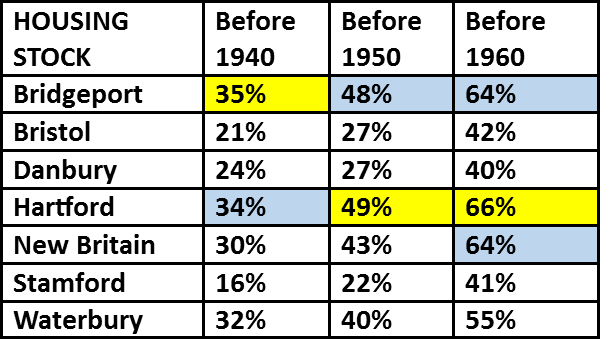
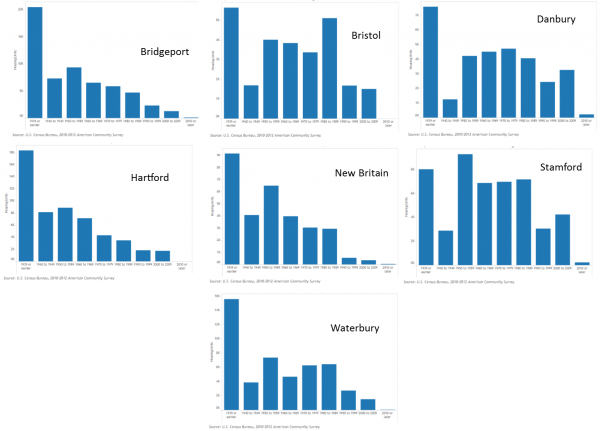
Approximately two-thirds of the housing stock in Hartford, New Britain and Bridgeport dates back more than half a century. Data compiled by Governing magazine shows that 66 percent of the housing stock in Hartford and 64 percent in Bridgeport and New Britain was constructed prior to 1960.  In Hartford, 34 percent of the housing dates back beyond 1940; in Bridgeport the percentage is slightly higher, at 35 percent.

Among the state’s largest communities, Danbury (40%) and Stamford (41%) have the smallest percentage of housing stock built prior to 1960.  The city with the smallest percentage of pre-1940 housing stock is Stamford, at 16 percent.

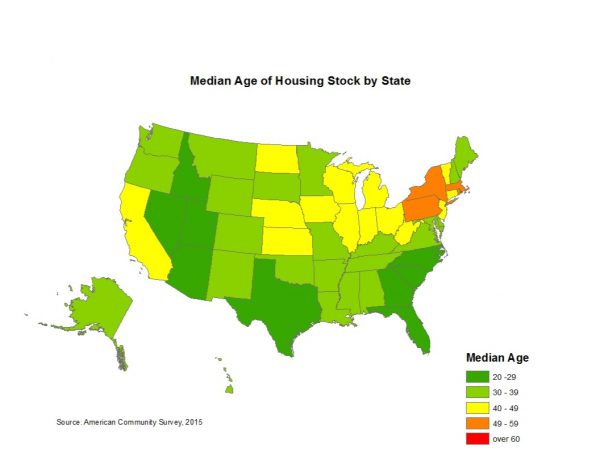
The median age of an owner-occupied home rose to 37 years in 2015, up from 31 years a decade ago, according to the latest data from the 2015 American Community Survey, as reported by Realtor Mag.   As of 2015, more than half of the housing stock in the U.S. was built prior to 1980. Thirty-eight percent of the homes were built prior to 1970. Meanwhile, homes constructed after 2000 comprise 19 percent of the housing stock.

The District of Columbia has the oldest homes with a median age of 75 years. New York and Massachusetts also have some of the oldest housing stock at 57 and 53 years, respectively.  Connecticut, overall, is not among the oldest, but places in the second tier among the states for the highest percentage of older homes, along with about a third of the states.  Among the state’s communities, however, the age of the housing stock differs.

Across the country, the West offers some of the newest homes. The median age of homes in Nevada is 20 years and in Arizona half of all occupied homes were built in the last 24 years.

The age of the housing stock nationwide varies greatly by region, the Governing analysis also points out, with some areas having a particularly large number of older homes.  More the two-thirds of housing units are at least 75 years old in Somerville, Mass., Buffalo, N.Y., and a few other cities with the oldest homes. In other regions, such as newer communities in the South, nearly all homes were constructed in the past few decades.

According to Census estimates, 13.5 percent of the nation's total housing units were built prior to 1940, while about 19 percent were built before 1950, Governing noted.  The analysis included age estimates for all cities with more than 25,000 housing units.


Gender Disparity Is Alive and Not-So-Well; Particularly in Connecticut, Analysis Finds

Connecticut places dead last among the 50 states in the degree of gender gap in executive positions in the workplace and overall workplace environment for women, according to a new analysis prepared by the financial website WalletHub.  The state also ranked in the bottom ten in the “education and health” category, ranking higher – in the top ten – only in “political empowerment,” despite having fewer women in the state legislature than about a decade ago. Overall, the state ranked 28th among the “Best and Worst States for Women’s Equality.”

The challenges present in Connecticut are true – to varying degrees – nationwide.  In 2016, the U.S. failed to place in the top 10 — or even the top 40 — of the World Economic Forum’s ranking of 144 countries based on gender equality, WalletHub reports.

Among the states, the top 10, with the slimmest inequality gap, were Hawaii, Nevada, Illinois, Minnesota, Washington, Maine, North Dakota, Oregon, Wisconsin, and Vermont.  Among the other New England states, Massachusetts ranked #13, New Hampshire was #16, and Rhode Island was #34.  The widest gaps were in Texas, Virginia and Utah.

"Connecticut ranked below average overall mostly because of its rankings for two of the categories we analyzed, Workplace Environment (50th) and Education & Health (43rd),” WalletHub analyst Jill Gonzalez told CT by the Numbers.  “Connecticut's disparities between women and men are quite pronounced when it comes to the workplace environment. Women earn 23 percent less than men, 9th highest in the country, and Connecticut has the highest gap of women in executive positions. Large differences also appear when looking at higher-income earners, with a 13 percent gap between women and men, and the entrepreneurship gap in Connecticut is at 48 percent, again favoring men."

To determine where women receive the most equal treatment, WalletHub’s analysts compared the 50 states across 15 key indicators of gender equality in three central categories: workplace environment, education and health, and political empowerment  Among the indicators used in the analysis, Connecticut ranked 46th with among the largest educational attainment gap among Bachelor’s Degree holders, 48th in the entrepreneurship gap, 49th in the disparity among higher income wage earners (in excess of $100,000 annually) and 50th with the largest executive positions gap.

According to the National Conference of State Legislatures, just over one-quarter of Connecticut’s legislators are women, at 27.3 percent, compared with the national average among state legislatures of 24.8 percent.  There are 1,830 women serving in legislatures across the country.  In Connecticut, 42 of 151 House members are women, and 9 of the Senate’s 36 seats are held by women.   Among the states with the highest percentage of women in their legislature are Vermont, Colorado and Nevada with 39 percent, Arizona with 38 percent, and Illinois and Washington at 36 percent.  Connecticut’s numbers have declined since 2009, when a total of 59 women held legislative seats, 8 in the Senate and 51 in the House.

The workplace environment category included data on income disparity, the number of executive positions held, minimum wage workers, unemployment rate disparity, entrepreneurship rate disparity and the disparity in the average number of work hours.

The analysis found that in every state, women earn less than men. Hawaii has the lowest gap, with women earning 12 percent less, and Wyoming has the highest, 31 percent. Connecticut ranked 41st.  Rhode Island has the highest unemployment-rate gap favoring women, with 2.4 percent more unemployed men. Georgia has the highest gap favoring men, with 1 percent more unemployed women. The unemployment rate is equal for men and women in Illinois and Idaho.  In Connecticut’s it’s nearly identical, with the 0.3 percent more unemployed men than women, based on the data reviewed.

Women continue to be disproportionately underrepresented in leadership positions nationwide. According to the Center for American Progress, women make up the majority of the population and 49 percent of the college-educated labor force. Yet they constitute “only 25 percent of executive- and senior-level officials and managers, hold only 20 percent of board seats, and are only 6 percent of CEOs.”  In addition, salary inequity continues, and women are underrepresented in government.

The analysis was released to coincide with Women’s Equality Day, which is observed annually on August 26. The U.S. Congress designated the commemoration beginning in 1971 to remember the 1920 certification of the 19th Amendment to the Constitution, granting women the right to vote. The observance of Women’s Equality Day also calls attention to women’s continuing efforts toward full equality, according to the National Women’s History Project.

7,000 Refugees Settle in CT Since 2001; Burma, Congo, Iran, Somalia Most Frequent Origin

The United States has long been the global leader in resettling refugees, defined as people forced to flee their home country to escape war, persecution or violence, explains Smithsonian magazine in a state-by-state comparison. Since 2001, the magazine reports, more than 895,000 refugees have settled in the U.S., typically after being referred by the United Nations and vetted by the State Department in a process that takes at least 18 months. By comparison, a million or so legal immigrants arrive annually. From October 2001 through 2016, Burma, Iraq, Somalia, Bhutan, and Iran are the top five nations that send refugees to the U.S.

Refugees to the United States have come mostly from the Middle East, Asia and Africa. While many immigrants, legal and undocumented, come from Latin America, U.S. regulations make it difficult for Central and South Americans to qualify as refugees, according to Smithsonian.

The magazine developed a series of charts that compare refugee populations resettled in 41 states since October 2001. In depicting the refugees’ nation or origin, the breakdown in each state is limited to nationalities with at least 500 people, and no more than the top 5 nationalities are shown.

The number of refugees from those five nations, as well the total number of refugees is indicated.

For Connecticut, the total number of refugees is 7,144. The largest percentage of refugees come from Burma, Democratic Republic of the Congo, Iran and Somalia.  Those four nations were the home country for 3,824 of the refugees who settled in Connecticut since 2001.

Massachusetts' total is three times Connecticut - 21,441 refugees moving to the Bay State since 2001.

States with the largest number of refugees include California (102,614), Texas (81,765), New York (53,790), Florida (46,553), Minnesota (40,762), Washington (40,111), Arizona (39,031), Michigan (38,175), and Georgia (35,328).

There were nine states that had less than 500 refugees from a single country since October 2001:  Alabama, Alaska, Arkansas, Delaware, Hawaii, Mississippi, Montana West Virginia and Wyoming.

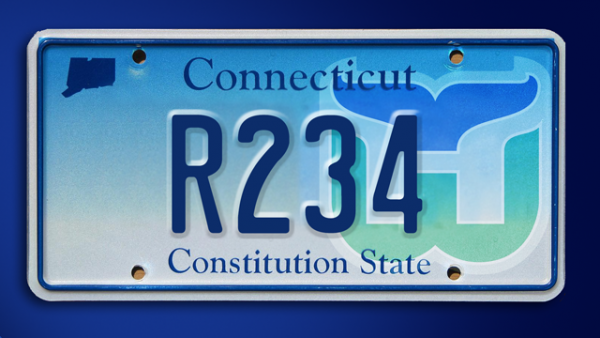
 

Hartford Whalers (Logo) Headed to Connecticut (Vehicles)

Connecticut drivers may soon see another vanity license plate option if a bill approved by the state legislature is signed into law by Governor Malloy.  A license plate commemorating the Hartford Whalers hockey franchise, which departed the Capital city 20 years ago, gained legislative approval in the final days of the General Assembly session. It is the latest of an ever-growing list of license plates supporting a variety of charitable causes and local organizations that are authorized by the state and raise money for various causes.  The Whalers license plate is to be a fundraising vehicle for the Connecticut Children’s Medical Center.

Stafford Springs State Rep. Kurt Vail, who introduced the bill, said in public hearing testimony earlier this year that “the popularity of the franchise has not gone away.”  He predicted that the license plate would be “a huge hit amongst our citizens.”  House Majority Leader Matt Ritter of Hartford said that “with memories of attending games with my grandfather still fresh…the Whalers continue to have a large and growing following in the city.”

Although the Whalers license plate was created by an act of the legislature, state law allows the Department of Motor Vehicles to issue special background plates on behalf of non-profit organizations. The organization must be non-profit, must submit a copy of the organization’s charter or by-laws, provide a letter of good standing from the State of Connecticut Secretary of State’s Office (if required) and supply any Internal Revenue Service ruling on their non-profit tax exemption status.

The logo production and cost incurred will be the responsibility of the organization. The logo prototype design, preferred in PDF format, must be submitted to the DMV. The logo can be no larger than 2 inches wide and 3.5 inches high. DMV has final approval on all the plate and logo designs.

A liaison for the organization must be appointed. This individual will be responsible for all communications with the DMV as well as certifying and authenticating (by signature) each member’s application, submitting the logo design to DMV for approval, submitting 400 applications with the required fee prior to the manufacturing of the special background plates, and submitting a Special Interest Plate disclaimer.

Many organizations in Connecticut offer license plates to their members and the general public.  General categories include animals, colleges, environment, organizations, police and fire, cities and towns, and recreation.

Organization vanity plates include Amistad, Benevolent & Protective Order of the Elks, IUOE Local 478, Grand Lodge of Connecticut, Knights of Columbus, Olympic Spirit, P.T. Barnum Foundation Inc., Preserving Our Past CT Trust for Historic Preservation, Red Sox Foundation, Lions Eye Research Foundation, Special Olympics, Federated Garden Clubs, Fidelco Guide Dog Foundation, Keep Kids Safe, New England Air Museum and the U.S.S. Connecticut Commissioning Committee.

When individuals purchase a Keep Kids Safe plate, a portion of the fee goes to the Keep Kids Safe Fund, which “makes many worthy projects happen for youngsters.”  The fund awards grants to schools, hospitals, municipalities and other non-profit organizations working to make all Connecticut children safer from severe and preventable injuries, according to the DMV website.

In most cases, remake of a current plate is $70; a new vanity plate is $139, a new series plate is $50.  For others, including the UConn Huskies plate, the price tag is somewhat different.  Off-the-shelf license plates cost $55, remake of a current plate is $75, a new vanity plate costs $144, according to the DMV website.

The Support Our Troops plate sends a portion of the fee to provide funding for programs to assist Connecticut troops, their families and veterans. When you buy a Red Sox plate, a portion of the fees support and help fund academic scholarship programs in Connecticut.

Also included are 17 varieties of military specialty plates, including Disabled American Veteran, Gold Star Family, Iwo Jima Survivor, Korean War Veterans Association, Marine Corps League, Laos Veterans of America, Military Order of the Purple Heart, Pearl Harbor 1941, U.S. Submarine Veteran, National Guard Association of Connecticut, First Company Governor’s Foot Guard, First Company Governor’s Horse Guard,

Colleges with designated plates include Central Connecticut State University, Penn State Alumni, University of Hartford, University of Connecticut, and University of New Haven.  Cities with available plates include Meriden, Norwich, and Stafford.

Organizations interested in launching a new special plate, should contact the DMV Special Plate Unit at (860) 263-5154 for further information.

Migration Patterns Show Some Pluses as Population Numbers Decline

Connecticut's total population has declined over the past 3 years.  In fact, in 2016 Connecticut's total population fell below 2010 levels. New England and our neighboring states have also experienced an increase in people leaving. However, Connecticut has fallen the most post-recession, according to an analysis by the Connecticut Data Collaborative. International migration has helped, the data shows, but not enough to offset domestic out-migration.  Average international in-migration has grown 29% post-recession compared to pre-recession, but in terms of overall net migration, the state has seen an increased loss starting from 2012.

The state gains prime working age adults and children and also attracts well-educated international migrants, according to the analysis, and Connecticut loses the smallest percent of graduate degree holders. By income, the largest flows are at the lowest income levels (though largely due to age of earners), though the state is experiencing a slight loss of its highest income earners (incomes of $5 million or more).

Among the factors contribution to the population decline:

  • Post-recession, Connecticut has about 14% fewer births each year compared to pre-recession averages. Increased deaths are also slightly contributing to Connecticut's overall population decline.
  • Average domestic out-migration has increased by 55% post-recession compared to pre-recession, a difference of about 9,200 people.

Young adults move at a higher rate than the rest of the population (larger flows both in and out of Connecticut), and the state is losing young adults on net (18-29 year olds), but gaining working age adults (30-49 year olds), the Data Collaborative analysis shows.

Historically, Connecticut experienced population losses to other regions of the U.S. This is also true of New England in general. However, the recent declines in Connecticut's total population are primarily driven by increasing rates of net domestic out-migration and to a smaller degree a declining birth rate. But there are positive trends.

The state gains prime working age adults and children. Connecticut also attracts well-educated international migrants, and loses the smallest percent of graduate degree holders.  By income, the largest flows are at the lowest income levels (though largely due to age of earners), though the state is experiencing a slight loss of its highest income earners (incomes of $5 million or more).

Connecticut's domestic migration trends are now more like New York and New Jersey.  However domestic out-migration has more than doubled in Connecticut while New York and New Jersey are better than pre-recession, the researchers found.

Flexer Sees Bad Choices Ahead if State Doesn't "Do Something Dramatically Different"

“Connecticut’s got to do something dramatically different,” implored State Sen. Mae Flexer.  Her impassioned comments came as part of a panel discussion at the unveiling of the 2017 Kids Count Policy Report at the State Capitol.  With budget negotiations proceeding in earnest amidst a worsening state fiscal situation, Flexer expressed her concern about the forces driving the conversation at the Capitol, and the long-term implications for residents in the state’s rural and urban communities. “As I think about the days and the weeks ahead, I’m frustrated, because frankly, this building as far as I can tell right now, is being ruled by the voices of the people of the wealthy and suburban communities, and not by the voices of people (in these districts),” she said, following concerns raised by colleagues Rep. Brandon McGee (Hartford, Windsor) and Rep. Susan Johnson (Windham), who had focused on the significant disparities outlined in the report, and the adverse impact on children and families in Connecticut.   

“We’re not winning the battle,” said Flexer, who represents Killingly, Brooklyn, Canterbury, Mansfield, Putnam, Scotland, Thompson and Windham.  “And as I sit here and think about what this data should be leading us to do, and the reality of the choices that we are going to be making in the next couple weeks, we’re going to be making bad choices,” Flexer continued.

The 37-page report, “Race Equity in the Five Connecticuts: A Kids Count Special Report“ provided detailed analysis on the disparities in the state’s differing communities, described based on demographic data as being in one of five categories:  wealth, suburban, rural, urban periphery or urban core.   The report was published by the Connecticut Association for Human Services.

The stark differences, according to Chief Executive Officer Jim Horan, “are reflected not only in disparities in economic well-being, but in education, health, and family and community indicators.” The report found “there are persistent inequities in outcomes along racial and ethnic lines. Poverty rates differ starkly by race and ethnicity, as do other economic indicators, academic achievement (including graduation rates), and health outcomes.”

“We need to do things differently,” Flexer told those attending the May 15 panel discussion, one of two held back-to-back as part of the release of the report  that began with a detailed presentation of the report’s findings.  “The workforce training program (that you’re talking about) – it’s not going to exist in four or five years on the path that we’re taking right now in Connecticut of thinking that we have to do things the same way but not bringing anymore resources into the picture and not thinking of creative ways to allocate those resources is just going to make these statistics worse.  It’s going to make the outcomes for the communities that the three of us represent, worse.  It’s going to drive up rates of poverty, it’s going to make a study like this when it’s done again in five years even more stark of a contrast between the different regions.”

Noting that the towns of Chaplin, Hampton, Windham, Scotland, and Mansfield were one town early in the state’s history, Flexer asked “how much money would that save if that were still the case?  Is looking at our past the solution to what we need to do in the future, in a system with limited resources?”

Reflecting on the budget choices being discussed at the Capitol to reign in the multi-billion dollar deficit, Flexer expressed apprehension at some of the options under consideration.

“There are people who think that the Office of Early Childhood should no longer exist, that your commission [Commission on Children, Women and Seniors] should no longer exist, as a solution to Connecticut’s budget situation.  That throwing more families off of HUSKY insurance coverage is the answer to the problem we’re in the State of Connecticut,” Flexer said.

Flexer’s frustration and apprehension, however, was tinged with optimism.

“I’m so grateful to have this report and to have this conversation. I’m hopeful that people will look at what you’ve put together here and understand that we’ve got to do things differently and we can’t fail folks in … these communities.”


CT-N coverage

Fake News More Believable Than Real News; Researchers Cite Familiarity As Reason

New research from Yale University indicates that fake news flourishes in large measure from its repetition – and can be more convincing than real news. The believably of fake news, according to the just-concluded study, is familiarity. Last year’s Presidential election brought considerable attention to the phenomenon of “fake news,” described as entirely fabricated and often highly partisan content that is presented as factual news. Disinformation of this sort poses a major threat to democracy, the researchers point out, after examining the success of fake news, particularly on social media.

Prior work has shown that familiarity increases perceived accuracy of entirely plausible and innocuous (but not necessarily true) statements. The Yale researchers investigated whether this effect extends to highly implausible and partisan statements.  Alarmingly, they found that it does.

Using actual fake news headlines presented as they are seen on Facebook, their 46-page research paper shows that even a single exposure increases perceptions of accuracy.  The researchers found that “increased perceptions of accuracy for familiar fake news headlines occurs even when the stories are labeled as contested by fact checkers, or are inconsistent with the reader’s political ideology. The effect is also evident when there is no conscious awareness of having previously seen the headline.”

“Collectively, our results indicate familiarity is used heuristically to infer accuracy. Thus, the spread of fake news is supported by persistent low-level cognitive processes that make even highly implausible and partisan claims more believable with repetition. Our results suggest that political echo chambers not only isolate one from opposing views, but also help to create incubation chambers for blatantly false (but highly salient and politicized) fake news stories.”

Three Yale University researchers - Gordon Pennycook a postdoctural fellow in the Department of Psychology, Tyrone D. Cannon, Professor of Psychology and Psychiatry and Director of the Clinical Neuroscience Lab, and David G. Rand, Associate Professor of Psychology, Economics & Management in the School of Management – are raising alarms about the effectiveness of so-called “fake news.”  Their paper, "Prior Exposure Increases Perceived Accuracy of Fake News," appears on SSSN, a site "devoted to the rapid worldwide dissemination of research."

“News stories … were fabricated and promoted on social media in order to deceive the public for ideological and/or financial gain. An analysis of the top performing news articles in the months leading up to the election revealed that the top fake news articles actually outperformed the top real news articles on Facebook (in terms of shares, likes, and comments). Although it is unclear to what extent fake news influenced the outcome of the Presidential Election, there is no question that many people were deceived by entirely fabricated (and often quite fanciful) fake news stories,” the researchers explained.

“These findings have important implications for our society, and the functioning of democracy which relies on an informed electorate. For example, the familiarity effect we demonstrate suggests a potential self-reinforcing cycle of online falsehoods: the sharing of fake news on social media leads to increased familiarity, which leads to increased perceptions of accuracy, which presumably leads to more sharing, which necessarily leads to increased familiarity, which leads to further increases in perceptions of accuracy, and so on.”

They further point out that the “feedback cycle is likely to be particular pernicious when coupled with so-called ‘echo chambers’ in which people mostly interact online with others who share the same political opinions.”  Their results suggest that echo chambers not only isolate one from opposing views, but also help to create “incubation chambers for blatantly false (but highly salient and politicized) fake news stories.”

These findings have implications beyond just fake news on social media, according to the researchers. They suggest that "politicians who continuously repeat false statements will be successful, at least to some extent, in convincing people those statements are in fact true.”


PHOTO: David G. Rand, Tyrone Cannon, Gordon Pennycook