Quasi-Public Agencies Avoid Many Requirements, Controls
/In addition to an array of nearly 100 state agencies of varying sizes and responsibilities, Connecticut has 15 quasi-public agencies, which operate under different rules of the road from run-of-the-mill state agencies.
The main reason for establishing the “quasis,” as they’re often called, “was their organizational location outside the structure of state government,” according to a report this year from the Office of Legislative Research (OLR). Thus, “they could avoid many of the requirements and controls imposed on governmental agencies.”
That status, according to OLR, meant “they could respond to problems and opportunities faster and more efficiently than a comparable state agency, while maintaining a degree of oversight and accountability.”
Some, such as the Connecticut Airport Authority, which runs Bradley International Airport and other airports in the state, the Connecticut Lottery Corporation, Access Health CT and the Connecticut Student Loan Foundation are relatively well known. Others, such as the State Education Resource Center or the Materials Innovation and Recycling Authority, less so.
The full list of 15 quasi-public state agencies:
- Connecticut Innovations, Incorporated (CII);
- Connecticut Health and Educational Facilities Authority (CHEFA);
- Connecticut Higher Education Supplemental Loan Authority (CHESLA);
- Connecticut Student Loan Foundation (CSLF);
- Connecticut Housing Finance Authority (CHFA);
- State Housing Authority (SHA);
- Materials Innovation and Recycling Authority (MIRA);
- Capital Region Development Authority (CRDA);
- Connecticut Lottery Corporation (CLC);
- Connecticut Airport Authority (CAA);
- Connecticut Health Insurance Exchange (doing business as Access Health CT);
- Connecticut Green Bank (CGB);
- Connecticut Retirement Security Authority (CRSA);
- Connecticut Port Authority (CPA); and
- State Education Resource Center (SERC).
Each quasi-public organization has its own governing board, and funding sources for quasi operations varies, ranging from fees to ticket sales.
The law requires each quasi-public agency to submit an annual report to the governor and auditors of public accounts, OLR explains. The report must, at a minimum, include:
- a list of all bonds issued for the prior fiscal year, including their cumulative value, value of outstanding bonds, and the state's contingent liability;
- a list of all projects, other than those pertaining to owner-occupied housing or student loans, receiving financial assistance during the preceding fiscal year, including each one's purpose, location, and funding amount;
- a list of all outside individuals and firms receiving more than $5,000 in loans, grants, or payments for services;
- a balance sheet showing all revenues and expenditures;
- the affirmative action policy statement, a description of the agency's workforce composition, and a description of its affirmative action efforts; and
- a description of planned activities for the current fiscal year
The law also prohibits quasi-public agencies from contracting with the same financial auditor or auditing firm for more than six consecutive fiscal years and each quasi-public agency must submit two quarterly reports to the Office of Fiscal Analysis (OFA).
All quasi-public agencies (except the Connecticut Lottery Corporation) must obtain the state treasurer's approval before borrowing any money or issuing any bonds or notes that are guaranteed by the state or for which there is a capital reserve fund that the state contributes to or guarantees.
The newest of the quasi-public agencies is the Connecticut Port Authority, established by the state legislature in 2015.

 Manufacturing, the sector with the most losses since 2012, is down 8,600 jobs in the five-year period. Educational Services employment (public and private) which has long been a sector with employment growth, declined during the 2015 to 2017 period, influenced by decreases in school-aged population and state and local budget issues.
 nanostructures, or Netflix. They did, however, have a vision that the academy would be dedicated to new knowledge—and these new members help us achieve that goal.”
 Also being inducted in this year's class are John J. Collins of the Yale Divinity School and Gerald I. Shulman and Haifan Lin of the Yale School of Medicine.

 “At Pratt & Whitney, we are in a very competitive industry and our continued success depends on our people driving innovation into every part, process and service,” said Carter. “Our customers have depended on Pratt & Whitney innovators literally for generations, and with the GTF, they can continue to count on us for the next generation.”
 nation at the forefront of global technology and economic leadership.
 The five dimensions, mentioned above, were weighted to determine an overall score on a 100 point scale using thirty relevant metrics including the cost of living, rate of home ownership and insurance, average student loan debt, voter turnout rate, unemployment rate, percentage diagnosed with depression and the average price of a latte at Starbucks.
 In comparing the average annual opioid-related death rates per 100,000 population in 2012-13, 2014-15, and 2016-17, the dramatic increases across communities statewide is quite evident. The data analysts point out that data are where deaths from 'any opioid' (meaning some type of opioid were found in the person) take place. Therefore, they explain, one would expect to see higher rates in places with large hospitals (hence high rates in cities). They add that one can also not discount that these places are also seeing higher rates among its residents.
 The Connecticut Data Collaborative has posted on its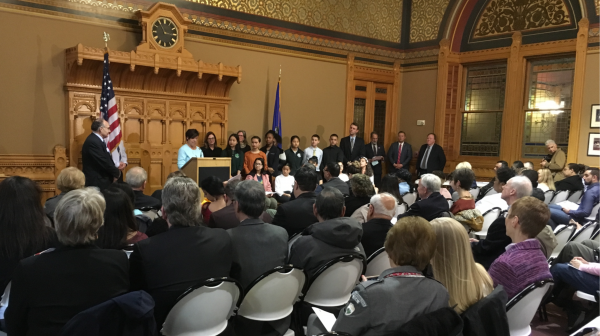
 Sixth-graders from the Interdistrict School for Arts and Communication in New London were recognized for their project, “Community Faces-Humanizing the Immigrant Label,” parts of which were on display at the Capitol. The second group was Teens4Citizenship, a Hartford Public Library and Hartford Public Schools collaborative program. As "Citizenship Guides," these high school immigrant students support family and community members on the path to Citizenship and upon turning 18 pursue their own citizenship.
 Instead of honoring Christopher Columbus, the Indigenous Peoples’ Day recognizes Native Americans, who were the first inhabitants of the land that later became the United States of America. Advocates for the switch to Indigenous Peoples Day argue that Columbus did not “discover” America in 1492 but instead began the colonization of it.
 On campus will be: