Safety of Fields with Crumbs From Rubber Tires Face Renewed Questions; CT Study Proclaims They’re OK
/Despite a series of NBC News reports over the past year – the latest last week - on the growing debate about the safety of crumb rubber artificial turf, the federal agencies that regulate the product have remained largely silent of late, the network reported. The Administrator leading the Environmental Protection Agency, former Connecticut Department of Environmental Protection Commissioner Gina McCarthy, would not answer a direct on-camera question about whether the surface found on playgrounds and athletic fields across the country is safe for kids to play on, NBC News said in a story aired on the network’s flagship news program.
Now members of Congress are asking the Environmental Protection Agency to weigh in on whether crumb rubber used in artificial turf fields in thousands of schools, parks and stadiums is safe for young athletes. A bipartisan panel gave the agency until Nov. 6 to answer 10 questions about what tests have been done to determine whether turf made from recycled tires poses a health risk and what investigators have found, NBC News reported.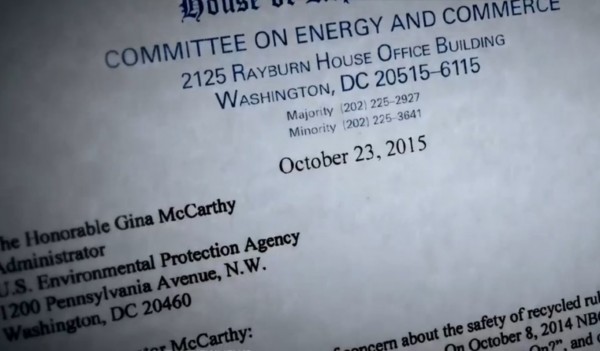
NBC News said that after a story about University of Washington women's soccer coach Amy Griffin aired on the network’s Nightly News last fall, many people contacted her, and the list she has developed of soccer players – especially goalies – afflicted with cancer has grown from 34 goalkeepers to at least 63. Griffin began keeping the list after she discovered that several goalies she knew had been diagnosed with the same cancer, the network reported. She and some of those athletes questioned whether crumb rubber could be exposing them to chemicals and carcinogens.
NBC News reviewed dozens of studies, the network’s story pointed out. “Several studies that concluded crumb rubber does not present acute health risks also included the caveat that more research is needed,” according to NBC News. “No study has examined the effects of regular exposure to shredded or crumb rubber on young children, over an extended period of time — something some experts believe should be done.” Industry officials have stressed that the products are safe, and cite numerous studies supporting that view.
In Connecticut, like elsewhere around the nation, artificial turf fields have become a popular alternative to natural grass fields in many communities, according to the state Department of Public Health (DPH). The department’s website points out that “the advantages of these fields include less maintenance costs, ability to withstand intense use and no need for pesticides.”
The state site notes, however, that “concerns have been raised about potential chemical exposures coming from the crumb rubber infill and the plastic grass blades commonly used in these fields. The crumb rubber usually comes from recycled tires that contain man made compounds such as polycyclic aromatic hydrocarbons (PAHs) and volatile organic compounds (VOCs).”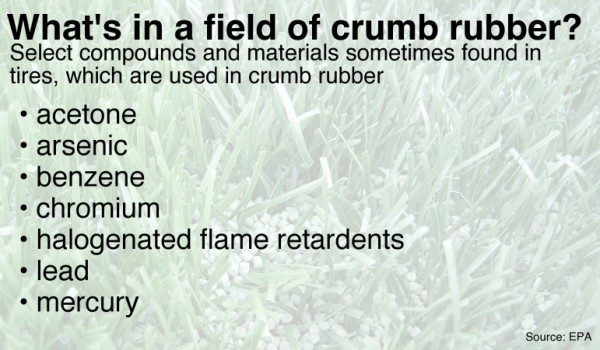
To address public safety concerns, four Connecticut state agencies collaborated in 2010 to evaluate the potential exposures and risks from athletic use of artificial turf fields, the DPH website explains. A two year, comprehensive investigation of releases from five fields during active play was conducted by the Connecticut departments of Public Health, Energy and Environmental Protection, University of Connecticut Health Center, and The Connecticut Agricultural Experiment Station. The study was peer-reviewed by the Connecticut Academy of Science and Engineering.
The overall conclusion of the report, according to the DPH website, is that “use of outdoor artificial turf fields does not represent a significant health risk.” The CT study did not find a large amount of vapor or particle released from the fields - findings that confirm prior reports from Europe and the US, according to the state public health agency. “CT DPH put these exposures into a public health context by performing a risk assessment analysis. This analysis did not find elevated cancer risk,” the site emphasized.
An agency news release noted, however, that “higher contaminant levels at one indoor field indicate that ventilation of indoor fields should be considered. Storm water run-off findings indicate that proper management of this run off is prudent to address possible environmental effects.”
The New England Center for Investigative Reporting indicated in an article earlier this year that David Brown, director of public health toxicology for the North Haven, Connecticut-based nonprofit Environment and Human Health, Inc., warned that as more is invested in artificial fields, it will be harder for state and local officials to change their position even if new information shows harm.
“A natural experiment is being conducted in which thousands of children are being exposed on playing fields to rubber,’’ said Brown, a former chief of Environmental Epidemiology and Occupational Health at Connecticut's Department of Public Health. “Given the high stakes, it is prudent to take action to protect children from this known hazard rather than wait for definitive evidence of harm.”
Brown’s organization reports that “there are now 153 cancer cases reported, and of those, 124 are soccer players with 85 being soccer goalies. Many of them are student athletes.” Gaboury Benoit, Ph.D., Yale Professor of Environmental Chemistry and Engineering and lead investigator of a study conducted by Yale in 2007, said, "Not surprisingly, the shredded tires contain a veritable witches' brew of toxic substances. It seems irresponsible to market a hazardous waste as a consumer product."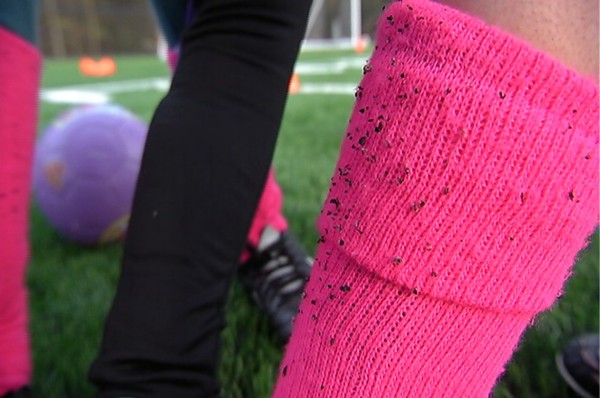
Of the state’s study released in 2010, then-DPH Commission Dr. J. Robert Galvin said: “This study presents good news regarding the safety of outdoor artificial turf fields. While the findings indoors were below the health risk targets, the elevated contaminant levels suggest a need to ventilate these fields so they can be brought to the level of safety outdoors. What we’ve learned from this study in Connecticut will provide valuable guidance to municipalities, schools and others who operate or are considering installing artificial playing fields.”
In this month’s NBC News report, Paul Anastas, former head chemist for the EPA, is said to disagree that studies have proven crumb rubber to be safe. "Tires were not designed to be playgrounds," Anastas, who is now Director of the Center for Green Chemistry and Green Engineering at Yale, told NBC News. "They were designed to be tires."




 At the same time, another initiative in the city was taking root – one which soon reached the pages of
  Last month
 In 2015, just over a dozen participating schools in Connecticut included North St School (Windsor Locks), Broadview Middle School (Danbury), Eastern Middle School (Greenwich), O.H. Platt High School (Meriden), Fairfield Woods Middle School (Fairfield), Washington Middle (Meriden), Northeast (Stamford), Schaghticoke Middle School (Warren), King Street Intermediate School (Danbury), Dag Hammarskjold Middle School (Wallingford), Orville H. Platt High School (Meriden ), Avon Middle (Avon), and Moran Middle School (Wallingford).

 h a cranial facial syndrome and was socially isolated during her middle school years, the organization’s website explains. After Lili died at the age of 15 due to medical complications from her syndrome, a group of teens from the local community banded together to bring change to their local schools. They had not realized that they had been leaving Lili out from all the fun social get-togethers. Upon hearing about Lili's feelings of being left out, they were determined to never let anyone feel that way again. The initiative was born.
 lorado with 79 and Missouri with 75.

 Eveleigh was nominated for the state Supreme Court by Gov. Rell in 2010, after having initially been appointed to the Superior Court in October 1998 by Gov. Rowland.

 15 states where the number of traffic fatalities has dropped in the first six months of 2015, compared with a year ago. The others were Alabama, Alaska, Delaware, D.C., Hawaii, Kansas, Montana, New Jersey, New Mexico, Oklahoma, Rhode Island, South Dakota, Tennessee and Texas.
 Writing in the
 Also this week, an official at the FCC indicated that the "enforcement hold" status of the station’s license renewal was "unchanged," and the station continues to operate until a decision is made, as is customary with delayed renewal applications. The WTIC-AM license renewal application has been on enforcement hold at the FCC since the license expiration date of April 1, 2014, as the agency’s Enforcement Bureau continues to consider “an alleged violation of FCC rules,” according to an FCC official. The renewal application was filed by the station almost 16 months ago, on November 27, 2013. Stations must file an application for license renewal) four months prior to the expiration date of the station’s license.
 WTIC-AM, which is licensed to Hartford but operates from studios in Farmington and has its broadcast tower on Avon Mountain, can continue broadcasting under the license that expired on April 1, 2014, until the FCC acts on its renewal application. Until the enforcement hold is lifted the FCC Media Bureau cannot proceed with a decision on whether or not to renew the station’s broadcast license. The Enforcement Bureau must first determine whether or not a violation of FCC rules has occurred. If the allegation is substantiated, the agency has a range of options, such as warning that the violation not be repeated or imposing a monetary fine on the station, officials said.
 The
The