Minorities, Children with Autism at Greater Risk of Drowning; Legislative Response Launched
/“I understand all too well the dangers that water can represent,” said Karen Cohn, founder of the Zac Foundation, pointing out that drowning is the second leading cause of death for children under age 14. “Many of these deaths could have been prevented.” Cohn’s 6-year-old son drowned in 2007 after his arm became stuck in the suction of the drain in their backyard pool. Although he was a strong swimmer, “swimming skills are not enough to combat an entrapment,” she said. The foundation named for her son is dedicated to educating parents about water safety, which goes beyond swimming skills. The ZAC Foundation held its first water safety awareness camp, called ZAC Camp in Greenwich in April 2011. “We can save lives,” Cohn stressed.
Cohn was among advocates and legislators who held a State Capitol news conference to announce the creation of a legislative task force to bring awaren ess to the issue of childhood drownings. Steven Hernández,, Executive Director of the Commission on Women, Children and Seniors, said the goal of the effort was “to prevent tragedies like these,” adding that “we need a multi-pronged response to a multi-pronged problem.”
The initiative was launched during National Water Safety Month, held each year in May, driven by statistics including:
- Almost 800 children die the U.S. every year from accidental drowning;
- 54% of these deaths are among children ages 0-4;
- African-American and Latino children are more than twice as likely to die from drowning, compared to Caucasian children; and
- According to the National Autism Association, accidental drowning led to 90% of the deaths of children with autism ages 14 and younger.
 The statistics about children’s drowning deaths have not changed over time, implying that current strategies for prevention are not enough, officials said. Increasing children’s access to swim lessons, encouraging schools to teach water safety skills to students and giving parents easy-to-use and engaging tools to talk to their children about how to be safe around water are just a few actions that can have a big effect in reducing drowning rates, officials stressed.
An issue brief on the subject, prepared by Jennifer L. Masone of the Institute for Educational Leaders, and Principal, Wolfpit Elementary School in Norwalk, indicated that “from 2004-2014, 62 children from birth to 19 died from unintentional drowning. Of those, 35% were white and 34% were minority while the general population averaged 75% white and 25% minority. These data do not include children who experienced other short or long term effects.
The State Department of Public Health corroborates this information with its summation that for 2000-2004, “The Non-Hispanic Black population experienced a drowning rate twice that of the Non-Hispanic White population, and 33% higher than the Hispanic population.”
Senate Majority Leader Bob Duff said the issue needs to be “seen as a community solution through education.” He said “this is an issue we can solve,” saluting the effort to bring interested parties together to work collectively.
In addition to establishing the task force, proponents of the initiative highlighted their support for HB 6260, which would require police officers to be trained to handle incidents involving juveniles with autism. The measure has passed the House and is awaiting Senate action. Rep. Liz Linehan, who introduced that bill, said, “Children with autism are at an increased risk of drowning because they have a tendency to wander away from adult supervision and to seek out bodies of water.”
Rep. Cathy Abercrombie said “accidental drownings in Connecticut are a serious problem that deserves our full attention and one thing we can stress is the need for more education for parents and people overseeing children, especially now as we approach summer.”
https://youtu.be/CULPxBSa_10
https://youtu.be/hkmY3oZWxyU


 wever, the state is among the worst for distracted drivers.




 The Cuban Lyceum of Bridgeport -- Liceo Cubano de Bridgeport- celebrated its 60th year in 2014, the Connecticut Post
  Traffic safety topics being tracked nationwide include: Aggressive Driving, Automated Enforcement/Photo Monitoring, Child Passenger Protection, Distracted Driving, Driver’s Licensing, Impaired Driving, Motorcycle Safety, Pedestrian and Bicycle Safety, School Bus Safety, Seatbelts and Occupant Protection, Senior Drivers Issues, Slow-Medium speed vehicles, Speed Limits, and Teen Driver Issues.


 Tammy Sneed, Director of Gender Responsive Adolescent Services at Department of Children and Families and co-chair of DCF’s Human Anti-Trafficking Response Team, said: “Reports of children suspected to be victims of domestic minor sex trafficking are increasing every year -- and, in 2016, there were just under 200 such referrals. For every child victim, the number of buyers on a given day in Connecticut is unfathomable. Some children report 10 to 15 buyers per night, which leads us to estimate that a minimum of 2,000 buyers in Connecticut bought sex from children last year.”
 “Demand keeps sexual exploitation and trafficking profitable,” says Beth Hamilton, associate director of the Alliance to End Sexual Violence (formerly CONNSACS). “We’ve started seeing the criminal justice system hold traffickers responsible, but we do not often see the people who purchase sex being held accountable for their role in keeping the industry thriving. If we want to end commercial sexual exploitation, we need to focus on ending demand and creating survivor-centered services.”
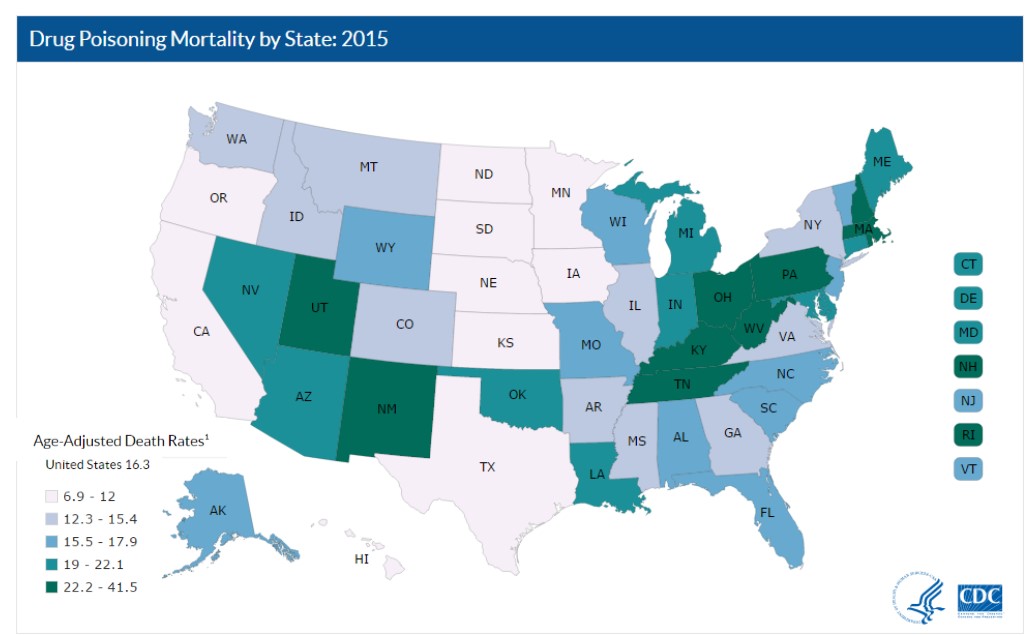 The five states with the highest rates of death due to drug overdose were West Virginia (41.5 per 100,000), New Hampshire (34.3 per 100,000), Kentucky (29.9 per 100,000), Ohio (29.9 per 100,000), and Rhode Island (28.2 per 100,000).