New School Year Approaches Without Seat Belt Requirement on School Buses
/June 7 was the final day of the regular legislative session in Connecticut. It was also the day following the signing of a new law to require seat belts on school buses – in Nevada. Gov. Brian Sandoval signed legislation, approved overwhelmingly by his state’s legislature, which requires that any new school bus purchased by a school district on or after July 1, 2019, be equipped with a shoulder-harness-type safety belt assembly for passengers.
There was no similar bill signing in Connecticut. Legislation that would have imposed a similar requirement in Connecticut, effective in 2022, failed to get out of the Transportation Committee after a public hearing months earlier. The new school year approaches with no requirement in Connecticut, and no change in policy on the horizon, despite years of efforts.
Nevada joins only six other states — California, Florida, Louisiana, New Jersey, New York and Texas —in enacting laws requiring seat belts. In Louisiana and Texas, however, the requirements are contingent upon funds being appropriated by the state, which has yet to occur.
The Connecticut legislator leading the unsuccessful effort says cost, rather than safety, drove the result.
"While the bill did not get voted out of the Transportation Committee, it was given a public hearing and received some favorable comments from committee members,” Rep. Fred Camillo told CT by the Numbers this week. “The main hold up continues to be funding, something that will take out of the box concepts as the state fiscal situation has not been resolved. I look forward to continuing the effort until our goal is achieved."
It has been elusive here, and elsewhere, despite a change in position by the National Highway Traffic Administration, more than a year ago. The federal agency previously viewed school buses as safe without seat belts, because of their construction. That changed in 2015. Since then, as Connecticut’s Office of Legislative Research noted last year in a report to the legislature, “NHTSA has been exploring ways to make seat belts on schools buses a reality.”
The Connecticut Association of Public School Superintendents testified against the measure, calling for approval to be “postponed” until a series of questions – ranging from the use of bus monitors to the cost of seat belt maintenance to district liability from unused seat belts – could be answered.
The Connecticut Association of Boards of Education (CABE) – representing local elected school boards across the state – also voiced their opposition at the January 30 public hearing. CABE officials expressed concern about “years of busses” that would “need to be replaced or retrofitted.” They also noted that lap belts “would not work best for 5-year-olds and 18-year-olds alike.” In addition, questions were raised about students who might “unclick the belt” and the liability of bus drivers if they did.
Camillo initially proposed the bill in 2011 after a Rocky Hill student was killed in a school bus crash. earlier this year, in March, after a school bus accident in Canterbury sent five students to the hospital, public discussion on the pending proposal was renewed, but the legislature did not take action. “This accident today is just another reminder that we really need to do something regarding this issue. We don’t want to wait for another tragedy to occur,” Camillo told the Norwich Bulletin. Later that month, five people were injured after a crash involving a school bus in North Haven.
Federal law doesn’t require seat belts on the “big yellow school buses” that most students ride, Stateline reported earlier this year. The buses are designed to protect riders through “compartmentalization,” structural safety features such as high, energy-absorbing seat backs and closely spaced seats so children are kept snug like eggs in a carton, Stateline reporting explained.
However, published reports indicate that those features don’t necessarily protect children during side-impact crashes or high-speed rollovers because passengers don’t always remain within their seating compartment, according to the National Transportation Safety Board, which has recommended for nearly two years that three-point seat belts be included in new buses.
Over the past 10 years, NHTSA reports, 6.2% of fatal injuries in school bus related crashes were school bus occupants.
The American School Bus Council, urging people to “support the school bus,” points out that “students are about 70 times more likely to get to school safely if they ride in the school bus instead of a car.”
 Among adults who admit to not always using safety belts in the back seat, 4 out of 5 surveyed say short trips or traveling by taxi or ride-hailing service are times they don't bother to use the belt. Nearly 40 percent of people surveyed said they sometimes don't buckle up in the rear seat because there is no law requiring it. If there were such a law, 60 percent of respondents said it would convince them to use belts in the back seat. A greater percentage said they would be more likely to buckle up if the driver could get pulled over because someone in the back wasn't buckled.
 The Governors Highway Safety Association issued a report in 2015, "Unbuckled In Back," analyzing the difference in highway fatalities between states that require rear seat passengers to buckle up and those that do not, the Hartford Courant reported. At a Connecticut legislative hearing that year, the paper noted, state Transportation Commissioner James Redeker said that everyone in a passenger vehicle should buckle up, saying statistics show "people become projectiles because they're not strapped in a safety device."



 rding to the Treasurer’s Office. Representing the Connecticut Treasurer’s Office at the annual meeting, and presenting the proposal, was Aeisha Mastagni, a Portfolio Manager in the Corporate Governance Unit of the California State Teachers’ Retirement System. Overall, according to a U.S. Securities & Exchange Commission filing, 74.7 million shareholders voted against the proposal, with 32.7 million voting in favor.
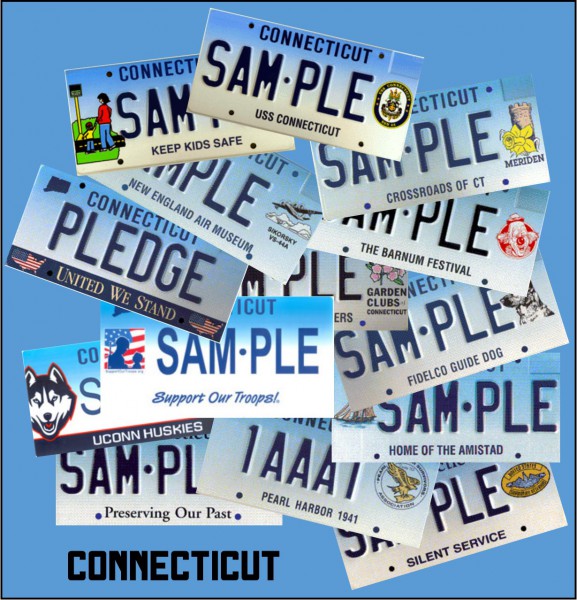
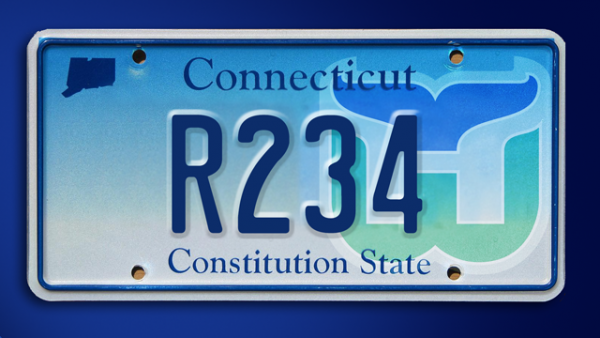 Organization vanity plates include Amistad, Benevolent & Protective Order of the Elks, IUOE Local 478, Grand Lodge of Connecticut, Knights of Columbus, Olympic Spirit, P.T. Barnum Foundation Inc., Preserving Our Past CT Trust for Historic Preservation, Red Sox Foundation, Lions Eye Research Foundation, Special Olympics, Federated Garden Clubs, Fidelco Guide Dog Foundation, Keep Kids Safe, New England Air Museum and the U.S.S. Connecticut Commissioning Committee.
 Only about 42 percent of motorcyclists in Connecticut wear helmets, according to Neil Chaudhary, PhD, leader of a Trumbull team of premier investigators on behavioral traffic safety-related issues at Preusser Research Group, Inc. In states where helmets are required, there is near 100 percent compliance, he recently told the Newtown Bee, adding professional driver training, offered throughout the state, can help riders to develop stronger defensive driving skills.


 wever, the state is among the worst for distracted drivers.
 The backdrop is offered by more than 700 global companies that have subsidiaries here, employing more than 100,000 people, the Organization for International Investment points out. The state’s convenient access to a variety of transportation options all provides access; there were 4.6 million tons of cargo carried on Connecticut rails in 2015, for example, and 11.4 million tons of freight shipped through Connecticut ports in 2013.
 l and freight movement by rail and highway makes Connecticut a prime location for domestic and international trade,” the report points out. Leading exports include: Aerospace/Transportation Equipment, Non-Electrical Machinery, Computers and Electronics, Chemicals, Electrical Equipment, Fabricated Metals Production, and Primary Metal Manufacturing.
 s specific to their industry.