PERSPECTIVE: Survey Data; Not What It Used to Be

by Michelle Riordan-Nold In public debate, I increasingly hear the phrase: data-driven decision making. At CTData part of our core mission includes advocating for the public availability of data to inform policymaking. But what does it really mean and what data are we talking about?

As people increasingly use data to inform business or policy decisions, the quality of that data becomes even more important. Using data responsibly is something creators and users need to take seriously. Part of this includes understanding the drawbacks of data collection methodologies.CT perspective

I recently attended the Association of Public Data Users conference where several of the speakers discussed the increasing unreliability of survey data.

As it turns out, most of what we know in social science comes from surveys of households. For example, the unemployment rate, poverty rate, rate of inflation are all collected through household surveys. Federal household surveys are used to make macroeconomic policy, they are used in indexing government benefits, and in determining tax brackets.

Surveys tell us a host of factors about people's lives, including: what people are doing in response to government programs, their level of education and employment, and how they spend their money, just to name a few. They tell us how the economy is operating and how government programs are working or not working. However, rarely do we talk about the challenges and deficiencies of survey data, yet we rely very heavily on this data for decision making.

quote 2Surveys as an instrument for collecting reliable data are deteriorating. Over time, as Bruce Meyer, the McCormick Foundation Professor at Chicago Harris, notes, people are "less willing to participate in surveys, less willing to answer the questions, and when providing answers people are less likely to give accurate answers than they did in past. People are over surveyed." Frankly, the allure of being surveyed and giving your opinion is no longer a thrill.

As the saying goes, ‘a picture is worth a thousand words.' The chart below, taken from a recent paper by Meyer, shows that the non-response rate for five key national household surveys has been creeping up over the years. People are not responding that they receive government services even when they actually are the recipients of government programs.chart

But it's not just a problem of people not responding, it is also an issue that the information they provide is also quite poor. Meyer's research revealed that

"in our most used survey, that's the source of official income and poverty statistics, only about half of people receiving food stamps report it, under 40% of those receiving cash assistance report it. If you want to know who is poor you get a very bad picture from just surveys alone."

How did he figure this out? Professor Meyer linked the main household survey data to government program data (also known as administrative data). In a secure research data center, using anonymized data, he was able to look at what a recipient says in a survey to what the recipient is actually receiving.

"In surveys, the poverty rate looks much higher than what it really is; second these programs look less effective than what they are because much of the receipt is missing; in addition it looks like people who you think should be receiving these programs aren't."

What does this mean for policy?

On the one hand, it makes it look like the poor are doing much worse than they are. It also makes government programs look less effective than they are.

Meyer was involved in federal legislation that called for the establishment of a commission to look into ways that administrative data could be made more widely available to administrative agencies to determine whether programs should be expanded or contracted and to provide access to researchers both inside and outside government. The commission would be staffed by program or data experts, experts on data confidentiality and security, and with equal appointments from the House, Senate, and White House.quote 1

If these statistics were found to be so unreliable at the national level; what does it mean for Connecticut?

Relying on survey data is no longer a reliable measurement tool. It is time to look at the administrative data and examine the effectiveness of state government programs. This can be done. It should be easier with the passage last year of Public Act 15-142 that gives the Office of Policy and Management authority to link agency data and provide it to public researchers, as well as with the continued development of the P20-WIN data sharing initiative.

In order for policymakers to make 'data-driven decisions' we need to:

  1. define the outcomes desired by government programs;
  2. ensure the data are being collected to measure efficacy;
  3. analyze the data to measure the programs; and
  4. take action on the research results to ensure efficient allocation of resources.

However, this requires good administrative data that must come from those administering the programs. Let's get a commission together to ask the questions, determine the needs, and analyze the data.

With the fiscal challenges the State is facing, it's important that policymakers ensure that dollars are well spent and government programs are working. Access to better data can only lead to better government decisions.

______________________________

Michelle Riordan-Nold is Executive Director of the Connecticut Data Collaborative

PERSPECTIVE commentaries by contributing writers appear each Sunday on Connecticut by the Numbers.

LAST WEEK:  The State Budget:  What Do Demographics Have to Do With It?

PERSPECTIVE: The State Budget: What Do Demographics Have to Do With It?

by Alissa DeJonge A combination of factors are having a negative impact on state revenues, contributing to budget woes. The different age cohorts in Connecticut’s population tell an important story of one reason revenues are declining. State legislators need to examine Connecticut’s current and future demographics as they look to solve fiscal problems.CT perspective

Much of the daily news centers on the state budget deficit and the lengths that legislators are attempting to go to find ways to balance it. There is a projected $220 million shortfall for this fiscal year that was addressed by legislators on March 29.[1] And the projected shortfall for the next fiscal year is approaching $1 billion. quote 1

Legislators are quite aware that revenues are not coming in to the extent originally anticipated, and that this trend has been occurring for the past number of years. Indeed, Senator Beth Bye, during a March 23 conference about broadband infrastructure,[2] discussed the revenue woes and the dire situation that Connecticut is facing.

What makes this situation particularly serious is the fact that the reasons there is a ‘revenue problem’ have been long in the making, and the trend is poised to continue.

Of course, the overall state economy continues to struggle. Connecticut is one of 10 U.S. states that has not regained all the jobs lost since the last recession.[3] If jobs are sluggish, so too are revenues back to the state. And wage growth, while seeing improvements in 2015, has been relatively flat since the end of the last recession, which also keeps state revenues in a static to declining state.[4]

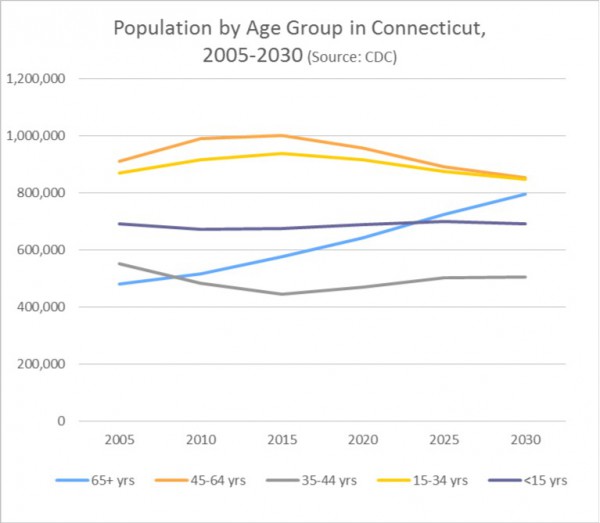
However, the lack of revenues also involves overall demographic patterns. The figure shows population by age for Connecticut between 2005 and 2015, and projections extending to 2030.

  • The age group over 65 is projected to increase 38% between 2015 and 2030. This will add much pressure to state services such as Medicaid and long term supports and services while at the same pop by age grouptime reducing revenues because this large age cohort is no longer working.
  • The Baby Boomer generation, those who are currently 45-64 years old, comprise the largest share of the state’s population. As they move from employment to retirement, the trend of increasing service needs and lessening revenues will accelerate.
  • Generation Xers will fill many Boomer jobs, but they are a much smaller group, which means that state revenues are unlikely to regain their previous higher levels because fewer people will be producing outputs.
  • The current Millennials (roughly ages 15-34 years) and the even younger Generation Z population have more people in their age groups then the Generation Xers. Therefore, demographic trends should eventually contribute to increasing state revenues. But it will be well over a decade before the Millennials begin to gain seniority and higher wages in the workforce and contribute more to the state revenues.

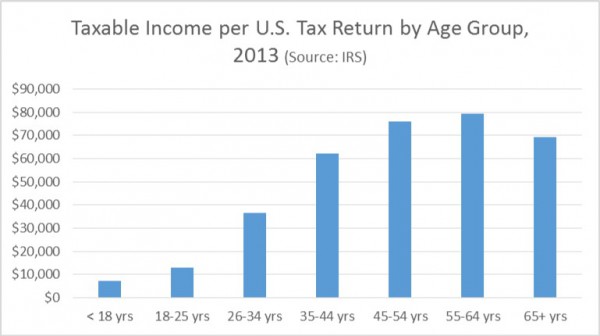
taxable incomeThis figure shows how taxable income ebbs and flows by age group. The Baby Boomers are in the best position to contribute to state revenues right now. However they are retiring in a consistent fashion, and the next younger cohort, of which there are fewer people to begin with, is earning less than their mature counterparts. This sets up a long-term issue for state revenue potential, one that will not be mitigated until the larger Millennial age cohort gets into their more profitable working years.


Revenue expectations are not what they used to be. In the 1960s, the economy consistently grew between three and five percent each year, and Americans assumed that it would continue to grow at that pace.  As a result, government was able to fund additional programs as economic and tax bases kept expanding. Today the economy is growing at only around two percent each year. This economic trend reduces the ability for the government to fund programs, and all demands cannot be met, with the current revenues coming in.[5]

If you multiply the taxable income per return by the number of people in each demographic group in both 2015 and 2030, excluding inflation, there would be a four percent decrease in the projected total amount of taxable income in the state.  This illustrates the effect of demographic trends on taxable income. Without even considering job trends, wage trends, or other long-term economic factors, the demographic shifts of the population are going to make it even more challenging for state governments to raise revenues.quote 2

The state revenue problem will not resolve itself with this legislative session, or even the next. While the current revenue problems are a combination of many factors, the demographic influence is significant and should not be overlooked because it can provide insight for decades into the future.

Since there are a number of longer term, structural issues that will continue to affect the state’s ability to raise revenues for many years, stakeholders and policymakers will have to adjust to this new economic reality. Prioritization of programs with specific intended targeted outcomes is the approach to the state budgeting process needed now.

_________________________________

Alissa DeJonge is Vice President of Research, Connecticut Economic Resource Center Inc. (CERC).

PERSPECTIVE commentaries by contributing writers appear each Sunday on Connecticut by the Numbers.

LAST WEEK: Freedom's Just Another Word For... 

_________________________________

[1] http://www.nbcconnecticut.com/news/local/Vote-on-State-Budget-Deficit-Expected-Tuesday-373779281.html (Accessed March 29, 2016)

[2] High-Speed Broadband Internet Infrastructure Informational Conference: A Toolbox for Municipalities (March 23, 2016)

[3] http://www.usnews.com/news/business/articles/2016-03-25/job-totals-trail-pre-recession-levels-in-10-us-states (Accessed March 29, 2016), from U.S. DOL calculations of jobs changes, December 2007 – February 2016.

[4] http://www.washingtontimes.com/news/2015/oct/8/comptroller-connecticut-wage-growth-continues-to-l/ (Accessed March 29, 2016)

[5] Robert Samuelson, Trump’s Wrong – We’re Hugely Well-Off (Op-Ed), The Hartford Courant, March 28, 2016.

PERSPECTIVE: Freedom’s Just Another Word For…

by Rich Hollant

Music.

Around the time the State of Connecticut and the City of Hartford were releasing bleak news of their respective budgets, Joey Batts, a Hartford Public School teacher, released a video wherein for 3 minutes 22 seconds he sang his heart out about his affection for the Capital City. The ditty was entitled, “Hartbeat: A Love Letter for Hartford”. You should give a listen—you’ll be inspired. Set against a gritty-yet-hopeful portrayal of our streets, Joey Batt’s rhymes didn’t look at the Hartford neighborhoods with rose-colored glasses, but rather with objectivity brought to focus by real love. At this writing, the video has 1,083 shares on social media and has accrued 54,921 unique views—that’s nearly half our city. Imagine that.

CT perspectiveDance.

At about the same time, I was paying attention to Arien Wilkerson, the 20-something artistic director of the Hartford-based troop, Tnmot Aztro. His ensemble had been dazzling audiences with wildly collaborative and awe-inspiring feats of syncopated brilliance. As the budget news dominated the headlines, Wilkerson was provoking the established media and city leadership in support of two opportunities critical to his success: press coverage of dance and greater access to performance venues. The self-generated tension in his pleas missed the intended mark, but it didn’t matter. Tnmot Aztro would become not just the first local dance troop to perform at the contemporary art space, Real Art Ways, they would do so for 3 solid sold-out performances.

expressionArt.

Against the backdrop of the General Electric exodus, union negotiations, and looming austerity budgets, co:lab launched Parkville Studios, a residency program for recent Connecticut art school graduates. Eventually, we will install a 360° mentoring program where the resident cohorts will support high school students interested in an arts education while the residents, themselves, will receive guidance from private collectors, gallery owners, and curators from throughout the Northeast. We’ll do this soon, but not right now.

Right now, we are motivated by a sense of urgency to keep the brightest of our emerging creative talents painting, drawing, and searching for their voice right here in Hartford. Our priority is to offer them the space to generate their indelible contributions to our culture. This priority is as benevolent as it is self-serving because if you care about a community’s ability to heal, or about equity finding its level, or about the pursuit of the elusive “Better World”, then you can do no better service to your own ideals than to double up your investment in creative expression. The timing is irrelevant. Do it because it needs doing—because it changes everything.in front

Wonder.

That’s what creativity does—it moves us to action. Yet in a down economy, the knee-jerk reaction has been to cut spending on the things that are deemed to be superfluous, limiting expenditures to the “essentials”. Among the first things to go are outreach through marketing and the fostering of the creative part of our culture. That approach is unsustainable. Take another look at the anecdotes above. This is how our community is primed to be reached—through song, through movement, through the paint and textures that represent the essence of who we are right here and right now. When things are tough, we need to stimulate more imagination, not less. We need more lifting up, more hope-giving. We need the new creative people up in front because they conduct the movement. If I were in dire straits, I’d want a New Orleans style marching band like Hartford Hot Several co-opting George Michael songs on the bow. Seriously—we’d levitate.

Invest boldly.

_______________________________________

Rich Hollant is the principal, strategist and a design director at co:lab, a firm he started in 1988.  co:lab helps organizations committed to social value tackle the big questions that lead to greater awareness, purposeful motivation, and deeper loyalty.

PERSPECTIVE commentaries by contributing writers appear each Sunday on Connecticut by the Numbers.

LAST WEEK: The Economic Impact of Not Investing in Social Purpose Leadership

PERSPECTIVE: The Economic Impact of Not Investing in Social Purpose Sector Leadership

by Maggie Gunther Osborn As a leader in transition leaving Connecticut, I wanted to reflect on what is happening with leadership in the social purpose sector in our state and sound a few alarm bells. For those of you unfamiliar with my terminology, I am talking about what we normally refer to as the non-profit sector.  I have chosen to stop saying non-profit, because it has trained us to believe that this is a sector with limited economic impact or does not require the same investments in infrastructure and human capital as other sectors. Non-profit is a tax status but does not describe the work of the social purpose sector.

CT perspectiveIn Connecticut, the social purpose sector employs between 14-17% of the workforce and generates $33.4 billion in revenues annually. Connecticut foundation giving supporting the sector totals more than $1 billion, but is primarily invested in the programs and outcomes of the sector giving very little attention to investment in leadership.  In fact, nationally less than 1% of all foundation grants support leadership capacity and development. The social purpose sector is a vital, critical part of our state and yet is not often regarded as such in discussions of economic benefit, sustainability, leadership, innovation and job creation.quote 1

I sit around the periphery of these discussions and see that much of the energy is focused on the leadership of organizations. We invest in leadership training for our corporate workforces because we understand it is key to the culture, sustainability and productivity of business. I often ask board members who run successful enterprises what they attribute their success to and often they reply “we invest in our people.” And yet very few of them, in their roles as board members, bring that same thought perspective to bear on social purpose decisions.

The result of a lack of investment in the leadership of the social purpose sector is leading to the statistics revealed in Third Sector New England’s Leadership New England Report 2015: Essential Shifts for a Thriving Nonprofit Sector.

  • 60% of CT leaders say they will be leaving their organizations within the next five years and 47% of those in the next two years.
  • 59% of CT leaders are over 55 compared to 53% in the New England region as a whole.
  • More than 54% of organizations have no succession or sustainability plan.
  • 61% of CT leader’s salaries are under $100k with 21% under $50k.
  • 59% of CT organizations have 3 or fewer month’s cash reserves in comparison to 49% of all New England organizations.
  • 29% of CT organizations have no cash reserves compared to just 7.2% of all New England organizations. This indicates that a much larger proportion of CT organizations is at risk of immediately running out of funds than the respective proportion in New England as a whole.

quote 2At this point, there are a couple of things to note. First, while we have been talking about leadership transitions for many years, the recession delayed the major transition of leaders out of the sector until now.  Second, there is no bench strength to call on from within these organizations when these leaders retire.  Very little investment has been made to build the skills and capacity of middle managers to step up into leadership roles. Third, most of the departing leaders are Baby Boomers whose leadership roles were dependent on their willingness to work long hours in a professionalized volunteer sector.  We will not fill these rolls with Millennials and Gen Xers for what we paid their predecessors.
Current professionals expect to work in places that are dynamic and culturally competent business environments where they feel comfortable and can advance.  They will not stay a professional lifetime anywhere, and will not stay more than a few years where these characteristics do not exist. In addition, the state budget crisis is going to be our norm for the next decade consequently offloading more responsibility to this sector. We need people with the skills to not only provide services, but also create new business models, attract talent and strategically work through these enormous challenges.

All of us, whether professional, volunteer, elected official, philanthropist, board member or donor, should strive to recruit the best and brightest to the social purpose sector by investing in leadership in the same ways we do in the private sectors. Strong leaders will make the next generation of the social purpose sector resilient enough to meet the challenges that face Connecticut.

______________________________________

Maggie Gunther Osborn is president of the Connecticut Council for Philanthropy.  She will be leaving the organization in June to assume the post of chief strategy officer for the Forum of Regional Associations of Grantmakers in Washington, DC. 


PERSPECTIVE commentaries by contributing writers appear each Sunday on Connecticut by the Numbers.

LAST WEEK: Reaching Untapped Potential of Urban Students

PERSPECTIVE: Reaching Untapped Potential of Urban Students

by Jahana Hayes My personal experiences are the greatest contributing factors to my becoming a teacher. These experiences shaped my views and continue to influence my teaching style. Being the first in my family to attend college helps me to fully appreciate the importance of education.

As a child everything I learned about school I learned at school. Teachers provided me with the support and encouragement to be a good student. My family provided for me; however education was not seen as a pathway to success. None of their experiences included higher education so they stressed the importance of hard work and industry. They told me to get a job with decent pay and benefits and work hard to support myself. This message was contradicted by the constant cycle of drugs, welfare and abuse that persisted in my family.

CT perspectiveTeachers exposed me to a different world by letting me borrow books to read at home and sharing stories about their college experiences. They challenged me to dream bigger and imagine myself in a different set of circumstances. I was oblivious to opportunities that existed outside of the projects where I grew up, but my teachers vicariously ignited a passion in me. I was surrounded by abject poverty, drugs and violence, yet my teachers made me believe that I was college material.

I can still remember the teachers who refused to accept the stereotypical views of inner city children and for them I am grateful. As a result, I entered this profession with a passion for the work that I do and an understanding that my work would extend beyond the classroom and into the world. I have a full understanding that many students come to school struggling to solve adult problems and teachers have to work through that before they can even begin to teach.

I became a teenage mother in high school and almost gave up on my dreams completely. However, my teachers showed me the many options that were still available if I continued my education. These positive experiences at school inspired me to become a teacher and that has always been my driving influence.qyote 1

As a teacher, my own life is a constant reminder that students come from different circumstances and experiences. I have learned that teaching is a lifestyle that extends well beyond the contracted hours. I strive to meet students where they are, and not dwell on where they should be. I remember myself at various points in my journey and wonder how hopeless I must have seemed to the teachers who continued to work with me. They saw potential in me and did not give up even when it seemed like I would not graduate.

Working in an urban public school district with a widely diverse population, I see so many things that fall outside of traditional teaching responsibilities. It is those times when I am transformed into an advisor, counselor, confidant and protector. I also recognize that not all of my students have the same desire as I did to go to college. I remind them that this too is ok.

Students have to learn to be their best selves and pursue their own dreams even if higher education is not their best option. Many students are amazed that I don’t constantly push them into a college setting. I let them know that it is wholly acceptable to be an entrepreneur or a carpenter, hairdresser, plumber or whatever they desire.

One of the most critical issues affecting both education and society is the lack of empathy and understanding of others. If we show students that they are important, begin to engage them in dialogue, help them develop an appreciation for diversity and recognize that all people matter while they are still in school; many of the challenges we face in society will be improved.

As a teacher, I strive to facilitate learning in a way that engages students by connecting on a personal level and stimulating academic growth while simultaneously producing contentious and productive members of society. By serving their community students are able to demonstrate personal growth and model adult behaviors. This has become extremely personal to me because I feel that graduating students who demonstrate respect, responsibility, honesty and integrity is as critically important as mastering content and demonstrating proficiency.

quote 2As a child growing up in an urban poverty stricken environment, I only came in contact with one minority teacher. This contact greatly influenced the person I became. Most of my teachers lived outside the district and had experiences that were very different from mine. Many of my teachers were second or third generation educators and had always known they would be teachers. I saw little of myself in any of them.

I do not say this to imply that only minority educators would have a clearer understanding of my life, or that a minority teacher would have similar experiences; but to say that as a child I would have loved to see a teacher who looked like me and shared my cultural background.

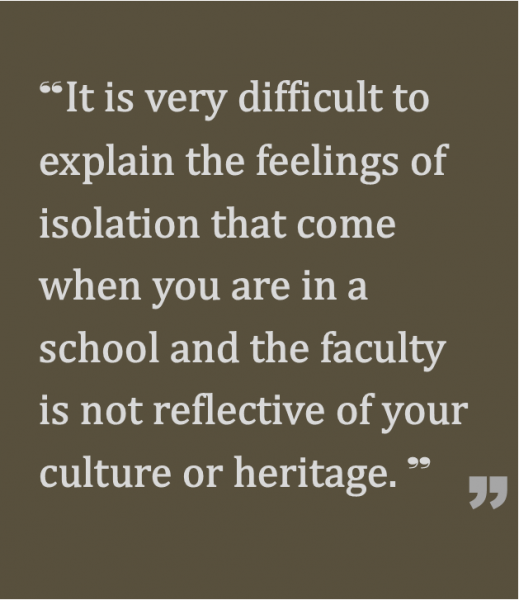
In a recently published study in Economics of Education Review, it was shown that Black, white and Asian students benefit from being assigned to a teacher that looks like them. Their test scores go up in years when their teacher shares their ethnicity, compared to years when their teacher has a different ethnicity. It is very difficult to explain the feelings of isolation that come when you are in a school and the faculty is not reflective of your culture or heritage. As population demographics continue to shift, school districts must be intentional in their efforts to create a more diverse workforce.

As a teacher, I try to always be enthusiastic and express a sincere interest in my students’ academic success. I aim to inspire students to be more interested in the process than the product. I am constantly trying to challenge students to take a constructivist approach, ask questions, and in turn, apply their learning in different ways. My goal is for students to become self-directed, intrinsically motivated learners who are less concerned with grades and more concerned with gaining deeper knowledge and understanding.

While I have a passion for educating students, I am most proud of the influence I have beyond the classroom and I see this as my greatest contribution. Students are constantly coming to me for advice and direction. In my job I have been able to engage students in a variety of multi-faceted service projects. I never expected community service to be such a pronounced part of my work but the satisfaction that comes from watching students take ownership of their community is unmatched.

I believe that it doesn’t matter how bright a student is or where they rank in a class or what colleges they have been accepted to if they do nothing with their gift to improve the human condition. I try to teach students that we are all obligated to help others and improve society. Oftentimes people in the community ask me how I get so many young people to volunteer for community service and my answer is always the same, “I ask.”

_________________________________________

Connecticut’s 2016 Teacher of the Year, Jahana Hayes, teaches social studies at John F. Kennedy High School in Waterbury.  In January, she was named one of four finalists by the Council of Chief State School Officers for National Teacher of the Year, which will be selected next month.  This perspective is an excerpt of her 18-page National Teacher of the Year application.  A native of Waterbury, she attended Naugatuck Valley Community College, Southern Connecticut State University, University of Saint Joseph and University of Bridgeport.

PERSPECTIVE commentaries by contributing writers appear each Sunday on Connecticut by the Numbers.

 LAST WEEK: Suicide Prevention - Creating a Message of Hope for Young Adults