PERSPECTIVE - Social Media Manipulation: Worse than Advertising?
/by Carrie Titolo I want to preface this by saying I’m not that old, but I still clearly remember life before social media (I was in college just as Facebook was born). Social media came about because of a demand for a network and personal connections that defied physical location. Facebook originally started as an online networking site just for college students (you actually needed a .edu email address to register), but what it has morphed into is an entirely different beast.
 What was once grassroots and organic now feels contrived, forced and flashy. With more paid content on your news feed than actual posts from your friends, and the rampant use of photo editing software rendering images of ourselves unrecognizable, I can’t help but think that we should be just as skeptical and wary of social media as we are of traditional advertising.
Consumers and celebrities alike have maligned the mainstream media and advertising industry for decades, criticizing them for photo manipulation and perpetuating false and unrealistic beauty standards, especially for women. A 2011 study conducted by Dove found that 80% of women surveyed felt insecure when seeing photos of celebrities in the media. Of the woman surveyed, 71% of them did not believe their own appearances were attractive or stylish in comparison to cover models. In spite of our rampant criticism of these practices, we’ve begun using social media and photo editing apps to create the same deception.
Consider the slew of apps dedicated to photo editing and the sheer number of users employing them on a daily basis to shape up their selfies. There’s PhotoWonder with the tagline “Shaping charming faces and slim bodies in the easiest way” which has over 100 million users in 218 countries. Then there’s Spring, which helps manipulate photos to make the object more model-esque: taller, thinner and with a sharper jawline. FaceTune and CreamCam remove wrinkles, zits, and skin imperfections while SkinnyCamera promises to make you look 10 to 20 pounds lighter. There are so many ways to tweak and change a photo, we might as well use computer generated caricatures or animation and save ourselves the hassle.
 With such an abundance of DIY image-altering resources, the deeper, more philosophical issue comes in the eyes of the beholder. Knowing what we now know, we can’t help but look at all photos with a critical eye. Whether it’s a vacation selfie your cousin posted or that photo of Ronda Rousey on the Tonight Show with Jimmy Fallon, we automatically assume what we’re seeing isn’t real and the image has been doctored (especially in the latter example). It is this skepticism that causes me to take pause. Didn’t we take to the Twitter-sphere because we wanted to avoid being misled and blatantly marketed to? That’s not what (Facebook) friends are for!
So what to do now that we’ve dug ourselves into a hole of disenchantment and cynicism? How do we reclaim the digital territory that once was ours? I wish I had the answer. I don’t think there’s a silver bullet that will fix everything, but perhaps we can start on an individual level by taking a vow of honesty when it comes to our social media accounts. Maybe if we all try to be genuine with the images we post and encourage our friends to do the same, we can turn this perfectly toned and blemish-free boat around. Maybe one day, we’ll even come to appreciate the imperfections that not only make us unique, but make us human. #nofilter.
_________________________________________
Carrie Titolo is a graduate of the Boston University College of Communication, and has a background in public relations, marketing and nonprofit communications. She loves to cook and bake, is an avid runner and enjoys spending time with her husband and two rescue dogs.
PERSPECTIVE commentaries by contributing writers appear each Sunday on Connecticut by the Numbers.
LAST WEEK: Survey Data: Not What It Used to Be


 Surveys as an instrument for collecting reliable data are deteriorating. Over time, as Bruce Meyer, the McCormick Foundation Professor at Chicago Harris, notes, people are "less willing to participate in surveys, less willing to answer the questions, and when providing answers people are less likely to give accurate answers than they did in past. People are over surveyed." Frankly, the allure of being surveyed and giving your opinion is no longer a thrill.


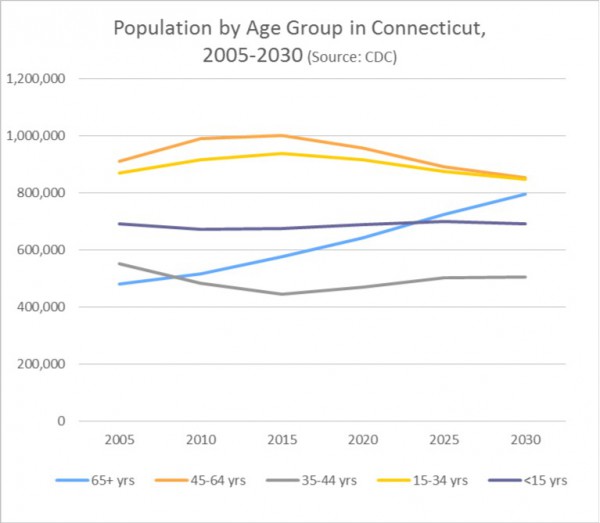 time reducing revenues because this large age cohort is no longer working.
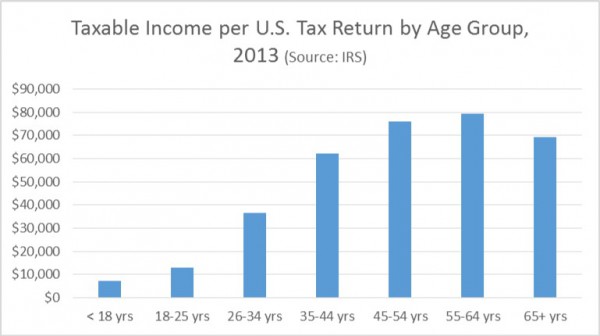 This figure shows how taxable income ebbs and flows by age group. The Baby Boomers are in the best position to contribute to state revenues right now. However they are retiring in a consistent fashion, and the next younger cohort, of which there are fewer people to begin with, is earning less than their mature counterparts. This sets up a long-term issue for state revenue potential, one that will not be mitigated until the larger Millennial age cohort gets into their more profitable working years.


 Art.
Art.


 At this point, there are a couple of things to note. First, while we have been talking about leadership transitions for many years, the recession delayed the major transition of leaders out of the sector until now. Second, there is no bench strength to call on from within these organizations when these leaders retire. Very little investment has been made to build the skills and capacity of middle managers to step up into leadership roles. Third, most of the departing leaders are Baby Boomers whose leadership roles were dependent on their willingness to work long hours in a professionalized volunteer sector. We will not fill these rolls with Millennials and Gen Xers for what we paid their predecessors.