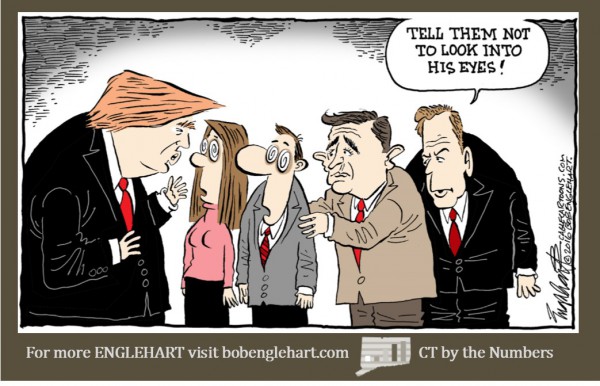
Editorial Cartoon by Bob Englehart
/
by Mary Glassman
The stroke of midnight on May 4 will signal the official close of Connecticut’s 2016 legislative session. Regardless of what bills pass during the last few days at the Capitol, this session clearly marks the beginning of a bold approach to regional cooperation, and it paves the way for us to meet the state’s growing needs and demographic changes.
As the state wrestles with ways to close a $1.1 billion deficit that is projected for next fiscal year, it is clear that a strategic plan is needed to identify the state’s future goals and to ensure that the state is providing services and educating all of Connecticut’s children. The many bills introduced this session that focus on regional cooperation offer a glimmer of hope. Connecticut may be ready to do just that.
Even the titles of the bills introduced this session provide us with a clue that Connecticut is ready to move forward. Bills that made it out of committee and are waiting to be debated on the floors of the House of Representatives and the Senate include: “An Act Concerning Regional Education,” “An Act Concerning Regionalism,” “An Act Concerning Regional Technology,” and “An Act Concerning Regional Efficiencies.”
Ideas included in the various legislative proposals would allow for the expansion of cooperative purchasing for towns and school districts through existing regional organizations, such as the state’s six regional educational service centers and nine councils of governments. The bills would also provide incentive funds for towns and schools to combine non-educational, backroom functions like human resources, finance, or technology services, and they would encourage long-term technology planning, which would enhance efficiencies, reduce costs, foster collaboration, and increase transparency and access to information.
For example, a proposed education bill would provide town and school districts with startup costs when they combine non-educational, backroom functions. While some towns, such as Mansfield, West Hartford, and Waterford, already share those behind-the-scene functions, other towns could use a little extra help when evaluating whether local taxpayers would save money by having different entities working together.
Another bill would require future enrollment projections to be provided as part of a request for state funding for the construction of new schools. This would encourage neighboring communities to share enrollment needs and to examine ways the state can help municipalities work together.
As local officials face uncertainty about state funding in this year’s budget, and probably in subsequent budgets, doesn’t finding ways to reduce costs by working together make sense?
___________________
Mary Glassman is Manager of CREC’s Office for Regional Efficiencies.
PERSPECTIVE commentaries by contributing writers appear each Sunday on Connecticut by the Numbers.
LAST WEEK: Social Media Manipulation: Worse than Advertising?
by Carrie Titolo I want to preface this by saying I’m not that old, but I still clearly remember life before social media (I was in college just as Facebook was born). Social media came about because of a demand for a network and personal connections that defied physical location. Facebook originally started as an online networking site just for college students (you actually needed a .edu email address to register), but what it has morphed into is an entirely different beast.
 What was once grassroots and organic now feels contrived, forced and flashy. With more paid content on your news feed than actual posts from your friends, and the rampant use of photo editing software rendering images of ourselves unrecognizable, I can’t help but think that we should be just as skeptical and wary of social media as we are of traditional advertising.
Consumers and celebrities alike have maligned the mainstream media and advertising industry for decades, criticizing them for photo manipulation and perpetuating false and unrealistic beauty standards, especially for women. A 2011 study conducted by Dove found that 80% of women surveyed felt insecure when seeing photos of celebrities in the media. Of the woman surveyed, 71% of them did not believe their own appearances were attractive or stylish in comparison to cover models. In spite of our rampant criticism of these practices, we’ve begun using social media and photo editing apps to create the same deception.
Consider the slew of apps dedicated to photo editing and the sheer number of users employing them on a daily basis to shape up their selfies. There’s PhotoWonder with the tagline “Shaping charming faces and slim bodies in the easiest way” which has over 100 million users in 218 countries. Then there’s Spring, which helps manipulate photos to make the object more model-esque: taller, thinner and with a sharper jawline. FaceTune and CreamCam remove wrinkles, zits, and skin imperfections while SkinnyCamera promises to make you look 10 to 20 pounds lighter. There are so many ways to tweak and change a photo, we might as well use computer generated caricatures or animation and save ourselves the hassle.
 With such an abundance of DIY image-altering resources, the deeper, more philosophical issue comes in the eyes of the beholder. Knowing what we now know, we can’t help but look at all photos with a critical eye. Whether it’s a vacation selfie your cousin posted or that photo of Ronda Rousey on the Tonight Show with Jimmy Fallon, we automatically assume what we’re seeing isn’t real and the image has been doctored (especially in the latter example). It is this skepticism that causes me to take pause. Didn’t we take to the Twitter-sphere because we wanted to avoid being misled and blatantly marketed to? That’s not what (Facebook) friends are for!
So what to do now that we’ve dug ourselves into a hole of disenchantment and cynicism? How do we reclaim the digital territory that once was ours? I wish I had the answer. I don’t think there’s a silver bullet that will fix everything, but perhaps we can start on an individual level by taking a vow of honesty when it comes to our social media accounts. Maybe if we all try to be genuine with the images we post and encourage our friends to do the same, we can turn this perfectly toned and blemish-free boat around. Maybe one day, we’ll even come to appreciate the imperfections that not only make us unique, but make us human. #nofilter.
_________________________________________
Carrie Titolo is a graduate of the Boston University College of Communication, and has a background in public relations, marketing and nonprofit communications. She loves to cook and bake, is an avid runner and enjoys spending time with her husband and two rescue dogs.
PERSPECTIVE commentaries by contributing writers appear each Sunday on Connecticut by the Numbers.
LAST WEEK: Survey Data: Not What It Used to Be
by Michelle Riordan-Nold In public debate, I increasingly hear the phrase: data-driven decision making. At CTData part of our core mission includes advocating for the public availability of data to inform policymaking. But what does it really mean and what data are we talking about?
As people increasingly use data to inform business or policy decisions, the quality of that data becomes even more important. Using data responsibly is something creators and users need to take seriously. Part of this includes understanding the drawbacks of data collection methodologies.
I recently attended the Association of Public Data Users conference where several of the speakers discussed the increasing unreliability of survey data.
As it turns out, most of what we know in social science comes from surveys of households. For example, the unemployment rate, poverty rate, rate of inflation are all collected through household surveys. Federal household surveys are used to make macroeconomic policy, they are used in indexing government benefits, and in determining tax brackets.
Surveys tell us a host of factors about people's lives, including: what people are doing in response to government programs, their level of education and employment, and how they spend their money, just to name a few. They tell us how the economy is operating and how government programs are working or not working. However, rarely do we talk about the challenges and deficiencies of survey data, yet we rely very heavily on this data for decision making.
 Surveys as an instrument for collecting reliable data are deteriorating. Over time, as Bruce Meyer, the McCormick Foundation Professor at Chicago Harris, notes, people are "less willing to participate in surveys, less willing to answer the questions, and when providing answers people are less likely to give accurate answers than they did in past. People are over surveyed." Frankly, the allure of being surveyed and giving your opinion is no longer a thrill.
As the saying goes, ‘a picture is worth a thousand words.' The chart below, taken from a recent paper by Meyer, shows that the non-response rate for five key national household surveys has been creeping up over the years. People are not responding that they receive government services even when they actually are the recipients of government programs.
But it's not just a problem of people not responding, it is also an issue that the information they provide is also quite poor. Meyer's research revealed that
"in our most used survey, that's the source of official income and poverty statistics, only about half of people receiving food stamps report it, under 40% of those receiving cash assistance report it. If you want to know who is poor you get a very bad picture from just surveys alone."
How did he figure this out? Professor Meyer linked the main household survey data to government program data (also known as administrative data). In a secure research data center, using anonymized data, he was able to look at what a recipient says in a survey to what the recipient is actually receiving.
"In surveys, the poverty rate looks much higher than what it really is; second these programs look less effective than what they are because much of the receipt is missing; in addition it looks like people who you think should be receiving these programs aren't."
On the one hand, it makes it look like the poor are doing much worse than they are. It also makes government programs look less effective than they are.
Meyer was involved in federal legislation that called for the establishment of a commission to look into ways that administrative data could be made more widely available to administrative agencies to determine whether programs should be expanded or contracted and to provide access to researchers both inside and outside government. The commission would be staffed by program or data experts, experts on data confidentiality and security, and with equal appointments from the House, Senate, and White House.
Relying on survey data is no longer a reliable measurement tool. It is time to look at the administrative data and examine the effectiveness of state government programs. This can be done. It should be easier with the passage last year of Public Act 15-142 that gives the Office of Policy and Management authority to link agency data and provide it to public researchers, as well as with the continued development of the P20-WIN data sharing initiative.
In order for policymakers to make 'data-driven decisions' we need to:
However, this requires good administrative data that must come from those administering the programs. Let's get a commission together to ask the questions, determine the needs, and analyze the data.
With the fiscal challenges the State is facing, it's important that policymakers ensure that dollars are well spent and government programs are working. Access to better data can only lead to better government decisions.
______________________________
Michelle Riordan-Nold is Executive Director of the Connecticut Data Collaborative
PERSPECTIVE commentaries by contributing writers appear each Sunday on Connecticut by the Numbers.
LAST WEEK: The State Budget: What Do Demographics Have to Do With It?
by Alissa DeJonge
A combination of factors are having a negative impact on state revenues, contributing to budget woes. The different age cohorts in Connecticut’s population tell an important story of one reason revenues are declining. State legislators need to examine Connecticut’s current and future demographics as they look to solve fiscal problems.
Much of the daily news centers on the state budget deficit and the lengths that legislators are attempting to go to find ways to balance it. There is a projected $220 million shortfall for this fiscal year that was addressed by legislators on March 29.[1] And the projected shortfall for the next fiscal year is approaching $1 billion.

Legislators are quite aware that revenues are not coming in to the extent originally anticipated, and that this trend has been occurring for the past number of years. Indeed, Senator Beth Bye, during a March 23 conference about broadband infrastructure,[2] discussed the revenue woes and the dire situation that Connecticut is facing.
What makes this situation particularly serious is the fact that the reasons there is a ‘revenue problem’ have been long in the making, and the trend is poised to continue.
Of course, the overall state economy continues to struggle. Connecticut is one of 10 U.S. states that has not regained all the jobs lost since the last recession.[3] If jobs are sluggish, so too are revenues back to the state. And wage growth, while seeing improvements in 2015, has been relatively flat since the end of the last recession, which also keeps state revenues in a static to declining state.[4]
However, the lack of revenues also involves overall demographic patterns. The figure shows population by age for Connecticut between 2005 and 2015, and projections extending to 2030.
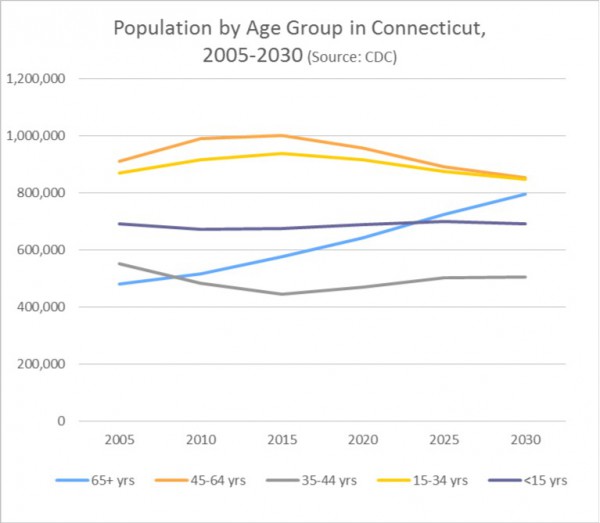 time reducing revenues because this large age cohort is no longer working.
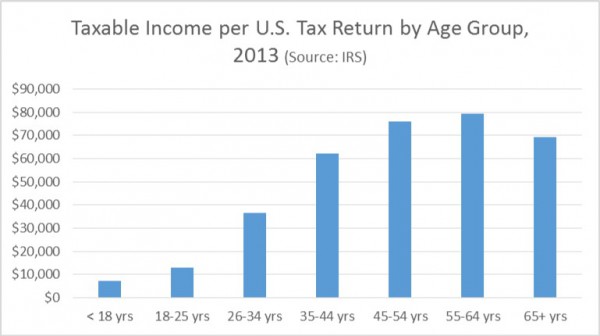 This figure shows how taxable income ebbs and flows by age group. The Baby Boomers are in the best position to contribute to state revenues right now. However they are retiring in a consistent fashion, and the next younger cohort, of which there are fewer people to begin with, is earning less than their mature counterparts. This sets up a long-term issue for state revenue potential, one that will not be mitigated until the larger Millennial age cohort gets into their more profitable working years.
Revenue expectations are not what they used to be. In the 1960s, the economy consistently grew between three and five percent each year, and Americans assumed that it would continue to grow at that pace. As a result, government was able to fund additional programs as economic and tax bases kept expanding. Today the economy is growing at only around two percent each year. This economic trend reduces the ability for the government to fund programs, and all demands cannot be met, with the current revenues coming in.[5]
If you multiply the taxable income per return by the number of people in each demographic group in both 2015 and 2030, excluding inflation, there would be a four percent decrease in the projected total amount of taxable income in the state. This illustrates the effect of demographic trends on taxable income. Without even considering job trends, wage trends, or other long-term economic factors, the demographic shifts of the population are going to make it even more challenging for state governments to raise revenues.
The state revenue problem will not resolve itself with this legislative session, or even the next. While the current revenue problems are a combination of many factors, the demographic influence is significant and should not be overlooked because it can provide insight for decades into the future.
Since there are a number of longer term, structural issues that will continue to affect the state’s ability to raise revenues for many years, stakeholders and policymakers will have to adjust to this new economic reality. Prioritization of programs with specific intended targeted outcomes is the approach to the state budgeting process needed now.
_________________________________
Alissa DeJonge is Vice President of Research, Connecticut Economic Resource Center Inc. (CERC).
PERSPECTIVE commentaries by contributing writers appear each Sunday on Connecticut by the Numbers.
LAST WEEK: Freedom's Just Another Word For...
_________________________________
[1] http://www.nbcconnecticut.com/news/local/Vote-on-State-Budget-Deficit-Expected-Tuesday-373779281.html (Accessed March 29, 2016)
[2] High-Speed Broadband Internet Infrastructure Informational Conference: A Toolbox for Municipalities (March 23, 2016)
[3] http://www.usnews.com/news/business/articles/2016-03-25/job-totals-trail-pre-recession-levels-in-10-us-states (Accessed March 29, 2016), from U.S. DOL calculations of jobs changes, December 2007 – February 2016.
[4] http://www.washingtontimes.com/news/2015/oct/8/comptroller-connecticut-wage-growth-continues-to-l/ (Accessed March 29, 2016)
[5] Robert Samuelson, Trump’s Wrong – We’re Hugely Well-Off (Op-Ed), The Hartford Courant, March 28, 2016.


















To see more Connecticut illustrations, visit christycoreyart.com

© 2026 Connecticut By The Numbers [TM] 557 Prospect Avenue - 1st Floor, West Hartford, CT 06105
Designed by RDK Design & Photography