Report Warns of Separate But Unequal Community Colleges

Community colleges "are in great danger of becoming indelibly separate and unequal institutions in the higher-education landscape," a Century Foundation task force warns in new report.

The report, "Bridging the Higher Education Divide: Strengthening Community Colleges and Restoring the American Dream," outlines a series of proposals aimed at shifting the patterns that result in four-year colleges' enrolling disproportionably more wealthy and white students while two-year colleges enroll a higher proportion of needy and minority students.

Among its recommendations, the group urges states and the federal government to provide additional funds to two-year colleges that serve the neediest students, much in the way the federal Title I program works for elementary and secondary schools.

The Chronicle of Higher Education reports that the task force effort is premised on the notion that community colleges, which enroll about 44 percent of the nation's college population, are in many cases not serving students well now and will be ill equipped to handle future demands without radical change.  Research undertaken for the report found that, at some community colleges, almost two-thirds of the students are COMMUNITY_COLLEGEblack, Hispanic, or members of other groups typically considered underrepresented in higher education.

The approach outlined in the report could not only create more-affordable college pathways for middle-class families and improve educational outcomes at community colleges, it could also give community colleges more political clout, the Chronicle reported.

Connecticut’s 12 community colleges have 58,228 students, according to the Connecticut State Colleges & Universities website.  According to a 2011 report by the now defunct Board of Governors for Higher Education, nearly two-thirds (62.1 percent in fall of 2010) of all Hispanic/Latino and African American students attending community college do so at four of the system’s 12 institutions – Capital Community College in Hartford, Gateway Community College in New Haven, Housatonic Community College in Bridgeport and Norwalk Community College – all situated within or near urban cities with large low-income and minority populations. These institutions also awarded more than two-thirds (68.9 percent) of the associate degrees conferred to Hispanic/Latino and African American students by the community colleges during the 2009-10.

The Board of Governors report added that “it is clear that there is no problem regarding access for minority students at the state’s community colleges; thus, the Department’s grant program designed to reward and support their diversity efforts will require that they focus solely upon the retention and graduation of targeted students.”   In 2011, the Connecticut Mirror reported that the state pays about $7,000 a year for each full-time student enrolled in one of the 12 two-year community colleges -- but only one out of every 10 full-time students who enroll seeking an associates degree or certificate will earn one in three years. That ranks Connecticut's community college graduation rate 47th in the nation, according to a report by the state Department of Higher Education.

Earlier this year, in March, the Board of Regents for Higher Education, which now oversees the state’s 12 community colleges and four state universities voted to increase tuition by 5 percent in the coming year, despite student protests.  Students at Connecticut's community colleges would pay 5.25 percent more. For a full time student, that's an increase of $188 more, for a total of $3,786, the Hartford Courant reported.

The report by the Century Foundation noted that in a survey, eighty-one percent of students entering community college for the first time saying they eventually want to transfer and earn at least a bachelor’s degree but just 12 percent do so within six years. Among low-income students with “high” qualifications for college (those who completed “at least Trigonometry”), 69 percent of students who began in a four-year institution earned a bachelor’s degree, compared with just 19 percent of those who started in a community college.

Richard D. Kahlenberg, a senior fellow at the Foundation, questions how "we shower the most resources on the wealthiest college students and the least on the neediest," noting that the idea of reducing stratification by enhancing community colleges is an important focus in the report. The 22-member task force was led by Anthony W. Marx, the former president of Amherst College who now heads the New York Public Library, and Eduardo Padrón, president of Miami Dade College.

Partnership Encourages Girls Interest in Science

Girls of Innovation is a day-long annual program that inspires today's middle school students to consider studies in science and technology-related research, health services and business areas.  Sponsored by the Connecticut Technology Council (CTC) and Covidien Surgical Devices and held at the Connecticut Science Center in Hartford, this year’s event will be on Saturday, June 15 from 8:30 to 2:30.GOI_2010-Logo

The Girls of Innovation Science Challenge is for girls, entering grades 7 & 8 in the 2013-2014 school year, to explore science and its challenges in a fun, interactive way. There is no cost to attend. Parents/guardians must pre-register participants and receive the confirmation e-mail from CTC.

An offshoot of CTC's Women of Innovation program, Girls of Innovation inspires today's middle school students to consider studies in science and technology-related research, health services and business areas.

Volunteers working with the girls during the day are drawn from the Connecticut Women of Innovation program and CTC membership.  They are there to talk with the students about their experiences and careers and to guide them through the challenges created by the CT Science Center staff scientists.   Working individually and in teams, the girls explore scientific concepts and do hands-on science.  Additional time to explore the science exhibits throughout the Connecticut Science Center is also provided.girlsofinnovation

The Connecticut Technology Council is a statewide association of technology oriented companies and institutions, providing leadership in areas of policy advocacy, community building and assistance for growing companies. Speaking for over 2,000 companies that employ some 200,000 residents, the Connecticut Technology Council seeks to provide a strong and urgent voice in support of the creation of a culture of innovation.

“By establishing Girls of Innovation, CTC is demonstrating once again its commitment to its mission, which benefits all of Connecticut's citizens. Girls of Innovation lives up to its name, and puts us further down the path toward a culture of innovation,” said Beth Alquist, Chair of the Women of Innovation Planning Committee and a Partner at the law firm of Day Pitney LLP.

Leadership Greater Hartford Initiative Selected for National Recognition

The Association of Leadership Programs, a national organization with affiliates across the country, will present Leadership Greater Hartford with its first "Excellence in Innovation" award for the implementation and success of the Leaders on Board program.  The presentation will take place during the 2013 National Leadership Conference to be held in Arlington, Virginia later this month.

Leaders on Board is an ongoing program that strengthens nonprofit organizations by training and connecting participants with boards of directors seeking new members.  The pLeaders on Boardrogram attracts individuals who want to serve on a board, develop their leadership skills and serve the community.

Leaders on Board has successfully matched nearly 300 individuals with more than 75 nonprofit organizations throughout the region since its inception in January 2009.  The list of organizations that have placed members on boards through the Express Match process is quite impressive – and a who’s who of community organizations.

Potential board members receive training in nonprofit organizational structure and management. They are introduced to the role and responsibilities of board members and are encouraged to explore their skills and interests.  Then nonprofit board leadership and prospective board members interview each other, and “matches” are pursued by the organizations and the individuals.

In announcing the recognition, LGH said the success of our Leaders on Board program is not only due to the hard work of the LGH staff, but also to the commitment and time that the participants and nonprofits invest in making sure the program is a success. "We are delighted to share this award with everyone who has been involved with Leaders on Board since 2009, especially the Hartford Foundation for Public Giving, our funding partner. Thank you for making Leaders on Board the best it can be." Leaders on Board is a program created by Leadership Greater Hartford with support from the Hartford Foundation for Public Giving and in collaboration with the United Way of Central and Northeastern Connecticut. Corporations and businesses also participate in the program by offering board governance training to encourage their employees who are interested in serving the community. IMG_1959

Also during the conference in Virginia, longtime LGH president Ted Carroll will be leading a workshop for conference participants, entitled “Building Community by Transforming Local Government.” The workshop description highlights that “As Leadership Greater Hartford’s consulting and training activities have increased, our most important, and most profitable client has become our city government. This workshop will provide insights into how community leadership programs can apply their services and expertise to help municipalities develop more collaborative, participatory cultures.”

Upcoming "Leaders on Board" Express Match The next Leaders on Board “Express Match” program is scheduled to be held on Tuesday, June 11, 5:30 – 8:30 at Asylum Hill Congregational Church (814 Asylum Avenue) in Hartford.  Pre registration required, on the Leadership Greater Hartford website.

For High School Stand-outs, Major League Baseball Draft Brings Tough Decision

When Masuk High School baseball standout Thomas Milone of Monroe was selected by the Tampa Bay Rays in the third round, 97th overall, in this week’s Major League Baseball draft, it instantly became decision time. His choice: sign with the Rays by July 12, or go to UConn, where he has signed a letter of intent.

His decision, yet to be announced, may impact UConn’s prospects to build on this year’s successful post-season, but will certainly affect the course of his own career, in baseball MLB draftand beyond.

For Matt Harvey, now a standout pitcher on the New York Mets, a similar dichotomy awaited him after being drafted #118 overall by the Minnesota Twins in 2007 out of Fitch High School in Groton.   Harvey decided to head to college at North Carolina, went back in the baseball player draft after his junior year, and became the #7 pick overall when the NY Mets selected him.  He signed with the Mets, and his career trajectory has been upward ever since.

Among the top ten picks this year, 17 year old Phil Bickford of California will be deciding whether to sign with the Toronto Blue Jays or follow through on his commitment to Cal State Fullerton to begin college and a collegiate baseball career.  High school pitcher Kohl Stewart, selected at #4 by the Minnesota Twins, has said he will likely sign with the team and walk away from a football scholarship to Texas A&M.  In the seventh round, Avon Old Farms student Neil Kozikowski, a pitcher from Burlington, was selected by the Pittsburgh Pirates, the 239th player selected.

For two other Connecticut players were drafted this week, it was a stellar college career that contributed to their position in the draft:

  • John Murphy, a former Seymour High and Sacred Heart University shortstop, was the sixth-round selection with the 194th pick for the New York Yankees.  He is the highest selection in SHU history and the 14th player from the school ever to be drafted, according to the Connecticut Post.
  • University of Connecticut infielder L.J. Mazzilli, son of former major leaguer Lee Mazzilli, was drafted by the Mets in the fourth round -- 40 years after his dad was a first-round pick of the club.  L.J. Mazzilli helped lead the Huskies to the Big East tournament title and an automatic berth to the NCAA tournament this year.  He had been drafted by the Minnesota Twins a year ago, but opted to stay at UConn for his senior year.

Play college ball, or turn pro?  For Joseph Matthews, first vice president and senior investment management consultant with the Global Wealth Management Division of Morgan Stanley Wealth Management in Fairfield, the answer is in the numbers.

Matthews, writing in the Connecticut Post, notes that Georgetown University’s Center on Education and the Workforce has found that “people who hold a bachelor's degree have an 85 percent higher lifetime earning capacity than people with only a high school education.  With an undergraduate college degree, a person will average lifetime -- that is, from age 25 to 64 years -- earnings of $2.8 million. With a high school degree, that average plummets to $1.5 million.”  Here’s how Matthews breaks it down:milone

  • Right now, there are 750 players on 30 major league teams. Additionally, there are 4,000 players on 160 teams in the minors.
  • Less than three in 50, or only about 5.6 percent, of high school senior boys in interscholastic baseball programs will go on to play men's baseball at an NCAA member institution.
  • Of those, fewer than 11 in 100 senior players in NCAA will be drafted into professional baseball. In all, only one in 200 (about 0.5 percent) high school seniors playing interscholastic baseball will eventually be drafted by an MLB team.

By way of comparison, data indicates that in basketball .03% of high school athletes are drafted by NBA teams; in football the percentage is .09% reacingh the NFL, in hockey it is 4% who achieve the NHL level.

The economics – for those who don’t make it to the major leagues – are stark.  “For the minor leagues, roughly 1,500 players are drafted per year, yet only 1,000 will actually get to play. These lower-level athletes are only paid a fraction of what their major league counterparts are paid: a first contract season pays only $850/month, maximum. Taking into account rent, food, utilities, transportation, entertainment and all the other expenses of independent living, it would be exceedingly difficult on a minor league salary to grow a nest egg for future use,” Matthews suggests.

Those whose careers don’t rise above the minors will be “cast out into the labor force, often with a wife and children, and no marketable skills to speak of,” Matthews says.  He concludes that “donning a cap and gown and stepping up to a podium -- to accept a college diploma -- is a far more realistic way to achieve their dreams.”

That is an opinion that Milone, and other freshly minted high school graduates drafted by a major league franchise this week, may well be pondering.

Overwhelming Support Spells Defeat for Creation of Social Benefit Businesses in CT

Despite being introduced with the backing of Governor Malloy, overwhelming support in the House of Representatives where it passed by a lopsided 128-12 on May 20, and co-sponsorship by the legislature’s four top leaders, legislation establishing the “benefit corporation” as a new type of corporate entity never came up for a vote in the State Senate.  And thus it died when the legislative session ended on Wednesday.

“Despite a great deal of effort, we lost. It is a sad day for Connecticut that we couldn't get something so unequivocally positive done. I personally find it hard not to be disheartened by the whole process, but I guess that's politics,” said Kate Emery, founder and CEO of reSET, the Social Enterprise Trust.

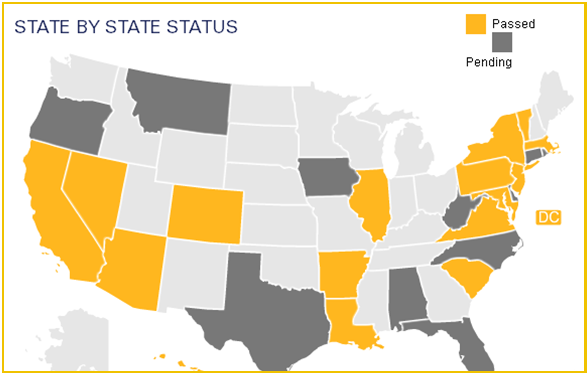
Similar legislation has already been passed and signed into law in California, Hawaii, Illinois, Louisiana, Massachusetts, Maryland, New Jersey, Pennsylvania, South Carolina, Vermont, and Virginia. It is pending in nine other states.

The bill (HB 6356) would have allowed businesses to legally incorporate as benefit corporations in Connecticut and was described as the most comprehensive piece of social enterprise legislation ever proposed in the United States.  It was designed to help social entrepreneurs protect their organization’s social mission, and provide a transparent, accessible, and simple mechanism for defining their business’s social goals.  Supporters said the legislation would also help drive job creation and increase the number of community-based partners benefit corpcommitted to solving some of Connecticut’s most pressing social issues without requiring additional state funding.

Here’s how Hartford Courant business editor Dan Haar described the bill in a column the day prior to legislative adjournment:  “The bill has few if any opponents, it would make it easier for private firms to do some good in the world and it wouldn’t cost the state any money (okay $62,000, once, to reprogram the computers).

Firms organized this way, known as type-B corporations, would have a stated social goal beyond profits for the owners — public health, perhaps, or promoting the arts or restoring the environment or creating economic opportunity for disadvantaged people. It’s the kind of stuff nonprofits tend to do, but allowing for-profit companies to set up with a social purpose simply adds an avenue.”

The bill not only required benefit corporations to publicly state their social mission within the business’s articles of incorporation, but it also would have created a culture of accountability within Connecticut’s social enterprise community by requiring that those businesses publish an annual benefit report detailing the public benefit that they have actually created, and make that information publicly available on their website.

It also would have given owners of social enterprises the option of locking in their commitment to the social mission that their business is designed to serve by electing to adopt its legacy preservation clause after a waiting period of two years. This would allow shareholders to ensure that their commitment to the creation of public good is maintained, even if ownership of that company changes over time.  But it was not to be.

“We did everything we could possibly do and we had a lot of great people working very hard to make it happen,” Emery said in an email to supporters of reSET across the state.  “It was a well fought battle and sooner or later we'll get it passed but for now we will have to take heart in knowing we did all we could.”

The broad coalition of supporters – all of whom submitted testimony during a public hearing on the bill -  included AARP, the Connecticut Association of Nonprofits, the Connecticut Conference of Independent Colleges and AT&T.  As Haar noted this week, Connecticut Innovations, the state’s technology investment arm, and the state Department of Economic and Community Development both supported it actively.  The Connecticut Bar Association, which opposed a similar bill last year, also supported this year’s revised version.

Benefit Corporations are a new class of corporation that 1) creates a material positive impact on society and the environment; 2) expands fiduciary duty to require consideration of non-financial interests when making decisions; and 3) reports on its overall social and environmental performance using recognized third party standards.

In her public hearing testimony, state Economic and Community Development Commissioner Catherine Smith said Connecticut “is poised to realize many benefits” from passage of the bill, which would “leave a lasting social and financial impact on our state for years to come.”

Increasing International Exports is Key to State's Economic Development Plan

A recent update on Connecticut’s Economic Development Strategy includes a strong focus on international economic development, including upcoming efforts to extend business in Israel, Canada and France as part of broader plans to strengthen Connecticut’s brand in the global markets and grow the state’s trade footprint abroad.

As described by Beatriz Gutierrez, director of international business development efforts at the state Department of Economic and Community Development (DECD), the department’s vision is “to position Connecticut as the destination of choice for companies looking to establish North American presence with preference to those in the areas of bioscience, precision manufacturing, fuel cells and renewable, and those looking to establish North American headquarters.”

The primary geographic targets for the state are China (which Gov. Malloy visited last year and Secretary of the State Denise Merrill visited last month), Germany and Western Europe (including the Paris Air Show this month), Israel (a CT-Israel Tech Summit will be held in Connecticut on June 12), and Brazil.  Goals include developing an international brand for the state, building an “opportunity pipeline,” and strengthening the relationship management process.

Meetings have been held with more than 50 companies and cluster associations in key industry segments, and a “concierge” program has been introduced in Europe.  During fiscal year 2012, DECD assisted in business exports to 39 countries for 62 state coCT boothmpanies, according to the DECD update.  The total assisted value of $548.6 million would equate to 2,785 jobs, according to DECD.  The department’s presentation added that unreported dollar amounts could account for “another 300 to 400 jobs, or more.”

The state has also been working closely with the U.S. Small Business Administration on international business growth, including the State Trade and Export Promotion (STEP) program.  Among the initiatives in Connecticut are a SBA pilot-grant to help small businesses increase exports, and efforts to assist businesses with participation in regional and industry focused export opportunities and international business development opportunities. Connecticut received grant awards of $546,822 in the first year and $339,319 in the second year, supporting 178 Connecticut companies with partial reimbursements for international business initiatives.

At a trade show in Hannover, Germany in April, for example, the state’s booth featured five Connecticut hydrogen and fuel cell companies, which officials say produced strong leads from both Germany and Canada. Later this month, Connecticut will have a presence at the Hydrogen + Fuel Cells Conference in Vancouver, with three state companies on hand, and at the Paris Air Show in Le Bourget, with 13 companies slated to be present at Connecticut’s booth.  It is the state’s eighth consecutive year at the air show, and $162 million in new business has been reported by the companies who exhibit under the Connecticut display umbrella.

Earlier this year, DECD reported that Connecticut is home to “691 foreign affiliates” employing 106,500 in the state.  At the time, exports were said to exceed $16 billion annually. More recent data indicate that exports dropped about two percent between FY 2011 and FY2012, from $16.21 billion to $15.86 billion.  Next steps outlined by the state in the May 22, 2013 update include implementing a statewide international activity scorecard, monitoring global trends and identifying potential “sweet spots,” and strengthening strategic partnerships.

Connecticut Well Represented in National Mental Health Dialogue

Keeping a commitment made in the aftermath of the Sandy Hook Elementary School murders last December, President Barack Obama launched a national mental health dialogue at the White House Monday aimed at increasing understanding and awareness of mental health, and Connecticut organizations are involved in the efforts from the outset.

Among the initiatives announced during the day-long conference was a new national website, www.mentalhealth.gov, and a series of public meetings to be held around the country under the “Creating Community Solutions” rubric.  Two of those community conversations will be in Connectwhite hosueicut – in Hartford and Norwalk – and one of the six national organizations coordinating the initiative has its headquarters in East Hartford.

The Center for Civic Engagement at the Hartford Public Library will organize the Hartford event as part of the National Dialogue on Mental Health. In response to unprecedented need for civic engagement, Hartford Public Library created the Center for Civic Engagement (CCE). The CCE aims to create a community change process, foster development of a community vision, contribute to a stronger, more successful community, and establish a civic engagement model.

The dialogue in Norwalk will be co-sponsored by the Fairfield County Community Foundation and the Southwest Regional Mental Health Board.  The Fairfield County Community Foundation promotes philanthropy to build and sustain a vital and prosperous community where all have the opportunCCSity to participate and thrive.  The Southwest Regional Mental Health Board is dedicated to ensure a quality system of comprehensive, recovery oriented mental health and addiction services that enhances the quality of life and well being of all residents of Southwest Connecticut.

The Creating Community Solutions initiative will allow participants to learn about mental health issues - from each other and from research - and to develop plans to improve mental health in their own communities, according to officials.   The national dialogue is to include young people who have experienced mental health problems, members of the faith community, foundations, and school and business leaders.

Among the six national “deliberative democracy” organizations involved in developing the Creating Community Solutions program is East Hartford-based Everyday Democracy, according to federal officials.  Everyday Democracy helps people organize, have dialogues, and take action on issues they care about, so that they can create communities that work for everyone. Its ultimate goal is to contribute to the creation of a strong, equitable democracy that values everyone's voice and participation.    Details about Everyday Democracy's role in the initiative and how partner communities and organizations can get involved will be available on the organization’s website in the coming dEDLOGOays.

Details regarding the date, location and registration information for the Hartford and Norwalk sessions will be available on a new website, at www.creatingcommunitysolutions.org.  The site is part of the national mental health website, which was created by the U.S. Department of Health and Human Services.   Thus far, community dialogues have been scheduled in New Mexico, California, Alabama, and Arizona, and an additional 29 sites – including the two in Connecticut – are making plans.   A Facebook page, https://www.facebook.com/CreatingCommunitySolutions, has also been launched.

Materials to support the conversations are being developed and will shortly be available for download, including an Information Brief, Organizing Guide and Discussion Guide.  In addition to Everyday Democracy, the organizations working together to design and implement Creating Community Solutions are America Speaks, Deliberative Democracy Consortium, National Issues Forums, the National Coalition for Dialogue & Deliberation, and the National Institute for Civil Discourse.

In addition, a number of national associations are asking their members or affiliates to organize local events. These groups include the United Way, American Bar Association, National League of Cities, YWCA, National School Public Relations Association, 4-H, Grassroots Grantmakers, Alliance for Children and Families, National Physicians Alliance, Association for Rural and Small Libraries, and the International Association for Public Participation, among others.

Changing Highway Exit Numbers in Eastern CT: Been There, Done That

There was a time when the best-known highway exit on the road to UConn was Exit 100 from Interstate 86.  Then everything changed.  It will be déjà vu all over again for Eastern Connecticut drivers during the next couple of years, as another set of prominent exits receive new numbers, courtesy of the state Department of Transportation (DOT).  The city of Norwich and the Mohegan Sun casino will be at the center of the changes.

DOT recently announced that it is planning to change Interstate 395 exit numbers as part of two projects totaling $9 million that will update road signs in accordance with U.S. government mandates for highway exits to match mile markers.

Under this plan, as reported in the Norwich Bulletin, thirty exit numbers along the interstate from New London County to the Massachusetts state line will change by the fall of 2015. Among the revisions are the northbound and southbound exits for Route 82/Downtown Norwich (Salem Turnpike) in Norwich, being changed to exit 11 from their current exit 80.  The well-known ex86 84it to Mohegan Sun, currently exit 79, would also receive a new exit number.

Construction is expected to begin in April 2014. The former exit numbers will remain on the new signs for at least two years, the DOT said last week.  Concerns about the costs to businesses to revise advertising, printed directions, and related materials have been raised.  We’ve been down this road before in Connecticut, as long-time residents will remember.

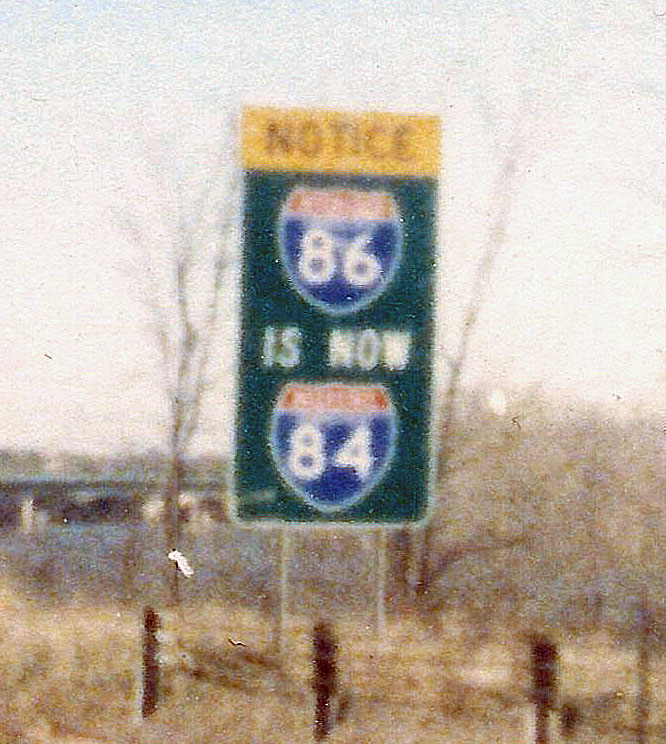
Nearly 30 years ago,  in 1984,  a more dramatic change re-wrote the exit landscape east of the Capital City, on what was then I-86 heading east from East Hartford.  The change eliminated I-86, changing the roadway’s designation to I-84, and requiring a renumbering of exits between East Hartford and the Massachusetts border, including the well-known exit 100, which led to Route 195 and UConn.  Today, it’s known as Exit 68 off I-84, the exit of champions.

In fact, I-84's intended east end has been changed twice, from the Mass Pike (I-90, Sturbridge) to Providence and back, according to the Connecticut Roads website. In late 1968, the Federal Highway Administration approved a new Interstate connection from Hartford to Providence, to be part of a rerouted I-84. The existing section of I-84 from Manchester to I-90 was redesignated I-86 (see map).

In 1970 and 1971, Connecticut built two isolated sections of the eastern I-84, in Manchester and Willimantic. Both were signed I-84. However, in 1982 Rhode Island canceled its portion of the highway, citing concerns over exitsthe Scituate reservoir, Providence's main fresh water supply. In August 1983, Connecticut canceled its portion, and the I-84 to I-86 numbering was rolled back.

The section of I-84 in Manchester became I-384, and the Willimantic section became part of US 6. This was made official on Dec. 12, 1984. The state is still trying to get an 11-mile freeway built between those two sections, from Bolton to Willimantic.

Also in the works for the coming years:  DOT has said the Route 2A exit numbers for Mohegan Sun Boulevard, the main road leading in and out of Mohegan Sun casino, will be changed.  Both the eastbound and westbound numbers will be changed to 6 from the current number 2, according to the DOT.

Dangers of Distracted Driving Attract Renewed Attention; Responses Pending, Urged

There was a time when smoking was permitted in restaurants, when seat belt use was not mandatory, when children were not required to wear helmets when bike riding.  Then the science of safety interceded, and state lawmakers – in Connecticut and elsewhere - took notice.  The convenience of technology, however, may be another matter.

Writing in The Hartford Courant this week, teen driving safety advocate Tim Hollister, who was a member of the Governor’s Safe Teen Driving Task Force in 2007-8 and publishes a national blog for parents of teen drivers, called for a ban on the use of electronic devices while driving, citing increasing evidence of  the dangers of distracted driving.  And a new study by a Texas university concluded that voice-to-text is as dangerous and traditional typed texting.

Hollister points out that six leading public health and traffic safety organizations (World Health Organization, National Transportation Safety Council, Insurance Institute for Highway Safety, and the Governor’s Highway Safety Association) “now agree that hands-free cellphone use is just as dangerous as hand-held.  Both cause cognitive blindness.”textingdrivingtons

With the addition of a new law passed in Hawaii last week, 40 states, the District of Columbia, the Virgin Islands and Guam have banned text messaging for all drivers using hand-held devices.  Hawaii becomes just the 11th state (including Connecticut, as well as the District of Columbia, Puerto Rico, Guam and the Virgin Islands) to prohibit all drivers from using handheld cell phones while driving.

Not a single state prohibits hands-free dialing, and neither state nor federal action appears on the horizon.  In fact, just the opposite is true.

Even as evidence of hazards grows, so do the range of electronic options.  Ford is one of a number of companies aggressively marketing electronic devices that offer more in-car options.  The company’s voice activated Sync technology, available beginning with 2012 models, includes hands-free calling, 411 business search, audible text messaging, and internet connectivity.  Hollister points out that “on tv and the internet, advertisements tout devices that enable texting by allowing drivers to attach their cellphones to the windshield so the screen is aligned with their view of the road.”

Connecticut Action Pending

Two bills that offer responses to certain aspects of distracted driving are now progressing through the Connecticut General Assembly, which adjourns on Wednesday, June 5.  The Associated Press reported that the House of Representatives voted 139-1 last week to add distracted driving to the list of moving violations that would be made available to insurance companibikees.  Currently, if someone disobeys the state's distracted driving law, they pay a fine and their insurer does not know about it.  The bill also increases fines and creates a task force to study distracted driving prevention. The legislation now moves to the Senate.

The Senate unanimously passed a bill establishing a fine of up to $1,000 for a motorist who "fails to exercise reasonable care on a public way" and seriously injures or causes the death of so-called vulnerable users, such as a bicyclists. The bill now moves to the House, the AP reported.

Federal Guidelines 

The dangers of technology-enabled distracted driving are so insidious – and increasing so rapidly – that the federal government has launched a website, www.distraction.gov, solely devoted to educating the public about the severe risks of distracted driving.  Among the statistics cited:

  • Driving while using a cell phone reduces the amount of brain activity associated with driving by 37%. (Carnegie Mellon)
  • Text messaging creates a crash risk 23 times worse than driving while not distracted. (VTTI)
  • Sending or receiving a text takes a driver's eyes from the road for an average of 4.6 seconds, the equivalent-at 55 mph-of driving the length of an entire football field, blind. Headset cell phone use is not substantially safer than hand-held use. (VTTI)
  • In 2011, 3,331 people were killed in crashes involving a distracted driver. An additional, 387,000 people were injured in motor vehicle crashes involving a distracted driver.
  • 11% of all drivers under the age of 20 involved in fatal crashes were reported as distracted at the time of the crash. This age group has the largest proportion of drivers who were distracted.
  • 40% of all American teens say they have been in a car when the driver used a cell phone in a way that put people in danger. (Pew)

A new study from the Texas Transportation Institute at Texas A&M University reveals that sending those messages using voice-to-text software is just as distracting as looking down at your phone and typing messages by hand.

Voluntary guidelines recently issued (April 2013) by the Department's National Highway Traffic Safety Administration (NHTSA), recommended specific criteria for electronic devices installed in vehicles at the time they are manufactured.  The guidelines include recommendations to limit the time a driver must take his eyes off the road to perform any task to two seconds at a time and twelve seconds total. The guidelines also recommend disabling several operations unless the vehicle is stopped and in park, such as:

  • Manual text entry for the purposes of text messaging and internet browsing;
  • Video-based entertainment and communications like video phoning or video conferencing;
  • Display of certain types of text, including text messages, web pages, social media content.

The department has also issued Blueprint for Ending Distracted Driving, a comprehensive plan on the subject.   The use of all cellular phones while driving a school bus is prohibited in 14 states thus far, including Connecticut, and the District of Columbia.  A federal proposal in 20ll that would have extended a ban on cell phone use – including hands-free – to all vehicles has not been enacted into law nationwide, or in any state.

The Washington Post reported 18 months ago that “Vehicles are being transformed into mobile communications centers, with cellphones, DVD players, access to Facebook and Twitter, Global Positioning System devices, and satellite radio.”

 “Unfortunately, drivers are being encouraged to do everything but drive,” Jonathan Adkins, spokesman for the Governors Highway Safety Association, told the Post. “It’s a sign of the pressures of modern-day life to do 10 things at once. However, driving is a complex task, and our message continues to be that a singular focus is needed.”

CT Differs from National Trend: Top Baby Names are Mason and Emma

Across the nation in 2012, the most frequent names for newborn babies were Jacob and Sophia.  Not in Connecticut.  Here, the leading names were Mason and Emma, choices that were runners-up nationally.

The top ten boys’ names in Connecticut were:  Mason, Jacob, Michael, Liam, Ethan, Jayden, Anthony, Matthew Noah and Ryan.  The top ten girls’ names in Connecticut were:  Emma, Olivia, Isabella, Sophia, Ava, Mia, Emily, Charlotte and Abigail.

Nationally, the leading boys names in 2012 were, Jacob, Mason, Ethan, Noah, William, Liam, Jayden, Michael, Alexander and Alden.  The most frequent girls names were Sophia, Emma, Isabella, Olivia, Ava, Emily, Abigail, Mia, Madison and Elizabeth.

In Connecticut, Sophia also topped the list in 2011, while Alexander was the leading name among boys.    Mason ranked third that year.  In 2010, Michael and Isabella were the most popular names chosen by Connecticut parents. Alexander dropped from number one in 2011 to number 13 in 2012.  Emma jumped from number four in 2011 to the top spot in 2012 in Connecticut.baby-cute-baby-1680x1050

The data is based on Social Security card application information, and compiled by the Social Security Administration. A decade ago, in 2002, the top names selected in Connecticut were Michael and Emily.  In 1992, Michael and Jessica topped the list.  By 2012, Jessica did not make the top 100 girls names in Connecticut.

Another name on the move – perhaps reflecting the growing popularity of the location in New York (and perhaps Connecticut, too?)  – is the name Brooklyn.  After finishing 75th in 2010 and 76th in 2011, the name jumped to47th in popularity in 2012.    Elizabeth is more popular outside Connecticut, ranked at number 10 nationally in 2012 and at number 20 in Connecticut, up slightly from number 23 the previous year.

Reasons for name selection vary widely.  One of the more recent findings, published in the October 2012 issue of Psychological Science, was developed by researchers Jonah Berger, Eric Bradlow, Alex Braunstein and Yao Zhang of the University of Pennsylvania’s Wharton School.  Writing in the journal of the Association for Psychological Science, they found that names starting with K, such as Karl and Katie, became about 9% more popular after Hurricane Katrina – evidence that parents’ choices about what to call their children are influenced by the sound of names in the news.   It is unclear whether Storm Sandy had a similar effect in Connecticut, since the storm occurred mid-way through the year.

A recent study by Bohan + Ipsos for WhyMomsRule.com found that nearly nine in ten Americans approve of their first names – 31 percent “love it,” 56 percent “like it,” 10 percent “dislike it” and 3 percent “hate it.”  The study also found a marked shift toward “unique” names and away from family and traditional names during the 20th century.  Daughters have more unusual names than sons, and sons have names that are easier to spell than daughters, the study, conducted in March 2013, found.

Closing out the top 100 most popular names in Connecticut were Antonio, for boys, and a three-way tie between Melanie, Serenity and Valentina among girls.  And just in case you’re wondering, in addition to Connecticut, Mason and Emma were the #1 names for 2012 in West Virginia.