Nation's First Black Astronaut in Space Calls for More Diversity in Science, Engineering Ranks

“A first class education is not just a requirement, it is a civil right,” America’s first African American astronaut, aerospace engineer Guion Bluford, told an attentive and appreciative audience at the University of Hartford, speaking as part of the university’s week-long “Empowering Change” initiative marking the 50th anniversary of the Civil Rights Act. Bluford, who flew on four space shuttle missions (in 1983, 1985, 1991 and 1992) and had a distinguished career with NASA and in private industry afterwards, told a standing-room-only audience of students, faculty and local residents that the caliber of the education at the high school he attended in Philadelphia has diminished to the point that area residents can’t imagine a graduate being  adequately prepared to pursue college-level engineering.

“Minorities of all kinds are seriously underrepresented in the science and engineering workforce of 5 million in this country.  Only 2.7 percent of African Americans and 2.2 percent of Hlogo Empowering Changeispanics have science or engineering degrees.  This disparity needs to be addressed,” Bluford said.

Bluford, 71, also noted that “534 astronauts have flown in space, but only 14 African Americans and 15 Hispanics have flown in space.  If America is going to maintain its scientific competitiveness, we must encourage more African Americans and Hispanics to pursue careers in science and technology.”

Bluford urged math and science at the high school level be mandatory with a focus on college preparation and career development, and called on colleges to “make an extra effort” to insure that minority students succeed, citing statistics indicating that approximately 60 percent of students who enter college majoring in STEM subjects end up graduating in a non-STEM field.guy bluford

He called for greater collaboration between colleges, professional organizations and industry, and with associate-degree institutions and high schools to better prepare and support students in science and math for work at the college level, and into careers.

“Success in these programs will provide a more diverse workforce with the skills they need to meet the technical demands of the 21st century,” Bluford said.  “America needs more underrepresented minorities in its talent pool if we are going to be competitive in tomorrow’s world.”

Bluford earned a bachelor of science degree in aerospace engineering from Pennsylvania State University in 1964; a master of science degree with distinction in aerospace engineering from the Air Force Institute of Technology in 1974; a doctor of philosophy in aerospace engineering with a minor in laser physics from the Air Force Institute of Technology in 1978 and a master in business administration from the University of Houston. In addition to his 688 hours in space on shuttle missions, he has logged more than 5,200 hours jet flight time, including 1,300 hours as a T-38 instructor pilot. He also has an FAA commercial pilot license and is a certified scuba diver.

Describing his parents as role models, Bluford said he was fortunate not to have suffered the injustices suffered by many African Americans in the South, having been raised “in an environment where everything was possible. They taught me the importance of working hard, aiming high, chasing my dream, never giving up, and being true to myself.”  He emphasized that in attending public schools, he had “excellent teachers who set high standards for achievement – teachers that were willing to stay after school to help their students.  My teacheblufordrs were demanding, my parents were relentless,” Bluford recalled.

Bluford said he “never thought he would be part of the space program,” but applied, and was selected, after witnessing with his generation the space program’s remarkable accomplishments in the 1960’s, including the first manned lunar landing.  He urged that interest in science be nurtured early in children – as early as kindergarten - and with after-school activities, such as traveling to "museums, scouting, summer camp, chemistry sets, robots... We need to close the education gap that exists between students attending schools in the poor  inner cities and students attending schools in the affluent suburbs," Bluford said.

“For African Americans growing up in the inner cities, a rich tapestry of activities focused on math and science is essential for success. Exposing these experiences to minority students gives them a feeling that they can also do it – be pilots, scientists, and even astronauts.”  As for the future, Bluford has no doubt that space exploration will continue, explaining that “curiosity will drive us to Mars and beyond.”

In-Person Explanations of New Health Insurance Program Outperform Web, Phone

In an era increasingly dominated by technology, a new study has underscored the importance of person-to-person assistance in a critical realm:  health insurance for chronically underserved populations. Consumers found it easier to get and use information from in-person assistance, and rated information from in-person assistance significantly better compared to information from a telephone helpline or the website of Access Health CT, Connecticut’s health insurance marketplace. In-person assisters played a crucial role in enrolling hard-to-reach, underserved populations, according to a study conducted by the Community Alliance for Research and Engagement at the Yale School of Public Health for the Universal Health Care Foundation of Connecticut.capture1

The evaluation examined the enrollment experiences of people from underserved urban areas of Connecticut, and sought to evaluate the outreach and enrollment process from the perspective of consumers and the in-person assisters and navigators who worked with them.  In-person assistance provided a critical service for consumers who were unable to navigate the helpline and website, the study found.

As trusted resources in the communities where they worked, assisters were clearly valued by their customers.  The study shows high rates of satisfaction overall with the enrollment process and emphasizes that in-person assistance was preferred by customers when they were asked to compare it to their interactions with the website or helpline.

Consumers mostly heard about AHCT through ‘word of mouth’ and ‘family and friends’.  Other sources of initial awareness, cited less frequently, were news programs, tv commercials, newspaper ads, library, internet and radio commercials. heard about

Satisfaction with the application and enrollment processes was high among survey participants. Ninety-five percent of respondents reported that the application and enrollment process was "definitely" or "somewhat" easy.  Twenty-nine percent reported some dissatisfaction with the amount of time required to enroll in a health plan.

The study found thta 90 percent would "definitely" recommend Access Health CT (AHCT), and an additional 9 percent would "probably" recommend AHCT.

During the open enrollment period of Octogetinfober 1, 2013, to March 31, 2014, the federal government was the major funder of in-person assistance, providing over $2.5 million in funding to the program.  The reported noted that “This level of funding is no longer available, yet, the need for assistance, both for the upcoming open enrollment period (November 15, 2014, to February 15, 2015) and beyond, is great.”  Plans for continuing in-person assistance, offered at store-front facilities, are under consideration according to published reports, with specifics uncertain.
Consumers most often wanted to learn about the cost of plans and the availability of financial assistance for insurance premiums. Of consumers who did not enroll, the most common reason was the need for more information, according to the study.

The report also noted that "because Connecticut is a national leader in the implementation of the US health insurance marketplace, the Connecticut experience may inform policy in other states and at the federal level."

CT Has 5th Largest Drop in State & Local Government Employment

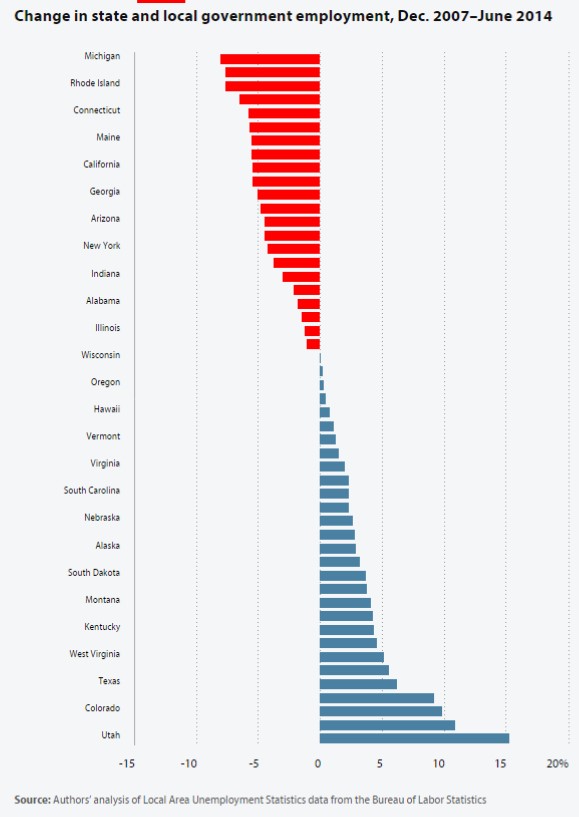
The drop in state and local government employment in Connecticut was the 5th largest in the nation between December 2007 and June 2014, according to data released by the Economic Policy Institute using data compiled by the Bureau of Labor Statistics. Connecticut’s government employment levels dropped 5.8 percent during the period.  Larger decreases in local and state government employees came in Michigan, 8 percent drop; Louisiana, 7.6 percent; Rhode Island, 7.6 percent; and Nestatesvada, 6.5 percent. Nationwide, 21 states saw a reduction in government employees, the remaining states had an increase in staffing during the six-and-a-half year period.

Among the states with the largest increases in public sector jobs were Utah, Colorado, North Carolina, Texas, Wyoming, West Virginia, Delaware and Kentucky.

While some state lawmakers attempted to preserve public-sector jobs—such as by raising taxes on the wealthy—too many chose to slash vital investments in the public sector, the Economic Policy Institute indicated, weakening the critical services provided by police, firefighters, teachers, and social workers.epi_logo

Since the start of the Great Recession in December 2007, 28 states plus the District of Columbia have added state and local government jobs, while 22 states have cut public sector workers. (see chart)

The Economic Policy Institute (EPI) is a nonprofit, nonpartisan think tank created in 1986 to  include the needs of low- and middle-income workers in economic policy discussions.  Washington, D.C.-based EPI conducts research and analysis on the economic status of working America.

Nationally, the state and local public sector had roughly 412,000 fewer jobs in July 2014 than it did in December 2007, and nearly 600,000 jobs fewer than at its peak in July 2008, the research found.

Connecticut Ranks #9 in MacArthur Fellows, Shows Net Gain of “Geniuses”

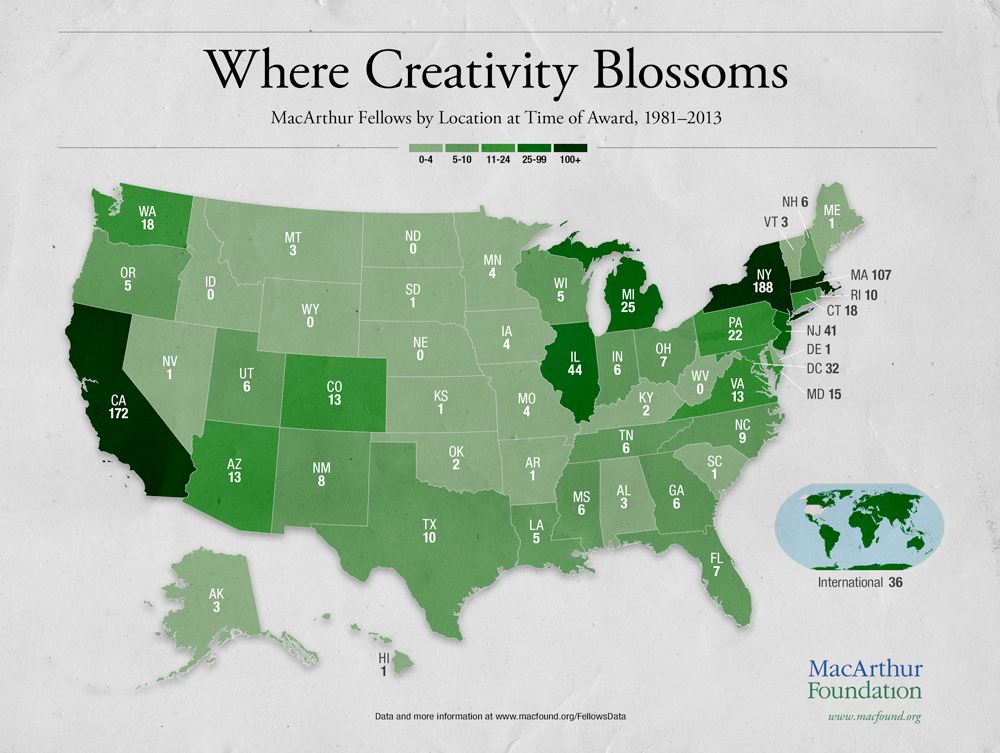
Each year, the MacArthur Foundation provides grants to some of the most talented minds in the country to provide them with the resources to pursue incredibly creative projects that just might change the world.  That’s why they’re often called the “genius awards.”  And it turns out that Connecticut ranks in the top 10 in recipients. Connecticut, with 18 recipients living in the state at the time of the award, ranks behind only New York (188), California (172), Massachusetts (107), Illinois (44), New Jersey (41), District of Columbia (32), Michigan (25), and Pennsylvania (22).  Tied with Connecticut ranking 9th is Washington state (18).

at time of _AwardThe MacArthur Foundation recently released data that shows where the 897 exceptionally creative individuals who have been recognized since 1981 were born, where they lived at the time they received the award and how mobile they are. This is the first time the data has been compiled and made publicly available.
This year's recipients will be announced on Sept. 17. The MacArthur Fellows Program awards unrestricted $625,000 fellowships to talented individuals who have shown extraordinary originality and dedication in their creative pursuits and a marked capacity for self-direction. Chicago-based MacArthur is one of the nation's largest independent foundations.

Another interesting finding is that MacArthur Fellows tend to not stay in one place. They will more likely end up somewhere other than their birthplace by the time they receive their award. California is the most popular state for fellows to move to with 113 new residents, followed by Massachusetts (58), New York (28), New Jersey (16) and a tie between Virginia and Arizona (10 each).  Connecticut also shows a net gain, at plus four.  Nationwide, 20 states reflect net gains, the remaining states have tended to lose future geniuses.

Nevada, Wyoming and Vermont, are the only states never to have produced a MacArthur Fellow.

The most recent Connecticut recipient is Daniel Spielman, a computer scientist at Yale University, selected in 2012. As the Henry Ford II Professor of Computer Science, Mathematics and Applied Science, Spielman “is a theoretical computer scientist studying abstract questions that nonetheless affect the essential aspects of daily life in modern society—how we communicate and how we measure, predict, and regulate our environment and our behavior,” according to the MacArthur profile of his selection.

In 2009, Richard Prum, an ornithologist at Yale University was among the 24 selected.  In his work, Prum draws from a wide spectrum of disciplines, including developmental biology, optical physics, molecular genetics, phylogenetics, paleontology, and behavior ecology, to address central questions about bird development, evolution, and behavior.

Officials note t hat innovative people tend to cluster near cultural centers and hotbeds of technological and scientific research, such as states with large cities like New York, California and Massachusetts, which may explain the mobility patterns of the fellows.  That may also have influenced Connecticut push in recent years into the biotechnology field and related disciplines.on the move  net plus

The data also highlight the contribution of immigrants to the creative culture of the United States. Nearly a quarter of MacArthur Fellows were born outside of the country. Though Fellows must be citizens or residents of the United States, their countries of origin span the globe.

Historian and 2003 Fellow Anders Winroth was born in Sweden and was teaching at Yale University at the time of the award, for example. The data indicates that 79% of the Fellows lived, at the time of the award, outside the state where they were born.  By way of comparison, according to recent U.S. Census Bureau data, approximately 30% of the general population and 42% of the college-educated population live outside the state where they were born.

An overwhelming number (169) of fellows were born in New York.  Other top states include California (59), Pennsylvania (52), Massachusetts (29) and Illinois (39). However, if you look at the data by per capita, those states are joined by Connecticut, Delaware, Rhode Island, Idaho, Montana and South Dakota, due to their relatively small populations.

The John D. and Catherine T. MacArthur Foundation, according to its website, “supports creative people and effective institutions committed to building a more just, verdant, and peaceful world. In addition to selecting the MacArthur Fellows, the Foundation works to defend human rights, advance global conservation and security, make cities better places, and understand how technology is affecting children and society.”

Daniel Spielman VIDEO (You Tube)     Richard Prum VIDEO (You Tube)


Fan Likes? Patriots Nation, Giants Country, Jets Nowhere

Although undefeated thus far this season, the New York Jets, it turns out, are nowhere.  At least nowhere on a nationwide, country-by-county map released by Facebook of the National Football League “likes” of Facebook users.tristate The breakdown showed Patriots dominance throughout New England and most of Connecticut – with the exception of Fairfield and New Haven counties, which remain Giants country.

The Jets were the only NFL team not to “win” a single county.

Months ago, The New York Times published a similar breakdown of major league baseball fans, which was especially interesting in breaking down the Red Sox-Yankees rivalry, but also highlighted the interest in the Yankees all across the country.

Unlike the MLB baseball map, there’s no clear “national” team, the Atlantic reported in analyzing the data.  Love for the the Bronx Bombers bubbled up in the absence of a prominent popular local franchise, appearing not only in greater New York City but also in far-reaching locations including North Carolina, Nebraska, Nevada and New Mexico. NoNewYorkJets

nation countryThat’s just not reflected in the NFL map. The Cowboys come closest, but they’re not “America’s team” as unambiguously, despite the longstanding public relations effort. Beyond Texas and its neighbors, the only isolated pockets of Cowboys fandom are in southern Nevada and southeastern Virginia. That’s it.

After the Cowboys, the Broncos control a huge region in the upper mid-west. Rivaling the Broncos are the 49ers, which rule almost all of California; and the Patriots, Seahawks and Saints, who all dominate their regions – at least on Facebook, if not in the NFL standings.

Connecticut, as it is in baseball, is divided in allegiances between New York and Boston professional teams.  But as is true throughout the tri-state region, the Jets don’t quite exceed Giants or Patriots fans – according to Facebook – anywhere.


NFL fan map

Remembering Connecticut's Enduring Loss on 9/11

“Jeff Gonski does not need a network television special or a commemorative newspaper edition to remember what he cannot forget: It has been 10 years since Amy Toyen, his 24-year-old fiancée, vanished in a cloud of toxic smoke and twisted steel at the tip of lower Manhattan. When American Airlines Flight 11 slammed into the North Tower of the World Trade Center, Amy was on the 106th floor preparing to make a presentation at a trade show for Boston-based Thomson Financial.” Boston magazine, in 2011, began its feature article with that stark recollection.  Legacy.com begins its remembrance by describing how that morning began.

“To catch her early flight on Sept. 11, Amy E. Toyen arose in Boston at 4 a.m. so she could arrive in New York City at 6:45 a.m., in plenty of time to attend the trade show in Windows on the World at 1 World Trade Center. Ms. Toyen, 24, was demonstrating a software product of her company, Thomson Financial in Boston, when her fiancé, Jeffrey Gonski, got a call at 8:58 a.m. — his caller ID showed it was her cellphone — but when he answered, no one was there.

Mr. Gonski haAmy Toyend met Ms. Toyen, who grew up in Avon, Connecticut, at their alma mater, Bentley College in Waltham, Mass., and had managed to pull off an elaborate proposal.
"We had just ordered her wedding dress," recalled her father, Martin Toyen. "She was so happy in her life — a woman in love, who loved her job." The wedding was set for June 16, 2002.

Toyen had lost a coin flip among business colleagues to decide who made the trip on Sept. 11; the night before, her flight from Boston to New York was canceled due to bad weather – but she was able to book a flight out of Logan International Airport at 6:00 the next morning.

After her death, Toyen’s parents would reflect on the luck that placed her in the worst part of the 110-story skyscraper, at the worst possible moment, the website MassLive reported. “It’s as if fate was telling her not to go,” said her father, adding that his daughter’s diligence pushed her to rebook the flight to get to the twin towers on time.

Since 9/11, Amy Toyen is remembered by those who knew her and loved her, those whose paths crossed hers along life’s journey, and by countless others, in her hometown of Avon, her native state of Connecticut, and well beyonddoc4e6796b9ae0265012592171.

A life size sculpture of a young Amy, funded by the student government of Avon High School, sits in the garden of the Avon Public Library.   Canton artist Marilyn Parkinson Thrall designed and executed the 22-inch bronze statue depicting Amy, sitting cross-legged on a bench and cradling a teddy bear as she reads a book on her lap.  Amy’s family sorted through many pictures in order to help Thrall capture her essence, incorporating her favorite daisy-print dress, tiny sneakers, and ponytails tied with pompom rubber bands. The statue sits upon a granite bench with a plaque that tells the full story.

Amy Elizabeth Toyen is one of the 2,977 people whose lives were tragically and abruptly ended on September 11, 2001, and one of 153 individuals named on Connecticut’s official memorial at Sherwood Island at Long Island Sound.

When the viewer faces the inscription on the state’s memorial stone they are oriented across the Sound to the site of the former World Trade Center in New York City, which had been visible from that scenic location. The inscription reads, "The citizens of Connecticut dedicate this living memorial to the thousands of innocent lives lost on September 11, 2001 and to the families who loved them."

9-11-Living-Memorial-2

As CT Workforce Ages, Employers Look to Attract Young Workers, Seek State Policy Support

The good news:  three times as many Connecticut businesses say they are growing rather than contracting, innovation and investment in technology is strong and three-quarters of manufacturers surveyed say they are exporting. Those are among the lead findings in a survey of Connecticut businesses conducted by BlumShapiro and the Connecticut Business and Industry Association. While the 2014 Survey of Connecticut Businesses shows optimism that Connecticut’s business landscape continues to improve, there remain concerns about the economy and the ability to create jobs in Connecticut, as well as signs that the state’s workforce continues to get older. In fact, one in four respondents are facing a wave of retirements over the next decade, with at least 40% of their workforce aged 55 or older.CTbusiness survey

“Connecticut’s workforce is aging, with 53% of our respondents reporting that 20% or more of their workforce is 55 or above. There is much to be optimistic about in this survey, but the aging workforce is certainly a challenge we continue to face,” pointed out Joseph Kask, Office Managing Partner of BlumShapiro’s West Hartford office.

While 38% of companies offer flexible work hours, only 8% offer telecommuting. One in four respondents also has specific practices or policies designed to attract and retain younger workers, including internships, tuition reimbursement, high entry-level wages, apprenticeships, and school/college recruitment programs.  Many companies employ apprentices (34%), interns (57%), and temps (58%), and eight in ten companies (79%) plan to hire these workers for permanent positions.

The survey shows slightly greater anticipated demand for mid-level employees than entry level or line workers. Among businesses of all types, workforce demand through 2015 is concentrated on mid-level employees (33% of companies say this is their area of greatest demand) followed by entry-level employees (29%), line workers (28%), managers (8%), and executive leadership (2%).Other highlights of this year’s survey include:

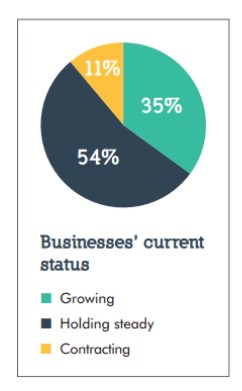
  • 35% of businesses surveyed indicate they are growing; 11% indicate they are contracting.
  • 46% of businesses surveyed introduced new products or services in the past 12 months; 47% of them plan on introducing new products or services in the next 12 months.
  • Three-quarters of manufacturers surveyed are exporting.
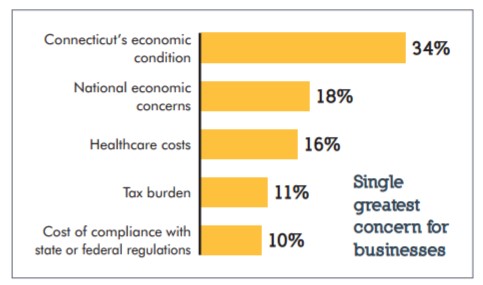
  • 52% of businesses surveyed say the most important step policymakers can take to enhance business in Connecticut is lowering taxes; 24% say it is reducing regulations, and 11% say it is cutting government regulations.
  • 27% of businesses surveyed say technology is the greatest single investment, 23% say it is employee training, and 23% say it is property and facilities.

concern When asked how Connecticut should address the shortage of skilled workers, 32% of businesses surveyed say the state should reduce the cost of living, 28% say the state should support trade schools, 20% say the state should support education overall, and 20% say there should be incentive for training programs.business steady;

The industries included in the survey include manufacturing, professional services, construction, retail, hospitality/tourism, wholesale, insurance, finance, real estate and software/technology.  Nearly one-third of the respondents were in the manufacturing sector.

CBIA is Connecticut’s leading business organization, with 10,000 member companies.  BlumShapiro is the largest regional accounting, tax and business consulting firm based in New England, with Connecticut offices in West Hartford and Shelton.

Connecticut Volunteers Pursue National Service; AmeriCorps to Celebrate 20th Anniversary

More than 3,700 people of all ages and backgrounds are helping to meet local needs, strengthen communities, and increase civic engagement through national service in Connecticut, according to data compiled by the Corporation for National & Community Service. Serving at more than 600 locations throughout the state, these citizens tutor and mentor children, support veterans and military families, provide health services, restore the environment, respond to disasters, increase economic opportunity, and recruit and manage volunteers.

During this past fiscal year, the Corporation for National and Community Service (CNCS) committed more than $9,390,000 to support Connecticut communities through national service initiatives. Through a unique public-private partnership, this federal investment leveraged an additional $2,720,000 in other resources to strengthen community impact, build local support, and increase return on taxpayer dollars.AC_20

Most AmeriCorps grant funding goes to the Connecticut Commission on Community Service within the state Office of Higher Education, which in turn awards grants to nonprofit groups to respond to local needs. AmeriCorps expected to provide more than 900 individuals the opportunity to provide intensive, results-driven service to meet education, environmental, health, economic, and other pressing needs in communities across Connecticut.

Nationally, AmeriCorps celebrates its 20th anniversary this month.  President Obama is scheduled to participate in a ceremony with AmeriCorps members at the White House on September 12 as part of a nationwide event marking the 20th anniversary of the AmeriCorps national service program.

The Connecticut Commission on Community Service administers programs under the National and Community Service Trust Act of 1993. The Commission is dedicated to supporting service and civic engagement to strengthen communities throughout Connecticut. In partnership with the Office of Higher Education, the Commission funds and supports programs that encourage all Connecticut residents to volunteer.  The Commission’s next meeting is scheduled for October 7.

Other individuals – in Connecticut and nationwide - serve their fellow citizens through AmeriCorps VISTA, whose members help bring individuals and communities out of poverty by serving full-time to fight illiteracy, improve health services, create businesses, and increase housing opportunities, and AmeriCorps NCCC (National Civilian Community Corps), a 10-month, full time residential program for men and women between the ages of 18 and 24. In exchange for their service, AmeriCorps members earn an education award that can be used to pay for college or to pay back qualified student loans.

In addition to the AmeriCorps participants, more than 2,800 seniors in Connecticut contribute their time and talents in one of three Senior Corps programs.logo community service

  • Foster Grandparents serve one-on-one as tutors and mentors to more than 1,000 young people who have special needs.
  • Senior Companions help more than 270 homebound seniors and other adults maintain independence in their own homes.
  • RSVP volunteers conduct safety patrols, renovate homes, protect the environment, tutor and mentor youth, respond to natural disasters, and provide other services through more than 230 groups across Connecticut.

The Corporation for National and Community Service is a federal agency that improves lives, strengthens communities, and fosters civic engagement through service and volunteering. Members of the Connecticut Commission on Community Service are appointed by the Governor and serve three-year terms. Commission members represent various areas of expertise as required by the National and Community Service Trust Act.


AmeriCorps video


Hartford Region Ranks #4 in USA in Digital Coupon Clicking, Survey Says

Coupons are fast-becoming money savers that are clicked, not clipped, and in few regions is that more the trend than in Greater Hartford.  Newly released data indicates that the Hartford-West Hartford-East Hartford market ranks #4 in the nation in the level of click activity, just behind New York, Boston and Philadelphia. According to results of a survey conducted by RetailMeNot, a leading digital offers destination, in conjunction with The Omnibus Company, the number of Americans who rely mostly on mobile coupons has been steadily increasing, as traditional scissor-clipped declines.

The study found that over the past four years, the use of printable coupons has dropped to 58 percent in 2014 from 73 percent in 2010. However, digital coupon usage has increased substantially as the world has gone more digital with online (27% in 2014 vs. 16% in 2010) and mobile (15% in 2014 vs. 4% in 2010) coupon usage.DigitalCoupon1

The latest edition of the company’s Shoppers Trend Report revealed that nearly all Americans (96 percent) are coupon users, and retailers and brands are steadily moving their marketing promotions to more mobile and digital formats. A separate survey of retail executives in May 2014, also conducted by The Omnibus Company, found that 75 percent of retailers believe that digital advertising delivers a higher ROI than offline advertising, including circulars and direct mail.

September has been designated as National Coupon Month, and based on the level of coupon click activity in ratio with each city’s population, the Northeast is leading the way.  Rounding out the top ten after New York, Boston, Philadelphia and Hartford are Providence, Baltimore, Pittsburgh, Washington, Tampa and Buffalo.

Western communities appear to lag in their savings activity, with the Las Vegas, Phoenix and Denver areas representing the bottom of the active-coupon-user list. In fact, the New York, Boston and Philadelphia areas appear to be four times more active than the Denver area at couponing, according to survey analysts.

In the top 10 active couponing cities, clothing and food categories ranked consistently at the top for click activity, followed by electronics and home and garden.Coupon

“Our survey findings show how a consumer’s mobile phone is becoming a key device within their savings tool kit as millions of shoppers increasingly take advantage of digital offers, promotions and sales opportunities.” says Trae Bodge, senior lifestyle editor for The Real Deal by RetailMeNot.

They survey also found that printable coupon usage for 18- to 34-year-olds dropped significantly in the past four years (40% in 2014 vs. 57% in 2010), and online coupon usage nearly tripled for those ages 50+ over the past four years (18% in 2014 vs. 7% in 2010).

According to the survey deep discounts aren’t the only deals that shoppers appreciate, as more than 2 in 5 (43%) coupon users consider discounts up to 25 percent to be a good deal. Respondents said they are most interested in deals that offer a specific dollar amount off of their purchase (30%).  The survey also shows that interest in different types of deals varies by region.

  • Coupon users living in the Northeast are more likely than those living in other regions to be most interested in receiving a specific percentage off a purchase (28% vs. 18% of the rest of the country).
  • Those living in the South are more likely than those living elsewhere (26% vs. 15% of the rest of the country) to be most interested in “buy one, get one free” deals.

In an August 2014 commissioned study conducted by Forrester Consulting on behalf of RetailMeNot, an overwhelming 59 percent of respondents stated that out of all the different types of promotions a retailer can employ, digital coupons still sway them the most when it comes to influencing a purchasing decision. The study also found that:

  • 63 percent of respondents agreed that digital coupons “close the deal” for them when undecided on a purchase,
  • More than 90 percent of smartphone and tablet users redeem their digital coupons within several days,retailmenot_logo_lg
  • Nearly 7 in 10 consumers (68%) said they strongly believe that digital coupons have a positive impact on a retailer’s brand
  • 68 percent state that coupons generate loyalty

RetailMeNot, Inc. operates what the company describes as the world’s largest marketplace for digital offers, and for the 12 months ended June 30, 2014, the company had more than 625 million visits to its websites.  See the complete list of the top 50 cities.

Top Cities (and Surrounding Metro Areas) Based on Click Activity

  1. New York-Newark-Jersey City
  2. Boston-Cambridge-Newton
  3. Philadelphia-Camden-Wilmington
  4. Hartford-West Hartford-East Hartford
  5. Providence-Warwick
  6.  Baltimore-Columbia-Towson
  7.  Pittsburgh
  8. Washington-Arlington-Alexandria
  9. Tampa-St. Petersburg-Clearwater
  10. Buffalo-Cheektowaga-Niagara Falls

Danbury-Based Ethan Allen In Retail Industry’s Hot 100; Only CT Company Named

The lone Connecticut-based retailer to make the list of the Hot 100 Retailers produced by the National Retail Federation is Danbury-based Ethan Allen Interiors, sliding in at #97.  Data from the national advocacy organization indicates 5 percent growth and 208 locations nationwide for the chain. Ethan Allen Interiors Inc. (NYSE:ETH) is a leading interior design company and manufacturer and retailer of quality home furnishings. The company offers free interior design service to its clients and sells a full range of furniture products and decorative accessories through ethanallen.com and a network of approximately 300 Design Centers in the United States and abroad.logo natl retail fed

Ethan Allen owns and operates eight manufacturing facilities including five manufacturing plants and one sawmill in the United States plus one plant in each of Mexico and Honduras. Approximately seventy percent of its products are made in its North American plants. Chairman, President and CEO is M. Farooq Kathwari.He has been president since 1985 and Chairman and Chief Executive Officer since 1987.

The company website indicates that “Ethan Allen is full-service. We conceptualize, design, source, manufacture, market, advertise, style, sell, distribute, and install. That means at headquarters our horizons are ever broadening. But our job is surprisingly straightforward: that is, to raise the bar — in all aspects of the company every day.”

Overall in Connecticut, the Federation highlighted the importance of the retail industry on the state’s economy:Ethan-Allen-Interiors-Inc.-ETH

  • Retail directly and indirectly supports 1 in 5 Connecticut jobs.
  • Retail is directly and indirectly responsible for 16% of Connecticut's GDP.
  • Retail directly and indirectly generates 15% of labor income in Connecticut.
  • Retail supports 476,568 jobs in Connecticut. (see breakdown below)

Among Connecticut’s neighboring New England states, Boston-based Wayfair was the #2 retailer nationwide on the Hot 100; Jordan’s Furniture, based in Taunton, MA was ranked #24; C & J Clark, headquartered in Newton, MA was #29; and Framingham-based Cumberland Farms was ranked #62.  In addition, LL Bean (Freeport, Maine) was #94 and BJ’s Wholesale Club (Westborough, MA) rounded out the list at #100.

Breaking down Connecticut employment by retail sector, the Federation reported:port_retail-ethan-allen-6-b

  1. Retail trade (including food services and drinking places) 17.2%
  2. Health care and social assistance 14.8%
  3. Finance and insurance 9.8%
  4. Manufacturing 9.4%
  5. Professional, scientific, and technical services 8.2%
  6. Other services, except public administration 5.8%
  7. Construction 5.8%
  8. Administrative and waste services 5.7%
  9. Real estate and rental and licensing 5.6%
  10. Education services 3.9%

Nationally, the top 10 leading the Hot 100 in sales growth were Albertsons (Boise, Idaho), Wayfair, Ascena Retail Group (Suffern, NY), Conn’s (The Woodlands, Texas), SpartanNash (GrandRapids, MI), Michael Kors Holdings (New York), Under Armour (Baltimore), Cardinal Health (Dublin, Ohio), Five Below (Philadelphia), and Amazon.com (Seattle).  Each of the top 10 companies had sales growth exceeding 25 percent from 2012 to 2013.

The data for the Hot 100 report was provided by Kantar Retail for the National Retail Federation.