CT Among Worst States For Business, Chief Executive Survey Says

Connecticut dropped one slot closer to the bottom of the list in this year’s Best & Worst States for Business, ranked by Chief Executive magazine’s survey of more than 500 CEOs nationwide.  The state was ranked 45th this year, down from #44 a year ago. Connecticut’s Northeast neighbors were mostly in the same neighborhood on the rankings list, with New York (#49), New Jersey (#47), and Massachusetts (#46) also in the bottom ten, along with Vermont, ranked #41.  In the middle of the pack, Maine was ranked #30 and New Hampshire was #21.best

According to Chief Executive, which is published in Greenwich, the results of the 11th annual survey show that CEOs favor states with progressive business development programs, low taxes and a quality living environment.  States are measured across three key categories to achieve their overall ranking: Taxes and regulations, quality of the workforce, and living environment, which includes such considerations as quality of education, cost of living, affordable housing, social amenities and crime rates.

The top ranked states were Texas, Florida, North Carolina, Tennessee, Georgia, Indiana, Louisiana, Nevada and Arizona.  Texas and Florida were also ranked one-two last year.  Texas has topped the list for a decade.  Tennessee and North Carolina traded places from a year ago. 61u-av0cWvL._SY300_

Among the CEO comments highlighted by the publication:  “A difficult tax structure like the ones in New York or Connecticut makes incentive-giving easy, but penalizes existing businesses. The climate for coming is better than the climate for staying.”

ctOf a maximum five stars in the CEO ratings, Connecticut received 1.5 for Taxation and Regulations, 3.0 for Workforce Quality and 3.0 for Living Environment.  The data used in determining the states' rankings included state GDP for 2013 vs. 2012, the unemployment rate in December 2014, state debt per capita in 2013, and state-local tax burden.  Key companies in the state highlighted by the website reporting of the survey include General Electric Company, Xerox Company, Aetna Corporation, The Hartford, and Stanley Black & Decker.

Indiana ranked first in the Midwest and sixth nationwide as the best place to do business. It was the only Midwestern state ranked in the top 10.  Among neighboring states, Kentucky ranked 28th, Ohio ranked 22nd, Michigan ranked 43rd and Illinois ranked 49th.  Among the largest moves up the list were Idaho (from #28 to #18), Pennsylvania (from #42 to #35), Iowa (from #19 to #13) and Maine (#36 to #30).

Chief Executive magazine is a bi-monthly publication for top management executives published by the Chief Executive Group LLC., founded in 1977, and headquartered in Greenwich.  According to the publication, state governments use the survey results to help determine how to improve their regulatory environments to attract more businesses, while corporations use the data to decide where to build facilities and attract vibrant workforces.

Last fall, Connecticut economic development officials and leading companies were featured in videos touting the state's efforts to attract and retain businesses.

https://youtu.be/sqNs8aaWpd0

https://youtu.be/CmDCxvRIC3I


Ten CT History Organizations Honored for Innovative, Effective Initiatives

When the Connecticut League of History Organizations (CLHO) hosts its annual conference and awards ceremony in Meriden on June 1, ten local organizations will be honored for their effective work in connecting state residents and history. The theme of the all-day conference is “Making History Collections Relevant in a Modern World.” Sessions will explore the many traditional and non-traditional ways that museums, historical societies, historic houses, and archives make their collections accessible and relevant to their communities.

The conferenceLOGO COLOR, which is open to the public,  includes an awards ceremony, as the CLHO presents Awards of Merit to institutions and individuals who demonstrate the highest of professional standards and who enhance and further the understanding of Connecticut history.  Along with opportunities for networking, there will be speakers, panel discussions, and how-to practical presentations.

The awards will be presented to the Wethersfield Historical Society, Weslyan University Press/Connecticut Explored/The Amistad Center, Norfolk Historical Society, Mattatuck Museum (Waterbury), Lyman Allyn Art Museum (New London), Kent Historical Society, Florence Griswold Museum (Old Lyme), Cheshire Historical Society, Bated Breath Theatre Company (Hartford), and Archaeological and Historical Services, Inc. (Storrs). [See details below]

Keynote speaker Rainey Tisdale is an independent curator specializing in city history. Tisdale led the consortium of local museums, libraries, and archives in collecting and interpreting the 2103 Boston Marathon Bombing, with emphasis on programming for the one-year anniversary in April 2014.

Tisdale’s most recent book, Creativity in Museum Practice, helps museum professionals unleash creative potential throughout their institution. She will discuss “The Poetry of Objects,” a wide-ranging meditation on the power of objects to move, inspire, and build community.

The awards ceremony features an award-winning performance by Bated Breath Theater Company, "Freedom In Three Acts." Admission to the conference is $75 per person, with discounts for members, students, and early registration, and covers all events of the day and lunch. Reservations  can be made at www.CLHO.org.

For over 60 years the Connecticut League of History Organizations has strengthened and built connections among those who preserve and share the stories and objects of our past by sharing knowledge and experience, and promoting best practices.

https://youtu.be/LM5xtk23cv0


The CLHO Awards of Merit will be presented to:

Archaeological and Historical Services, Inc. - Storrs, CT

Publication - Highways to History: The Archaeology of Connecticut’s 18th-Century Lifeways

Highways to History is a publication describing the lives of ordinary residents in 18th century colonial Connecticut. Based on a combination of historical and archaeological investigations at four buried homesteads, the book opens a new window into how people in Connecticut lived in colonial times. Distributed around the state, and made available online, Highways to History provides an accessible and engaging account of how ordinary colonial Connecticut citizens lived, and demonstrates the strength of combining archaeological and documentary evidence.

Bated Breath Theatre Company (a collaboration with The Amistad Center for Art & Culture) Hartford, CT

Educational Program - Freedom: In 3 Acts

Freedom: In 3 Acts is a collaborative performance between The Amistad Center for Art & Culture and Bated Breath Theatre Company. This innovative program responded to and amplified The Amistad Center’s exhibition, Emancipation! The three act performance incorporates song, movement and narrative to explore the struggle for freedom and justice for African Americans. Since its initial performance, Bated Breath Theatre Company has performed Freedom: In 3 Acts at a variety of venues, using its innovative and engaging approach to bring the original exhibit off the walls and out of the exhibit cases to engage audiences around Connecticut.

Cheshire Historical Society - Cheshire, CT

Educational Program - Cheshire Heritage Tour – An App for Mobile Devices

Looking to bring a traditional walking tour of the center of Cheshire alive, The Cheshire Historical Society developed an app that appeals to people of many ages and interest. Free to download, the app combines humor, seldom-seen images from the Historical Society’s collection, and contemporary photos and maps to guide the user around the center of town. With the help of two characters, Alonzo the Adventurer and Emmy, the Magical History Box, the Cheshire Heritage Tour keeps visitors engaged while learning about the history of the area.

Florence Griswold Museum - Old Lyme, CT

Project - Thistles and Crowns: The Painted Chests of the Connecticut Shore

In 2014 the Florence Griswold Museum presented the exhibition Thistles and Crowns: The Painted Chests of the Connecticut Shore to highlight the distinctive beauty and historical significance of a group of painted chests made in Old Saybrook and Guilford, Connecticut between 1700 and 1740. Bringing together a selection of these chests from six museums for the first time since 1950, the exhibit asked visitors to look at aspects of construction, decoration, use and history. Accompanied by a full-color catalog, Thistles and Crowns highlighted stories about Connecticut’s artistic, cultural, and historical legacies that can be found in unexpected places.

Kent Historical Society - Kent, CT

Project - Iron, Wood, and Water: Essential Elements of the Evolution of Kent

As the site of the second most valuable iron ore deposit in Connecticut, Kent became a desirable place to live for iron works, and the impact of their activities had deep influence on the evolution of Kent into the community it is today. While much scholarly research explores the technicalities of the iron making process and the entrepreneurs who ran the industry, the exhibition, Iron, Wood and Water: Essential Elements of the Evolution of Kent told the story of the common men who toiled daily in the mines, at the furnaces, and deep in the woods. It was these workers who left impressions on the community and played a large role in transforming Kent first from an untamed wilderness to a bustling industrial town, and later to a community of dairy farmers and finally to the home for artists and writers that it is today.

Lyman Allyn Art Museum and Stephen Fan, Guest Curator - New London, CT

Project - SubUrbanisms: Casino Company Town / China Town

In 2014 the Lyman Allyn Art Museum opened Suburbanisms: Casino Company Town/ China Town. Using a variety of approaches the exhibit documented and historicized the development of a suburban Chinatown surrounding the Mohegan Sun casino in Connecticut. Built up by a large number of Asian casino patrons and workers – many recent immigrants - this innovative exhibition presented an under-explored topic in Connecticut’s and the nation’s history. In addressing key themes in suburban, housing, labor, and immigrant history, the exhibit used history to bridge cultural divides and to question the future ecological, social, and economic sustainabilites of the ever-changing American suburban ideal.

Mattatuck Museum - Waterbury, CT

Project – The Way We Worked – Connecticut At Work

As one of seven venues selected to host The Way We Worked, a traveling exhibition created by the Smithsonian Institution in 2014, the Mattatuck Museum sought to create a parallel group of exhibitions and a series of programs to bring the story home to Connecticut audiences. Know as Connecticut At Work, the resulting local exhibitions, film series, lectures, and programs engaged broad and diverse audiences and addressed issues of immediate concern. Through providing a local backdrop for the Smithsonian’s exhibition, Connecticut At Work merged the national story with the regional one.

Norfolk Historical Society - Norfolk, CT

Project - From the Mills to the Main Street: The Irish in Norfolk

From the Mills to Main Street: The Irish in Norfolk was an inventive interpretive exhibition mounted by the Norfolk Historical Society in 2014. Using historical documents, artifacts, photographs, and ephemera, many not previously on view, the exhibit explored the contribution and assimilation of the Irish in the town of Norfolk from 1836 to 1920. The well-attended exhibit and related programming that included lectures, gallery talks, and walking tours, brought to life the importance of a significant immigrant group to the economic and cultural landscape of Norfolk.

Wesleyan University Press, Connecticut Explored, The Amistad Center - Middletown, CT

Publication - African American Connecticut Explored

African American Connecticut Explored is the first book published for a public history audience that provides the long arc of the African American experience in Connecticut with an emphasis on the African American perspective. Through more than 50 essays by more than 30 of the state’s leading historians, curators, and writers, the book covers a wide range of topics. Published by Wesleyan University Press, it was developed by Connecticut Explored, The Amistad Center for Art & Culture, and representatives from the State Historic Preservation Office.

Wethersfield Historical Society - Wethersfield, CT

Project - Castle on the Cove: the Connecticut State Prison and Wethersfield

Mounted in 2014, and on view through 2016 the exhibition Castle on the Cove: the Connecticut State Prison and Wethersfield, explores the Connecticut State Prison during its years of operation between 1827 and 1963 in Wethersfield, Connecticut. The prison was an integral component of the town’s identity during these formative years as Wethersfield transitioned from rural town to suburb. Exploring both previously undocumented and often requested materials the exhibit looks at the prison from the perspectives of the inmate, employee, and local resident to present the history of the prison within a broad context and to encourage visitors to consider the impact of the prison on these three groups.



PERSPECTIVE l Partnering Far to Benefit Near

by John Simone Only a couple of weeks after the Connecticut Main Street Center’s (CMSC) workshop last month on Building Lasting DownTOWN/GOWN Partnerships, our friends and colleagues at the Connecticut Economic Development Association,  a not-for-profit membership organization committed to advancing economic development, hosted an event at Middlesex Community College (MXCC) on how community colleges are leveraging resources to meet community workforce needs.

While this topic was touched on at the CMSC workshop, with Enfield’s Assistant Town Planner Courtney Hendricson and Asnuntuck Community College President James Lombella describing how they’re partnering to meet the town’s needs, the CEDAS event delved more deeply into emerging workforce trends in Connecticut, namely the expected growth in media-based jobs and a looming shortage of skilled manufacturing workers.perspective square

According to MXCC’s Center for New Media, Connecticut can expect an 11.7 percent job growth in all media categories – arts, sports and media, and entertainment through 2020 (the national average is 4.3 percent). And according to Marjorie Valentin, Associate Dean of Three Rivers Community College, without training there will be a critical skills gap of new and existing manufacturing employees, as an aging skilled workforce leaves the field and a stigma of the profession remains, leaving a shortage of skilled workers that threatens the future of manufacturing in Southeastern Connecticut.

In response, these and several other community colleges are partnering directly with manufacturers like Electric Boat, who offer input into the curriculum to ensure graduating students have the skills necessary to perform. And MXCC recently opened a beautiful, state-of-the-art Center for New Media, complete with high-tech classrooms, a high-definition studio, a video control room, green room, audio production studio, and a radio station.

While it was impressive to see and hear how much our community colleges have to offer today’s students, truly preparing them to succeed in a competitive workforce, what really struck me was our need to think beyond just our downtown borders when building strategic partnerships.

While we should absolutely strive to create fruitful relationships between our main street organizations and local anchor institutions, we also need to keep in mind that as a state, our successes and failures are often shared. So while Windsor may not have a community college within its borders, it may have high school students and a manufacturer who could benefit from a training program offered in Norwich. Meanwhile, a student can benefit from learning medical animation in Middletown, working at a downtown Hartford hospital during the day, before going home to Portland at night.

Offering attractive, inviting downtowns and Main Streets with a variety of housing, businesses and resources accommodates a population that is fluid not just over the course of a lifespan, but often over the course of a day!

By being mindful that a wider, regional or even state-wide partnership can benefit our towns and downtowns at a very local level, we ensure our successes are complementary, not exclusive.

John Simone is President & CEO of Connecticut Main Street Center, which provides solutions that help communities create great downtowns across Connecticut, revitalizing downtowns as the social and economic heart of the community. At the local level, CMSC works with dedicated stakeholders including municipal employees, business owners and volunteers to help them craft an inviting, vibrant downtown.  Learn more at www.ctmainstreet.org

____________________________________________________________________________

CT by the Numbers publishes opinion articles of 600 words or less.  Submissions should be emailed to info@ctbythenumbers.info.  Perspectives are published at the discretion of CT by the Numbers. 

National High School Mock Trial Championships to be in Hartford in 2017

The 2017 National High School Mock Trial Championship, promoting an understanding and appreciation of the American judicial system through academic competitions and related programs for high school students, will take place May 11-13, 2017 in Hartford. The national mock trial championship was initiated in 1984 in Des Moines, Iowa, with high school teams from Illinois, Iowa, Minnesota, Nebraska and Wisconsin participating. After the success of the inaugural tournament in Iowa, more states became interested in participating and the tournament became an "All-State" Tournament and now attracts competitors from across the country and internationally.

national_mock_trial_logo_0_1395406080The tournament is hosted annually by different states to ensure that the cost of running the tournament doesn't fall disproportionately on any particular state.

The Carolina Center for Civic Education is making final preparations for the 2015 National Championship, which will be held May 14-16 in Raleigh, North Carolina. Connecticut will be represented by the team from Weston High School, the 2015 High School Mock Trial State Champions.  The winning team was one of three from the school that participated in the statewide competition in March.  The finals were held in the State Supreme Court chamber in Hartford.  The students on the winning “Weston Red” team were Ursula Alwang, Cameron Edgar, Sam Glasberg, Zoe Howard, Alex Ishin, Scarlett Machson, Ben Muller, Jack Seigenthaler, Henry Tracey, and Micah Zirn, the Weston Forum reported.mocktrial-FI

The Idaho Law Foundation will host the 2016 National Championship in Boise, Idaho. Last year's competition in Madison, Wisconsin included a total of 46 teams, including Guam, South Korea, the Commonwealth of Northern Mariana Islands, and State Champion teams from across the country.

In Connecticut, the mock trial competition is sponsored by the nonprofit organization Civics First. Throughout its history, thousands of students and their teachers have participated in the program.  In recent years, the program has included over 700 students from more than 50 Connecticut high schools.

The high school mock trial competitions are held each year in the fall. Regional trials are held in early winter in superior courts throughout the state, followed by quarter-finals, and semi-final contests. The state final mock trial competition is held at the Connecticut Supreme Court in Hartford.

For the national competition, each state’s "official team" includes six to eight student team members; one primary teacher coach; one primary attorney coach, and the State Mock Trial Coordinator, for a maximum of 11 members of the "official" team.

In recent years, the competition has been held in Madison, Wisconsin (2014), Indianapolis, Indiana (2013), Albuquerque, New Mexico (2012), Phoenix, Arizona (2011), Philadelphia, Pennsylvania (2010), and Atlanta, Georgia (2009). The Executive Director of Civic First and state coordinator for the high school mock trials in Connecticut is Beth DeLuco.

CFCivics First is a private, non-profit association that promotes and conducts law-related education programs and projects in Connecticut's public and private schools, courtrooms and communities. Its goal is the incorporation of citizenship education into the curriculum of all schools, from kindergarten through high school.

Photo: The Weston High School Mock Trial Red Team won the Connecticut state championship . (This photo originally appeared in the Weston Forum.)


Aging Issues in CT Highlighted for White House Conference

When the White House Conference on Aging is held later this year, there will be no shortage of anecdotal stories accompanied by demographic information, comprehensive reports and recommendations, and a treasure-trove of data emanating from Connecticut, with the nation's 7th oldest population.  Officials received a preview this week at a public hearing that included these sit-up-and-take-notice items:

  • Connecticut is undergoing a “permanent and historic transformation” in its demographics
  • Between 2010 and 2040, Connecticut’s population of people age 65 and older is projected to grow by 57%, with less than 2% growth for people age 20 to 64 during the same period
  • Residents born in Connecticut today can expect to live to be 80.8 years old—the third highest life expectancy in the nation.
  • In Connecticut’s 65 to 69 year-old age group, 39% are in the labor force, as are 21% of Connecticut residents aged 70–74, and 7% of those 75 years and over. These rates are among the highest in the country

Those were among the facts highlighted by Julia Evans Starr, Executive Director of Connecticut’s Legislative Commission on Aging, which also explained that Connecticut, with the nation’s 7th oldest population, will see that population grow dramatically in the coming decade.  By 2025, virtually every town in Connecticut will have 20 percent or more of its residents over age 65 – the largest percentage in state history. photo

The White House Conference on Aging is held every 10 years, and has served as a key platform for the development of aging policy for the past 50 years.  Organizers are now holding a series of regional public forums around the country.  New England’s session will be in Boston later this month, and the testimony presented at the Connecticut State Capitol, in a forum sponsored by the state Department of Aging and the Legislative Committee on Aging, will be passed on to officials there.

Among those speaking in Hartford were Lieutenant Governor Nancy Wyman, State Aging Department Commissioner Betsy Ritter, and George Kuchel, Director of UConn’s Center on Aging.  AARP Connecticut Director Nora Duncan and Chris Fishbein of the Area Agencies on Aging also provided presentations.

Wyman, noting that life span is increasing, said "we have quantity of life, we want to make sure there is a quality of life."  In a theme that was repeated by others during the session, Wyman said that "we can change the way people are viewing people who are aging."

Nora Duncan, state director of AARP-CT, said the organization's focus will be on short-term actions that can have a more immediate impact, such as preventing exploitation, fraud and scams and providing information on financial products and improving retirement security.  Rose Biaggi of the state Department of Public Health pointed to the health disparities among the aging population, noting that 60% of older adults with the highest incomes indicate that their health is very good or excellent, while only one-quarter of those with lowest income feel that their health is very good or excellent.

Kuchel, who suggested that the nation may be at a “tipping point” regarding a national policy on aging, said the future focus needs to be:

  • Proactive: There must be a focus on prevention and improvements in health and function across the lifespan.
  • Predictive: We need tools to predict individual risk, target therapies and monitor success of interventions.
  • Personalized: We must address differences at the level of each individual and time point in life as regards personal aging trajectories.
  • Gerontology: Health care must always be defined by patient needs first, driven by science and supported by evidencelogo-WHCOA2015-600

Common themes that have begun to emerge nationwide as the hearings have progressed, according to officials, include: how to ensure we prepare for financial needs in retirement; how to remain healthy as we age; what types of services and supports can help older Americans remain independent in the community as we age; and how to support this care and the caregivers who provided it; and how to protect older Americans from financial exploitation, abuse and neglect.

The co-chairs of the legislature’s Committee on Aging, Sen. Mae Flexer and Rep. Joe Serra, were to lead the session, with Flexer noting that “Older individuals want to remain in Connecticut and be active, independent members of their community.  How we accomplish this, how we fund it, what services we need to have in place – these are some of the questions we are seeking input on today.”

In testimony provided to the committee, the state’s Permanent Commission on the Status of Women indicated “women, who make up 58% of residents age 65 and over, are disproportionally impacted by economic insecurity as they age and are therefore much more likely to live in poverty than their male counterparts. In fact, 10.7% of women age 65 and over live in poverty compared with 6.2% of men.” PCSW also cited data that found Connecticut women are more likely to work in part-time jobs that don’t qualify for a retirement plan.

The legislative Commission on Aging also pointed out that “the comparatively low rate of older adults in poverty (8 percent) provides evidence that programs like Social Security and Medicare have been extremely effective at reducing poverty among this population and serves as a testament that these programs warrant continued support and modernization.”  Federal officials have noted that this year’s White House Conference on Aging takes place as the nation marks the 50th anniversary of Medicare, Medicaid and the Older Americans Act, as well as the 80th anniversary of Social Security.


CT-N coverage of the Connecticut forum on May 5, 2015.

Connecticut Ranks #16, Above National Average in Online Job Ads for College Graduates

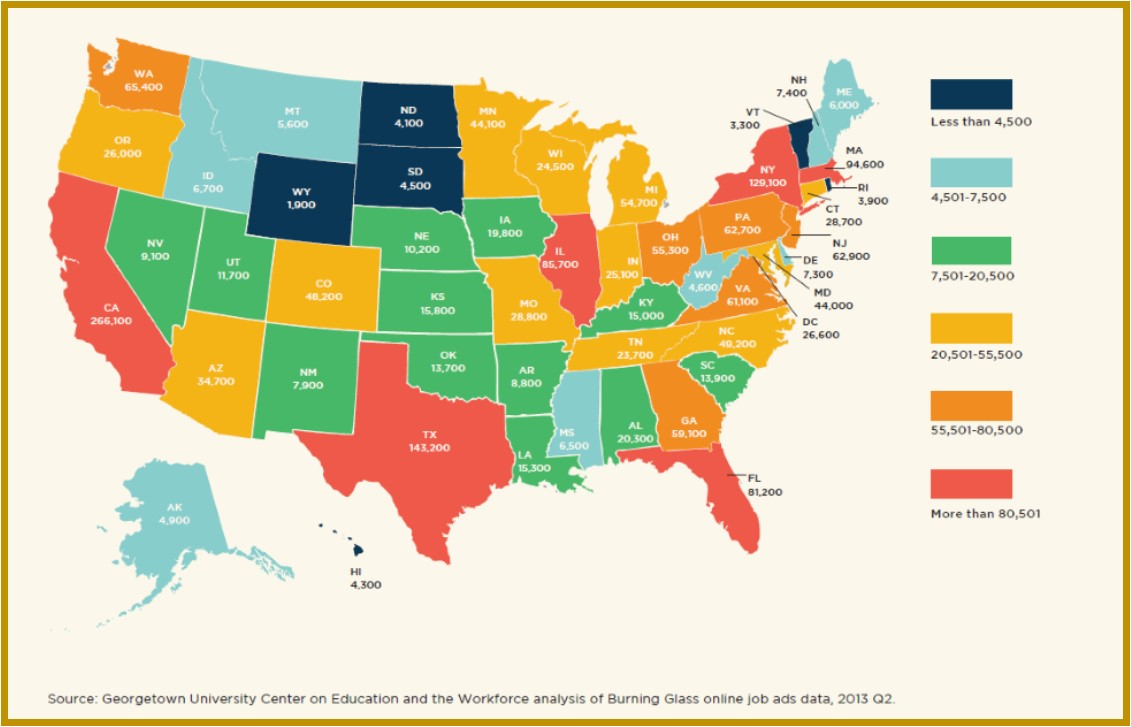
Connecticut ranks as the 16th best online college labor market in the U.S., according to data compiled by the Georgetown University Center on Education and the Workforce.  In Connecticut, 53 percent of online job ads seek college graduates.  That translates to 28,700 online job ads, and places Connecticut – just barely – in the top tier of the states. Massachusetts provides college graduates with the best odds of landing a job, according to the national survey. Using online job ads, the report provides information about where the jobs are for college graduates for each of the 50 states to help students, educators, and policymakers make better decisions.OCLM_Cover_326-234x300

The report ranks the states by how many job openings there are per college-educated worker overall and within industries and career fields. College graduates seeking work in science, technology, engineering, and mathematics (STEM) careers, for example, have the best odds in Delaware, Massachusetts, and New York.  Connecticut is in the middle of the pack.

Nationwide, between 60 and 70 percent of job openings are advertised online, and even though only 35 percent of workers have college degrees, nearly half of online job ads cater to college graduates.  The top five best online markets for college graduates are Massachusetts, Delaware, Washington, Colorado, and Alaska.

The survey found that in Connecticut:

  • 36% of online job adds for college graduates are for managerial and professional office occupations
  • 22% of online job ads are in the consulting and business services sector
  • The fastest growing occupational cluster for college graduates is in food and personal service, growing by 73 percent between the 1st quarter of 2010 and 2nd quarter of 2013
  • The fastest growing industry sector of college graduates is construction, with a 92 percent increase in employment between the 1st quarter of 2010 and 2nd quarter of 2013

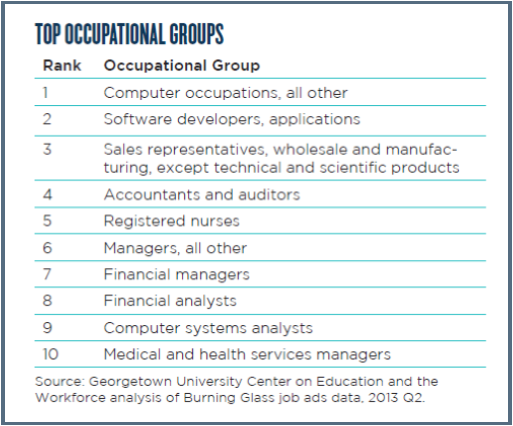
top occupationalThe top occupational groups reflected in the online job ads were 1) computer occupations, 2) software developers, 3) sales representatives,4) accountants and auditors, 5) registered nurses, 6) managers, 7) financial managers, 8) financial analysts, 9) computer system analysts and 10) medical and health services managers.
The distribution of online college job ads by occupational cluster shows that the largest percentage (24%) are in managerial and professional office occupations, followed by sales and office support (23%), STEM fields of science, technology, engineering and math (15%) and blue collar jobs (9%).

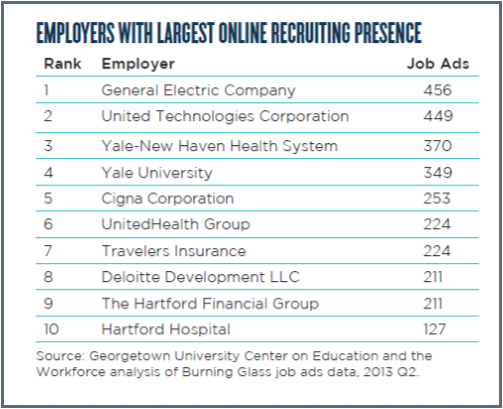
Connecticut employers with the largest online recruiting presence were General Electric Company, United Technologies Corporation, Yale-New Haven Health System, Yale University, Cigna Corporation, UnitedHealth Group, Travelers Insurance, Deloitte Development, The Hartford Financial Group, and Hartford Healthcare.

Across the country, college-educated workers will have the best odds of finding a job in STEM, managerial and professional office, and healthcare professional and technical occupations. The jobs of the new economy are prevalent for college graduates across the 50 states. Employers in information services, consulting and business services and financial services sectors post the most online job ads per college-educated worker.

largest employersThe Georgetown University Center on Education and the Workplace is affiliated with the McCourt School of Public Policy.  The study was done by Anthony Carnevale, Tamara Jayasundera, Dmitrirepnikov and Artem Gulish.
“The promise of this information is the ability to connect real people with real jobs in real time,” said Anthony P. Carnevale, the report’s lead author and director of the Center. “By combining information on online job ads with traditional employment data we are able to get a more complete picture of job opportunities available to college graduates in each state,” said Tamara Jayasundera, the report’s co-author.

In Massachusetts, 63 percent of job openings are for college graduates, while in West Virginia, only 36 percent of job openings are for college graduates.


college states

Weston High, Hotchkiss School Are Top High Schools in CT

Three Connecticut public high schools are ranked in the top 100 in the nation - Weston High School at #84 and New Canaan High School at #85, Staples High School in Westport at #94.  The rankings, compiled by the website Niche, focused on the overall student experience at the schools in developing the list.  Academics, health and safety, teachers, and student culture and diversity were aspects of the analysis.niche rankings banner 290px The top 15 public high schools in the state were Weston High School, New Canaan High School, Staples High School (Westport), Darien High School, Simsbury High School, Ridgefield High School, Wilton High School, Greenwich High School, Glastonbury High School, Amity Regional High School (Woodbridge), Conard High School (West Hartford), Farmington High School, Cheshire High School, Joel Barlow High School (Redding) and Daniel Hand High School (Madison).

Weston High School was named a National Blue Ribbon School for excellence in education by the U.S. Department of Education in 2013.  The school’s “greatest strength is the level of personalization that students receive during their four-year experience,” the Blue Ribbon citation indicated.

The Hotchkiss School in Lakeville is ranked as the top private school in Connecticut, and reached the top ten in the nation, at number seven.  It is the only Connecticut private school in the top 25.  The other Connecticut private schools in the top 50 nationally are Choate Rosemary Hall at #30 and Hopkins School in New Haven at #43. An independent boarding school founded in 1891, Hotchkiss School provides "an education of unsurpassed quality" to 600 students in grades 9 through 12, according  to the school website, which indicates that students come from across the United States and 34 foreign countries. best-overall_300x300 (1)

A high ranking in Overall Experience generally indicates that:

  • Students are very happy with their experiences in all aspects, including academics, teachers, health, safety, resources, facilities, extracurriculars, sports, and fitness;
  • The school is an exceptional academic institution in terms of teachers, students, resources for learning, and student outcomes;
  • The school is made up of a diverse population and fosters an accepting, positive school culture;
  • Students are actively involved in a variety of extracurriculars and sports the school offers.

The Best Public High Schools ranking provides what Niche describes as “a comprehensive assessment of the overall experience at public high schools in all 50 states, the District of Columbia, and Puerto Rico. It uses data sourced from various government and public data sets, Niche’s own proprietary data, and 4,625,227 opinion-based survey responses across a variety of topics from 287,560 current students, recent alumni, and parents.”

best-overall_300x300Factors considered in the analysis include:

  • Academics, which incorporates statistics and student, alumni, and parent surveys regarding academics at the school.
  • Health & Safety, which incorporates statistics and student, alumni, and parent surveys regarding health and safety at the school. R
  • Student Culture & Diversity, which incorporates statistics and student, alumni, and parent surveys regarding culture and diversity at the school.
  • Survey Responses, which consist of parent and student opinions about the overall experience at the high school they currently or recently attend(ed).
  • Teachers, which incorporates statistics and student, alumni, and parent surveys regarding teachers at the school.
  • Resources & Facilities, which incorporates statistics and student, alumni, and parent surveys regarding resources and facilities at the school.
  • Extracurriculars & Activities, which incorporates statistics and student, alumni, and parent surveys regarding clubs and activities at the school.
  • Sports & Fitness, which incorporates statistics and student, alumni, and parent surveys regarding athletics and general fitness at the school.

Niche-Rankings-CCA-GraphicAAmong private schools in Connecticut, according to the website analysis, the leaders are The Hotchkiss School in Lakeville, Choate Rosemary Hall in Wallingford, Hopkins School in New Haven, The Taft School in Watertown, Brunswick School in Greenwich, Greenwich Academy in Greenwich, Kent School in Kent, King Low Heywood Thomas School in Stamford, Greens Farms Academy in Westport and The Master’s School in West Simsbury.

According to the analysis, a high ranking indicates that “the school is an exceptional academic institution with a diverse set of high-achieving students who rate their experience very highly.”

The next ten private schools in the rankings are Westminster School in Simsbury, The Cheshire Academy, Miss Porter’s School in Farmington, Williams School in New London, The Loomis Chaffee School in Windsor, Canterbury School in New Milford, Marianapolis Preparatory School in Thompson, Kingswood-Oxford School in West Hartford, Avon Old Farms School  and Westover School in Middlebury.

Niche, based in Pittsburgh, was founded in 2002 by Carnegie Mellon University students as CollegeProwler.com, and has since “grown into one of the largest content startups in the country,” according to the company’s website.

Trees Sprouting Across Connecticut, 19 Municipalities Lead the Way

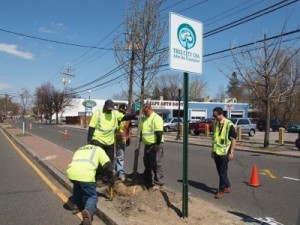
Tree City USA is an honor earned by cities and towns that meet four standards set by the Arbor Day Foundation and have their application approved the State Forester. Connecticut currently has 19 municipalities with the Tree City USA designation, which cover 31 percent of the state’s population. According to the Arbor Day Foundation, Connecticut’s longest running Tree City is Fairfield, which recently surpassed 26 years.  The largest community is Bridgeport, the smallest, by population, is Brookfieldthumb-grid-shaded-path

The four standards are having:

  • A tree board or department
  • A tree care ordinance
  • An urban forestry program with an annual budget of at least $2 per capita
  • An Arbor Day observance and proclamation

The other Tree City USA communities in Connecticut are Branford, Danbury, East Hartford, Groton, Hartford, Middletown, Monroe, New Canaan, New Haven, Norwalk, Ridgefield, Southbury, Stamford, West Haven, Wethersfield and Wilton.

Norwalk and Wethersfield, for demonstrating a higher level of tree care, have received Growth Awards from the organization.  Overall, there are 3,400 Tree City USA honorees across the country, with a combined population of more than 140 million.logo-tree-city-usa-color

Annual participation as a Tree City USA community provides the opportunity to educate people who care about their community about the value of tree resources, the importance of sustainable tree management and engage individuals and organizations in advancing tree planting and care across the urban forest.

The organization also offers on-line education courses for individuals interested in learning more about trees, or about serving in a citizen advisory role in their local community.

The Arbor Day Foundation indicates that an effective tree program can:

  • Reduce costs for energy, storm water management, and erosion control. Trees yield up to three times their cost in overall benefits to the city, averaging $273 per tree.
  • Cut energy consumption by up to 25%. Studies indicate that as few as three additional trees planted around each building in the United States could save our country $2 billion, annually, in energy costs.
  • Boost property values across your community. Properly placed trees can increase property values from 7-21% and buildings in woodedareas rent more quickly and tenants stay longer.

tree in BridgeportThe Arbor Day Foundation also has a campus program, designating colleges and universities as a Tree Campus USA.  The University of Connecticut is the only college in Connecticut to earn the designation.


The state Department of Energy and Environmental Protection's Urban Forestry Program is available to work with any community interested in exploring whether it qualifies as a Tree City USA and what is needed to earn that designation.

DEEP officials indicate that “many communities might be surprised at how close they are.”  Applications for next year's honor are due in December.  The program was initiated by the Arbor Day Foundation in 1976.

https://youtu.be/ol2_IcwaeDI


PERSPECTIVE l The Hills of Connecticut are Slippery; and So is Steering

by Bill Denya Connecticut is hilly. In fact, the western part of the state, known officially as the Western New England Upland, is characterized by steep hills and ridges. There are abrupt inclines in the central region, sharp peaks in Litchfield County, and a long drop towards the Coastal Lowlands that run along the southern shore of the state near Long Island Sound. You would be hard-pressed to drive very long without encountering significant ups and downs.

With spring rainfall, especially over last year’s dead leaves, hills can become dangerous; they often mean skidding, sliding, slipping, and occasionally crashing. That in turn leads to trips to the auto body shop to bring our vehicles back to pristine, road-worthy condition. Or not.

perspective squareThrough no fault of our own, many consumers unwittingly are directed, or steered, to specific auto body repair shops by the appraiser who inspects the damage to our vehicle, or by our automotive insurance policy holder. The rationale behind this "steering" is that we consumers are sent to places where the repairs will cost less and everyone wins.

The auto body shop will get our business, the insurance company won't have to pay out as much in damages and we policy holders may not see our rates go up as much. Great idea.

Except that far too often the reason the repairs cost less is because substandard parts are used, sometimes in conjunction with substandard workmanship. This further endangers us motorists who certainly don't want to get back out on the road only to find ourselves in another collision, this one caused by our own recently repaired vehicle.

The Connecticut Auto Body Association has successfully fought against insurance company steering for many years, and in 2010 was instrumental in convincing the state legislature to outlaw steering in Connecticut.

Nonetheless, the practice still exists in Connecticut and nationwide, and it is causing considerable concern. State Attorneys General and auto body shop owners in at least 36 states currently are pushing for anti-steering legislation nationwide. It is obvious that the current laws need stricter enforcement and new laws need to be passed.

Among those pushing for nationwide anti-steering legislation is U.S. Senator Richard Blumenthal who was a staunch proponent of Connecticut's earlier legislation. Blumenthal is so concerned about the possibility of injuries to motorists due to substandard replacement parts that he has asked the U.S. Justice Department to launch an investigation into the practice.

Blumenthal recently said that "steering often involves the use of parts that may be salvaged or inferior or even counterfeit." He added that the possibility of accident and injuries caused by such parts are "a real urgent and imminent safety concern for the consumer who may have no idea what the origin of the parts are, who made them, or even whether they're installed properly."

It is one thing to have an accident because the hills of our Connecticut can send us “slip-sliding away” in a rainstorm. It is quite another matter to cause a collision due to inferior parts and workmanship on a vehicle that we just paid to have repaired, and that we trusted to be roadworthy.

There are enough dangers on the roads, regardless of the season or weather, without adding to them by using poor quality parts.

Bill Denya is a board member and former president of the Auto Body Association of Connecticut, a statewide consumer advocacy group. He is the owner of Denya’s Auto Body in Meriden, and can be reached at (203) 237-6068.

_______________________________________________________________

CT by the Numbers publishes opinion articles of 600 words or less.  Submissions should be emailed to info@ctbythenumbers.info.  Perspectives are published at the discretion of CT by the Numbers. 


Bigelow Tea Takes On Flavor of Girl Scout Cookies

Fairfield-based Bigelow Tea, celebrating its 70th year of operation as a family-owned company, has teamed with the Girls Scouts of the USA in a licensing agreement that has put the popular Thin Mints and Caramel & Coconut cookie flavors in teas on shelves across the country. The teas are marketed as gluten free, sugar free and Kosher-certified and will be available for a limited time only, according to company officials. Bigelow produces 1.7 billion tea bags annually in 130 flavors, the company reported. Bigelow, which is privately held, employs 350 people in Fairfield; Boise, Idaho; and Louisville, Kentucky; as well as its Charleston Tea Plantation in South Carolina.

scoutsBigelow President and CEO Cindi Bigelow is a former Girl Scout. “Once a Girl Scout, always a Girl Scout,” she said in a statement. “As a proud Girl Scout alumna, our two new tea temptations reflect the Bigelow Tea blenders’ never-ending quest to delight consumers with up-to-the-minute flavor innovations in a way that’s very special to me.”

Only about 5 percent of companies nationwide have female CEOs, including Cindy Bigelow, who has been involved with the family business in one way or another since she was a teenager.  Bigelow, who represents the third generation in her family to run the business, said it's the personal touch that keeps the company successful.  The company was founded in 1945 by Cindi Bigelow's grandmother, Ruth Campbell Bigelow.

“These delicious teas are made possible by a licensing arrangement with Girl Scouts of the USA and combine the renowned flavor blending expertise of the Bigelow Tea Co. with the time-honored exciting Girl Scout Cookie flavors we all know and love,” the company said. The company-suggested price is $3.99 per 20-bag box.Cindi-Bigelow-head-shot

The Thin Mint tea “delivers the perfectly balanced mint and chocolate flavor of the Girl Scouts’ famous Thin Mints cookies” and the Caramel & Coconut tea is described as a “black tea blend offering a delectable taste combination of luscious caramel and coconut,” the company explained.

Tea has been increasing in popularity, and now ranks as the second most consumed beverage in the world, after water, according to the Tea Association of the U.S.A.  The wholesale value of tea sold in the U.S. grew from less than $2 billion in 1990 to more than $10 billion today.  Bigelow has about $150 million in annual sales, according to a company news release, but it claims 24 percent market share in the specialty teas category, making it the industry leader.

As CEO, Cindy Bigelow initiated the Annual Bigelow Tea Community Challenge that has donated over $1 million to local charities and participates in volunteer projects that include Habitat for Humanity’s Adopt-a-Home program. Under her leadership, the company was one of the first in Connecticut to install solar panels to offset energy usage, and she has implemented other innovations that have earned Bigelow Tea the distinction of being a Zero Waste to Landfill company.  Over the past several years, the company reports it has reduced our energy consumption by over 2.5 million kWh in the Fairfield plant through energy efficiency measures, resulting in a savings of over 2.7 million pounds of carbon, or the equivalent of planting 41 million trees.

As a family owned company for three generations, Bigelow Tea’s company culture includes a commitment to sustainability and fair business practices, "not only here at home but around the world.  That’s why we’re proud to be part of the Ethical Tea Partnership, an organization that works with tea growers to establish methods for responsible conservation of the world’s tea fields and improve the lives of the beautiful people who work the," the company website points out.


https://youtu.be/6xQVEtve_d4

Portions of this story originally appeared in the Fairfield County Business Journal