Hartford Area Ranked #5 Up-and-Coming City for Tech Jobs

As tech grows to increasingly  impact almost every aspect of our lives, it’s not surprising that the industry is moving beyond its traditional home of Silicon Valley and taking root in regions across the nation.  Where that growth is happening is the subject of continual scrutiny and intense interest.  Now, a new analysis indicates that among the leading up-and-coming regions for tech jobs is Connecticut's Capitol Region of Hartford-East Hartford-West Hartford, which placed fifth in a review of tech jobs by ZipRecruiter. By analyzing the hiring trends nationwide, the company has compiled a list of the Top 10 Up-and-Coming Cities for Tech Jobs.  Greater Hartford was one of two regions in New England to make the top 10 list; the other is Manchester, New Hampshire, three slots behind Hartford.  They were the only Northeast cities to earn a position on the list.region

According to the company’s website, “although it once suffered the same decline characterizing many Rust Belt cities, Hartford has diversified into the insurance, healthcare, and tech industries and exhibited positive growth as of our latest jobs report.” While noting that “the city is home to headquarters for United Technologies,” ZipRecuiter also indicated that the region “continues to attract new companies with its population of entry level job seekers from local universities and excellent quality of life.”  UTC recently announced it would be moving its headquarters from Hartford to Farmington, CT, just one town west of West Hartford.

Top 5 technology jobs, according to the analysis, in the Hartford-West Hartford-East Hartford region are:

  • Applications Engineer
  • Systems Analyst
  • Infrastructure Engineer
  • Java Developer
  • Data Architect

Top-Tech-Jobs-Overall, the top 5 up-and-coming regions for tech jobs in the U.S. were 1) Austin-Round Rock, TX, 2) Raleigh-Cary, NC, 3) Provo-Orem, UT, and 4) Fort Collins-Loveland, CO.  Also reaching the top 10 were 6) Indianapolis-Carmel, IN, 7) Boise City-Nampa, ID, 8) Manchester-Nashua, NH, 9) Nashville-Davidson-Murfreesboro-Franklin, TN and 10) Eugene-Springfield, OR.

ZipRecruiter allows small businesses, individual employers and recruiters to easily reach the right candidates and make the best hiring decisions with single-click postings to 100+ leading job networks azipnd online interview tools, all while eliminating bulky and expensive software. Founded in 2010, ZipRecruiter is a privately held company based in Santa Monica, California.


Largest Community Survey in U.S. Now Underway in Connecticut; 15,000 People to be Interviewed

The 2015 Community Wellbeing Survey is set to become the largest cross-sector community survey in the United States, interviewing 15,000 randomly-selected residents this spring and summer including individuals from every town and city in Connecticut. The initiative is creating the first-ever shared measures of quality of life, happiness, and community health across all neighborhoods, towns, regions, and the state as a whole. These interviews will reveal findings that are currently unavailable at a local level from any other public data source.

New Haven-based DataHaven is working with leaders from more than 100 statdatahavene and local government agencies, major health care and academic institutions, and community and philanthropic organizations to design and conduct the program.

The organization has combined many existing grassroots and regional efforts-including DataHaven's own 2012 Greater New Haven Wellbeing Survey-into a single, exceptionally high-quality survey covering all of Connecticut and a few adjacent sections of New York State.

Survey-takers are based at the Siena College Research Institute, a leading independent research organization near Albany with a staff of more than 100 highly-trained English- and Spanish-speaking interviewers. Calls began in April and will continue throughout the summer. (The survey calls will come from the 518 area code.)

“Our initial feedback from residents and our previous experience with this survey shows that people like to answer these questions,” says Mark Abraham, Executive Director of DataHaven, which is spearheading the campaign. “They are answering questions about their own happiness and health, their family’s financial security, and how their communities and neighborhoods are faring. These questions show that we care about how they feel.”

Seeing the potential impact of its results, dozens of Connecticut’s leading hospitals, government agencies, universities, and charities are backing the 2015 Community Wellbeing Survey with major donations. Supporters joining DataHaven include regional community foundations, United Ways, and health care providers located in Hartford, New Haven, Bridgeport, Stamford, Waterbury, New Britain, Norwalk, Danbury, Bristol, Derby, New London, and elsewhere.phone

This nationally recognized program provides neighborhood- and regional-level information not available from any other source on community vitality, health, family economic security, and individual happiness. Other topics such as civic engagement, transportation, housing,and employment – even satisfaction with government and community life – are included. The mission of the initiative is to produce the highest-quality, neighborhood-level information on issues that are most meaningful to local residents, and to foster collaboration between the hundreds of organizations, institutions, businesses, and agencies that are working to build stronger communities.

“With such a detailed snapshot, state and local community leaders will be able to better serve the health and well-being needs of our communities,” says Abraham.

Partners providing significant funding for the program are representative of each region of Connecticut:

  • In Fairfield County, $200,000 has been committed by leading organizations such as Fairfield County's Community Foundation, Bridgeport Hospital, Stamford Hospital, Greenwich Hospital, and the United Way of Coastal Fairfield County.
  • In south-central Connecticut, The Community Foundation for Greater New Haven along with Yale-New Haven Hospital, Workforce Alliance, United Way of Greater New Haven, and others have joined forces to commit over $100,000 in funding.
  • In Greater Hartford and New Britain, the program has drawn over $100,000 in support from the Hartford Foundation for Public Giving, Community Foundation of Greater New Britain, Trinity College Office of the President and Center for Urban and Global Studies, Saint Francis Hospital and Medical Center, Johnson Memorial Medical Center, and others.

wellbeingAdditionally, DataHaven has secured funding to ensure that residents of Connecticut's smaller cities and rural areas are included to the same degree as those living in its major metropolitan areas. Nearly $200,000 has been committed from organizations such as the Connecticut Community Foundation, Valley Community Foundation, Lawrence + Memorial Hospital, Ledge Light Health District, Community Foundation of Eastern Connecticut, Connecticut Housing Finance Authority, and others.

Results from the survey will be published in a series of local and statewide reports throughout late 2015 and 2016, helping to shed light on progress made toward various longstanding community priorities, including financial security for families and opportunities for children to succeed.

"We believe the 2015 Community Wellbeing Survey, the most comprehensive local level survey of its type in the United States, will be of great value to neighborhoods and organizations striving to make our cities and towns even better places to live and work,"says Abraham.

DataHaven is a non-profit organization with a 25-year history of public service to Greater New Haven and Connecticut. DataHaven’s mission is to improve quality of life by compiling, sharing, and interpreting public data for effective decision making. DataHaven is a formal partner of the National Neighborhood Indicators Partnership of the Urban Institute in Washington, DC. Last fall, the Community Indicators Consortium presented an “Impact Award”  to DataHaven’s Executive Director Mark Abraham, honoring Abraham with a trophy and opportunity to speak to the organization's annual assembly. Abraham illustrated how DataHaven and its partners across Connecticut have collected and used public data to advance community change.

 

Tolland Is CT's Youngest County as State, National Population Grow Older, Millenials Outpace Boomers

The latest estimates from the U.S. Census Bureau indicate that the nation is getting older, even as the millennials are outpacing the baby boomers.  The U.S. median age ticked up from 37.6 on July 1, 2013, to 37.7 on July 1, 2014, and each of Connecticut’s eight countries got just slightly older as well. The youngest counties in Connecticut — those with the lowest median age — were Tolland, at 38, Fairfield and New Haven, both at 39.8 and Hartford, at 40.1.  The countieages in Connecticut with the highest median age on July 1, 2014, were Litchfield at 46.3, Middlesex at 44.6 and New London at 40.9. (Median age means that half the population was older than this age and half younger.)

The Census Bureau also announced that millennials, or America’s youth born between 1982 and 2000, now number 83.1 million and represent more than one quarter of the nation’s population. Their size exceeds that of the 75.4 million baby boomers, according to newly released estimates.

Overall, millennials are more diverse than the generations that preceded them, with 44.2 percent being part of a minority race or ethnic group (that is, a group other than non-Hispanic, single-race white).  The U.S. Census examined population changes among groups by age, sex, race and Hispanic origin nationally, as well as in all states and counties, between April 1, 2010, and July 1, 2014.

Even moasdfre diverse than millennials are the youngest Americans.  The Census Bureau indicates that those younger than 5 years old became majority-minority for the first time, with 50.2 percent being part of a minority race or ethnic group, as of 2014 data. Reflecting these younger age groups, the population as a whole has become more racially and ethnically diverse in just the last decade, with the percentage minority climbing from 32.9 percent in 2004 to 37.9 percent in 2014.

Nationally, non-Hispanic, single-race whites was the largest group in 2014, at 197.9 million. Hispanics were next, with a population of 55.4 million, followed by blacks, at 45.7 million, Asians (20.3 million), American Indians and Alaska Natives (6.5 million) and Native Hawaiians and Other Pacific Islanders (1.5 million).Census_Bureau_seal

In Connecticut, the populations of each group were as follows:

Non-Hispanic single-race

  • whites 2,475,371

Race alone or in combination groups

  • Hispanics -  541,152
  • Blacks - 461,437
  • Asians - 184,332
  • American Indians and Alaska Natives - 40,267
  • Native Hawaiians and Other Pacific Islanders - 7,779

Five states or equivalents were majority-minority: Hawaii (77.0 percent), the District of Columbia (64.2 percent), California (61.5 percent), New Mexico (61.1 percent) and Texas (56.5 percent). Among the remaining states, Nevada is the closest to crossing this threshold, with a population 48.5 percent minority. More than 11 percent (364) of the nation’s 3,142 counties were majority-minority in 2014.

The nation’s 65-and-older population grew from 44.7 million in 2013 to 46.2 million in 2014. This group, which now contains the oldest four years of the baby boom generation (born between 1946 and 1964), is 21.7 percent minority, less diverse than younger age groups.

In contrast to most states, including Connecticut, where the population got older, five states experienced a decline in median age between July 1, 2013, and July 1, 2014: North Dakota, Hawaii, Montana, Wyoming and Iowa. Maine experienced the largest increase in median age among states, rising from 43.9 to 44.2 over the period.

There were only 10 states where males made up a majority of the population in 2014. Alaska had the highest male percentage (52.6 percent), followed by North Dakota (51.3 percent).

PERSPECTIVE l Time, Talent, Treasure, Testimony – The Ideal Attributes of a Volunteer Board Member

by Peter F. Eder More than five hundred not-for-profit boards are operational in Connecticut.  Over the past century, not-for-profit organizations have played a vital and often times critical role in delivering services and support to folks in need.

A considerable body of knowledge – case histories, seminars, publications, expert presentations – and individuals and organizations expert in the field help create, sustain, enhance and measure such organizations performances.

perspective squareAs a volunteer Board member of several organizations over the past three decades, I would like to reflect on what I perceive provides the most effective volunteer support of a not-for-profit organization.  There are four attributes … time, talent, treasure, testimony.

Time

Volunteers must be able to make a firm commitment of time to Board service.  Ideally over the course of a three year period, they should invest enough time to first understand the organization’s mission and objectives, the community environment, the social, political, economic issues.  There should be a time commitment not only to “do things” (activities assigned by the Director and the Board), but also to learn and reflect on the Board’s plans, its actions and consequences.

Talent

Volunteers should have an array of skills that can be used to supplement and enhance the organizations objectives.  Expertize should be employed to train and mentor others, to tackle special issues or to improve ongoing practices.  A mix of talent should be recruited, including individuals from the community or cause being served.  This is particularly important since it will provide very real and current insights into needs, attitudes and available resources in the community being served.

Talent should not necessarily be used as a way to replace operational tasks on a day-to-day business, or to second guess or override any paid staff members.  Rather, talent should be used to enhance and enrich efforts.

Treasure

Volunteer board members should be a source of financial support and provide a revenue base for the organization.  This is to set an example of commitment both within the Board and the community, to underwrite special events or needs, to cover revenue gaps and to provide a source for covering emergencies.  Those volunteers who are capable of sizeable donations, should be willing to reach out and solicit potentially generous family and friends to do likewise.quote

Testimony

Volunteers should be able to speak and write with conviction, passion and knowledge about the mission and the objectives of the organization.  It should be done on a daily basis in the community, on public and private platforms.  This should be done face-to-face, online in the form of message boards, perhaps Facebook, tweets or twitters, community TV stations, newspapers or online daily newspapers.  A volunteer, speaking with certainty and compassion can animate the cause.  In these days of media fragmentation and multiplication, spreading the word is vital.

Conclusion

It is the rare individual volunteer who will possess all four of these attributes.  Typically, human nature will provide some with several of these assets or perhaps just one of them.  In the identification and recruitment of volunteer board members, the need for these traits should be decided on and spoken about with the candidates, so that there is a clear understanding and comfort level about the expected responsibilities.

The nominating committee and the organization’s leader should be upfront and explicit about the expectations, and also about the rewards that will accrue to the volunteer.  Because we know of course, that one of the truly great rewards of volunteering is that it gives back more to the volunteer, than that individual will ever initially envision.

Peter F. Eder is a retired marketing executive, AARP Connecticut community volunteer and a founding member of At Home In Darien, his community aging-in-place organization.

_________________________________________________________

CT by the Numbers publishes opinion articles of 600 words or less.  Submissions should be emailed to info@ctbythenumbers.info.  Perspectives are published at the discretion of CT by the Numbers. 

Performing Marriage Ceremonies: CT and MA Present Very Different Choices

Getting married in Connecticut or Massachusetts are two vastly different experiences – especially when it comes to who can legally perform the ceremony.  Massachusetts – many options.  Connecticut – not so much. A Connecticut Justice of the Peace may perform a marriage anywhere in the state. That’s where the flexibility ends.  So-called Internet Ministers are not authorized to perform marriage ceremonies in Connecticut. JPs from other states are not recognized in Connecticut. Nor does the state offer ordinary citizens authorization to perform a specific ceremony.

In neighboring Massachusetts, ordinary citizens – such as the couple’s best friend – can legally perform the wedding ceremony.  And the number of people doing just that is growing rapidly, an analysis by the Boston Globe illustrated recently.officiant

Across the state, the one-day marriage designation, which grants non-clergy the right to officiate at a wedding and sign a marriage license, is growing in popularity. The annual number of applications more than doubled from 2008 to 2014, according to records obtained by the Globe and MuckRock.com.

Last year, 5,083 people applied for the designation to perform weddings in 322 of the state’s 351 municipalities, the records showed. In Boston alone, one-day officiants married more than 600 couples that year, the Globe reported.

The state of Massachusetts has received just shy of 2,000 applications so far this year, the governor’s office indicated to the Globe. To obtain the one-day marriage designation, applicants submit a form, a letter of recommendation, and $25 to the governor’s office. The location of the wedding must be in Massachusetts, though neither the couple nor the officiant have to be residents.

For many couples, the one-day designation offers a secular way to celebrate a marriage. One-fifth of the U.S. public — and about a third of people under 30 — do not have a religious affiliation, the highest percentage on record, according to the Pew Research Center, the Globe reported.

Connecticut General Stautes (Sec.46b-22) governs who may join persons in marriage in Connecticut:wedding

  • all judges and retired judges, either elected or appointed and including federal judges and judges of other states who may legally join persons in marriage in their jurisdictions
  • family support magistrates
  • state referees
  • justices of the peace may join persons in marriage in any town in the state
  • all ordained or licensed clergymen, belonging to this state or any other state, so long as they continue in the work of the ministry

In Connecticut, many weddings are performed by justices of the peace, and there are no special requirements to become a justice of the peace.  However, the process is controlled by the local towns (town clerks) and the political parties.  Each town sets aside one-third of the total allotted number to each major political party, Democrats and Republicans, and to minor parties and unaffiliated.  The parties decide the rules for appointments with the Independents governed by the town clerk.  The term is for four (4) years and coincides with presidential elections with the office beginning January 1.  In addition, “all marriages solemnized according to the forms and usages of any religious denomination in this state,” according to the CT Business Response Center website.  All marriages attempted to be celebrated by any other person are void, the state website emphasizes.

Regarding Connecticut weddings, private websites also warn against internet ordinations or other creative ideas.  “You are strongly cautioned that Connecticut has cracked down on people getting "ordained" via the Internet. Such "ordinations" are not valid in Connecticut. Marriages performed without the proper legal authority are not valid,” indicates the website nutmegjp.  Connecticut law does not set the fees that Justices of the Peace may charge for their services.

Different Shelf Positions Prompt Different Types of Thinking, Buying by Consumers

If you ever wondered why store shelves are stocked as they are, or whether the location of various items impacts which ones make it into your shopping cart, new academic research is providing some answers. It turns out that looking up and looking down to survey store shelves can influence your purchasing decisions. When people have to look downward to see a product, their thinking becomes more concrete; when they have to look upward, it becomes more abstract, according to a research team led by Anneleen van Kerckhove, a researcher at Ghent University in Belgium.

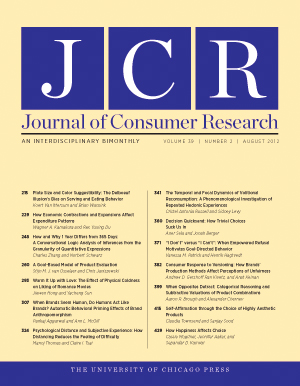
JCR new coverAbstract processing has several effects on consumers, such as increasing their willingness to pay. The presumed source of the effect is that people are accustomed to looking downward to process nearby, concrete information and upward to absorb distant, more-abstract information, the researchers say.

Knowing how looking up or down impacts consumers can help businesses manage product displays. A product placed on a low shelf in a store may be evaluated in terms of specific features, cost, or the likelihood that the product will deliver on its promises. On the other hand, a product placed on a high shelf is more likely to be evaluated in terms of the general purpose it serves.

The research020, “The Floor Is Nearer than the Sky: How Looking Up or Down Affects Construal Level,” is published in the April 2015 edition of the Journal of Consumer Research.

“Consumers pay attention to different aspects of products depending on whether they are looking down or up when choosing between available products. People are used to paying detailed attention when looking down because everything that happens close to them could be important or dangerous. However, people are more likely to think about the big picture when looking up because they are used to looking at things from more of a distance (to get the full picture),” the researchers, Anneleen Van Kerckhove, Maggie Geuens, and Iris Vermeir, conclude.

Ghent University is one of the major Belgian universities with over 41,000 students and 9,000 employees.  It was founded in1817, current faculty conduct in-depth research in both exact and social sciences.

stocked shelvesA year ago, the website BizShifts-Trends pointed out that “Some of the hottest real estate in the country these days is on retail store shelves. Shelf space allocation is a serious issue in retail business. It’s an important tool for attracting customers’ attention, but getting a product on the shelf is no guarantee that it will sell.”   The website also noted that “most vendors are willing to pay significant premiums to obtain preferred retail locations on both a promotional and everyday basis.”

In addition, the website Real Results magazine reports that “Paired with growing private-label popularity, manufacturers are realizing that they must quickly differentiate themselves from their closest competitors by becoming more consumer centric at the shelf level.”

Now research suggests that the difference between looking up and looking down can also impact the chance of products moving off the shelf and into the grocery cart.

Business Conferences Seek to Help Businesses Stay and Grow in CT

As Connecticut’s overall policy attitude toward business growth and development continues to be the center of attention as legislators contemplate revisions to the recently passed state budget, a renewed effort to help businesses get underway this week. Employers interested in learning more about hiring incentives, tax credits, job creation programs, creating a business plan, opportunities for women and minority owned business, obtaining low interest financing and other opportunities are being asked to attend one of a series of workshops being offered this month and in September, at locations around the state.step up

The state Department of Labor and other agencies  are offering free Regional Step Up Conferences.  Online registration is now open for the three events in June. While there is no admission to the conferences, interested businesses are asked to complete the pre-registration form on the website.  The conferences are designed for local businesspeople to see how state and federal resources can help achieve business success.

The first conference will be on Tuesday, June 23 at Naugatuck Valley Community College (Fine Arts Center Lever Atrium-Main Stage Theatre), 750 Chase Parkway, Waterbury, 8:00 – 10:30 AM (light refreshments begin at 7 AM).  Tuesday’s conference will also offer tours of the college’s Advanced Manufacturing Center.

In addition to the Waterbury conference, this week will see Step-Up conferences in Stamford on June 24 and Shelton on June 30.  The conferences resume in the fall, with scheduled sessions in Middletown on September 9, New Haven on September 15, New Milford on September 17, Hampton on September 22 and Bridgeport on September 24, according to the state Department of Labor website.

The events are also sponsored by Governor Dannel P. Malloy and Lt. Governor Nancy Wyman, Secretary of the State Denise Merrill, the Connecticut Department of Labor, the Department of Economic & Community Development and a range of community partners, including Chambers of Commerce, local community colleges, business and manufacturing associations, workforce and community organizations, local legislators and organizations work with the African-American and Latino communities.

This free event will provide valuable information on how companies can take part in the state’s Subsidized Training and Employment (Step Up) programs, Small Business Express, tax incentives, tax credits and more.  Among the topics highlighted are:wby

  • Wage reimbursement & training incentives (Subsidized Training and Employment Program Step Up) and Veterans Step Up that reimburse your company up to $12,500 for new hires
  • Low Interest financing under the Small Business Express Program
  • How to find and recruit new and qualified employees, including veterans
  • Tax incentives for equipment upgrades and job creation
  • How to become a State of Connecticut vendor
  • Free business plan, marketing analysis
  • Incumbent Worker Training programs to develop your workforce
  • How apprenticeship programs can assist the trades and manufacturing sectors

CT Ranks 35th in Economic Clout of Women-Owned Businesses; Growth Rate Ranks 43rd

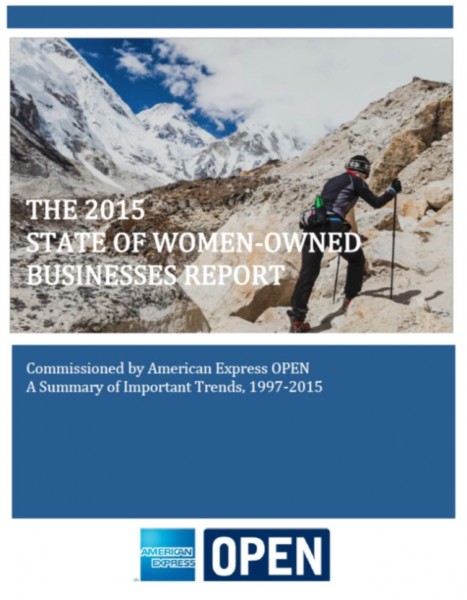
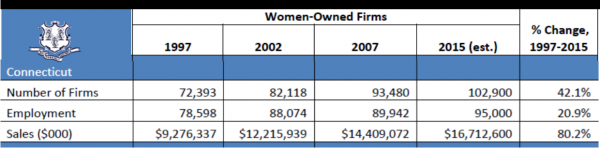
According to the latest State of Women-Owned Businesses Report, women-owned firms in the U.S. now make up 30 percent of all businesses -- and they're generating about $1.5 trillion in revenue, an increase of 79 percent since 1997.  Connecticut, however, ranks 43rd in the nation in the percentage of growth, below the national average, at 42.1 percent.  The state also ranks 28th in percentage of revenue growth of women-owned businesses, and 22nd in the growth of employment levels in women-owned businesses.  Overall, Connecticut ranks 35th in the nation in the combined "economic clout" ranking of women-owned businesses, considering growth in the number of firms, revenues and employment during the past two decades.report cover The newly released report, looking back at the past two decades, found that women-owned firms are found in every state and in every industry:
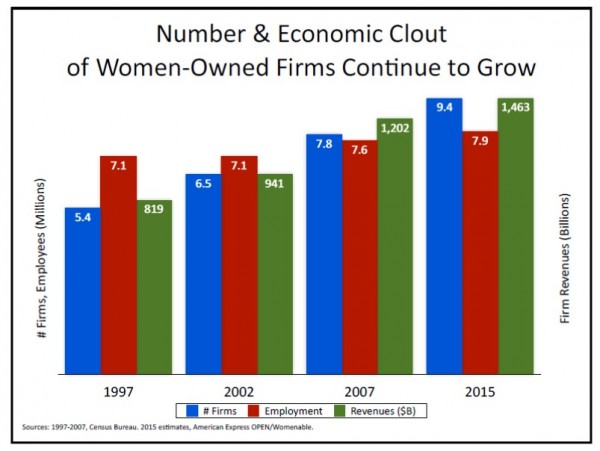
  • The number of women-owned firms in the U.S. continues to climb, and is now estimated to have surpassed 9.4 million enterprises—30 percent of all businesses in the country;
  • Women-owned firms now employ over 7.9 million workers (excluding owners), providing one in seven jobs among privately-owned businesses.
  • The fastest growing industry sector is educational services, which has seen a 67% increase in the number of women-owned firms since 2007 versus an overall 21% increase.

A study by American Express OPEN using U.S. Census data found the number of women-owned businesses has grown dramatically since 1997.  Since that year there have been an average of 608 net new women-owned firms launched each and every day across the nation—and the rate just over the past year stands at 887 per day. The number of women-owned firms is increasing at a rate 1.5 times the national average.

Connecticut has nearly 103,000 women-owned businesses employing 95,000 people and generating approximately $16.7 billion in sales, according to data outlined in the report.  Picture4

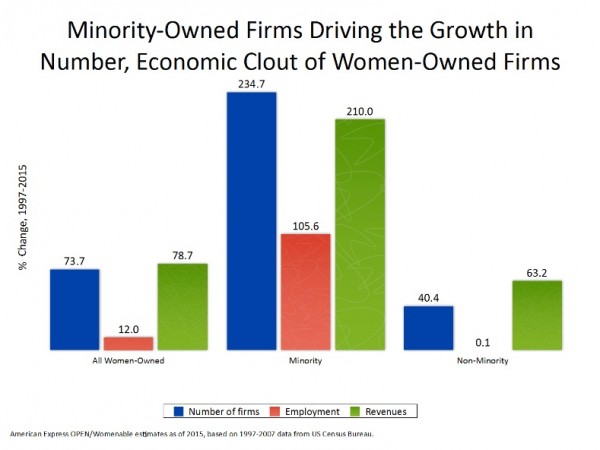
Nationally, the number of women-owned firms has increased by 74 percent since 1997. The states with the fastest growth in the number of women owned firms over the past 18 years are: Georgia (up 132%), Texas (116%), North Carolina (98%), North Dakota (89%) and New York (89%). The top ten states for women-owned firms, in terms of growth in number and economic clout, are North Dakota, Wyoming, D.C., Arizona, Georgia, Nevada, Maryland, Texas, Utah and Hawaii.  The states at the bottom of the list are Iowa, Rhode Island, Maine, Vermont and Ohio.

In 1997, there were just under 1 million (929,445) firms owned by minority women, accounting for one in six (17%) women-owned firms.  That number has skyrocketed to an estimated 3,111,300 as of 2015, now comprising one in three (33%) women--‐owned firms. These 3.1 million multicultural women--‐owned firms employ 1.6 million workers in addition to the owner and generate an estimated $268 Billion in revenues.women owned firms

The industries with the highest concentration of women-owned firms are healthcare and social assistance (53 percent of firms in this sector are women-owned, compared to a 30 percent share overall), educational services (45 percent), other services (42 percent), and administrative support and waste management services (37 percent).

In the mid-west, Illinois ranks 19th nationally with 68 percent growth in the number of female business owners over the last 18 years, while Indiana placed 45th nationwide with 37.7 percent growth (somewhat below Connecticut's ranking).  New Jersey ranked 25th for growth in the number of women-owned businesses, with a 58.3 percent growth rate between 1997 and 2015, and 40th for growth in revenue, at 58.2 percent.

The report also found that the number of minority women who own businesses has grown significantly. In 1997, minority women owned 17 percent of women-owned firms in the United States. Today, minority women own 33 percent of the nation's 9.4 million women-owned companies. African-American women own 1.3 million businesses and Latinas own 1.1 million companies.swob-report-weeks-openforum-embed1

The report points out that "the only bright spot in recent years with respect to privately-held company job growth has been among women-owned firms.  They have added an estimated 340,000 jobs since 2007.  Among men-owned and equally-owned firms, employment has declined over the past eight years."

The study also found that start-up activity among women is on the rise, as the daily rate of net new women-owned firms was 602 in 2011-12, 744 in 2012-13, 1,288 in 2013-14 and this past year was 887 net new women-owned firms per day - all higher than the overall 554 per day over the entire 2007-15 period, according to the report.

Among the 484 net new minority-owned firms per day last year were 223 African-American women-owned firms, 168 Latina-owned firms and 105 Asian American owned firms started each day in 2014.


PERSPECTIVE l Put Aside the Shallowness, Hollowness of Self

by M. Jodi Rell A few words as we send you on your way to the rest of your life. A list of do's and don'ts, if you will.

Do continue your learning. Get an advanced degree. It's almost mandatory these days. Take a couple of years off if you need to, but go back and get a master’s degree or higher. Do it not just for a better job but for a better mind.

Whether you go back or not, keep learning. Keep asking questions. Keep finding out why. Demand to know why not. Expand your experiences and your minds. Let intellectual curiosity be your constant companion.PageLines- CTperspective.jpg

Do keep every door open to yourselves. Never say never. Always try something new — a new idea, a new place, new travel, new friends, new opportunities. This girl from Norfolk, Virginia, never would have guessed she would be the governor of Connecticut one day. But I left every door open — and look where it led me.

Don't let fear guide you. Don't let failure stop you.

This is your moment. Take it. Own it. Master it. Make the most of it.

Trust me, you really can change the world. And we need you to change it, because our world is changing in so many ways, and at WARP speed.

Our economy, the job market, technology, education, health care — all are evolving, advancing every day.

Frankly the pace of change is breathtaking. Yes, breathtaking and challenging. But nobody is better prepared, better equipped to rise to the challenge.

quote block RellDo remember to always treat those around you with respect, compassion and kindness. Don't let the size of your paycheck be the measure of your success. Rather let it be how well you treat others and what kind of difference you make.

Do remember to say thank you. And you can start today by thanking your parents, your advisers, your professors — all those who helped you to get to this day.

Do work hard. Play hard. And love harder.

It's not just about a job or a job title. Yes a good, satisfying, rewarding job is important. But far, far more important is grabbing and enjoying life and building a family whom you love and who loves you.

Participate in your community. Volunteer. Contribute. Put aside the shallowness, hollowness of self. Embrace and elevate others.

Think about the person you love the most. Admire the most. Think about why. And then do. Do as they do.

Oh, I envy each one of you. You are on the precipice of a whole new beginning. The canvas of your life is mostly blank, waiting now for you to fill it in with flourish and flair. With broad strokes and fine lines. With love and laughter.

This is your moment. Take it. Own it. Master it. Make the most of it. You are the sons and daughters of Connecticut. We are all so proud of you.

M. Jodi Rell of Brookfield was Governor of Connecticut, 2004-2011, after serving as Lieutenant Governor and State Representative. These remarks are excerpted from the commencement address delivered to undergraduates at Western Connecticut State University on May 10, 2015.

_________________________________________________________

CT by the Numbers publishes opinion articles of 600 words or less.  Submissions should be emailed to info@ctbythenumbers.info.  Perspectives are published at the discretion of CT by the Numbers. 

Smith, Johnson and Brown are Connecticut’s Most Popular Last Names

The top surname in Connecticut and the United States is Smith.  The next most popular are Johnson and Brown.  Brown is most common in California, Nevada and the Northeast, and ranks 4th nationally, according to data compiled from the Social Security Administration by the website MooseRoots. Williams is 6th in Connecticut, but the third most popular in the nation.  Jones is 7th in Connecticut and 5th ranked nationally.  Miller, which is most popular in the Pacific Northwest and across the Rust Belt, ranks 6th in the nation but 5th in Connecticut.d13e63f8-33d1-4650-8cbc-8210d5ba55a1CT names

The website points out that “baby name trends can change wildly from generation to generation, but last names tend to stick around. Still, immigration, birth rates and geography can all have an effect on the overall ranking, which can shift from decade to decade.”

Smith’s popularity is unmatched: the name is the most prevalent in a majority of US states, only slightly less popular in New Mexico and some northern states.  Johnson’s US popularity can be split into three regions: less popular in the East, more popular in the West, and especially popular in the North, according to the website’s analysis. Most popular in the Southeast, Williams is notable for being more evenly split between whites and blacks.

While Davis is a predominantly white name, nearly one third of Americans with the name identify as black.  Davis ranks 7th nationally, and 9th in Connecticut.  The Nutmeg State’s 4th most popular last name is Anderson, which ranks at #12 in the U.S.  Anderson is described as “a distinctly northern name, most popular among states like Montana, North Dakota, Sodavisuth Dakota, Wisconsin, and Minnesota, where it ranks 2nd.  Anderson also ranks high in Massachusetts and Rhode Island, at #6.

The top Hispanic surname nationally is Garcia, ranked at #8.  In Connecticut, Garcia ranks #317 among last names of state residents, according to the data.  It is directly followed by Rodriguez, ranking #9 in the U.S. and #114 in Connecticut.  Over 90 percent of individuals with a last name of Rodriguez identify as Hispanic. The name is most popular in large states such as New York and Florida, as well as across the entire Southwest.

smithThe #10 surname in the U.S. is Wilson, which is described as having “a checkerboard-like popularity across the United States.”  In Connecticut, Wilson ranks as the 13th most popular last name.

In Connecticut, the 11th most popular last name is White, which ranks #20 among the nation’s population.  While White is predominantly a Caucasian surname, the website points out, it is still reasonably common among blacks. Geographically, the name is most popular in the Northeast, particularly among the New England states.  White ranks as #6 in Maine and New Hampshire, #8 in Vermont, #7 in Massachusetts and #10 in New York  The only other states where White is a top-10 surname are Missouri (#10) and West Virginia (#9).  In addition to Connecticut, White ranks at #11 in Mississippi.

The MooseRoots website “combines historical records with relevant supporting information to provide unique insights into your family's past.”  It is operated by FindTheBest, a technology company focused on collecting and interpreting data.