Pratt & Whitney’s Caitlin Oswald Among Most Creative in U.S. Business for Propelling Jet Innovation

Pratt & Whitney additive manufacturing project manager Caitlin Oswald is one of the “100 Most Creative People in Business for 2015,” in a list compiled by Fast Company magazine featuring business and industry leaders well known – and some relatively obscure - from across the globe. The elite international list of scientists, fashion designers, app developers, architects and others from Nike, Evernote, IBM and Pepsico  and other well-known organizations are among those that Fast Company, the oft-cited media voice for innovation in business, keeps an eye on for the latest in technology and business models that have the potential to change the world.caitlin oswald photo
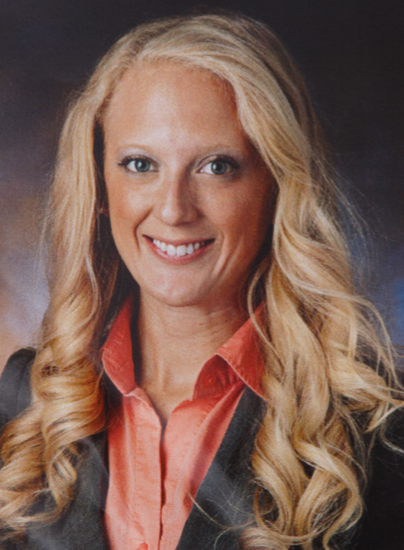
Oswald was recognized for her work in additive manufacturing, or "3D printing," especially as it has been applied to Pratt & Whitney's PurePower® Geared Turbofan™ (GTF) engine platform. She is credited with leading a team that incorporated additive manufacturing, specifically electron beam melting, through the development process and helping engineers approach challenges in a new way, according to the publication.sidebar-mcp-2015
As Fast Company explained Oswald’s business leadership:  “When a new fleet of Airbus regional jets take off later this year, they will feature something new under their wings: geared turbofan engines. Possibly the most sustainable jet engine ever built, the GTF will use 16 percent less fuel and significantly reduce CO2 emissions—a breakthrough that was only possible via advances in 3-D–printing technology.”

The publication indicated that “Caitlin Oswald led the team that incorporated 3-D printing into the design process, looking at each part of a jet engine to determine if it could be better developed with the new technique. As a result, engineers were able to approach challenges in a completely different way.”

"They’re able to print a part to scale and hold it in their hand," Oswald told Fast Company. "They can really understand what it looks like and what the capabilities and limitations are."

Added Oswald, a Design and Applied Technology Manager at Pratt & Whitney:  “This concept of additive manufacturing is this big, scary concept out there. Some people can take it and they look at it like it's the best thing since sliced bread and they're going to use it everywhere and let's forge ahead. Then there's the other side who thinks it's too risky; it's just a fad that's never going to gain any ground. My job is in this sweet spot where I'm able to take this big, scary concept and break it out into many bite-sized chunks.”

Pratt_&_WhitneyThe Fast Company top 10 include:  Charles Arntzen of Arizona State University’s Center for Infectious Diseases and Vaccinology; Rajan Anandan, Google’s Vice President and Managing Director for India and Southest Asia; Dao Nguyen, publisher of Buzzfeed; Maria Claudia Lacouture, president of ProColombia; Jens Bergensten, lead creative designer for Minecraft; and Leslie Dewan, CEO of Transatomic Power.

Oswald ranked #30 on the list, between Barbara Bush and Tracy Young.  Bush, the daughter of former President George W. Bush, is co-founder and CEO of Global Health Corps.  Young is co-founder of PlanGrid, which developed a software product allows a large team to share a master set of blueprints, so that each team member can add their own markings and see their changes reflected in real time.FCLA
The magazine’s awards were presented to the Most Creative People in Business recipients at a Fast Company conference in Los Angeles recently. Said Oswald of the experience: “What I really enjoyed was learning about how people use their passion for creativity to drive their goals."

Read the Fast Company profile of Caitlin Oswald


Leadership Greater Hartford Connects More Than 400 Volunteers with Nonprofit Board Service

In just over six years, more than 400 people in the Greater Hartford area have joined the board of directors of local nonprofit organizations, through an innovative matching program run by Leadership Greater Hartford.  The program has proven both popular and successful, and is seen as a win-win for the nonprofit organization in need of expertise and individuals looking for ways to contribute to the well-being of the community. The Leaders on Board program has matched 404 individuals – from young professionals to retirees - with more than 100 nonprofit organizations since January 2009.  The program attracts individuals with an interest in serving on a board, and looking to develop their leadership skills and serve the community.  Potential board members receive training in nonprofit organizational structure and management, are introduced to the role and responsibilities of board members and are encouraged to explore their own individual skills. The training session provides the foundation for effective board service. LOB no Express Logo 34

Leaders on Board, unique in Connecticut and perhaps the largest initiative of its kind in the region, provides a critical connection for nonprofit organizations who are looking for board members that have been trained in the basics of board membership and have expressed an interest in serving on a nonprofit board.  In some cases, individuals’ employers encourage such community activism, in others, the person is seeking to give back to the community or broader their involvement in issues that are of particular interest.  Corporations and businesses participate in the Leaders on Board program by offering board governance training to encourage their employees who are interested in serving the community.

The program works in a round-robin matching session, where representatives of nonprofit organizations conduct brief one-on-one interviews.  At the end of the session, both the individual and the organizations indicate where they think there might be a match.  If there’s agreement, there are further follow-up conversations to determine if selection to a specific board should go forward.  Often, the answer is yes.

“I decided to participate in leaders on Board because I was looking for a way to become a board member on a local, small to medium-sized nonprofit organization," explained Bill Valentine, Donor Relations Manager, United Way of Central and Northeastern CT. "Leaders on Board is the ideal way to learn the basic information about the responsibilities of being a board member and to learn about the organizations that are looking for new board members.”

At times, prospective board members learn of nonprofit organizations they had not been aware of or knew little about.  For people new to the region, and even those who have spent a career in Greater Hartford, the variety of nonprofit organizations, and they work they pursue with various populations, can be eye-opening.  The list of organizations that have placed members on boards through the Express Match process is quite impressive – a who’s who of community organizations.logo_block

In 2013, the Association of Leadership Programs, a national organization with affiliates across the country, presented Leadership Greater Hartford with its first “Excellence in Innovation” award for the implementation and success of the Leaders on Board program.  Recent years have also seen greater diversity among prospective board members, and interest by nonprofit organizations in having boards that more closely reflect the diversity of the community they serve.

"I had been considering pursuing board membership for a few years when The Junior League of Hartford offered its members a chance to participate in Leaders on Board," recalled Patricia Sasser, Dean of Students at Loomis Chaffee.  "The Leaders on Board orientation provided great information on what a prospective board member needs to know about board service; it definitely set me up for success.  I felt prepared and excited when I attend my first Leaders on Board Express Match. Having a chance to speak with different organizations about their mission and purpose opened my eyes to all the different types of organizations I could support. I found several that really spoke to my heart and was excited when I was matched with an organization I admired."

Among those who have recently accepted board of directors positions, following the most recent Leaders on Board session:

  • Ann Means - Hartford Preservation Alliance
  • Chris Whelan - First Choice Health Centers
  • Sue Murphy & George Montowski - Hebrew Health Care
  • Nancy Frede - Hartford Knights Youth Foundation
  • Jessica Dansereau & Veda White - Lupus Foundation of America - CT Chapter
  • Veda White - Trinity Academy
  • Michael Fournier, Richard Moriarty and Patrick Garrity - Kinsella Arts, Inc.
  • Chris Thomas - Mental Health Association of CT
  • Jim Barrett - St. Philip House
  • Bernard Jenkins, Meri Horowitz and Gary Brochu - Coram Deo Recovery, Inc.
  • Richard Moriarty and Patrick Garrity - Kinsella Arts, Inc.
  • Karen Adamson, Maia Brooks, and Anthony Viggiano - Project Genesis
  • Aaron Clay and Jasmine Baten - West Hartford YMCA

Leaders on Board operates with support from the Hartford Foundation for Public Giving.  For more information, contact Mae Ryan Maloney at 860.951.6161 x1900 or email Mae.Maloney@leadershipgh.org. The mission of Leadership Greater Hartford is to develop, connect and inspire diverse leaders to build strong and vibrant communities.

https://youtu.be/vuXF7lKGuew

New Partners, Speakers Add to Momentum for Digital Citizenship Summit in CT

Billed as “a national gathering of the leading thinkers in the digital citizenship community,” plans are rapidly developing for the Digital Citizenship Summit to be held in Connecticut at the University of Saint Joseph (USJ) in West Hartford in October. Organizers have announced four new national partners, the National Association for Media Literacy Education, Common Sense Education, Media Literacy Now and Cyberwise, and added additional speakers to an impressive roster of experts from around the country.  Signing on as partners for the Summit:digcitsummitlogo

  • The National Association for Media Literacy Education (NAMLE) is a New Jersey-based national membership organization dedicated to advancing the field of media literacy education in the United States. NAMLE members “weave a diverse network of people and organizations committed to advancing media literacy education as a new vision of literacy for the 21st century.”
  • Cyberwise is described as “the go-to learning source for adults who want to help kids use technology safely and wisely.” The organization helps parents and educators understand online safety, privacy, digital citizenship.”
  • Common Sense Education, based in San Francisco, is dedicated to helping kids thrive in a world of media and technology, “empowering parents, teachers, and policymakers by providing unbiased information to help them harness the power of media and technology.”
  • Media Literacy Now provides policy and advocacy information, expertise, and resources to develop state laws to implement media literacy education in schools.

The aim of the Digital Citizenship Summit, to be held on October 3, is to create positive, practical solutions along with amplifying the overall message of improving tech usage. Topics for the all-day Summit include digital literacy, etiquette, wellness, security, and law. The term “digital citizenship” describes appropriate, responsible tech and Internet use. Similar to the rights and responsibilities involved in being a citizen, there are legal and ethical obligations with being a digital citizen, notes co-organizer David Ryan Polgar, a tech ethicist and digital lifestyle expert from West Hartford.

"The Digital Citizenship Summit is striking a nerve nationwide. There is a tremendous level of enthusiasm to collectively work towards better tech use standards,” Polgar explained.  “What the Summit is doing is bringing all of those voices together and amplifying the message. It has been gratifying to see the level of support so far, and we're proud that Connecticut is playing such an integral role in shaping the national conversation concerning digital citizenship."namle-web-logo2015

Registration for the day-long Summit has recently opened, and organizers are anticipating the limited capacity will sell out quickly.  Already, attendees and participants from Florida to California have signed on.  The organizing committee includes Polgar, Marlialice B.F.X. Curran, an Associate Professor at USJ, and JoAnn Freiberg, an educational consultant with the Connecticut Department of Education.

Speakers added recently include Janell Burley Hofman, an author, speaker and consultant on topics including technology, media, health, relationships and personal growth.  Janell is the author of the book, iRules: What Every Tech-Healthy Family Needs to Know About Selfies, Sexting, Gaming and Growing Up. She has also presented at TEDx San Diego with a talk titled “Parenting in the Screen Age.” Janell is an essayist and contributor to the Huffington Post, and a contributor to APR’s Marketplace Tech. CYBERWISE-logo-300x81

Also added to the speaker roster is Tanya Avrith, the Lead Pedagogical Consultant at Amplified IT. She is a Google Certified Teacher, Apple Distinguished Educator and holds a M.A. in Educational Technology.  She previously served as the Lead Educational Technology and Digital Citizenship Teacher at the Lester B. Pearson School Board in Montreal, Canada. While there she was instrumental in the vision and execution of the district wide Digital Citizenship Program (dcp.lbpsb.qc.ca) leading to her being invited to Facebook to discuss Digital Citizenship Education.comon sense

Speakers at the October event also include Reuben Loewy, Founder and Director of Living Online Lab, a nonprofit organization dedicated to preparing students to be informed, critical and active participants in our digital society, and Denise Lisi DeRosa, Program Manager for the Family Online Safety Institute. She is dedicated to empowering families with the tools needed to embrace the current social and digital technologies in meaningful, creative and positive ways.1391787304Media-Literacy-Now-Logo

The University of Saint Joseph, which will host the Summit, has offered two digital citizenship courses since 2010, created and taught by Dr. Curran, an Associate Professor in the School of Education. Curran and Tracy Mercier, a consultant for Responsive Classroom and a graduate of the University of Saint Joseph, co-founded the first digital citizenship #digcit chat on Twitter.

Transportation Seen As Key for Growing Senior Population in CT

Connecticut is the 7th oldest state in the nation with the 3rd longest-lived average life expectancy, at 80.8 years.  Transportation is “the vital link,” according to a new report, “that connects residents across the lifespan with their communities and the elements of a vibrant and engaged life.”  By 2025, at least 20 percent of the population in every Connecticut town (except Mansfield and New Haven) will be age 65 or older, according to projections. As the state considers a range of transportation options – all carrying considerable price-tags – the impact of various alternatives on the state’s fast-growing senior population was the focus of a statewide survey and report led by the Connecticut’s Legislative Commission on Aging.47 8

The Commission’s Transportation Policy Brief, issued last month, was prepared in partnership with the Connecticut Chapter of the American Planning Association and the Capitol Region Council of Governments. Among the key findings:

  • Connecticut’s older adults are currently more likely than any other age group to rely on their cars as their primary form of transportation. Currently, 82% of all Connecticut adults use their cars as their primary form of transportation, versus 92% of adults age 50 and older.
  • However, Connecticut residents want to become less car-dependent. Compared to today (82%), 10% fewer Connecticut adults (72%) plan to use their cars as their primary form of transportation in the future. Moreover, 47% of Connecticut adults reported currently living in a suburb where most people drive to most places, but only 8% of Connecticut adults want to live there in the future.bike

The report calls for the state and municipalities to create environments that promote equity, environmental sustainability and support healthier lifestyles for everyone; retrofitting car-dominated infrastructure for the safety of all users; rebuilding the street as a public space for social experience; supporting economic activity, and sustaining, coordinating and growing both fixed route and demand-responsive transportation options.

Connecticut residents, especially older residents, are looking for transportation alternatives, according to the online survey conducted for the Commission this year by the Harris Poll:

  • Connecticut residents intend to use public transit more in the future, especially older adults. Among adults 66 years of age and older, more (12 percentage point increase) plan to use the bus as their primary form of transportation in the future (14%), compared to today (2%).
  • More Connecticut residents plan to bike in the future, with the highest increases for the 50-65-year-old age group (13 percentage point increase) and 66 years and older age group (9 percentage point increase).
  • Creating a more walkable infrastructure is a top priority for Connecticut residents, second only to maintaining existing transportation systems (41%). Among new public investments, the strongest demand by Connecticut residents is for new sidewalks and pedestrians crossings (38%).

The survey also found that as economic uncertainty continues, 43% of Connecticut adults identified keeping transportation costs low to be a high priority.  The survey found that 28% of Connecticut adults said the quality of life, including community transportation features, was the single most important factor in choosing where to live, ranking higher than friends and family living there (17%) or job prospects (11%).

“The Commission recognizes that continued strategic investments, as well as critical policy expansions and transformations, are necessary to shape a transportation system that values community and much as it values mobility” said Julia Evans Starr, Executive Director of the Commission.

coupleFixed route transportation operates along a prescribed route and on a fixed schedule, and includes buses and light rail. In 2014 in Connecticut, buses provided over 43 million passenger trips and rail provided over 39 million passenger trips.  Demand-responsive transportation provides routes and scheduling more individually tailored to the needs of the user. The Americans with Disabilities Act (ADA) requires transit agencies to provide paratransit service, subject to certain parameters, to people with disabilities who cannot use the fixed route services. Paratransit ridership in Connecticut in fiscal year 2014 under the ADA totaled over one million rides, and dial-a-ride ridership neared 100,000 rides.

Among the report’s 12 recommendations were a call to “incentivize and enhance funding for municipalities to engage in transit-oriented development in conducive locations to ensure that compact, walkable, mixed-used, mixed-income cCommission on Agingommunities are located within a reasonable distance of quality, dependable public transportation.” In addition, policy makers were urged to “identify funding streams to sustain, coordinate, grow and make more convenient both fixed route and demand-responsive transportation options (including providing door-to-door service), and provide technical assistance to support regionalization efforts.”

The report also advocated efforts that would “enhance collaboration with non-transportation partners, including those in housing, health care, public health, planning and zoning, social services, law enforcement, and the business community, among others.”  Improved data collection regarding key risk factors in road traffic injuries, and research into self-driving vehicles were also recommended.

Between 2010 and 2040, Connecticut’s population of people age 65 and older is projected to grow by 57 percent, but its population of people age 20 to 64 is projected to grow by less than 2 percent.

For more information and to read the full report visit the Legislative Commission on Aging website at www.cga.ct.gov.coa


PERSPECTIVE l Inclusion … Every Senior’s Wish

by Peter F. Eder The body of demographic and sociographic data that is emerging on seniors needs and satisfactions is fueling and underscoring the growth of aging-in-place organizations (organizations dedicated to helping seniors remain in their homes as they age).  Today there are more than 140 of them in forty states and another 120 under consideration or in development.

Nationwide surveys reveal that more than 90% of those sixty years of age or older want to remain in their own homes and communities as they age.  When asked what supports they need, transportation is most frequently mentioned.  This is followed by assistance with daily chores (shopping, home repairs, untangling medical information, etc.); the need for a reliable source of vetted services providers; and exposure to community activities, both public and private.

PageLines- CTperspective.jpgOverall, they desire inclusion – not exclusivity – in their communities.  Seniors don't want special attention called to themselves as individuals requiring privileges or advantages.  They want to continue “normal” living in the places they call “home.”
Modern times are creating real hurdles to satisfying this simple desire. In an American age characterized by increasing exclusivity fostered by social media, economic inequality and a shrinking “common wealth”, seniors desires for inclusion and the avoidance of  age stigma face major challenges.

Let’s take the social media aspect as one example. The seemingly endless accelerating pace of change finds its greatest reflection on the internet and its communications and social media dimensions.  Nodes and clusters of like-minded people feed off themselves and create virtual gated communities.  It allows and encourages individual’s self-aggrandizement.  Visitors are often disparaged or turned away.  Outsiders are often the subject of cruel humor and vilification.  Old ageism is often a target of undefended or unanswered ridicule.

While seniors are increasing their on-line usage, they tend to use it for more inclusionary purposes – namely to gather information and to participate in neighborhood and local events that make their lives easier and more pleasurable.

It is in this climate of increasing exclusivity that the expanding population of seniors face an increasing struggle to ensure their inclusion in their communities.  Acting collectively through aging-in-place organizations is proving to be a valuable and viable strategy.text quote

On behalf of seniors I would like to suggest a series of small and quickly implementable steps that can be effected through active aging-in-place groups.

Aging-in place organizations should be structured to be available to all seniors in the community, without any income requirements or wealth qualifiers or verifications, and not considering segments of age, condition of health or physical ability.  Any qualifications beyond simply reaching an age level fosters the feeling of exclusivity.

Existing public and private (for-profit and not-for-profit) organizations should be encouraged to include seniors in a normal fashion in all their ongoing activities.  Not just public senior centers, or established long-term care institutions or neighborhood hospitals or health practices, but libraries, schools at every level (elementary through college), fraternal, sports and arts organizations, clergy councils should foster inclusion of all seniors. Regular and ongoing activities should be made more convenient and cost efficient for the total senior population.

Those individuals and organizations that determine and set public policy must be made aware of the positive impact of curtailing the diminishment of the common wealth, and ensure that seniors will have access to services, in easy and normal forms of integration, without financial burdens or penalties.

In closing, it should be recognized that including seniors in the full spectrum of a community's daily life has substantial benefits for the total community.  To mention just a few:  a sense of historical relevance through the shared wisdom of oldest to youngest generations; a source of stable tax and property value  revenue; cohesion in family structure; enriching lives through teaching; care giving and support to working parents or single parent households.

Senior inclusion will pay dividends to all aspects of society.

Peter F. Eder is a retired marketing executive, an active AARP Connecticut community volunteer, and a founding Board member of At Home in Darien, his community’s aging-in-place organization.

_________________________________________________________

CT by the Numbers publishes opinion articles of 600 words or less.  Submissions should be emailed to info@ctbythenumbers.info.  Perspectives are published at the discretion of CT by the Numbers. 

CT Drops in State Rankings of Startup Business Activity, Now 35th in US

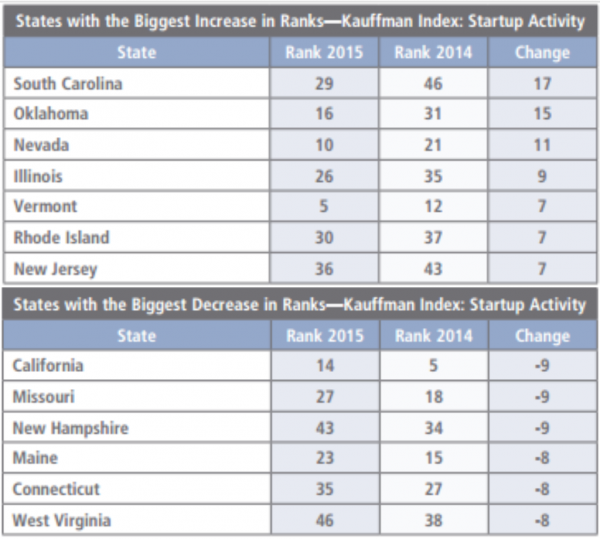
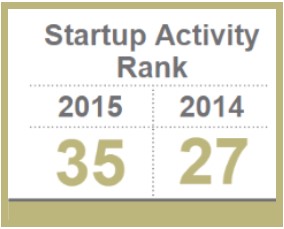
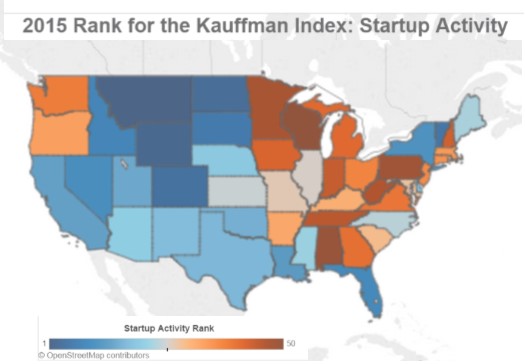
Connecticut dropped from number 27 a year ago to number 35 in the nation in business start-up activity, according to annual rankings developed by the Kauffman Foundation.  The drop of 8 positions was among the six worst among the 50 states, the analysis indicated.  Only New Hampshire, Missouri and California plummeted further, each dropping nine positions in the annual rankings. Nationally, the U.S. economy reversed a five-year downward trend in startup activity last year with a big jump in the number of new entrepreneurs - the largest year-over-year growth in two decades, according to the analysis.  New business creation increased in 32 states.  Connecticut was not among them.rank

The largest leaps forward came in South Carolina, jumping from 46th to 29th, Oklahoma, from 31st to 16th and Nevada, from 21st to 10th in the 2015 rankings, based on 2014 data.  Three components were used to make up the rankings:  the rate of new entrepreneurs, the opportunity share of new entrepreneurs and startup density.

states_insertThe top ranked states were Montana, Wyoming, North Dakota, Colorado, Vermont, South Dakota, Alaska, Idaho, Florida, Nevada and New York.
Connecticut dropped in two of the three key measures of startup activity used by Kaufman in the analysis.  The “Opportunity Share of New Entrepreneurs” fell from 76.9% to 74.9%.  The stat is described as “the percent of new entrepreneurs starting businesses because they saw market opportunities.”  The “Rate of New Entrepreneurs” fell from .31% to .29%.  That measure is the percent of the adult population that became entrepreneurs in a given month.

The final measure in the Kauffman formula, Startup Density, saw a slight uptick for Connecticut.  The stat consists of the number of startup firms per 100,000 residents, defined as firms less than one year old employing at least one person besides the owner.  Connecticut moved from 105.3 in the previous year to 110.4.USA map

For the past 10 years, the Kauffman Index has been "a trusted, early indicator for entrepreneurship in the United States," used by entrepreneurs and policy makers, from the federal to state and local levels.

Sol LeWitt Designed Synagogue Is Focus of World Premiere Documentary in Madison

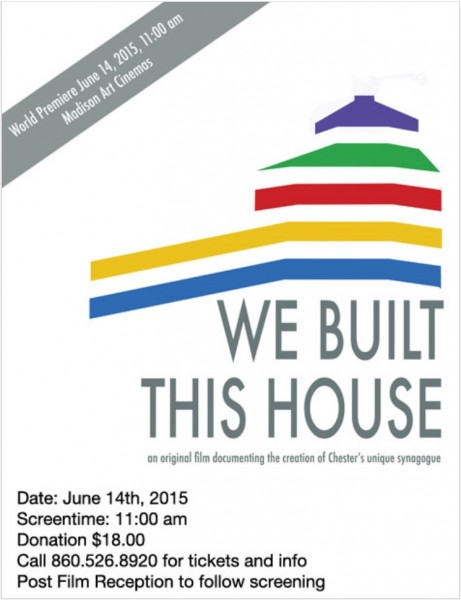
Complete with a red carpet, the Madison Art Cinemas will host the June 14 world premiere of the documentary We Built This House, a one-hour film telling the story of Chester synagogue Beth Shalom Rodfe Zedek—known as a global art landmark for being the only public building that acclaimed artist and Connecticut native Sol LeWitt ever designed. Film producer-director Jon Joslow, a lifetime member of the congregation, will discuss the movie and a reception will follow the screening. Tickets are open to the public and may be obtained for a donation of $18 each through the synagogue office, 860 526 8920. The showing begins at 11:00 am, and organizers have offered that “paparazzi are welcome.” Joslow is a crisis/transition leader for private equity who spent a year researching the history of the congregation and its building.house

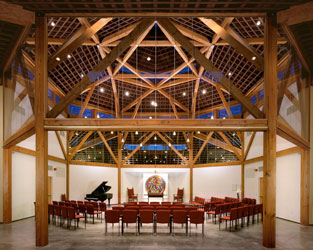
In a 2013 profile, Town & Country’s arts editor compared the striking Chester sanctuary with a masterpiece chapel Henri Matisse created in Nice, France. But the synagogue, opened in 2001, started as a napkin sketch, organizers of the project say. LeWitt first drew a structure inspired by traditional wooden temples of Eastern Europe combined with elements of colonial New England barns.

We Built This House traces how architect Stephen Lloyd translated LeWitt’s vision into post and beam, and how the Beth Shalom Rodfe Zedek community collaborated and improvised—even adapting a design discovered in a medieval English watermill—to give structure to the sanctuary’s wooden dome. LeWitt’s iconic installation on the ark drew national attention when the building opened; it prompted Town & Country to observe “modern art as [the sanctuary’s] focal point.”

LeWitt, a Chester resident who died at age 78 in 2007, is recognized as one of the most celebrated artists of the 20th century.  His work is prominently featured in venues worldwide, including at the Wadsworth Atheneum in Hartford.  A retrospective of his work is featured at the Massachusetts Museum of Contemporary Art in North Adams, through 2033.

The sanctuary has become known as one of the most astonishing, and spiritually welcoming, religious spaces in the world.  True to its roots, the Chester synagogue has become one of the shoreline’s most vital cultural centers.about_2

Beth Shalom Rodfe Zedek—Hebrew for “House of Peace Pursuing Justice”—is marking the 100th year since the founding of one of its two predecessor temples in Moodus. We Built This House is part of yearlong centennial celebrations culminating in an October 3 gala and the inaugural presentation of the synagogue’s new annual Pursuer of Peace and Justice Award. Though it is located in Chester, temple members come from 36 towns, from West Hartford to Westbrook, Norwich to North Branford.

Given the film’s unique insights into art as architecture, and into how a community can join together in creative enterprise, organizers anticipate interest among public television stations, those engaged in architectural and design collaborations, and art museums, in airing it following the premiere.  DVDs of are expected to be released later this year.

The Madison Art Cinemas is located at 761 Boston Post Road in Madison. For more information on We Built This House or Beth Shalom Rodfe Zedek, visit www.cbsrz.org or www.ancientandcool.com.

Students Among Avid Followers of Serial as Creators Arrive in Hartford

It was nothing short of a phenomenon.  The first podcast to win a Peabody Award, it was the talk of the nation, in a way that happens less often than years ago, given the fragmented media landscape and dizzying array of choices. But the inaugural season of Serial on NPR this past fall hooked listeners intently.  The story was compelling, and presented in riveting fashion, hosted by journalist Sarah Koenig exploring the 1999 murder of Baltimore teenager Hae Min Lee and her ex-boyfriend Adnan Syed’s subsequent life sentence. Syed continues to claim that he’s innocent. Following the conclusion of Serial‘s first season in December, the Maryland Court of Special Appeals granted Syed license to move forward with the appeal of his case, according to the Washington Post.logo

Hartford will get a behind-the-scenes perspective of the making of Serial as creators Sarah Koenig and Julie Snyder take to the Bushnell stage Wedmesday (June 10), in a special edition of the popular Connecticut Forum, with “Binge-Worthy Journalism: Backstage with the Creators of Serial Sarah Koenig and Julie Snyder.”   The podcast, produced by Chicago Public Media/This American Life, has been downloaded nearly 60 million times. 280x157-1aR

In the audience will be nearly 100 local students who have used the 12 episode podcast series as the platform for education.  Local teachers have been using Serial podcast to teach students about the law,  advocacy and the judicial system – a new and apparently successful way to engage students.  Students at the Law & Government Academy at Hartford Public Schools especially related to the Serial podcast – involving inner city magnet school students much like themselves. Other schools in attendance at this event include: Global Communications Academy in Hartford; Simsbury High School; Granby Memorial High School; CREC Public Safety Academy; and East Granby High School.  The students attendance is made possible by underwriting from Audible.

This strong community – school connection is at the heart of the work of The Connecticut Forum, and their mission to inform, challenge, entertain, inspire and build bridges among all people and organizations in the community.

Questioning the ≠accuracy of every bit of information she is given Ö Sarah KoenigAt the Law and Government Academy of Hartford Public High School, one class used Serial as the basis for a semester’s curriculum.  Over the course of five months, students examined the issues in each episode of the 12-episode podcast and were asked to choose a side – such as defense counsel, prosecutor, or witness – and then advocate for their position.  For their final exam, students wrote appellate court briefs and argued their cases.
Students from the other schools planning to attend had similar experiences, quickly becoming regular listeners, intrigued by the issues it was highlighting and the storyline.  Other classes in Connecticut and across the country also used the podcast as part of the curriculum, to rave reviews.

julie snyder“It’s use of new media and compelling storytelling has opened up many new opportunities for students, educators, and the intellectually curious to reexamine aspects of our legal system,” said CT Forum Executive Director Doris Sugarman. “We’re thrilled to see what is sparked when our community connects to the expression of big ideas that The Forum brings to Connecticut audiences.”

Serial, with a new story line, is set to return for a second season in the fall and a third next spring, according to published reports.  (Photos:  Sarah Koenig, above, and Julie Snyder, below)

12podcasts

UConn Brings Science to Downtown Hartford, In Informal Preview

A couple of drinks, some munchies and spirited discussion about an unlikely topic, “3D Printing:  Living Tissue to Human Organ.”  That was the recipe for the kick-off of a new panel series in downtown Hartford sponsored by UConn and the UConn Foundation aimed at facilitating conversations between science experts and the public. The “UConn Science Salon” series, taking place at downtown restaurants, is a precursor of the type of programming that is expected to pop up around the city when the UConn Hartford Campus takes up residence in the former Hartford Times building two years from now, just down the road from Front Street, where the June 4 event was held at Nix.ScienceSalon_Graphic-01-e1432649930237

The next event in the series, “SciFi Meets Reality,” will be held in Hartford on Sept. 17, from 6 to 8 p.m., at a location to be determined.

University Communications science writer Kim Krieger says UConn Science Salon series gives attendees easy access to top scientists and experts and “raise the profile of UConn research in a friendly, stylish way.  The purpose of the program is to enhance public discourse at the intersection of science and culture,” she told UConn Today. “Sure, people can read about research and technological developments, or watch some talking head opine about it on television. But how often does the average citizen get to ask a scientist a question?”

The initiative is not unique, but it is new for UConn, and Hartford.Salon150604d081

“The goal is to share exciting developments in technologies through an engaging and interactive format,” UConn Provost Mun Choi. “The insights from leading experts will lead to a greater understanding of the role of science and technology in our society.”

Science cafés are held all over the world, according to sciencecafes.org, a site run by NOVA as a resource for those interested in hosting or attending such events. The events, which have been around for about a decade, are typically casual gatherings held in places like coffeehouses, pubs, and libraries, and are focused on facilitating discussions about science.  In Connecticut, New Haven and Branford have seen science cafés.

“These are not long lectures with a passive audience listening to an expert,” the site points out. “Rather, they are dynamic, two-way interactions between a scientist and the public. In this way, the public feels empowered to learn, and the scientist speaker gains valuable perspective on his or her own work.”

Provost Choi adds that attendees will see how “UConn is playing a critical role in advancing science and engineering in areas such as genomics, manufacturing, and sustainability,” UConn Today reported. The June discussion focused on state-of-the-art initiatives in 3D printing and the potential for the technology – also known as additive manufacturing – particularly in the field of health care.Salon150604d177

Panelists at the inaugural event, attended by about 120 alumni, faculty, staff and members of the public, were Anson Ma, a UConn assistant professor of chemical and biomolecular engineering; Richard Langlois, a UConn economics professor; Dr. John Geibel, vice chairman of the Department of Surgery and director of surgical research at Yale University School of Medicine, who leads one of seven global teams competing to create a viable regenerative or bioengineered liver; and Dale Kutnick, senior vice president emeritus and distinguished analyst at the technology research firm Gartner Inc.  Lakshmi S. Nair – UConn assistant professor of orthopaedic surgery and chemical, materials, and biomolecular engineering – moderated the discussion.science cafe

Tickets for the events are $15 and can be purchased at UConnAlumni.com/ScienceSalon.  Drinks are extra.

(UConn photos by Peter Morenus)


17 CT Companies Reach Fortune 500, From #8 GE (Fairfield) to #487 Amphenol (Wallingford)

Connecticut has a total of 17 companies headquartered in the state that are now ranked on the Fortune 500, as the latest annual business list is published by Fortune magazine this week.  That includes one company, General Electric, in the top 10, a total of seven companies in the top 250, and two that reached the Fortune 500 list this year. The nation's largest companies ranked in the newly updated Fortune 500 list earned combined total annual revenue of $12.5 trillion last year — an all-time high that's up 2.6 percent from the year before.  Total market value of firms that made the 2015 list reached $17.4 trillion as of March 31, also an all-time high that's up 7.7 percent from the previous year, the publication announced.  This year's list of U.S. companies ranked by their 2014 revenue also employ 2fortune500logo6.8 million employees in all, more than ever, according to Fortune, whose issue with the 61st annual ranking is out this week.

The top 10:  Walmart, ExxonMobil; Chevron; Berkshire Hathaway; Apple; General Motors; Phillips 66; General Electric; Ford Motor and CVS Health.  CVS Health made the top 10 for the first time.  There were 19 companies that made their debut on the 2015 list of the nation’s top 500 companies, including Netflix, Salesforce.com, Expedia and News Corp., as 26 firms dropped out of the updated ranking.  Facebook, in its third year on the list, jumped into the top 250, at number 242, up from number 341 a year ago.

The 7 companies headquartered in Connecticut that rank among the 250 top businesses on the list:

  • 8. General Electric of Fairfield (up from 9 last year)
  • 45. United Technologies of Hartford (same as last year)
  • 49. Aetna of Hartford (up from 57)
  • 90. Cigna of Bloomfield (up from 97)
  • 143. Xerox of Norwalk, down from 137.
  • 160. The Hartford Financial Services Group of Hartford (down from 113)
  • 249. Praxair of Danbury (down from 233)

The 8 Connecticut-headquartered companies that remained in the Fortune 500, and 2 companies that earned a slot for the first time:

  • 261. Stanley Black & Decker of New Britain (down from 255)
  • 317. Charter Communications of Stamford (up from 331)
  • 339. Priceline Group of Norwalk (up from 383)
  • 377. Terex of Westport (down from 358)
  • 385. W.R. Berkley of Greenwich (up from 409)
  • 421. EMCOR Group of Norwalk (down from 407)
  • 442. Starwood Hotels & Resorts of Stamford (down from 424)
  • 461. United Rentals of Stamford (up from 500)
  • 486. Harman International Industries of Stamford (up from 576)
  • 487. Amphenol of Wallingford (up from 533)

harmanLogoOne of the two new entries on this year’s list that are headquartered in Connecticut is Harman International Industries, based in Stamford, the parent company behind an array of world-renowned audio brands including AKG®, Harman Kardon®, JBL®, Mark Levinson®, Lexicon®, and Infinity®.  Well established for six decades, since it was launched by audio pioneer Sid Harmon, the company’s founder, the current Chairman, President and CEO is Dinesh Paliwal. states

Amphenol-Corporation-logoAmphenol World Headquarters is in Wallingford, and a number of the international company’s divisions are also based in Connecticut: Amphenol Nexus Technologies Division is in Stamford, Amphenol Times Microwave and Times Fiber Communications in Wallingford, Spectra Strip in Hamden and Amphenol RF in Danbury.  Amphenol, founded in 1932, is one of the largest manufacturers of interconnect products in the world. The Company designs, manufactures and markets electrical, electronic and fiber optic connectors, coaxial and flat-ribbon cable, and interconnect systems.  The primary end markets for the company's products are communications and information processing markets, including cable television, cellular telephone and data communication and information processing systems; aerospace and military electronics; and automotive, rail and other transportation and industrial applications. (see company video)

Fortune 500 companies had revenues last year that equaled 71.9 percent of U.S. GDP—up from 58.4 percent two decades ago, and 35 percent in 1955, according to Fortune. “To be sure, much of that revenue comes from overseas operations. But these companies are still the guts of the U.S., and the global, economy,” the publication points out.greatest challenge

As part of the magazine’s research for the list, they sent a survey to all the Fortune 500 CEOs. One question asked: What is your company’s greatest challenge? “The rapid pace of technological change” topped the list, besting “cybersecurity” (a close second), as well as other traditionally popular responses, such as “increased regulation,” “shareholder activism,” and a “shortage of skilled labor.” Interestingly, 94 percent of those who responded said their companies would change more in the next five years than in the past five, Fortune reported.

New York is the state with the most companies on the list with 55, followed by Texas with 54 and California with 53.  There are 33 companies headquartered in Illinois, 23 in Ohio, 20 in Georgia, 19 in New Jersey and Virginia, 18 in Pennsylvania, 16 in Florida, and 10 in Wisconsin.

Walmart takes the top spot for the third year in a row and the eleventh time ever.Only three companies have held the number 1 spot on the Fortune 500 since its creation in 1955: General Motors, Exxon Mobil and Walmart, according to published reports.