Since 2008, CT’s Tuition Increases at Public Universities Nearly $2,000, Ranks 28th

The rate of tuition increases at Connecticut’s public colleges and universities between 2008 and 2015 ranks Connecticut 28th in the nation, with an increase of 22.8 percent, or just under $2,000 per student.  The tuition increases in Arizona, Hawaii, Georgia, Louisiana and Florida and California, all exceeding 60 percent, were highest in the nation. Overall, since the 2007-8 academic year, average annual tuition has increased 29 percent, or just over $2,000 nationally, according to a report by the Center on Budget and Policy Priorities.  On average, states are spending 20 percent or less in 2015 than they did in 2008.  Connecticut is spending 16.7 percent less.college tuition

Published tuition -- the "sticker price" -- at public four-year institutions rose in 34 states over the past year, but only modestly. But since the 2007-08 school year, average annual published tuition has risen by $2,068 nationally, or 29 percent, above the rate of inflation.

The share of students graduating from public universities with debt has risen, according to the Center’s analysis. Between the 2007-08 and 2012-13 school years, the share of students graduating from a public four-year institution with debt rose from 55 to 59 percent. At the same time, the average amount of debt held by the average bachelor's degree recipient with loans at a public four-year institution grew 16 percent -- from $22,000 to $25,600 (in 2013 dollars).

Forty-seven states -- all except Alaska, North Dakota, and Wyoming -- are spending less per student in the 2014-15 school year than they did at the start of the recession.  Connecticut ranks 34th on the list of states spending below pre-recession levels at 16.7 percent less.  The most dramatic drop is in Arizona (47%), Louisiana (42%), South Carolina (38%), and Alabama and Pennsylvania (36%).  The analysis compares state spending in 2008 and 2015.tuition increases

UConn plans a 6.5 percent increase in tuition and fees next year; the Board of Regents for Higher Education has approved a 4.8 percent increase for students attending the four regional state universities.  The state legislature approved legislation this year that would have added two students to the UConn Board of Trustees, in part to give students a strong voice in recognition of the increasing percentage of tuition that is now paid by students.  The plan was vetoed by Gov. Malloy.  The total in-state undergraduate cost of attending UConn, including tuition, room and board, will be about $25,500 in 2015-2016, up from about $24,500, according to published reports.

logoThe Center’s study found that over the past year, as states have started to restore funding for public higher education, tuition hikes have been much smaller than in recent years.  Just seven states -- Louisiana, Colorado, Connecticut, Hawaii, Kansas, Virginia, and Mississippi -- raised tuition by more than $300, after inflation.

The change in average tuition at public four-year colleges, adjusted for inflation, between fiscal years 2008 and 2014 placed Connecticut in the middle of the states, ranking 25th with an increase of $1,695.  The largest increase was in Arizona ($4,493) and the laws in Montana ($253).

Start-Up Business Accelerator Program Selected to Receive Federal Funds to Expand Impact

The LaunchPad for Impact is an accelerator program for early-stage ventures that equips entrepreneurs with tools, resources, and guidance to test drive business assumptions and build a business model that delivers peak value and impact. The program, developed and operated in Hartford by reSET, the Social Enterprise Trust, has been selected to receive a cash prize of $50,000 from the U.S. Small Business Adminstration (SBA), one of only 80 organizations in the country to be designated to receive the funding. Selected in the SBA's Growth Accelerator Competition, LaunchPad for Impact  is the only Connecticut accelerator to receive an award this year.  President Obama made the announcement this week from the White House of awards totallying $4.4 million. The award includes a $50,000 cash prize to help fund the Hartford-based accelerator, and provides public recognition.  Overall, the recipients represent 39 states, the District of Columbia and Puerto Rico. logo

The selected accelerators across the nation serve entrepreneurs in a broad set of industries and sectors – from manufacturing and tech start-ups, to farming and biotech – with many focused on creating a diverse and inclusive small business community.  "The entrepreneurial ecosystem in America is incredibly exciting and very powerful,” said Javier Saade, Associate Administrator for the U.S. Office of Investment and Innovation.  Elsewhere in New England, three Massachusetts programs were selected, as were two Maine initiatives, and one in both Rhode Island and New Hampshire.Lean-Launch-300x168

reset-logo1Through customer feedback, expert guidance, and a peer network, Launchpad for Impact helps transform a start-up business or concept in to a scaleable model by helping entrepreneurs learn quicker, pivot where necessary, and move forward with a better chance of success. Through peer to peer feedback from other entrepreneurs, expert coaching, and an innovative online platform that captures validation and measures investment readiness,  participants “get the data, knowledge, and tools needed to pitch to clients, investors, and partners. In an environment where most start-up businesses fail, this program helps you get the validation and sound evidence you need to support your business model,” the program website indicates.

Thus far, the program has included 138 social entrepreneurs in Connecticut, helped launch or accelerate 54 impact ventures, and awarded over $75,000 in funding to early stage ventures in the past two years, according to the program website. Participants meet for nine scheduled, in person sessions and are offered supplemental workshops in multiple areas of business development.white hosue

In the SBA competition, applications were judged by more than 40 experts with entrepreneurial, investment, startup, economic development, capital formation and academic backgrounds from both the public and private sector.  The first panel of judges reviewed over 400 applications and presentations and established a pool of 180 highly qualified finalists.  The second panel evaluated the finalists’ presentations and pitch videos and selected the 80 winners.

“SBA is continuing to make advances in supporting unique organizations that help the start-up community grow, become commercially viable, and have a real and sustained economic impact,” said SBA Administrator Maria Contreras-Sweet. “Through the wide-spread outreach of this competition, we are able to reach entrepreneurial ecosystems across the country. My commitment is to make our resources available to 21st century entrepreneurs where they are, and these accelerators, also known as incubators and innovation hubs, are the gathering place for today’s innovators and disruptors.”


Correctional Institutions or Institutions for the Mentally Ill? Governments Seek New Solutions

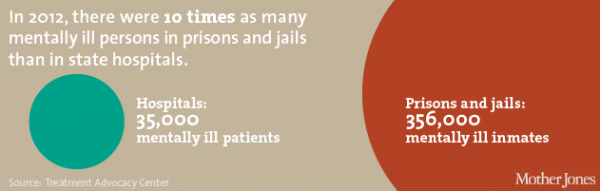
How to effectively respond to the fact that America’s prisons have rapidly become de facto institutions for the mentally ill is increasingly gaining attention in policy circles and the news media.  In recent days, The New York Times, Governing magazine, and other publications have focused both on the alarming statistics and some innovative approaches across the country. There are now 10 times as many mentally ill people in the nation’s 5,000 jails and prisons as there are in state mental institutions, according to a study last year by the National Sheriffs’ Association and the Treatment Advocacy Center, a nonprofit group that supports expanded access to treatment, the Times reported.

In Connecticut, out of the 16,154 inmates in state prisons, about 3,423 have a serious mental illness, 21 percent of the total prison population, Michael Lawlor, undersecretary for criminal justice policy and planning at the Office of Policy and Management, told the New Haven Register earlier this year. Just a few years ago, the National Alliance on Mental Illness (NAMI) estimated that approximately 16 percent of the state’s prison population consisted of persons with mental illness.

The State Department of Correction confirms that those defined as “seriously mentally ill” include 17 percent of the male population, 66 percent of the female population, and 20.8 percent of the overall prison population in the state.

According to the Council of State Governments, jails in the U.S. report that between 20 and 80 percent of their inmates suffer from a mental illness, Governing reported.   Today’s acute challenge has been decades in the making.  In the mid-1950’s, the publication indicated, more than 500,000 people were held in state psychiatric hospitals.  “By the 1980s that number had fallen to around 70,000.  During this period, the number of people with mental illnesses who were arrested and ended up in local jails surged.”

Chicago’s Cook County Jail, now referred to by local officials as the nation’s largest mental institution in the country, has 8,600 inmates – an estimated one-third of them suffering from mental illness.  The newly appointed warden of the facility is a clinical psychologist – underscoring “how much the country’s prisons have become holding centers for the mentally ill,” the Times reported.
imprisioned-mentally-illWriting in the Connecticut Law Review, Christina Canales observed that “Many supported deinstitutionalization because they believed that the mentally ill would benefit from being released from the state hospitals.  They believed that with the assistance of anti-psychotic medications, the mentally ill would be able to live independently in the community and that the community mental health centers would provide the additional care, treatment, and follow up services.

“Although a good plan in theory,” Canales concludes, “deinstitutionalization quickly became one of the main reasons for the substantial increase in mentally ill people in jails and prisons. Patients were ejected from state mental hospitals at a substantially faster rate than community mental health programs were created.”

The Law Review article, published three summers ago, concludes that “the United States faces a crisis in that prisons are among the largest mental healthcare providers. Some mentally ill individuals turned to crime after deinstitutionalization left them on the streets with no support system. Others wound up in prison because police officers lacked the proper training to identify persons as mentally ill and in crisis, or mistakenly believed that individuals receive adequate treatment in prison. The change in civil commitment laws also made it harder to commit the mentally ill, and society as a whole wants these individuals punished, mentally ill or not.”prison

Earlier this year, the Connecticut state legislature considered – but did not approve - a bill that would have established a pilot program to serve courts in New Haven, New London and Norwich to identify and track the mentally ill, along with homeless and addicted individuals entering the criminal justice system. The idea behind it was to get these individuals treatment and help as an alternative to incarceration and to prevent future arrests, according to published reports. The initiative also called for a formal assessment of its effectiveness.

In Chicago, the Times reported, “before becoming warden, Dr. Nneka Jones Tapia oversaw mental health care at the jail, and under her guidance, Cook County began offering services that would have been unthinkable a few years ago. All inmates upon arrival now see a clinician who collects a mental health history to ensure that anyone who is mentally ill gets a proper diagnosis and receives medication. The jail then forwards that information to judges in time for arraignments in the hope of convincing them that in certain cases, mental health care may be more appropriate than jail.”

According to a report by the Virginia-based Treatment Advocacy Center, 95 percent of the public psychiatric beds available in 1955 in the country were no longer available by 2005, the New Haven Register reported.  The Center recommends a minimum of 50 beds per 100,000 people, a standard that no state meets. Connecticut has about 20 public psychiatric beds per 100,000 people, according to the center’s website. Between 1995 and 2013, the number of inpatient psychiatric beds, at both public and private hospitals, decreased from 160,645 to 107,055 nationally, according to data from the American Hospital Association.

Connecticut, which recently approved a Second Chance Society Act proposed by Gov. Malloy that reduces some criminal sentences for nonviolent offenses and drug possession, is expected to reduce the number of people incarcerated for drug use, which officials expect will also reduce the number of mentally ill in prisons, “since drug use and mental health problems frequently coexist in a significant group” of the population.

The Governing article highlights a diversion system in Miami-centered Dade County in Florida, a post-booking alternative program that permits individuals arrested for “misdemeanor offenses and identified as having acute mental illnesses” to be transferred to mental health treatment facilities.  The results, according to the publication:

“About 80 percent of people offered the chance to participate in the program accepted it.  What was surprising was how many people stayed out of the system afterward.  An evaluation conducted soon after the program began found that recidivism rates one year out among participants who complete the program was just 20 percent.  In contrast, 72 percent of peers who did not participate in the program were back in jail within one year of their release.”

https://youtu.be/zSbFbv2Bs_0?list=PLQ9B-p5Q-YOP2OVnCPdYKLSmPkqLA2igT



Grit ‘N Wit Planning Underway for October Obstacle Course in Hartford

The Hartford Marathon will not be the only race in town in October. For those seeking an extra degree of challenge – both physical and mental – there’s another race course for you.  It’s called Grit ‘N Wit, New England’s first obstacle course to combine brain and brawn, and is the brainchild of a Connecticut-grown company “committed to the development of healthy, engaged communities.” 7E410F3A-B88F-9222-B96A76B9901A575B

Launched just two years ago by UConn law school graduate James Moher, the event, now held in Hartford’s Keney Park, is attracting a growing following of enthusiastic participants.  The goal is to take on 20-plus obstacles over a 3-mile course designed to challenge individuals both physically and mentally.

"Most competitions are one dimensional. If you do well at a race, that just tells you're fast. But if you do well at Grit 'N Wit, that tells you a whole lot more,” Moher explains.  "I've always thought that there should be a competition that should test the whole person. And there wasn't one...until now."

This year Grit ‘N Wit will take place October 24, 2015 from 9:00AM – 5:00PM. The event is open to the public in the morning and for college students in the afternoon.  It is open to all ages 10 & up.

Organizers have seen the event grow from 240 participants in its first year, to 420 last year.  This year, with improvements to both the physical and mental challenges, and strong support from local busoctober24inesses, they’re pushing the envelope - hoping to surpass 1,000 participants. gritwit

Last year’s event, for example, had participants memorize a pattern, then scale a hill and put the pieces of the puzzle together. After climbing over a series of inclined monkey bars and 5' walls, participants came to Ultimate Field Sobriety Test. There they had to get two golf balls through a maze while standing on an inclined balance beam. A post-race survey showed that 95 percent of participants like – or loved – the experience.

“The mental obstacles are designed to be fun and challenging - think Survivor, the Amazing Race or MTV's The Challenge - but without the bugs, plane ticket or a stint on the Real World,” organizers point out.  Rebekah Castagno, a two-time participant, said "It's the creative and physical combination that makes it such a fun and unique challenge."

As Grit ‘N Wit continues to grow, plans are in the works for it to be extended to other cities, and perhaps to college campuses, in the future – another Connecticut export that began as nothing more than an idea.  In addition, organizers say the event will support college students by offering scholarship awards and prizes in this year’s Hartford event.

Teams are not required, but are highly encouraged. Registration is currently $57 and increases the first of every month.  The website is www.gritwitrun.com  Volunteers are also welcome to help out for the day.


https://youtu.be/4ng_GKZsZo8

State Will Step Up Efforts to Respond to Needs of Women Veterans

The U.S. Department of Veterans Affairs estimates there are 16,545 veterans in Connecticut who are women. Some among them struggle with issues such as unemployment, homelessness and mental illness, and many more are unaware of the support services available to them.  That was the impetus for legislation approved this year by the General Assembly and recently signed into law by Gov. Malloy, requiring the Department of Veterans' Affairs to establish, within available resources, a Connecticut women veterans' program. 3D Connecticut Flag

The new women’s veterans program must:

  • reach out to women veterans to improve awareness of eligibility for federal and state veterans' benefits and services;
  • assess women veterans' needs for benefits and services;
  • review programs and research projects and other initiatives designed to address or meet Connecticut women veterans' needs; and
  • incorporate women veterans' issues in strategic planning on benefits and services.

The program must also annually submit recommendations for improving benefits and services for women veterans to the veterans' affairs commissioner and the Veterans' Affairs Committee of the legislature, beginning January 15, 2016.

Under the law’s provisions, a “veteran” is anyone discharged or released (under conditions other than dishonorable) from active service in the armed forces - U. S.  Army, Navy, Marine Corps, Coast Guard, and Air Force -and any reserve component of these branches, including the Connecticut National Guard operating under certain Homeland Security missions.

Jackie Evonison, the women veterans’ outreach coordinator with the American Legion Connecticut, told legislators considering the program that many female veterans are unaware of available services or don’t feel they’re qualified to receive them.vet

In 2012, there were   more than 2,600 women veterans residing in Hartford County, according to data included in a report from the Aurora Foundation. Women veterans face substantial and unique challenges readjusting to civilian life, the report pointed out, especially in the areas of housing, mental health, health care, employment and homelessness:

  • In Hartford County, approximately 8 percent of the population are veterans; females are 5 percent of this population (approximately 2,619 women vets in Hartford County).
  • Female veterans are almost four times more likely to become homeless than women who have not served in the military.
  • Only one of the three veterans’ housing facilities in the county house female veterans.

As a group, female veterans are younger than their male counterparts, with an average age of 48, compared to 63 for men. More than 80 percent of the female veterans are working age, compared to 55 percent for men, according to published reports.

Commissioner Sean Connolly of the state Department of Veterans Affairs said the mission of the program will be “to see what kinds of programs are out there, develop recommendations for improving benefits, and determining whether new programs and projects are necessary to meet the needs of our women veterans.”


PERSPECTIVE l A Lesson in Finding - and Maintaining - Your Passion

by Paul Steinmetz After two years of planning, Cynthia Newlin O’Connor’s career as an activist hit the peak. She stood in Times Square and watched a ton of ivory that had been smuggled into the U.S. go through a crusher.

These ivory crushes, as they’re called, are held to demonstrate to a world audience, including poachers and smugglers, that there will be no profit in killing elephants for their tusks.

perspective squareO’Connor is the executive director of Elephants Matter, a nonprofit concerned with stopping the slaughter of elephants for the ivory trade.

A week after her daughter graduated from college, O’Connor suggested, “Let’s go to California and clean up those sea birds that were caught in the oil spill at Santa Barbara.”

Her daughter replied, “You had me until you mentioned cleaning the sea birds, mom.”

O’Connor is quick-talking and petite but not demure – “I try to use Cynthia, not Cindy, but I can’t pull it off.” She gave herself about two weeks to recoup from the crush before starting her current venture. She’s gathering signatures on a petition to Pope Francis that asks him to join the elephant crusade and to sponsor his own crush of Vatican ivory.

I’m writing about O’Connor because she demonstrates the passion that all single-minded people have in some supply. Sure, she has more than the rest of us, but writers and entrepreneurs get excited about things, too. That’s why they take off on quests to start their own businesses or are certain in their belief that they can persuade others with a unique collection of words and sentences. It seems a little nutty to everyone else, but most of us with the calling feel we have little choice: We must pursue our belief in ourselves and our abilities.

Sometimes it works out. O’Connor became an elephant crusader as a youngster. She was a child model doing a photo shoot at a zoo near Chicago. The young elephant was aggressive and sent her flying with a swat of its trunk. O’Connor asked her mother why the elephant would do that and mom replied, “He’s surely not a happy baby. He should be with his mother back in Africa where he belongs!”

As O’Connor says, “I was imprinted.”oconnor

She traveled to Africa in 1988 and visited the David Sheldrick Wildlife Trust orphanage in Nairobi. “On that day I promised myself and the elephants that I would do whatever it took to save them.”

O’Connor has worked as a photographer and in sales for radio. She created Elephants Matter and in 2013 became a full-time crusader, testifying in January 2014 before the New York State Assembly in support of a bill condemning the illegal trade in ivory. The bill was signed into law on Aug. 12, which is World Elephant Day. At the hearing, O’Connor committed to the creation of an ivory crush in Manhattan. She campaigned, researched, and enlisted the support of state Sen. Brad Hoylman, whose district includes Times Square, and the crush happened on June 19.

Now she is circulating her petition.

“I strongly believe that when the Pope speaks out about this issue it will be the final word needed,” O’Connor says. “The world embraces him, and he embraces the world. Above any political agenda, financial gain or personal aggrandizement, when the pope speaks, the world listens.”

Whether the pope and the world do listen, you can count on one thing. O’Connor is not going to stop.

Paul Steinmetz, a former editor of the Danbury News-Times, is the director of Community Relations and Public Affairs for Western Connecticut State University and the principal of Writing Associates, providing publicity and writing services for businesses, institutions and individuals.

_________________________________________________________

CT by the Numbers publishes opinion articles of 600 words or less.  Submissions should be emailed to info@ctbythenumbers.info.  Perspectives are published at the discretion of CT by the Numbers. 

Assessing Developmental Concerns Early in Children: Connecticut Approach Becoming Standard of Care

Identifying and addressing developmental or behavioral concerns in young children early, before problems escalate, can rewrite the script for their future. Easier said than done.  But organizations in Connecticut are taking steps to address the gap in services, making an innovative "mid-level" development assessment available to families across the state.  It is an approach that has local roots, and is now helping children not only in Connecticut, but beyond the state’s borders. In a newly released issue brief, Connecticut Health and Development Institute of Connecticut (CHDI) points out that for early intervention to occur, “developmental surveillance and screening must be followed by timely assessment to determine the need for intervention services. Children for whom surveillance and screening show concerns but don’t meet the threshold for a high-level evaluation historically fall through the cracks.”

CHDI’s Issue Brief indicates that concerns identified by a primary care provider can range from mild to severe and may lead to a referral to Connecticut’s Birth to Three early intervention program. Yet, 40 percent of children in Connecticut referred to Birth to Three fail to meet the eligibility criteria for services. Without an alternative, “mid-level” assessment resource, these children and their families often end up on long waiting lists for costly and sometimes unnecessary evaluations by specialists in neurology, developmental pediatrics or psychiatry.

issue briefIn that circumstance, “precious intervention time is lost, and most children evaluated by specialists do not end up meeting the threshold for an official diagnosis despite real concerns and delays. Without a diagnosis, many families are not connected to helpful services. Furthermore, children with the most severe concerns are precluded from securing timely assessments and interventions, as appointment times are scarce.”

Mid-Level Developmental Assessment (MLDA) offers an alternative, or “mid-level”, option filling the gap for children 6 months to 6 years old with mild to moderate developmental or behavioral concerns. This approach provides an efficient assessment between initial screening and a full evaluation.  It is now being used in Connecticut and five other states. CHDI points out that “MLDA optimizes the screening process; delivers more appropriate care earlier; and leads to more efficient use of limited full-evaluation resources.”

The rapidly advancing approach is relatively new.  In 2009, three child-serving organizations in Connecticut – The Village for Families and Children, Pediatric Associates of Bristol and the Pediatric Primary Care Center at Yale New Haven Hospital – pilot tested MLDA with a grant awarded by CHDI and funded by the Children’s Fund of Connecticut. The pilot study showed that MLDA could efficiently identify developmentally vulnerable children who could benefit from community-based services. The pilot study in Connecticut found:

  • Fewer than 20 percent of children undergoing MLDA required higher-level evaluation.
  • Eighty percent could be enrolled immediately in available developmental and mental health programs.
  • Children referred to more extensive evaluations qualified for services with stringent eligibility criteria.

The Village’s MLDA model is now available for young children in the Greater Hartford area through a partnership with Connecticut’s Help Me Grow access point, Child Development Infoline (CDI), according to the CHDI report. Since 2009, The Village has evaluated more than 350 children using the MLDA model.CHDI

The partnership between the MLDA program and the statewide Help Me Grow access point has established solid groundwork for replication of MLDA among other organizations in Connecticut that perform Birth to Three and preschool special education evaluations. In partnership with The Village and the United Way of Connecticut, the Office for Community Child Health at Connecticut Children’s Medical Center is currently replicating MLDA throughout the state with the support of a two-year grant from the LEGO Community Fund U.S.

“Connecticut was the first state to test the feasibility of the model,” the CHDI report indicates. “Now it is becoming the standard of care for young children at risk for developmental delay and unlikely to qualify for publicly funded programs.”

The report indicates that by efficiently assessing children at risk of developmental delays, using limited specialist resources more efficiently, and decreasing health care system costs, “MLDA can have a profound effect in shaping the futures of children across Connecticut and other states.”

CHDI is “a catalyst for improving the health, mental health and early care systems for children in Connecticut.”  The organization works to “advance and inform improvements in primary and preventive pediatric health and mental health care programs, practice and policy in Connecticut, with particular focus on disadvantaged or underserved children and their families.”

Housing, Education, Poverty Among Greater Hartford Region's Challenges, Report Reveals

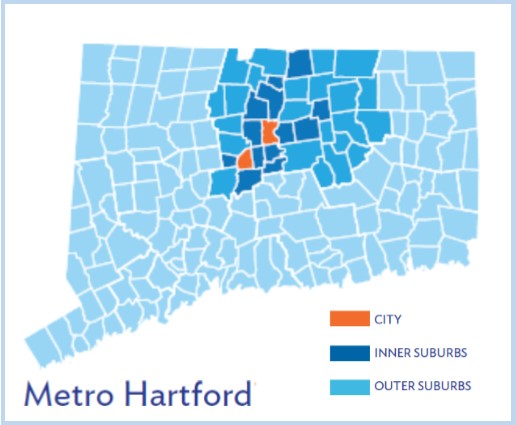
Of the 4,000 affordable housing units added to the 38-town Greater Hartford region over the past five years, nearly half (47 percent) have been in Hartford and New Britain – almost as many as were added in all of the other 36 towns in the region combined. That stark statistic is among the points emphasized in the second edition of Metro Hartford Progress Points, an analysis of data compiled by the Hartford Foundation for Public Giving and a coalition of community and regional organizations.  The inaugural report was released last year, and the new edition updates some of that initial data, as well as revealing new information about the region’s demographics, opportunities and challenges.region

Regarding the fact that much of the housing is being developed in municipalities that face considerable economic challenges, the report notes that those 36 towns have lost over 9,000 students in local schools during the past five years, despite having school districts that perform more than 30 points higher and standardized testing than those in Hartford and New Britain.  The report indicated, for example, that for every 100 children born in the region’s outer ring suburbs (such as Glastonbury), 113 enroll in local public school five years later, as opposed to 81 who enroll in city schools and inner ring suburbs (such as Bloomfield).

The second edition of Progress Points “takes a deeper look at key issues impacting our communities and how they are connected. The report asks how we can build on our strengths and fully utilize the assets that the region has to provide access to opportunity for all,” officials explained.  Using key indicators to identify opportunities for action, the 2015 report focuses on three regional priorities: 1) Access to better schools, 2) Access to better jobs, and 3) Access to stronger neighborhoods.

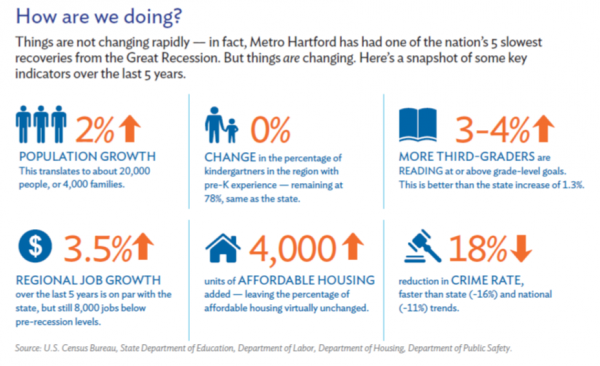
progress pointsLooking at five year trends, the report found that the region’s population of about 1 million people has grown by 2 percent, which translates to about 20,000 people or about 4,000 families.  Regional job growth, 3.5 percent, is on par with the state, but remains about 8,000 jobs below pre-recession levels.  The crime rate across the Greater Hartford region has been reduced by about 18 percent during the past five years, faster than the state (-16%) and national (11%) trends.
The study determined that there are more people living in poverty in the region than 10 years ago.  “Suburban communities have seen a major increase in the population living in low-to-mid-poverty neighborhoods,” the report said.   “Poverty is a regional, not an urban, problem.  Addressing poverty requires improved coordination among towns to better connect transportation and other services to increase access to opportunity.”

In education, the report also notes that about 4 percent more third-graders are reading at or above grade-level goals, a faster improvement than statewide (1.3 percent).  There has been no change in the percentage of kindergartners in the region starting school with pre-K experience.  That level, 78 percent, is the same in the region as statewide.  Focusing on declining enrollment, officials indicated that some of the region’s highest-performing school districts are seeing the greatest decrease in enrollment as a result of declining birth rates: Simsbury at 13 percent, Tolland at 16 percent, Granby at 14 percent. Avon and Glastonbury both are experiencing a decline of 8 percent.

Metro Hartford Progress Points was introduced “in order to identify and better understand the critical education, income and opportunity gaps that exist in our region. This year, we’re continuing the discussion, looking for ways to improve access to better schools, better jobs and stronger neighborhoods for everyone in the region,” officials indicated.  “Access to better jobs builds stronger neighborhoods. Stronger neighborhoods help to connect families to better schools. And better education ensures that workers are ready to take on those jobs — increasing prosperity, growth and quality of life for all.”stats

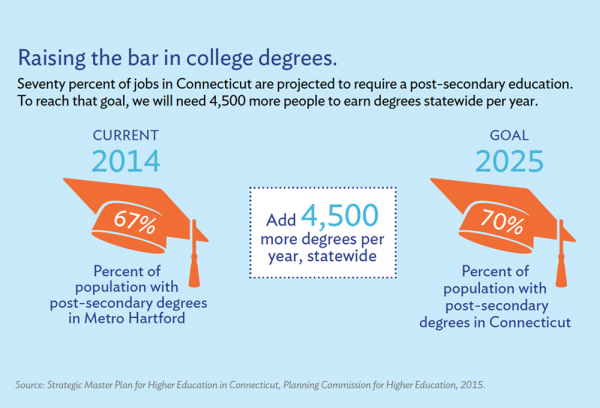
Regarding preparation for college, the report indicates that “almost 50 percent of all students entering community college or Connecticut state universities require remedial coursework and training, even those from high-performing districts.”  The report notes “this means paying for additional courses, which only increases student debt.” The report indicates that 70 percent of jobs in Connecticut are projected to require a post-secondary education by 2025.  To reach that level, it is estimated that an additional 4,500 people will need to earn degrees statewide per year.  Currently, 67 percent of the population in Greater Hartford has a post-secondary degree.

collegeLargePartner organizations in developing the report include the Hartford Foundation for Public Giving, Capital Workforce Partners, Capital region Council of Governments, Metro Hartford Alliance, Hispanic Health Council, United Way of Central and Northern Connecticut, Urban League of Greater Hartford, Center for Urban and Global Studies at Trinity College, and the City of Hartford.

Impacting Public Policy, Local Fellowships Bring Young Professionals to Center of Government

The ZOOM Foundation Public Policy Fellowship is designed to develop a sustainable public service leadership pipeline in Connecticut by providing action learning opportunities and leadership development training that empowers emerging leaders to contribute meaningfully to Connecticut's public policy. For Waterford native Katie Magboo, a 2005 Magna Cum Laude graduate of the University of Connecticut who taught elementary school in New York City and Westport for nine years, it was the perfect opportunity at precisely the right time.

“I enjoy policy development work, and I’m very invested in this state,” said Magboo, who concluded her year-long fellowship this month.  Of her work with the state Board of Regents for Higher Education, “bridging the gaps” in the connections between K-12 education, college curriculum and workforce needs, she says “I’ve been privileged to have had the opportunity.” Recalling her work with the state’s Early College Steering Committee, she proudly recites the initiatives that she played a role in developing that have already begun to take root in the state – with more in the pipeline.Kathleen Magboo

Established in Connecticut in 2001, ZOOM Foundation has sought to partner with “exceptional leaders who use a practical, entrepreneurial approach to innovation and change.” The Foundation is concerned with opportunities for impact at both a national scale as well as in Fairfield County. Primary areas of interest are education and the environment.

For the past year, five Fellows worked in the upper ranks of state and local government.  Meg Hourigan in the Office of Governor Dannel Malloy, Karla Lindquist in the Department of Economic and Community Development, Jenna Lupi in the Mayor’s Office in Milford, Katie Magboo with the State Board of Regents for Higher Education and Katie Stenclik in the New Haven Mayor’s Office.  Lupi, Lindquist and Magboo are Connecticut natives.  ZOOM Foundation awarded two fellowships in 2012 and six in 2013.logo

The Fellowship supports “select emerging leaders to increase their impact through the opportunity to work on high-level policy projects in Connecticut and participation in an intensive professional development and network building program,” the organization’s website points out.

The selection criteria include: intellectual curiosity coupled with a learning stance, entrepreneurial spirit, resourcefulness, emotional intelligence and commitment to public service.  Eligibility requirements include a bachelor’s degree, at least two years of post-grad work experience, relevant leadership experience, and a desire to continue on a path of leadership.

The Fellows “work on a variety of high-level policy projects to develop the insights and strengthen the skills necessary to lead change for the public good,” bringing “a sense of urgency, an action orientation, and a dogged optimism that meaningful social change can be achieved.” The government agencies or municipalities where the Fellows are placed choose the specific assignment and area of focus for their work.

Among the programs that Magboo helped to develop is one now underway in Norwalk.  Norwalk Early College Academy is based on the Pathways in Technology Early College High School (P-TECH) model, which combines the best of high school, college and the professional world.Norwalk

NECA is a high school plus two years, grades 9 to 14. Within this six-year timeframe, students earn not only a high school diploma, but also an Associate in Applied Science degree, from Norwalk Community College. Graduates will have the skills and experience to step into well-paying jobs in the Information Technology (IT) industry, the program’s website explains.

Similar initiatives are being developed in western Connecticut and eastern Connecticut, connecting local high schools, community colleges and local employers.  In the Danbury area, a relatively recent business in the region is serving as a partner in the initiative, to begin next year.  In eastern Connecticut, major employer Electric Boat, a division of General Dynamics, is set to be the workforce partner when that initiative gets underway.

The Foundation notes that “Connecticut has the greatest educational achievement gap in the country and the Foundation has invested in organizations and programs that will cause significant, lasting change and which generate momentum to close the gap.”

Magboo said the fellowship provided an opportunity to “make an impact at more of a macro level, and be a part of positive change.”  Her efforts included research, on the ground application, and program development, working alongside individuals from academic and industry.  “It has been an incredible opportunity.”

Applications from across the nation for the Connecticut-based ZOOM Public Policy Fellowship for 2015-16 were submitted in February, with the newly selected Fellows to begin their work later this summer. ZOOM Fellows receive a salary from the Foundation, as well as medical and other benefits, and most spend a full year working within a government organization or agency.  Based in Fairfield, the independent family foundation is led by Stephen and Susan Mandel.

AARP, The Hartford Aim to Assist Low Income Seniors Become Entrepreneurs

The Hartford has committed $1.4 million to the AARP Foundation to extend the Foundation’s Back to Work 50+ initiative to help low-income older adults assess opportunities to become entrepreneurs and create microenterprises. The three-year sponsorship, which broadens The Hartford's long-standing relationship with AARP, is part of The Hartford’s national philanthropic program. Communities with HART aims to "nurture the well-being of America’s communities by inspiring new generations of business leaders, enabling underserved neighborhood business owners to achieve growth and engaging the community in neighborhood business support," highlights the program description. “We are thrilled to sponsor the Back to Work 50+ program to educate and inspire older Americans who are interested in developing their own small businesses,” said Diane Cantello, vice president of Corporate Responsibility at The Hartford. “By encouraging entrepreneurship among older Americans, this program will help foster small business growth and contribute to the vibrancy of our communities.”1287788340353

“Older adults are redefining traditional approaches to work and careers,” said Lisa Marsh Ryerson, president of AARP Foundation. “While many want to continue to work or advance in their current jobs, a growing number want to generate income by using their talents and skills to start their own business or microenterprise. Through this effort, AARP Foundation stands ready to help by equipping them with the information and skills they need to achieve their goals.”aarp-logo

The recent announcement of this new sponsorship follows the one-year anniversary of The Hartford’s Communities with HART Program, a five-year initiative aimed at benefitting small businesses and supporting students through partnerships with the Accion U.S. Network (Accion) and Junior Achievement USA (JA).  In its first year, The Hartford announced a $1.25 million partnership with Accion to help small business owners who experience difficulty in accessing the traditional loans they need to sustain and grow their businesses. Accion manages the loan process, which focuses on community-oriented businesses in low-and-moderate income areas that hire and source locally, deliver social value and make a positive difference in their neighborhoods. With an initial focus in four key markets - Chicago, Hartford, San Antonio and San Diego – Communities with HART also provides training and web resources to help small business owners succeed.

The Hartford is also helping to inspire the next generation of small business owners as the title sponsor of the JA Company Program®, which includes a new online blended learning model and offers students the opportunity to launch their own small business while learning the basics of entrepreneurship, financial literacy and work readiness. With the help of a $1.5 million investment, JA has already seen more than a 25 percent increase in the number of JA Company Programs being conducted since the new program was rolled out across the country at the end of last year, according to company officials.