PERSPECTIVE - Social Media Manipulation: Worse than Advertising?

by Carrie Titolo I want to preface this by saying I’m not that old, but I still clearly remember life before social media (I was in college just as Facebook was born). Social media came about because of a demand for a network and personal connections that defied physical location. Facebook originally started as an online networking site just for college students (you actually needed a .edu email address to register), but what it has morphed into is an entirely different beast.

CT perspectiveWhat was once grassroots and organic now feels contrived, forced and flashy. With more paid content on your news feed than actual posts from your friends, and the rampant use of photo editing software rendering images of ourselves unrecognizable, I can’t help but think that we should be just as skeptical and wary of social media as we are of traditional advertising.quote 1

Consumers and celebrities alike have maligned the mainstream media and advertising industry for decades, criticizing them for photo manipulation and perpetuating false and unrealistic beauty standards, especially for women. A 2011 study conducted by Dove found that 80% of women surveyed felt insecure when seeing photos of celebrities in the media. Of the woman surveyed, 71% of them did not believe their own appearances were attractive or stylish in comparison to cover models. In spite of our rampant criticism of these practices, we’ve begun using social media and photo editing apps to create the same deception.

Consider the slew of apps dedicated to photo editing and the sheer number of users employing them on a daily basis to shape up their selfies. There’s PhotoWonder with the tagline “Shaping charming faces and slim bodies in the easiest way” which has over 100 million users in 218 countries. Then there’s Spring, which helps manipulate photos to make the object more model-esque: taller, thinner and with a sharper jawline. FaceTune and CreamCam remove wrinkles, zits, and skin imperfections while SkinnyCamera promises to make you look 10 to 20 pounds lighter. There are so many ways to tweak and change a photo, we might as well use computer generated caricatures or animation and save ourselves the hassle.

quote 2With such an abundance of DIY image-altering resources, the deeper, more philosophical issue comes in the eyes of the beholder. Knowing what we now know, we can’t help but look at all photos with a critical eye. Whether it’s a vacation selfie your cousin posted or that photo of Ronda Rousey on the Tonight Show with Jimmy Fallon, we automatically assume what we’re seeing isn’t real and the image has been doctored (especially in the latter example). It is this skepticism that causes me to take pause. Didn’t we take to the Twitter-sphere because we wanted to avoid being misled and blatantly marketed to? That’s not what (Facebook) friends are for!

So what to do now that we’ve dug ourselves into a hole of disenchantment and cynicism? How do we reclaim the digital territory that once was ours? I wish I had the answer. I don’t think there’s a silver bullet that will fix everything, but perhaps we can start on an individual level by taking a vow of honesty when it comes to our social media accounts. Maybe if we all try to be genuine with the images we post and encourage our friends to do the same, we can turn this perfectly toned and blemish-free boat around. Maybe one day, we’ll even come to appreciate the imperfections that not only make us unique, but make us human. #nofilter.

_________________________________________

Carrie Titolo is a graduate of the Boston University College of Communication, and has a background in public relations, marketing and nonprofit communications. She loves to cook and bake, is an avid runner and enjoys spending time with her husband and two rescue dogs.


PERSPECTIVE commentaries by contributing writers appear each Sunday on Connecticut by the Numbers.


LAST WEEK: Survey Data: Not What It Used to Be


Baseball Cards, eBay and Racial Discrimination Drive Research Study

Racial discrimination is often difficult to prove, with a variety of influencing factors making a clear cut determination often impossible.  But it is also widely recognized that racial discrimination is also difficult to eliminate. Now, academic researchers have found yet another way of demonstrating that racial prejudice continues to impact daily lives – often in ways we are unaware of or hadn’t considered. In the 27-page study, published this past winter in the RAND Journal of Economics, Ian Ayres and Christine Jolls of Yale University, and Mahzarin Banaji of Harvard University investigated the journalimpact of a seller’s race in a field experiment involving baseball card auctions on eBay. The results, according to the researchers, left little doubt.cards

In the experiment, photographs posted on eBart showed the cards being held by either a dark-skinned/African-American hand or a light-skinned/Caucasian hand. The study found that cards held by African-American sellers sold for approximately 20 percent ($0.90) less than cards held by Caucasian sellers.

“Our evidence of race differentials is important,” the researchers said, “because the online environment is well controlled (with the absence of confounding tester effects) and because the results show that race effects can persist in a thick real-world market such as eBay.”

They added that the experiment is “well suited to studying and isolating race effects because online bidders have no access to the types of seller information—such as demeanor and socioeconomic background—that are usually observable in field experiments examining the effects of race on economic behavior.”

The study, “Race Effects on eBay,” was featured in the Winter 2015 edition of the Journal, and has been referenced in national publications thereafter.  The Washington Post reported that “the cards that were held by the African-American hand actually ended up being worth more, suggesting they should have sold for more than the other batch. That is, when the researchers added up how much they had originally paid for all of the cards sold by the black hand versus the white hand, thhold cardse first total was larger.”

The Post also reported that researchers found that cards sold by the African-American seller to bidders living in Zip codes with a higher proportion of white residents sold for less than those sold to in Zip codes with a larger Black population. In addition, the Post pointed out, “one interesting feature of the study is that, on eBay, the value of the auctioned good is decided in a kind of collective process. Buyers are not just trying to determine how much the good is worth to them; they are also trying to figure out how much everyone else is likely to bid for it. In an eBay auction, buyers can see others’ bids and continue to submit their price until the last minute. In other words, buyers might submit lower bids for the African-American seller not because they personally are biased, but because they expect everyone else to be.”

Christine Jolls (left) is thfaculty researcherse Gordon Bradford Tweedy Professor at Yale Law School and the Director of the Law and Economics Program at the National Bureau of Economic Research (NBER) with headquarters in Cambridge, Massachusetts. Ian Ayres (center) is a lawyer and an economist. He is the William K. Townsend Professor at Yale Law School, the Anne Urowsky Professorial Fellow in Law, and a Professor at Yale's School of Management. Mahzarin Banaji (right), a psychology professor at Harvard University, studies unconscious thinking and feeling as they unfold in social context, relying on multiple methods including cognitive/affective behavioral measures and neuroimaging (fMRI).  Previously, she was Director of Undergraduate Studies at Yale.


Paid Family Medical Leave Has Broad Support in CT, Survey Shows

Eighty-two percent of registered Connecticut voters age 45-plus and a similar majority of voters age 25-plus, 83 percent, support a paid family medical leave plan now being considered by the state legislature, according to a recent survey by AARP Research.AARP-CT-logo The large majority is also present across the ideological spectrum, with 94 percent of registered Democrats, 79 percent of independents and 68 percent of Republicans indicating their support for state paid family medical leave to support Connecticut workers and family caregivers.

pie chartOne-thousand state voters age 25-plus were asked two questions about the paid family medical initiative, whether they supported such a plan, and whether they would support political candidates who did.

Among the 83 percent over age 45 who said they supported a paid family medical leave plan, 65 percent indicted they strongly supported such a plan, which would give employees an opportunity to contribute to and utilize a limited amount of paid leave from work to care for themselves or a loved one who is recovering from a serious medical condition.

“Connecticut voters overwhelmingly support paid family leave for workers,” said Nora Duncan, AARP CT state director. “We urge lawmakers to give serious consideration to passage of SB 221, An Act Concerning Paid Family and Medical Leave, in the remaining weeks of the 2016 legislative session. Voters are clearly interested in this policy and will make it a part of their considerations at the ballot box this fall.”

Asked if they would support a candidate for state elections who worked to implement a paid family leave plan that included working caregivers, 74 percent indicated their support, with half saying they would strongly support such a candidate. chart 2

SB 221 would create a statewide system of paid family and medical leave for workers needing time off to care for themselves, an ill loved one or a new baby. The system that’s being suggested would be fully funded by employees with no employer contribution. According to The Institute for Women’s Policy Research, the cost to Connecticut employees would be very low at just about one half of one percent of someone’s income.

Nearly half (46 percent) of registered voters in Connecticut ages 45-plus say they are currently providing or have provided unpaid caregiving to an adult loved one.  Among them, two in three (63 percent) say they have been employed either full or part time while providing that care, the survey found.

Versions of paid family medical leave laws have been approved in California, New Jersey, Rhode Island and Washington.  California's law took effect in 2004, New Jersey's in 2009 and Rhode Island's in 2014.  Washington's has yet to take effect.

CT Ranks Behind 33 States as Technology Innovation Adopter, Report Finds

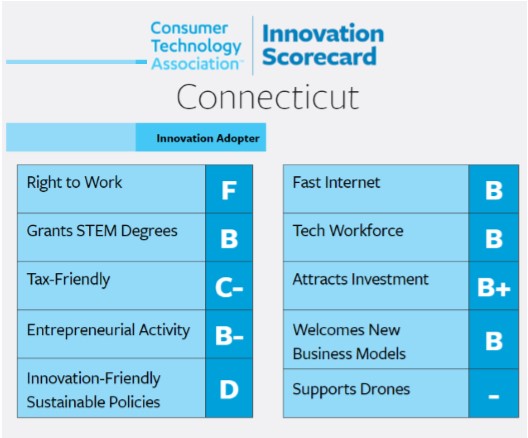
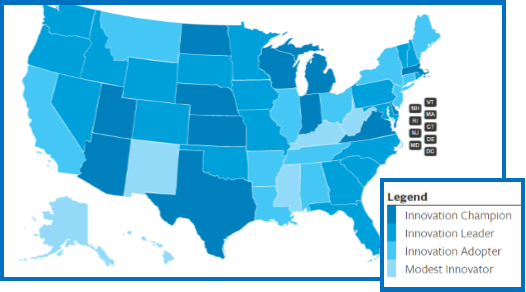
Twelve states and the District of Columbia are now championing innovation-friendly policies at the highest level according to the 2016 Innovation Scorecard, an annual innovation policy performance index developed by the Consumer Technology Association (CTA). Arizona, Kansas, Nebraska, North Dakota and Wisconsin are first-time Innovation Champions – the top designation - joining repeat champion winners Delaware, Indiana, Massachusetts, Michigan, Texas, Utah, Virginia and the District of Columbia.CT scorecard

Connecticut ranked in the third of four tiers, as an Innovation Adopter. The CTA Innovation Scorecard grades every state and the District of Columbia on 10 criteria, ranging from quantitative to qualitative, and ranks them across four categories — Innovation Champions (13 states), Innovation Leaders (20 states), Innovation Adopters (12 states including Connecticut) and Modest Innovators (6 states).

"We hope the Innovation Scorecard will be a guide for states who want to embrace those policies that best drive innovation, create good jobs and fuel economic growth," said Gary Shapiro, president and CEO, Consumer Technology Association. "We've identified and measured some key practices that enable innovators to thrive including drawing entrepreneurs from across the country, welcoming disruptive business models and educating the workers of tomorrow. But unless more state policymakers adopt a light regulatory framework, they risk sending valuable talent and economic growth to a neighboring state - or, far worse, overseas."cover

The 2016 Innovation Champion states earned high grades for maintaining strong right-to-work legislation, fast Internet access, a robust entrepreneurial climate and an open posture to new business models and technologies. Other Scorecard criteria are tax policy, tech workforce, investment attraction; Science, Technology, Engineering and Mathematics (STEM) degrees; unmanned innovations and sustainability policies. Since the last edition of the Scorecard, six states regressed to a lower tier.

Connecticut’s top grade, a B+, come in the Attracts Investment category.  The state earned a B in four categories:  Fast Internet, Tech Workforce, Welcomes New Business Models and Grants STEM degrees, and a B- in Entrepreneurial Activity.  The state’s lesser grades were in the categories Tax Friendly (C-), Innovation-Friendly Sustainable Policies (D) and Right to Work (F).  The report indicates that “Connecticut’s state-run electronics recycling system overcharges residents and manufacturers of consumer tech products, who pay for recycling at twice the market rate.”

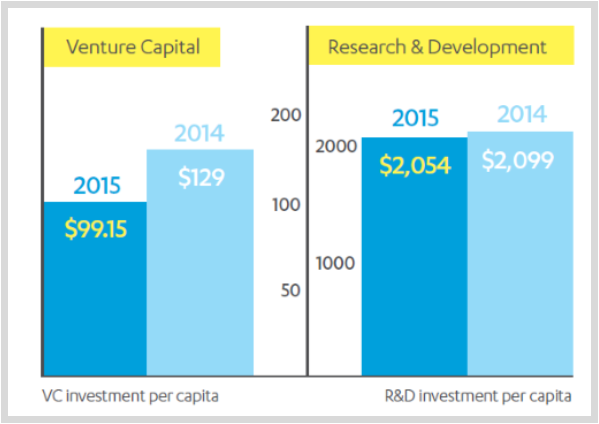
investmentThe report also highlights an area of decline in Connecticut:  “Over $100 million of venture capital left Connecticut in 2015, causing the state to lose ground after earning an ‘A-’ in the category in the inaugural 2015 Scorecard. Connecticut should improve its tax code, which is among the least growth-friendly in the country, and reform regulations that stifle innovation.”

Among the findings: Delaware, Massachusetts, Rhode Island, Utah and the District of Columbia have the fastest Internet speeds in the country; Montana, North Dakota and Wyoming are among the leading states - along with the District of Columbia - at creating new jobs and new small businesses; and Arkansas, Maryland, Mississippi and Oregon were the only states earning a top grade for creating a policy environment favorable toward drones.

Consumer Technology Association (CTA)™, formerly the Consumer Electronics Association (CEA)®, is the trade association representing the $287 billion U.S. consumer technology industry.

usa map

Indiana Insurance Department to Hold Hearing on Anthem Acquisition of CIGNA on April 29

The Indiana Insurance Department will consider the proposed acquisition of Bloomfield-headquartered CIGNA Health Care by Indianapolis-based Anthem, Inc. at a public hearing on Friday, April 29 in Indianapolis.indiana “Any member of the public interested in the proposed acquisition of control may attend the hearing,” indicates a public notice of the hearing. In addition, “Any policyholder of Cigna HealthCare of Indiana, Inc., or other person whose interests may be affected by the proposed acquisition of control shall have the right to appear and become party to the proceeding.”

Officials indicated that written testimony could be mailed in lieu of an in-person appearance, and would be considered. Members of the public may make written submissions  without appearing in person at the hearing. Length of submissions should not exceed 5 pages, double-spaced. Officials indiated that submissions should be sent to John Murphy, outside counsel to the Commissioner in this matter, by close of business on April 26, 2016. Contact information is: John T. Murphy, ICE MILLER LLP, One American Square, Indianapolis, IN  46282, (317) 236-2292, john.murphy@icemiller.com  [this information was updated on 4/19]


Consumer Groups, State Comptroller Call for Full Review

Among those aligned in opposition to the acquisition is the American Medical Association, noting that the deal would make the combined firm the nation’s largest insurer by membership and also give the company a tremendous amount of leverage when negotiating with providers.  In a press release, AMA President Steven J. Stack, MD, said such proposed mergers threaten to reduce competition and choice. “To give commercial health insurers virtually unlimited power to exert control over an issue as significant and sensitive to patient health care is bad for patients and not good or the nation’s health care system.”

Anthem and CIGNA suggested that the deal will create new efficiencies that will make the healthcare market function more efficiently.  A website, www.betterhealthcaretogether.com, has been established to highlight the companies commitment to “drive health care innovation.”

Last month, a coalition of consumer and medical organizations in Connecticut called for greater public input into the Connecticut Insurance Department’s review of the proposed Anthem-CIGNA  mega-merger, expressing concerns about the potential “negative impact on both the cost and quality of care in Connecticut” of that acquisition and the proposed Aetna-Humana merger. The groups – Universal Health Care Foundation, Connecticut Citizen Action Group and the Connecticut State Medical Society – formed the “Connecticut Campaign for Consumer Choice” coalition and urged state Insurance Commissioner Katherine Wade to “ensure an open, transparent hearing process in Connecticut, where policy holders, physicians and other interested parties are given maximum opportunity to share their views.” The coalition has been conducting public information sessions, including one in Mansfield this week, to provide state residents with information on "what the proposed health care mergers will mean for Connecticut consumers."

A week ago, State Comptroller Kevin Lembo, in a letter to the Department, urged an open and thorough review in order to address significant concerns raised by health care consumers and providers.  Lembo expressed his support for the efforts of the Connecticut Campaign for Consumer Choice, noting that a merger between Anthem and Cigna would increase the Connecticut health insurance concentration over 40 percent.   Lembo indicated that only Georgia is expected to experience a more significant increase in market concentration.

CIGNA Questions Anthem; Feds Question CIGNA

A week ago, Modern Healthcare, a web publication focused on healthcare business news, raised questions about the absence of detail in the year since Anthem disclosed “what was by far the largest data breach in healthcare history.  The cyberattack—in which hackers stole the names, birth dates, Social Security numbers, home addresses and other personal information of 78.8 million current and former members and employees – caused consumers to question “whether Anthem and other healthcare organizations could manage the volumes of data they had,” according to the news report. anthem-cigna-logos-thumb-400

The publication also questioned whether state regulators would consider not only the breach, but CIGNA’s reaction to it at the time:

“Trust with customers and providers is critical in our industry, and Anthem has yet to demonstrate a path towards restoring this trust,” CIGNA CEO David Cordani and former Board Chairman Isaiah Harris Jr. wrote in a June 21, 2015 letter: “We need to understand the litigation and potential liabilities, operational impact and long-term damage to Anthem's franchise as a result of this unprecedented data breach, as well as the governance and controls that resulted in this system failure.”  It was estimated that in Connecticut, about 1.7 million people were affected.

In January, published reports indicated that U.S. regulators temporarily banned CIGNA-HealthSpring from offering certain Medicare plans to new patients after a probe uncovered issues with current offerings, citing that CIGNA’s deficiencies “Create a Serious Threat to Enrollee Health and Safety.”  CIGNA disclosed that the U.S. Centers for Medicare and Medicaid Services (CMS) had suspended the company from enrolling new customers or marketing plans for CIGNA Medicare Advantage and Standalone Prescription Drug Plan Contracts. CIGNA acquired HealthSpring in 2012.CMS_logo

In an enforcement letter, CMS accused CIGNA of "widespread and systemic failures," including the denial of health care coverage and prescription drugs to patients who should have received them. The actions "create a serious threat to enrollee health and safety," said CMS, which required CIGNA to appoint an independent monitor to audit its handling of the matter.

“Cigna has had a longstanding history of non-compliance with CMS requirements. Cigna has received numerous notices of non-compliance, warning letters, and corrective action plans from CMS over the past several years. A number of these notices were for the same violations discovered during the audit, demonstrating that Cigna has not corrected issues of non-compliance,” said the 12-page enforcement letter from the Director of the Medicare Parts C and D Oversight and Enforcement Group.

CIGNA, First in Connecticut

Nearly five years ago, in July 2011, CIGNA announced it was to receive $50 million in economic benefits from the Connecticut Department of Economic and Community Development with the promise of adding at least 200 jobs the following two years, which would increase the company’s employment in the state to more than 4,000.  CIGNA also declared Bloomfield its corporate headquarters in the United States, replacing Philadelphia which had been the company’s corporate headquarters since 1982.gov_first_five_a

CIGNA was the first company to receive economic incentives under Governor Dannel Malloy’s “First Five” program, which was designed to spur job growth and support Connecticut businesses in becoming more competitive in the global marketplace. “CIGNA is proof that these tools work and that Connecticut is open for business,” Malloy said at the time.

“Through this partnership with the Governor and the state, we are building upon our long history in Connecticut,” added CIGNA Chief Executive Officer David Cordani.

Anthem's application states it has "no current plans or proposals to reduce in any material respect the number of employees employed by the Cigna companies."  The $54 billion merger would increase Anthem's membership from 38 million to 53 million members nationwide.

Approval in Florida, Concerns in California

“There are no meaningful adverse impacts resulting from the acquisition,” Florida’s Insurance Commissioner said last week in approving the acquisition in his state. “The companies, individually or in combination, are an important part of, but not a dominant factor in, the Florida market, and their combination does not noticeably increase the market concentration across the broadly measured market on a statewide basis.”

In California, the combined membership of Anthem Blue Cross and Cigna would make it the largest insurer in the state with more than 8 million members.  At a public hearing in California last month convened by that state’s Insurance Department, consumer advocates and the AMA opposed the acquisition.

"This merger would create the nation's largest insurer, which could have a significant impact on California's consumers, businesses, and the healthcare marketplace," said California’s Insurance Commissioner. "I am considering what is best for consumers and the overall marketplace. Anthem and Cigna bear the burden of demonstrating this proposed merger is in the best interest of California consumers and the health-care marketplace."

Shareholders of Anthem and Cigna voted overwhelmingly in favor of the merger plan late last year, and regulators in 26 states where the companies operate are at various stages of considering the acquisition.  Attorneys General in a number of those states, including Connecticut, are looking into the proposed acquisition on anti-trust grounds, and the U.S. Department of Justice has the final authority to approve the deal, published reports indicate.California_Department_of_Insurance_seal

The news site Business Insurance reported soon after the acquisition was announced that “viewed in tandem with rival Aetna Inc.'s recent $37 billion merger agreement with Humana Inc.— as well as St. Louis-based health insurer Centene Corp.'s proposed acquisition of Woodland Hills, California-based Health Net Inc. for $6.3 billion — experts said regulators may be more stringent in examining the Anthem/Cigna deal's potential to dampen health insurer competition.”

CT Businesses Expect More Hiring During 2nd Quarter, Survey Says

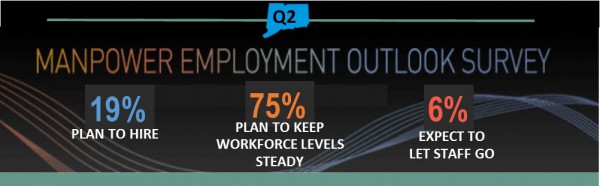
Employers in Connecticut expect to hire at a respectable pace during the second quarter of 2016, which began on April 1, according to the Manpower Employment Outlook Survey. From April to June, 19 percent of the companies interviewed plan to hire more employees, while 6 percent expect to reduce their payrolls. Another 75 percent expect to maintain their current workforce levels. This yields a Net Employment Outlook of 13 percent, according to the Survey.

“Hiring intentions are stronger compared to Q1 2016 when the Net Employment Outlook was 8 percent,” said Manpower spokesperson Becca Dernberger. “The hiring pace is expected to slow down compared to one year ago when the Net Employment Outlook was 19 percent.”

Q2CTFor the quarter just underway, job prospects appear best in Construction, Durable Goods Manufacturing, Transportation & Utilities, Wholesale & Retail Trade, Information, Financial Activities, Professional & Business Services, Education & Health Services, Leisure & Hospitality and Other Services. Employers in Nondurable Goods Manufacturing plan to reduce staffing levels, while hiring in Government is expected to remain unchanged, according to the projections.
Plans for potentially massive state employee layoffs, now anticipated in the coming weeks, had not been announced when the survey was conducted.

In the Northeast, the expectations are somewhat better than in Connecticut, as 21 percent  of employers surveyed plan to increase staff levels during Quarter 2 2016 while 4 percent expect a decrease in payrolls, resulting in a Net Employment Outlook of +17 percent.

Among Connecticut’s largest municipalities, the net employment outlook for Q2 includes 14 percent in Bridgeport, 13 percent in Hartford and 11percent in New Haven.  Survey results were developed for the 100 largest Metropolitan Statistical Areas, based on business establishment count.  Leading the list were Charlotte and Omaha at 29 percent, followed by Albany and Boise City and 28 percent, Dallas and Providence and 27 percent, and Phoenix and Toledo at 26 percent.

The Net Employment Outlook is derived by taking the percentage of employers anticipating an increase in hiring activity and subtracting from this the percentage of employers expecting a decrease in hiring activity.hiring_now

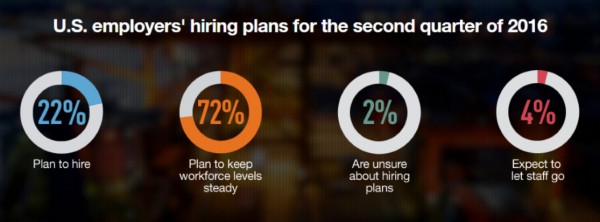
Of the more than 11,000 employers surveyed in the United States, 22 percent expect to add to their workforces, and 4 percent expect a decline in their payrolls during Quarter 2 2016. Seventy-two percent of employers anticipate making no change to staff levels, and the remaining 2 percent of employers are undecided about their hiring plans. When seasonal variations are removed from the data, the Net Employment Outlook is +16 percent, relatively stable compared to the Quarter 1 2016 Outlook, +17 percent.

The Manpower Employment Outlook Survey is conducted quarterly to measure employers’ intentions to increase or decrease the number of employees in their workforces during the next quarter. The weakest outlook for 2016 Q2 are projected in Youngstown, Akron, Baton Rouge, and Las Vegas.

“The U.S. labor market is strong compared to the global situation, with the economy still generating a sufficient number of jobs to keep the unemployment rate down,” said Kip Wright, Senior Vice President, Manpower North America. “However, we now live in a world of ‘certain uncertainty,’ where increased volatility may be here to stay. As a result, organizations and individuals need to be more agile in order to better adapt to this rapidly evolving environment, and a key differentiator to success is attracting and developing the right skills.”

US outlook

PERSPECTIVE: Survey Data; Not What It Used to Be

by Michelle Riordan-Nold In public debate, I increasingly hear the phrase: data-driven decision making. At CTData part of our core mission includes advocating for the public availability of data to inform policymaking. But what does it really mean and what data are we talking about?

As people increasingly use data to inform business or policy decisions, the quality of that data becomes even more important. Using data responsibly is something creators and users need to take seriously. Part of this includes understanding the drawbacks of data collection methodologies.CT perspective

I recently attended the Association of Public Data Users conference where several of the speakers discussed the increasing unreliability of survey data.

As it turns out, most of what we know in social science comes from surveys of households. For example, the unemployment rate, poverty rate, rate of inflation are all collected through household surveys. Federal household surveys are used to make macroeconomic policy, they are used in indexing government benefits, and in determining tax brackets.

Surveys tell us a host of factors about people's lives, including: what people are doing in response to government programs, their level of education and employment, and how they spend their money, just to name a few. They tell us how the economy is operating and how government programs are working or not working. However, rarely do we talk about the challenges and deficiencies of survey data, yet we rely very heavily on this data for decision making.

quote 2Surveys as an instrument for collecting reliable data are deteriorating. Over time, as Bruce Meyer, the McCormick Foundation Professor at Chicago Harris, notes, people are "less willing to participate in surveys, less willing to answer the questions, and when providing answers people are less likely to give accurate answers than they did in past. People are over surveyed." Frankly, the allure of being surveyed and giving your opinion is no longer a thrill.

As the saying goes, ‘a picture is worth a thousand words.' The chart below, taken from a recent paper by Meyer, shows that the non-response rate for five key national household surveys has been creeping up over the years. People are not responding that they receive government services even when they actually are the recipients of government programs.chart

But it's not just a problem of people not responding, it is also an issue that the information they provide is also quite poor. Meyer's research revealed that

"in our most used survey, that's the source of official income and poverty statistics, only about half of people receiving food stamps report it, under 40% of those receiving cash assistance report it. If you want to know who is poor you get a very bad picture from just surveys alone."

How did he figure this out? Professor Meyer linked the main household survey data to government program data (also known as administrative data). In a secure research data center, using anonymized data, he was able to look at what a recipient says in a survey to what the recipient is actually receiving.

"In surveys, the poverty rate looks much higher than what it really is; second these programs look less effective than what they are because much of the receipt is missing; in addition it looks like people who you think should be receiving these programs aren't."

What does this mean for policy?

On the one hand, it makes it look like the poor are doing much worse than they are. It also makes government programs look less effective than they are.

Meyer was involved in federal legislation that called for the establishment of a commission to look into ways that administrative data could be made more widely available to administrative agencies to determine whether programs should be expanded or contracted and to provide access to researchers both inside and outside government. The commission would be staffed by program or data experts, experts on data confidentiality and security, and with equal appointments from the House, Senate, and White House.quote 1

If these statistics were found to be so unreliable at the national level; what does it mean for Connecticut?

Relying on survey data is no longer a reliable measurement tool. It is time to look at the administrative data and examine the effectiveness of state government programs. This can be done. It should be easier with the passage last year of Public Act 15-142 that gives the Office of Policy and Management authority to link agency data and provide it to public researchers, as well as with the continued development of the P20-WIN data sharing initiative.

In order for policymakers to make 'data-driven decisions' we need to:

  1. define the outcomes desired by government programs;
  2. ensure the data are being collected to measure efficacy;
  3. analyze the data to measure the programs; and
  4. take action on the research results to ensure efficient allocation of resources.

However, this requires good administrative data that must come from those administering the programs. Let's get a commission together to ask the questions, determine the needs, and analyze the data.

With the fiscal challenges the State is facing, it's important that policymakers ensure that dollars are well spent and government programs are working. Access to better data can only lead to better government decisions.

______________________________

Michelle Riordan-Nold is Executive Director of the Connecticut Data Collaborative

PERSPECTIVE commentaries by contributing writers appear each Sunday on Connecticut by the Numbers.

LAST WEEK:  The State Budget:  What Do Demographics Have to Do With It?

Former Hometown Stamford, Public Television Launch Ken Burns' Documentary on Jackie Robinson

As the 2016 major league baseball season begins, the eyes of the nation – and his former hometown of Stamford – will once again turn to the remarkable legacy of Jackie Robinson. A new documentary by acclaimed film director Ken Burns, titled Jackie Robinson, premieres Monday, April 11 at 9 p.m. and continues Tuesday, April 12 at 9 p.m. on PBS and CPTV. To kick-off the program’s debut, the Connecticut Public Broadcasting Network (CPBN) will host a special tribute to Jackie Robinson at The Palace Theatre, Stamford on Friday, April 8 at 7 p.m. The event will include live jazz music by award-winning saxophonist Albert Rivera, and commentary and a Q&A session with ESPN commentator and former Major League Baseball player Doug Glanville.Jackie_Robinson_Title_878x494

Although not a Connecticut native, Robinson lived in Stamford for nearly 20 years, having moved to the community while a member of the Brooklyn Dodgers in 1954.  Robinson, known world-wide for breaking the color barrier in major league baseball in 1947, died of a heart attack in 1972, at age 53.

The evening will include an advance preview screening of the new two-part documentary by Ken Burns. The story of the first African American to play baseball in the major leagues features interviews with President Barack Obama, Harry Belafonte, Tom Brokaw, and others who share how Robinson’s determination and heroism influenced generations.12191994_10153655136803080_6232117043660408872_n

Upon arriving in Stamford, Robinson and his family lived with Richard Simon, co-founder of Simon and Schuster, and his wife, Andrea and their family at their North Stamford home before building a home on Cascade Road in North Stamford. The Simons’ daughter, singer/songwriter Carly Simon, recalled going with Robinson to Ebbets Field to see the Brooklyn Dodgers when she was young, the Greenwich Time recently reported.

parkStamford has a public park named in his honor, recalling that Robinson represented tolerance, educational opportunity, and the confidence that inspires personal achievement and success. A life-size bronze statue of Jackie Robinson with an engraved base bearing the words “COURAGE,” “CONFIDENCE,” AND “PERSEVERANCE” stands in the park located on West Main Street, the gateway to downtown Stamford.

Just weeks ago, Jackie Robinson’s daughter Sharon and her mother Rachel accompanied President Obama to Cuba, and joined him and the United States delegation at an exhibition baseball game.  She told mlb.com:

robinson“It brought back very personal memories of my father talking about his trip to Cuba in 1947, when the Brooklyn Dodgers trained in Havana. At the time, dad was a member of the Dodgers' farm team, the Montreal Royals. Branch Rickey arranged for him to fly to Cuba for an exhibition game, just a couple of months before he broke down baseball's color barrier in the United States. To me, this connection to my father almost brought me to tears. I was watching a baseball game in the same stadium nearly 70 years later.”

In the two-part documentary, Ken Burns “reveals fascinating stories about the legend’s life on and off the field.”  In part one, Robinson “rises from humble origins to integrate Major League Baseball, performing brilliantly despite the threats and abuse he faces on and off the field and, in the process, challenges the prejudiced notions of what a black man can achieve,” according to PBS.  In part two, Robinson” uses his fame to speak out against injustice, alienating many who had once lauded him for ‘turning the other cheek.’” After baseball, during his years in Stamford, “he seeks ways to fight inequality, but as he faces a crippling illness, he struggles to remain relevant.”

The documentary “paints the picture of a man who challenged institutional racism in the face of harsh criticism. It also delves into his close-knit relationship with his wife, Rachel, and their children through candid interviews and personal family photos.”

In 1997, Major League Baseball “universally” retired his uniform number, 42, across all major league teams; he was the first pro athlete in any sport to be so honored. Initiated for the first time on April 15, 2004, Major League Baseball has adopted a new annual tradition, “Jackie Robinson Day,” in which all players on all teams wear #42.

Of his interest in sharing Robinson’s story, director Ken Burns said, “There was so much more to say not only about Robinson’s barrier-breaking moment in 1947, but about how his upbringing shaped his intolerance for any form of discrimination and how after his baseball career, he spoke out tirelessly against racial injustice, even after his star had begun to dim.”

My dad once said, "A life is not important except in the impact it has on other lives," Sharon Robinson recently recalled.