NHL Considers Las Vegas and Quebec, Not Hartford

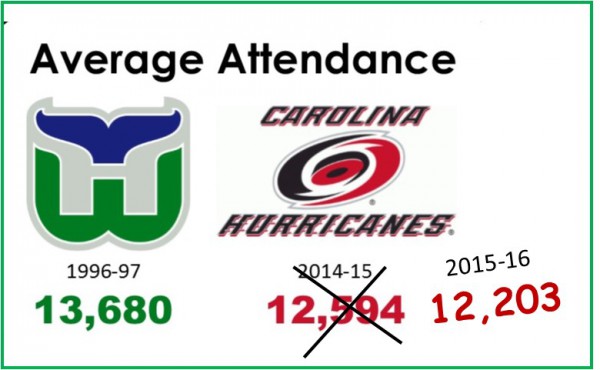
Apparently, it’s all about the lease.  Rumors continue to fly about the possible relocation or sale of the Carolina Hurricanes of the National Hockey League, but Hurricanes owner Peter Karmanos, who moved the team formerly known as the Hartford Whalers there two decades ago, says they’re staying put. The Hockey News is reporting that no team in the league has had worse attendance this season than the Hurricanes, whose average attendance has been 12,203 this past season. That’s more than 1,000 fewer fans than Arizona’s attendance, and Carolina is the only team in the league consistently selling less than two-thirds of the maximum attendance at home. In fact, the Hurricanes’ average of 65.3 percent capacity is the lowest by more than 12 percent.cities

In Forbes’ annual franchise valuations, the Hurricanes were ranked 28th at a value of $225 million, the News reported. Only the Arizona Coyotes and Florida Panthers were given a lower valuation by Forbes. In addition, Forbes said the Hurricanes had an operating income of -11.7 million, which ranked behind only the Panthers and New York Islanders.

“We have commitments that we value (in Carolina). We have an excellent lease, I love (PNC Arena) and I am deeply committed to this market,” Karmanos was quoted as saying in quashing rumors that the team was headed to Quebec, where an NHL-ready arena is waiting. attendence updated

A Las Vegas-based website, sinbin.vegas, reports that “their lease runs through 2024. He receives 100% of all parking and concessions for all non-North Carolina State events and a discount on utilities.”  Las Vegas has also been rumored for a franchise relocation or expansion team, and was one of two cities (Quebec was the other) to formally apply for an expansion franchise late last year.

The website reiterates that the Hurricanes are filling only 65% percent of the PNC Arena in Raleigh, which lists a capacity of 18,680. “The obvious reason is because the Hurricanes will once again not take part in the postseason…which doesn’t inspire the folks of Raleigh to attend… which sparks talk of relocation. To give this proper perspective the Columbus Blue Jackets are second from the bottom while filling only 77.7 percent of the Nationwide Arena.

NESN reported in March that, according to NHL commissioner Gary Bettman, “We have two applications, one from Quebec City and one from Las Vegas. That’s exactly what we expected when we began the process, that those would be the two applications we’d have.” Quebec City has a brand-new arena that opened last fall, but would be the smallest market in the league.  It would also add another Eastern city, in a league that currently has an imbalance in Eastern teams, but has promised not to move teams from the mid-west, including Detroit, into a Western conference under realignment.

Veteran hockey journalist Stan Fischler is reporting that the NHL “could very well put teams in tiny Quebec City and sprawling Las Vegas; and likely will make that decision in June.”

A return to Hartford is not on the NHL radar.  As Hartford Courant columnist Jeff Jacobs pointed out last summer, when the NHL expansion process began, “without anyone willing to pay a whopping $500 million expansion fee the league owners want, bid or not there is no way — zero, zero, zero way — the NHL would select Hartford in 2015.”  Or 2016, apparently.  And 2017 is not looking good either.

PNC_Arena

PERSPECTIVE: Highway Winter Maintenance Pay off? Safety!

by Eric Jackson, PhD and Donald Larsen, PE In Connecticut, as in many other snow belt states, the state Department of Transportation (CTDOT) as well as local Public Works Departments (DPWs) can suddenly be thrust into the spotlight (or the hot seat) when winter storms hit, particularly when driving conditions deteriorate.  Our daily exposure to lightning fast activities and information, which allow us to assess situations aCT perspectivend form opinions rapidly have altered our expectations.

Interestingly, as little as ten years ago, when a winter storm would make travel hazardous and place our busy lives on hold, we seemed able to adapt, maybe wait a day, adjust and move on.  Today’s society has little patience for travel delays and the “privilege” to travel is now seen as more of a right.

Fortunately, the CTDOT does not view this challenge as insurmountable and has used foresight and innovation to keep winter travel as safe as possible.  Since the winter seaq1son of 2006/2007 CTDOT has changed the way winter maintenance is performed.  They have discontinued the use of abrasives (such as sand) and phased in methods known as ‘anti-icing’ strategies [1].  These strategies have been honed and polished continually over the past ten years.
The Connecticut Academy of Science and Engineering (CASE) prepared a report for the Connecticut General Assembly in 2015 that evaluated winter maintenance strategies employed at CTDOT.  This study reviewed CTDOT’s anti-icing effects on safety, the environment, and corrosion of vehicles and highway infrastructure.  The entire report can be found at http://www.ctcase.org/reports/  [2].  The safety implications of these changes were analyzed using the Connecticut Crash Data Repository (CTCDR), a motor vehicle crash database housed at the University of Connecticut.

An analysis of vehicle crashes over thirteen winter seasons, 1999 to 2013, was conducted to try and evaluate the impact of anti-icing on safety (see chart).  A comparison of crashes, specifically for state-maintained roads during winter seasons, indicates that injuries declined by 19.2%, on average, since anti-icing strategies were implemented.  When crashes on snow/slush or ice surface conditions were examined the average reduction in crashes with nonfatal injuries was an even more dramatic, 33.5%. graph
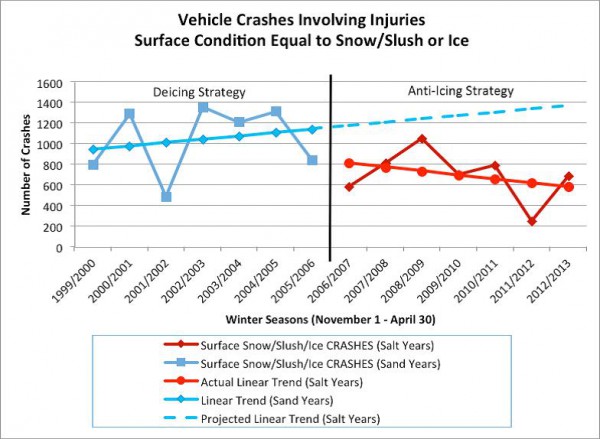
CHART: Motor vehicle crashes involving nonfatal injuries with pavement surface condition equal to snow/slush or ice on Connecticut state-maintained roadways.

The reduction in the number of motor vehicle crashes with nonfatal injuries is a significant finding because according to a study by Qiu et al at the University of Iowa the rate of crashes on snow can be 84% higher than on dry pavement [3].  With an estimated cost in 2010 (from the National Highway Traffic Safety Administration) of $276,000 per non-incapacitating injury, [4] society- including everyone that travels - benefits from this significant reduction in injurious crashes.

Between 2006 and 2013, there was a reduction of 2,449 crashes with nonfatal injuries on Connecticut state-maintained roadways during snow/slush or ice conditions.  This calculates out to a cost savings of approximately $676 million.*q2
Other ongoing research throughout the world shows that plowing is still the most cost effective way to clear the roadways of snow and ice.  Abrasives such as sand, grit or stone dust do not remove the snow or ice, and only delay the inevitable need for removal or melting.

However, the anti-icing techniques – the scientific application of deicing chemicals such as salt and other materials - provide a very important aid to snow/ice removal operations, preventing ice and snow from bonding to paved surfaces.  With anti-icing, the time period with snow covered roads – which are those critical times when crashes are most likely to occur - is also reduced.

From the estimated savings shown, it is important that CTDOT and the local municipal DPWs continue to improve winter maintenance by employing state-of-the-art equipment for chemical applications, timely snow and ice removal, and using weather monitoring stations as well as advanced weather prediction services and models. It appears that from the safety benefits alone, the continued expenditures made on winter maintenance have paid off.  Reducing the negative economic impact that results when people and goods don’t move is another benefit.

The CTCDR is available to anyone wishing to view motor vehicle crash statistics in Connecticut, for any type of crash, under any road conditions.  Connecticut is one of the few states that maintains a publicly accessible crash database.  It is highly recommended that if you have an interest in crash data, visit http://ctcrash.uconn.edu/ [5].

____________________________________

Dr. Eric Jackson is an Associate Research Professor in the School of Engineering at the University of Connecticut and is Director of the Connecticut Transportation Safety Research Center.  Donald Larsen PE, is a Temporary University Specialist at the Connecticut Transportation Institute at UConn and former Supervising Engineer with the Connecticut Department of Transportation

PERSPECTIVE commentaries by contributing writers appear each Sunday on Connecticut by the Numbers.

LAST WEEK: Do Community College Students Go Begging?

______________

[1]   CTDOT Staff, An Overview of Snow and Ice Control Operations on State Highways in Con­necticut, Office of Maintenance, Bureau of Highway Operations, Connecticut Department of Transportation, Newington, CT, June 2015.

[2]   Mahoney, J., D. Larsen, E. Jackson, K. Wille, T. Vadas, and S. Zinke, Winter Highway Maintenance Operations: Connecticut, Publication CT-2289-F-15-1, CTDOT, Connecticut Academy of Science and Engineering, July 2015. http://www.ctcase.org/reports/WinterHighway2015/winter-highway-2015.pdf

[3]   Qiu, L., and W. Nixon, Effects of Adverse Weather on Traffic Crashes, Transportation Research Record: Journal of the Transportation Research Board, No. 2055, Transportation Research Board of the National Academies, Washington, D.C., 2008, pp. 139-146.

[4]  Blincoe, L. J., Miller, T. R., Zaloshnja, E., & Lawrence, B. A., The Economic and Societal Impact of Motor Vehicle Crashes, 2010, National Highway Traffic Safety Administration, USDOT, Washington, DC, Report No. DOT HS 812 013, May 2014, (rev. 2015, May).

[5]   Connecticut Crash Data Repository, Connecticut Transportation Institute, University of Connecticut, Storrs, CT. Website. http://ctcrash.uconn.edu/ (Accessed May 5, 2016).

*   For purposes of this calculation, each crash was arbitrarily assigned one non-incapacitating injury.

This article is based on a study conducted by the Connecticut Academy of Science and Engineering on behalf of the Connecticut Department of Transportation.  Eric Jackson and Donald Larsen served as members of the Research Team from the Connecticut Transportation Institute at the University of Connecticut.  Access the full study report, an executive summary, and briefing at http://www.ctcase.org/reports/index.html

Six State Commissions, Victims of Budget Consolidations, Disappear After Decades-Long Record of Achievement

After 43 years, the ironically-named Permanent Commission on the Status of Women began the organization’s final newsletter with an ironic observation:  “the PCSW had its most successful legislative session ever, celebrating the passage of four bills instrumental in protecting women's health and safety.” The PCSW is one of six legislative commissions eliminated in a last-minute budget compromise at the end of the legislative session a month ago.  The six ceased to exist on Thursday (June 9).  In their place will be two Commissions, each a mash-up of three of the organizations.

Wiped from the roster of state agencies are the PCSW, Legislative Commission on Aging, Commission on Children, Latino and Puerto Rican Affairs Commission, African American Affairs Commission and Asian Pacific American Affailogo-for-webrs Commission.  Replacing them will be the Commission on Women, Children and Seniors and a Commission that merges the Latino, African-American and Asian Pacific American Commissions.
All staff members were effectively laid off, some applied for the handful of jobs that are to exist in support of the new Commissions.  The volunteer Commissioners will be holdovers, meaning that 63 Commissions will remain in place to set policy direction.

The 23 year old Commission on Aging was eliminated as Connecticut rapidly approaches a new, long-term reality—older adults will comprise an increasingly large proportion of the population.  At least 20 percent of almost every town’s population in the state will be 65 years of age or older by 2025, with some towns exceeding 40 percent.  Already, Connecticut is the 7th oldest state in the nation.Official_Logo_md

The Asian Pacific American Affairs Commission, the most recent of the six, was established in 2008 to respond to a growing population in Connecticut.  With the smallest budget, the agency struggled to gain traction, and was just beginning to fulfill its mission when the end arrived.  Connecticut's Asian American population grew from 95,368 in 2000 to 157,088 in 2010 – a 65% increase. Asians represent the majority minority in 40 percent of Connecticut school districts, according to the Commission. apacc_logo5-300x151

The Permanent Commission on the Status of Women was formed in 1973 to study and improve Connecticut women’s economic security, health and safety; to promote consideration of qualified women to leadership positions; and to work toward the elimination of gender discrimination.

Over the next four decades, the organization played a pivotal role in the passage of more than 50 significant pieces of legislation, often placing Connecticut at the forefront of progress towards greater justice or equal treatment for women.

That was certainly true in 2016, in what turned out to be, as was once said in a different context, the best of times and the worst of times.  This year, PCSW advocated for major initiatives that gained legislative approval:

  • Allow judges to remove firearms during temporary restraining orders in domestic violence;
  • Make affirmative consent the standard for investigating alleged campus sexual assaults;
  • Establish a working group to study possible labor violations in the nail salon industry;
  • Eliminate the discriminatory tax on feminine hygiene products and diapers;
  • Dramatically strengthen anti-trafficking laws by: shifting the focus of arrests in prostitution cases to the "demand side"; raising penalties against buyers of sex; removing the "mistake of age" defense; and requiring hotels and motels to keep records of those who rent rooms by the hour; and
  • Give judges authority to remove parental rights from rapists in cases of clear and convincing evidence of sexual assault resulting in pregnancy.

Established in 1997, the mission of the African-American Affairs Commission (AAAC) was to improve and promote the economic development, education, health and political well-being of the African-American community in the State of Connecticut.  The Commission has been at the forefront of a range of issues impacting the African American community in Connecticut, and its demise occurs when race relations and equal opportunity remain under heavy scrutiny in Connecticut and across the country.   AAAC Logo

Glenn A. Cassis Executive Director of the African-American Affairs Commission, when the consolidation plan was announced, said merging the panels will cause "irreparable damage to the African-American community in Connecticut."

"The elimination of AAAC tells the African-American community that their issues are not important to the state,'' Cassis wrote in an open letter to the leaders of the General Assembly. "The message that resonates is that despite the successful efforts of the past to eliminate the disparities that exist for this constituency in education, health, economic development, criminal justice and incarceration, and social well-being have become marginalized. Years of progress made has been cut short from being fully impacted to the level that this growing segment of Connecticut’s population deserves and expects."

downloadThe Latino and Puerto Rican Affairs Commission (LPRAC) was created by an act of the Connecticut General Assembly (CGA) in 1994. This 21 member non-partisan commission is mandated to make recommendations to the CGA and the Governor for new or enhanced policies that will foster progress in achieving health, safety, educational success, economic self-sufficiency, and end discrimination in Connecticut.  As of 2014, the state’s Hispanic population exceeded 500,000, about 15 percent of the state’s overall population.

In an Open Letter, LPRAC Executive Director Werner Oyanadel said “The decision to eliminate LRPAC does not in any way diminish the significant pride of the Commissioners and LPRAC staff, present and past, in the far-reaching and often ground-breaking work that has been accomplished to advance the quality of life for our state’s steadily growing Latino population.”  He added that “the end of a distinguished and impactful decades-long history does not diminish or eviscerate the landmark laws, policy-changing research and enduring impact of LPRAC on countless families, businesses and individuals of Hispanic heritage, and all the citizens of Connecticut.”

The Commission on Children, established in 1985, was borne of the legislature’s desire for the development of “policies that would ensure the health, safety, and education of Connecticut children.”  Said long-time Executive Director Elaine Zimmerman: “We feel we’ve succeeded beyond anyone’s wildest hopes, taking a leading role in issues as important—and diverse—as closing the achievement gap in reading, school climate, immunization, disaster planning for families, school readiness, children’s mental health, home visitation, youth employment, equity, and poverty reduction.landmarks”

One of the testimonials on the PCSW website, said succinctly: “The commission boldly tackles the issues that matter to my survival and prosperity! Their work to identify and eradicate inequality (whether of the deliberate kind or not), to serve as a public voice for women’s issues which are underrepresented in all public spheres, and to engage the public is integral in working toward a fair and just society.”

Regarding the state’s Latino population, Oyanadel said “the successor combined Commission will not be nearly the same; we can only hope that its impact will not be diluted or weakened, though we are concerned that our community will have a softer voice advocating for those issues of particular importance in and impact on the Latino community.”

Back in 2011, when consolidations and eliminations were under consideration by legislators, but ultimately not approved, as was the case repeatedly since the 2008 recession, Gov. Malloy told the CT Mirror: "If they asked my advice, I'd consolidate a bunch of them."

And in 2016, it came to pass.

Fast Forward Past Fiscal Crisis: CT Developing Goals for the Year 2041

New goals approved in the waning hours of the state legislative session focus not on the impending deficit in the next two years, but what Connecticut should look like a quarter-century from now. Fast forwarding to the future, the newly approved legislation establishes a “Connecticut 500 Project” to develop a plan to, within 25 years:

  • Increase private sector jobs by 500,000;
  • Increase Connecticut’s population by 500,000;
  • Increase by 500 the number of start-up companies organized around Connecticut-developed intellectual property;
  • Increase by 500 the number of students graduating from each state college and university;
  • Achieve a national ranking within the top five for economic growth, public education, quality of life, and private sector employee salary;
  • Maintain Connecticut’s position within the top five for productivity, higher education, and income per capita.

500“This is an effort to reassert Connecticut as one of the strongest economies in the nation and in the world,” State Representative William Tong recently told WNPR. He's co-chair of the state’s Commission on Economic Competitiveness, and said the Connecticut 500 Project comes directly out of the work of the commission.  The commission will continue to flesh out the Connecticut 500 Project, and look to hire a private consultant to take the plan forward, WNPR reported.

Tong added that the project is modeled after similar efforts in states like New York, Minnesota, and Ohio, and one of its centerpieces will likely be to move away from Connecticut’s traditional suburban strategy, focusing instead on building population and business vitality in its urban cores.

Some of the groundwork begins sooner, and comes with a price tag.

The state Department of Economic and Community Development (DECD) is required to establish a Talent Advisory Committee to assess shortages in the software development and other technology workforces, and develop pilot programs to correct such shortages.  And the Committee would develop knowledge enterprise zones around colleges and universities with the same benefits accorded entities in enterprise zones.

Details are still to be worked out as to how such an initiative would unfold, and the precise role of the state’s public and private institutions.  The committee would design a pilot program to recruit developers and train state residents over the next 10 years, according to the legislation.

The department’s First Five financial assistance program to encourage business expansion and job creation, is also expanded, as a means of hitting the lofty goals within the next two-and-a-half decades. first

The initiative, which began just a few years ago with five companies and has expanded almost every year since, providing loans and grants to Connecticut businesses as an incentive to remain in the state either despite, or because of, the steadily increasing state deficit driven in part by declining tax revenues.  The First Five program is increased once again under the bill to 20 projects from 15.

When it began in 2012, the companies identified to receive state funds were CIGNA, ESPN, NBC Sports, Alexion Pharmaceuticals, and CareCentrix.  Subsequent participating companies benefitting from the program include Deloitte, Bridgewater, Charter Communications, Sustainable Building Systems, Navigators, Synchrony Financial and PitneyBowes.

Earlier this spring, DECD Commissioner Catherine Smith told the legislature that over the last three years the program has provided $256 million to thirteen different companies. Smith stated that the companies have “committed to retain more than 13,500 jobs and to create between 2,600 and 5,264 jobs” and urged the program’s expansion and extended deadline (into 2019), which was ultimately granted.

Most recently, the state provided $22 million in loans and grants to the world’s biggest hedge fund, Bridgewater Associates, to stay in Connecticut – a decision that instantly received both praise and criticism, from Democrats and Republicans alike.

More Rapes Reported at UConn Than Other Colleges in U.S.; New Study Finds Attitudes Toward Women Key In Higher Rates of Sexual Assault By College Athletes

Whether the number is interpreted as reflecting growing confidence in university adjudication systems, or a growing problem, there were 43 rapes reported at the University of Connecticut in 2014.  Nearly 100 colleges and universities had at least 10 reports of rape on their main campuses, according to federal campus safety data for that year, with UConn and Brown University in Rhode Island  tied for the highest annual total — 43 each. The release of the data comes as:

  • a new study suggests an alarming frequency of students – especially college athletes - coercing a partner into sex, and
  • the sentencing in California of a student athlete to a six month jail term for sex-related crimes, a sentence widely criticized for its brevity.

An on-line survey of 379 college men found that more than half of athletes and a more than 38 percent of non-athletes admitted to coercing a partner into sex.  Researchers surveyed male college students from one large, public, Division I university in the Southeast and asked about a list of sexually coercive behaviors — including threatening partners into oral or anal sex — almost all of which met the legal definition of rape.

The study was published in the journal Violence Against Women last week, with the researchers analysis showing “significant differences between the responses of athletes and non-athletes.”

The UConn data was announced last fall; the comparison with other universities was made public this week.  In an editorial, the UConn Daily Campus, the student newspaper, said “If students made targets of sexual abuse and harassment feel they can come forward and at least somewhat trust their university’s administration to appropriately address their situations, that speaks volumes on the progress the school is making as a bureaucracy and, most paramount, as a culture.”student

UConn spokeswoman Stephanie Reitz said the university “works very hard to cultivate a culture of forthrightness so this traditionally under-reported crime can be addressed and our students receive appropriate services and support.”

During the 2012-13 school year, UConn disclosed 13 reported rapes. That number increased to 18 the next year and to 43 last school year.  The number of reports of dating violence increased from eight in 2013-14 to 26 the following year, and the number of reports of stalking more than quadrupled, from 6 to 30.

New stories indicated that the highest number of reports occurred at Brown: 43; UConn: 43; Dartmouth College: 42; Wesleyan University: 37; and University of Virginia: 35. Yale had 13 reported rapes; Trinity had 12; SCSU had 9; Connecticut College had 8; Quinnipiac had 5; Fairfield had 4; University of New Haven had 4; University of Saint Joseph had 3; University of Bridgeport had 3; and WCSU, ECSU, CCSU and University of Hartford all had 1, according to published reports.

In April, UConn officials released the results of a survey designed to measure the problem of sexual violence on campus, and it indicated that students there feel safe, FOX61 reported. About 1,500 of 6,000 students responded to the anonymous survey, and 82 percent said they felt safe. Of the respondents, 5.5 percent said they'd been sexually asscourtaulted.

UConn was pointedly criticized two years ago from a group of students who alleged their complaints of sexual assault were not handled properly. The university later paid $1.3 million to settle the lawsuit filed by those students and made numerous changes to improve how students are treated when they come forward.  At the time, UConn was one of 67 higher education institutions under review by the Education Department’s Office for Civil Rights due to its handling of sexual assault cases.violence_against_woman_cover

Last week a former Stanford swimmer was sentenced to six months in jail and three years of probation for sexually assaulting a woman outside a fraternity party in 2015. The sentence, far more lenient than what prosecutors sought, provoked public outrage and drew renewed attention to an issue that in recent years has brought controversy and concern on campuses nationwide, including UConn.

The athletes included in the study were mostly those who play recreational, not intercollegiate, sports.  “What we see in this study speaks to a larger issue than just the high-profile and sensational reports we hear about,” Sarah Desmarais, an associate professor of psychology at North Carolina State University and the study’s co-author, told the publication. “There are some attitudes and beliefs prevalent among all kinds of male athletes that seem to be leading to high levels of sexually coercive behavior.”

For this study, the researchers surveyed online 379 male undergraduates: 191 non-athletes, 29 intercollegiate athletes and 159 recreational athletes. The study was conducted by researchers at NC State, the University of South Florida, Northern Arizona University and Emory University.

“We found that 54.3 percent of the intercollegiate and recreational athletes and 37.9 percent of non-athletes had engaged in sexually coercive behaviors – almost all of which met the legal definition of rape,” Desmarais said, in a published report on the NC State website.  “As high as these numbers are, they may actually under-represent the rates of sexual coercion, since the study relied on self-reported behavior,” Desmarais said.

The Washington Post and the Kaiser Family Foundation published in June 2015 a national poll that found one in five women who attended a residential college during a four-year span said they had been sexually assaulted. Those findings have been reinforced by surveys at several prominent research universities, the Post reported.

National Recognition for Charter Oak, Quinnipiac, Fairfield As State Stand-outs

Charter Oak State College, Connecticut’s public online college, has been ranked #2 of 100 colleges scored in the recently compiled Best College for Returning Adults. The national rank was awarded by College Factual and reported on the Forbes.com website. “We are very proud of this ranking. It speaks to the flexibility of and demand for our online workforce relevant programs, such as our new Master of Science in Organizational Effectiveness and Leadership, and the intense and successful focus on our mission of helping adults complete college degrees,” said Ed Klonoski, President, Charter Oak State College.

College Factual’s rankings specifically address “non-traditional students who actually make up the majority of degree-seekers” and include the following categories: students returning to college after dropping out or transferring; working adults seeking flexible options; students seeking distance learning options; and professional who want to utilize life experience to earn college credit.

Of Charter Oak, the website indicated “about 80% of the public school’s students are part-timers, and its online courses in liberal arts studies are among its most popular for returning adults.”  Factors deemed as “high importance” by College Factual were accreditation and early career salary boost.

Founded in 1973, Charter Oak State College is Connecticut’s only public online college, offering associate and bachelor’s degree completion programs in high-demand fields including Health Information Management, Health Care Administration, Cyber Security and Business Administration.

school logosAnother Connecticut school has received national recognition, as Military Times ranked the School of Business at Quinnipiac University as the best business school for veterans in Connecticut and the 24th best in the nation, according to its Best for Vets: Business Schools 2016 rankings.

The organization, made up of Army Times, Navy Times, Air Force Times and Marine Corps Times, focused on culture and curriculum that cater to military veterans when conducting and scoring the fourth annual Best for Vets: Business Schools survey, a highly respected analysis of a graduate business school's complete offerings for veterans. As with all of the Best for Vets rankings, Best for Vets: Business Schools is an editorially independent news project that evaluates the many factors that make an institution a good fit for military veterans.

"Veterans have told us they were attracted to a business degree because it wouldn't tie them down to a certain industry," said Amanda Miller, editor of Best for Vets. "The survey lets us recognize the graduate business schools with close military connections that truly take vets' success to heart."Forbes

Matthew O'Connor, dean of the School of Business, said, "The School of Business is proud to be selected as a 2016 Best for Vets Business School by the Military Times. As an AACSB-accredited business school, we offer a wide variety of high-quality business programs and student services”

He added, “Our excellent internship program and enviable track record for helping graduates secure full-time employment is particularly attractive to veterans. Quinnipiac is proud of the service of military personnel and veterans and celebrates the contributions they make to our University."

The rankings were published in full in the issues of Army Times, Navy Times, Air Force Times and Marine Corps Times and online.

Quinnipiac University also recently announced that the Hamden-based university will be adding a School of Engineering in the fall, breaking off from what has been the School of Business and Engineering, which offered engineering courses to students during the past four years.  The School of Engineering becomes that university’s ninth school leading to a bachelor of science degrees. It will of offer engineering degrees in civil, industrial, mechanical, software engineering and computer science.

Dr. Justin Kile has been appointed the founding dean of the new school after previously serving as Quinnipiac’s associate dean of engineering since 2013. He will guide the school through the Accreditation Board for Engineering and Technology’s yearlong approval process.

Regarding business schools in the state, Bloomberg recently concuded a study of the best U.S. undergraduate business schools, ranking Fairfield No. 1 in Connecticut with an overall national ranking of 43rd.The school jumped 15 spots from last year's rankings.

The other Connecticut business schools on the list were University of Connecticut, ranked 72nd; Quinnipiac University, 91st; Sacred Heart University, 92nd; University of Hartford, 101st; and the U.S. Coast Guard Academy, ranked at number 104. The elements that contributed to the rankings included an employer survey, student survey, starting salaries of graduates and internships available as part of the curriculum.

Another distinction for Fairfield University: the school is among nine universities nationwide to receive accreditation from the International Dyslexia Association (IDA) and its affiliate, the Center for Effective Reading Instruction, for having met the standards outlined in IDA’s Knowledge and Practice Standards for Teachers of Reading.dyslexia

The Certificate of Advanced Study (6th year), Reading and Language Development program in GSEAP received the designation.

The IDA Standards provide a framework for course content in university and other teacher preparation programs, offering research-supported documentation of what teachers ought to know and be able to demonstrate when teaching dyslexic students.  The standards also apply to the teaching of other struggling readers or the general student population.

The goal of the standards initiative is to promote consistent and high-quality teacher preparation to improve outcomes for those who struggle with written language. Fairfield’s Sixth Year Professional Certificate in Reading and Language Development is open to those who have received their master’s in education degree.

"We are very excited about this national recognition from IDA. Elementary teachers and even Reading Specialists are not prepared with the tools and training to diagnose and intervene with children with dyslexia; this program addresses that," said Robert Hannafin, Phd., Dean of GSEAP. "We are committed to helping all students read and particularly struggling readers."

Nine in Ten CT Residents Have a Usual Source of Care, But 3 in 10 Haven’t Seen Doctor in Past Year

A new federal report finds that all but 10.1 percent of Connecticut residents had a usual source of medical care during 2014 – tied for the sixth lowest percentage among the states.  The same report found great variation among states but, on average, 17.3 percent of Americans lacked a usual source of care. Vermont led the country with only 2.8 percent of residents reporting they do not have a regular care site, according to data compiled by the Centers for Disease Control and Prevention’s National Center for Health Statistics, followed by Delaware at 6.8 percent.CT stats

Even in Connecticut there remains room for improvement as nearly 3 in 10 – 29.6 percent - of Connecticut residents had not seen or talked to a general doctor during the last year, slightly better than the national average. Vermont also led the country in that statistic, with 84 percent having seen or spoken with a physician during the previous year.

The percentage of adults without a usual place of medical care ranged from 2.8 percent in Vermont to 26.7 percent in Nevada.  The percentage of adults who did not have a general doctor visit in the past 12 months ranged from 15.9 percent in Vermont to nearly have the state’s population - 48.1 percent - in Montana.

The federal data indicated that nine states (Nevada, Idaho, Texas, Oregon, Wyoming, Kentucky, Arizona, Alaska, and Florida) had a higher percentage of adults without a usual place of medical care compared with the national average (17.3%).box-2a

Conversely, Vermont, Delaware (6.8%), Massachusetts (7.5%), Wisconsin (9.5%), Hawaii (10%), Connecticut (10.1%), Rhode Island (10.1%), New Hampshire (11.6%), North Dakota (11.9%), South Dakota, New York, Alabama, Iowa, Maine, and Pennsylvania had a lower percentage of adults without a usual place of medical care compared with the national average.

Eleven states (Montana, South Dakota, Alaska, Nevada, New Mexico, South Carolina, Idaho, Nebraska, Texas, Florida, and California) had a higher percentage of adults who had not seen or talked to a general doctor in the past 12 months compared with the national average (34.0%).  Vermont, Delaware, Virginia, Pennsylvania, Michigan, Wisconsin, New Hampshire, Oklahoma, and Ohio had a lower percentage of adults who had not seen or talked to a general doctor in the past 12 months compared with the national average.

Connecticut, at 29.6 percent, ranked just outside the top 10 states in the second quartile, but just below the national average.map states

Also of note, the study found little impact on these metrics of states’ decisions to expand Medicaid or create a state-based health insurance exchange. The federal analysis concluded that “continued state-specific monitoring will be helpful in identifying and tracking state and regional disparities in health care utilization over time.”

The National Health Interview Survey is a multipurpose health survey conducted continuously throughout the year by the National Center for Health Statistics (NCHS). Interviews are conducted in person in respondents’ homes, but follow-ups to complete interviews may be conducted over the telephone. The federal report was authored by Lindsey I. Black and Jeannine S. Schiller, with the National Center for Health Statistics, Division of Health Interview Statistics.

PERSPECTIVE: Do Community College Students Go Begging?

by Endia DeCordova A professor at Manchester Community College noticed that a student – typically a regular class attendee – had stopped coming. Efforts to contact the student ultimately revealed that she had given up on many of her goals, including her education, because of depression. Having her electricity turned off because she couldn’t afford the bill was the last straw.CT perspective

A staff member at the college was approached by a student who asked to borrow a dollar for the vending machine. He had to remain on campus all day -- through an evening course -- and couldn’t afford to buy anything from the cafeteria.

One more anecdote involves a student who dropped out because of an inability to scrape up bus fare. That student relied on public transportation to get everywhere, including to class.

q1These are true stories. The names are omitted and details smoothed over for obvious reasons. But they really happened this spring at MCC.  The image of the college student – not a care in the world – partying and protesting, cramming just in time to pass an exam, and simply marking time until graduation has never really been accurate. It is certainly far from the truth today. College students face major financial and emotional stress just to get to the point where they can even settle into their studies, much less complete their degrees.
In fact, the story of the borrowed candy-bar dollar is especially heartbreaking as it makes clear how much of a hurdle food-insecurity is for an increasing number of college students. A February 2016 article in The Chronicle of Higher Education, “Students Shouldn’t Have to Choose Between Books and Food,” highlights the disturbing data on hunger among college students. According to a 2015 study by the Wisconsin HOPE Lab, 20 percent of community-college students were going hungry. Another, by City University of New York, found that 39 percent of its students were similarly at risk.

This underscores a major issue for college students nationally. How is it that higher ed creates poverty among people who are clearly working to improve their lives?

Rising costs of tuition, fees and books are easy to point to. At MCC, people are struggling to pay for higher education and after they enroll, often can’t follow through. For the spring 2016 term, nearly 900 students who applied to MCC paid their application fee but did not enroll. Another nearly 500 students enrolled but couldn’t complete their payments and were forced to drop out for lack of financial resources. Of those, many struggled to buy books or other class materials.

But the real issue is running just below the surface. Common sense tells us all that if you can’t afford to pay for something that is essentially a luxury – or a privilege, as many still view a college degree – you don’t buy it.

For many MCC students, not going to college is not an option. Their education is key to transformation – in many cases, moving them from zero hope to a promising future and a life of contributing to their families and their communities.

Yet as they forge ahead, they go begging for the basics. As the students above tragically did, they too often give up short of their goals. At the same time, public funds in Connecticut for higher ed are dropping.q2

This is why MCC is working through its foundation to develop a retention and completion grant program. Like many community colleges nationwide, we are determined to support students who have delayed starting college or “stopped out” of college because of short-term financial distress.

We ask students to assume some of the risk connected with the funding so they remain vested in their futures, but these grants (not loans) are designed to help them pay for the books -- or the bus pass, the electricity, the food they need -- to keep going and to graduate or transfer.

A college education today is a necessity. No one should have to beg.

__________________

Endia DeCordova is Dean of Institutional Advancement and Community Engagement for Manchester Community College.


PERSPECTIVE commentaries by contributing writers appear each Sunday on Connecticut by the Numbers.

LAST WEEK: Face Your Fears - and the Editorial Board