Metro Hartford Progress Points Report Looks at Promise in Communities Amidst Considerable Challenges

First, the bad news.  The Metro Hartford region “has not produced meaningful job growth in the past 25 years, despite having advanced industries that offer a family-sustaining wage and having residents eager to work.”  The region’s spending on local schools continues to increase, even as enrollment declines, and the region “retains the fewest four-year graduates of any metro region in the country – with 60 percent of recent graduates citing jobs as their primary reason for leaving.”  Even in the region’s traditional strength in advanced industries, such as aerospace manufacturing and computer systems designs, “our competitive advantage may be eroding.” If the goal of the latest edition of the Metro Hartford Progress Points report, driven by the Hartford Foundation for Public Giving, is to push a region-wide conversation that spurs progress, the data highlighting five key issues impacting the region’s 38 communities may have just enough unsettling news and rays of hope to do just that.  “The need for systemic change,” the report indicates, “requires leadership and more regional coordination and integration.”progresspointslogo
The third annual edition of the report is the result of collaboration between nine stakeholders representing local government, businesses, nonprofits, academic and philanthropic institutions and organizations committed to making long-term progress in the region.

The 2016 report focuses on five related themes: attracting and retaining a skilled workforce; better connecting people to opportunity; aligning workforce and economic development strategies; ensuring a quality education for all despite scarce resources and building collaborative leadership and civic engagement to create long-term progress.

The data suggests that the region may be poised for greater success, but not without accelerated efforts, noting flatly that “more is needed.”

The report notes that the beginnings of “meaningful change” is evident, with towns creating walkable areas near transportation through transit-oriented development along the CT Fasttrak corridor and the New Haven-Hartford-Springfield rail line, expanding transportation options to meet the needs of today’s population and employers, an expanding presence of colleges in downtown Hartford, and regional collaboratives creating career pathways and bridging the divide among differing aspects of the education system from middle school through the workforce.
c1Local and regional organizations and associations, such as the MetroHartford Alliance’s HYPE, reSET, United Way’s Emerging Leaders and the Urban League’s Young Professionals “engage and connect millennials” and offer “business advisory services and other supports to help small businesses thrive,” the report explains, providing “a great start” on what needs to be done.

The report notes that “regional thinking is not new to Metro Hartford, even if successes have been intermittent. Without regional government, we must rely on informal, voluntary collaboration among leaders to address regional challenges.”

Among the findings:

  • Most job openings in the future will be in either high-wage jobs that require advanced degrees (27 percent) or low-skill jobs with wages that cannot sustain a family (72 percent).
  • While school enrollment in our region has declined by 7 percent since 2001, amounting to 29,000 additional empty seats in our region’s classrooms, education expenditures have increased 25 percent.
  • Millennials are projected to be the largest workforce segment by 2025, but who are they? Nearly half (43%) of the region’s 18- to 34-year-olds live in households that don’t earn family-sustaining wages.
  • Millennials and those aged 45-64 are moving out of our state in large numbers, along with those with post-secondary education, and are taking $912 million of their income with them. Overall, college graduates, individuals with advanced degrees and older residents are moving out of state, while younger and less educated people are moving in.

Regarding economic growth – or the lack thereof – the Hartford region ranks at the bottom of the list among Cleveland, Buffalo and New Orleans over the past quarter-century.  Topping the list are Austin, Las Vegas, Orlando and Raleigh.
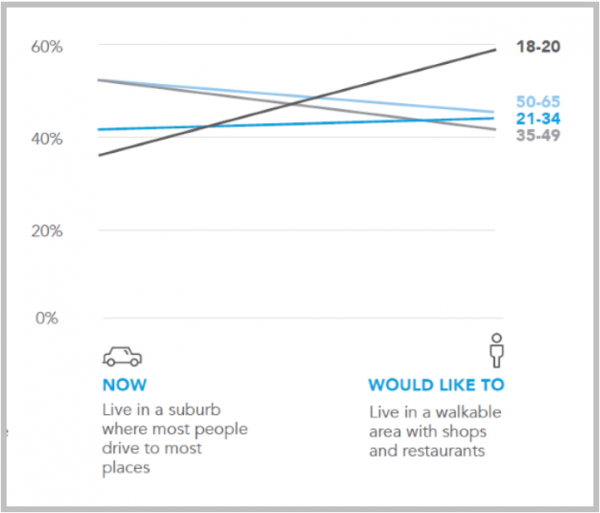
c2The report includes a timeline of past efforts aimed at addressing the region’s long-standing challenges, “not to be disheartening, but instead to highlight where positive changes have been made” and how collaborative efforts can “create opportunities for all Greater Hartford residents.” The report also indicates that:

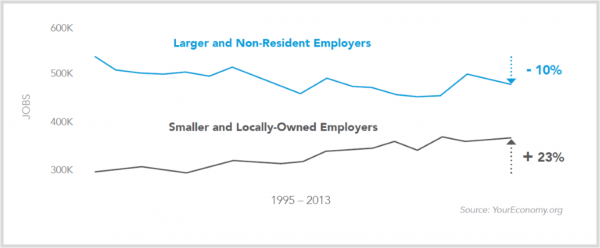
  • While net job growth in our region has been flat, the region’s smaller and locally-owned businesses have increased employment by 23 percent between 1995 and 2013. Unfortunately, larger and employers headquartered out of state have decreased employment by 10 percent during this same time period.
  • New and proposed rail, bus and highway projects offer the promise of access to jobs, housing and amenities that can spur economic growth.
  • Many of the region’s residents – of all ages – would like to live where they can walk to shops, restaurants and other amenities, compared to where they lie today. That is true of 60 percent of those ages 18-20, and more than 40 percent of other age demographics.

The Metro Hartford region consists of 1 million people living in Hartford, New Britain and the 36 surrounding communities.  The partners in the initiative expressed the hope that the latest edition of the Progress Points report creates the “sense of urgency necessary to address shared regional challenges.”

The Metro Hartford Progress Points Partners are: Capitol Region Council of Governments, Capital Workforce Partners, City of Hartford, Hartford Foundation for Public Giving, Hispanic Health Council, MetroHartford Alliance, Trinity College Center for Urban and Global Studies, United Way of Central and Northeastern Connecticut, and Urban League of Greater Hartford.

https://youtu.be/0zTQjsbNlw0

PERSPECTIVE: The Challenge of Philanthropy - Anxiety, Alienation and Adversity

by Ambassador James A. Joseph, President Emeritus, Council on Foundations When I think about philanthropy in a badly divided nation and a badly divided world, I am reminded of what Scott Peck, the psychiatrist and noted writer said some years ago. He wrote that we build community out of crisis and we build community by accident but we know very little about how to build community by design. I would like to offer three observations about building community by design.

The first is the need to reimagine and reaffirm the centrality of community in the American narrative. I first became involved in organized philanthropy as an executive and a trustee a little more than fifty years ago. It was a time when Alexis de Tocqueville was the most quoted, but probably the least read, of our literary legacies. The public discourse about community centered on the civic habits of early Americans and how social cohesion was established and sustained by the coming together in local groups to promote the common good. It was a time when neighbors came together to help build each other’s barns and to take in the crops before the rains came.CT perspective

In recent years, however, a second concept of community has competed for primacy in the American story. It emphasizes the centrality of the individual and romanticizes the lone ranger who conquered a hostile environment. A primary calling of leaders in the philanthropic sector, as well as policymakers and opinion leaders, is to help get the narrative right; to help bring back into balance the legitimate romance of rugged individualism with the equally legitimate effort to form communities where individuals embrace, reaffirm and take responsibility for supporting and promoting a common good.

I like the concept of community I encountered in Southern Africa in the 1970s. It had its genesis in the Xhosa proverb “People are people through other people.” It was not “I think, therefore, I am” but “I am because you are.” I am human because I belong. I was made for community, so If I deny your dignity I deny my own. If I diminish your humanity I diminish my own.  The early warring tribes in Southern Africa had war healers who came together after a conflict to plan initiatives to ensure that both the victor and the victims were restored into full standing in the community. It was said of Mandela’s ancestors that they had a short memory of hate.

When we are able to say that people are people through other people we are more likely to make the condition of others our own. It has been my experience that when neighbors help neighbors and even q1when strangers help strangers both those who help and those who are helped are transformed. When that which was their problem becomes our problem, the connection that is made has the potential for new forms of community. In other words, when you help someone who is homeless to find a home, when you help someone who is hungry to find food, when you help someone to find meaning in a painting or sculpture, when you help someone to fight bigotry or to find a job, you will be laying the groundwork for the genesis of community.
But while providing help can lead to a deeper connection, I must also caution that while charity is good, justice is better. One involves ameliorating the consequences of deep social ills. The other involves eliminating the cause and is likely to be more enduring. Let me provide an example of why I make this distinction. When we think of helping those in need, we often think of the Good Samaritan who encounters someone badly beaten on the side of the road and stops to give aid. But I ask you to imagine what the response would be if he travelled the same road every day and on each day he found someone badly beaten at the same location on the side of the road. Wouldn’t he be obliged to go beyond charity to the kind of strategic intervention that asks who has responsibility for policing the road? Charity is good, but justice is better.

My second observation is that foundations will need to help demonstrate that the fear of difference is a fear of the future. They will need to help persuade a concerned public that diversity need not divide, that pluralism rightly understood and rightly practiced is a benefit and not a burden. All of us will need to be reminded that when those who wrote the American constitution committed us to forming a more perfect union they realized that their initial work was neither fixed nor final. They understood that the American society is a community that is always in the making. Yet, it is this remaking of America that is causing great anxiety and even fear.q2

This conference comes at a time in which the fabric of American life is being torn apart by passions that seem almost out of control. We talk about forming a more perfect union, but the more interdependent we become, the more people are turning inward to smaller communities of meaning and memory. It is increasingly true in many parts of the United States that if you ask someone to step back and imagine what it means to be an American, they will not think of my face or even the face of our president. They will think of someone in whose image they see themselves; someone who fits their comfort zone; someone who looks like them, talks like them and thinks like them, that is, if they think at all.

Our challenge as we look at the passions that have been aroused around us, and often within us, is to help ensure that we do not misunderstand what divides us or misdiagnose the pathology that disturbs us. I am persuaded as I travel around the country that the emotions on display have at least three dimensions: anxiety, alienation and adversity; and that building and sustaining community will require that we recognize the distinctiveness of each of these emotions and develop strategies to respond to the cause of each.

__________________________________

Ambassador James A. Joseph is professor emeritus of the Practice of Public Policy at the Sanford School of Public Policy at Duke University. The president of the Council on Foundations from 1982-1995, he has served in senior executive or advisory positions for four U. S. presidents, including Undersecretary of the Interior for President Jimmy Carter and Ambassador to South Africa for President William Clinton. His most recent book is “Saved for a Purpose,” published by the Duke University Press. This piece is excerpted from his keynote address delivered at the Connecticut Council on Philanthropy annual Luncheon and Conference on May 13, 2016. ©

Part II of Ambassador Joseph's remarks will be published next Sunday in perspeCTive.

CT Has 3rd Lowest Teen Birth Rate in U.S.

Connecticut has the third lowest teen birth rate in the nation, and ranks among the states with the lowest incidence of low birthweight babies, preterm birth rate and percent of births to unmarried mothers, according to data from the National Center for Health Statistics of the Centers for Disease Control and Prevention. The data, reflecting statistics from calendar year 2014, indicate that Connecticut ranked  32nd in Percent of Births to Unmarried Mothers, 30th among the states in Low Birthweight Rate, and 28th in Preterm Birth Rate.  The state ranked 48th in Teen Birth Rate, third lowest in the U.S.

teen birth rateThe NCHS data also ranked Connecticut 12th in the Cesarean Delivery Rate.

The Teen Birth Rate, determined by the number of births per 1,000 females age 15-19, was 24.2 nationally.  In Connecticut, it was 11.5.  The only states with a lower rate were Massachusetts at 10.6 and New Hampshire at 11.0.  Among the other states with low teen birth rates, well below the national average, were New Jersey, Vermont, Minnesota, Rhode Island, New York, Maine and Maryland.

The highest rates were in Arkansas (39.5), Oklahoma (38.5), Mississippi (38.), Texas (37.8) and New Mexico (37.8).

birthsRegarding the percentage of babies born to unmarried mothers, a statistic long tracked by federal health officials, three states saw more than half the children born in that category.  The highest percentages were in Mississippi (54.0%), Louisiana (52.7) and New Mexico (51.3%).

Connecticut ranked 32nd, at 37.1 percent, slightly lower than the national average of 40.2 percent.  The state with the lowest rate was Utah, at 18.6 percent, followed by Colorado (22.4%), Idaho (27.8%), Washington (32.1%) and Minnesota (32.3%).

Policies Vary on Who Pays for Public Sidewalk Repairs; 38 Towns Report No Sidewalks At All

A survey of Connecticut’s 169 municipalities identified the party that is financially responsible for repairing public sidewalks, and discovered that policies vary from town to town - and there are 38 municipalities that indicate they don’t have any sidewalks. As for financial responsibility for repairs among those that do, it varies, according to a report by the Office of Legislative Research (OLR).  The survey found that 127 municipalities had sidewalk repair policies that were spelled out in ordinances or based on informal practices. Four municipalities, Burlington, Ledyard, Sterling, and Woodbridge, reported that they do not have a sidewalk repair policy.circle chart

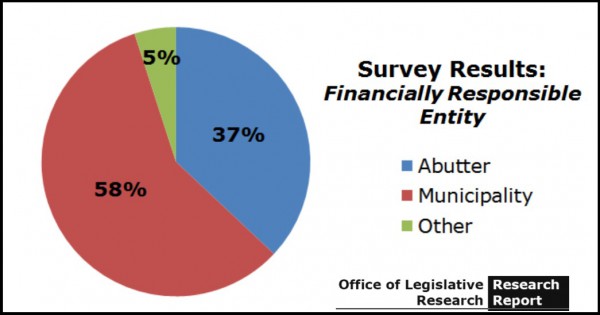
Of the 127 municipalities with sidewalk repair policies, 74 (58%) are responsible for repairing sidewalks and 47 (37%) require abutting property owners to pay for sidewalk repairs, subject to certain exceptions, OLR reported. For example, many municipalities that require abutters to pay for sidewalk repairs exempt them from doing so if the damage was caused by the roots of municipally owned trees. Other municipalities exempt abutters in downtown areas or those whose sidewalks are used by children walking to school.

sidewalk

In other municipalities, abutters may be relieved of responsibility for sidewalks within the downtown area or used by children walking to school. And in municipalities where abutters are generally not responsible for sidewalk repairs, they may be responsible if they cause the damage, for example when doing construction work on their property, the OLR report explained.

Communities indicating they do not have sidewalks include Andover, Barkhamsted, Bethany, Bethlehem, Bolton, Bozrah, Bridgewater, Brookfield, Brooklyn, Canterbury, Chaplin, Colebrook, Columbia, Cornwall, Durham, Easton, Franklin, Goshen, Hampton, Hartland, Killingworth, Lebanon, Lyme, Middlefield and Morris.  Additionally, the towns of New Fairfield, North Stonington, Orange, Oxford, Pomfret, Preston, Prospect, Roxbury, Scotland, Union, Warren, Weston and Wolcott report no sidewalks in town.

Five municipalities have policies shifting the burden depending on whether the sidewalk is (1) state- or municipally-owned or (2) within the state or municipal right of way. One municipality reported that repairs are the state’s responsibility. In many municipalities, sidewalk repair policies are informal and based on past practice, the survey found.

The OLR Report, 2015-R-0213, was issued in December 2015 and highlighted by OLR last month.  Data was compiled through an email survey of municipal planning offices and chief elected officials. According to the report, nine municipalities shift the burden from abutters to themselves when damage is caused by tree roots, a snow plow, or other activities conducted by the municipality. And 14 municipalities make abutters responsible for repair costs if their actions gave rise to the needed repairs.  The sidewalk version of “you break it, you pay for it.”

Connecticut Among 11 States Upgrading to Next Generation 911

Connecticut is one of 11 states that have upgraded, or are in the process of upgrading, their Emergency 911 system to what’s called Next Generation 911, to allow the emergency notification system to respond to text messages and utilize a range of new technologies.  Connecticut’s upgrade began last year, and is expected to be fully operational later this year. The National Emergency Number Association (NENA), which represents government agencies and private firms involved in the emergency system, and the National 911 Program, housed in the U.S. Department of Transportation, are pushing states and localities to adopt what they call Next Generation 911, according to a published report in Governing magazine. NG911CT

The urgency driving the upgrade effort was highlighted in recent weeks. Like most 911 systems in the U.S., Orlando’s emergency communication center cannot receive text messages, photos or videos. Nor can most 911 systems tap into other mobile device features, like detailed location services, Governing points out.

The magazine, which focuses on state and local government operations, notes that texting 911 could be valuable in emergencies like the Orlando shooting or a domestic violence incident, where it is unsafe to make any noise let alone talk out loud about the danger at hand. And sending text messages to 911 could allow people who are deaf or have speech impairments to communicate without other special devices.

One day last month, a computer glitch knocked out portions of the statewide 911 system briefly in Connecticut.  The Hartford Courant is reporting today that state officials have determined the partially installed high-tech 911 emergency dispatch system  became overwhelmed by duplicate messages July 15, leading to a breakdown that failed to connect callers at about half the call centers.  The state has temporarily halted a $13.2 million upgrade of the system, William Youell, director of the Division of Statewide Emergency Telecommunications, told the Courant.

Connecticut’s Department of Emergency Services and Public Protection (formerly Emergency Management and Homeland Security) reports that The Next Generation 9-1-1 system is Internet Protocol based and will utilize the new Connecticut Public Safety Data Network to deliver 911 calls to Public Safety Answering Points (PSAPs) in Connecticut.

The new system, according to the agency’s website, will provide the infrastructure to allow “Text to 9-1-1”, the ability to send images or video with a 9-1-1 call to a PSAP, and to call 9-1-1 directly via the Internet when telecommunication service providers make these features available to the public.cell

It has been estimated that full implementation of the system, which began in the spring of 2015, would take 18 months. Initial installation of the system call answering components first got underway at ten pilot PSAPs around the state in May 2015, in New Britain, Wilton, Enfield, Newington, Valley Shore (12 towns), Fairfield, Middletown, Mashantucket, Shelton, and Wolcott.  Training sessions for PSAP personnel have been held in New Haven, in collaboration with AT&T.

Four states — Indiana, Iowa, Maine and Vermont — already have moved to Next Generation 911, according to NENA. Another seven — Connecticut, Hawaii, Massachusetts, North Dakota, South Dakota, Tennessee and Virginia — are doing so, Governing points out. The goal is for there to be a nationwide changeover completed by 2020, as utility companies abandon old copper phone lines for fiber optic cables.

In at least five additional states — Florida, Illinois, Michigan, Ohio and Texas — city, county and local governments either have upgraded their systems or are in the process of doing so.  But in at least six states — Georgia, Missouri, Nevada, New Mexico, Oklahoma and West Virginia — it is unclear if any preparations for the switch have been made at the state or local level, according to the Governing update.

CT ESPPThe entire statewide system in Connecticut, purchased through A&T, cost $13.26 million with annual maintenance costs of about $3.2 million, Stephen Verbil, a telecommunications manager with the Division of the Statewide Emergency Communications, told the Day of New London last year.  The system uses Dell servers connected through a fiber optic network and is paid for through a surcharge on land lines and cellphones.

Finding callers who aren’t using landlines, which are registered to a physical address, has been a problem since cellphones became popular in the 1990s, Governing reported. Calls to 911 from cellphones are not routed based on the exact location of the caller, but on the location of the tower transmitting that call. This can lead to emergency calls getting answered by faraway call centers and make it hard for responders to locate the caller.  Next Generation 911 will be able to use technology like Wi-Fi, Bluetooth signals and geographic information systems to find mobile callers, Trey Forgety, government affairs director for NENA, told Governing.


Public Health National, Statewide Conferences Reflect Greater Attention to Field

With concerns about the Zika virus reaching the United States as reflected in the recent report of four cases in Florida and state public health monitoring now reaching Connecticut, public awareness of the role of public health officials, here and across the country, is likely to increase in the coming weeks and months. That coincides with the National Conference of the National Association of Local Boards of Health next week in St. Louis, and the Annual Meeting of the Connecticut Public Health Association slated for November in New Haven.  The statewide organization is marking its hundredth anniversary this year, and the theme of the conference will be "Back to the Future- 100 years of Public Health in CT and Beyond."

For the past century, the Connecticut Public Health Association has been “committed to improving the quality of the public health profession and advocating for policies and programs that promote health and prevent disease.” The association’s members, representing a wide variety of disciplines, “are united in the goal of protecting and promoting the public's health.”logo

The CPHA has invested its advocacy and education resources in key areas of public health such as public health infrastructure, racial and ethnic health disparities, health literacy, universal health care, environmental health, and disease prevention. The organization’s president is Brittany Allen, staff attorney with the state Department of Public Health.

Among those from Connecticut expected to attend the National Association of Local Boards of Health session in Missouri will be the Secretary on the national organization’s Board of Directors, Judith Sartucci of Rocky Hill and the Central Connecticut Health District which serves the towns of Berlin, Newington, Rocky Hill and Wethersfield.   The National Conference is scheduled to focus on ways to improve community heath, the Flint (MI) financial and water crisis “through a board of health lens,” and collaborative governance in an era of population health management.  The public health threats identified by the national Centers for Disease Control and Prevention will also be highlighted, as will Zika, according to Association Director Jamie Michael.state circle

The mission of the Connecticut Public Health Association is to “represent and unite the diverse expertise of Connecticut's public health professionals, to ameliorate the most pressing public health issues in the state, and to promote health and safe living for the people of Connecticut.” CPHA works to promote and protect the public's health through advocacy; education; program, professional and workforce development; and networking among the public health community.

The CPHA website points out that “today, more than ever, the value of public health in saving lives and reducing health care costs is at the forefront of public policy. Being a part of this movement is exciting for practitioners and organizations alike.”

Among the learning objectives anticipated at the state conference in November, where 300 public health officials from across the state are expected, “attendees will be able to:

  • Describe how policies, systems, and environmental changes can be applied to improve the public’s health.
  • Identify evidence-based strategies that engage communities to improve health outcomes and explain how they work and are applied effectively.
  • Explain how collaboration with nontraditional partners supports the improvement of population health and wellness.
  • Promote the formation of collegial professional networks and the exchange of ideas among members of the public health community.

CPHA-logo_2The keynote address will be provided by Camara P. Jones, MD, MPH, PhD, research director on social determinants of health and equity in the Division of Adult and Community Health, National Center for Chronic Disease Prevention and Health Promotion and President of the American Public Health Association (APHA).

Dr. Jones is a family physician and epidemiologist whose work focuses on the impact of racism on the health and well-being of the nation. She seeks to broaden the national health debate to include not only universal access to high quality health care but also attention to the social determinants of health (including poverty) and the social determinants of equity (including racism).

Her biography points out that:

  • As a methodologist, she has developed new ways for comparing full distributions of data (rather than means or proportions) in order to investigate population-level risk factors and propose population-level interventions.
  • As a social epidemiologist, her work on race-associated differences in health outcomes goes beyond documenting those differences to vigorously investigating the structural causes of the differences.
  • As a teacher, her allegories on race and racism illuminate topics that are otherwise difficult for many Americans to understand or discuss.

Dr. Jones was an assistant professor at the Harvard School of Public Health from 1994 to 2000, is a member of the World Health Organization’s Scientific Resource Group on Equity and Health.


PERSPECTIVE: How Brexit Could Impact Connecticut Companies

by Alissa DeJonge On June 23, voters in the United Kingdom made the decision to have the UK exit the European Union – an unprecedented split from the 28-country economic and political partnership. It will take at least two years for the terms of the separation to be agreed upon, so the changes and the outcomes will not be fully understood or felt for awhile. While it is obvious that the greatest effects of “Brexit” will be in Europe, companies in Connecticut could be affected for a few different reasons.CT perspective

Exporting companies are sensitive: Connecticut is particularly linked to Europe through exports. France and Germany are top destinations for Connecticut exports. Plus, Connecticut trading with the United Kingdom is strong, with the UK being Connecticut’s 7th largest exporting destination and our state’s largest source of imports.[1] When there is uncertainty or economic downturns in areas like the UK, there can be decreases in demand for Connecticut’s exports. In addition, exports become more expensive because the U.S. dollar strengthens relative to the British pound or euro (although imports become relatively cheaper, boosting the Connecticut companies with significant imports).

Global companies make location decisions: The UK represents the 7th largest economy in the world. The Brexit process is therefore likely to disrupt global business operations and will have companies rethinking wquote DeJongehere they do business in Europe and elsewhere. At least 82 UK-based companies are currently doing business in Connecticut.[2] In addition, a number of Connecticut companies use the United Kingdom as a gateway to the EU for operations because once a company has one location in the EU they do not have to obtain separate regulatory approvals in order to do business in other member countries.

As Brexit occurs, tariffs and trading relationships will have to be renegotiated.  For companies with their location in the UK and not otherwise in the EU, this will add to business costs. So these companies may prefer to control their costs by moving their European locations out of the UK to avoid the uncertainties related to the renegotiation process.c2

Uncertainty affects all companies: This additional uncertainty about what the exit agreement will look like adds to the general increased economic uncertainty throughout the world. Brexit is an action that no other European Union country has undertaken and it affects a relatively large economic region. Does this mean that other countries will follow? The answer is unclear. The possibility of a recession in Europe has become more likely as a result of this turmoil.

When there is uncertainty in the global economic outlook, stock markets typically behave erratically. And when there is uncertainty, consumer spending can get held up, as can company investments. This poses additional risk not just for companies that are thinking globally, but for those with a local focus too, because overall demand for a host of products and services can decrease when consumers and companies are worried abc1out the economic future.

Uncertainty is the ‘name of the game’ for Brexit, and with uncertainty comes risks (and potential rewards) for a host of Connecticut companies. One thing is for certain though – analysts will be tracking and forecasting the outcomes of Brexit for years to come. This ‘British Invasion’ unfortunately has less to do with popular songs and more to do with unpopular economic insecurities.

_________________________________

Alissa DeJonge is Vice President of Research, Connecticut Economic Resource Center Inc. (CERC).

PERSPECTIVE commentaries by contributing writers appear each Sunday on Connecticut by the Numbers.

Also of c3interest: The State Budget - What Do Demographics Have to Do With It?

[1] Imports of nucleic acids and pharmaceuticals

[2] Connecticut Secretary of the State


Entrepreneurship May be Boomer, Rather Than Millennial, Phenomenon

Contrary to popular belief, entrepreneurship among Boomers is strong when compared to younger age groups, including millennials, according to a new analysis from The Kaufman Foundation of national research into entrepreneurship. The Kauffman Startup Index reveals that nationally the rate of new entrepreneurs ages 55-64 has increased from 0.34 percent in 1996 to 0.37 percent in 2014. (This rate means that 370 out of every 100,000 adults in this age group became entrepreneurs in a given month.)

EntrepreneurshipThe same measure showed the age 20-34 demographic group, at 0.22 percent, was considerably below the rate for other age groups. (This rate means that 221 out of every 100,000 adults in this age group became entrepreneurs in a given month.) The data also indicates that the rate of new entrepreneurs for the age 20-34 group is down from the high point for this age group of 0.28 percent in 1996.

For Connecticut, which has increasingly focused economic development attention and resources on entrepreneurial start-up businesses, the demographic findings may inform the state’s approach.

Connecticut Innovations, for example, “helps innovative Connecticut companies, or those that want to move here, no matter what stage of the business life cycle you’re in.”  CI describes itself as “entrepreneur-friendly, trustworthy and collaborative,” without mention of the demographics of the individuals driving the start-up businesses.

Connecticut’s self-identified “innovation ecosystem,” CT Next, equips “startups and entrepreneurs with resources, guidance and networks to accelerate growth and success.”  CT Next recently launched the Entrepreneur Learner’s Permit Program, which cuts fees that start-ups in specific industries are required to pay to the state.kauffman-foundation-squarelogo

Other organizations around the state, such as Hartford Area Young Professionals and Entrepreneurs (HYPE), focus on young people starting fledgling businesses.  The Connecticut Center for Arts and Technology (ConnCAT) in New Haven has developed an Entrepreneurial Academy, a hands-on program that coaches interested and capable youth on business fundamentals and entrepreneurship skills. ON the other end of the demographic continuum, AARP has launched an initiative called Encore Entrepreneurs, focusing on supporting and encouraging businesses launched by individuals age 50 and older.

There are competing views as to whether “success or hardship” is driving the growth of entrepreneurship for older Americans, according to the Kaufman analysis. “On one hand, working and starting business late in life might be a result of increased debt levels especially for younger female Boomers. On the other hand, some researchers have found that growth of Boomer entrepreneurship may be an indication of financial strengths rather than weaknesses.”

The oldest cohort of Baby Boomers turned 65 in 2011, and the last cohort of Boomers will turn 65 in 2029, the analysis indicates, stressing that the peak age for entrepreneurs is “closer to 40 than 20.”

The Kaufman review indicates that today’s millennials are “starting businesses at lower rates than other cohorts did when they were the same age.” Possible reasons suggested include growing student debt, timing of entry to workforce with the Great Recession, change in risk-taking attitudes, housing costs, among others. A poll by Young Invincibles, cited by the Kaufman presentation, found that Millennials identified student debt and lack of retirement savings as barriers to entrepreneurship.

CT Launches Entrepreneur Learner’s Permit to Cut Start-Up Fees

Connecticut’s Entrepreneur Learner’s Permit program, operated by CTNext, is underway.  The two-year pilot initiative, which reimburses first-time entrepreneurs for filing, licensing, and permitting fees associated with starting a business, is aimed at giving certain businesses a boost on the bottom line. A wholly-owned subsidiary of Connecticut Innovations, CTNext is Connecticut’s innovation ecosystem, designed to build a more robust community of entrepreneurs and accelerate early-stage growth by providing access to talent, space, industry expertise, services, skill development, and capital to foster innovation and create jobs in Connecticut.ctnext-logo

The Entrepreneur Learner’s Permit program, signed into law earlier this year, allows owners and executives of businesses in the information technology, bioscience, and green technology industries to receive reimbursement up to $1,500 for state and municipal business startup fees.

The Entrepreneur Learner’s Permit legislation sets a funding cap of $500,000 in Fiscal Years 2017 and 2018, equaling $1 million for reimbursable fees for entrepreneurs in the state.

Eligibility in the three industries has been defined by CTNext as the program gets started this month:ELP-CT

Bioscience: Defined as the manufacturing of pharmaceuticals, medicines, medical equipment, or medical devices and analytical laboratory instruments, operating medical or diagnostic testing laboratories, or conducting pure research and development in life sciences.

Information Technology: Defined as software publishing, motion picture and video production, teleproduction and post-production services, telecommunications, data processing, hosting and related services, custom computer programming services, computer system design, computer facilities management services, other computer related services and computer training.

Green Technology: Defined as the production, manufacture, design, research or development of clean energy, green buildings, smart grid, high-efficiency transportation vehicles and alternative fuels, environmental products, environmental remediation and pollution prevention.

Glendowlyn Thames, director of Small Business Innovation and CTNext at Connecticut Innovations, recently told Hartford Business Journal that “Starting and running a business in its earliest stages can be a massive undertaking, no matter the location. This benefit does more than cover fees — it is another step the state has taken to help create a more active ecosystem and assist entrepreneurs when they need it most. Entrepreneurs scrutinize every cost, so while the fees may not deter a company from coming to Connecticut, removing those fees can certainly serve as a benefit.”

The Connecticut Business and Industry Association has described the program as “a pro-small business, solid stepping stone toward paving the way for Connecticut to become a much more business friendly state.”  The legislation establishing the program was authored by State Rep. Caroline Simmons-D-144 and State Sen. Scott Frantz-R-36, the Stamford Advocate reported.CTI_Logo

“Our vision is to attract new businesses to Connecticut and to encourage entrepreneurship and job growth in our state,” Simmons told the Advocate. “This is a pro-business, bi-partisan bill that will benefit Connecticut's economy.”

The legislature’s Office of Fiscal Analysis (OFA) estimated the program will cost the state $27 million annually in lost fee revenue; other agencies like transportation and banking will lose $7 million annually. OFA assumes 25,000 startups launch in Connecticut every year.

CTNext, described as Connecticut’s innovation ecosystem, is tasked under revisions to the state’s economic development structure approved by the state legislature to “equip startups and entrepreneurs with resources, guidance and networks to accelerate growth and success.” CTNext launched in 2012, and has worked with more than 1,100 companies.

Companies need to certify that they are eligible for the Entrepreneur Learner’s Permit program, and after filling out a very brief online application, a “CTNext team member will reach out to you to collect receipts for reimbursement.”  At the end of the two-year program, CT Innovations is to evaluate its effectiveness and make a recommendation to the legislature regarding whether it should be continued, concluded, or revised.


https://youtu.be/U0vyYsDrl10

Project Undertakes Mapping CT With Precision From the Air

Unbeknownst to most of us, there is a world of difference between an aerial photograph and an orthophotography.  In fact, enough of a difference for the State of Connecticut to get behind an initiative to photograph the entire state. The results are to be made publicly available through the state’s Open Data Initiative.  The orthoimaging of Connecticut, now complete, was undertaken by the Sanborn Map Company, under a contract with the Capitol Region Council of Governments made possible by a grant from the state's Office of Policy and Management. It will provide Connecticut with its first statewide acquisition of datasets at this high level of accuracy, according to those involved with the project.PR_Mystic_Seaport_Connecticut_06142016

The Sanborn flight team overcame challenging spring weather conditions to successfully collect high-resolution imagery of the entire state of Connecticut and its coastline in just five weeks, according to the company.  Altogether, the firm collected more than 42,500 4-band, 3-inch resolution images during March and April, including more than 6,000 coastline images during low-tide conditions.

The Sanborn team, which included subcontractors, also collected more than 5,200 square miles of high-density light detection and ranging (LiDAR) data covering the entire state during the same time period. All of the data were collected during snow-free, cloud-free and leaf-off conditions, which makes them ideal for a host of products and applications.

A conventional perspective aerial photograph contains image displacements caused by the tilting of the camera and terrain relief, or topography. It does not have a uniform scale and one cannot measure distances on an aerial photograph as if it were a map.orthophotography

In orthophotography, the effects of tilt and relief are removed from the aerial photograph by a computer rectification process to create an orthophoto, which then becomes a uniform-scale photograph. Since an orthophoto has a uniform scale, it is possible to measure directly on it, as with traditional maps.

The product combines the image characteristics of a photograph with the geometric qualities of a map; thus, it is possible to get direct measurements of distances, areas, angles, and positions.

That distinction can make a big difference for governments and businesses seeking such images. Brad Arshat, Sanborn director of strategic accounts in the Northeastern United States, estimates that statewide collaboration on the project will result in several million dollars in tax dollar savings, as opposed to each of the state's 169 municipalities acquiring its own data.

Sanborn is now creating mapping products from the data, which will be delivered later this year. These include 3-inch ground sample distance (GSD) orthoimagery; U.S. Geological Survey (USGS) QL2 LiDAR data; bare Earth digital elevation models (DEMs); and 1-foot contour maps.

223284LOGOIndividual municipalities and state agencies also have options to purchase additional products as needed, such as 3-D building footprints, planimetrics, landcover maps, impervious surface maps and more, according to company officials.

"We need to support our communities by giving them the tools to do their jobs in a modern, efficient and effective way," Gov. Dannel Malloy pointed out in a Sanborn news release. "As a former mayor, I know how valuable this information is to municipalities. In addition, this information is critical to our state agencies."crcog-logo

Sanborn is a preeminent innovator in the geospatial industry, the company website indicates, delivering state-of-the-art mapping, visualization, Web GIS™ and 3-D solutions to customers worldwide. The firm, which marked its 150th anniversary in 2016, operates a fleet of 14 aircraft located strategically across the United States.

connecticut"Our flight team did an exceptional job of outmaneuvering the unusual weather present during the collection period (in Connecticut)," says Shawn Benham, Sanborn project manager. "The savings truly are astronomical when you merge many smaller project areas into a single large project because of the fixed costs associated with each mobilization," added Arshat in statement released by the company.