Commitment to Children Honored in CT

Connecticut Voices for Children has honored community leaders, policymakers and advocates for children at its 14th annual “First for Kids” awards ceremony. The awards recognize individuals and organizations that have worked to make a difference in the lives of children in the state of Connecticut. This year’s honorees are:

  • Priscilla Canny Research Award - Judith Meyers, President and Chief Executive Officer of the Children’s Fund of Connecticut and its subsidiary, the Child Health and Development Institute of Connecticut., for her leadership to ensure that all children have the opportunity to thrive. The Children’s Fund of Connecticut, a public charitable foundation and supporting organization of Connecticut Children’s Medical Center, is dedicated to ensuring that children in Connecticut have a strong start in life with ongoing supports to promote their optimal health and well-being. For over 17 years she has led the organizations' efforts to improve the health, mental health and early care systems for children in Connecticut.
  • Public Service Award - Myra Jones-Taylor, former Commissioner of the Connecticut Office of Early Childhood, for her efforts to coordinate and improve the state’s early childhood system. Jones-Taylor, a California native who was the first in her family to graduate from college, came to Hartford in 2012 to lead the planning effort for the newly forming state office. She left the agency in September 2016 and is currently Entrepreneur in Residence at Dalio Foundation.
  • Statewide Child Advocacy Award - Sarah Eagan, Connecticut’s Child Advocate, for her work advancing honoreesthe right of abused and neglected children and children with disabilities. She was appointed by Governor Dannel Malloy to serve as Connecticut's Child Advocate on August 1, 2013. As Child Advocate, she sets priority reviews for the OCA, manages office operations, and publishes vital information regarding the well-being of children and recommendations for system reform. Prior to this appointment, she served for several years as the Director of the Child Abuse Project at the Center for Children's Advocacy in Hartford.
  • Youth Voice Award - Kate Matos and her Fourth-Grade Students at Avon’s Pine Grove Elementary, 2015-2016, for their efforts to raise funds for advocacy through kindness and team work.

“Each of us wants our children to have an opportunity to achieve their full potential. Today, at our annual First for Kids celebration, Connecticut Voices for Children is proud to honor four champions who have worked tirelessly to ensure that opportunity is available to all children in our state, regardless of race, ethnicity or family income,” says Ellen Shemitz, Connecticut Voices for Children’s Executive Director. “Children need champions willing to raise their voices to make universal opportunity a public priority. Today’s honorees have led the way.”voices

“Many children in Connecticut still face considerable challenges to succeed,” says Sharon Langer, Advocacy Director at Connecticut Voices for Children. “Nearly 1 in 3 of our children of color live in poverty, compared to 1 in 20 white children. Our state has one of the largest achievement gaps in the nation based on family income and race. There is a lot of work to be done to close these gaps. We are optimistic that together we can improve the lives of children.”

Connecticut Voices for Children is a research-based policy think tank based in New Haven. The organization “produces research and analysis, promotes citizen education, advocates for policy change at the state and local level and works to develop the next generation of leaders.”

PHOTO:  Judith Meyers, Sarah Eagan, Myra Jones-Taylor

CT 5th Graders Elect State's New Kid Governor

Jessica Brocksom of John F. Kennedy School in Milford has been elected by 5th graders across the state as Connecticut's next Kid Governor.   Connecticut’s Kid Governor is a national award-winning statewide civics program for 5th graders created by the Connecticut Public Affairs Network at Connecticut’s Old State House. Jessica ran on a platform focused on stopping animal cruelty. She plans to lobby state leaders for tougher animal cruelty laws, educate her peers on tkid-governorhis important issue and help animals by organizing fundraisers in Connecticut communities.  The announcement of her election, after more than 4,000 ballots were cast earlier this month by 5th graders, was made at her school in Milford.  She was one of seven candidates on the ballot; only 5th graders were eligible to vote.

In November 2015, hundreds of 5th graders across the state participated in the election of the first ever Connecticut’s Kid Governor. After an exciting race, students elected Elena Tipton of East Hartford who ran on a Campaign for Kindness platform. During her term as Connecticut’s Kid Governor, Elena’s has shared her 3-point plan of action through video messages to constituents, a Kindness is Kool blog, public appearances, and additional activities.  She had an "office" at the Old State House, and met with elected officials including Gov. Dannel Malloy and Congressman John Larson.

The Kid Governor program was designed to teach fifth-graders about government, elections and the importance of civic involvement, and complements the state's social studies curriculum.  It was created by the Connecticut Public Affairs Network and is sponsored by the Connecticut Council for the Social Studies and the State Department of Education. Connecticut’s Kid Governor serves his or her constituents for one year in an active leadership role.

Her teacher, Donna Stuart, told her, “I’m so so unbelievably happy for you. I know you are going to do an amazing job serving all fifth graders in the great state of Connecticut," the Milford Mirror reported.  “You are such a perfect candidate and you inspire me every day, and I am so thrilled that you are now going to be inspiring sokid many others,” Stuart added.

Leaders of the initiative said "We would also like to congratulate the other final candidates for their incredibly inspiring campaigns, which shined a light on many issues important to the children of Connecticut. The 5th grade teachers and students of our state deserve a big thank you for taking part in the 2016 CKG Election - where student participation more than quadrupled from the previous year."


https://youtu.be/u51CzOW0lKI

https://youtu.be/FSXfVW-239c

National Cyclocross Championships Arrive in Hartford in January

Hartford’s Riverside Park will play host to the 2017 Cyclocross National Championships January 3-8, 2017, as another popular sport brings a national caliber event to Connecticut’s Capital City.  logo-2017 “The cyclocross national championships are the pinnacle of cyclocross racing in the United States each year,” said Micah Rice, Vice-President of National Events, USA Cycling. Cyclocross is a very specific type of bike racing, as described by Cyclocross Magazine. For the most part, the course is off-road but there are sometimes portions of pavement included in the course. Riders can expect to encounter grass, dirt, mud, gravel, sand, and a whole slew of other assortments and combinations. The races are based on a set time (measured by numbers of laps), not distance. Depending on your category, a race can be as quick as 30 minutes (for beginners), or as long as 60 minutes (for pros).

‘Cross is wildly popular in countries like Belgium and Holland and is currently the fastest growing cycling discipline in the U.S., according to USA Cycling.  Cyclo-cross specific bikes look very similar to a road bike but have more clearance around the tires for mud, have a different type of braking system — either a cantilever or disc brakes — and have wider tires with knobs on them similar to mountain bike tires.

The event schedule for Hartford details a range of competition for various age categories, men and women, 9-10 year olds to seniors, throughout the week, capped by awards ceremonies at the end of each day.  The 2017 USAC National Cyclocross Championships is organized via a three-way partnership between the CT Cycling Advancement Program, Riverfront Recapture, and USA Cycling. As the local organizing committee (LOC), the CCAP and Riverfront are committed to hosting a high-quality event that supports and highlights both organization’s non-profit missions, the regional cycling community, and the city of Hartford, the organization's website explains. "Our responsibilities and activities include the management of the event venue, the management of emergency city services, the recruitment and management of volunteers, and fundraising for the event." Local volunteers are being sought, with a number of opportunities prior to and during the week-long Championships.  caroline-bend-1024x790

“The USA Cycling cyclocross national championships is an exciting first for Connecticut, and Hartford’s selection is the result of a great partnership between the Connecticut Cycling Advancement Program, Riverfront Recapture, the city of Hartford, and the Connecticut Convention & Sports Bureau,” said Bob Murdock, the Connecticut Convention & Sports Bureau’s director of sports marketing.

“Our state capital’s Riverside Park is a prime venue for this dynamic winter sports event and offers many design options for a challenging course that will satisfy thrill-seeking competitors and spectators alike. We look forward to welcoming cycling enthusiasts from all over the nation,” Murdock added.

According to the USA Cycling website, there are two cycling clubs in Connecticut, based in Middletown and Storrs.   The UConn Cycling Team, based at the main campus in Storrs Connecticut, is a recognized club sports team and a member of both the ECCC (Eastern Collegiate Cycling Conference) and USA Cycling.rider

The vision of USA Cycling is to make the United States of America the most successful country in the world of competitive cycling, and the championships planned for 2017 and 2018 underscore that effort.  Reno, Nevada, will host the 2018 USA Cycling cyclocross national championships.

“Going from the East in 2017 to the West in 2018 with Hartford and Reno is indicative of how quickly the sport is spreading from coast to coast, and these two cities will do an excellent job of helping us crown the best in the sport in the coming years,” Rice said.

Connecticut has a long and storied heritage within cyclocross and the annual Connecticut Series of Cross series “seeks to continue that,” according to the 8-race series website.  2016 marks the 5th annual Connecticut Series of Cross, described as designed to encourage true "grassroots CX racing".  All the events are unique and reflect the style and passion that each promoting club/team has for the sport of cyclocross.

​The final event in the series will be December 18 in New Haven, just weeks ahead of the National Championship in Hartford.

usac-logo

CT Ranked 9th Among Small States in "Main Street Entrepreneurship," Showing Improvement

Improvements in Connecticut’s “Main Street Entrepreneurship” has pushed the state’s ranking to 9th among the nation’s 25 smaller states, up from 12th a year ago, in the latest analysis from the Kauffman Foundation. The nation as a whole and most states and metro areas are experiencing higher rates of small business activity, according to the 2016 Kauffman Index of Main Street Entrepreneurship.  Nationally, there was a sharp uptick in the survival rate of businesses in the last year. At the same time, Main Street entrepreneurship activity gained ground in 47 states and 38 of the 40 largest metropolitan regions.kauffman

Among the nation’s smaller states, the top ranked entrepreneurial states were South Dakota, Vermont, Montana, North Dakota, Maine, Iowa, Nebraska, New Hampshire.  After Connecticut, Oregon rounded out the top ten.  Connecticut was one of only two states to move up three positions in the ranking.

The state’s rate of business owners was 6.55 percent; the percentage of the adult population that owns a business as their main job, according to the survey data.

The number of established (older than four years) small (less than fifty employees) businesses per 1,000 firms was 649.9 in Connecticut.  In Massachusetts, which ranked third among the nation’s 25 larger states, it is 684.7.  The top ranked larger states were Minnesota, Wisconsin, Massachusetts, Colorado, Pennsylvania, Maryland, Ohio, Louisiana, California and Illinois. state

"The Main Street Entrepreneurship Index provides additional evidence that U.S. small business activity has rebounded from the downturn and continues to gather strength," said Arnobio Morelix, senior research analyst at the Kauffman Foundation. "More new businesses are making it through their first five years of operation. While this could indicate that a lack of dynamism is allowing less-productive firms to hang on longer, overall the entrepreneurial increases bode well for the established, small businesses that underpin much of our economy."

Among the larger states, the rate of businesses surviving through their first five years ranges from 44 percent in Arizona to 53.3 percent in Pennsylvania. Among the smaller states, the business survival rate ranges from 43.4 percent in Nevada to 58.1 percent in North Dakota.  In Connecticut, the rate is 51.35 percent, the 8th highest among the 25 smaller states.

In start-up activity, Connecticut ranked 22nd out of 25 smaller states, a drop of two positions since last year.  The Survival Rate of American businesses is the main driver of the recent improvements in Main Street Entrepreneurship in the United States, and has reached a three-decade high of 48.7 percent—meaning that almost half of new businesses make it to their fifth year of operation.chart

U.S. Census Bureau business statistics show that established small businesses represent almost 68 percent of all employer firms in the country.   The five metros with the highest Main Street entrepreneurship activity are Pittsburgh, Boston, Portland, San Francisco and Washington, D.C.

The Kauffman Index of Main Street Entrepreneurship captures business activity in all industries and is based on both a nationally representative sample size of roughly 900,000 responses each year and the universe of all employer businesses in the United States, in a dataset that covers approximately five million businesses.

PERSPECTIVE: Paving a Path to Postsecondary Attainment in Connecticut and Beyond

by Jamie Merisotis I was raised in Manchester. My father arrived in Connecticut almost 70 years ago after serving his country in World War II. Although he and my mother never made it to college, they instilled a strong belief in the value of education. Two generations of us – most still living here – have benefited from the state’s public schools, and colleges and universities.

So, as leader of a national foundation focused on increasing Americans’ success in higher education, Connecticut’s success is always on my mind. Last month, Lumina Foundation released its 2017-20 Strategic Plan. The plan describes what must happen for to achieve Goal 2025. Within the next eight years we must reach our goal for 60 percent of working-age Americans to earn college degrees or credentials, effectively creating a universal learning system beyond high school. We need a system that improves people’s lives and enables the nation to meet the rising demand for talent.CT perspective

Since 2011, the U.S. economy has grown by 11.5 million jobs for workers with more than a high school education. In contrast, only 80,000 jobs have been added for those with a high school diploma or less. This disparity is projected to grow. By 2020, nearly two-thirds of jobs will require more than a high school diploma. Yet almost every state has an average level of education among working-age residents that is too low.

When the Foundation began reporting on the share of people with college degrees eight years ago, Connecticut stood at 46.6 percent. In 2014, the most recent year for which data is available, the rate reached 48.2 percent.q1

This year, Lumina added data about people with certificates and industry certifications. We believe an expanded focus on these credentials is vital for creating a better-educated country. Quality credentials have clearly stated, easy-to-grasp learning outcomes that create paths to good jobs and further education. In Connecticut, one of every 20 working-age residents has these types of certificates, bringing the share of people with meaningful credentials to 53.2 percent.

To reach the national goal of 60 percent by 2025, all of us have to do more to ensure fairer results for students who fare poorly today. The Foundation has been focused over the last several years on both traditional-age students and those who previously have gone to college but never finished.  Yet increasingly, we’ve come to recognize that we must do more and better for the nearly 64 million adults with no education beyond high school. This population is mostly made up of people from poorly represented racial and ethnic groups, immigrants with limited English-speaking skills, people who have lost middle-income jobs, and prisoners.

Others are faring better. In Connecticut, whites and Asian/Pacific Islanders with education beyond high school represent 53.6 percent and 71.9 percent of those populations, respectively. Yet for people who are African-American, Hispanic and American Indian, the percentages range from 22.5 percent to 32.8 percent. These numbers mean the system is not serving these learners who desperately need quality credentials to have better lives and jobs.

q2Eliminating disparities in outcomes across racial and ethnic groups and by socioeconomic status will require civic leaders, education leaders, policymakers, and employers to participate in a large-scale effort to redesign the system. To build tomorrow’s workforce, we must build a system that works for today’s diverse students. In the same way communities banded together to make universal high school a reality, it will take broad, coordinated action to ensure education beyond high school becomes a reality for all Americans.

This movement is underway, led by states setting goals to dramatically increase the number of people with education beyond high school. Connecticut is one of 26 states that set challenging, sustainable, and measurable goals in support of fair outcomes for students of all racial and ethnic backgrounds. My hope is that other states will follow Connecticut’s lead to ensure the country has the talented people it needs to address future civic, economic, and social challenges.

________________________

Jamie Merisotis is President and CEO of the Lumina Foundation,  an independent, private foundation committed to increasing the proportion of Americans with degrees, certificates and other high-quality credentials to 60 percent by 2025. Lumina’s outcomes-based approach focuses on helping to design and build an equitable, accessible, responsive and accountable higher education system while fostering a national sense of urgency for action to achieve Goal 2025.  Lumina operates from Indianapolis. 


  1. America’s Divided Recovery, Georgetown University Center on Education and the Workforce, https://cew.georgetown.edu/cew-reports/americas-divided-recovery/
  2. Recovery: Job Growth and Education Requirements Through 2020, State Report, Georgetown University Center on Education and the Workforce, https://cew.georgetown.edu/wp-content/uploads/StateProjections_6.1.15_agc_v2.pdf
  3. A Stronger Nation: Postsecondary Learning Builds the Talent that Helps Us Rise, Lumina Foundation, http://strongernation.luminafoundation.org/report/2016/#connecticut


New Haven Chamber Spotlights Millennial Leaders in Region

The Greater New Haven Chamber of Commerce has recognized 12 distinctive millennial leaders who are "making an outstanding difference in the professional and outside world." In making their selections, the Chamber indicated that "from organizing community events, working with charities on weekends or holidays, or tireless public outreach - these are the people that lead by example to the entire millennial generation and the rest of us."

The Chamber's young professional organization, PULSE, made the selections from those nominated for the recognition.  The announcement was made at a reception at the conclusion of the Chamber's day-long business expo, The Big Connect, held Thursday at the Oakdale Theater in Wallingford.

The millennial move makers for 2016 are:

Jack Yeung, a serial entrepreneur, attended St. John’s University for his Doctorate of Pharmacy degree. He started his own pharmacy in 2010, after noting he could offer services that other pharmacies were not offering, such as delivery. Jack who now owns pharmacies in Southbury, Danbury and one in the Bronx, started the Panic Room: Escape Room Entertainment in Norwalk, CT, which challenges participants while providing a safe and fun real-life adventure. Jack’s latest business venture is the opening of The Halal Guys Restaurant in New Haven this fall.

Ashley Calabrese is responsible for developing and implementing effective lobbying strategies and grassroots advocacy campaigns to best suit her clients’ interests. She works with the state legislature, the executive branch, municipal leaders and the Connecticut congressional delegation. Her efforts have created better insurance coverage for more advanced forms of breast tissue scmillennialreening, including coverage for ultrasound and MRI screening. Through volunteer efforts, Ashley has advanced legislative efforts for ‘Are You Dense Advocacy’ to ensure that women with dense breast tissue have access to an early breast cancer diagnosis. She helped form the Danny Gilman Scholarship in memory of one of their peers. Ashley serves as President of the Association of Connecticut Lobbyists.
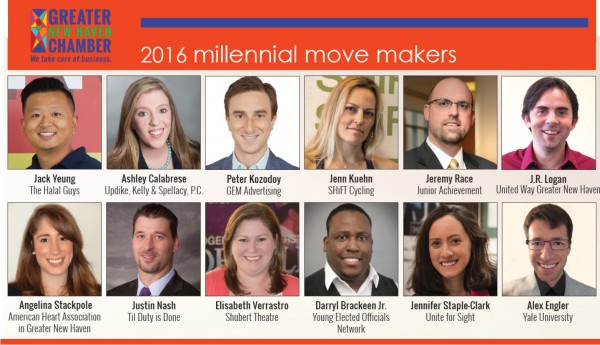
Peter Kozodoy is an author, speaker, serial entrepreneur, and the Chief Strategy Officer of GEM Advertising. His work at GEM has been featured in CNBC, Yahoo!, Bloomberg, Reuters, MarketWatch and more, and has earned Telly, Pixie, Communicator, Aurora, Davey and W3 awards in U.S. and international branding, advertising and production. He has spoken for Microsoft, the US Department of Commerce, and CEO Clubs of America on topics like millennials, and global advertising. He serves on the boards of the Greater New Haven Chamber and Junior Achievement in Connecticut. He is also a SAG/AFTRA professional actor, a three-time New England Champion in Men’s Figure Skating, and a black belt in Taekwondo.

Jenn Kuehn began SHiFT Cycling with a vision to create a workout experience that is accessible yet challenging to every rider, no matter where they are in their fitness levels. She left the high-powered world of corporate sales to create an inspirational local fitness experience. In less than a year, Jenn built a reputation for inspiring effective workouts in a judgment-free environment. Still sensing a missing need for a greater connection between motivation, mind and body, she launched SHiFT Cycling in March 2014. In 2015, Jenn and the team evolved and created SHiFT New Haven. In 2016 Jenn launched her newest fitness concept SHiFT Balance, a studio designed for barre, yoga, kickboxing, strength and mediation classes.

Jeremy Race is the President and CEO of Junior Achievement Southwest New England.  Through Junior Achievement, Jeremy is helping young people dream big about their futures and teaching them the strategies to achieve those dreams. Each year, Jeremy has the pleasure of working closely with several JA students in preparation for their speaking roles at JA’s annual Partners in Achievement breakfasts in Hartford and New Haven. At last year’s event, Jeremy was proud to watch Josslyn, a student from New Britain who at one point was on track to not graduate from high school, stand up in front of 400 guests and state that thanks to JA, “I will graduate high school. I will attend college.  I will be successful.” It was a moving moment and Jeremy will never forget.

J.R. Logan has worked as a volunteer to organize the establishment of a trail along the Mill River in New Haven. He serves on the boards of the New Haven Land Trust and Eli Whitney Museum. He led Cluefest for several years and is a cofounder and Chief Maker at MakeHaven, a community makerspace where anyone can participate in 3D printing, laser cutting, wood working, sewing, metal milling, electronics fabrication, programming, mold making, bike repair and more. In this role, he fosters a community of more than 100 entrepreneurs, artists and craftspeople. J.R. is also employed as Director of Digital Resources for United Way of Greater New Haven, where he works to implement organizational learning and technology locally as well as being a significant contributor to technology advancement in the worldwide United Way network.big-connect-logo-2016

Angelina Stackpole is a Director at the American Heart Association in Greater New Haven, where she oversees corporate fundraising and wellness initiatives in Greater New Haven. She is responsible for the Greater New Haven Heart Walk, which raises awareness and funds for cardiovascular diseases and stroke. In the past five years, Angelina has increased annual revenue from the event by 50%, and has grown participation to nearly 5,000 area professionals and community members. She is also responsible for starting an annual Connecticut-wide event that provides fun activities, support, and networking to families who have children suffering from congenital heart disease. Angelina currently serves as Chair on the PULSE Board of Directors.

Justin Nash, following his graduation from West Point in 2001, was commissioned as an Infantry Officer where he led an infantry platoon deployed to serve in Afghanistan. He was awarded the Bronze Star Medal, Army Commendation Medal, Army Achievement Medal, and Global War on Terrorism Expeditionary and Service Medals. His military career was cut short due to injuries sustained in the line of duty. He has also served as a project manager in the energy industry where he delivered complex projects over $10 million. Justin is the founder of Veteran Construction Services LLC and serves as president of Til Duty is Done, an organization he founded to help restore and improve the lives of veterans through supportive housing and employment opportunities.

Elisabeth Verrastro has a passion and drive to make live performance accessible to everyone and loves seeing her work come to life when the curtain rises and the audience erupts into applause. She is the Shubert Theatre’s Director of Development & Communications. Over the past eight years, Elisabeth has worked tirelessly to tackle the world of development, while giving birth to two children and exceeding expectations by raising over $1.2 million each year while implementing a campaign to raise over $8 million to celebrate the Shubert’s 100th Anniversary and complete Phase 1 of the Centennial Improvement Project. It is Elisabeth’s mission to continue her work to make Shubert’s Phase 2 of renovations a reality.

Darryl Brackeen Jr. was elected in 2014 to the New Haven Board of Alders (City Council), where he is the first African-American and youngest Alder to have been elected from Westville 26th district. While in office, he has championed the passage of the City of New Haven’s Clean Air Resolution, Domestic Workers Bill of Rights & Janitors Bill of Rights, and supported passage of a Connecticut student loan bill of rights, and countless other pieces of legislation and initiatives. In December 2015, he was named the CT State Director for the Young Elected Officials Network. Darryl serves on the Board of Directors for Greater New Haven Green Fund.

Jennifer Staple-Clark founded Unite For Sight in her dorm room in 2000 as a sophomore at Yale University. Unite For Sight is now a leader in both global health education and in providing cost-effective care to the world’s poorest people. Jennifer is the author of journal articles and book chapters about social entrepreneurship, best practices in global health, and community eye health. Additionally, she serves as a judge in social entrepreneurship competitions, including the Canadian Government’s Grand Challenges in Health. Jennifer is a member of the Yale University President’s Council on International Activities, and on the Operating Board of the Yale Entrepreneurial Institute.

Alex Engler is a Ph.D. student and NSF Graduate Research Fellow in Biomedical Engineering at Yale University. While at Dartmouth College for undergraduate studies, Alex’s research focused on developing biomaterials for orthopedics. Outside of the classroom, he led multiple music groups and mentored local middle schoolers for science competitions. Between Dartmouth and Yale, Alex worked in the heart of Boston’s hospital network developing medical devices to treat infants born with birth defects. Alex’s current research focuses on whole lung regeneration and tissue engineering. Outside of lab, he serves as a Director of the Science in the News program. He is also actively involved with the Yale Pathways to Science program and the New Haven Science Fair.



Superintendents on the Move as Revamped Education Funding is on State's Agenda

With a major overhaul of education funding to Connecticut communities on the state legislature's agenda when the newly elected legislature convenes in January in order to comply with a court order, some of the state’s largest school districts are undergoing seismic changes of their own, as superintendents are moving at what appears to be an unprecedented rate in the midst of a school year. Torrington selected a new superintendent just a week ago, even as vacancies were imminent or in place in Hartford, New Haven and Bridgeport, and a new Stamford superintendent is just settling in.superintendent2

Denise Clemons was appointed as the new superintendent of the Torrington public schools, returning to Connecticut after serving as superintendent in Gardner, MA. Previously she was assistant superintendent of curriculum and instruction in Groton, MA; the assistant superintendent of secondary education in Bridgeport; and an English teacher in New Haven.

“I hope to kind of bridge the gap between the community and the schools — kind of open it up. I think that we need to work together, and with that, we’ll be better,” Clemons told the Torrington Register- Citizen. “I’m glad to be here because I think that this is a great community, and I think it’s ready for change, and I’m ready to change with them.”

In Bridgeport, the city school board will soon be identifying someone already working in the district, who holds a superintendent certificate and preferably a doctorate degree, to take over for the current interim superintendent until a permanent replacement can be hired next year, the CT Post is reporting.  Fewer than a handful of current district leaders hold the superintendent certification according to the State Department of Education. They include Career and Craftsmanship principal Wayne Alexander, who was a finalist this fall for the interim superintendent position in New Haven.  Applicants in Bridgeport have until November 28 to apply and will be interviewed the first week in December. The board hopes to have made a selection before current Interim Schools Superintendent Fran Rabinowitz leaves on December 30, 2016.

New Haven Superintendent of Schools Garth Harries announced at the end of September that he would be leaving that post in November, after three years in that position, and more than a year before the end of his contract.  A buyout was worked out, reportedly due to clashing priorities and personalities inthe district.  Last month, the Board appointed Reginald Mayo, the longtime superintendent of New Haven Public Schools and the immediate predecessor to departing superintendent Harries, as the school district’s interim superintendent. Mayo worked in the district’s schools for 46 years, 21 of them as superintendent.  A search committee in New Haven has begun work to select a new superintendent, the New Haven Register has reportedglass

Beth Schiavino-Narvaez, the superintendent of Hartford public schools, announced in early September that she is stepping down to take a job with the United States Department of Defense Schools in Okinawa, Japan. She will be the Chief of Instructional Leadership Development with the United States Department of Defense Schools, which is a newly-created position.  The announcement came just weeks into the new school year, and years before her contract was due to expire.  She leaves the district on Dec. 8.  An interim superintendent is expected to be named shortly, the Hartford Courant has reported.

Stamford began the year with an interim Superintendent, James Connelly, who began his stewardship of the district in January.  Earl Kim, a Hawaii native, became Superintendent of Stamford Public Schools in July 2016, after his appointment by the Board of Education in March. Prior to arriving in Stamford, Kim served as Head of School, Kamehameha Schools – Kapālama, and prior to that as Superintendent of Schools in Montgomery Township New Jersey from 2008 to 2012, and in Verona Township New Jersey from 2003 to 2008, according to the district’s website.

Connecticut’s major urban communities are not the only districts seeing superintendent transitions.

The town of Killingly saw its superintendent depart in July, and in September the local board chose Lynne Pierson, most recently the interim superintendent for the Darien school system, to oversee the Killingly district, beginning Oct. 1. She is expected to serve through March 1, or until a new superintendent is chosen, the Norwich Bulletin reported.

And Dr. Toni Jones was appointed the new superintendent of Fairfield Public Schools by the local Board of Education in September.  Jones, who has been serving as the superintendent in the Falls Church City school district in Virginia, will begin serving in her new role in Fairfield on Dec. 5.

Stamford-based Harman to be Acquired by Samsung

Even as Connecticut’s economic development leaders toil diligently to retain and attract industry-leading businesses to the Land of Steady Habits, market forces at times pull in different directions.  That is again in evidence as Samsung has announced it will buy Stamford-based Harman for $8 billion. The acquisition of will make Samsung a major player in automotive technology, and removes an independent corporate headquarters from the state’s roster. Earlier this year, Harman was one of four Connecticut-based companies to be named among the most innovative companies by Fast Company magazine.  Harman ranked seventh on the Fast Company ranking of the 10 most innovative companies in the automotive sector.harman_logo_thmb

Upon closing, Harman will operate as a standalone Samsung subsidiary, and continue to be led by Dinesh Paliwal and Harman’s current management team, both companies indicated in a news release.  Harman has a workforce of approximately 30,000 people across the Americas, Europe, and Asia and reported sales of $7.0 billion during the 12 months ended September 30, 2016.

“Samsung is pursuing a long-term growth strategy in automotive electronics, and plans to retain Harman’s work force, headquarters and facilities, as well as all of its consumer and professional audio brands.  Samsung believes the combination will increase career development and advancement opportunities for the employees of both companies,” the news release stated. harmanmicrosoft_mid

“This compelling all-cash transaction will deliver significant and immediate value to our shareholders and provide new opportunities for our employees as part of a larger, more diversified company,” Harman Chairman, President and CEO Dinesh Paliwal said.

For Samsung, it is the biggest overseas acquisition ever by a South Korean firm, according to the news service Reuters. The Harman acquisition is subject to regulatory approvals and is expected to close in mid-2017, reports indicate. The agreement has been unanimously approved by the boards of directors of both companies.

1516092_871290752969831_1531732641_nHarman's products, which provide infotainment, telematics, connected safety and security services, are used in more than 30 million vehicles made by automakers such as BMW, Toyota Motor Corp and Volkswagen, according to its website. Harman’s portfolio of audio brands includes AKG®, Harman Kardon®, Infinity®, JBL®, Lexicon®, Mark Levinson®and Revel®

Harman executives will be at the Fleet Europe Forum and Awards on November 16 in Barcelona, Spain to highlight Harman's premium products for the fleet industry , which caters to businesses, government agencies and other organizations that purchase or lease groups of vehicles to support their services.samsung

Absenteeism Continues to Decline in CT Schools, Nation Looks to CT Approach

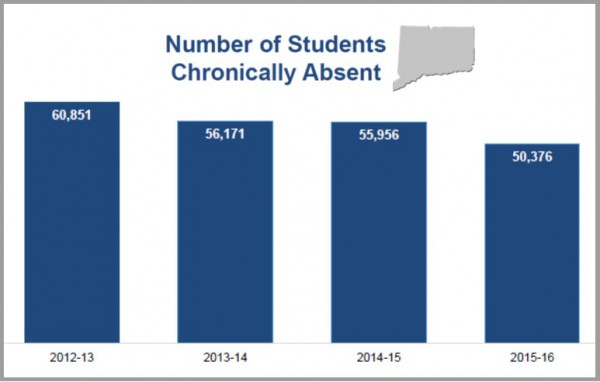
Chronic absenteeism is down across the state, according to new data released by the State Department of Education (SDE), a trend that is gaining notice beyond Connecticut and a sign that collaborative efforts to keep students across Connecticut in school and engaged are having a positive impact. The number of chronically absent students in Connecticut dropped to 9.6 percent in 2015-16, down from 10.6 percent the year before and down from a high of 11.5 percent in 2012-13. The decline in Connecticut’s chronic absenteeism rate means that over 10,000 more students are attending school on a daily basis than four years ago. Nationally, missing too much school is a coast-to-coast crisis that affects more than 6.5 million students.

Connecticut's work is gaining attention at the national level, and was subject of an article in the education publication Kappan Magazine.  The article, “Chronic early absence: What states can do” was co-authored by Hedy Chang, executive director of Attendance Works, Charlene M. Russell-Tucker, chief operating officer of the Connecticut State Department of Education, and her colleague Kari Sullivan,  state attendance lead at SDE.missing

The data also shows that while minority students have disproportionately high rates of chronic absenteeism when compared with their white peers, rates of chronic absenteeism are decreasing for black and Hispanic students in Connecticut.

In 2015-16, the chronic absenteeism rate for Hispanic students was 15.7 percent, down from 19.1 percent in 2012-13. For black students, the rate was 14.5 percent in 2015-16, down from 16 percent in 2012-13. (The new data is available on the CSDE’s data portal, EdSight. The data was released as part of a Chronic Absenteeism presentation delivered this month to the State Board of Education.)  The magazine article notes that “Low-income students are four times more likely to be chronically absent than others, often for reasons beyond their control, such as unstable housing, unreliable transportation, and a lack of access to health care.”

Chronic absenteeism is defined as missing 10 percent or more days of school for any reason, including excused absences, unexcused absences, suspensions, and other disciplinary actions.

“We have identified several areas where we are shifting our focus to fulfill our promise of an excellent public education for every Connecticut child. One of those focus areas is chronic absence,” said Commissioner of Education Dianna R. Wentzell. “We want every public school student in our state to be in school and engaged. That means we have to work with families, educators, and community stakeholders to decrease the number of days that students are out of school.”

Earlier this year, the State Board of Education adopted its Next Generation Accountability System, which uses multiple academic and non-traditional indicators to assess how well a school is performing toward the goal of preparing all students for success in college, career, and life. Chronic absenteeism is one of the new indicators included in the system, which means school districts will have to pay close attention to the problem of chronic absenteeism and take steps to ensure more students attend school on a daily basis.graph

Research shows that chronic absenteeism is inextricably linked with student performance, and students who are chronically absent are less likely to read on grade level, are less likely to perform well academically, and are at a greater risk for dropping out of high school. Risk factors for chronic absence include poverty, homelessness, chronic health conditions, frequent moves, and disabilities.

The article notes that “Most school districts and states don’t look at all the right data to improve school attendance. They track how many students show up every day and how many are skipping school without an excuse but not how many are missing so many days in excused and unexcused absence that they are headed off track academically.”

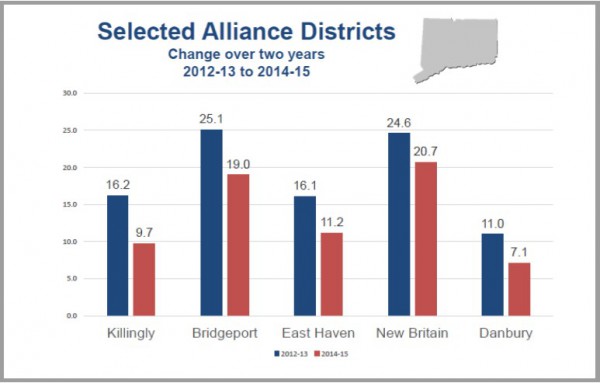
Among the communities being highlighted by SDE are Killingly, where chronic absenteeism dropped from 16.2% to 9.7%; Bridgeport, where the reduction was from 25.1% to 19.0%; East Haven, where the drop was from 16.1% to 11.2%; New Britain, where absenteeism was reduced from 24.6% to 20.7%; and Danbury, which saw a reduction from 11% to 7.1% between 2012-13 and 2014-15.  Attendance Works,  a national and state initiative that promotes awareness of the important role that school attendance plays in achieving academic success, is also highlighting specific Connecticut districts where progress is being made, including New Britain, Middletown and Vernon.  alliance

The SDE has been working with key partners such as the Governor’s Prevention Partnership, Attendance Works, the Campaign for Grade-Level Reading, and the Legislature’s Committee on Children. Chronic absenteeism is addressed in the annual Alliance District grant application for participating districts. The state is also expanding restorative justice programs, such as the Connecticut School-Based Diversion Initiative, and positive behavioral interventions and supports. Additionally, districts are increasing utilization of the Department of Children and Families’ Emergency Mobile Psychiatric Services to respond to mental health crises.

“It is critical that we all understand the importance of daily school attendance. Even in the early grades, lost time in school can put students at risk of becoming disengaged or dropping out of school down the road,” said Commissioner Wentzell.  The state approach focuses on six "high-impact" strategies:

#1: Build Awareness #2: Use Data to Promote Action #3: Cultivate Champions to Build a State-Level Infrastructure #4: Build Capacity #5: Identify and Leverage Bright Spots #6: Foster Accountability

The magazine article co-authors stress that “By monitoring chronic absence in grades K-12 — and paying particular attention to the youngest students — states can address the needs of students and their families before they require more expensive intervention and remediation.”

PERSPECTIVE: At the Next Presidential Election, the Popular Vote Must Win Out

by John R. Koza The state-based winner-take-all system no longer serves the citizens of the country and we must act to reform it now.

The fact that it appears the winner of the 2016 election, Donald Trump, was not supported by a majority of voters dictates that we elect our next president by popular vote. We can no longer endure presidential elections that primarily focus on the issues and outcomes in a shrinking number of battleground states, while the rest of us feel marginalized and muted in the political process.

The reason five of our nation’s 45 incoming presidents have entered office after losing the national popular vote is that most states have winner-take-all laws that award all the state’s electoral votes to the candidate receiving the most popular votes in that state.CT perspective

Given that the average national popular vote has been close in the last eight presidential elections (an average margin of less than 5%), it is likely that the nation will continue to experience elections in which the president wins the electoral college, but loses the nationwide popular vote.

These same state winner-take-all laws force presidential candidates to focus 94% of their general-election campaign events in 12 closely divided “battleground” states – with the remaining states receiving little or no attention. In 2012, they concentrated all of their campaign events in 12 states. As presidential candidate and Wisconsin governor Scott Walker publicly observed a year ago: “The nation as a whole is not going to elect the next president. Twelve states are.”

When presidential candidates devote virtually all of their attention to 12 states (representing just 30% of the nation’s voters), it is not just about TV advertising and rallies. It has a real impact on public policy. Battleground states receive 7% more presidentially controlled grants, twice as many disaster declarations, considerably more Superfund and No Child Left Behind exemptions, and benefit from many other major presidential policy decisions. For example, in 2016, both party’s nominees catered to Michigan, Wisconsin, Ohio and Pennsylvania on the issue of trade treaties.

Former presidential spokesman Ari Fleischer said, “If people don’t like it, they can move from a safe state to a swing state.”

q1Fortunately, the Founding Fathers provided us with a better way to improve the system than mass migration. Article II, section I of the US constitution empowers state legislatures to change their method of awarding electoral votes. National Popular Vote asks the legislatures if they want to join together as states to make every vote matter throughout the country.

The National Popular Vote bill would guarantee the presidency to the candidate who receives the most popular votes in all 50 states and the District of Columbia. This interstate compact will go into effect after it is enacted by states possessing a majority of the electoral votes – that is, enough to elect a president (270 of 538). Under this system, the compacting states award all of their electoral votes (in block) to the candidate who received the most popular votes in all 50 states (and the District of Columbia). This guarantees the presidency to the national popular vote winner and makes every voter, in every state, politically relevant in every presidential election.

Eleven states possessing 165 electoral votes have already enacted the National Popular Vote bill into law. In addition, the bill has made significant progress by passing one legislative chamber in 12 additional states with 96 electoral votes. The bill was recently approved by a bipartisan 40-16 vote in the Republican-controlled Arizona house, a 28-18 vote in the Republican-controlled Oklahoma senate, a 37-21 vote in the Democratic-controlled Oregon House, and unanimously by legislative committees in Georgia and Missouri. A total of 2,794 state legislators have endorsed it.

The National Popular Vote bill offers the additional benefit of preventing a presidential election from being thrown into the US House of Representatives.

We cannot expect a system that makes every voter happy with the end result of every election. We can, however, demand a system where all citizens feel that their vote mattered and voice was heard. National Popular Vote will deliver this promise in every presidential election.

_______________________

John R. Koza is the founder of National Popular Vote.  A plurality of voters in Connecticut and in the United States voted for presidential candidate Hillary Clinton in 2016.  Connecticut's legislature considered, but did not approve, legislation proposed by National Popular Vote in 2015, 2014, 2013, 2012, 2011, and 2009.  The Connecticut House, but not the State Senate, approved NPV legislation in 2009, the same year that a statewide poll indicated that three-quarters of state residents were of the view that the presidential candidate receiving the most votes nationwide should be elected president.  This article first appeared in The Guardian.