

Changes on the Way in New Haven Media Coverage
/The news media focused on New Haven is undergoing some changes, as one publication ends, a new electronic weekly business news round-up is about to begin, and a longtime local business paper is changing its subscription system, reducing the number of non-paying subscribers. New Haven Living magazine, published by the Hartford Courant Media Group in recent years, will cease publication with its January edition, the company recently announced. The New Haven-focused edition of the weekly CTNOW. an entertainment section, will also cease publication, last publishing on Dec. 29, the company said.
The Courant plans to continue publishing Hartford Magazine and the Hartford edition of CTNOW.  Each monthly addition of New Haven Living was nearly identical to Hartford Magazine, usually with a handful of New Haven-focused articles and features added. The Courant reported that it made the decision while evaluating opportunities to invest in higher-growth areas and the cost of distribution in Greater New Haven.
Business New Haven, which began publication in 1993, announced in its latest issue that “we are changing our publishing approach” in an open letter to readers from veteran publisher Mitchell Young, under the headline “The Time Has Come To Decide. Do You Want Business New Haven?”
Young says that “only paid subscribers will be guaranteed” to be included on the newspaper’s circulation list beginning with the next issue. Subscriptions to the monthly print edition will be $24 per year.
“We believe in the value of quality local publications and we hope you find us worth the cost of a lunch – perhaps that is a way of saying there is No Free Lunch,” the full-page letter said.
 A limited number of promotional copies will be limited “based on a proprietary algorithm for the support of our advertisers,” Young noted. He also indicated that plans are in the works to expand the publication’s CONNTACT.com website in the next year, as “we try to build our subscriber base” for the print edition. Business New Haven also publishes the monthly New Haven Magazine.
The Hartford Business Journal (HBJ), which prints a weekly print edition in the Hartford region and has a roster of electronic news publications and business-oriented events, added a statewide daily email aimed at business executives statewide in 2013. The paper recently announced that for those doing business in New Haven and Middlesex Counties, a weekly news round-up, New Haven Biz, will be added to the HBJ e-mail line-up on February 1.
The email is slated to deliver a weekly roundup of business news and information from the Elm City and beyond, the paper’s website explains. The Hartford Business Journal recently had a prominent location at the Greater New Haven Chamber of Commerce Big Connect annual business-to-business event to promote the upcoming news service.
The publication also emails HBJ Today each weekday at noontime highlighting the day’s lead business stories. Subscriptions to the email-delivered news products, which also include the CT Health Care Weekly and CT Green Guide Weekly, are free. CT Morning Blend includes the top business stories from online news sources around the state and the nation “to keep business decision-makers ahead of the competition.” It also includes a stock market snapshot and a business calendar.
HBJ, with a strong local presence in Greater Hartford for more than two decades, is published by New England Business Media, which also publishes the Worcester Business Journal and MaineBiz. It also sponsors the annual CT Business Expo at the Connecticut Convention Center and numerous business programs and events in the region.
 The state’s construction industry unemployment rate nudged downward from 7.1 percent in September, but was 6.4 percent in July 2016. In recent years, the rate ballooned to 18.1 percent in October 2010, at the height of the recession, from a low of 5.8 percent in October of 2008.
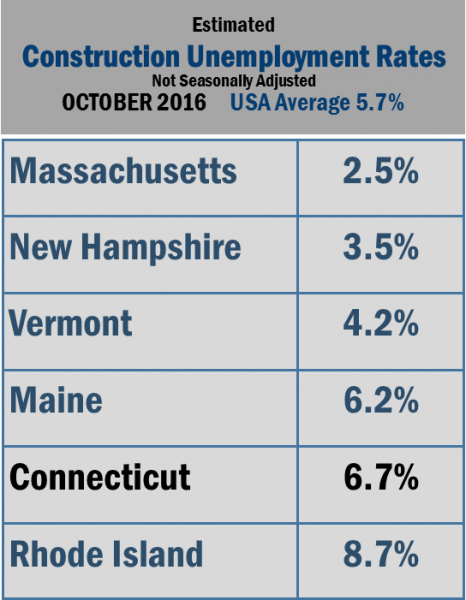


 arch done



 In 2015 the legislature considered, but did not pass, a bill requiring the insurance commissioner to study and report on health insurance coverage of and out-of-pocket expenses for EpiPens, according to the OLR report. The 2014 legislation requires (a) schools to designate and train nonmedical staff to administer EpiPens to students having allergic reactions who were not previously known to have serious allergies and (b) the public health and education departments to jointly develop an annual training program for emergency EpiPen administration.
 Quality of life in the United States is heavily dependent on financial status, the survey summary points out. As a consequence, the nation’s best states to live in often report very high incomes. With a median household income of $71,346 a year, fifth highest of all states, Connecticut is the second

 In a reversal from the previous quarter, 42 percent of state residents surveyed said they were unlikely to move out of state in the next 5 years, compared with 34 percent who described such a move as likely. In the previous survey, conducted in the second quarter of this year, the numbers were reversed with 42 percent saying that it was likely they’d be moving out of state within five years, compared with only 32 percent who said such a move was unlikely.
 Residents of Windham and Fairfield counties were more likely to view overall business conditions as being better now than six months ago, the survey found. Twenty-nine percent of Windham residents held that view as did 28 percent of Fairfield residents. Residents of the state’s other six counties, Middlesex (23%), New London (20%), New Haven (20%), Litchfield (16%), Tolland (16%) and Hartford (16%) had fewer residents expressing that opinion.

 Louise DiCocco, Assistant Counsel for the Connecticut Business & Industry Association, noted that “24 years ago, more than 80 percent of Connecticut votes overwhelmingly approved a spending cap to keep the cost of state government within the taxpayers’ means to afford it. Voters demanded the cap as an offset to the persona income tax in Connecticut. The state must enact a spending cap that is ironclad and works.”
 State Senator Toni Boucher of Danbury told the Commission: “I hope that the commission to adopt a definition of general budget expenditures that is comprehensive and gives a complete and realistic account of all the money that the state spends… it is equally critical that the legislature not be allowed to move what was once an expenditure included under the cap to bonding or fund it with a revenue intercept for the purpose of undermining the cap’s integrity.”



 cal Centers is a joint venture between two leading health care organizations – GuideWell Mutual Holding Company and Organización Sanitas Internacional. GuideWell is a U.S.-based not-for-profit mutual holding company and the parent to a family of forward-thinking companies focused on transforming healthcare.
 Mini-golf courses, skating rinks, gym facilities, laser tag, mazes, and even go-kart raceways are all within the spectrum of entertaining additions to malls these days.

 the right of abused and neglected children and children with disabilities. She was appointed by Governor Dannel Malloy to serve as Connecticut's Child Advocate on August 1, 2013. As Child Advocate, she sets priority reviews for the OCA, manages office operations, and publishes vital information regarding the well-being of children and recommendations for system reform. Prior to this appointment, she served for several years as the Director of the Child Abuse Project at the Center for Children's Advocacy in Hartford.






















