PERSPECTIVE: Connecticut Must Act to End Traffic-Related Deaths and Injuries

by Adina Gianelli We have a problem in the state of Connecticut, a problem as stunning as it is abhorrent, as urgent as it is fixable. That problem is one of road safety.

According to the Connecticut Crash Data Repository, an estimated 311 car crash-related fatalities occurred throughout our state in 2016, a four year high. These crashes disproportionately affect people who are walking or biking. This is cause for alarm and a call to action.

Some may think: “I don’t ride a bike, and I don’t really walk anywhere, either. Why should this matter to me?”

Streets are the most fundamental of public spaces. And whether you think of yourself as a pedestrian or cyclist, we all require safe access to our streets.

Complete streets benefit cyclists and walkers, a broad and diverse category that includes, among many others, children who bike to school and seniors who walk for exercise, commuter cyclists and those who travel via public transportation, triathletes and people with mobility limitations (and triathletes with mobility limitations). It benefits people when they get out of the car, as motorists inevitably do. And yes, complete streets benefit drivers, as well. When it comes to street safety, policies that improve conditions for walkers and cyclists benefit us all.

Humans are not invincible. We remain especially vulnerable to the dangers of cars, as the 311 vehicular crash-related deaths in Connecticut in 2016 reveal. But even one death to a cause wholly preventable is one too many. This is why Vision Zero, which strives to end all traffic-related death and injury, is so important, and has been implemented in NYC and a growing number of cities nationwide.

I wish I could devote this piece to highlighting the joys and pleasures of biking, which confers myriad benefits to well-being and community health. I’d love to tell you about the advantages of walking, which Dr. Thomas Frieden, Director of the Centers for Disease Control (CDC), describes as “the closest thing we have to a wonder drug”.

In a perfect world, I wouldn’t have to tell you that there were 32,166 fatal motor vehicle crashes in the United States in 2015, resulting in 35,092 deaths. I wish I didn’t feel compelled to tell you that traffic fatalities represent the leading cause of death for teenagers nationwide, or that 4500 people are killed crossing the street in the United States each year, a disproportionate number of whom are children, seniors, and people of color. But as a matter of conscience, it is imperative to share this data. These statistics are harrowing and reveal necessary truths about the critical need for action on the part of the Connecticut General Assembly.

How might we move forward to improve road safety for all of Connecticut, and our most vulnerable users in particular? The problem is massive, but the solutions are all but laid out before us. We simply need to implement them.

Complete streets—and the resource allocation necessary to implement this infrastructure—are essential. Education represents another cornerstone, and a critical component of lasting cultural change. By adopting and implementing a statewide, evidence-based cycling education program—such as the one developed by Bike Walk Connecticut—in our public schools, we can keep our children healthy and safe.

Connecticut must strengthen its crosswalk legislation to align with best practices for public health and safety. As a state, we would be well served to revisit our vulnerable user laws, increasing penalties for motorists who injure or kill walkers or cyclists. Ours is one of only 10 states that doesn’t require motorists to refrain from opening a vehicle door until conditions are safe; this, too, must change. Boston, Massachusetts recently implemented a 25 MPH default speed limit; there is no reason that Hartford—and other Connecticut municipalities—shouldn’t do the same. Adopting Vision Zero is an imperative. The work has never been more urgent, and the need has never been more clear.

Arudhati Roy once wrote that “[a] new world is not only possible, but she is on her way. On a quiet day, I can hear her breathing.” On a quiet day, I can see her biking and walking, safe on beautiful and complete streets.

____________________________________

Adina Gianelli is Executive Director of Bike Walk Connecticut, a member-supported non-profit organization changing the culture of transportation through advocacy and education to make bicycling and walking safe, feasible, and attractive for a healthier, cleaner Connecticut.

State’s First Law Incubators Set to Launch in Hartford, Bridgeport

Connecticut’s first law incubators are due to open early this year at the Center for Family Justice, a Bridgeport-based nonprofit, and at UConn School of Law,  being established to provide affordable legal services to people who need them and help lawyers establish solo practices. The Connecticut Community Law Center, an initiative of the law school and the Hartford County Bar Association, aims to help people who have traditionally been underserved by the justice system: low- and moderate-income clients who don’t qualify for legal aid but can’t afford standard legal fees, the UConn School of Law announced this month.

“Too many people face legal problems concerning essential human needs without proper representation because they fall into the growing access-to-justice gap, between the very poor who qualify for legal aid and those with the financial means to pay a private lawyer,” said attorney Mark Schreier, who was appointed director of the Connecticut Community Law Center. “Standing alone and without professional guidance, those individuals enter our justice system at a tremendous disadvantage.”

The incubator is set to open in February in William F. Starr Hall on the UConn Law campus in Hartford. In addition to the services of the director, the law school will provide office space and support – including training, guidance, and legal research resources – for up to six solo practitioners. The Hartford County Bar Association and the law school faculty will provide mentors, and Greater Hartford Legal Aid will help with training and referrals.

The subsidized working environment will allow participating lawyers to provide legal services at a modest cost that is lower than standard legal fees, with each lawyer setting the fee on a case by case basis. Schreier said he expects cases to involve a wide range of legal problems, including family, consumer, probate, housing, bankruptcy, employment, immigration, and other general civil matters.

In Bridgeport, the Center for Family Justice, a Bridgeport-based nonprofit that provides services to trauma survivors affected by domestic violence, sexual assault or child abuse, will house the incubator.

The Center is working with Connecticut law schools to help build the center’s legal apparatus, Fairfield County Business Journal reported, with several professors from Quinnipiac University on the steering committee to help develop the parameters of the program.  Four attorneys are being sought.

Lawyers in the incubator program at the Center will provide the legal advices services and representation needed by victims of domestic violence, including restraining orders, divorce proceedings, child custody and support, housing and immigration issues.  An Open House was held in September to interest local attorneys in participating.

“A legal incubator is like a business incubator,” Jennifer Ferrante, who joined the Center for Family Justice staff as the coordinator for the new service, told the Journal.  At the center’s office at 753 Fairfield Ave., “We are going to be housing four attorneys here on site,” she said. Two of the first attorneys who applied and were accepted in the program are recent law school graduates.

The American Bar Association counts more than 60 lawyer incubators around the country, three-fourths of them established since 2014. The Connecticut Community Law Center and the Justice Legal Center at the Center for Family Justice in Bridgeport, will be the first in Connecticut.

Participating lawyers will spend 18 to 24 months at the Connecticut Community Law Center before moving on with their practices. The training and experience they receive will not only help them jump-start their practices, it will spread seeds of innovation in the delivery of legal services at an affordable cost, UConn Law Dean Timothy Fisher said.

Clients who qualify for services at the Hartford incubator will be those whose incomes exceed the limits for legal aid but fall within three times the federal poverty level. For a family of four, this would mean a maximum household income of $72,900. Clients wishing to apply for services may do so beginning in February, when information will be available at the center’s website: cclc.law.uconn.edu.

“I think it will give the low- and moderate-income community a real chance in getting their legal needs met and ending their cycles in abuse and poverty,” Ferrante said of the new Bridgeport center.

Planning for the legal incubator has been ongoing since 2009. Although the Center for Family Justice is focused on serving six Fairfield County municipalities – Bridgeport, Easton, Fairfield, Monroe, Stratford and Trumbull – it also welcomes those seeking help from elsewhere in the state, officials said.

CT Council Urges Change in Focus to Combat Human Trafficking in State

Recognizing that the sex industry – especially when it involves underage children – is a form of human trafficking, the Connecticut Trafficking in Persons Council (TIP) is making several legislative recommendations aimed at shifting the onus for the crime of prostitution from the prostitute to “the demand side” – the buyers of sex. On National Human Trafficking Awareness Day, the TIP Council released its Annual Report and recommendations for the state legislature, and launched a new initiative and website, www.enddemandct.org.

“Conversations about sex trafficking almost exclusively disregard the role of the individual buying sex—the ‘john,’” says Jillian Gilchrest, chair of Connecticut’s Trafficking in Persons Council and Director of Health Professional Outreach at the Connecticut Coalition Against Domestic Violence. “The sex trafficking of Connecticut’s women, men, and children is driven by demand for the commercial sex acts they perform. Put simply, without ‘buyers’ to purchase sex there would be no sex-for-pay industry. So, we are embarking on an ‘End Demand’ campaign to bring much needed attention to those buying sex who create the demand that fuels sex trafficking.”

The TIP report questions why, since Connecticut enacted the felony crime of patronizing sex from a minor in 2013, there have been no arrests or convictions for the felony. Significantly, DCF has seen an increase in the trafficking of children; currently, there are 456 referrals for children at high risk of trafficking.

The report also calls on Connecticut lawmakers, state agencies, and advocates to work together to better understand the demand side of sex trafficking in order to effectively prevent this crime from happening. This begins, the report explains, with creating awareness, since more often than not, those buying sex are left out of conversations about human trafficking. With the use of social media, traditional media, and advertising, the TIP Council indicated it aims to raise public awareness about the individuals in our state who choose to pay to sexually abuse children and exploited individuals.

The report indicates that law enforcement and State’s prosecutors argue that those buying sex with children and exploited adults can be charged with other crimes, such as sexual assault in the second degree or risk of injury. The Council will be looking into this, the report notes, to better understand if buyers of sex are being arrested, and if not, why.

In addition, the report outlined that with over 100 members, the Department of Children and Families (DCF) Human Anti-trafficking Response Team (HART) comprises multi-department, multiagency partners, various levels of law enforcement, the provider community, faith-based network, among others. In 2015, DCF received 133 referrals of youth who were at risk or confirmed victims of human trafficking. As of September 2016, DCF has received 151 referrals of youth who were at risk or confirmed victims of human trafficking, the report indicated.

Tammy Sneed, Director of Gender Responsive Adolescent Services at Department of Children and Families and co-chair of DCF’s Human Anti-Trafficking Response Team, said: “Reports of children suspected to be victims of domestic minor sex trafficking are increasing every year -- and, in 2016, there were just under 200 such referrals. For every child victim, the number of buyers on a given day in Connecticut is unfathomable. Some children report 10 to 15 buyers per night, which leads us to estimate that a minimum of 2,000 buyers in Connecticut bought sex from children last year.”

In the report, the Council recommends:

  • the Connecticut Sentencing Commission, Special Committee on Sex Offender, Subcommittee on Sex Offender Sentencing consider whether to include 53a-192a. Trafficking in persons and 53a-83(c), Patronizing a prostitute when such other person is under the age of 18, to the Registration of Sex Offender statutes;
  • further discussion and inquiry on why there have not been any convictions under Sec. 53a-83(c), Patronizing a prostitute under the age of 18, effective 2013;
  • further discussion on increasing the penalty for Sec. 53a-83(c), patronizing a prostitute under the age of 18, to align with similar sexual crimes against children; and
  • further discussion on revising Sec. 53a-192a, Trafficking in persons, to include recruitment, harboring, transportation, provision, obtaining, patronizing, or soliciting of a person for the purpose of a commercial sex act and increasing penalties to recognize the severity of the crime.

The Trafficking in Persons (TIP) Council is convened by the Commission on Women, Children and Seniors and chaired by the Connecticut Coalition Against Domestic Violence (CCADV). The Council was formerly run by the Permanent Commission on the Status of Women. The council consists of members from a diversity of backgrounds, including representatives from state agencies, the judicial branch, law enforcement, motor transport and community based organizations that work with victims of sexual and domestic violence and immigrants and refugees, and address behavioral health needs and social justice and human rights.

“Demand keeps sexual exploitation and trafficking profitable,” says Beth Hamilton, associate director of the Alliance to End Sexual Violence (formerly CONNSACS). “We’ve started seeing the criminal justice system hold traffickers responsible, but we do not often see the people who purchase sex being held accountable for their role in keeping the industry thriving.  If we want to end commercial sexual exploitation, we need to focus on ending demand and creating survivor-centered services.”

In Connecticut, a person is guilty of trafficking in persons when such person compels or induces another person to engage in sexual contact or provide labor or services by means of force, threat of force, fraud or coercion. Anyone under the age of 18 engaged in commercial sexual exploitation is deemed a victim of domestic minor sex trafficking irrespective of the use of force, threat of force, fraud or coercion.

The report points out that “For many people, sex and labor trafficking bring visions of foreign places and people, but this idea is false. In reality, sex and labor trafficking are happening in the state, to Connecticut residents.”

College Debt Continues to Climb; Connecticut Students Graduate with 3rd Highest Loan Debt in US

Nearly two-thirds of students who graduated from public and nonprofit colleges in Connecticut in 2015 had student loan debt averaging $34,773, the third highest level in the nation.  The state ranked 14th in the percentage of students graduating with debt, according to data compiled by The Institute for College Access & Success (TICAS). Student debt continues to rise for new graduates, across the country and in Connecticut.  Student debt at graduation ranged from $15,521 for Yale University graduates to $47, 715 at Sacred Heart University and $47,873 at Quinnipiac University.

At public and nonprofit colleges in 2015, seven in 10 graduating seniors (68%) had student loans. Their average debt was $30,100: up four percent compared to the Class of 2014. About one-fifth of 2015 graduates’ debt (19%) was in private (non-federal) loans, which are typically more costly and provide far fewer consumer protections and repayment options than federal student loans, the Institute pointed out.

At institutions across the country, state averages for debt at graduation in 2015 ranged from $18,850 to $36,100, and new graduates’ likelihood of having debt ranged from 41 percent to 76 percent.

In 12 states, including Connecticut, average debt was more than $30,000 – up from six states the year before. High-debt states remain concentrated in the Northeast and Midwest, with low-debt states mainly in the West. Average debt at the college level varies even more, from a low of $3,000 to a high of $53,000, and the share graduating with loans ranges from seven percent to 100 percent.

“Student debt is still rising, and the typical college graduate now leaves school with over $30,000 in loans,” said TICAS president Lauren Asher. “We need to make college more affordable and debt less burdensome for students and families.”

The states with the highest debt levels for graduating students, according to the TICAS study, are New Hampshire ($36,101); Pennsylvania ($34,798); Connecticut ($34,773); Delaware ($33,849) and Rhode Island ($32,920).  At the other end of the spectrum, students graduation from colleges in Oklahoma have the lowest average debt ($24,849), followed by Washington, Arizona, Nevada and Hawaii.


CT Seen As Hiding Bad Budget News

In an article headlined “Bad Budget News? Some States Just Bury It.” Connecticut is one of two states selected as a poster child for what a national publication describes as “hindering transparency.” The Connecticut policy that brought the unwelcome attention was put in place last year.  As Governing explains:

“Connecticut ended its practice of current services projections. That’s a boring-sounding way of talking about how much programs will cost over time, assuming there are no policy changes. It’s a baseline against which to compare any proposed cuts or increases in spending.”

Ben Barnes, Connecticut’s budget director (Secretary of the Office of Policy and Management), said last year that it didn’t make sense to project shortfalls or surpluses into the future, Governing explains. “There’s no such thing, in my view, as a deficit or a surplus in years in which there is no appropriation in place,” said Barnes, whose photo accompanies the article.

Some legislators complained that the new rules would be a blow against transparency in the budget. The change was adopted anyway, the publication noted, adding that a majority of states already choose not to publish current services projections.

“There is kind of a tendency for policymakers to focus on the immediate and not the future,” Liz McNichol of the Center on Budget and Policy Priorities, told Governing. “This reduces the outside pressure to look beyond one year.”

The publication’s report notes that Connecticut “will have to fill a shortfall of more than $1 billion in its budget this year.”

The other state highlighted in the article is Kansas, where a state task force recommended that the department stop releasing monthly budget reports after numerous reports indicated that the state had fallen short of anticipated revenues.   The Governor’s administration also “decided to kill a quarterly economic report that was also habitually filled with bad numbers.”

Governing is the nation's leading media platform covering politics, policy and management for state and local government leaders.


Career Services Grows in Importance to College Students, Survey Finds

While 52 percent of U.S. college graduates report visiting the career services office at least once during their undergraduate experience, they are equally likely to say their experience was "not at all helpful" (16%) as they are to say it was "very helpful" (16%), according to a new national survey of college graduates.  Overall, just under eight in 10 graduates who visited a career services offices describe the experience as “very helpful,” "helpful" or "somewhat helpful." The findings are outlined in the Gallup-Purdue Index Report 2016, released last month, based on more than 11,000 interviews with U.S. adults aged 18 and older with at least a bachelor's degree, conducted Aug. 22-Oct. 11, 2016. The study was conducted as part of the third year of the Gallup-Purdue Index -- a nationally representative survey that has interviewed 70,000 different college graduates over three years.

The survey found that graduates who recall having a high-quality experience with their career services office are markedly more likely to rate their college experience positively. For example, graduates who rated their experiences with career services as very helpful are 5.8 times more likely to strongly agree that their university prepared them for post-collegiate life, nearly three times more likely to "strongly agree" that their education was worth, and 3.4 times more likely to recommend their alma mater.

The campus Career Services office has grown increasingly important to students.  The survey found that recent college graduates are more likely than those who graduated earlier to report visiting their school's career services office. Sixty-one percent of graduates who received their degree since 2009 say they visited the career services office at least once during their undergraduate experience, while 32 percent report they did not (7 percent were unsure).

The results could stem from substantial changes in college students' interactions with career services over time and the fact that colleges' career services' offerings have evolved dramatically in past decades. It is also possible that a larger percentage of earlier graduates may be unable to recall their experience with the career services office, Gallup points out.

Gallup notes that Americans with a bachelor's degree can expect to earn about $1 million more than those with a high school diploma over the course of their careers. However, the unemployment rate for college graduates in the U.S. aged 25 and older is now nearly double what it was in 2000, compared with an overall employment rate that is only one percentage point higher in 2016 than it was in 2000.

As a result, the Gallup organization observes, “schools must adopt new programs and policies to better prepare their graduates for a changing and competitive job market.”  Career services are apparently an increasingly important part of that changing landscape.

Career services offices often provide this support, which can include stimulating student interest in disciplines they had previously not considered, helping students select a major field of study, helping students secure employment while enrolled in college, and preparing students for finding a job upon graduation through mock interviews and resume workshops.

PERSPECTIVE: Effective State Spending Cap Is Number One Priority for Business

by James C. Smith Formulating definitions for key spending cap terms and holding the line on exemptions from the cap in the name of fiscal responsibility will have a significantly positive impact on businesses’ willingness to invest here and on our state’s socio-economic future. Our success depends on the state’s ability to create a stable, competitive economic environment where people can start and expand businesses and families, with confidence in the future operating environment.

I am a Middlebury resident who was born and raised and works in the great city of Waterbury in our great state of Connecticut. I'm chairman and chief executive of Webster Bank. Webster was founded by my father, Harold Webster Smith, in Waterbury in 1935, the depth of the Great Depression, to help his neighbors build and buy their own homes. Over the years we've grown to become one of the largest commercial banks headquartered in New England.

For all of our recent growth into markets beyond Connecticut’s borders, Connecticut remains our most important market, accounting for nearly 70% of our 185 banking offices and over 70% of our 3,300 bankers. Webster serves one of every nine Connecticut households and about 30,000 Connecticut businesses. Yet as Connecticut’s growth has lagged the nation and the region in recent years, most of our growth is coming from faster growing regions in the Northeast…

We feel we have a duty to our customers and communities to speak out on important policy issues, like the spending cap, as we strive to be a catalyst for positive economic change. We are driven by policy, not partisanship. We listen closely to our customers, and we share with you the thoughts and concerns of many of them today.

I am deeply concerned for the state's fiscal condition, which I think we can agree is deteriorating. I strongly believe that fiscal pressures and related uncertainty regarding taxes and regulatory rules are largely responsible for the low and waning confidence expressed by businesses and consumers and is contributing to our alarmingly low standing in surveys measuring the business environment and economic prospects in states across the country…

It’s well known that Connecticut has yet to recoup all of the jobs lost in the Great Recession and that we lag well behind the nation in economic growth. In fact, private sector employment is about what it was in 1990. At the same time, many of the jobs that are being created are in lower-paying sectors of the economy, so personal income is growing slowly. At the core of our stubbornly slow recovery lies a profound lack of confidence among businesses, large and small, in the sustainability of state fiscal policies. Despite the two largest tax increases in state history in recent years, our state nonetheless remains mired in an endless cycle of budget crises with no end in sight…
This crisis atmosphere has had a predictable impact on business confidence… We are seeing a diminished appetite for capital investment among our state’s businesses compared to what we customarily have seen in the past. Many of our clients are being acquired rather than becoming active acquirers. As a barometer for the future, these signs do not portend a robust economy that provides good jobs for our children and grandchildren.

More and more people are losing confidence in our ability to achieve fiscal sustainability given the ‘new economic reality’, asserting that the challenges are insurmountable and apparently accepting our fate as a second tier state sinking deeper into that "economic cul-de-sac" that Michael Gallis, the expert on state competitiveness, warned us about in 1999.

I’m confident that we can turn it around if we adopt a ‘control our destiny’ approach to solving our fiscal problems, and that begins with you. You have it within your power to change the course of events by defining the spending cap, and especially the exemptions, in a way that sustainably controls total state spending, lowers the state’s cost of doing business and improves public sector productivity, and enables investment of the savings in programs and infrastructure improvements that will facilitate and encourage economic investment, thereby increasing business confidence and job creation. If we do not instill businesses with confidence in our state's leadership and finances, the attrition of businesses to other states will accelerate.

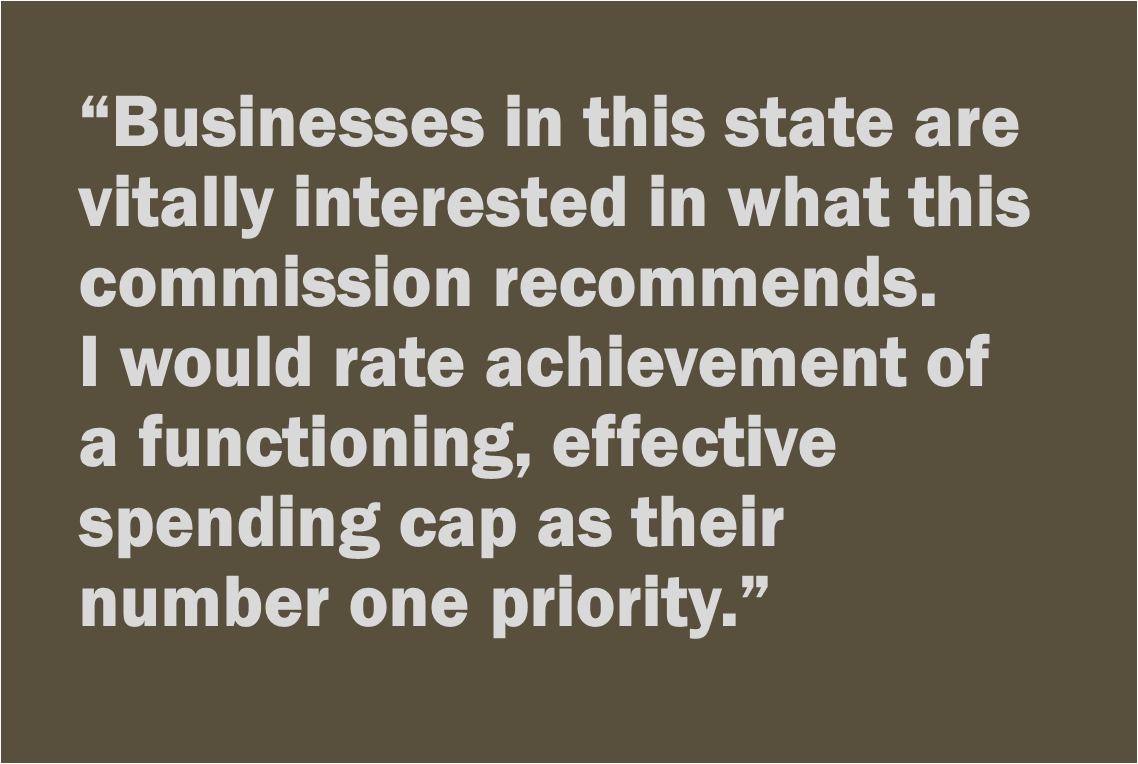
Businesses in this state are vitally interested in what this commission recommends. I would rate achievement of a functioning, effective spending cap as their number one priority. The commission’s recommendations will be closely watched to determine the level of discipline it seeks to impose on future spending, and taxes. You can be sure that businesses will make investment and location choices accordingly.

The plain truth is that our state has promised more than it can afford, or has been willing to fund, over many years. Governors and Legislatures made and underfunded forward commitments for decades and only recently have begun to defease them. Not funding those commitments is the primary reason we’re in the difficult situation we’re faced with now, since it led directly to more spending under the cap, which would not have been possible had that funding occurred more responsibly. Now two powerful forces are colliding, threatening to push spending even higher…the need to fund our promises previously made, and the willingness of the legislature to continually raise taxes to meet seemingly insatiable overall spending desires.

As the required funding trajectory for unfunded liabilities now rises, some favor exempting these expenses from the cap. This is 100% contrary to the intent of the constitutional amendment, and I believe it’s the biggest issue facing the commission.

The spending cap was intended to enforce fiscal discipline by limiting spending, and ‘limit’ is the key word in the constitutional amendment. This would require government to decide what to fund…and, importantly, what not to fund…and to make decisions that enable efficient management of government within our appropriately constrained ability to increase revenue consistent with growth in personal income or inflation.

Pushing fast-growing expenses out from under the cap in order to nominally comply with the cap while still satisfying our spending habit defeats the cap’s purpose and the voters’ intent. It’s like trying to eat our cake and have it, too. Most recently a simple majority of legislators moved $1.9 billion in payments toward unfunded pension liabilities outside the cap, freeing up approximately $100 million in additional spending under the cap this year. Such maneuvers violate the will of voters and only serve to make our finances more precarious. Unchecked, these maneuvers will surely produce a catastrophic result and would be the ruin of Connecticut. Exemptions from the cap now comprise approximately 30% of state expenditures. Remember that in the end, it’s total spending that matters most, since that is the basis for determining appropriations and taxes.

The constitutional amendment envisioned that only debt service was to be exempted, since placing debt service under the cap could unsettle the credit markets, raise the state’s cost of borrowing and possibly lead the state to postpone needed infrastructure improvements. I believe that only debt service should be exempted in the future since the fewer the exemptions, the more likely we can achieve true fiscal discipline. A case in point is that over the last forty-five years, total appropriations have grown at well over twice the rate of personal income.

We need to resurrect our Inner Yankee and become the "Land of Steady Habits" once again on spending. Despite its currently flawed status, the spending cap has acted as a brake on spending, encouraged bipartisanship, and spurred innovation in program delivery and organization of state government. And if the cap had been faithfully observed since 1992, cumulative state spending would have been reduced by as much as $5.5 billion.

The spending cap was adopted by more than 80% of voters as part of the grand bargain that led to the state income tax. I urge you to adopt definitions that allow the cap to work as voters intended. With proper definitions, an effective spending cap will encourage working across the aisle in the General Assembly, force our leaders to prioritize spending, and lead to new ways to deliver state services more efficiently.

To those who say that the spending cap is blind to needs, I point to the cap's safety valve. By a gubernatorial declaration and a three-fifths legislative vote, the cap can be exceeded, providing sufficient flexibility to respond to unforeseen needs.

Another area that needs attention is the Budget Reserve Fund (‘rainy day fund’) which is designed to protect surpluses to plug revenue shortfalls in recessions. Much of the surpluses were appropriated by the Legislature for other purposes such that in the early 2000's, when our state ran more than $5 billion in surpluses, only about $1.5 billion of that went to fill emergency revenue gaps or to retire outstanding obligations.

Had the Legislature faithfully adhered to the spending cap, Connecticut‘s rainy day fund in 2008 would have been over $2 billion greater. A larger balance in the rainy day fund could have significantly reduced the need for subsequent tax increases. And as any economist will tell you, a recession is not the time to raise taxes. I hope your recommendations will include some reference to the need for tighter oversight of the BRF.

As you craft definitions, I urge you to consider to these thoughts,

  1. In my view the most important issue the commission faces is deciding what expenditures should be included under the cap. The spending cap should be comprehensive and include all state spending other than debt service as envisioned in the constitutional amendment. The selective removal from the cap of fast-growing budget items guts the value of the cap and defeats the will of voters by allowing otherwise unallowable spending increases which in turn raise taxes.
  2. Specifically, contributions to meet unfunded pension liabilities (and other post-employment benefits) should be under the cap, since this is one of the state's largest and fastest-growing expenditures. Yes, this will lead to hard choices, as envisioned in the constitutional amendment… and hard choices are required for Connecticut to regain competitiveness.
  3. The definitions for income growth and the inflation rate should look back over at least five years to smooth out volatility and ameliorate the impact of one-time events.
  4. Capital gains should continue to be excluded from the calculation of personal income due to their inherent volatility. Capital gains are subject to numerous influences beyond the control of the state, including market movements up and down and federal tax increases, such as the 2013 increase that most likely inhibited investors from taking gains and in turn affected state tax collections.
  5. In years of revenue windfalls, a meaningful portion of revenue in excess of the cap should go automatically to the BRF with the remainder going to pay down the state's unfunded pension and healthcare obligations, the highest in the nation on a per capita basis.
  6. The spending cap must be enforceable and include a mechanism for judicial review in anticipation of potential legislative attempts to exploit any ambiguity in the definitions.
  7. Consider these three principles of fiscal responsibility -- stability, predictability, and competitiveness -- in crafting your recommendations:

Stability. Volatility and changeability are anathema to business investment. Businesses seek assurance that state finances, together with the BRF, are on solid footing when deciding where to invest or expand their workforce. The cap should act to protect both taxpayers and recipients of needed services from the unforeseen.

Predictability. Businesses need to have to have confidence in the state’s policy direction. In recent years, the state has made repeated changes to the tax code that penalize businesses or create uncertainty as to tax structure and rates. Recent actions to limit the research and development tax credit, adopt the unitary tax, and restrict the use of net operating loss carry-forwards are prime examples of the whipsawing policy that unnerves businesses and discourages investment. Likewise, state retirees need the confidence to know that the state can meet its pension obligations while fiscal responsibility requires that we adopt a credible plan for funding them, which we don’t have today.

Competitiveness. Competition breeds advantage, while a lack of competitiveness breeds decline, whether for states or nations. Competition lowers costs and enhances affordability by continually improving efficiency and creating the capacity to invest, which otherwise would be lacking. Every service that government delivers should be subject to rigorous competitive review to ensure delivery through the most efficient means, including knowledge of other states’ best practices. Our tax structure and rates must be competitive if we are to grow.

When Connecticut voters spoke in 1991, their message was loud and clear. They demanded a mandatory brake on state spending, which would be especially important in times when incomes are growing slowly. We live in such a time.

I urge the commission to recommend adoption of spending cap definitions that will impose constructive discipline on state spending, force our elected leaders to make choices, encourage public sector productivity gains, and regain the public’s confidence. If this commission adopts and the Legislature enacts definitions that meet the principles I’ve shared, Connecticut’s businesses will regain the confidence to grow and invest and create jobs.

____________________________

James C. Smith is Chairman and C.E.O., Webster Bank.  This is excerpted from testimony provided on Sept. 7, 2016 to the State Spending Cap Commission, where Smith was invited to testify.  Subsequently, at the Commission's Dec. 15 meeting, the members did not reach a consensus on recommendations.  The state legislature convened this month for the 2017 session.  

 

CT Playing Catch-up to Other States in Reducing Childhood Obesity

Although Connecticut has fared comparatively well to other states in adult obesity rates, the state does “not do as well for children, especially low-income children,” according to two new national reports, the Child Health and Development Institute (CHDI) of Connecticut indicates in the organization’s latest issue brief. “Preventing children from being overweight or obese requires action in the earliest years since experts agree that reversing these trends later in life can be very difficult,” CHDI points out. “It is currently estimated that one in four children are overweight or obese by the time they enter kindergarten.

The reports highlight how Connecticut is doing relative to other states on early childhood obesity prevention. Data for low-income children was drawn from families participating in the federal Special Supplemental Nutrition Program for Women, Infants, and Children (WIC).

The Trust for America’s Health and Robert Wood Johnson Foundation’s State of Obesity in America report shows that Connecticut ranks:

  • 12th out of 50 states for highest WIC obesity rates (low-income children ages 2-4 years old)
  • 27th out of 37 states for highest adolescent obesity rates (students grades 9-12) Mississippi high schoolers have the highest obesity rate in US: 18.9%. Montana the lowest: 10.3% Connecticut is 12.3%
  • 42nd out of 50 states for highest adult obesity rates (18 and older)

A new report from the Centers for Disease Control (CDC), Early Care and Education State Indicator Report, tracks state policies aimed at preventing obesity in child care settings and shows that Connecticut is missing opportunities to address healthy nutrition in early childhood and education settings (ECE).

The 2016 report examines 15 data indicators including, assessing each state’s licensing regulations for high impact obesity prevention standards. Connecticut only had 2 out of 47 obesity prevention standards in State licensing regulations for early care and education programs and lacked ECE professional development training on obesity prevention that 42 other states offer.

CHDI explains that since 2014, Connecticut state agencies have started to address early childhood nutrition through licensing and training. The State is currently in the process of reviewing Early Childhood Education (ECE) licensing regulations, and has developed general training for some early childhood providers on nutrition and fitness.

Additionally, the Department of Public Health offers training to ECE providers via funding through the Centers for Disease Control and is working with the Connecticut State Department of Education (SDE), Office of Early Childhood (OEC), and the UConn Rudd Center for Food Policy and Obesity to enhance professional development training focused on obesity prevention.

“Despite this progress,” the CHDI stresses, “more needs to be done to catch up with other states and reduce obesity rates among young children.” CHDI adds that “Connecticut must look at best practice standards related to early childhood obesity prevention and do better for our children to ensure that they grow at a healthy weight.”

Connecticut now has the 10th lowest adult obesity rate in the nation, according to The State of Obesity: Better Policies for a Healthier America released September 2016. Connecticut's adult obesity rate is currently 25.3 percent, up from 16.0 percent in 2000 and from 10.4 percent in 1990.

Sandy Hook Shooting Among Top 10 Impactful Historic Events for Millennials

Among American millennials, the 2012 shooting of students and teachers at Sandy Hook Elementary School in Newtown is one of the 10 events during their lifetime with the greatest impact on the country. That’s according to a new survey conducted by Pew Research Center in association with A+E Networks’ HISTORY. For Millennials, the 9/11 terror attacks and the Obama election leads the list – and by a greater margin than for other generations.

The top 10 list for these young Americans also varies from the rankings of other generations. For example, the Columbine school shooting makes the top 10 list of Millennials and Gen Xers but not Boomers or the Silent Generation.

Millennials also are unique in that five of their top 10 events – the Sandy Hook and Orlando/Pulse nightclub shootings, the death of Osama bin Laden, the Boston Marathon bombing and the Great Recession – appear in no other generation’s top 10 list.

The perceived historic importance of the attacks on New York and the Pentagon, span virtually every traditional demographic divide, the survey found.

The top 12 among millennials were: Sept.11; Obama election; Iraq/Afghanistan wars; Gay marriage; the tech revolution; Orlando shooting; Hurricane Katrina; Columbine shooting; Bin Laden; Sandy Hook; Boston Marathon bombing; Great Recession.
When participants of all ages were asked to identify a time or event during their lifetime when “you felt most disappointed in America,” among the events mentioned most often were the school shootings at Sandy Hook and Columbine.

To measure how Americans view the importance of recent historic events, Pew Research Center conducted a national, probability-based survey with a representative sample of adults who are members of the GfK KnowledgePanel, a national, probability-based online panel. Pew Research Center received supplemental funding from HISTORY to conduct this survey.

Survey participants were asked to list the 10 historic events that occurred during their lifetimes that they thought “have had the greatest impact on the country.” Respondents were further told that they could name a specific event, a series of related events or any other historic development that had a major influence on American life.

Leading the list among Generation X were Sept. 11; Obama election; Fall of Berlin Wall/End of Cold War; The tech revolution; Iraq/Afghanistan wars; Gulf War; Challenger disaster; Gay marriage; Hurricane Katrina; Columbine shooting; Orlando shooting; Oklahoma City bombing.

For baby boomers, the top historic events were Sept. 11; JFK assassination; Vietnam War; Obama election; Moon landing; the tech revolution; Civil rights movement; Fall of Berlin Wall/end of Cold War; MLK assassination; Iraq/Afghanistan wars.

Millennials are those young adults born between 1981 and 1998.  Generation X were born 1965 to 1980; the Baby Boom generation were born between 1946 and 1964.

CT Employers Less Optimistic About Hiring in First Quarter

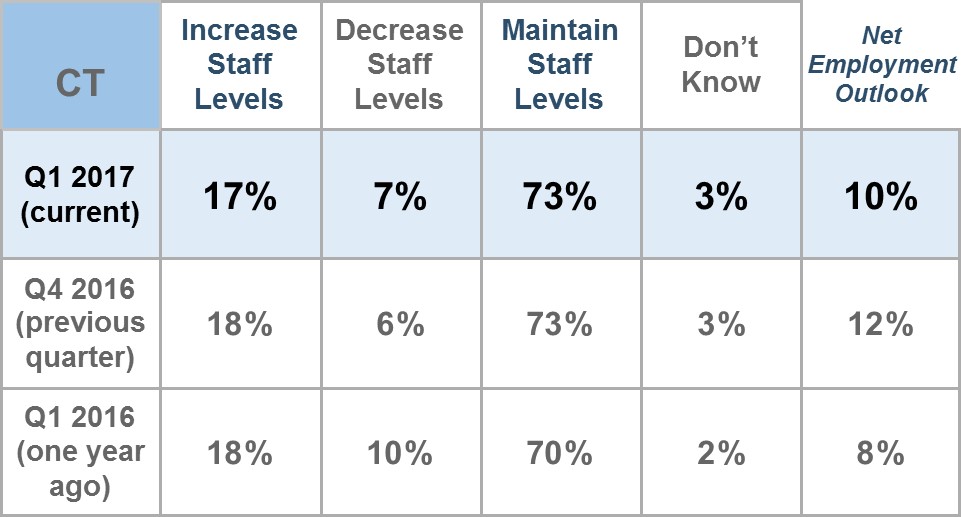
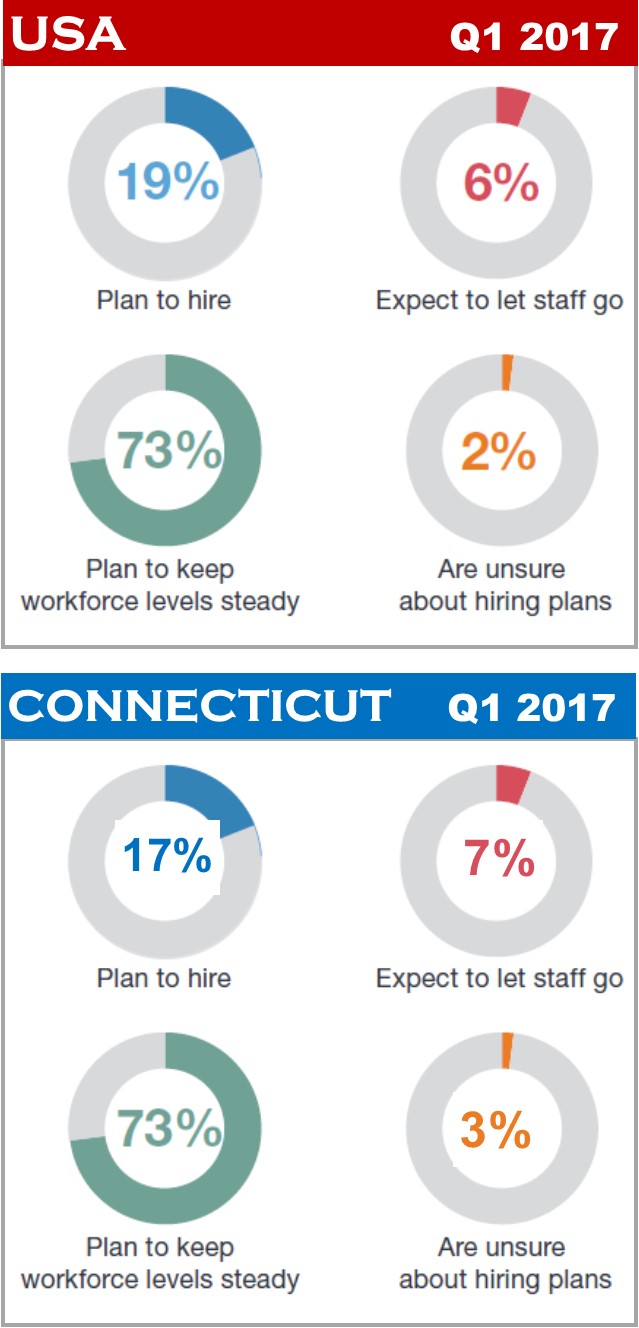
Employers nationwide are slightly more optimistic about hiring in the first quarter of 2017 than employers in Connecticut, according to the ManpowerGroup Employment Outlook Survey, although both expect to hire at a favorable pace during the first quarter of 2017. From January to March, 17 percent of Connecticut companies interviewed plan to hire more employees, while 7 percent expect to reduce their payrolls. Another 73 percent expect to maintain their current workforce levels and 3 percent are not certain of their hiring plans. This yields a Net Employment Outlook* of 10 percent.
For the coming quarter, job prospects appear best in Durable Goods Manufacturing, Nondurable Goods Manufacturing, Transportation & Utilities, Wholesale & Retail Trade, Financial Activities, Professional & Business Services, Education & Health Services, Leisure & Hospitality and Government. Employers in Construction, Information and Other Services plan to reduce staffing levels.

“Hiring intentions are weaker compared to Q4 2016 when the Net Employment Outlook was 12%,” said ManpowerGroup spokesperson Betty Gooding said about the Connecticut outlook. “The hiring pace is expected to pick up compared to one year ago when the Net Employment Outlook was 8%.” Of the more than 11,000 employers surveyed in the United States, 19 percent expect to add to their workforces, and 6 percent expect a decline in their payrolls during Quarter 1 2017. Seventy-three percent of employers anticipate making no change to staff levels, and the remaining 2 percent of employers are undecided about their hiring plans.

When seasonal variations are removed from the data, the Net Employment Outlook is +16 percent, a slight decrease compared to the Quarter 4 2016 Outlook, +18 percent.  That’s a somewhat more optimistic view than employers in Connecticut, the survey found.