Florida vs. Connecticut - Mixed Bag of Growth and Opportunity

Florida Governor Rick Scott spent much of Monday in Connecticut, urging businesses here to relocate to the Sunshine State. There’s no question that Florida has attracted some Connecticut residents and created jobs in recent years, but recent published reports highlight more of a mixed bag that appearances may suggest at first glance.

Chris McCarty, the director of the University of Florida's Bureau of Economic and Business Research, said in a PolitiFact.com article earlier this year that the state has yet to regain the construction jobs that were lost in the recession. McCarty said these jobs are important to note because they are high-paying. Prior to the recession (2006), there were about 668,700 construction jobs and in November 2016 there were only 461,800.

Scott, elected at the start of this decade, pledged to create 700,000 jobs (on top of what the state would have created anyway) in seven years, according to PolitiFact, has “more work to do before Scott hits the jobs total that he promised,” McCarty noted.

PolitiFact Florida is a partnership of the Tampa Bay Times and the Miami Herald, “to help you find the truth in politics.”

Scott’s office announced last month that Florida tied Georgia for the fastest private-sector job growth rate of the 10 largest states in the nation during the past year, when Florida added 233,800 new private-sector jobs, the second-most in the nation.

Scott is a former resident of Stamford.  He has made similar trips to California, Illinois, Kentucky, Maryland and Minnesota, according to the Miami Herald.  The paper reported that Scott brought chief of staff Jackie Schutz Zeckman to Connecticut, but none of his economic development experts joined him. Scott has previously urged GE and Yale University to relocate to Florida.

The Connecticut foray comes a week after he gained legislative approval of a “growth fund” for infrastructure and job training meant to create new jobs, the Orlando Sentinel reported.

The new fund cannot be used for direct payments to businesses, according to published reports, but can be tapped to build roads or other infrastructure and improve job skills to benefit citizens at large, rather than just one company. Local governments and state colleges can apply for money for specific projects from the fund.  It was the result of a compromise with legislative leaders in Florida, who had been critical of what was described as “corporate welfare.”

Job-poaching trips to other states had been routine for Scott, the Sentinel reported, but were cut back last year when lawmakers eliminated funding for direct incentive payments to businesses. Florida legislators have set aside $1.6 billion for business incentives over the past seven years but have become increasingly wary of their effectiveness in light of high-profile projects such as the Orlando biotech firm Sanford Burnham, which is leaving the state after failing to meet its job creation goal, set more than a decade ago. The company had been approved for $350 million in incentives.

A recent United Way report in Florida shows that nearly 70 percent of jobs in the state pay less than $20 an hour, the state’s public radio station, WFSU, recently reported. The most common job in Florida is a retail sales position paying an average of $10 an hour. Next are food preparers and cashiers, according to the report.  An economic analysis compiled for the Miami Herald/Tampa Bay Times Tallahassee Bureau by Florida International University Metropolitan Center last fall showed that although many jobs have returned since the Great Recession, the new jobs are paying workers significantly less than the jobs they replaced, and the rebound has been dramatically uneven across the state.

Last month, Scott announced the unemployment rate in Florida stood at 4.5 percent in April, the lowest it had been since September 2017 and just above the national unemployment rate of 4.4 percent. Connecticut’s unemployment rate rose from 4.8 to 4.9 percent in April as the state lost 1,500 non-farm jobs, according to the state Department of Labor.  The jobless rate was 0.5 percentage points lower than a one year ago and the state added 5,500 jobs during the previous 12 months, with private sector employment increasing by 9,900 positions during the previous year.

Earlier this month, Scott signed a state worker pay raise into law, marking the first time in over a decade that Florida state employees will receive an across-the-board raise. All employees who earn $40,000 a year or less will get a $1,400 raise, and employees who earn more than $40,000 a year will get a $1,000 raise. Most state law enforcement officers will get a 5 percent raise and most correctional officers will get a $2,500 raise, and judges, elected state attorneys and public defenders will get 10 percent pay hikes, the Tampa Bay Times reported.  In addition, state group health insurance will begin moving toward a four tier system, and most public sector employees will default into a 401-k style retirement program.
Subway Looks to Technology to Spur Growth, Reinvigorate Brand

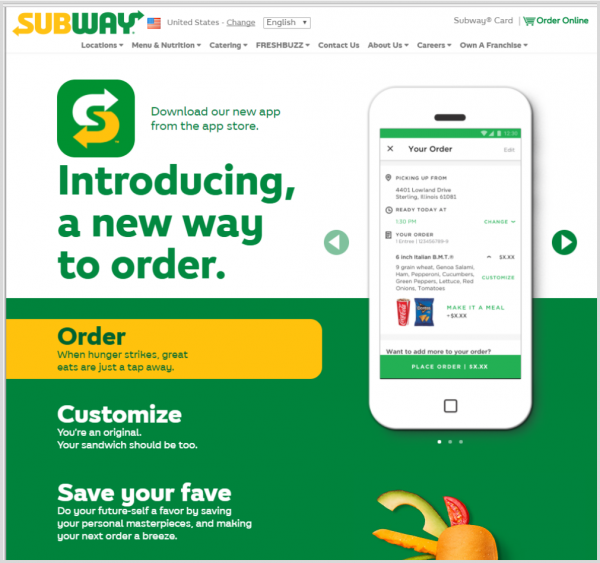
If it seems like Subway restaurants have stepped up the use of technology to combat the company’s first dip in growth in memory, you’re right.  Low-tech is out and high-tech is increasingly in at the Connecticut-based sandwich franchise mega-chain. Subway is aggresively introducing touch-screen ordering kiosks and a new mobile app – an effort to close the gap with competitors that have credited technology with helping boost sales. Subway is also testing dedicated pickup areas for mobile orders, a first for the company.

“It’s really a vision and strategy in how we want to evolve,” Carman Wenkoff, Subway’s chief information and digital officer, said in an interview with Bloomberg. “Customers are demanding a more complete experience.”

Subway launched a “bot” for Facebook Messenger in April that allows guests to order sandwiches and salads. The first-of-its-kind sandwich ordering bot was announced at the F8 Facebook Developer Conference with Agilitee, one of Subway’s digital partners, and is an innovation driven by the company's year-old Subway Digital division.

Customers can use the bot to order a sandwich or salad, customize it with their favorite bread; cheese; vegetables; and sauce, and pay on any device that supports Messenger. The bot for Messenger is described by the company as the latest addition to the brand’s mobile order systems that includes web ordering and app ordering. The new mobile app is available in about 26,500 of the chain’s 27,000 U.S. stores, which the company says is the largest deployments of a Messenger bot in the restaurant industry.

Subway has a presence in 112 countries, with more than 44,600 franchised locations. The company reports 7.5 million sandwiches a day served around the world.  Subway has more locations than any other restaurant chain U.S., but sales fell 1.7 percent last year to $11.3 billion, marking the third straight annual decline, according to research firm Technomic. Industry analysts point out that traditional fast-food chains are upgrading their equipment and embracing more natural ingredients, cutting into Subway’s decades-long edge in the healthy-eating arena.

The company, based in Milford, Connecticut, was founded almost 52 years ago by Fred DeLuca and Peter Buck. It remains a family-owned business. The company now operates about 26,744 stores in the U.S., a decline of 359 locations in 2016, the first annual decline the company has experienced.

A year ago, Subway announced the launch of Subway Digital, a new division centered on tech initiatives. The division’s focus was to be on evaluating all of the chain’s technology, ranging from its app to its loyalty program, with the ultimate aim of enhancing guest engagement, according to published reports in June 2016.

“With the creation of Subway Digital, we are committed to making the guest experience as meaningful, convenient and contemporary as possible, across all channels,” Suzanne Greco, Subway president and CEO, said in a statement at the time.

Subway is currently testing about 50 of the new self-ordering kiosks, Bloomberg reported. The technology allows customers to walk in and tailor their meals with more accuracy. Digital menus, meanwhile, are available in hundreds of stores. They can be changed instantly without having to print new signs and replace them. The chain also is testing out remodeled restaurants in eight areas in the U.S., Canada and England, according to published reports.

The upgrades require buy-in from franchisees, which own all of Subway’s locations. Though the company is helping pay for the changes, independent owners will bear much of the cost.

“We are investing heavily,” Wenkoff said in the Bloomberg interview. “Our franchisees are with us 100 percent.  Mobile devices are attached at the hip to pretty much all our customers these days.  It’s all about convenience.” The company also noted that Subway Digital, established last year, is in the midst of hiring more than 150 people for jobs supporting the brand’s “omnichannel approach.”

PERSPECTIVE: Law is the Fabric That Holds Society Together

by Richard A. Robinson Let's face it, regardless of one's political leaning, economic philosophy, or cultural beliefs, we are in the midst of great turmoil. In the face of so much uncertainty, I initially found it somewhat difficult to be both sincere and inspiring.  But as I continued preparing, I realized that I had been looking for inspiration in all of the wrong places.

In our busy lives, we turn to video clips and sound bites for news and let the tenor of these brief snippets shape our outlook. Our mood is at the mercy of headlines, news feeds, and 140 character messages. We are accustomed to looking to our leaders and other public figures for encouragement and inspiration, and when it isn't readily available, we are easily discouraged. So, in times like these, we need to think a little bit more about the sources of our hope, encouragement, and inspiration.

When you think about it, doesn't real inspiration come from the people we live with, the people that we work with, and the people that we interact with on a daily basis? People who work hard and do their best to make the world a better place in their own unique way. People who make a commitment to something worthwhile and important, just as all of you have done.

The bottom line is that the reason we are celebrating today is because you are the future. The direction we will follow as a profession, as a nation, and as a world, is up to you.  Is that a bit scary? It should be! But it should also be exciting and exhilarating. As you graduate and prepare to embark on your career in the law, you hold tremendous power. On this most important day, I'd like for you to think about that power and to truly comprehend its significance.

So what does this mean for you? It means that, as you begin your career in the law, it is essential for you to understand that your obligations as an attorney extend far beyond the interests of your clients. They extend to the justice system, to the legal profession, and to society at large.

William Shakespeare focused on this duality in his play Henry the Sixth. The play includes a scene in which a character named Jack Cade, the leader of a rebellion against the crown, muses about what he would do if he were king. It is then that one of his followers, Dick the Butcher, utters what I believe is the most misunderstood line in all of Shakespeare's writings: "The first thing we do, let’s kill all the lawyers." Cade heartily agrees. i

While many people believe that Shakespeare was expressing society's frustration with the lawyers and the legal profession, others, including myself, believe that he was actually paying us the ultimate compliment by pointing out that lawyers and the rule of law are the only things protecting society from anarchy. If you want to bring down society and render the people powerless, the first thing that you must do is get rid of the rule of law and all those who fight to protect it.

John Curtin, a former president of the American Bar Association once remarked that "[a]nyone who believes a better day dawns when lawyers are eliminated has the burden of explaining who will take their place. Who will protect the poor, the injured, the victims of negligence, the victims of . . . discrimination, and the victims of . . . violence? . . . Lawyers are the simple yet essential means by which people seek to vindicate their rights and we must not foreclose that means." ii

As you prepare to enter the practice of law, I urge you to think about the power that you hold, and strive to balance your obligation to your clients with your duties as an officer of the legal system. Our profession needs individuals who understand that, when a single attorney starts to chip away at the rule of law in order to secure an easy win for their client, it undermines the bedrock of our society. I recognize that, at times, this may not be easy. This is why our profession is in dire need of individuals who are willing to devote their time to working through these issues. Our small steps matter.

What we do every day affects the way that our profession is perceived by the public. The way that we act in the courtroom, the tone of voice that we employ, and whether we choose to treat others with dignity and respect. Our everyday words and deeds express our commitment, or lack thereof, to a fair and effective justice system. The simple decision to conduct ourselves in a manner that fosters respect also builds respect for what we do. When our own actions are added to those of our colleagues, we have an effective force for improvement.

If each of us strives to balance our duties to the public with our commitment to fairness, justice, and the rule of law, it will go a long way to restoring the public's faith in our profession and our legal system as a whole. This is particularly important in times of uncertainty. As you embark on your legal career, I urge you to keep this balance in mind. In doing so, you will serve as a source of inspiration and motivate others to take similar action.

Today you are taking a great step in your journey toward the practice of law and, on this special occasion, we celebrate the success that comes from many years of your hard work, sacrifice, and dedication. You have achieved a major goal by making major sacrifices. However, as others have said, what you get by achieving your goals is not as important as what you become by achieving your goals. The power to practice law brings not only the financial ability to support yourself and your family; it also brings along with it the responsibility to assist others and to help shape the legal profession of the future.

We are a remarkable people, living in a remarkable country, with a remarkable system of laws and justice, yet we are not perfect. As a quinquagenarian, I can remember some very turbulent times, the crescendo of the civil rights movement, the assassination of a United States President, a Presidential candidate, and several national civil rights leaders. I remember what happened at Kent State, and the burning of some of our major cities. These are the type of things that have destroyed other nations. Yet, we did more than survive; we thrived. So what saved us? What was different?

I believe that it was the hard work, dedication and sacrifices of people like you. People that chose paths similar to the ones that brought you here today. People who know that a lawyer assumes not only an obligation to their clients, but also solemn duties as an officer of the legal system and a public citizen having special responsibility for the quality of justice.

The oaths that you will eventually take and various rules, laws and regulations related to the practice of law are all designed to help you reach this lofty goal; you would be wise to heed them. But make no mistake, what I am asking you to do runs much deeper.

The legal profession is a noble one, but it is often greatly misunderstood. Many assume that lawyers are merely troublemakers that bring lawsuits that should not be brought and defend that which should not be defended. In reality, the law is the very fabric that holds our society together and, as lawyers, you bear the responsibility of being its tailors.

Look at any form of mass media today and you will see that we are living in interesting and troubling times. Both present events and those which lie on the horizon will stretch this fabric beyond its tearing point. As lawyers, you bear the tremendous burden of mending any rift that may occur.

Bear this responsibility well. Approach it with civility, reason, respect, compassion, and great purpose. The cold dispassionate procedures and technicalities of the legal profession often makes people think that lawyers are more interested in money, papers, forms, and procedures than they are in the everyday struggles of life.

People go to lawyers because they believe them to be problem solvers that will help them get through life's struggles. It would be a great disservice to let them leave feeling that they were not heard or, even worse, believing that your involvement not only failed to put out the embers of their angst, but fanned the flames that eventually consumed them.

Remember that you are more than just a representative of your clients. You are an officer of the legal system and a public citizen having special responsibility for the quality of justice. Persuade when you can, compromise when you should, and fight when you must.

Your responsibilities as lawyers will be great. You are the tailors of the very fabric of our society. Although you may never receive a hero's welcome for the work that you do, please know that you are our heroes.

I ask that you do more than just follow the rules, oaths, laws, and regulations that I mentioned earlier. I ask you to fully accept your responsibilities as lawyers, and to continue to listen ever so closely for that subtle tearing sound because you are the keepers of the cloth.

_________________________________

Richard A. Robinson is an Associate Justice of the Connecticut Supreme Court. He graduated with a Bachelor of Arts Degree from the University of Connecticut in 1979 and a Juris Doctor degree from West Virginia University School of Law in 1984. Justice Robinson’s career is complimented by an array of public and judicial service.  This is an excerpt of remarks delivered on May 14 at the Commencement and Doctoral Hooding ceremony of the Quinnipiac University School of Law in the TD Bank Sports Center on the university’s York Hill Campus.


i WILLIAM SHAKESPEARE, THE SECOND PART OF KING HENRY THE SIXTH act 4, sc. 2.

ii THOMAS F. BURKE, LAWYERS, LAWSUITS AND LEGAL RIGHTS 24 (2002).


UConn Researcher: E-Cigarettes as Harmful as Tobacco

Researchers at the University of Connecticut have revealed evidence that electronic cigarettes, or e-cigarettes, may be as harmful as tobacco cigarettes. Since e-cigarettes came on the market in 2004, there has been considerable debate on their safety, as well as the potential adverse health effects on users. E-cigarettes have risen in popularity in recent years as many consider them a "safer" alternative to traditional tobacco cigarettes.

Now, a just-published study by chemists at the University of Connecticut offers new evidence that electronic cigarettes, or e-cigarettes, are potentially as harmful as tobacco cigarettes.  The contents of e-cigarettes -- known as e-liquid or e-juice -- contain propylene glycol, glycerine, nicotine and flavorings.

Using a low-cost, 3-D printed testing device, UConn researchers found that e-cigarettes loaded with a nicotine-based liquid are potentially as harmful as unfiltered cigarettes when it comes to causing DNA damage.

“Some people use e-cigarettes heavily because they think there is no harm,” said Karteek Kadimisetty, a postdoctoral researcher in UConn’s chemistry department and the study’s lead author. “We wanted to see exactly what might be happening to DNA, and we had the resources in our lab to do that.”

The researchers found that vapor from non-nicotine e-cigarettes caused as much DNA damage as filtered cigarettes, possibly due to the many chemical additives present in e-cigarette vapors. Cellular mutations caused by DNA damage can lead to cancer.

The findings appear in the journal ACS Sensors, a publication of the American Chemical Society.  ACS Sensors is a peer-reviewed research journal that is devoted to the dissemination of new and original knowledge on all aspects of sensor science that selectively sense chemical or biological species or processes.  Since publication, the research has been widely featured in the news media across the country.

How much DNA damage e-cigarettes cause depends on the amount of vapor the user inhales, the other additives present, whether nicotine or non-nicotine liquid is used, and other factors, according to Kadimisetty.

“From the results of our study, we can conclude that e-cigarettes have as much potential to cause DNA damage as unfiltered regular cigarettes,” Kadimisetty told UConn Today.

How much e-cigarettes contribute to serious health problems and whether they serve as a gateway for future tobacco smokers remains the subject of debate among scientists, legislators and the public. A year ago, the U.S. Food and Drug Administration tightened some regulations on e-cigarettes due to concerns that were raised.

Electronic cigarettes are battery-powered devices that heat up liquid and turn it into an aerosol vapor that can be inhaled. Using e-cigarettes is also called ‘vaping.’ The contents of e-cigarettes, called e-liquid or e-juice, are usually made up of propylene glycol, glycerine, nicotine, and flavorings such as menthol, cherry, vanilla, or mint. Non-nicotine e-cigarettes are also available.

Joining Kadimisetty and Rusling on the study, UConn Today reported, was former UConn Ph.D. student Spundana Malla, now a scientist at Alliance Pharma in Pennsylvania. The study was supported by funding from the National Institute of Environmental Health Sciences of the National Institutes of Health.

Photo: UConn postdoctoral researcher Karteek Kadimisetty. (Peter Morenus/UConn Photo)

Broadway Awards Point Spotlight at Connecticut Connections

Westport native Justin Paul is having a big year.  The 2003 Staples High School graduate  added two Tony Awards this week to an Oscar won just months ago. And he is not the only Connecticut connection to the Tony Awards, announced on Sunday night. Paul won in the Best Original Score category for his work on Broadway’s “Dear Evan Hansen,” along with writing partner Benj Pasek. Before the night was out, the writers were back on the Radio City Music Hall stage to share another Tony for Best Musical for “Dear Evan Hansen.” In all, the play won six Tonys. Paul was the show's co-composer, co-lyricist and co-creator.

Rebecca Taichman won for directing "Indecent," the klezmer-scored historical drama about the Yiddish Theater that she co-created with playwright Paula Vogel. "Indecent" had its world premiere at the Yale Repertory Theatre in New Haven in 2015. The play began as Taichman's thesis project for the Yale School of Drama in 2001. "Indecent" also won for best lighting for a play.

The 9/11-themed musical "Come From Away" won for best direction of a musical, Yale University graduate Christopher Ashley. It had a significant early reading at Goodspeed Musicals' Festival of New Artists in 2013. One of the show's producers spoke about "Come From Away" at this year's Goodspeed festival, just prior to the Broadway production opening.

Paul won an Oscar Award in February for Best Original Song during the Academy Awards for “City of Stars” from “La La Land.” At that ceremony, he thanked Westport's education and arts communities in his speech: "I was educated in public schools where arts and culture were valued and recognized and a resource," said Paul. "I am so grateful to all my teachers who taught so much and gave so much to us."  Paul shared the award for the song "City of Stars," from the film "La La Land," with fellow lyricist Benj Pasek and composer Justin Hurwitz, and Hurwitz's score from the film also won an Oscar.


Additional Connecticut connections at the Tony Awards:  the revival of "Hello, Dolly!" won awards for best revival of a musical, actress, featured actor and costumes. The show is based on a play by Thornton Wilder, who lived a large part of his life in the New Haven area. And the late August Wilson's "Jitney" won a Tony for best revival of a play. The majority of the 10 plays in Wilson's "Century Cycle" (though not "Jitney") were developed at the Eugene O'Neill Theater Center in Waterford and the Yale Repertory Theatre.

Connecticut and TESLA: The Battle Lines Expand

It was a one-two punch from Connecticut aimed at Tesla, in the marketplace and in the boardroom. On Tuesday, at the company’s annual shareholder meeting at the Computer History Museum in Mountain view, CA, a shareholder resolution advocated by the Office of State Treasurer Denise Nappier was on the agenda.

And on Wednesday, the Connecticut legislature concluded the 2017 regular session, leaving behind a proposal that would have enabled Tesla to sell cars directly to Connecticut consumers, as is done in many other states.  It was the third consecutive year that the plan did not receive approval from legislators, in the face of strong opposition from the Connecticut Automotive Trades Association.

The Tesla proposal was approved by two legislative committees - Transportation and Finance, Revenue, and Bonding - but was never voted on by House or Senate members in their respective chambers.  The bill pitted the state’s longstanding car dealers against the new model that Tesla prefers.

The Connecticut Retirement Plans and Trust Funds shareholder resolution called for the declassification of Tesla’s board and for the annual election of all of Tesla’s directors.  The $32 billion Connecticut Retirement Plans and Trust Funds (“CRPTF”), of which Treasurer Nappier is principal fiduciary, owned 32,837 shares of Tesla, Inc. common stock with a market value of $11.6 million as of June 6, 2017.

Tesla’s board currently is classified, which means that each year only a portion of the directors are elected by shareholders.  This year shareholders had the opportunity to vote on three of Tesla’s seven directors. The company’s board recommended that “our stockholders vote against this proposal.”

“Independent shareholders gave Tesla a clear message: it's time to sharpen the company's governance profile and strengthen board member accountability to shareholders, whose interests they are elected to represent,” Nappier said after the shareholder vote.

Connecticut’s resolution, the first ever filed to declassify Tesla’s board, received an estimated 47 percent of the votes not controlled by directors and officers, indicating strong support for the annual election of directors, according to the Treasurer’s Office.  Representing the Connecticut Treasurer’s Office at the annual meeting, and presenting the proposal, was Aeisha Mastagni, a Portfolio Manager in the Corporate Governance Unit of the California State Teachers’ Retirement System. Overall, according to a U.S. Securities & Exchange Commission filing, 74.7 million shareholders voted against the proposal, with 32.7 million voting in favor.
“And now that Tesla has joined the ranks of the Fortune 500, we encourage the company to take particular heed of the recent vote,” Nappier added, “given that most of its largest U.S. company peers have already embraced annual election of directors.  It should reconsider its opposition to this fundamental provision of good governance.”

“At the end of the day, Tesla has and will continue to develop and deploy new technologies and products that will be an important part of the global economy’s clean energy future.   The company’s corporate structure should likewise evolve toward a more accountable governance framework that will fortify its bottom line and sustainable value,” said Nappier, a veteran shareholder activist.

In the aftermath of the Connecticut legislative session, a spokesman for Tesla told CT NewsJunkie that the company wasn’t quite ready to give up on the state. Tesla is allowed to sell direct to consumers in most jurisdictions in the U.S. and around the world. They are prohibited from selling directly in Connecticut, Michigan, Texas, and West Virginia, according to the company.

“The residents of Connecticut overwhelmingly want Tesla to be able to freely operate in the state, and despite inaction during this session,” a company spokesman said.  There are approximately 1,300 Tesla vehicles registered in Connecticut.

Student News Stories Showcase Next Generation of Journalists

With journalism and journalists under increasing criticism and new technology making old models of financing investigative journalism tougher, Hartford’s FOX 61 is showcasing young journalists as they learn the profession and develop stories that reach local newscasts. FOX 61 Student News was relaunched in February after a multi-year absence, and last week honored students at a special year-end awards ceremony held at Goodwin College in East Hartford. During the school year, FOX61 Student News empowered Connecticut middle and high school students to explore the world of multi-media journalism by giving them the opportunity to capture, edit and publish original content under the guidance of industry professionals.

Each student produced and hosted a news segment that showcased a local story or event that aligns with the station’s weekly HOPE segment. The student stories were featured on-air during Friday's Good Day Connecticut at 6:20 a.m. 7:30 a.m., and during the 5 and 10 p.m. news.

Among the winning stories:

  • Best in Student News Reporting and Writing was awarded to Manchester High School’s Kailey Feshler for her story on the CT Humane Society.
  • Best in Student News Pre and Post Production and Editing was awarded to three students from Daniel Hand High School in Madison: Liam Bennett, Delvantae Hutton and Ashleigh Violette for their story on Saferides.
  • Best in Student News Photography and Lighting was awarded to two students from Norwich Free Academy: Alyssa Friedrich and Maggie Peter for their story on Local Manufacturing.

The winners in each of these categories received a scholarship, donated by Fox 61.

  • Most Compelling Student News Story was awarded to three students from South Windsor High School: Lauren Adamo, Madison Donahue and Hannah Mitchell for their story on Josie the Therapy Dog. They shared the $3,500 scholarship provided by local sponsor, Big Y World Class Market.

Through the years, many students have participated in the Fox 61 Student News, reporting on different issues in their communities.

FOX 61 is one of the nation's most highly rated FOX Network affiliates, producing more news and winning more awards than any station in Connecticut. FOX 61 now airs more than 61 hours of local news and public affairs programming each week, more than any other market station. FOX 61 is owned and operated by Tribune Media, one of the country’s leading multimedia companies.


PERSPECTIVE: On the Job Hunt After Cancer

by Julie Jansen A recent Harris Poll survey conducted on behalf of Cancer and Careers (CancerAndCareers.org) found that 78% of the cancer survivors surveyed were concerned that their cancer diagnosis would hinder their ability to find a new job. For many survivors, job hunting after cancer proves to be a challenging experience. However, you can rest assured that if you are qualified for a job, an employer cannot refuse to hire you simply because you have had cancer.

If you are one of those survivors who is back on the job market after battling cancer, here are some tips to help make your job search a success.

Spiff Up Your Resume

The primary goal of your resume is to describe your experience and achievements in a way that makes a prospective employer want to set up an interview with you to talk about how you can do the same great things for them. A resume is not a job description. So keep lists of tasks and responsibilities short and to the point. Instead, your resume should focus more on your accomplishments and how you were able to make a positive difference to your department or company. A bulleted format works best for this part of your resume.

Another important element of a contemporary resume is a profile or summary, which is a brief paragraph at the top of your resume that summarizes your work experience. Your summary can be used to add a bit of personality to your resume. This is a good place to list the unique qualities that make you the right fit for the job.

Most companies use applicant-tracking software to scan your resume’s keywords before a human reads it. So it’s important to add the right keywords to your resume. Use technical or functional descriptors such as project management, event planning, and website design, rather than clichéd phrases like effective communicator and team player.

Absolutely add volunteer experience to your resume, especially if you have an employment gap because you took time off for treatment or had to leave your job. Include a list of achievements for your volunteer experience, just as you would for your paid jobs.

Finally, despite the persistent myth that a resume should only be one page, if you have worked for two or more years, then a two-page resume is the new rule of thumb.

Prepare for the Interview

Interviewing for a new job is nerve wracking for most people, with or without a cancer history. Preparation is the key to feeling more comfortable and confident during the interview process – and to getting invited back for that second interview.

The most important thing an employer is looking for during the interview process is how you, the job candidate, can solve their problems and meet their needs. Research the company as much as you can so that you can incorporate your knowledge of the company into the interview. This will also help you to ask smart, thoughtful questions about the job you’re applying for.

Prepare answers to the standard questions that are often asked during an interview, for example:

  • Tell me about yourself.
  • What are your strengths and weaknesses?
  • Describe a time when you failed.

When answering, tell stories about your achievements and use concrete examples – but keep your answers brief and meaningful. Stay composed, and don’t let an interviewer’s quirky questions rattle you. Unless a question or request is discriminatory, just go with the flow.
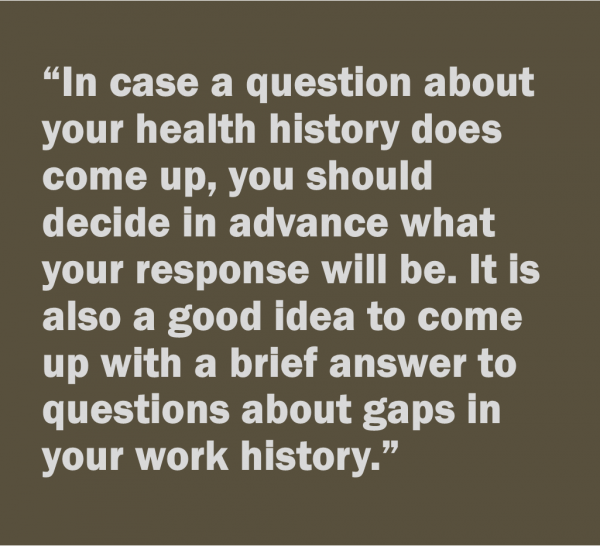
Speaking of discrimination, you are not obligated to share the fact that you had cancer. And a prospective employer legally cannot ask you this question. However, in case a question about your health history does come up, you should decide in advance what your response will be. It is also a good idea to come up with a brief answer to questions about gaps in your work history.

If you are asked an uncomfortable question, try not to ramble. Instead, turn the conversation back to how you can make a positive difference for your potential employer.

The thought of looking for employment after cancer can be a frightening one. However, the good news is that many companies are hiring, and now that you are armed with these job- hunting tips, you’re more prepared than ever to land that job you’re after.

______________________________________

Julie Jansen is a career coach, resume and LinkedIn profile writer, and the author of I Don’t Know What I Want, But I Know It’s Not This: A Step-By-Step Guide to Finding Gratifying Work. She is a graduate of the University of Hartford.  This article first appeared in Coping magazine.  Her website is JulieJansen.net.

Hartford Whalers (Logo) Headed to Connecticut (Vehicles)

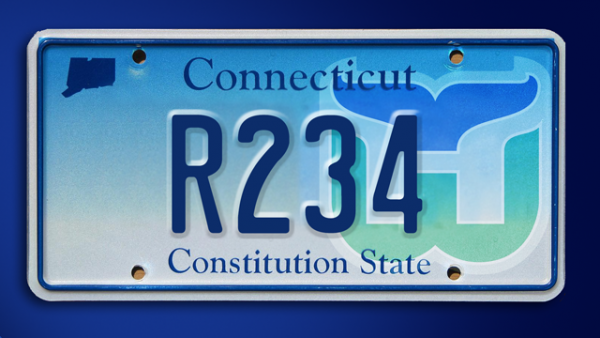
Connecticut drivers may soon see another vanity license plate option if a bill approved by the state legislature is signed into law by Governor Malloy.  A license plate commemorating the Hartford Whalers hockey franchise, which departed the Capital city 20 years ago, gained legislative approval in the final days of the General Assembly session. It is the latest of an ever-growing list of license plates supporting a variety of charitable causes and local organizations that are authorized by the state and raise money for various causes.  The Whalers license plate is to be a fundraising vehicle for the Connecticut Children’s Medical Center.

Stafford Springs State Rep. Kurt Vail, who introduced the bill, said in public hearing testimony earlier this year that “the popularity of the franchise has not gone away.”  He predicted that the license plate would be “a huge hit amongst our citizens.”  House Majority Leader Matt Ritter of Hartford said that “with memories of attending games with my grandfather still fresh…the Whalers continue to have a large and growing following in the city.”

Although the Whalers license plate was created by an act of the legislature, state law allows the Department of Motor Vehicles to issue special background plates on behalf of non-profit organizations. The organization must be non-profit, must submit a copy of the organization’s charter or by-laws, provide a letter of good standing from the State of Connecticut Secretary of State’s Office (if required) and supply any Internal Revenue Service ruling on their non-profit tax exemption status.

The logo production and cost incurred will be the responsibility of the organization. The logo prototype design, preferred in PDF format, must be submitted to the DMV. The logo can be no larger than 2 inches wide and 3.5 inches high. DMV has final approval on all the plate and logo designs.

A liaison for the organization must be appointed. This individual will be responsible for all communications with the DMV as well as certifying and authenticating (by signature) each member’s application, submitting the logo design to DMV for approval, submitting 400 applications with the required fee prior to the manufacturing of the special background plates, and submitting a Special Interest Plate disclaimer.

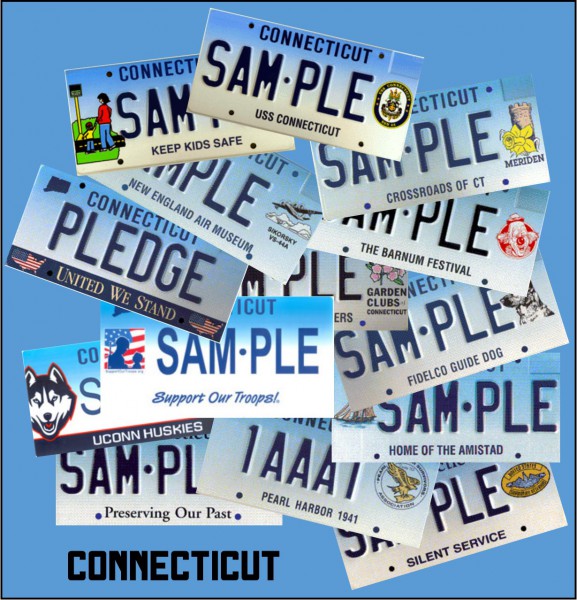
Many organizations in Connecticut offer license plates to their members and the general public.  General categories include animals, colleges, environment, organizations, police and fire, cities and towns, and recreation.

Organization vanity plates include Amistad, Benevolent & Protective Order of the Elks, IUOE Local 478, Grand Lodge of Connecticut, Knights of Columbus, Olympic Spirit, P.T. Barnum Foundation Inc., Preserving Our Past CT Trust for Historic Preservation, Red Sox Foundation, Lions Eye Research Foundation, Special Olympics, Federated Garden Clubs, Fidelco Guide Dog Foundation, Keep Kids Safe, New England Air Museum and the U.S.S. Connecticut Commissioning Committee.

When individuals purchase a Keep Kids Safe plate, a portion of the fee goes to the Keep Kids Safe Fund, which “makes many worthy projects happen for youngsters.”  The fund awards grants to schools, hospitals, municipalities and other non-profit organizations working to make all Connecticut children safer from severe and preventable injuries, according to the DMV website.

In most cases, remake of a current plate is $70; a new vanity plate is $139, a new series plate is $50.  For others, including the UConn Huskies plate, the price tag is somewhat different.  Off-the-shelf license plates cost $55, remake of a current plate is $75, a new vanity plate costs $144, according to the DMV website.

The Support Our Troops plate sends a portion of the fee to provide funding for programs to assist Connecticut troops, their families and veterans. When you buy a Red Sox plate, a portion of the fees support and help fund academic scholarship programs in Connecticut.

Also included are 17 varieties of military specialty plates, including Disabled American Veteran, Gold Star Family, Iwo Jima Survivor, Korean War Veterans Association, Marine Corps League, Laos Veterans of America, Military Order of the Purple Heart, Pearl Harbor 1941, U.S. Submarine Veteran, National Guard Association of Connecticut, First Company Governor’s Foot Guard, First Company Governor’s Horse Guard,

Colleges with designated plates include Central Connecticut State University, Penn State Alumni, University of Hartford, University of Connecticut, and University of New Haven.  Cities with available plates include Meriden, Norwich, and Stafford.

Organizations interested in launching a new special plate, should contact the DMV Special Plate Unit at (860) 263-5154 for further information.

Innovative Start-Up Companies Seek State Funds to Propel Growth

CTNext will bring together start-up businesses seeking the financing to move forward, providing the opportunity for them  to pitch at the next Entrepreneur Innovation Awards (EIA) event scheduled for Thursday, June 15 at the LOFT at Chelsea Piers in Stamford. Connecticut's "innovation ecosystem" will be highlighted as the nine companies, from all across the state, will be competing for $10,000 grants.  The competitors include:

  • Deo2go (Fairfield): Creating a topical delivery device that can be filled with a variety of products including, but not limited to deodorant, lip balms, and sunscreen
  • Egghead (Danbury): Developing a new way to package and sell ice cream that brings new revenue to a mature market
  • FallCall Solutions (Trumbull): Creating a tele-monitoring system for the Apple watch and other mobile systems for elders and caregivers
  • Fjord Weather Systems (Wilton): Developing a way to turn every boat on the water into a weather-monitoring system
  • LiquidSphere (New Haven): Creating an interactive app that will connect people who struggle with stress, anxiety, depression and addiction with therapists via text and video sessions
  • Lucca Ventures (Southington): Developing a Bluetooth-enabled microphone attachment to a full-face oxygen mask, letting patients communicate clearly while wearing it
  • Obvia (West Hartford): Manufacturing dual-winglet blades and semi-shroud power upgrade for Sunforce Wind Turbines that will improve efficiency and scalability for the turbines
  • Sweet Equations (East Hartford): Making custom candy cakes, edible cupcake displays and other desserts through the development of an on-demand decorating device
  • Trekeffect (Lyme): Developing a system to let individual travel planners buy and sell their itineraries.

To determine the finalist pool, each company’s application was vetted by a separate and independent team of reviewers who deemed their products, services and/or business ideas worthy of consideration for an EIA. Each finalist will have an opportunity to compete for a $10,000 grant as well as the judges’ and crowd favorite awards, each in the amount of $2,000 each.

The judges who will hear the company pitches and determine the winners include:

  • Elena Cahill: Senior Lecturer, University of Bridgeport, Entrepreneurship Department
  • Jim Kern: Co-founder, COMRADITY
  • Greg Kivenzor: Associate Professor of Marketing, Director of Experiential Learning Collaborative, UCONN- Stamford
  • Mark Lasoff: Founder, LearnToProgram
  • Mike Roer: President, The Entrepreneurship Foundation

Throughout the year, CTNext hosts the EIA, a Shark Tank–style pitch event where Connecticut-based startups and entrepreneurs compete for grants that can be applied toward a specific project that will help accelerate growth.

CT Next support the success of companies and entrepreneurs by providing guidance, resources, and networks to accelerate their growth. CT Next is a wholly-owned subsidiary of Connecticut Innovations, described as "a network of passionate people who offer services to busy entrepreneurs." Launched in 2012, there are now more than 1,500 members. Since its inception in 2014, CTNext has held 11 total events in cities and towns all over Connecticut, awarding $544,000 to 52 unique companies.

https://youtu.be/Au4ULyo5L1g