Reversal of Fortunes: A Decade Up, A Decade Down for Connecticut’s Economy

Connecticut’s economy is now smaller that it was 2004. The state’s lackluster performance stands in sharp contrast with all of the other New England states, whose economies have seen real growth, as have those of New York, New Jersey, Pennsylvania. The state’s economy contracted in 2017, as it did in 2014 and 2016, and its overall performance for the year ranked 49th, topping only Louisiana. An analysis by the University of Connecticut’s Connecticut Center for Economic Analysis (CCEA) points out that since 2008, Connecticut’s economy, measured in real GDP (corrected for inflation) has contracted every year, except for 2015. That year’s positive blip of 1.1 percent growth was quickly overtaken by contraction in the two subsequent years.

The suddenness of this persistent downturn for Connecticut has been dramatic.  Between 1997 and 2007, the state’s economy grew by 3 percent annually, outpacing Massachusetts (2.9%), Rhode Island (2.5%), and New York (2.3%), based on the compound rate of annual real GDP growth.  In the decade since, through 2016, the Connecticut economy contracted by 0.9 percent annually while Massachusetts and New York grew by 1.6 percent and Rhode Island by .6 percent, according to data from the U.S. Bureau of Economic Analysis.
The Bureau reports the state's GDP shrank 0.2 percent last year—one of just three states with negative growth— after contracting by 0.3% the previous year.  At the same time, the national economy expanded 2.1 percent, CBIA recently pointed out.  CBIA economist Pete Gioia said “We are missing the economic growth party that the region and most of the country are experiencing."  He noted that through March this year, Connecticut has recovered just 80 percent of all jobs lost in the 2008-2010 recession, the slowest recovery in New England. The U.S. has recovered 219 percent of jobs lost.

At the same time the state economy has contracted, Connecticut has seen 78 continuous months of job creation, measured year over year, since 2010, the CCEA analysis acknowledges. While private sector jobs are now above their previous peak, public sector jobs- including those at Foxwoods and Mohegan Sun - have been contracting, and will likely continue to contract for a couple more years, points out Center Director Fred Carstensen.  He adds that jobs created in the private sector have been broadly of lower quality than that of jobs lost. Thus real personal income, like real output, has been contracting even as employment has grown.  So the common focus on job creation has been deceptive: rising job numbers has not meant economic growth.

Adding to the complexity of the situation in Connecticut, Carstensen explains, is the increasing number of residents who work out of state. Since 2016, more than 35,000 additional Connecticut residents have found job outside of the state —so the number of Connecticut residents employed is near an all-time peak. Unfortunately, those 35,000 all pay their income tax first to the state where they work, thus contributing to the fiscal crisis in Connecticut, Carstensen noted.
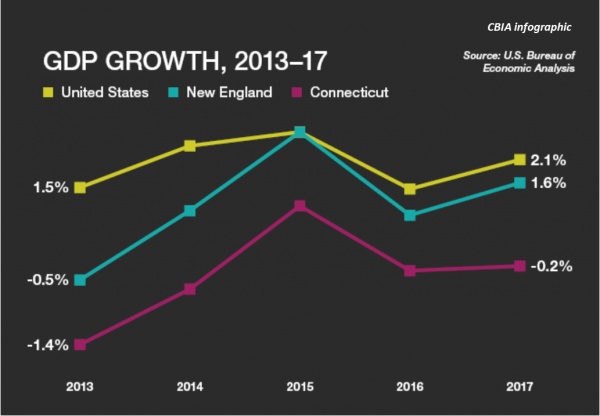
In 2017, Massachusetts led the way in New England with 2.6 percent growth, followed by 1.9% in New Hampshire, with Rhode Island (1.6%), Maine (1.4%), and Vermont (1.1%) all showing growth, unlike Connecticut. In November, 2017, the Connecticut Department of Labor reported that total payroll employment in the state had fallen below the level of February, 1989, according to CCEA.

“The dramatic reversal in fortunes for Connecticut, shifting from a decade and more of strong growth to a persistently contracting economy, is nearly unprecedented among state economies.  The next Governor and Legislature need to make a determined effort—absent to date—to understand what drove this climatic reversal of fortunes in Connecticut’s economy health.  Such an understanding is central to adopting policies and initiatives to reverse the state’s decline,” Carstensen argued.

The Connecticut Center for Economic Analysis (CCEA), under the direction of Carstensen, is a University Center located within the School of Business at UConn.  CCEA specializes in economic impact and policy analysis studies, as well as advising clients regarding business strategy, market analysis, and related topics.  CBIA’s research department, led by Goia, provides in-depth economic and policy analysis and survey research assistance to CBIA’s legal, insurance, and human resources divisions and member companies.

Connecticut-Grown Businesses Lead Stand-out Cohort of Entrepreneurial Start-Ups

reSET, the Hartford-based Social Enterprise Trust, whose mission is advancing the social enterprise sector and supporting entrepreneurs of all stripes, has announced the winners of its 2018 Venture Showcase, and three Connecticut-grown businesses took the top awards. The annual event recognizes the talented entrepreneurs and innovative businesses that have just graduated from reSET’s nationally recognized accelerator. This year, 18 early stage enterprises graduated from the most recent cohort, and eight finalists competed for $20,000 in unrestricted funding.  reSET’s goal is to meet entrepreneurs wherever they are in their trajectory and to help them take their businesses to the next level.

The entrepreneurs pitched their business models to an audience of founders, investors, and community and corporate stakeholders. The panel of judges included Claire Leonardi, former CEO of Connecticut Innovations; Alan Mattamana, Partner at Fairview Capital Partners; and Lalitha Shivaswamy, President of Helios Management Corporation.

Winning the top $10,000 award was Loki, which was created in a “group independent study” through UConn’s Digital Media and Design program by Andrew Ginzberg and co-founders Jeffrey Santi, Brian Kelleher, and Case Polen.  Described as “a new kind of media company” - a video sharing platform exclusively for smartphones - Loki is “a place where you can watch events through collections of many perspectives, live-streamed through the eyes of people actually there.”  The company’s website is welcoming people who would like to learn more to leave an email address.

Taking the second-place $6,000 award was Florapothecarie, a line of 100% natural + vegan skincare products, “lovingly handmade in Connecticut” by Sami Jo Jensen.  The line of products is certified vegan and cruelty-free by Leaping Bunny and PETA.

The third-place entrepreneurial business was Bare Life, launching a line of crave-worthy food products with the world’s first Organic, Vegan, Paleo, Non-GMO, Dairy Free, Gluten Free and Refined Sugar Free Hot Chocolate Powder.  Founded by local resident Ali Lazowski, who was put on a very restricted diet due to numerous medical conditions and learned first-hand how scarce allergen and irritant-free foods are. So, she set out to create them. Bare Life's mission is to make these allergen and irritant friendly foods and recipes convenient for everyone, especially the chronically ill.

The event was held last week at the YG Club at Dunkin’ Donuts Park to a sellout crowd of 225. Before selecting the 18 ventures that would participate in the Accelerator class, officials had reSET had to sift through an applicant pool that was the most competitive yet, with 110+ submissions from all over the world.  Since 2013, reSET has graduated 105 companies from its accelerator program and has awarded more than a quarter of a million dollars to scaling ventures.

The Superlative Award for “Most Improved Pitch” was won by FieldOwler, a new business that provides auditing and risk management software and solutions to help businesses, organizations, and agencies.  Other finalists were CNG Fit, LLC / Fit Party Me, Lioness Magazine, Noteworthy Chocolates, RecordME, and SKYWIREme .

The Accelerator program and Venture Showcase was made possible by reSET’s partners and sponsors, including  CTNext, The Hartford Foundation for Public Giving, Travelers, The Walker Group, Bank of America, The Hartford, GoodWorks Insurance, and People’s United Community Foundation.  SnapSeat Photo Booths also provided in-kind services.

reSET, the Social Enterprise Trust is a non-profit organization whose mission is to advance the social enterprise sector. reSET serves all entrepreneurs, but specializes in social enterprise ― impact driven business with a double and sometimes triple bottom line. In addition to providing co-working space and accelerator and mentoring programs, reSET aims to inspire innovation and community collaboration, and to support entrepreneurs in creating market-based solutions to community challenges.


Four Stores in CT Warned by FDA for Selling e-Cigarettes to Minors as Popularity, Concern Grows

The U.S. Food and Drug Administration has sent out warning letters to 40 retailers in 17 states  – including four in Connecticut - as part of a “concerted effort to ensure youth are not able to access” e-cigarettes – specifically responding to what officials describe as the “surging youth uptake” of JUUL products. According to the federal agency, those receiving the warnings in recent weeks included four Connecticut retailers: Discount Tobacco and Vape in Vernon, Mobil Mart in Waterbury, Shell/Henny Penny in Lisbon, and Smoker’s Outlet in West Hartford. The retailers were warned about selling the increasingly popular – but hazardous – products to minors.

The FDA explained that warning letters are sent to retailers the first time a tobacco compliance check inspection reveals a violation of the federal tobacco laws and regulations that FDA enforces.  During undercover buy inspections by agency representatives, “the retailer is unaware an inspection is taking place” and the minor and inspector “will not identify themselves.”

Published reports nationwide indicate that vaping is increasing rapidly in popularity with young people, especially with the most popular brand, JUUL. Its devices are tiny, and look like a pen or flash drive. When someone vapes, there is no fire, ash or smoky odor — instead, the devices heat up and vaporize a liquid or solid.  School bathrooms, where cigarette smoking was done in “secret” a generation ago, are now often referred to as “juul rooms” according to numerous reports – the nicotine fix of choice of the current generation.  A recent New York Times article prominently featured a description of the magnitude of the problem in a suburban Connecticut high school.

“The FDA has been conducting a large-scale, undercover nationwide blitz to crack down on the sale of e-cigarettes – specifically JUUL products – to minors at both brick-and-mortar and online retailers,” said FDA Commissioner Scott Gottlieb, M.D.

Gottlieb highlighted the danger – and the attraction – of the products to youth.

“We understand, by all accounts, many of them may be using products that closely resemble a USB flash drive, have high levels of nicotine and emissions that are hard to see. These characteristics may facilitate youth use, by making the products more attractive to children and teens.  These products are also more difficult for parents and teachers to recognize or detect. Several of these products fall under the JUUL brand, but other brands, such as myblu and KandyPens, that have similar characteristics are emerging.”

Businesses receiving the warning letters are directed to provide, within 15 days, “an explanation of the steps you will take to correct the violation(s) and prevent future violations (for example, retrain your employees, remove the problematic items, etc.),” the agency website points out.  In addition to federal restrictions, purchase/possession of an electronic nicotine delivery system or vapor product by persons under age 18 is prohibited in Connecticut.

The FDA also sent an official request for information directly to JUUL Labs, requiring the company to submit important documents to better understand the reportedly high rates of youth use and the particular youth appeal of these products.

Said Gottlieb: “We don’t yet fully understand why these products are so popular among youth. But it’s imperative that we figure it out, and fast. These documents may help us get there.”  The agency plans what it calls a “full-scale e-cigarette prevention effort” in the fall.

In addition, the FDA also recently contacted eBay to raise concerns over several listings for JUUL products on its website. eBay took what the agency described as “swift action to remove the listings and voluntarily implement new measures to prevent new listings” from being posted to the website.

PERSPECTIVE: Government Algorithms and the Public’s Right to Know

by Mitchell W. Pearlman In many respects, computers have made life easier. But they have also made life quite a bit more complicated. For example, before the computer age most government documents were on paper. Today, people not only need access to government information on computer media and in computer-readable formats, they need access to the computer programs and systems government uses to make policy and other important decisions. Yale Law Professor Jack Balkin calls this “algorithmic transparency.”

An algorithm is the step-by-step procedure by which a task is performed. People use simple algorithms in their lives every day, such as for adding numbers or sorting books. On the other hand, algorithms used in computers are often highly complex. They require sophisticated logic and advanced mathematical modeling in the design and functionality of the applications in which they are embedded. Because of this, algorithms are considered intellectual property and deemed trade secrets by most private enterprises and many government agencies that create and use them.

Governments now gather almost incomprehensible amounts of information, organize them into vast databases, and make and implement important decisions using the algorithms they create or purchase. Governments use computer algorithms in making tax policy and budget decisions; they use them in forecasting various transportation and infrastructure needs; and they use them in analyzing public health and environmental issues and formulating policy based on these analyses. Of course, if the data used are less than complete or accurate, or if the algorithms themselves are based on flawed reasoning or assumptions, then government policies and decisions based on them will likewise be flawed. Such errors can lead not only to unsound decisions, but they also can lead to an enormous waste of public resources and even to a significant loss of life.

In Connecticut, as elsewhere, various government agencies forecast income and expenditures to help guide lawmakers in constructing state budgets. Each of these offices has access to the same data sets. But the assumptions programmed into their algorithms can differ significantly, leading to different outcomes in determining whether a budget will or will not be in balance. The 2018 state budget was out-of-balance by several hundred million dollars just weeks after it was enacted. How did this happen? Was it because the data was faulty? Or was it because the algorithms, and the assumptions built into them, were wrong?

The first shots in the battle for algorithmic transparency have already been fired. Recently the New York City Council passed an algorithmic accountability bill, which establishes a task force to study, and within 18 months of passage report, how city agencies use algorithms to make decisions. The bill was enacted in the wake of a racially biased algorithm used to assess risk factors of criminal defendants. The algorithm’s source code was confidential until a federal judge ordered it to be disclosed and the bias subsequently identified.

Trade secrets and confidential commercial information – which are exempt from public disclosure under current Freedom of Information laws – often represent a significant financial investment by those enterprises and organizations that create or own them. On the other hand, computer algorithms are now – and increasingly will be – vital components in government policy and other decision making. To prevent significant errors or miscalculations in the future, many government algorithms need to be transparent so they can be publicly vetted before policy decisions are made or legislation becomes law.

Thus, proprietary rights face an important competing value when they would prevent the disclosure of information about which there is a legitimate and important public interest. The notion of an informed and knowledgeable electorate is one of the cornerstones of our country’s democratic tradition. To paraphrase the Connecticut Supreme Court in another context, trade secrets and confidential commercial information must give way when balanced against the publication of matters of public interest, in order to ensure the “uninhibited, robust and wide-open discussion of legitimate public issues.”

So in this case, as in others before it, the balance of competing interests must be resolved in favor of algorithmic transparency to the greatest extent possible. This is not to say that government need not provide some measure of just compensation if it discloses secret or confidential proprietary information. But the bottom line is that algorithmic transparency is essential to the continuance of our democratic system of governance.

___________________________

Mitchell Pearlman is the former executive director of the Connecticut Freedom of Information Commission. He currently teaches law in the Journalism Department of the University of Connecticut at Storrs. Rogers Epstein, MIT class of 2019, also contributed to this article. The article is abstracted from a “White Paper” published by the Connecticut Foundation for Open Government (CFOG), which can be found in its entirety at www.ctfog.org.


PERSPECTIVE columns from contributing writers appear each weekend on Connecticut by the Numbers.

Quasi-Public Agencies Avoid Many Requirements, Controls

In addition to an array of nearly 100 state agencies of varying sizes and responsibilities, Connecticut has 15 quasi-public agencies, which operate under different rules of the road from run-of-the-mill state agencies. The main reason for establishing the “quasis,” as they’re often called, “was their organizational location outside the structure of state government,” according to a report this year from the Office of Legislative Research (OLR).  Thus, “they could avoid many of the requirements and controls imposed on governmental agencies.”

That status, according to OLR, meant “they could respond to problems and opportunities faster and more efficiently than a comparable state agency, while maintaining a degree of oversight and accountability.”

Some, such as the Connecticut Airport Authority, which runs Bradley International Airport and other airports in the state, the Connecticut Lottery Corporation, Access Health CT and the Connecticut Student Loan Foundation are relatively well known.  Others, such as the State Education Resource Center or the Materials Innovation and Recycling Authority, less so.

The full list of 15 quasi-public state agencies:

  1. Connecticut Innovations, Incorporated (CII);
  2. Connecticut Health and Educational Facilities Authority (CHEFA);
  3. Connecticut Higher Education Supplemental Loan Authority (CHESLA);
  4. Connecticut Student Loan Foundation (CSLF);
  5. Connecticut Housing Finance Authority (CHFA);
  6. State Housing Authority (SHA);
  7. Materials Innovation and Recycling Authority (MIRA);
  8. Capital Region Development Authority (CRDA);
  9. Connecticut Lottery Corporation (CLC);
  10. Connecticut Airport Authority (CAA);
  11. Connecticut Health Insurance Exchange (doing business as Access Health CT);
  12. Connecticut Green Bank (CGB);
  13. Connecticut Retirement Security Authority (CRSA);
  14. Connecticut Port Authority (CPA); and
  15. State Education Resource Center (SERC).

Each quasi-public organization has its own governing board, and funding sources for quasi operations varies, ranging from fees to ticket sales.

The law requires each quasi-public agency to submit an annual report to the governor and auditors of public accounts, OLR explains.  The report must, at a minimum, include:

  • a list of all bonds issued for the prior fiscal year, including their cumulative value, value of outstanding bonds, and the state's contingent liability;
  • a list of all projects, other than those pertaining to owner-occupied housing or student loans, receiving financial assistance during the preceding fiscal year, including each one's purpose, location, and funding amount;
  • a list of all outside individuals and firms receiving more than $5,000 in loans, grants, or payments for services;
  • a balance sheet showing all revenues and expenditures;
  • the affirmative action policy statement, a description of the agency's workforce composition, and a description of its affirmative action efforts; and
  • a description of planned activities for the current fiscal year

The law also prohibits quasi-public agencies from contracting with the same financial auditor or auditing firm for more than six consecutive fiscal years and each quasi-public agency must submit two quarterly reports to the Office of Fiscal Analysis (OFA).

All quasi-public agencies (except the Connecticut Lottery Corporation) must obtain the state treasurer's approval before borrowing any money or issuing any bonds or notes that are guaranteed by the state or for which there is a capital reserve fund that the state contributes to or guarantees.

The newest of the quasi-public agencies is the Connecticut Port Authority, established by the state legislature in 2015.

CT Employment Lags New England States; Slight Job Growth is Anticipated

Connecticut has recovered the number of private sector jobs lost during the previous recession. However, during the past six years, Connecticut’s job growth has been significantly slower than the nation’s and that of our neighbor states, according to the new issue of The Connecticut Economic Digest, produced by the state Department of Labor. Between March 2012 and March 2018, Connecticut’s nonfarm employment is up 3.0 percent, with the private sector up 61,900 jobs (4.4%) and government employment down 12,100 jobs or 5.0%.  In total, Connecticut’s employment increase over the six-year period is the lowest among the six New England states, at 3 percent.  The others: Massachusetts, 10.1%; New York, 9.3%, New Hampshire, 8.0%; Rhode Island, 7.0%; Maine 4.8%; and Vermont, 3.2%.

Health Care and Social Assistance makes up the largest combined industry sector in the state, as in all of the New England states, comprising over 18 percent of Connecticut employment. In the past five years (year ending 2nd Quarter 2012 to 2nd Quarter 2017) Health Care has grown by approximately 5,000 jobs while Social Assistance has added nearly 10,000, according to the data.

Accommodation and Food Services is the third largest growing sector, adding more than 11,000 jobs from 2012 to 2017. This is consistent with changing consumer preferences and is also occurring at the national level, report authors Matthew Krzyzek, Economist, and Patrick Flaherty, Assistant Director of Research, at the Department of Labor, point out.

The occupational category of Transportation and Warehousing has seen strong growth in recent years. From 2012 to 2017, the sector has added nearly 5,000 jobs including 2,300 since 2015, largely due to online retailers such as Amazon adding warehouses and distribution centers in the state.  The consumer preference shift to online shopping is seen as responsible for the increase in Transportation and Warehousing employment, but has also negatively impacted Retail Trade, which lost jobs throughout 2017.

Manufacturing, the sector with the most losses since 2012, is down 8,600 jobs in the five-year period. Educational Services employment (public and private) which has long been a sector with employment growth, declined during the 2015 to 2017 period, influenced by decreases in school-aged population and state and local budget issues.

Current projections for Connecticut, for the two-year period from the second quarter of 2017 to the second quarter of 2019, suggest overall employment in Connecticut will increase by 1.1 percent. Connecticut’s projected 2017- 2019 job growth is slower than projected by most other states, although it is faster than the growth projected by seven states, including Delaware, Kansas and Maine, the Department of Labor review and analysis indicate.

Projections for the New England states range from anticipated growth of 2.9 percent in Massachusetts to .2 percent in Maine.  Connecticut’s expected job growth is second lowest among the six states.

Major Industries that are projected to have the largest percent employment increases are the Other Services, Leisure and Hospitality, and Construction sectors, which are projected to grow 3.0 percent, 2.4 percent, and 2.1 percent, respectively.

The occupational groups expected to increase the most are Personal Care and Service Occupations, up 3,664 jobs, Food Preparation and Serving Related, up 3,592 jobs, Transportation and Materials Moving Occupations, up 2,367 jobs, and Healthcare Practitioners and Technical, up 2,308 jobs, according to the analysis.  The three major occupational groups projected to decline over the two-year period are Office and Administrative Support, down 1,736 jobs, Sales and Related, down 979, and Production Occupations, down 160 jobs.

“Connecticut’s short-term projections show that Connecticut’s slow employment growth over the recent few years is likely to continue, and sectors will continue to shift. Manufacturing is picking up while Education expected to slow. Connecticut is also part of a national trend which sees increases in warehousing and transportation while retail is under pressure,” the analysis points out. “Our best judgment is that the rapid growth seen in early 2018 will moderate but that growth will continue through the end of the projections period.”

Trinity's Berger-Sweeney, Barack Obama, Tom Hanks, Yale Faculty Are Among American Academy Inductees

The 238th class of new members of the highly selective American Academy of Arts and Sciences, to be inducted later this year, include many household names - and one prominent local individual.  The academy is one of the country’s oldest learned societies and independent policy research centers, and its members include some of the world’s most accomplished scholars, scientists, writers, and artists, as well as civic, business, and philanthropic leaders. Being added to the ranks this year are, among others, former president Barack Obama; actor Tom Hanks; Netflix CEO W. Reed Hastings Jr.; NASA climatologist Claire L. Parkinson; Supreme Court Justice Sonia M. Sotomayor;  pediatric neurologist Huda Y. Zoghbi - as well as Trinity College President and Professor of Neuroscience Joanne Berger-Sweeney and three Yale professors in the schools of divinity and medicine.

“This class of 2018 is a testament to the academy’s ability to both uphold our 238-year commitment to honor exceptional individuals and to recognize new expertise,” said Nancy C. Andrews, the academy’s chair of the board. “John Adams, James Bowdoin, and other founders did not imagine climatology, econometrics, gene regulation, nanostructures, or Netflix. They did, however, have a vision that the academy would be dedicated to new knowledge—and these new members help us achieve that goal.”

The 238 newly elected members represent 25 categories and 125 institutions. The new class will be inducted at a ceremony in October 2018 in Cambridge, Massachusetts. The full class of new members is available at www.amacad.org/members.

“This is truly a great honor that I share with my family and friends and with Trinity College, which I’m privileged to serve,” said Berger-Sweeney. “To be elected to the academy is an extraordinary highlight of my career in science and education.”

Berger-Sweeney has served as president of Trinity College since July 2014. Over the past four years, she has, among other accomplishments, overseen the completion of the college’s strategic plan, Summit, which will guide Trinity toward its bicentennial in 2023 and beyond; the creation of the Bantam Network mentoring program for first-year students; the launch of the Campaign for Community, a campus initiative promoting inclusiveness and respect; and the expansion of Trinity’s footprint to Constitution Plaza in downtown Hartford.

Before coming to Trinity, Berger-Sweeney served for four years as dean of the School of Arts and Sciences at Tufts University. Prior to Tufts, she spent 13 years as a member of the Wellesley College faculty and as associate dean from 2004 to 2010. Berger-Sweeney received her undergraduate degree in psychobiology from Wellesley College and her M.P.H. in environmental health sciences from the University of California, Berkeley. While working on her Ph.D. in neurotoxicology from the Johns Hopkins School of Public Health, Berger-Sweeney did the proof of concept work on Razadyne, which went on to be the second-most-used Alzheimer’s drug in the world. She completed her postdoctoral training at the National Institute of Health (INSERM) in Paris, France.

Also being inducted in this year's class are John J. Collins of the Yale Divinity School and Gerald I. Shulman and Haifan Lin of the Yale School of Medicine.

Collins is Holmes Professor of Old Testament Criticism and Interpretation at Yale.  A native of Ireland, Professor Collins was a professor of Hebrew Bible at the University of Chicago from 1991 until his arrival at Yale Divinity School in 2000, and previously taught at the University of Notre Dame. He has published widely on the subjects of apocalypticism, wisdom, Hellenistic Judaism, and the Dead Sea Scrolls.

Dr. Shulman is the George R. Cowgill Professor of Medicine, Cellular & Molecular Physiology and Physiological Chemistry at Yale University, where he serves as Co-Director of the Yale Diabetes Research Center and Director of the Yale Mouse Metabolic Phenotyping Center. He is also an Investigator of the Howard Hughes Medical Institute. Dr. Shulman has pioneered the use of magnetic resonance spectroscopy to non-invasively examine intracellular glucose and fat metabolism in humans for the first time.

Haifan Lin is Eugene Higgins Professor of Cell Biology, and Professor of Genetics and of Obstetrics, Gynecology, and Reproductive Sciences; and Director of the Yale Stem Cell Center. Current study is focused on molecular mechanisms underlying the self-renewing division of stem cells. There is a focus on small RNA-mediated epigenetic programming and translational regulation that are required for the self-renewal of germline and embryonic stem cells, according to the Yale website, which notes that he continues to explore the clinical implications of recent findings.


https://youtu.be/RK5vvvRhGEA


CT Has 3rd Highest Catholic Population; 4th Most Jewish Among the States

Connecticut is the third most Catholic state in America, ranking just behind Rhode Island and New Jersey, in a national analysis by the Gallup organization.  Twenty-three percent of all Americans identify as Catholics, but there is wide variation in Catholic representation across states -- ranging from 44 percent in Rhode Island, the most Catholic state in the nation, to 6 percent in Alabama.  Connecticut is at 38 percent.  Other states with above-average Catholic representation include New York and New Hampshire, and then several more geographically dispersed states including New Mexico, Illinois, California and Wisconsin. One of the most significant trends in American religion in recent years, according to Gallup, has been the increase in the percentage of Americans who have no formal religious identity, rising from 15% in 2008 to 21% in 2017. These so-called "nones" are most prevalent in the two most Western states of the U.S., Hawaii and Alaska, and also constitute relatively high proportions of the population in a number of other Western and New England states: Washington, Vermont, Oregon, Maine, Colorado, New Hampshire and California.

Overall, the Gallup analysis found that Americans continue to be geographically segregated by religion. Protestants dominate in the South, while Catholics are most common in the Northeast and mid-Atlantic, with some representation in the Midwest. Two smaller religious groups are also geographically concentrated: Mormons are a major population factor in Utah and Idaho, and Jews tend to be disproportionately located on the East Coast, the review of religion in America found.

About half of Americans (48%) identify as Protestants or other Christians who are not Catholic or Mormon. Protestants have long been a fixture of the Southern Bible Belt and that trend continued in 2017.

Connecticut has the fourth largest Jewish population, at four percent.  Only New York (8%), New Jersey (6%) and Massachusetts (5%) have larger Jewish populations.  Nationwide, Americans who identify their religion as Jewish are a small percentage of the U.S. adult population -- about 2% according to Gallup's review of 2017 data.

In a similar survey in 2004, Gallup ranked Connecticut as having the fourth highest Catholic population, at 46 percent, behind Rhode Island, Massachusetts and New Jersey.  At that time, the state's Jewish population was the sixth highest percentage among the states, at three percent.

PERSPECTIVE - The Sky Hasn’t Fallen: Numbers Support Adoptee Equality

by Karen Caffrey Currently, the legislature is considering House Bill 5408, which would restore the right of adult adoptees born and adopted before October 1, 1983, and their adult children and grandchildren, to obtain the adoptee’s original birth certificate. This right was restored to post-October 1, 1983 adoptees in 2014.

Contrary to popular understanding, for much of Connecticut’s history both adult adoptees and adoptive parents had an absolute right to the adoptee’s original birth certificate. This was the law until 1975. This misperception is due to the history of secrecy and shame surrounding “out-of-wedlock” pregnancies, resulting in many young women being essentially forced to relinquish their infants. While the woman’s identity was hidden from the public, the law deemed it important for the adoptee and their family to know the adoptee’s biological origins.  

From 1919-2011, Connecticut finalized 62,480 adoptions. About 39,600 of them are older, pre-1983 adoptees whose rights would be restored under HB 5408. Many are in their 50s, 60s and even 70s. The way the law reads now, pre-1983 adult adoptees must go through an expensive, time-consuming and exhaustive legal process to either obtain the birth parents consent to release the original birth certificate, or to confirm the birth parent has died. (All Connecticut adoptees may obtain their original birth certificate once the birth parent is deceased.) It’s basically an expensive race to the grave.

There is overwhelming support for HB 5408. Over 200 testimonies in support of the bill were submitted by adoptees, birth and adoptive parents and adoption professionals. The bill has been endorsed by the Connecticut State Medical Society, the Connecticut Council on Adoption, and Concerned United Birthparents, the only national birthparent organization. HB 5408 has 47 bipartisan legislator cosponsors.

It’s been approved by both the Judiciary and the Appropriations Committees. By enacting this law, Connecticut would join three of our New England neighbors (Maine, New Hampshire and Rhode Island) and become the tenth state in the nation to restore equality to its adopted citizens.

Many adoptees are simply abandoning statutory​ avenues to search by other means, particularly by using consumer DNA testing, which only requires a saliva sample. This technology is rapidly ending genetic secrecy, even for those who haven’t tested their own DNA.  An adoptee who tests could find “Cousin Suzie” (who got a DNA test as a Christmas present), who in turns calls the birth mother before she even knows the adoptee is looking for her. This is much less private than an adoptee directly contacting her known birth mother who is named in the original birth certificate, as would be the case if HB 5408 becomes law.


So what’s the problem? Some are concerned about the very small percentage of women who may have kept the relinquishment of their infant a secret from their families, and who don’t want it to be discovered. Data collected by the American Adoption Congress from eight states during the period between 2000-2011 indicates that approximately 1 out of 2000 birth mothers will refuse contact by their adult offspring. (In Connecticut, not one of the 35 “Contact Preference Forms” filed under the 2014 law indicates​ the birth mother prefers not to be contacted.) The vast majority of birth mothers welcome at least a phone call, if not more extensive contact and exchange of information, with the adult adoptee. Neither in Connecticut nor other states that have enacted these laws have the feared, catastrophic consequences come to pass.

We can only have compassion for the very human fear of being rejected or judged if someone discovers our hidden secret. Some birth mothers say, “I’m so ashamed of what I did; I thought you would be mad at me for not telling you all these years; I was afraid you would judge me; I didn’t want you to think less of me; I don’t want to remember that time in my life”.

And yet despite these fears and difficulties, all over the country birth mothers, birth fathers and adult adoptees are finding each other, facing their secrets, confronting their fears and handling their lives like the adults that they are. Surprisingly, we find that our families love us, even with our flaws and imperfections. They may be surprised, they may be angry, and they may feel hurt, yet they continue to love us (and we continue to love them).

A final consideration: most adoptee rights advocates are women. We are women connecting with other women. We are women seeking our biological roots, our identity, our family medical history (to help ourselves and our own children) and our heritage. We do not want to hurt our sisters in womanhood, or our fathers, or other biological family members. We simply want to have the same freedom and equality as all other citizens to know who we are and where we came from.

__________________________

Karen Caffrey, LPC, JD is the President of Access Connecticut Now, Inc., a 501(c)(4) nonprofit organization of adoptees, birth and adoptive parents and adoption professionals dedicating to restoring the right of adult adoptees to obtain their original birth certificate.  She may be reached at the organization’s website, www.accessconnecticut.org or at 860-306-0900.


Pratt & Whitney to Receive State's Medal of Technology

Pratt & Whitney has been selected as the 2018 recipient of the Connecticut Medal of Technology in recognition of its accomplishments in creating the groundbreaking geared turbofan (GTF) technology with unprecedented reductions in fuel consumption and noise, representing an incredible technological achievement in mechanical engineering and aircraft propulsion. It marks the first time in recent memory that the Medal will be presented to a business; previous recipients have been individuals.  David B. Carter, Senior Vice President of Engineering will accept the award on behalf of Pratt & Whitney at the 43rd Annual Meeting & Dinner of the Connecticut Academy of Science and Engineering (CASE) on Thursday, May 24, 2018 at the Red Lion Hotel in Cromwell.

Pratt employs thousands of engineers and workers with headquarters, research and development organizations and production facilities in Connecticut. United Technologies Corporation, parent company of Pratt & Whitney, spent more than $10 billion on research before launching the GTF engine.

With more than 8,000 engines sold to date, the GTF represents several hundred billion dollars of economic activity in Connecticut over the next few years. Numerous airline customers have chosen Pratt & Whitney’s PurePower® turbofan engines because of the superior architecture and performance, as well as economic and environmental benefits.

“At Pratt & Whitney, we are in a very competitive industry and our continued success depends on our people driving innovation into every part, process and service,” said Carter. “Our customers have depended on Pratt & Whitney innovators literally for generations, and with the GTF, they can continue to count on us for the next generation.”
“From the smallest detail of our engine design to the last stage of our manufacturing line, they are continuously improving how our engines are designed, manufactured and serviced. In the GTF alone, we matured or invented at least 48 technologies to drive performance benefits and we have over 3600 patents and patent applications filed globally to protect our investment in innovative GTF architecture. These technologies go beyond the gear and include advancements to the fan blade, engine core, materials, monitoring systems and a host of others.

Pratt & Whitney has had a long-term commitment to and association with the State of Connecticut. “The State of Connecticut is proud to award the Connecticut Medal of Technology to Pratt & Whitney,” said Governor Dannel P. Malloy.

Malloy said that “Connecticut is the proud home of some of the nation’s most talented aerospace and defense manufacturers and suppliers, and Pratt & Whitney is certainly among them. This company continues to conduct cutting-edge aerospace research, providing exciting new opportunities for top engineering and science graduates from our state’s colleges and universities. We applaud Pratt & Whitney for their ongoing innovations and continued commitment to the State of Connecticut.”

The Connecticut Medal of Technology is awarded to individuals, teams, and companies/non-profits or divisions of companies/nonprofits for their outstanding contributions to the economic, environmental and social well-being of Connecticut and the nation through the promotion of technology, technological innovation, or the development of the technological workforce.

By highlighting the importance of technological innovation, the Medal also seeks to inspire future generations to prepare for and pursue technical careers to keep Connecticut and the nation at the forefront of global technology and economic leadership.

The Connecticut Academy of Science and Engineering was chartered by the General Assembly in 1976 to provide expert guidance on science and technology to the people and to the state of Connecticut, and to promote the application of science and technology to human welfare and economic well-being.

Modeled after the National Medal of Technology and Innovation, this award is bestowed by the State of Connecticut, with the assistance of the Connecticut Academy of Science and Engineering, in alternate years with the Connecticut Medal of Science.

The Connecticut Medal of Science was presented last year to Professor Robert Schoelkopf, Sterling Professor of Applied Physics and Physics and Director of the Yale Quantum Institute.  Previous Connecticut Medal of Technology recipients include Cato T. Laurencin (2016) Professor at the University of Connecticut andCEO, Connecticut Institute for Clinical and Translational Science, and Frederick J. Leonberger (2014), Principal of Ovation Advisors, LLC and Senior Vice President and Chief Technology Officer (ret.), JDS Uniphase Corporation.

For more information about the Academy, visit www.ctcase.org.