Will CT Legislature Reverse Representation Trend in "Year of the Woman"?

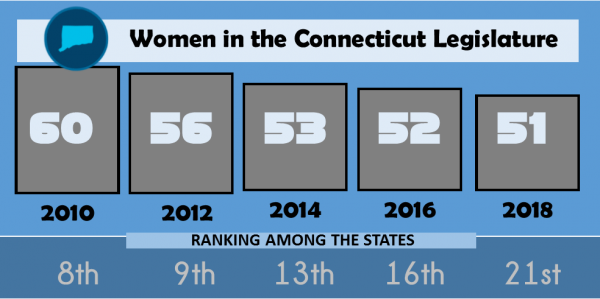
The number of women in the Connecticut legislature has dropped with each legislative election throughout this decade, dropping the state from 8th to 21st in the nation in the percentage of women in the legislature. The 2018 election year has been widely declared the year of the woman in politics, a reaction to the MeToo movement and related issues that have risen to the top of many political agendas.  It appears that Connecticut ballots may have a record number of women candidates in November, depending upon the outcome of the August 14 primaries in some legislative districts.

If it turns out that a record number of women are elected to the state’s 187 General Assembly seats (36 in the Senate, 151 in the House) in November, it would reverse a trend a decade in the making.

This year, the state legislature saw 42 women serving in the House (21 Democrats and 21 Republicans) and 9 women in the Senate (7 Democrats and 2 Republicans).  The total of 51 seats held by women, 27.3 percent of the 187 seats, placed Connecticut as one of 19 states between 25 and 34 percent.

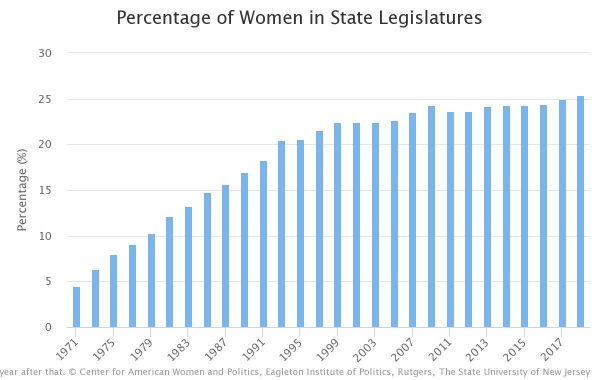
Leading the nation were Arizona (40%), Vermont (40%), Nevada (38.1%), Colorado (38%), Washington (37.4%), and Illinois (35.6%).   Women make up 25.4 percent of all state legislators nationwide.

In 2010, there were 60 women in the Connecticut legislature, 52 in the House and 8 in the Senate.  Connecticut ranked 8th among state legislatures in the percentage of women, at 32.1 percent.

Connecticut’s place among the states continued to drop through the decade, from 8th in 2010 to 9th in 2012, 13th in 2014, 16th in 2016 and 21st in 2018.

PERSPECTIVE: Recruitment, Retention, and Reactivation of Connecticut's Hunters and Anglers

by William A. Hyatt R3, or recruitment, retention, and reactivation, is the newest buzz word being bantered about Fish and Wildlife Agencies. At first glance, R3 seems like nothing new. After all, it is just another way of saying that our agencies need to pay close attention to the ever-changing interests and behavior of our customers if we are to remain a vital force for conservation, hunting, and fishing through the 21st century. But, it is something new, really new.

While agencies like ours have always understood the need to recruit new sportsmen and women—witness our tremendously successful Conservation Education/Firearms Safety and Aquatic Resource Education programs—we have not historically recognized the importance of retaining and reactivating participants or understood the impact of “churn” on our customer base. Most of us have grown up thinking that the majority of hunters and anglers purchase a license each and every year. However, recent data have revealed this is simply not the case. In fact, participation rates of two or three years out of five are more the norm (this is “churn”) and many people stop buying a license at some point due to unrelated life events and simply do not return to the sport.

Why is this so important?

I’ve previously written about the amazing contributions hunters and anglers make in supporting conservation through the purchase of licenses and gear. By now, I hope all of Connecticut’s hunters and anglers know that 100% of the money they pay for licenses and permits comes back to our Agency and is used to fund natural resource programs. But, it’s not just about the money!

Conservation of our fish, wildlife, and natural landscape is a quality of life issue that affects not only us, but our children and all subsequent generations. Our collective ability to succeed in conserving critical habitat, public access for fishing and hunting, or just enjoying nature is a function of having both the financial resources and political will to get the job done and done right. Funding provided by sportsmen is our foundation and the large number of hunters and anglers, found across all walks of life in Connecticut, are the engine that makes all of this possible.

Sportsmen spend a huge amount of time in the woods and on the waters learning what they need to know to be successful. In the process, they absorb a great deal of knowledge on how natural systems work and develop an instinctive feel for what is truly needed to conserve fish and wildlife. Along with this comes a passion for wild places and, oftentimes, a lifelong commitment to hunting and fishing traditions and environmental stewardship. In short, these sportsmen become the public’s most knowledgeable, passionate, and effective conservationists. This is why our Agency has invested so deeply in conservation education, youth hunting days, pheasant stocking, trout parks, community fishing areas, free fishing days, and Connecticut Hunting and Fishing Day.

Let’s get back to R3 and the need to do even more.

Going forward to help motivate and inspire, we will make hunting and fishing information more convenient as we deliver interactive maps, posts on social media, and live stream about fish and wildlife (check out our Facebook page at www.Facebook.com/CTFishAndWildlife). We also will be emailing relevant news and information through monthly newsletters and exploring truly innovative methods for contacting and encouraging lapsed sportsmen to get back outdoors.

However, we cannot do this alone. To be successful, we need to call on each of you to be on the lookout for friends and family members who used to hunt and fish but no longer do. We need you to reach out to these folks and help them return to the outdoors. Often all that is needed is an invitation; your excitement and passion will carry the day. Please join me in making a pledge for 2018 to re-introduce someone to hunting, take a kid or a friend fishing, buy someone a license, or invite a nonmember to your club. You will be doing them a favor and also helping future generations and all of Connecticut in the process.

________________________

William A. Hyatt of Glastonbury is Chief of the Bureau of Natural Resources in the state Department of Energy and Environmental Protection.  This first appeared in the Connecticut Angler's Guide.  The Bureau can be reached at (860) 424-3010. The DEEP Bureau of Natural Resources celebrated 150 Years of Natural Resource Conservation in Connecticut in 2016.

Nuclear Attack on NYC Could Impact CT, Report Suggests

The illustration in a recent edition of New York magazine has drawn some attention in Connecticut.  Accompanying an article describing the anticipated aftermath in the tri-state region of a nuclear attack on New York City, the potential path of nuclear fall-out was shown to extend through Connecticut towns including Greenwich, Stamford, Wilton and others, reaching as far north as the town of Monroe. Within two hours of an attack on Times Square, the article described, a plume of radioactive fallout would “unfurl 60 miles beyond the city, lingering for weeks, contaminating food and water supplies.”

The article explains that “In the hours and days after a nuclear blast, a massive plume of fallout would unfurl past the city’s borders and up the Eastern Seaboard, scattering radioactive dust on everything in its path: people, homes, farms, animals, forests, rivers. The most radioactive region of the plume would reach its full length of 20 miles an hour after the explosion, exposing every unsheltered person in the area to toxic levels of radiation; if it were to spread north from Times Square, it would reach as far as New Rochelle. Within a day, this danger zone would shrink to about a mile in length. Within a week, it would have dissipated completely.

A much bigger but less radioactive region of the plume, called the hot zone, would reach its maximum length of 60 miles — extending, say, as far north as Monroe, Connecticut — two hours after the explosion. A week later, the hot zone would still extend 20 miles from the city, and it would take many more weeks for it to disappear altogether. Although radioactivity in the hot zone would likely be too weak to cause any acute symptoms of radiation sickness, it could still subtly damage the human body and increase the chance of cancer.

How far and in what direction a plume of fallout travels depends on the altitude of the mushroom cloud, as well as temperature, wind, and other meteorological variables. Within an hour of an explosion, FEMA’s Interagency Modeling and Atmospheric Assessment Center would begin to track the plume’s movement, providing updates and projections to federal, state, and local authorities. They would use the information to evacuate people in the opposite direction of the plume and warn people in the plume’s path to seek shelter and avoid consuming any exposed water or food.”

Nearly a decade ago, a New York Times story on the subject included this:  Suppose the unthinkable happened…Do not flee. Get inside any stable building and don’t come out till officials say it’s safe.”  That advice, the Times indicated, was “based on recent scientific analyses showing that a nuclear attack is much more survivable if you immediately shield yourself from the lethal radiation that follows a blast, a simple tactic seen as saving hundreds of thousands of lives. Even staying in a car, the studies show, would reduce casualties by more than 50 percent; hunkering down in a basement would be better by far.”

“We have to get past the mental block that says it’s too terrible to think about,” W. Craig Fugate, administrator of the Federal Emergency Management Agency at the time, told the Times. “We have to be ready to deal with it” and help people learn how to “best protect themselves.”

Connecticut's state website focuses on nuclear preparedness related to an emergency at a nuclear power plant in the state.  The Department of Emergency Management and Homeland Security site indicates "While the Dominion Energy- Millstone Station in Waterford is the main focus of emergency planning in Connecticut, the fuel storage site at the former Connecticut Yankee site in Haddam, CT and the Indian Point nuclear power plant in Buchanan, New York, are also included in Connecticut's radiological emergency preparedness and response program."

Communities near those sites are linked, and a calendar of upcoming training is provided.  The United Way also provides information related to evacuation and taking shelter on the agency's website. New Haven conducted an exercise of their host community reception center to prepare for the unlikely event of a nuclear release at the Millstone power plant in 2015; video here:  https://www.fema.gov/media-library/assets/videos/109671

(New York magazine illustration)


Power of Nature to Help Cities and Local Residents Being Revealed in Bridgeport

What would happen if ways to integrate nature into a major urban community were pursued?  In Connecticut, the largest city is Bridgeport, and the Connecticut chapter of The Nature Conservancy (TNC) has been undertaking an effort to find out. Nature offers a lot of benefits to communities, TNC points out. “Trees provide shade and help clean the air. Gardens absorb and filter water, which reduces flooding and runoff into nearby rivers. Healthy dunes and wetlands protect coastlines from storms.”  In addition, the organization points out, “nature can also transform the way people experience their neighborhood.”

With 70 percent of the world’s population predicted to live in cities by 2050, heat and air pollution constitute a major public health concern, TNC points out, underscoring the importance of the organization’s initiatives to plant trees in urban areas across the country, among a series of related undertakings.

“People are at the core of our efforts to identify how neighborhoods are addressing daunting challenges in this formerly industrialized city,” said Drew Goldsman, Urban Conservation Program Manager. “We want to partner with communities to implement natural solutions in Bridgeport that help both people and nature.”

Their Eco-Urban Assessment looked at areas in Bridgeport that have poor air quality, high risk of flooding, and limited access to nearby green spaces and layered it with data on income level, impervious surfaces and asthma rates. The team was able to pinpoint neighborhoods where trees, green stormwater systems and open spaces will make the biggest difference for people and nature.  Air quality and flood risk topped the list of most acute needs.

In collaboration with local partners, the Conservancy is supporting a neighborhood-led greening effort known as ‘Green Connections’ in Bridgeport’s East Side neighborhood. Creating a plan for ways natural resources can shape the future of the community while making immediate changes to the landscape —through tree plantings and green stormwater infrastructure projects— is one of the initiative’s main goals, along with empowering volunteer stewards living in the community to take ownership of these natural areas. All of this helps create safe spaces for the community to gather, provides cooler and cleaner air, and improves wildlife habitat in the city.

According to the Nature Conservancy, Bridgeport currently has a 19% tree canopy cover, for example.  If all open spaces, vacant lots and parking lots could be planted, the city would have a 62% tree canopy cover.  The ramifications would be substantial, impacting various health and quality of life factors.

“Healthier people, cooler temperatures in the summer, cleaner air, reduced flooding, more urban habitat, parks and forests, less sewage overflow, a clean Pequannock River a more resilient coastline and green jobs” are cited as potential benefits.

The national publication Governing pointed out last year that “Streets cover about a third of the land in cities, and they account for half of the impervious surfaces in cities. Impervious surfaces don’t allow water to soak through them, which means they can alter the natural flow of rainwater. City streets collect, channel, pollute and sometimes even speed along water as it heads to the sewers.”

Goldsman indicates that currently efforts are focusing on the city of Bridgeport, but the Eco-Urban Assessment model is available to urban communities that want a deeper understanding of where nature can bring solutions to some of the most pressing urban issues.

“With the Eco-Urban Assessment model, we’re able to help municipalities identify the places and ways we can work together to use nature to improve residents’ quality of life and build more sustainable communities,” said Dr. Frogard Ryan, Connecticut state director for The Nature Conservancy. “From the beginning, we wanted this to be a community-led and TNC-supported program. Residents help us identify areas of other focus that aren’t highlighted by the model and be sure our study reflects what people experience day-to-day.”

K-12 School District Regionalization May Do More Harm Than Good, Analysis Reveals

“Generalizations about regionalization oversimplify a complex topic,” according to a new report on K-12 School District Regionalization in Greater Hartford, which warns that “K-12 regionalization can actually increase costs and harm educational outcomes.” As some school districts in Connecticut have been considering regionalizing their K-12 education services as a way to reduce costs, the 23-page report prepared for the Hartford Foundation for Public Giving raises some red flags, noting that “policies that call for wholesale regionalization based on imposed criteria (e.g., minimum/maximum number of students) can have unpredictable, and often adverse, consequences.”

In an effort to get a clearer understanding of the potential educational and community impacts of school and district regionalization, the Hartford Foundation for Public Giving sponsored the comprehensive analysis to help inform those efforts gathering data on what is known about the effects of K-12 regionalization on education expenditures and educational achievement, based on recent empirical studies.

“The Hartford Foundation is committed to the availability of high-quality, impartial research,” said Scott Gaul, the Hartford Foundation’s Director of Research and Evaluation. “As policymakers continue to consider strategies to reduce the costs of government, the issue of regionalizing services continues to draw attention. This research is intended to provide a clearer picture on the potential benefits and challenges of regionalizing school districts in an effort to support a shared understanding and to support informed decision-making.”

K-12 regionalization generally includes combining school districts, boards of education, and central office staff. This can result in closing schools, eliminating teaching positions, reducing administrative staff, and increasing student-to-teacher ratios, among other consequences, according to the report.  Connecticut, like other New England states, relies mainly on municipalities to provide government services, including K-12 education, to its residents.  In 2017, there were 196 public school districts including town districts, charter school districts, regional districts, and regional education service center districts.

The review of the research, conducted by Connecticut-based Rodriguez Data Solutions, points out that policymakers often promote K-12 regionalization as a way to achieve cost savings, but often fail to consider the consequences for student educational achievement. The report reviewed initiatives to promote K-12 regionalization in several states including Connecticut, Maine, New York and Vermont.  Among the findings:

  • While there is no definitive answer on optimum school size, research on Connecticut suggests that a district with 2,500 to 3,000 students may be both cost-effective and foster educational achievement. This roughly matches the range suggested in research from other locations. In at-risk communities, research suggests that elementary school enrollment should not exceed 300 students, and high school enrollment should not exceed 500.
  • In rural communities, closing a town’s school can cause the social fabric of a community to unravel. Research also suggests that “impoverished regions often benefit from smaller schools and districts and they can suffer irreversible damage if consolidation occurs.”
  • The literature review suggests that deconsolidation of large school districts be considered as an option for cost savings.  In Connecticut, it is estimated that the total savings from the 129 smallest school districts would match the combined equivalent per-pupil savings from the three largest school districts.  Consequently, a significant reduction in statewide education costs requires reducing per-pupil spending in urban areas, not just in small rural districts.

Researchers found that “regionalization may lead to diseconomies of scale resulting from: higher transportation expenses because of longer bus routes, overall increases (leveling up) in staff salaries because of seniority and/or contract renegotiation, and increases in the number of mid-level administrators and administrative support staff.”

Warning of the perils of large, consolidated schools, the report also included the finding that “Students who are involved in extracurricular activities (e.g., band, sports, clubs) have higher graduation rates and it is widely accepted that participation in extracurricular activities decreases as enrollment increases.”

The report also provides a cautionary tale regarding demographics and the impact of school closing decisions:  “While it seems apparent that the closing of school buildings will reduce costs, savings are limited because there may not be buyers, and the facilities still must be maintained by the school district. In already struggling neighborhoods, these now empty school buildings (with boarded windows)

contribute to a downward economic spiral by attracting scavenging, dumping, drug users, and graffiti. The neighborhood children who previously attended the now closed school are then exposed to an increase in crime resulting from the blighted property.”

“Connecticut’s Black and Hispanic children,” the report adds, “are already disproportionately overexposed to crime in their neighborhoods.”

In addition, the report explains, “Students from advantaged (i.e., high socioeconomic status) households have similar educational achievement in both small and large schools. However, the situation is much different for students from low-income communities for whom “… smaller [school] size mediates the association between

socioeconomic status and achievement.” The potential for high educational achievement diminishes for at-risk students when they attend large schools that are disconnected from their communities.”

The report also included an update on the state’s student population.  From 2010-2011 to 2016-2017, the state’s public school enrollment dropped by 25,606 students – a decline in enrollment of 4.5 percent. The analysis found that “most Connecticut school districts have declining enrollments and it is more prevalent in rural areas.”

The report also cited a survey of Vermont voters, who expressed preferences for saving money and maintaining local control of local schools. “Vermont voters had not grasped that saving money may inherently include loss of local control,” the report indicated, concluding that “Vermont voters had conflicting goals, which could also be expected from Connecticut voters.”

New Haven is Among Safest Cities in U.S. for Cycling, Analysis Shows

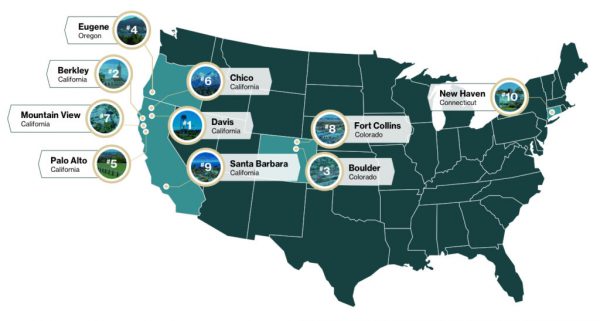
New Haven is one of the nation’s ten safest cities for cyclists, according to a new analysis.  In a ranking dominated by communities in California, with six of the top ten, New Haven was not only the lone Connecticut city to earn a spot among the top ten, it was the only city in the Northeast to do so.  The ranking saw Davis and Berkeley California named the safest cities for bicyclists, followed by Boulder, Colorado; Eugene, Oregon; Palo Alto, Chico, and Mountain View, California; Fort Collins, Colorado; Santa Barbara, California, and New Haven.  Minneapolis ranked number 12.

Five other Connecticut cities made their way into the top 100 nationally:  Hartford at number 55; Norwalk at number 82; Bridgeport at number 85; New Britain at number 91 and Waterbury, which was ranked at number 92.  Lower down the list were Stamford, ranked number 221 and Danbury,  which came in at number 229.

New Haven debuted Connecticut’s first protected bike lanes a year ago, according to published reports, from City Hall to Long Wharf, and city officials have said  “New Haven encourages alternative transportation options in the city so there is a variety of existing supported infrastructure available, including off-street shared use paths, on-street bicycle lanes, a contra-flow bike lane, bike boxes at intersections, on-street bike corrals, bike racks on sidewalks, bike racks on parking meters and bike racks on buses.”

"New Haven likely fared well due to their bike laws, a high percentage of spending per capita on bike lanes and their low percentage of fatal crashes," said Laura Schmitz, Safety Writer with Your Local Security. "The city of New Haven should be proud of their efforts to make their city safer for cyclists!"

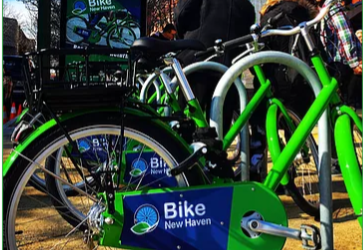
The city also launched a bike sharing program this year, in February, and celebrated National Bike to Work Day in May with a program encouraging bike riding.  In addition, Yale University is a Gold-level Bicycle Friendly University, as awarded by the League of American Bicyclists, and the city has developed on-line bike route maps.

The safest city in Massachusetts, Somerville, ranked number 58.  Providence was the safest in Rhode Island, but ranked number 482 on the national list.  Syracuse was determined to be the safest in New York State, ranking number 537.

The rankings were issued by yourlocalsecurity.com, an ADT Authorized Premier Provider.  To determine the safest and least safe US cities for bikers, metrics and data were used from Census.gov, the National Highway Traffic Safety Administration, People for Bikes, and The League of American Bicyclists to find the percentage of bike commuters, number of fatal crashes, amount of bike lanes, and what bike laws are in place or in the works in each city.

At the bottom of the list, the ten most dangerous cities included Los Angeles, New York, Houston, and five cities in Iowa.  Cities were included if these sources had data for them. Cities included had populations of 20,000 or more.

Community College Manufacturing Program Continues to Expand

Tunxis Community College in Farmington is establishing Connecticut’s eighth advanced manufacturing education programme as employers struggle to keep up with demand for workers. Brian J. Fries, president of Atlantic Precision Spring Inc., a Bristol-based metal-stamping manufacturer, said the college training program, set to launch in August, can’t come soon enough.

“The last thing I need is to have jobs and not have personnel,” he said following a meeting of employers and state education officials at Tunxis in Farmington.

Jim Lombella, president of Asnuntuck and Tunxis community colleges, said he receives phone calls daily “from employers looking for skilled workers.”

Connecticut is benefiting from rising demand for commercial and military jet engines, submarines and helicopters. However, thousands of manufacturers in the state are scrambling to hire qualified workers to keep up with production and fill jobs left vacant by retiring baby boomers.

More than 13,600 manufacturing workers — machinists, welders, tool and die makers and others — are needed, according to a survey by the Connecticut Business & Industry Association.

The state currently operates advanced manufacturing programs at Asnuntuck, Housatonic, Manchester, Middlesex, Naugatuck Valley, Quinnebaug Valley and Three Rivers community colleges.

“Now we have an opportunity to build on that at Tunxis,” Mark Ojakian, president of Connecticut State Colleges and Universities, said at the meeting.

Many central Connecticut manufacturing industries, including automotive, aerospace, defense and medical equipment, are expected to also benefit. The Tunxis program is close to what Ojakian called a “ripe market for manufacturing” in Bristol, Hartford, New Britain, Newington, Plymouth and Southington.

It will offer associate degrees in manufacturing and machine technology. It also will offer certificates in machine technology and manufacturing electro-mechanical maintenance technology.

The program, accommodating 30 to 50 students, will provide course work that meets the needs of manufacturers and avoids a “disconnect between employers in the region and programs on campus,” Ojakian said.

Citing the state’s fiscal troubles, he asked business representatives to lobby the General Assembly for funding for the advanced manufacturing centers.

“We cannot scale this without additional support,” he said.

Lombella said the initial cost will be $700,000 for laboratory equipment, renovation and other requirements. But, he said, there will be a funding gap between the $16,000 it costs the college to educate each student and tuition of $8,500.

___________________

This article first appeared in The Gulf Today, a 36-page English-language daily newspaper based in the United Arab Emirates.

Engineering Entrepreneurship Leads Three CT Institutions to Collaborate in Masters Program

The latest effort to attract talented entrepreneurs from around the world to the state of Connecticut is a new partnership between the University of Connecticut, Trinity College and the University of New Haven, launching a joint Master’s of Engineering in Global Entrepreneurship. It is the first engineering-focused entrepreneurial graduate degree in the state.

The new master’s degree program aims to create what officials describe as “a nurturing ecosystem” to enable novice entrepreneurs to learn best practices, receive mentorship from veteran entrepreneurs, and be “set-up for success.”

The program, which is fully funded, will recruit individuals from all over the world who are in the early stages of developing start-ups, or who have shown an impressive penchant for entrepreneurship, to apply to the program. Accepted students will receive full tuition remission, a yearly stipend, and significant other resources to help them commercialize their ventures.

“This program, and its related initiatives, will be a major step towards bringing in the best and the brightest from all over the world, giving them the tools they need, and turning them into major entrepreneurial advocates for the state of Connecticut,” said UConn associate dean of engineering Mei Wei. “If we can bring them in early, train them, and open up doors toward commercialization, then we can literally help create start-ups from scratch, and help them to grow roots in this state.”

Similar programs are being offered by universities across the country, including at Brown, Dartmouth, University of Pennsylvania, and Villanova.  Some include a focus at the undergraduate and graduate levels, while others are certificate, rather than degree, programs. Support for the Connecticut program comes from CTNext, with a funding match from UConn’s Schools of Engineering and Business, Trinity College, and the University of New Haven.

Kazem Kazerounian, dean of UConn’s School of Engineering, says it is essential to spread the net wide when recruiting in order to bring in the most talented students, regardless of their state or country of origin, in the same way student-athletes are recruited. “We have to search nationally and internationally to assemble the best possible collection of talent.”

John Elliott, dean of the School of Business, says that creating more entrepreneurial programs in a wider variety of academic concentrations will have a significant impact on Connecticut’s economic future.

“At the School of Business, we have a tremendous opportunity to help other entrepreneurs, in the sciences, engineering, medicine, and other specialties, to develop the business knowledge and meet the mentors and advisers who can help them take a great idea and bring it to the marketplace.

The three institutions will work during the next few months to develop the curriculum, establish an advisory board, create a virtual inter-institutional platform, and plan to start recruiting for the first cohort of students. All three institutions have a lengthy pedigree in engineering, and effective programs to advance entrepreneurship at the undergraduate level.  UNH offers the Kern Entrepreneurial Engineering Network (KEEN), focused on fostering an entrepreneurial mindset in engineering students.  Trinity College President Joanne Berger-Sweeney has described engineering, entrepreneurship and innovation as part of the college’s DNA.

The program is being co-led by David Noble, professor-in-residence in management, director of the Peter J. Werth Institute for Entrepreneurship & Innovation, and co-director of the UConn Entrepreneurship and Innovation Consortium; Hadi Bozorgmanesh, professor of practice in engineering entrepreneurship and co-director of the UConn Entrepreneurship and Innovation Consortium; Sonia Cardenas, dean of academic affairs and strategic initiatives at Trinity College; and Ron Harichandran, dean of the Tagliatela College of Engineering at the University of New Haven.

PERSPECTIVE: Marketing Connecticut to College Grads

by Kevin McLaughlin As a rising senior at the College of the Holy Cross in Worcester, Massachusetts, I find that there is one thing at the forefront of my mind, and the minds of all my fellow classmates who are entering their final year of college: post-graduation plans.

The mere mention of those three words causes stress and anxiety levels to skyrocket amongst many college seniors. The significance that those in college place on post-grad plans can be discerned through the fact that, according to a major annual survey of incoming students conducted by UCLA, the number one reason that people attend college is to “get a better job,” which has superseded the former number one reason, which, before 2006, was to “learn about things that interest me.”

Disregarding the question of whether this shift is a positive or negative one, the fact remains that college students today are overwhelmingly preoccupied with securing their futures. Despite this, college students are struggling to find the good jobs that they desire. According to the Federal Reserve Bank of New York, nearly half of new college graduates are underemployed, which means that they are working in jobs that do not require a Bachelor’s degree.

If college students care more than ever about getting a job after graduation, then why are they struggling to find good jobs in a relatively strong economy? The disjunction here is apparent. Many potential factors can explain this disconnect, but one that I find prevalent on my campus is that all rising seniors seem to want to work in the same select few cities.

When you ask the average college student at Holy Cross where he or she would like to work post-graduation, the answer is almost always one of two locations: Boston or New York City. Sometimes you will hear answers that are as exotic as Washington D.C., San Francisco, or Chicago, but places more obscure than these are rarely, if ever, considered by the vast majority of Holy Cross students, and it seems as if this is a familiar refrain expressed across colleges throughout the northeast.

This reality is disconcerting for Connecticut because one key way to develop the Connecticut economy is to inject it with the region’s best available young talent. This will fail to happen if college students never consider Connecticut, along with its cities and towns, as a worthwhile destination for post-graduate employment.

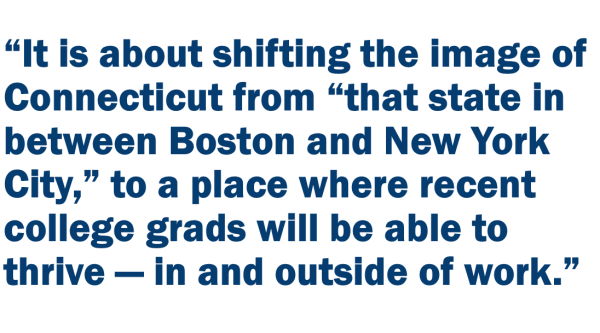
If there is a large supply of new college graduates wishing to find good jobs, and there is demand from the Connecticut economy for these new college graduates, the question becomes how Connecticut can attract these students by marketing itself as the great job source and place to live that it is. It is about shifting the image of Connecticut from “that state in between Boston and New York City,” to a place where recent college grads will be able to thrive—in and outside of work.

With the goal of conveying some of the qualities that make Connecticut a great place to live and work for young college grads, the following are my top 5 qualities of Connecticut that should attract young workers:

  1. Cities – Connecticut cities such as Hartford and New Haven offer cultural attractions that young college graduates crave, but are not as large as Boston and New York City—a smaller size that allows young people to feel a more integral part of the community. Cultural attractions in Connecticut’s cities include concerts, festivals, and ballgames which, along with vibrant bars and clubs create a great nightlife.
  2. Nature – Immediately outside of its cities, Connecticut offers premiere natural attractions, with serene lakes and miles of hiking and walking trails, that give young people an escape into nature only minutes outside the city. Furthermore, Connecticut also has many miles of breathtaking shoreline which are a quick drive from most Connecticut towns and cities. Weekend or even day-trip getaways to lakes, mountains, or to the beach are easily accomplished in Connecticut, which creates a balance between city and country living that is unrivaled by any location proximate to downtown Boston or New York City.
  3. Convenient Location – In addition to being situated between Boston and New York City, with easy access to both, Connecticut provides its residents with proximity to a hassle free international airport and easy access to busses and trains. This convenience means that if you want to leave the state for any reason, there are painless ways to get anywhere across the country, and the globe.
  4. Affordable Rents – Connecticut offers housing that is far more affordable than that found in either New York City or Boston. This is evidenced by the statistic that, according to the apartment listing website Rent Jungle, the average one-bedroom apartment in Boston rents for $2703 a month, while the average one-bedroom apartment in Hartford rents for only $1291 a month. This significantly lower rent gives recent college graduates more available capital to spend on cultural attractions, and to pay back student loans!
  5. Opportunities to Give Back – Connecticut offers its recent grads great opportunities to volunteer and improve the lives of people around the state. Since Connecticut is home to many small cities and towns, young volunteers can have a real, tangible impact in those communities. This is a significant social impact that they cannot as easily access in big cities such as Boston and New York.

If Connecticut can successfully market itself as an ideal place for recent college graduates, a more significant portion of those graduates will move to Connecticut towns and cities, which will in turn promote economic growth, leading to more opportunities. It is a path dependent process, meaning that once a more significant portion of young people settles in Connecticut, the culture will shift, and more young people will follow. Now, it is imperative to get the ball rolling.

____________________________

Kevin McLaughlin of Farmington will be a senior at the College of the Holy Cross in Worcester, MA this fall.  This piece first ran as a blog post on the website of the Connecticut Economic Resource Center (CERC), where he is interning this summer.  It is reprinted with permission.


State Funds Continue to Support Transit-Oriented Development; $8.5 Million in New Grants to 5 Municipalities

Five Connecticut communities – Danbury, Hartford, Stamford, Torrington and West Hartford - will share approximately $8.5 million in funding under the second phase of the state’s 2017 Responsible Growth and Transit-Oriented Development (TOD) Grants. They are the latest in a series of competitive state grants to be awarded in recent years to support the development and implementation of TOD initiatives around the state. The competitive grant program “supports transit-oriented development and responsible growth in the state and is targeted at boosting economic activity and creating jobs,” according to state officials. Administered by the Office of Policy and Management (OPM) the grants rely on a combination of funding from the Responsible Growth Incentive Fund and the Transit-Oriented Development and Pre-development Fund.

A year ago, OPM released a request for applications for the current grant program, and the State Bond Commission approved a total of $15 million to be used – comprised of $5 million from the Responsible Growth Incentive Fund and $10 million from the Transit-Oriented Development and Pre-development Fund. Following that, OPM – with input from other state agencies – reviewed, rated, and ranked each of the proposals.

In this round of funding, Danbury’s Downtown Streetscape Project is receiving $2 million to prepare design drawings and construct sidewalk and streetscape infrastructure improvements along key downtown pedestrian routes within the vicinity of the Danbury train station. Improvements include the new construction or replacement of sidewalks, intersection improvements, landscaping, removal and installation of street trees, ornamental lighting, and pedestrian access improvements as detailed in the city’s Downtown TOD Planning Study.

Stamford’s Springdale TOD Implementation project is receiving $1,994,188 to prepare design and engineering drawings and construct improvements around the Springdale train station consistent with the recommendations of the Glenbrook/Springdale TOD Feasibility Study. Improvements include safer bicycle and pedestrian access to the village center and rail station, realignment and modification of the station’s main entrance at Clearview Avenue, and other improvements to landscaping, lighting, and general accessibility in and around the station area.

In Torrington, the East Main Street (Route 202) Sidewalk Implementation will receive $1,997,700 to construct new sidewalks, and repair/replace existing sidewalks along portions of East Main St (Route 202) between Torrington Heights Road and the Big Lots Plaza. The city will use a portion of the funding to evaluate existing conditions at nine signalized intersections within the project boundary, and at more complex sections of roadway which lack sidewalks, to determine if additional pedestrian improvements are feasible.

Hartford’s Main Street Complete Streets Vision Plan and Innovation District Activation will receive $450,000 to develop a Complete Streets Vision Plan for a section of Main Street from State House Square to the vicinity of South Green in order to identify improvements to bike and pedestrian amenities, and prepare complete construction documents for future buildout. In addition to bike and pedestrian amenities, the final plan is to identify potential improvements to transit services, new streetscaping, a new cycle track, and other linkages to improve bike and pedestrian connections within the project area.

A portion of Hartford’s funding will also be used to implement the Innovation District Activation Program, to provide grants to new and existing businesses within the project area to support capital and other investments such as façade improvements, building infrastructure, marketing, business planning, public events, and other business/community support services with the objective of creating vibrant employment and residential hubs.

West Hartford’s New Park Avenue Complete Streets Implementation will receive a grant of $2,000,000 to construct complete streets infrastructure improvements along New Park Avenue from New Britain Avenue to Oakwood Avenue, consistent with the recommendations of the 2017 New Park Avenue Transit Area Complete Streets Study. Improvements include a road diet with center turn lane, landscaped medians and protected bike lanes, new street trees, lighting, wayfinding signage and other amenities, and a pocket park at the gateway to the Trout Brook Trail.

“Transportation isn’t just about cars, trains, and buses – it’s about building vibrant communities and continuing to make Connecticut a more attractive place to live, visit and do business,” Gov. Malloy said in announcing the grants. The awards “will build upon the smart, targeted investments we have made in recent years, which have already led to significant growth in transit-oriented development across the state.”

The first round of grants under the current initiative were released in December 2017, with eleven projects to receive $15 million.  Communities selected to receive funds were Berlin, Clinton, East Windsor, Madison, New Britain, Norwalk, Stratford, Wallingford, Winchester, Windsor Locks, and the Southeastern Connecticut Council of Governments.

In 2016, state officials announced that twenty projects in towns and cities across Connecticut would receive a total of nearly $11 million to transit-oriented development and responsible growth, targeted at boosting economic activity and creating jobs. At the time, Gov. Malloy said “Our focus is on not only improving overall quality of life for residents in these areas, but also encouraging economic development by making our towns and cities more accessible."

Communities selected were Berlin, Branford, Canton, Clinton, Danbury, Hartford, Madison, New Canaan, New Haven, Old Saybrook, Torrington/Winsted, Waterbury, Westport, Windsor, and Windsor Locks.  Also receiving funds were the Capitol Region Council of Governments, Naugatuck Valley Council of Governments, and Northwest Hills Council of Governments.

Previously, 11 state grants between $75,000 and $150,000 were provided in 2015 to “prospective planning projects that best support transit oriented development.”  Receiving the state grants were Berlin, Bethel, Bridgeport, Enfield, Meriden, Milford, New Britain, New Haven, Stratford, Wallingford and West Hartford.