PERSPECTIVE: Dyslexia and Persistence Can Be Route to Achievement
/Dan Malloy overcame tremendous challenges to build a successful career in public service and law. Born with severe dyslexia and motor-control problems, he was unable to walk steadily or to execute simple tasks like tying his shoes and buttoning his clothes. As a young student, Malloy couldn’t read, spell, or do mathematical problems. But his mother, a public-health nurse, didn’t buy into the idea that her son was slow, says Malloy. “She made a definitive decision to stress the things that I was good at and not bother with the things I wasn’t good at. My mother pushed me to develop my strengths, to focus on my leadership and oral-communications skills. Concentrating on those skills, which were my strengths, helped me meet the challenges of college, law school, and my career.”
Malloy’s mother also encouraged his listening skills by giving him a radio, so he went to bed each night tuned in to the news and other programs. At school, he found little encouragement. One of his teachers labeled him “mentally retarded” as a fourth grader; another hung his failed spelling tests on the wall beside those of “A” students. “It’s a tribute to my mother that I never envisioned that I wouldn’t be successful; I just didn’t know how I’d do it,” he says.
By the end of fifth grade, Malloy could button his clothes and tie his shoes, and by eighth grade, he was a much-improved reader. “I developed some compensatory skills and had halfway decent grades,” he says. “I also had a good level of academic success in high school and remembered everything I read, although reading was still arduous.” Luckily, Malloy attended a supportive high school, which waived the foreign language requirement and any math class beyond Algebra I, in which he scored a D. “That allowed me to take courses I was good at, like social studies and history,” says Malloy, who also had access to books on tape.
“The real point where my future was decided was when I had a serious injury in high school,” says Malloy. Sidelined by a compressed vertebra during football practice, he ended up in pancreatic failure as a result of undiagnosed ulcers. He lost sixty pounds and was not expected to live, until an advanced X-ray machine detected the ulcers and put him on the road to recovery” and to thoughts of college. Early in 1974, he wrote a candid letter to several colleges. “I told them that I almost died and that I had learning disabilities, and I asked them to take a look at me. I was lucky some schools were willing to take a chance on me,” says Malloy, who describes his SAT scores as “abysmal.”
Another byproduct of his dyslexia is Malloy's ability to listen and absorb information, an asset to anyone, but especially to a candidate for public office. At Boston College, his reading skills improved steadily, and his reading retention and comprehension were “off the charts,” says Malloy. “I got very good grades and the school was behind me.” His professors granted him extra time on multiple-choice tests and allowed him to answer essay questions orally or to dictate them to a third person.
He also wrote papers orally, dictating them to his future wife, Cathy, whom he met as a freshman. While Malloy is a fluent reader, reading aloud is difficult, so he plans speeches in his head and delivers them without consulting a written text. Another byproduct of his dyslexia is Malloy’s ability to listen well and absorb large amounts of information, an asset to anyone, but especially to a candidate for public office.
These assets certainly paid off in the November 2010 Connecticut gubernatorial election. In a tight race, Dan Malloy edged out his opponent to take the seat as Connecticut’s 88th governor. He was sworn into office on January 5, 2011. [He will have served two terms when he leaves office in January 2019.]
___________________________
This perspective appears on the website of The Yale Center for Dyslexia & Creativity (YCDC). YCDC is a source of research, advocacy and resources to help those with dyslexia reach their full potential. Dyslexia is defined as an unexpected difficulty in learning to read. Dyslexia takes away an individual’s ability to read quickly and automatically, and to retrieve spoken words easily, but it does not dampen their creativity and ingenuity.
The Center’s tools and resources are used widely by parents, educators and those with dyslexia to advocate for greater recognition and support for dyslexic children and adults. YCDC builds awareness in all communities and mobilizes grassroots efforts to close the reading-achievement gap for all students.
The Center also showcases the success stories of adults with dyslexia, including writers, scientists, celebrities, and government and business leaders. Malloy is one of two current Governors featured on the YCDC website. The other is John Hickenlooper of Colorado, a graduate of Wesleyan University in Middletown. California Lieutenant Governor Gavin Newsom, now a candidate for Governor, and former Connecticut Congressman Sam Gejdenson are also among the political leaders profiled.
It was recently announced that Gov. Malloy will be a visiting professor at the Boston College Law School in 2019.

 In total, 27 states have raised or reformed their gas taxes since 2013. Indiana instituted a 10-cent increase in 2017; Oregon approved a 10-cent phase-in that began this year. The South Carolina legislature overrode a Governor’s veto to enact a 12-cent-per- gallon increase in the tax rate to be phased in over 6 years, according to data compiled by the Institute on Taxation and Economic Policy. Oklahoma’s legislature approved a 3 cent increase this year - that state’s first since 1987.
 The survey revealed that residents are not satisfied with the current health care system: 80 percent agree or strongly agree that “the system needs to change.” When given more than 20 options, they focused on the high prices charged by industry players, citing most frequently as a “major reason” for high health care costs:


 The comprehensive assessment of Hartford’s ecosystem also noted that “Hartford’s [startup] founders claim to have the right ambition to go global,” concluding that “Hartford’s startups have more potential to strengthen Global Market Reach and Global Connectedness.” In a number of areas analyzed in the assessment, Hartford is seen as having potential to strengthen the local startup community, its reach beyond Hartford, and the demographic of startup teams.


 The VentureClash competition started with applications from 300 companies from more than 15 countries. After two rounds of judging, nine finalists were named, and they then went on to compete at the live pitch event. The judges included investors and subject-matter experts from Greycroft Partners, Oak HC/FT, Real Ventures, Stanley Ventures, Teamworthy Ventures, Travelers and the Royal Bank of Scotland.
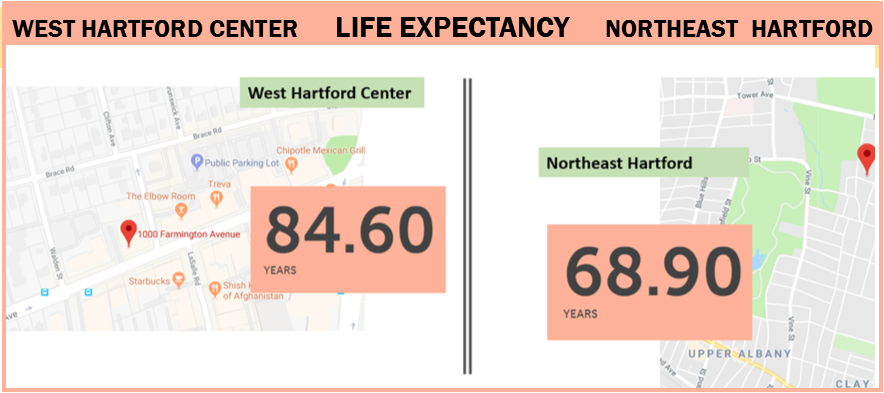 There is variation within cities and towns. In New Haven’s Newhallville neighborhood, life expectancy is 71.7 years. In the neighborhood next door, Prospect Hill, life expectancy is more than a decade longer: 82.3 years.

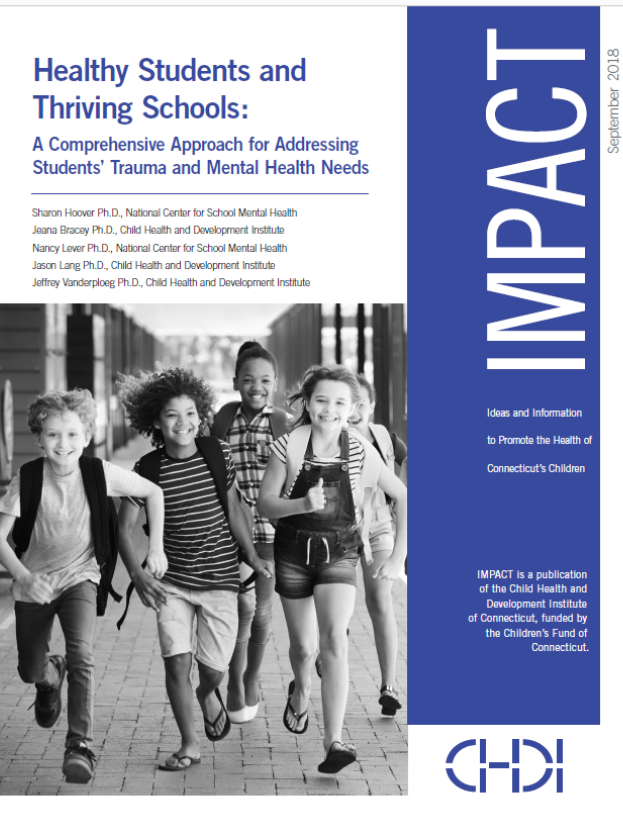 The 40-page report, developed by The Child Health and Development Institute of Connecticut (CHDI), a subsidiary of the Children’s Fund of Connecticut, in partnership with the national Center for School Mental Health at the University of Maryland, provides a framework for policymakers and school districts interested in improving outcomes by addressing the mental health and trauma needs of students. The report indicates that “in a typical classroom of 25 students, approximately five will meet criteria for a mental health disorder but most of them are not receiving appropriate mental health treatment or support. Among those who do access care, approximately 70 percent receive services through their schools.”
 “Approaching student mental health with a comprehensive lens that integrates health promotion, prevention, early intervention, and more intensive treatments leads to better school, student and community outcomes," said Dr. Sharon Hoover, Co-Director of the Center for School Mental Health at the University of Maryland and lead author of the report.

 The personal-finance website WalletHub compared the largest U.S. cities – including at least two from each state - across 31 key indicators of disability-friendliness. The data set ranges from wheelchair-accessible facilities per capita to rate of workers with disabilities to quality of public hospital system. The 31 indicators were grouped into three categories: Economy, Quality of Life and Health Care.
 “Bridgeport has one of the lowest number of wheelchair accessible art, entertainment and recreational establishments per capita, and a large number of older buildings with little to no access for disabled residents," Gonzalez said.