Federal Government Shutdown Direct Impact on Connecticut Among Least in U.S.

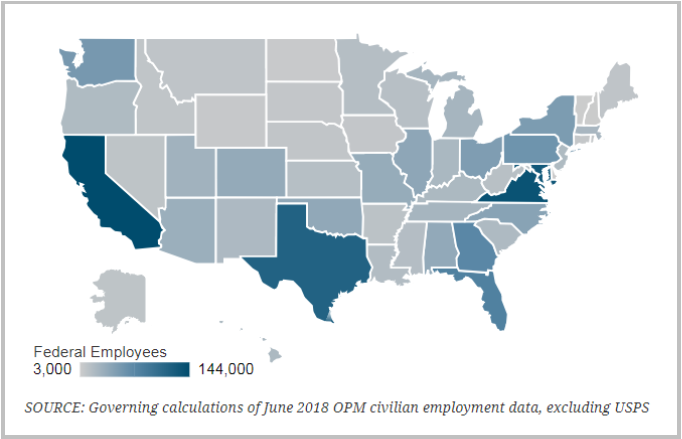
The impact of the continuing partial federal government shutdown in Connecticut is among the smallest among the 50 states, in terms of the number of federal employees affected, according to a new analysis. A total of 1,481 federal employees in Connecticut work for agencies that are without federal appropriations, as the political stalemate in Washington, D.C. has drifted into the new year.  That is 18.3% of all federal employees in Connecticut.  There are 6,595 federal employees in Connecticut working for agencies that currently do have federal appropriations.

Nationally, about 800,000 federal employees are working without pay or will be furloughed.  The partial government shutdown began on December 22.

About one-third of federal agencies have not received funding. The largest of the federal agencies not yet funded include the departments of Agriculture, Commerce, Homeland Security, Interior and Transportation. In these and other agencies, a sizable share of employees are furloughed or working without pay, according to published reports.

Only Maine, Delaware and Rhode Island have fewer federal employees employed by agencies without appropriations, according data compiled by GOVERNING magazine.  Connecticut’s share of the total number of federal employees who work for agencies that have not been funded is four-tenths of one percent.

States most affected – those with the most employees – are the District of Columbia (102,183), California (41,178), Texas (35,694), Virginia (34,344), Maryland (28,266), New York (16,657), Florida (15,992), Colorado (15,818), Georgia (15,735), Missouri (14,048) and Pennsylvania (14,024).
Connecticut’s Department of Labor reportedly hopes to help some of the approximately 1,500 federal employees likely affected by the partial federal government shutdown, and who work or live in Connecticut.  Published reports indicate that Commissioner Kurt Westby indicated that the agency can assist those workers who are eligible to collect unemployment benefits to navigate the unemployment compensation process. Federal employees who are on furlough are eligible to apply online for benefits, while those required to work during the shutdown but are not getting paid are ineligible to file for unemployment.

The impact in D.C. is the greatest.  About 32,000 Homeland Security and Justice department employees are stationed in D.C., GOVERNING reports, many of whom are continuing to report to work without pay. State Department, Securities and Exchange Commission and Smithsonian Institution employees are also heavily concentrated in the District, accounting for more than half the workforce for those agencies.

California is home to nearly 10,000 employees of the Department of Agriculture, which hasn’t secured funding. The state’s federal workforce also includes approximately 7,600 Treasury Department employees and nearly 6,800 in the Department of the Interior, the GOVERNING analysis indicates.  Among agency employees impacted in Texas are nearly 9,000 Treasury Department employees, along with about 5,700 Homeland Security employees and 4,300 in the Department of Transportation.

To determine federal employment in each state, GOVERNING compiled the latest data from the federal Office of Personnel Management (OPM). Data current as of June reflect all civilian workers, excluding those who work for the Postal Service and a limited number of smaller agencies.  The analysis does not include federal relationships that  impact private businesses.

Co-Working Headed to Sacred Heart University in Alliance with Verizon, Alley

Co-working in Connecticut will be gaining another player in the field, with a distinctive twist.  Sacred Heart University in Fairfield will be the site, as the university signs an agreement with Verizon and Alley, for the creation, management and operation of a coworking space on the university’s West Campus in Fairfield, formerly the corporate headquarters for General Electric. This new partnership, called Alley powered by Verizon, will be the first in Connecticut and the first time “Alley powered by Verizon” is located on a college campus. Verizon and Alley together have successfully built innovation hubs in New York, Cambridge, and Washington.  Locations in Palo Alto and Los Angeles were announced in September, described as “the next phase of its business that will fuel local innovation and entrepreneurship on the West Coast.”

“Fairfield County has several corporations and businesses that stand to benefit from the work that will be done here, not to mention its ideal location between New York City and Boston. We’re helping to create a startup mindset and environment that will provide members much-needed access to corporate resources typically unavailable to small businesses, from key relationship introductions to cutting-edge technology,” said Jason Saltzman, CEO of Alley.

Work on the new innovation coworking space is expected to be completed with the space open for business late next year.  It is slated to be a hub for innovation teams from large and small companies; for entrepreneurs who want to test their ideas, grow their businesses and work collaboratively in a supportive environment; and for individual professionals who want to work in a dynamic office environment, according to officials.

“A robust commitment to innovation is in keeping with the University’s dedication to educating our students on technology, emerging trends and entrepreneurship. This is exactly the kind of innovative and entrepreneurial platform that Connecticut desperately needs, and we’re delighted to be hosting it on our campus, working collaboratively with Verizon and Alley,” said SHU President John J. Petillo.

A dedicated SHU project coordinator will help identify, activate and create engagement between the innovation community and SHU’s faculty, staff, administration and student body.  As part of this venture, Alley will oversee marketing and advertising to develop a vibrant community of members, manage member experience and help coordinate events and programs. SHU also will establish a Student Concierge Service that members can use as a resource for making connections with various University programs, internships, recruiting, events, speaker sessions, office hours and mentoring.

The new center at Sacred Heart University will further Verizon’s commitment to cultivate strong relationships with academic institutions with emerging technology curricula, officials stressed.  The coworking spaces allow Verizon to tap into local startup and innovation networks, build relationships with potential partners and open new doors for ideas and technology. With Verizon, Alley is bridging the gap between startup and corporation by helping the community workspace build next-level ecosystems for entrepreneurs. Verizon provides entrepreneurs and start-up companies working on new products with the technology and services they need for growth.


As with other coworking spaces that have increasing taken root across Connecticut, the space is expected to offer various levels of memberships and services that include private office space, hot desks, meeting and conference room space, events, recruiting services, marketing services and programming services. The community also plans to draw on SHU faculty, staff, students and other resources to build an academic-focused environment that attracts local startups, entrepreneurs, corporations and other forward-thinking organizations and individuals.

“This is a major boost to Fairfield’s economic development efforts to bring more jobs and businesses to our town,” said Fairfield First Selectman Mike Tetreau. “I am very excited about this Sacred Heart University initiative as it certainly goes a long way to helping replace the loss of GE in our community.”


New Tax Credit of $500 Annually for 5 Years Offered to STEM Graduates Working in CT

Passed by the state legislature over a year ago as part of the 2017 state budget compromise, a new tax credit aimed at keeping college graduates in the technology fields in Connecticut – and attracting young professionals to the state - becomes effective this year. It is a “refundable personal income tax credit for college graduates who are employed in the state; receive, on or after January 1, 2019, a bachelor’s, master’s, or doctoral degree in a science, technology, engineering, or math (STEM) field; and live in Connecticut or move here within two years after graduating.”  The credit is $500 and may be claimed in each of the five years after graduation.

The initiative is new to Connecticut, but not New England.  Maine has had a similar initiative for a decade, Rhode Island for more than a year.

The tax credit approved in Connecticut was advocated by House Speaker Joe Aresimowicz. Testifying at the State Capitol in support of the proposal in March, 2017, the president of the Connecticut Conference of Independent Colleges, Jennifer Widness, pointed out that “projections included in our state’s Strategic Master Plan for Higher Education indicate that by 2025 Connecticut’s economy will require a workforce in which 70% will have some education beyond high school. Hitting that 70% target will require production of 300,000 more graduates than the current rates of production will yield.”

In his testimony supporting the proposal in 2017, State Rep. Christopher Rosario of Bridgeport noted that “This is not a new concept. Over the years, we tried to find ways to provide incentives for our constituents to not only pursue higher education, but to continue to live and work in our state.”  Added Milford State Rep. Kim Rose: “This is a way to not only encourage student success in our state, but also attract creative new ideas that add to our economy. Student success is Connecticut’s success, they are the future of tomorrow.”

The program in Maine is broader, and was started in 2008 as a retention tool for young professionals already living in Maine, CNN reported recently. It has been revised through the years into a tool to attract young workers in the STEM fields. The Opportunity Maine Tax Credit reimburses student loan payments for college graduates who live and work in Maine.

The state’s website declares” “The State of Maine recognizes the investment you've made in your education, and has puts its money where its mouth is – come here to live and work, and the State will reimburse your student loan payments via the Opportunity Maine Tax Credit.”

When you move to Maine, CNN reported, the money you spend toward paying your student loan debt each year is subtracted from your state income taxes.  For instance, if you pay $1,800 toward your loan and owe the state $2,000 in taxes, you’ll only end up paying Maine $200.

Rhode Island reopened their Wavemaker Fellowship Program last year. The program offers tax credits for taxpayers who work in a science, technology, engineering or mathematics (STEM) field at a Rhode Island-based employer. The credit is equal to the taxpayer’s annual loan payments -- up to $1,000 for an associate degree, $4,000 for a bachelor degree, and $6,000 for a master’s degree or higher. Taxpayers may use the credit to pay their state income tax, receive a refund of the credit amount, or both.



CT Economic Development Leadership Has Been Changing, With More About to Arrive

Incoming Gov. Ned Lamont’s transition team looked at the state’s economy and business climate and declared, "Given the current fiscal pressures and environment in Connecticut, an economic development and pro-growth platform must have the laser-like focus of the new administration.” If the new administration follows through on that pointed recommendation, it will do so with a relatively new line-up in the field as well as in the administration, where, in addition to a businessman Governor, expectations are that Connecticut will have it's first Secretary of Commerce, along with a restructured economic development framework and approach.

One needs only look as far as four of the state’s leading business organizations to see that change is already underway around the state, and Connecticut’s economic development line-up is in the midst of a major makeover.

The Greater New Haven Chamber of Commerce, the MetroHartford Alliance and the Danbury Chamber of Commerce all have leaders at the helm who came on board with the past year.  And less than two months ago, the Bridgeport Regional Business Council saw a new leader take the reins.

Dan Onofrio began as president and CEO of the Bridgeport Regional Business Council (BRBC) in November after a decade as executive vice president of operations and general manager of business systems operations at Environmental Data Resources. He is also a franchise partner in three Rita’s Ice franchises in Connecticut and was the co-founder of the Greater Valley Chamber of Commerce’s Young Emerging Professionals business networking group, the Fairfield County Business Journal reported.

“The greater Bridgeport region has so much opportunity and I see so much potential to be part of the good things that are ahead of us,” Onofrio said in a recent interview.  “There is a perception that it is difficult to do business in Connecticut, so I think that we — not just as a region but as a state — need to change the perception of what Connecticut is and what we have to offer.”

Among his top priorities: “to get engaged with the small-business community as well as the large corporations, and to work with the universities to see how we can create that ecosystem to create a sustainable downtown.”  Widening to a statewide lens, he observed “If policy in Hartford can change, we will see a domino effect of activity in Connecticut that will boost the economy. But it’s not a silver bullet — there are a multitude of things that need to happen.”

Garrett Sheehan has served as president of the Greater New Haven Chamber of Commerce (GNHCC) since March. Before taking the post at the chamber, Sheehan worked as a broadcast journalist, in economic development and at United Illuminating (UI). He grew up in Middlefield before career stops elsewhere in the country, and service in the U.S. military.  The Chamber of Commerce advocates for business interests in New Haven and 15 suburbs, from Madison to Wallingford to Orange to Milford.  He also serves as 1st Vice President of the Connecticut Economic Development Association.

Sheehan said recently, “from an economic development standpoint I think [the region] has a really strong selling point: location, quality of workforce, institutions of higher education here, and business space we have here…  I’m from Connecticut I want to be a part of the solutions to make Connecticut a great place to be.”

The MetroHartford Alliance’s new leader, David Griggs, also took the helm in March, moving to Connecticut from a similar economic development post in Minneapolis-St.Paul.

“Hartford is a fabulous region that has been flying under the radar,” Griggs said on his arrival in Hartford. “The world needs to know what a great place Hartford is, like the world knows what a great place Minneapolis is… Our focus needs to be less convention and visitors bureau-type messaging about Hartford being a great place to live, work, or play. It needs to be more of a focused message to very specific industries about why they need to be in Hartford if they want to prosper in the U.S. marketplace in their industry.”

In November, Griggs unveiled plans for a changing focus, including an internal restructuring with new leadership staff (to include a research director), strengthening recruiting strategies and an unprecedented level of travel to promote Greater Hartford across the country, the Hartford Business Journal reported.  The Alliance will also rekindle its previous chamber function, bringing back the old Hartford Chamber of Commerce name that hasn’t been used in nearly two decades.

Peter “P.J.” Prunty, who served as director of CityCenter Danbury for the last two and a half years, was appointed as president and CEO of the 10-town Greater Danbury Chamber of Commerce last March. Prunty was born and raised in Danbury.

States, Including CT, Reach $575M Settlement with Wells Fargo

In a settlement described as  "the most significant engagement to date by state attorneys general involving a national bank without a federal law enforcement partner, Connecticut Attorney General George Jepsen announced that Wells Fargo Bank N.A. will pay $575 million to resolve claims that the bank violated state consumer protection laws by (1) opening millions of unauthorized accounts and enrolling customers into online banking services without their knowledge or consent, (2) improperly referring customers for enrollment in third-party renters and life insurance policies, (3) improperly charging auto loan customers for force-placed and unnecessary collateral protection insurance, (4) failing to ensure that customers received refunds of unearned premiums on certain optional auto finance products, and (5) incorrectly charging customers for mortgage rate lock extension fees. Connecticut served on a multistate investigation leadership and negotiating team, along with the attorneys general of Arizona, Iowa and Pennsylvania. Connecticut's share of the settlement is $5,242,279, which will be deposited into the state's General Fund.

Through this settlement with all 50 states and the District of Columbia, the company will also create a consumer redress review program through which consumers who have not been made whole through other remediation programs already in place can seek to have their inquiry or complaint reviewed by an escalation team for possible relief, officials said.

"Wells Fargo engaged in conduct that violated the public's trust and ran afoul of state laws," said Attorney General Jepsen. "This settlement resolves Connecticut's consumer protection claims against the bank and creates an important avenue for Connecticut consumers seeking redress for the bank's  improper conduct. I'm proud of the strong, bipartisan work of the states in this investigation that has helped bring this matter to a close."

As part of its settlement with the states, Wells Fargo has agreed to implement within 60 days a program through which consumers who believe they were affected by the bank's conduct, but fell outside the prior restitution programs, can contact Wells Fargo to be reviewed for potential redress. Wells Fargo will create and maintain a website for consumers to use to access the program and will provide periodic reports to the states about ongoing restitution efforts.

According to the Attorney General's office, Wells Fargo has identified more than 3.5 million accounts where customer accounts were opened, funds were transferred, credit card applications were filed, and debit cards were issued without the customers’ knowledge or consent. The bank has also identified 528,000 online bill pay enrollments nationwide that may have resulted from improper sales practices at the bank.  In addition, Wells Fargo improperly submitted more than 6,500 renters insurance and/or simplified term life insurance policy applications and payments from customer accounts without the customers’ knowledge or consent.

The states alleged that Wells Fargo imposed aggressive and unrealistic sales goals on bank employees and implemented an incentive compensation program where employees could qualify for credit by selling certain products to customers. The states further alleged that the bank's sales goals and the incentive compensation program created an impetus for employees to engage in improper sales practices in order to satisfy such sales goals and earn financial rewards. Those sales goals became increasingly harder to achieve over time, the states alleged, and employees who failed to meet them faced potential termination and career-hindering criticism from their supervisors.

The states also alleged that Wells Fargo improperly charged premiums, interest, and fees for force-placed collateral protection insurance to more than two million auto financing customers, despite evidence that the customers’ regular auto insurance policy was in effect, and despite numerous customer complaints about such unnecessary placements.  Wells Fargo has agreed to provide remediation of more than $385 million to approximately 850,000 auto finance customers.  The remediation will include payments to over 51,000 customers whose cars were repossessed.

Additionally, the states alleged that Wells Fargo failed to ensure that customers received proper refunds of unearned portions of optional Guaranteed Asset/Auto Protection (GAP) products sold as part of motor vehicle financing agreements.  As a result, the bank has agreed to provide refunds totaling more than $37 million to certain auto finance customers.

Finally, the states alleged that Wells Fargo improperly charged residential mortgage loan consumers for rate lock extension fees even when the delay was caused by Wells Fargo, a practice contrary to the bank’s policy.  Wells Fargo has identified and contacted affected consumers and has refunded or agreed to refund over $100 million of such fees.

It is the latest major settlement involving government action against Wells Fargo practices.

Wells Fargo has previously entered consent orders with federal authorities – including the Office of the Comptroller of the Currency (OCC) and the Consumer Financial Protection Bureau (CFPB) – related to its alleged conduct. Wells Fargo has committed to or already provided restitution to consumers in excess of $600 million through its agreements with the OCC and CFPB as well as through settlement of a related consumer class-action lawsuit and will pay over $1 billion in civil penalties to the federal government. Additionally, under an order from the Federal Reserve, the bank is required to strengthen its corporate governance and controls, and is currently restricted from exceeding its total asset size.

More information on the redress review program, including Wells Fargo escalation phone numbers and the Wells Fargo dedicated website address for the program will be available on or before February 26, 2019.  Consumers with questions about the redress program can contact the Office of the Attorney General's Finance Department at 860-808-5270.

How Does Your Health Insurance Plan Stack Up? There’s A Resource for That

Connecticut’s Insurance Department has issued its 2018 Consumer Report Card on Health Plans in Connecticut, providing consumers with an updated snapshot of 12 health carriers in the Connecticut marketplace.  The goal:  to help consumers make informed choices when choosing a health plan. “The Department’s annual Report Card is designed to deliver side-by-side comparisons of health carriers across a variety of quality measures, including coverage for mental health and substance abuse treatment,” Commissioner Katharine L. Wade said recently. The analysis includes health claims, mental healthcare, pregnancy coverage and preventative care, and reviews the reasons cited in instances of denial of coverage. 

Among the trends identified in the latest annual report care are:

  • Total enrollment over 2.2 million, a slight increase from 2016.
  • 5 percent of those covered (1.85 million people) get their insurance from large group plans
  • 131,000 people have individual plans (5.9 percent)
  • 235,000 people are covered under small group plans (10.6 percent)

The 72-page data-filled report card also notes that there was an increase in the number of primary care providers, specialists and pharmacies participating in health plan networks. There was a decline in the number of participating hospitals, officials indicated, but attributed it “primarily due to consolidations in the industry and not facilities closing.”

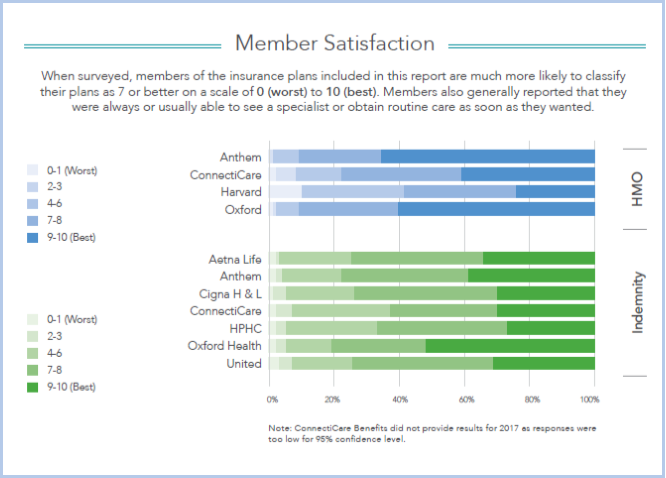
Customers surveyed said they were always or usually able to see a specialist or get routine care as soon as they wanted.  The enrollment breakdown in Connecticut is lopsided.  Among HMO's, Anthem has 81% of the market, ConnectiCare 17%, Oxford 2%.  Among indemnity enrollments, Anthem has 42%, followed by Aetna's 20%, CIGNA's 19%, United's 7% and ConnectiCare's 5%.

The report card, issued this fall,  includes “terms” that consumers should know, a series of frequently asked questions and answers, and results of a member satisfaction survey for HMO’s Anthem, ConnectiCare, Harvard Pilgrim and Oxford Health.  Indemnity insurers Aetna Life, Anthem, CIGNA, ConnectiCare, Harvard Pilgrim, United Health and Oxford Health also had members surveyed on a range of “satisfaction” queries.

This report includes three years of data, where available, to be informative for consumers, officials said.  The data utilized was through 2017.

The mission of the Connecticut Insurance Department is to protect consumers through regulation of the industry, outreach, education and advocacy. The Department recovers an average of $4 million yearly on behalf of consumers, according to officials, and regulates the industry by ensuring carriers adhere to state insurance laws and regulations and are financially solvent to pay claims.

Each year, the Department returns an average of $100 million a year to the state General Fund in license fees, premium taxes, fines and other revenue sources to support various state programs, including childhood immunization. The Department’s annual budget is funded through assessments from the insurance industry.

Individuals with questions or seeking further information may contact the Department at  insurance@ct.gov or 860-297-3900.

Most Expensive States for Car Insurance? CT Ranks Fifth in Survey of 50 States

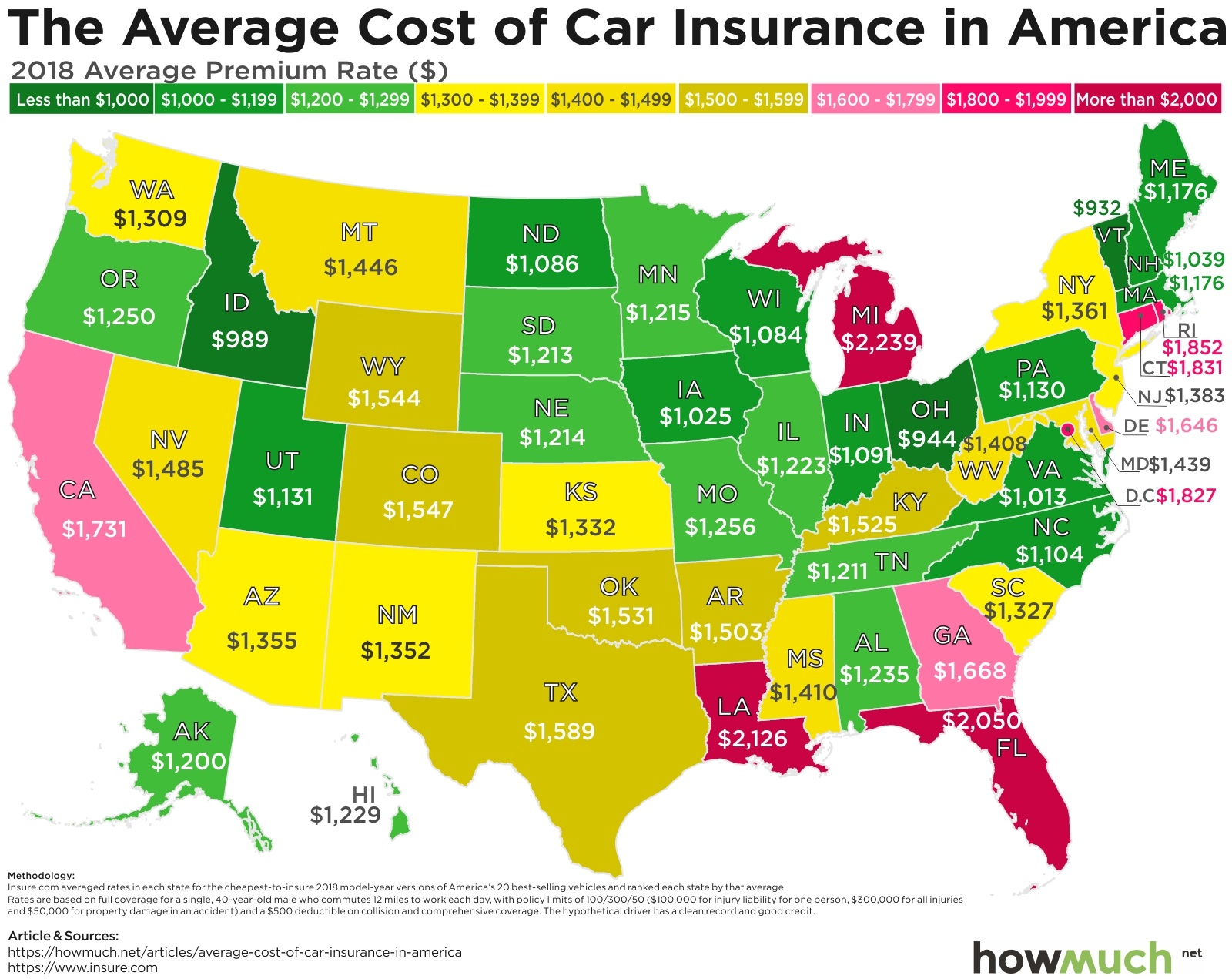
Connecticut is fifth, but Michigan has been first for five consecutive years in an annual comparison of car insurance rates.  Connecticut is 34 percent more expensive than the national average, according to the criteria used in the state-to-state comparison. When the website insure.com looked to compare car insurance rates, they worked with Quadrant Information Services to calculate car insurance rates for a 40-year old man seeking full coverage from six different major carriers. They tabulated the price quoted in 10 zip codes for every state, looking for the average of a 2018 model-year version of America’s 20 best-selling vehicles.

Their finding: car insurance rates can vary widely depending on the state you call home, and numerous other factors. Connecticut was near the top – in the middle of the top ten most expensive states for car insurance, based on this criteria.  A year ago, Connecticut ranked third.

The website’s analysis pointed out that high vehicle density is one culprit for higher than average premiums. They noted that Connecticut is the fourth densest state in the country and “tons of cars piled into a small space leads to accidents, which leads to claims, which ends in high car insurance rates.”

The top five states with the highest rates were Michigan ($2,239), Louisiana ($2,126), Florida ($2,050), Rhode Island ($1,852) and Connecticut ($1,831).  Rounding out the top ten most expensive states for car insurance, according to the survey, were Washington DC ($1,827), California (1,731), Georgia ($1,668), Delaware ($1,600), and Texas ($1,589).

Across the Northeast, Vermont ranks lowest in the entire country at just $932.  New Hampshire was also among the lowest, at $1,039.  Massachusetts ranked number 38, with an annual premium of $1,176.

Hartford Surges into Top 50 Cities to Start a Business

Hartford is surging.  So says Inc. magazine, in the latest ranking of the leading “Surge Cities” in the U.S. – the 50 Best Places in America for Starting a Business.  Of Hartford, which ranked number 46, the publication said “Hartford gets its groove back by doubling down on manufacturing--and social impact startups.” Hartford ranked just ahead of Memphis, Cleveland, Virginia Beach and Buffalo in rounding out the top 50.  Leading the list were Austin, Salt Lake City, Raleigh, Nashville, San Francisco, San Jose, San Diego, Denver, Orlando and Portland.

Inc. pointed out that “Despite years of state budgetary woes, the Hartford area is on an upswing--thanks, in part, to a rebound in manufacturing. Aerospace company Pratt & Whitney can't keep up with jet engine orders, and Otis Elevator does over $12.3 billion in net sales.”  They went on to highlight what’s new: “Pioneering accelerator ReSet, which has a social impact focus, has graduated 100 area companies over the past five years. Toolmaker Stanley Black & Decker recently launched a manufacturing accelerator with Techstars. And Hartford--the ‘insurance capital of the world’--was named one of the state's four Innovations Places, making it eligible for $2 million in matching funds, part of which it's putting toward an accelerator aimed at insurance startups.”

Among the criteria in the analysis, and Hartford’s ranking:  rate of entrepreneurship (38), high-growth company density (48), net business creation (35), early-stage funding deals (35) and wage growth (21).

Elsewhere in New England, Boston ranked number 15; Providence was number 44.