Cultural and Historic Sites Receive $3 Million in Waning Weeks of Malloy Administration

Aimed at small to medium-sized cultural organizations seeking funding for “collaborative projects which demonstrate a clear vision of how individual sites and organizations can effectively tie together local, regional or statewide cultural assets,” the Good to Great grant program was created in 2014 during the administration of former Governor Dannel Malloy to “go beyond basic facilities repair or expansion to support projects that tell the stories of our cultural and historic sites in engaging, meaningful and relevant ways.” The final round of grants – unless the program is renewed by the Lamont administration – were announced less than three weeks prior to the change in gubernatorial leadership.   The Connecticut Department of Economic and Community Development (DECD) announced $3,051,971 in grants to 12 nonprofit organizations through the program in late December.
The grants may be used for capital projects that address the rehabilitation and/or adaptive re-use of existing facilities that will transform the visitor experience, site work associated with rehabilitation projects or additions, rehabilitation of historic landscapes, or protection and/or interpretation of archaeological sites.  Other appropriate uses include artists’ fees, conservator fees, construction costs, ADA accessibility, evaluation services and documentation and exhibit scripts, fabrication and installation to complement capital improvement.

The grants range between $50,000 and $150,000 and require a 25 percent cash match; grantees will have two years from date of grant contract to complete the funded project.  Applicants for the state grant must be a Connecticut 501(c)(3) or 501(c)(13) organization that owns, operates and/or sponsors a cultural venue or historic site in Connecticut with an average annual income of $500,000 or less.

The just under-the-wire recipients:

  • The New England Carousel Museum in Bristol was awarded $150,000 to install a new energy-efficient, air-handling system with humidity control to protect the Museum's collection and improve the visitors' experience.
  • The Connecticut Electric Railway Association (aka The Connecticut Trolley Museum) in East Windsor was awarded $50,000 to complete the on-going restoration of one of theMuseum's most historically significant trolleys - Connecticut Company Car #3001.
  • The Friends of the Pinney House, Inc. in Ellington was awarded $150,000 for the interior restoration of the Pinney House so it can be used as a cultural center, a meeting place and an education site.
  • Ebony Horsewomen Inc. in Hartford was awarded $50,000 to erect a pre-fab barn building to create a meeting & classroom space and a mini Black Cowboy Museum.
  • The Madison Historical Society was awarded $138,600 for the restoration and preservation of the interior of Lee's Academy and to create an ADA-compatible learning and community center.
  • The Denison Society, Inc. (aka Denison Homestead) in Mystic was awarded $150,000 to restore the Homestead's barn so that it may provide areas for programs, workshops and community events.
  • The Norfolk Historical Society was awarded $60,546 to redesign the welcome/reception area, reinterpret gallery space and reclaim research space.
  • The Keeler Tavern Preservation Society, Inc. (aka Keeler Tavern Museum & History Center) in Ridgefield was awarded $96,575 for facility improvements (climate controlled, fire-protected, well-designed storage) for its most fragile objects that relate directly to major moments in U.S. history.
  • The Stonington Historical Society (aka Old Lighthouse Museum) was awarded $56,250 for a comprehensive research effort and the commission of an archeological survey of a potential Venture Smith site; creation of a permanent Venture Smith and slavery exhibit at Old Lighthouse Museum.
  • The Ward Heitmann House Museum Foundation, Inc. (aka Ward Heitmann House Museum) in West Haven was awarded $150,000 to repair the foundation and exterior along with period appropriate landscaping so the House can reopen its doors to the public.
  • The Eastern Connecticut Center for History, Art and Performance (aka EC-CHAP) in Willington was awarded $1,000,000 to preserve and rehabilitate two secondary buildings for use again as an in-residence artist and a café and conduct a water mitigation plan for the main structure.
  • The Mary & Eliza Freeman Center for History and Community in Bridgeport was awarded $1,000,000 for the exterior restoration of both structures, as well as the interior restoration of the Eliza Freeman House.

The grant award recipients constituted the final announcement of 2018 by the state Department of Economic and Community Development.  Nineteen days later, Gov. Lamont took the oath of office.  He is expected to announce the department's new leadership and management structure in the coming days.


Foundation Raises $1 Million in 2018 in Support of Next Generation of Mental Health Care Professionals

The Quell Foundation seeks to reduce number of suicides, overdoses, and incarcerations of people living with a mental illness.  The Massachusetts-based nonprofit organization, which spent some time in Connecticut in 2018, continues to impact lives across the country, raising over one million dollars last year toward their mission to remove the stigma of mental health and to fund the next generation of mental health care professionals. The Foundation came to the Wadsworth Atheneum in May to show a new documentary, Lift the Mask, which featured the first-person stories of individuals impacted by suicide.  Among those featured in the film was a Vice President at Aetna and a recent college graduate from Middletown. It was the first time the documentary was shown outside a college campus.  It was also shown at the University of Connecticut in September.

Following the film's showing in Hartford, a panel discussion was held before a packed auditorium, featuring both the Aetna executive and the former Middletown resident and her parents, who movingly told the story of their brother/son’s suicide.

“The generous support of our sponsors and individual donors is overwhelming,” said The Quell Foundation CEO, Kevin Lynch. “This outstanding growth comes to us at a pivotal time for mental health in America and our journey as an organization. We are deeply grateful and look forward to continuing our work in the years to come.”  Lynch’s wife, Karen, is Executive Vice President of CVS Health and was recently named President of the Aetna Business Unit following the company’s merger.

The Foundation awards scholarships to students living with the challenges that come with having a mental health diagnosis, students who have endured the loss of a parent or sibling to suicide, and to students pursuing a career in the mental health field.  Lynch and his team have distributed over $835,000 to young adults representing forty states and 118 colleges across the country since the Foundation’s establishment in 2015.

“The scholarship program is one of the most important tools we have in normalizing the conversation around mental health while also addressing the dearth of mental health providers,” said Lynch. “We are developing a pipeline of professionals to offset the aging population and high-demand of mental health care providers we have in this country.”

The Quell Foundation works to reduce the number of suicides, overdoses, and incarcerations of people with mental illness by encouraging people to share their story, increasing access to mental health services, and supporting first responders in recognizing the mental health warning signs among their own.

“The Quell Foundation’s Bridge the Gap award to students pursuing degrees in the mental health care field are most strongly facilitated through The Quell Foundation’s long-term partnerships,” said Renee Wilk, Executive Director of The Quell Foundation. “We invest in their students and the unique, mental health, degree-awarding programs offered at these institutions to promote and sustain workforce development in this critical space.”

The Quell Foundation is currently accepting applications for the 2019-2020 scholarship cycle.

CT Insurance Department Recovers $7.8 Million for Policyholders, Taxpayers in 2018, Up $1 Million

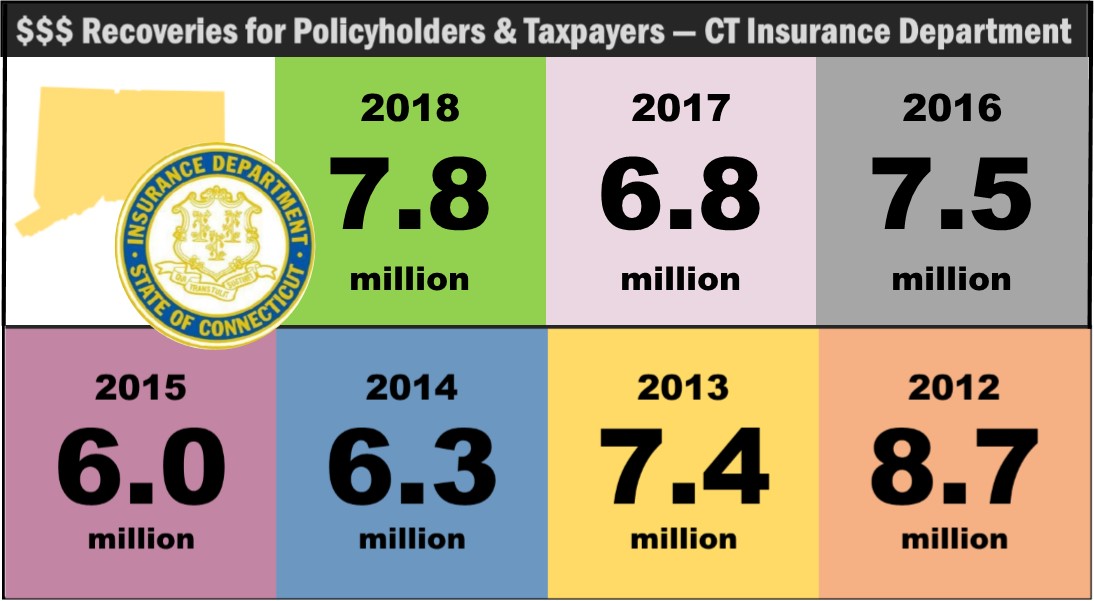
The Connecticut Insurance Department recovered $7.8 million for policyholders and taxpayers in 2018, helping individuals, families and employers with their claims and complaints, according to department officials. The Department’s Consumer Affairs Unit (CAU) fielded 6,350 complaints and inquiries in 2018 and helped policyholders recoup more than $5.5 million during the calendar year. In addition, the Department’s Market Conduct Division levied approximately $2.3 million in fines against carriers and returned that money to the state’s General Fund.  Both financial results are up from a year ago.

“The Department’s Consumer Affairs staff helps thousands of consumers each year with their questions and concerns about their insurance and makes certain that companies are compliant with all state insurance laws and regulations,” Acting Commissioner Paul Lombardo said.

In comparison, during 2017 CAU fielded 5,800 complaints and inquiries and helped policyholders recoup nearly $4.8 million.  The Department’s Market Conduct Division levied approximately $2 million in fines.  The Department’s fines result from a variety of violations and settlements ranging from untimely claim payments to improper licensing. The Market Conduct enforcement actions are posted on the Department’s Web site at www.ct.gov/cid

The majority of the funds recovered during 2018 for policyholders stemmed from complaints over health, accident, homeowners and life and annuities policies. The breakdown of funds recovered:

  • Accident, Health - $2.3 million
  • Auto - $1.5 million
  • General Liability - $30,000
  • Homeowners and Commercial Property - $1.13 million
  • Life, Annuities - $523,000
  • Miscellaneous - $37,000

Recoveries in the area of Homeowners and Commercial Property more than tripled, going from $344,600 in 2017 to $1.13 million in 2018.

The Department calculates its consumer recoveries based on what the policyholder received as a result of the Department’s intervention. The inquiries and complaints also help the Department identify industry trends that may adversely affect consumers and trigger investigation by the Market Conduct division.

In 2017, the state Insurance Department recovered $6.8 million for policyholders and taxpayers.   That was a slight drop from the previous year, when it recouped $7.5 million in 2016.   and approximately $6 million in 2015.  In previous years, the department recaptured $6 million in 2015, reached a recent high of $8.7 million in 2012, $7.4 million in 2013 and $6.3 million in 2014.

Complaint data also help determine topics for consumer education and serve as tools to help the Department monitor the industry, officials noted.

The mission of the Connecticut Insurance Department is to protect consumers through regulation of the industry, outreach, education and advocacy. The Department’s annual budget is funded through assessments from the insurance industry.


One-Third of Connecticut Legislators are Women, Reversing State Trend, Ranking 14th in U.S.

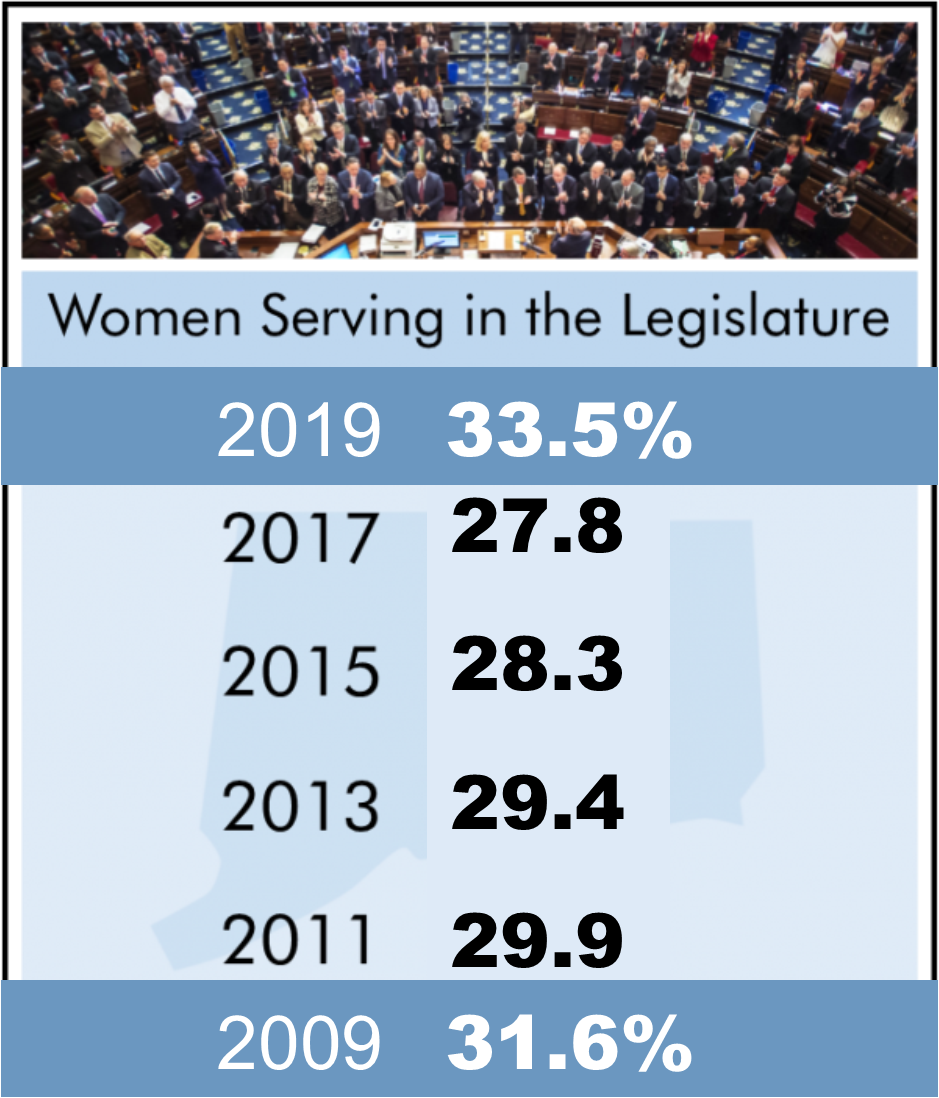
As the new Connecticut legislative session gets underway, 33.5 percent of lawmakers are women, the 14th highest percentage among the states.  The Connecticut legislature now includes 61 women, apparently the high water mark in state history, and exceeding the national average among the states of 28.5 percent. In the Senate, there are currently 9 women out of 33 members.  Eight of the nine are Democrats.  In the House, which currently has 149 members, 29 are Democrats and 22 are Republicans.

Connecticut’s 33.5 percent is from 182 seats, with five vacancies to be filled in special elections on February 26.  Candidates for those seats have not all been selected.

The ranks of women dropped by two in the Senate between Election Day and Opening Day of the legislative session, with former Senators Terry Gerratana of New Britain and Beth Bye of West Hartford accepting positions in the Lamont Administration and not taking the oath of office for a new legislative term.  Two male House members and a male Senate member also did not take their oaths of office in order to join the administration.

Nearly one-third of the women in the legislature this year - 20 of the 61 female legislators - are in their first term in the General Assembly.  Last year, women represented just over 27 percent of the legislature’s membership.

The 2018 election marked a slight comeback for Connecticut in terms of female representation.

Prior to this year, the state had fallen from ranking 8th to 19th during the past decade in the percentage of women serving in the legislature, with the percentage dropping from 31.6% as recently as 2009, according to the National Conference of State Legislatures. Connecticut’s 2009 legislature included 59 women, 31.6 percent of the membership, the 8th highest percentage among the states. In 2011, there were 56 women, 29.9 percent.

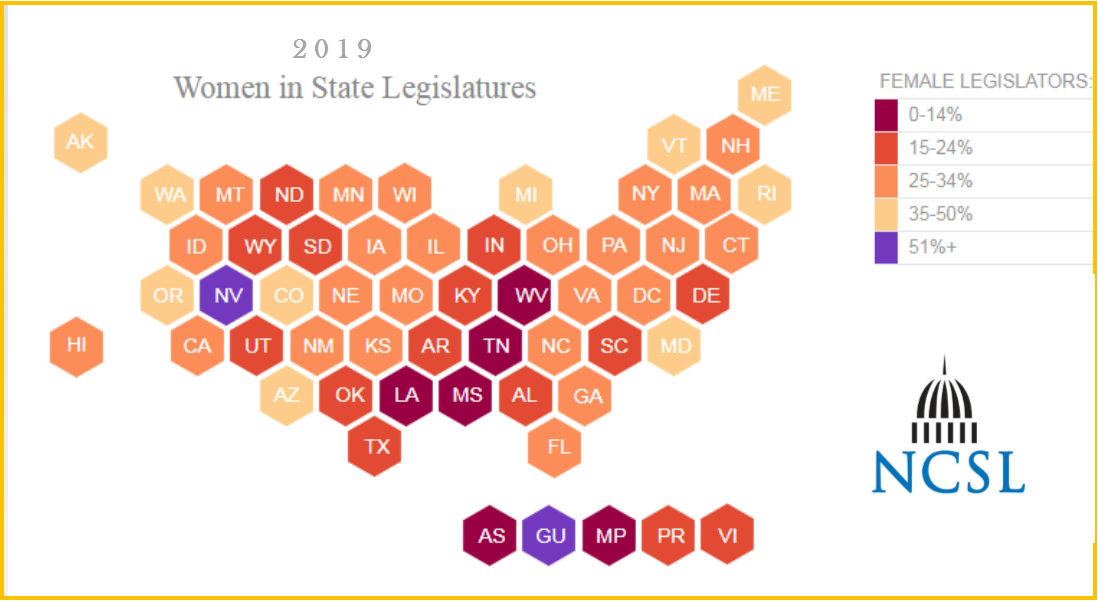
For their 2019 legislative sessions, the states with the largest contingent of female legislators are Nevada 50.8%, Colorado 47%, Oregon 41.1%, Washington 40.1%, Vermont 39.4%, Arizona 38.9%, Alaska 38.3%, Maine 38.2%, Maryland 37.8%, Rhode Island 37.2%, Illinois 36.2%, Michigan 35.8% and New Mexico 34.8%.  As with Connecticut, the numbers in other states may vary slightly due to resignations or elected legislators opting not to serve.

Nationally, women hold 2,110 of 7,383 state legislative seats.  Democrats hold more than twice as many – 1,430 Democrats and 663 Republicans. That is an increase of more than 300 Democratic women and a drop of about 40 Republican women in state legislatures across the country compared with 2017, according to NCSL data.


Hartford Area CFA Charterholders Gather to Hear Economic Forecasts, Focus on Guiding Investors Through 2019

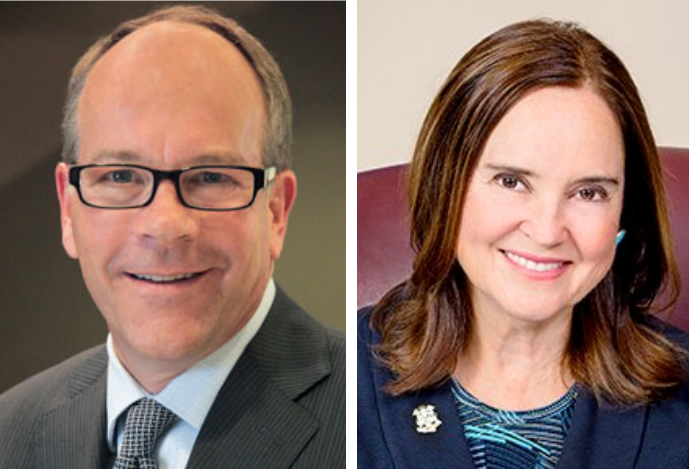
In the midst of tumultuous and uncertain economic times, hundreds of Connecticut’s leading investment and financial professionals will be gathering on Tuesday, Jan. 22 in Hartford to delve into the financial outlook for 2019 with one of the nation’s most respected economists, get an inside look at the state’s cybersecurity efforts to protect the integrity of the election process, and connect with industry peers from throughout the region. More than 400 professionals - CFA® members, investment professionals, personal investors, key decision-makers and college students - are expected.  They will hear from keynote speaker Brian Wesbury, Chief Economist of First Trust Advisors L.P., at the 2019 Annual Forecast Dinner hosted by CFA Society Hartford, the local chapter of the CFA Institute. Connecticut Secretary of the State Denise Merrill will offer comments on the future of voting security with “Election Cybersecurity: A Wake Up Call”.   It is the organization’s premier networking event of the year, being held at the Connecticut Convention Center.

The Hartford chapter is one of 151 local member societies of the CFA Institute, a worldwide organization and a respected source of knowledge in the global financial community. Hartford, with a long history of prominence in financial services – has one of the international organization’s oldest chapters, dating back to 1952. It is also one of the largest chapters outside of a major metropolitan area, with more than 700 members working in over 175 investment organizations, serving the Hartford and Springfield, MA region. There is another Connecticut chapter based in Stamford.

The CFA Institute is a global non-profit organization of investment professionals that distinguish themselves through their commitment to their clients and to the highest ethical and investment standards.  The Chartered Financial Analyst® designation, which has been described as the “industry gold standard,” requires passing one of the most rigorous series of exams in the financial industry to earn the credential.  Fewer than one in five candidates become CFA® charterholders.

“We strive to help advisers understand and anticipate stock market and economic changes to be able to provide the best guidance for their clients,” said Juliana Dalton, CFA, president of CFA Society Hartford.  Members include CFA® charterholders employed by leading financial services companies and those who are private wealth managers.  While many have been in the field for decades – providing much-needed expertise to a range of clients, particularly in turbulent economic times – CFA Society Hartford also continues to reach out to young professionals, as well as college students considering careers in the financial services industry.
In addition to the formal speaking program at the annual event, attendees can learn how the demanding CFA® Program provides a strong foundation of advanced investment analysis and real-world portfolio management skills that will provide a career advantage. Successful candidates for the CFA® designation take an average of four years to complete the program, which includes passing three exams sequentially and accumulating 48 months of approved work experience. Each exam level generally requires six months of preparation.

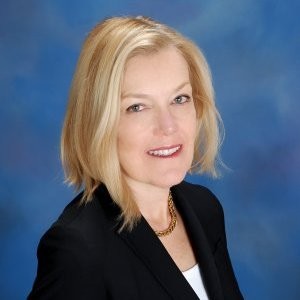
Dalton, Senior Vice President and Senior Credit Risk Manager at Webster Bank, analyzes credit risk across the organization. She will provide introductory remarks on Tuesday, and CFA Society Hartford Past-President Ray Bovich will introduce the keynote speaker as he shares “The Real News About the U.S. Economy”.

“For the past nine years, analysts have predicted apocalypse for the U.S. economy around every corner, but the strong market and economic recovery are both the longest ever,” commented Dalton.  The program will look ahead at what might be next.
For young members of the profession, applying technology to financial analysis can be particularly attractive. “Technology is all to the benefit,” Dalton explained, “as it helps to provide numbers-based and fact-based analysis. But people skills never go away.”  She noted that even with advancing technology – which is integrated throughout the industry – every client’s investment priorities differ, calling for a mix of people skills and technological know-how by CFA® charterholders.

The CFA Society Hartford chapter, in an effort to interest college students, has been running an annual Research Challenge for the past six years in conjunction with local colleges including the University of Connecticut and Trinity College.  Teams of college students analyze a particular company, and present a written report that is judged by local professionals.  The top three teams go on to make an oral presentation before industry practitioners, and the winning team has an opportunity to advance to national and international competition.  The program has grown in popularity, and although it is quite rigorous, is seen as an excellent educational opportunity and hands-on glimpse into the field. The 2018/2019 competition finals will be held next month.

The forecast dinner’s lead speakers will also provide insight.  Brian Wesbury is Chief Economist at First Trust Advisors L.P., a financial services firm based in Wheaton, Illinois. He has been a member of the Academic Advisory Council of the Federal Reserve Bank of Chicago since 1999. In 2012, he was named a Fellow of the George W. Bush Presidential Center. In 1995 and 1996, he served as Chief Economist for the Joint Economic Committee of the U.S. Congress, and has been ranked by the Wall Street Journal as the nation’s #1 U.S. economic forecaster (2001), and by USA Today as one of the nation’s top 10 forecasters (2004).  Denise Merrill was re-elected in 2018 to her third term as Secretary of the State of Connecticut, and is past president of the National Association of Secretaries of the State.  She previously served in the Connecticut House of Representatives.  Her office oversees elections and business data, among its responsibilities.


For more information about the Hartford chapter, visit www.hartfordcfa.org.  Gold Sponsors for the event include Hartford Investment Management Company (HIMCO), Virtus Investment Partners, Voya Investment Management, and INVESCO.  Individual seats are $110 for CFA® Society Hartford members and $145 for non-members.  There are more than 150,000 CFA® charter holders worldwide in 165+ countries and regions. CFA® and Chartered Financial Analyst® are registered trademarks owned by the CFA Institute.

Frontier Airlines Growth Continues with Return to Hartford and Boston in 2019

In the spring of 2012, Frontier Airlines discontinued service to Boston’s Logan International Airport, which consisted of a daily flight to Kansas City.  Frontier has flown out of Bradley International Airport in Windsor Locks in the past decade as well, with a Milwaukee flight that was discontinued in 2011 and service to Denver that ended in 2008. Now, they’re coming back to both New England airports, but they’re not headed to Milwaukee or Kansas City.  In a series of announcements in recent weeks, Frontier unveiled an expansion including eight-routes from North Carolina’s Raleigh/Durham airport.

Boston will become the 106th city on its route map with the addition. The other seven routes Frontier is launching from Raleigh/Durham include Albany, New York; Columbus, Ohio; Hartford (BDL); Jacksonville; Long Island/Islip, New York; and Philadelphia.

The added service continues a rapid ramp-up by Frontier in Raleigh/Durham (RDU). Once the new services begin, Frontier says it will offer either year-round or nonstop flights to 32 different cities from RDU.  Boston will have four weekly flights beginning May 1.  Bradley International will see three weekly flights beginning April 30.  Delta is a competitor in both markets.

[Why all the increased air traffic to North Carolina? Must be burgeoning interest in the Carolina Hurricanes since they put those Whalers jerseys back on the ice!]

Frontier also plans to launch service to Orlando from both Boston’s Logan Airport and Bradley International, and service to Denver from Bradley.  In making the announcement, Frontier pointed out that it “flies one of the youngest fleets in the industry, the Airbus A320 Family of more than 80 jet aircraft. With nearly 200 new planes on order, Frontier will continue to grow to deliver on the mission of providing affordable travel across America.”

In December, Frontier announced it was returning to Bradley with flights to Denver starting March 28, operating on Tuesdays, Thursdays and Sundays.  Southwest and United also fly from Bradley to Denver.

The Raleigh-Durham flights will operate on the same days of the week; the Orlando service will run on Wednesdays and Saturdays from Bradley.

Frontier’s service from Bradley to Raleigh-Durham, Denver and Orlando is described as seasonal.  The services start this spring; the end dates for 2019 have not been announced.

Current pricing for roundtrip flights in May:  from $78 to Raleigh/Durham and Orlando, from $118 to Denver, depending upon length of stay and day of the week of selected flights.

Frontier will be Bradley’s ninth passenger airline.  Other carriers are Aer Lingus, Air Canada, American Airlines, Delta Air Lines, JetBlue, Southwest, Spirit and United.  Some of those airlines’ flights from BDL are operated by regional affiliates flying under brands like American Eagle, Delta Connection and United Express.

The tenth carrier at BDL will be Via Airlines, which will operate flights to Pittsburgh four times a week, year-round, on Mondays, Tuesdays, Wednesdays, and Fridays beginning in July.  That announcement also came earlier this month.

Frontier announced last week that the airline and its pilots, represented by the Air Line Pilots Association, Int’l (ALPA), ratified a new five-year working agreement. Of the 99 percent of pilots who voted, 77 percent cast ballots in favor of the agreement, the company said.

Trump Told Coast Guard Academy “Things Happen to You That You Do Not Deserve;” Without Paychecks, They’re Now at Food Pantry

Twenty months ago, addressing the graduating class of the Coast Guard Academy in New London and their families, President Donald Trump said: “I hope you feel the full gratitude of our nation… Cadets, you deserve not only the congratulations but the gratitude of each and every American, and we all salute you.” He also noted that “this class has been exceptionally dedicated to public service. You served breakfast at the local food bank every single weekday.”

Now, the tables have turned.  It is members of the Coast Guard and their families that are lining up at a local food pantry to receive – rather than distribute - donated food.

Because the Coast Guard is part of the Department of Homeland Security, one of the federal government agencies subject to the now more than three-week old shutdown, paychecks have ceased and putting food on the table has become the latest challenge.

Adm. Karl Schultz said in a letter to the Coast Guard's 42,000 members this week that the lapse in pay marks the first time to his knowledge that U.S. Armed Forces service members have not been paid because of a shutdown. Other military branches fall under the Department of Defense, which is not affected by the shutdown.

Published reports indicate that the southeastern Connecticut chapter of the Coast Guard Chief Petty Officers Association, the Coast Guard Enlisted Association of Southeastern Connecticut and the Coast Guard Spouses' Association of Southeastern Connecticut, set up the pantry at the Academy, providing items including food, diapers, household items and pet supplies.

Connecticut Senator Richard Blumenthal has said he will advocate for legislation that would authorize paying the Coast Guard, even as the government shutdown continues.

President Trump members of the Coast Guard in May 2017 that “you will face many challenges and many threats, but one thing you will never have to face is that question of what will I do. When you look back, you won’t doubt.”  He added, “Over the course of your life, you will find that things are not always fair. You will find that things happen to you that you do not deserve and that are not always warranted.”

Trump also told that graduates that “you have to learn how to act under great, great pressure. You’re all going to be under great pressure. You have to learn how to respond and to act under great pressure.”


State Office of Early Childhood Welcomes Bye with $8.5 Million from Feds

The Connecticut Office of Early Childhood (OEC) has announced what amounts to a welcome gift for its incoming leader, former State Senator Beth Bye, named by Gov. Lamont two weeks ago to head the state agency.  Just days ahead of Lamont’s inauguration, OEC said it had been awarded an $8,591,087 federal grant - funds intended to enable the state to design and launch better, more cost-effective systems serving families with young children. The most anticipated federal early childhood initiative in years, according to OEC officials, the new Preschool Development Grant program was highly competitive. Connecticut is a national leader among states in both grant size and per capita funding, officials indicated. 

“This new grant will allow Connecticut to build on our nation-leading efforts, giving OEC new resources to work across agencies and increase impact for children and families,” former Gov. Dannel Malloy said as the grant was announced, in the final days of his administration. Connecticut was selected to receive one of the nation’s largest awards by the two federal agencies administering the grant, the Department of Health and Human Services and the Department of Education. Among the largest state recipients, no state received more funding per target family than Connecticut.

Bye will begin serving as the Commissioner-designate later this month. Her nomination will be sent to the General Assembly for confirmation.  Earlier in her career, Bye was director of the University of Saint Joseph School for Young Children and Trinity College Community Child Center preschools, and was early childhood director at the Capitol Region Education Council (CREC), where she supervised the birth to three program for CREC, and also helped to open two early childhood magnet schools.  She was later elected to the Board of Education in West Hartford, then to the State House and State Senate.  Reelected last fall, she did not take the oath of office last week in order to accept Lamont’s offer to lead the agency.

“Beth Bye has devoted her entire professional career to helping to build a more progressive and equitable early childhood system in which all children, regardless of their parent’s socioeconomic status, can grow, learn and develop,” said Lamont. “It’s clear that the formative early childhood years are key to providing children a solid educational base and platform, and I know Beth is the best person to take helm of this critical agency.”

Her soon-to-be-predecessor, David Wilkinson, said “Connecticut punched well above its weight on this grant. That’s because its goals are in our DNA. OEC’s enabling legislation calls on us to be data driven, to be outcomes accountable, and to support the whole family by working across government silos. We’ve been delivering on that mission, but no agency can do those things alone. What’s exciting here is that these resources will allow the next administration to build a smart, collaborative infrastructure across agencies – one that better supports young children and families, reducing redundancies and focusing on shared goals for family success.”

Unlike a previous iteration of this federal grant program – which focused on expanding preschool for four year-olds – the new grant focuses on child success from to zero to five, with an emphasis on infants and toddlers. Further, officials said, it calls on states to look beyond the classroom to broader measures of child and family success, including mental and physical health, family stability, and parental employment. Because such considerations involve multiple agencies, it calls on states to advance a cross-system data and performance infrastructure, asking them to cost-effectively implement new solutions with an emphasis on measurable outcomes.

With this new grant, federal authorities call on states to improve measurable outcomes for children and families and to more efficiently use federal and state resources. The grant program asks states to do this by planning and building more coordinated systems, deploying resources to:

  • Better link families to the full range of services they need, aligning and improving coordination among existing agencies and programs while blending and braiding funds for better efficiencies
  • Advance an infrastructure for data sharing across the silos of government to better support families
  • Design and implement a performance management approach focused on measurable child and family outcomes
  • Develop and implement evidence-based practices to cost effectively improve child and family outcomes
  • Investing in the cross agency, digital infrastructure to support all of the above

Established in 2014 with bi-partisan support and at the urging of Gov. Malloy, Sen. Bye and colleagues, the  Connecticut  Office  of  Early  Childhood  advances  a  family-centered  approach  to support young children  and families. Integrating early childhood programming formerly administered by five separate state agencies, OEC serves children each year through programs including child care, preschool, home visiting, health and safety assurance, early intervention and parenting supports.