Overwhelming Support Spells Defeat for Creation of Social Benefit Businesses in CT

Despite being introduced with the backing of Governor Malloy, overwhelming support in the House of Representatives where it passed by a lopsided 128-12 on May 20, and co-sponsorship by the legislature’s four top leaders, legislation establishing the “benefit corporation” as a new type of corporate entity never came up for a vote in the State Senate.  And thus it died when the legislative session ended on Wednesday.

“Despite a great deal of effort, we lost. It is a sad day for Connecticut that we couldn't get something so unequivocally positive done. I personally find it hard not to be disheartened by the whole process, but I guess that's politics,” said Kate Emery, founder and CEO of reSET, the Social Enterprise Trust.

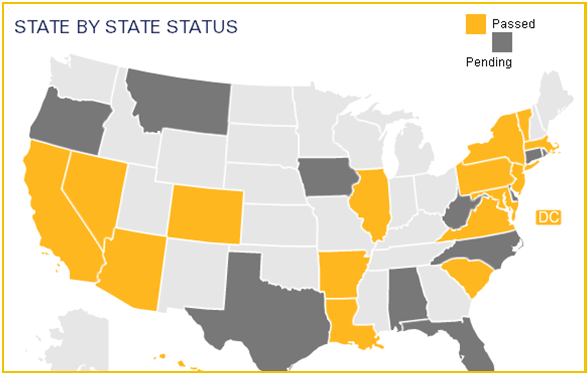
Similar legislation has already been passed and signed into law in California, Hawaii, Illinois, Louisiana, Massachusetts, Maryland, New Jersey, Pennsylvania, South Carolina, Vermont, and Virginia. It is pending in nine other states.

The bill (HB 6356) would have allowed businesses to legally incorporate as benefit corporations in Connecticut and was described as the most comprehensive piece of social enterprise legislation ever proposed in the United States.  It was designed to help social entrepreneurs protect their organization’s social mission, and provide a transparent, accessible, and simple mechanism for defining their business’s social goals.  Supporters said the legislation would also help drive job creation and increase the number of community-based partners benefit corpcommitted to solving some of Connecticut’s most pressing social issues without requiring additional state funding.
Here’s how Hartford Courant business editor Dan Haar described the bill in a column the day prior to legislative adjournment:  “The bill has few if any opponents, it would make it easier for private firms to do some good in the world and it wouldn’t cost the state any money (okay $62,000, once, to reprogram the computers).

Firms organized this way, known as type-B corporations, would have a stated social goal beyond profits for the owners — public health, perhaps, or promoting the arts or restoring the environment or creating economic opportunity for disadvantaged people. It’s the kind of stuff nonprofits tend to do, but allowing for-profit companies to set up with a social purpose simply adds an avenue.”

The bill not only required benefit corporations to publicly state their social mission within the business’s articles of incorporation, but it also would have created a culture of accountability within Connecticut’s social enterprise community by requiring that those businesses publish an annual benefit report detailing the public benefit that they have actually created, and make that information publicly available on their website.

It also would have given owners of social enterprises the option of locking in their commitment to the social mission that their business is designed to serve by electing to adopt its legacy preservation clause after a waiting period of two years. This would allow shareholders to ensure that their commitment to the creation of public good is maintained, even if ownership of that company changes over time.  But it was not to be.

“We did everything we could possibly do and we had a lot of great people working very hard to make it happen,” Emery said in an email to supporters of reSET across the state.  “It was a well fought battle and sooner or later we'll get it passed but for now we will have to take heart in knowing we did all we could.”

The broad coalition of supporters – all of whom submitted testimony during a public hearing on the bill -  included AARP, the Connecticut Association of Nonprofits, the Connecticut Conference of Independent Colleges and AT&T.  As Haar noted this week, Connecticut Innovations, the state’s technology investment arm, and the state Department of Economic and Community Development both supported it actively.  The Connecticut Bar Association, which opposed a similar bill last year, also supported this year’s revised version.

Benefit Corporations are a new class of corporation that 1) creates a material positive impact on society and the environment; 2) expands fiduciary duty to require consideration of non-financial interests when making decisions; and 3) reports on its overall social and environmental performance using recognized third party standards.

In her public hearing testimony, state Economic and Community Development Commissioner Catherine Smith said Connecticut “is poised to realize many benefits” from passage of the bill, which would “leave a lasting social and financial impact on our state for years to come.”


Increasing International Exports is Key to State's Economic Development Plan

A recent update on Connecticut’s Economic Development Strategy includes a strong focus on international economic development, including upcoming efforts to extend business in Israel, Canada and France as part of broader plans to strengthen Connecticut’s brand in the global markets and grow the state’s trade footprint abroad.

As described by Beatriz Gutierrez, director of international business development efforts at the state Department of Economic and Community Development (DECD), the department’s vision is “to position Connecticut as the destination of choice for companies looking to establish North American presence with preference to those in the areas of bioscience, precision manufacturing, fuel cells and renewable, and those looking to establish North American headquarters.”

The primary geographic targets for the state are China (which Gov. Malloy visited last year and Secretary of the State Denise Merrill visited last month), Germany and Western Europe (including the Paris Air Show this month), Israel (a CT-Israel Tech Summit will be held in Connecticut on June 12), and Brazil.  Goals include developing an international brand for the state, building an “opportunity pipeline,” and strengthening the relationship management process.

Meetings have been held with more than 50 companies and cluster associations in key industry segments, and a “concierge” program has been introduced in Europe.  During fiscal year 2012, DECD assisted in business exports to 39 countries for 62 state coCT boothmpanies, according to the DECD update.  The total assisted value of $548.6 million would equate to 2,785 jobs, according to DECD.  The department’s presentation added that unreported dollar amounts could account for “another 300 to 400 jobs, or more.”

The state has also been working closely with the U.S. Small Business Administration on international business growth, including the State Trade and Export Promotion (STEP) program.  Among the initiatives in Connecticut are a SBA pilot-grant to help small businesses increase exports, and efforts to assist businesses with participation in regional and industry focused export opportunities and international business development opportunities. Connecticut received grant awards of $546,822 in the first year and $339,319 in the second year, supporting 178 Connecticut companies with partial reimbursements for international business initiatives.

At a trade show in Hannover, Germany in April, for example, the state’s booth featured five Connecticut hydrogen and fuel cell companies, which officials say produced strong leads from both Germany and Canada. Later this month, Connecticut will have a presence at the Hydrogen + Fuel Cells Conference in Vancouver, with three state companies on hand, and at the Paris Air Show in Le Bourget, with 13 companies slated to be present at Connecticut’s booth.  It is the state’s eighth consecutive year at the air show, and $162 million in new business has been reported by the companies who exhibit under the Connecticut display umbrella.

Earlier this year, DECD reported that Connecticut is home to “691 foreign affiliates” employing 106,500 in the state.  At the time, exports were said to exceed $16 billion annually. More recent data indicate that exports dropped about two percent between FY 2011 and FY2012, from $16.21 billion to $15.86 billion.  Next steps outlined by the state in the May 22, 2013 update include implementing a statewide international activity scorecard, monitoring global trends and identifying potential “sweet spots,” and strengthening strategic partnerships.

Rebranding of Tweed-New Haven Seen as Key to Airport Growth

For a time, it seemed as if Tweed-New Haven Airport would be handling flights without the benefit of air traffic controllers.  That altered state of reality was averted – at least for the time being – when Congress intervened, after federal sequestration budget cuts called for eliminating the control tower personnel this spring.

But at a news conference earlier this month, members of Connecticut’s Congressional delegation stressed that Tweed-New Haven and other regional airports are not out of the woods yet. That means the facility needs to more aggressively state its case – to lawmakers and the public.  Which is precisely what’s being done, with a reinvigorated public information effort including a recently developed website and logo.Tweed

Last July, officials at Tweed launched a new user-friendly website to meet the needs of its expanding customer base. The new website www.flytweed.com makes it easier to price and track flights throughout the world. In addition to the website, a new logo was created and Tweed mobile applications were launched.

The initiative to refresh the airport's identity and branding online was aimed at changing travelers' search habits, placing the airport's code ("HVN") into prominence as the first step at accomplishing that goal.  The tagline “Southern Connecticut’s Airport” is also featured with the revised logo.  The airport is served several times a day by US Airways Express, through connecting flights via Philadelphia to over 130 national or international destinations.

A report issued last year indicated that more airline passengers flew out of Tweed in 2011 than in 10 of the previous 11 years – including a jump of 11% in 2011 over 2010. Figures for 2012 were not immediately available.  Total 2011 departures exceeded the average annual number of departures over the last 12 years by a strong 24%.   It also marked the third consecutive annual increase in the number of passengers flying from Tweed.

In addition to Tweed, the six airports that would have been impacted by the federal cuts include Hartford’s Brainard Airport and the airports in Danbury, Bridgeport, Groton-New London, Waterbury.

Officials have pointed out that with competitive fares, convenient parking and easy access from downtown New Haven and I-95, Tweed’s popularity has grown  from a decade ago. The growth also reflects thedestination_banner-938x333-938x333 increasing vitality of the New Haven business community, reflected in a growing and vibrant retail community and greater demand for residential space in the city. Airport officials have said they will continue working with airline representatives to  seek additional service and destinations.

Million Dollar Packages Routine Atop Connecticut Hospitals, CEO’s Receive Highest Pay at 26 of 30

Newly released data from the state Office of Health Care Access, which regulates hospitals in Connecticut, reflects that 18 Connecticut hospital executives received pay packages of over $1 million during fiscal year 2012.

Leading the top-compensated list – and exceeding $1.5 million in total compensation for their highest paid individual staff member - were William Backus Hospital ($3.4 million), Hartford Hospital ($3.3. million), and Yale- New Haven Hospital ($2.8 million).

In addition to the top three, there were seven other hospitals where the highest compensated official received a pay package exceeding one million dollars during FY2012.  Rounding out the top ten were officials at  Greenwich Hospital ($1.5 million), Saint Francis Hospital & Medical Center ($1.5 million), Stamford Hospital ($1.5 million), Hospital of Central CT ($1.5 million), Bridgeport Hospital ($1.1 million), Hospital of Saint Rafael ($1.8 million), and Middlesex Hospital ($1 million).

An analysis by Connecticut by the Numbers indicates that the top salary and benefit package at all but four of the state’s 30 hospitals went to top administrators, usually the President or CEO.  The exceptions included  Hospital signNew Milford Hospital, where the president’s total package ranked 5th and a lab physician led the list;  at Charlotte Hungerford Hospital, where the CEO also ranked 5th and a physician surgeon ranked first, and at Rockville General Hospital which was led by the Medical Director, with the CEO placing third in the salary hierarchy.    At Windham Community Memorial Hospital, the top administrator – the Vice President of Operations – placed 7th in salary and fringe benefits amongst hospital leadership.

Only five hospitals in the state saw the top ranked individual receive less than half a million dollars in compensation.  The lowest was at  Rockville General Hospital, where the Medical Director received $324,458, followed by Windham Community Memorial Hospital, where the top  Physician/Hospitalist earned $463,270, John Dempsey Hospital, where the CEO earned $477,518, New Milford Hospital, where the top package was $480,036 and Johnson Memorial Hospital, where the President’s pay package totaled $483,070.

The OHCA report did report the names of individual administrators, but listed the top 10 paid positions at the state's 30 acute care hospitals. The state's two largest hospitals—Hartford Hospital and Yale New Haven Hospital—each had four senior executives that received million-dollar plus pay packages last fiscal year, the Hartford Business Journal has reported, while Stamford Hospital had two administrators earn over $1 million.

The highest paid hospital executive in fiscal 2012 was the former president & CEO of William Backus Hospital, who received a total pay package of $3.4 million. That included $3.2 million in fringe benefits, the report said.  In addition, the President & CEO received compensation of $975,550 during the year.  The highest active paid hospital administrator was Hartford Hospital's vice president of academic affairs and chief academic officer, who received $3.4 million in compensation.

In 2007, there were seven hospital CEO’s earning in excess of $1 million in compensation, according to the Office of Legislative Research.  In fiscal year 2005, five of the top paid positions at the state’s 30 hospitals received more than $1 million, data from the Office of Legislative Research indicates – all of them CEO’s.

Hospitals are required to provide their top ten highest paid hospital positions annually to OHCA.  The full list for FY2012 is available on the OHCA website. The top salary at each hospital, according to the report:

Bridgeport Hospital, President & CEO: $1,101,139

Bristol Hospital, President & CEO: $605,526

Charlotte Hungerford Hospital, Physician Surgeon: $661,640

CT Children’s Medical Center, President & CEO : $748,347

Danbury Hospital, Chief Executive Officer: $955,838

Day Kimball Hospital, President & CEO: $514,375

Essent-Sharon Hospital, Chief Executive Officer: $736,907

Greenwich Hospital, President & CEO: $1,530,629

Griffin Hospital, Chief Executive Officer: $558,543

Hartford Hospital, VP, Academic Affairs & CAO: $3,351,507

Hospital of Saint Rafael, President  : $1,803,605

John Dempsey Hospital, CEO : $477,518

Johnson Memorial Hospital, President : $483,070

Lawrence and Memorial Hospital, President, CEO: $761,734

Manchester Memorial Hospital,CEO: $560,793

Middlesex Hospital, President/CEO:  $1,022,460

MidState Medical Center, President/CEO: $958,020

Milford Hospital, President: $579,475

New Milford Hospital, Lab-Physician: $480,036

Norwalk Hospital, President & CEO : $901,148

Rockville General Hospital, Medical Director:  $324,458

Saint Francis Hospital & Med Ctr., President: $1,521,090

Saint Mary’s Hospital, President & CEO: $791,256

Saint Vincent’s Medical Center, Chief Executive Officer:   $2,394,278

Stamford Hospital, President & CEO: $1,532,094

The Hospital of Central CT, President & CEO: $1,499,546

Waterbury Hospital, President: $520,298

William W. Backus Hospital, Former Pres. & CEO: $3,357,690

Windham Community Memorial Hospital, Physician/Hospitalist: $463,270

Yale-New Haven Hospital, President & CEO* : $2,803,228

*includes Yale-New Haven Hospital and Yale-New Haven Health System

Strategies to Advance Transit-Oriented Development Outlined by Coalition

Strategies including community engagement, placemaking, mixed-income housing, complete streets, parking configuration, green infrastructure and energy efficiency are outlined in a comprehensive 68-page “toolkit” focusing on opportunities to extend transit-oriented development in Connecticut, as the state moves forward with significant rail and bus initiatives.

 Working in partnership, Connecticut Fund for the Environment, Partnership for Strong Communities, Regional Plan Association and Tri-State Transportation Campaign have created a Transit-Oriented Development (TOD) Toolkit that highlights key strategies necessary for developing competitive and sustainable TOD in Connecticut.  The toolkit has been shared in recent weeks with interested officials  and organizations around the state, and discussed at two public forums in Bridgeport that brought together more than   80 municipal leaders from the region.TOD Toolkit

The document outlines the primary components of a TOD program that meets common community goals of strengthening town centers, supporting municipal budgets, expanding housing and commercial opportunities, and minimizing environmental impacts. Among the central components outlined:

  • The process and design for getting TOD built in a community, from developing a community vision and supportive zoning, to determining how accessible a station is for non-drivers.
  • The demographic trends that favor mixed-income, transit-accessible housing, the fiscal impacts of residential TOD, and mechanisms to include affordable housing within TOD development.
  • Complete Streets strategies that enhance streets and sidewalks to promote walking and biking to a station and to TOD built around it. Transit access, walking an bicycling, and the mix of uses in TOD mean that TOD districts require less parking than traditional development.
  • Best practices for managing parking, including parking maximums, shared parking, and transit incentives.  
  • Information and resources for incorporating green infrastructure and energy solutions in a community. Green infrastructure minimizes wastewater and pollutant impacts from development. Energy-efficiency, local energy generation and micro-grids help communities use less power and withstand disruptions to the regional energy supply. housing starts

Efforts are continuing by the organizations participating in the effort, and others pursuing a transit-oriented development agenda, to coordinate with key state agencies regarding strategies to move TOD forward in the state, especially along key transportation corridors.  Officials are working to secure funds for a new TOD position that would initially provide technical support to Meriden and other towns on the upcoming New Haven - Hartford - Springfield rail and CTfastrak bus lines and to develop a funding source to support financing and land acquisition for priority TOD sites.

 Transit-oriented development is described in the toolkit as “development that’s built to take advantage of the ability of people to access it with transit - a strategy for growth that produces less traffic and lessens impact on roads and highways.”  The overview also points out that “households located within walking distance of transit own fewer cars, drive less, and pay a smaller share of their income on transportation related expenses. Homes and businesses can be built with less parking, reducing the cost of development, making development more feasible in weak markets, and increasing local tax revenue.”


How Numbers Sound Can Create Misperceptions of Value, Study Finds

Harvard Business Review is featuring three-year old research by UConn marketing professor Robin A. Coulter that found people unconsciously associate certain letter sounds, such as the "s" and "i" in "sixty-six," with smallness and the "t" and "oo" of "twenty-two" with largeness, and these associations interfere with the accuracy of their quantitative perceptions.  Next time you hear an advertisement on tv or radio featuring a sale price, the findings would be good to keep in mind.

The  2010 study by Keith S. Coulter and Robin A. Coulter, “Small Sounds, Big Deals: Phonetic Symbolism Effects in Pricing” is receiving renewed attention as part of Harvard Business Review’s “Daily Stat,” an email newsletter sent to subscribers.  It was featured as the lead item on May 15, 2013.

The study findings, publishedLaw-of-Large-Numbers in the Journal of Consumer Research, pointed out that when sale prices are said in English, an $11.00 to $7.88 (28.4%) discount is perceived as greater than a $10.00 to $7.01 (29.9%) discount; however, when these same prices are said in Chinese, the latter discount is correctly perceived as greater.  So, the sounds of the language matter.

"Number sounds impact price magnitude perceptions only when consumers mentally rehearse a sale price, as they might do when comparing items on a shopping trip," Science Daily reported when their research was initially released. The study’s bottom line: the mere sounds of numbers can non-consciously affect and distort numerical magnitude perceptions.

Dr. Robin Coulter is Department Head and Professor of Marketing at the UConn School of Business. She teaches in the undergraduate, Executive M.B.A. and Ph.D. programs in the areas of consumer behavior, integrated marketing communications, and marketing management. Dr. Coulter’s research interests include cross-cultural consumer behavior, branding, advertising effects and effectiveness, pricing, and services marketing.  She has published in a variety of marketing and social science journals, and participated last month in the Geno Auriemma UConn Leadership Conference.

Keith Coulter is Associate Professor of Marketing at Clark University.  He is a UConn graduate, and was a visiting Assistant Professor at Eastern Connecticut State University in the ‘90’s

The study authors found that “small sounds can create the impression of big deals” and that number-sound effects were more likely to occur when a frame of reference (a regular price) was provided, Science Daily reported, noting that the sounds of numbers at times created false impressions of value. For example, participants perceived a $10 item marked down to $7.66 to be a greater discount than a $10 item discounted to $7.22.

CT Beer Week Highlights Growing Local Industry, Economic Benefits

In case you hadn’t heard, we're in the midst of the first annual Connecticut Beer Week, and the theme is “Brew and Buy Local.”  The week-long promotion,  a collaboration of events hosted by brewers, wholesalers, retailers and restaurants throughout Connecticut, seeks to draw attention – and customers - to microbreweries in the state  that make specialty craft beers in numbers that are growing.

About 17 production breweries and more than 35 bars and restaurants are expected to participate during the week, with events that include brewery bus tours, beer tastings and live music performances. The local events coincide with American Craft Beer Week.  Connecticut beer manufacturers, distributors and retailers are highlighting the state's growing craft beer industry and encouraging consumers to buy local brews.

One of them, Willimantic Brewing Co,. has served home-brewed beer since 1997 in a renovated post office building. It produces about 800 barrels of beer annually and runs beer dinners and other events to educate customers, the Associate Press reported.

About 2,300 craft breweries operate in the U.S., according to the Colorado-based Brewers Association. About half are brewpubs, which brew and sell beer on location, and the other half are microbreweries that are usually restricted from selling retail.  The association defines a craft brewebdg_ctbeerweek2013_lgry as a facility that produces 6 million barrels or less of beer annually, is independently owned and uses traditional ingredients.

A $2-per-barrel reduction in the federal excise tax on beer, from $9 to $7, set off the revolution in American "craft" beer that began in 1976 and led to a surge in the number of U.S. breweries, which at the time numbered only a couple of dozen, the Wall Street Journal reported. The tax cut, pushed by a coalition of brewers and labor unions, was enacted just as popularity was soaring for hobbyists' home-brewing clubs, which produced Sierra Nevada and Dogfish Head, among a growing roster.

Earlier this year, a report by the National Beer Wholesalers Association (NBWA) highlighted the overall economic impact of the beer industry in Connecticut:

  • Connecticut beer distributors directly employ 1,084 people.
  • When the impacts of Connecticut distributor operations, capital investment and community involvement are considered, the total number of impact jobs is 3,013.
  • Connecticut beer distributors generate $545 million in total economic impacts.
  • Connecticut beer distributor activities contribute $126 million to the federal, state and local tax bases. This does not include an added $97 million in federal, state and local alcohol excise and consumption taxes on beer sold in Connecticut.
  • The Connecticut beer distribution industry contributes more than $303 million in transportation efficiencies for the beer industry each year.
  • Beer distributor contributions to local community activities generate $1.5 million in impacts annually.

Microbrewers in the state benefit from the local and organic food movements that have seen increasing sales around the nation. Jason McClellan, owner of Olde Burnside Brewing Co. in East Hartford, told the AP that he buys many ingredients in-state. State government regulates the production and sale of alcohol at brewpubs and microbreweries.

The state is also supporting the industry as an economic driver A 2011 law established the Connecticut Brewery Trail, which permits authorized beer manufacturers and retailers to display signs advertising their association with the trail. It’s intended to make residents aware of what's available in their own backyard and to inform out-of-state travelers about the state’s home-grow beers.  Road signs for the brewery trail have not been erected yet, but the information is available online. The breweries include:

New Haven's Prometheus Research Has Triple-Crown Worthy Win Streak

If innovation, recognition and funding are the triple crown of research technology, New Haven-headquartered Prometheus Research is in every sense a leader.

Autism Speaks and Prometheus Research have teamed up to develop a new, more user-friendly assessment portal through which parents can complete surveys for use in autism research.  The tool, called the Online Clinical System for Research (OSCR), allows parents to complete forms over the web and makes them accessible to Autism Speaks' Autism Genetic Resource Exchange (AGRE) scientists, among others.  Assessments collected via OSCR provide important clues for autism research, increase the power of statistical analyses, and are easily shared with scientists and clinicians via a secure browser.logo

Autism Speaks is now able to view OSCR data alongside information on patient visits, diagnosis, biospecimens, and medications, points out Prometheus CEO, Dr. Leon Rozenblit.  "Through its support for new study configuration and data re-purposing, the integrated data management platform will enable Autism Speaks to significantly grow their research capabilities."  Autism Speaks' VP of Clinical Programs, Dr. Clara Lajonchere , explained that “This web-based patient-facing data collection interface will allow families to work more closely with researchers and healthcare professionals in real time.  Questionnaires can be integrated with electronic medical records or made available to clinicians prior to a clinical visit allowing healthcare professionals to better understand patient needs."

Also within the past month, P to extend its Open Source Research Exchange Database (RexDB) for the management of autism spectrum disorders research. The project aims to empower autism investigators to make more effective use of their data and more efficiently exchange data across the scientific community.  AutismSpeaks

Collaborating with Prometheus on the grant are the Yale University Child Study Center, the Marcus Autism Center, Weill Cornell Medical College, the University of Missouri Thompson Center, and others. SBIR grants are judged for scientific and technical merit, including significance of the problem being addressed, the innovative nature of the proposed solution, the overall strategy for execution, and the quality of the research team.

And finally, completing a very good month, Prometheus Research was named as one of the top ten Best Places to Work in Connecticut by the Hartford Business Journal. Prometheus received the recognition for the second year in a row.  The survey and awards program was designed to identify, recognize, and honor the best employers in Connecticut, benefiting the state's economy, workforce, and businesses. Prometheus Research was selected in the small business category.

Autism Speaks is the world's leading autism science and advocacy organization. It is dedicated to funding research into the causes, prevention, treatments and a cure for autism; increasing awareness of autism spectrum disorders; and advocating for the needs of individuals with autism and their families. Autism Speaks was founded in February 2005 by Suzanne and Bob Wright, the grandparents of a child with autism.  Wright is the former vice chairman of Connecticut-based General Electric and chief executive officer of NBC and NBC Universal.

Prometheus Research's mission is to help research institutions and funding organizations get more utility from their data.  Prometheus offers integrated data management services, expert consulting, and software customization to deliver sensible solutions powered by their adaptable, open-source, web-based RexDB technology.  The company was founded a decade ago, and is an active community participant, most recently sponsoring an Arts for Autism contest at the Betsy Ross Arts Magnet School in New Haven.  Winning artwork was featured by the company on social media channels and provided inspiration for t-shirts to be worn by the Prometheus team during the Autism Speaks Walk.

Thriving Initiatives on State Main Streets Gain Recognition

Communities and organizations actively championing the revitalization and economic development of downtowns across Connecticut - through initiatives ranging from rebuilding and redesigning downtown spaces to working with local partners to provide fresh food for downtown residents- are gaining recognition for their efforts.

Initiatives and organizations from Hartford, Waterbury, Willimantic and Storrs Center and among those selected for 2013 Awards of Excellence, to be presented by the Connecticut Main Street Center (CMSC) at their annual awards gala, being held in Hartford for the first time on June 10.  The projects and programs range from Fireball Run and iQuilt to vibrant partnerships bringing business, education, municipal and community organizations together to advance new initiatives.  The recipients are:

  • Main Street Partnership (sponsored by Webster Bank) - "Brass City Market on Field" Indoor Farm Market, to Brass City Harvest, Main Street Waterbury, Naugatuck Valley Community College, Waterbury Development Corporation and the City of Waterbury.
  •  Economic and Business Development - "Make New Friends, but Keep the Old": Retention and Relocation of Existing Businesses during Development of Storrs Center, to Mansfield Downtown Partnership, UConn, Town of Mansfield, LeylandAlliance, Milone & McBroom, Cipparone & Zaccaro, and the Business Owners of Mansfield & Storrs Center.
  •  Public Space Master Plan - The iQuilt Plan (Downtown Hartford), to iQuilt Partnership, City of Hartford, and Suisman Urban Design.
  • Historic Preservation - End of an Era": Past Identity/Future Vision and the Portrait Project (Downtown Willimantic), to Harrison Judd, Thread City Development, Inc., Eastern CT State University, Windham Textile & History Museum, Town of Windham, TBS Properties, Windham Region Chamber of Commerce, ArtSpace Windham Gallery.
  •  Downtown Event -  Fireball Run 2012 (Downtown Waterbury), to Waterbury Regional Chamber of Commerce, City of Waterbury, and Main Street Waterbury.
  • Business Owner of the Year (sponsored by Webster Bank) - Dr. Richard A. Fichman, Fichman Eye Center, in the Upper Albany Main Street District, Hartfordone-dog-lane

In addition, the 2013 Nationally Accredited Main Street Programs - Simsbury Main Street Partnership, Upper Albany Main Street (Hartford), and Main Street Waterbury will be recognized, and The Connecticut Light and Power Company Award for Outstanding Contributions to Main Street Revitalization will be presented to longtime activitst Toni A. Gold of Hartford.

"Connecticut's city centers are critical drivers of commerce and competitiveness," said Governor Dannel P. Malloy. "I applaud the 2013 award winners for their efforts to make Connecticut's downtowns thrive. The collaboration to create more livable communities is to the benefit of all Connecticut's residents."

Connecticut Main Street Center is a statewide nonprofit that inspires great Connecticut downtowns, Main Street by Main Street. Its mission is to be the champion and leading resource for vibrant and sustainable Main Streets as foundations for healthy communities.

The Connecticut Main Street Awards of Excellence, established a decade ago, recognize outstanding projects, individuals and partnerships in community efforts to bring traditional downtowns and neighborhood commercial districts back to life, socially and economically. Submissions were judged on criteria which included innovation, replication, representation, partnerships utilized, and outcomes.

Awards will be presented at the 2013 Connecticut Main Street Awards Gala on June 10th at the Wadsworth Atheneum Museum of Art in Downtown Hartford. Major Sponsors include Fuss & O'Neill, Webster Bank, Baywater Properties, Travelers, and Renaissance Downtowns.


New Partnership to Encourage Focus on Workforce Skills Gap

A new partnership has been formed to enhance communication between members of the public and community leaders on important issues in the Capitol region, and public events to facilitate the conversation are already on the calendar for this month.

Working in collaboration, CT News Project (parent of CT Mirror), WNPR, and the Hartford Public Library, with the support of the Hartford Foundation for Public Giving, have launched the Community Information Hub for the Capital Region to increase opportunities for people to have their voices heard on issues affecting them and their communities.

The Community Information Hub will offer web-based and community-based forums and dialogues where concerned citizens can report and discuss issues they care about and work together towards solutions. The online resource will provide residents with a broader platform to share their perspectives and ideas for community action.

The Community Hub also will present and connect to data and other information on issues and sponsor public events.  In its first public event, the Community Information Hub will host a forum on the workforce skills gap in Connecticut on Tuesday, May 7, from 5:30 p.m. to 7:30 p.m. at Hartford Public Library.

The Hub will also offer people the opportunity to participate in a community conversation on the workforce skills gap and training programs on Saturday, May 18, from 10 a.m. to 12:30 p.m. at Hartford Public Library.

The Community Information Hub builds on the ongoing partnership between The CT News Project’s online news site, CT Mirror, and WNPR to collaborate on web and radio stories, cross mConcept image of the six most common questions and answers on a signpost.arketing, and to share reporters and other resources. Both operations are located in the same facility at 1049 Asylum Avenue in Hartford.  The project also integrates and expands on the Hartford Public Library’s experience in providing facilitated community dialogues through its Hartford Listens series.

Offered in collaboration with East Hartford-based  Everyday Democracy, these events will inform residents of the issues, and the dialogues will help residents develop action agendas. Recent community dialogues focused on adult learning and the special needs of children of incarcerated parents.

The hub project is supported by two civic engagement staff:

  • Heather Brandon serves as the director of civic media at CT News Project and WNPR, a new position responsible for efforts to promote civic engagement throughout Connecticut. Brandon will lead the partnership’s efforts to create a new civic media website, and will also develop and coordinate public issues forums and events. Brandon is a former freelance producer for Morning Edition, Where We Live, and The Colin McEnroe Show at WNPR.
  • Tricia Barrett serves as the project’s community dialogue coordinator at Hartford Public Library and is responsible for the planning and implementation of all aspects of community conversations as well as related activities in the Community Information Hub project. Barrett is the former educational services manager at the Hartford Courant.

“The formation of the Community Information Hub in partnership with the Connecticut News Project, WNPR and Hartford Foundation for Public Giving leverages our assets in new ways and puts the library at the center of an important community movement. We are already at the heart of the community, and civic engagement is at the heart of where the public library is going in the 21s century.”said Matthew K. Poland, chief executive officer of Hartford Public Library.

The Community Information Hub is supported by a three- year, $374,362 grant from the Hartford Foundation for Public Giving.

 “The Hartford Foundation supports the Community Information Hub partners’ goal of broadly engaging the community, reaching residents and organizations from throughout the region, including local schools, faith-based organizations and diverse nonprofit and community leaders,” said Linda J. Kelly, president of the Hartford Foundation.

To register for the workforce skills gap forum log onto: https://events.r20.constantcontact.com/register/eventReg?llr=eco8pgdab&oeidk=a07e7adwjkh9a034b6f&oseq= 

To register for the community dialogue on the workforce skill gap log onto http://workforcedialogue.eventbrite.com/#