Connecticut Ranks #7 in Internet Connectivity Speed, National Data Shows

Connecticut ranks #7 in the nation in Internet connectivity speed, according to a report published by the website StateTech, which provides technology insights for leaders of state and local governments.  The report is based on data compiled by Akamai, a Massachusetts-based web services provider, which gathers data from 180 countries to publish a State of the Internet Report.  Akamai employed its EdgeScape geolocation tool to determine the top  U.S. states with the highest connection speeds.

In the recent report, the average connection speed increased in 43 states and the District of Columbia, during the third quarter of 2012, StateTech reports.  Fast bchartroadband is defined as speeds of 10 megabits per second (Mbps) or faster.  Although the average connection speed declined nearly 10 percent quarter-over-quarter, Delaware, at 10.9 Mbps, leads the way as the state with the highest average connection speed.

Rhode Island saw the smallest increase in connection speed, with 7.2 percent, while the District of Columbia saw the largest increase, with 50 percent. Connecticut, in placing seventh with a speed of 9.10 Mbps, came in just behind its New England neighbors of New Hampshire, Vermont, Rhode Island and Massachusetts, which finished #3 through #6.

Texas was #34, and the three states at the bottom of the list were Kentucky, Alabama and Arkansas, at less than half the speed of Connecticut.

The top 20 Internet speeds across the United States:

Rank

State

Mbps

1.

Delaware

10.88

2.

District of Columbia

10.75

3.

New Hampshire

10.41

4.

Vermont

10.38

5.

Rhode Island

9.13

6.

Massachusetts

9.12

7.

Connecticut

9.10

8.

Utah

9.07

9 .

Washington

8.51

10.

Virginia

8.44

11.

New York

8.25

12.

Pennsylvania

8.07

13.

Indiana

7.94

14.

Oregon

7.86

15.

New Jersey

7.79

16.

California

7.68

17.

Minnesota

7.48

18.

South Dakota

7.46

19.

Wisconsin

7.41

20.

North Carolina

7.41

Local Business Extends “Fostering Hope” Program Providing Backpacks for Foster Children

In honor of National Foster Care Month, locally owned and operated advertising specialty and marketing company The Perfect Promotion collected new duffle bags, backpacks and luggage to supply to children in foster care as part of the Fostering Hope Program that they launched in 2010.

Through donations made  by the community, factory suppliers and The Perfect Promotion, hundreds of bags have been donated since the initiative was launched, including more than 200 this year. The bags were donated in May to the Rocky Hill-based Connecticut Association of Foster and Adoptive Parents, Inc. (CAFAP) and were distributed statewide to children in the cfoster careare of the Connecticut Department of Children and Families (DCF).

According to the Connecticut DCF, as of February 2012, there were a total of 4,515 children in foster care.  The average age is 9-years-old.    The placement breakdown includes 1,953 children in direct foster care, 1,221 in congregate care, 996 in relative care, 131 in independent living and 30 in a trial home.

“When I first learned that children in foster care oftentimes use a trash bag to carry all of their worldly belongings when they move from placement to placement, I knew we had to do something,” said Jody Ferrer, president of The Perfect Promotion. “It is my goal that the Fostering Hope Program will provide every child in foster care in the State of Connecticut with a bag to call their own, and a dignified means to move their possessions.”

More information about foster care is available from the state Department of Children and Families in a pamphlet, “A New Beginning” which tells the stories of the impact of foster care on the children and their foster families.

In  an ABC Primetime report telecast in 2006, it was reported that “Children have on average three different foster care placements. Frequent moves in and out of the homes of strangers can be profoundly unsettling for children, and it is not uncommon to hear of children who have been in 20 or 30 different homes.”

All families providing foster care and pre-adoptive care for children in Connecticut are licensed or approved according to the regulations of the Connecticut DCF.  The first step is to attend an open house offered by one of 14 area offices around the state. At the open house, staff provide an overview of the agency’s mission, philosophy of foster care, and the liheartcensing process and requirements. To begin this process, or to learn more, call 1-888-KID-HERO or check the Open House Schedule.

The Perfect Promotion uses a consultative approach the focus is on the needs and goals of the client. Imprinted apparel and promotional products are used as tools to help businesses and nonprofits achieve their goals and maintain a positive, top-of-mind presence. For more information, visit www.theperfectpromotion.net.

Market Concerns, State Rankings May Yet Lead to Economic Growth

The reverberations from the Wall Street roller coaster of market highs and lows can have a significant impact on Connecticut’s budget balance, as tax revenues meet or miss projections due to fluctuations in tax revenue.  That, in turn, can create the need for unanticipated budget cuts - which then can affect a range of state services.

It can also take a toll on the state’s overall economy, in part because of the concentration of jobs in the financial services industry, and the significant wealth in Fairfield County impacted by the market.

Connecticut’s economic growth was ranked worst in the nation in 2012, with total state GDP dropping about $250 million compared to the previous year, according to data published this month by the United States Bureau of Economic Analysis.  Among the decline’s biggest factors, the report cited, were government austerity and challenges in real estate businesses, financial services and insurance.

Connecticut traditionally emerges slowly from national recessions, usually lagging other states - which appears to be true yet again, as the state’s unemployment rate of 8.0% remains above the national average.

All of which explains why recent market drops have been the cause of consternation and concern.  Last week, the Dow had dropped 6 percent since hitting its all-time high in May, accoarrowrding to CNBC, and the S&P 500 dropped more than 7 percent from its all-time high in May.  Stocks declined by more than 2 percent last Thursday, as the S&P 500 recorded its biggest daily decline since November 11, 2011, Reuters reported, and 94 percent of stocks traded on the New York Stock Exchange down for the day and more than four-fifths of Nasdaq-listed shares ending lower.

However, Joseph Matthews, First Vice President at Morgan Stanley Wealth Management, and supervisor of the firm's Fairfield office, says the disquiet in recent days, attributed to the Federal Reserve’s intention to eventually ease off in its monetary policy, is nothing more than a “mid-course” correction.  “Change creates anxiety,” he says, noting that while sluggish, the economy is grinding along.  Connecticut has gained jobs in four of the first five months of 2013, only losing employment during the blizzard-impacted month of February.

In responding to the state’s economic ranking this month, Governor Dannel Malloy pointed out that “one of the things that Connecticut has done, which is showing up in these numbers, is shrink the size of government faster than just about every other state.  That is not generally understood. So that has a negative impact [on the economy] and specifically had a negative impact in 2012."

Matthews concurs.  In his view, the decision to reduce the size of government provides an opportunity for the private sector to “drive growth” in the future – and he says the strategy may have the appearance of bad news but could ultimately improve the state’s economic prospects as the private sector steps up.

A graduate of Fairfield University with a B.S. in Accounting and an M.A. in Organizational Communication, Matthews assists institutions with the development and maintenance of definable and repeatable investment processes.  With both Chartered Financial Analyst (CFA) and Certified Financial Planner™ professional designations, he has a history analyzing the markets and living in the midst of the Connecticut economy.  He says a vacuum in consumer confidence – such as in the aftermath of the 2008 recession – “cuts very deeply here.”  He stresses that the “one-two punch” of jobs and housing, which brings a negative multiplier effect, citing homes not being purchased, moving companies not being hired, closing fees not being paid, painters and carpenters not being hired, and so on.  Reversing that cycle takes time.2011 graphic

Earlier this year, Stateline reported that many states were likely to see their income tax revenue increase for 2012 and then fall in 2013 because taxpayers decided to sell off capital assets before the end of 2012 in anticipation of higher capital gains rates imposed by the federal government. Nine states ended fiscal 2012 with tax collections that were anywhere between 10 percent and 20 percent lower than their high point before the recession, according to the latest figures from the Nelson A. Rockefeller Institute of Government. Topping the list are Arizona and Louisiana.  Connecticut is outside the top 10 most severely impacted states.

In 2011, the Wall Street Journal reported that “New York, New Jersey, Connecticut and Illinois—states that are the most heavily reliant on the taxes of the wealthy—are now among those with the biggest budget holes. A large population of rich residents was a blessing during the boom, showering states with billions in tax revenue. But it became a curse as their incomes collapsed with financial markets.”

Fast forward to 2013.  Matthews sees consumer confidence returning, and with it increasing tolerance for risk in the market.  That, combined with Connecticut’s policy to reduce government and incentivize business, could be a beneficial combination.

According to the state Department of Labor, overall, Connecticut has recovered 48.3% of the (seasonally adjusted non-farm) jobs that were lost in the state in the March 2008 to February 2010 employment downturn. The private sector, however, has been more upbeat and has recovered 59.2% of the private jobs that were lost during the same employment recession.

Matthews stresses he’d rather have investment dollars in the hands of businesses and consumers, rather than government – which appears to be what’s happening in Connecticut.  And uneasiness with revisions to Fed monetary policy notwithstanding, recent market drops may prove fleeting, as the Fed stays in the game and confidence builds – even in Connecticut.

Another Bank Brings Town Name, This Time From Out-of-State

Just two months ago, Connecticut by the Numbers reported on the increasing number of banks with a Connecticut town in their name that have opened branches – and many of them - in other towns.  Now, there’s a new entry in the field, with a twist.  Massachusetts-based Westfield Bank has opened a branch in Granby, CT.  The bank reports that there are no active plans to open additional branches in the Constitution State.

Already, the list of town names doing double-duty as bank names is lengthy, with the institutions numbering two dozen:  Fairfield, New Canaan, Groton, Davaultrien, Essex, Farmington, Greenwich, Suffield, Guilford, Jewett City, Litchfield, Milford, Naugatuck, Putnam, Rockville, Salisbury, Danbury, Simsbury, Stafford, Thomaston, Torrington, Wilton and Windsor.  And those are only the Connecticut towns, of course.

Although there are 25 out-of-state banks with a presence in Connecticut, only Rhode Island-based Newport Federal Savings Bank, with an office in Stonington, included the name of a town – until the arrival of Westfield Bank.  Other well-known names, evoking out-of-state regions, include Bank of New York, Berkshire Bank, First Niagra Bank, and Hudson Valley Bank.  And then there’s Bank of America, rather all-encompassing geographically.

To look back at the hometown bank story, click here: http://ctbythenumbers.info/2013/04/17/hometown-names-go-beyond-hometown-for-connecticut-banks/

To review the list of banking institutions in Connecticut, see the state Department of Banking list:

http://www.ct.gov/dob/cwp/view.asp?a=2228&q=296954

Two Minor League Baseball All-Star Games in Connecticut This Summer

It is an all-star summer in Connecticut, with the state hosting not one but two minor league all-star games.  The New Britain Rock Cats, the Double-A Eastern League affiliate of the Minnesota Twins, will host the annual Eastern League All-Star Game at New Britain Stadium on Wednesday, July 10, preceded by a series of fan events in Hartford and New Britain.  And the Connecticut Tigers of the New York – Penn. League (NYPL) will host that league’s all-star game at Dodd Stadium in Norwich on Tuesday, August 13.

The Rock Cats have planned community events for fans leading up to the game, both at the ballpark and in the state’s Capitol City. The community events include:

·         All-Star Fan Fest The Rock Cats along with MECA (Marketing, Events & Cultural Affairs for the City of Hartford) will host an All-Star Fanfest on Friday, July 5th at 5:00 PM at Bushnell Park in Downtown Hartford. This free event will be open to the public and include: A Ribbon Cutting ceremony, Vintage Baseball Exhibition, Beer Garden, Food Vendors, Wiffle ball games, inflatable games and mascots for the kids. The event will culminate with a public screening of A League of Their Own as part of Hartford Parks' "Movies After Dark Series."

·         Wiffle Ball Tournament for Charity  

The Rock Cats are creating a mini baseball park inside Bushnell Park in Downtown Hartford. The space will be used for a community Wiffle Ball tournament, Monday July 8th through Wednesdrock cats all staray July 10th, sponsored by UnitedHealthcare. The Wiffle Ball Tournament will include teams from local companies and will benefit charities such as the YMCA of Greater Hartford.

·         Celebrity Skills Challenge The Rock Cats will host an All-Star Celebrity Skills Challenge at New Britain Stadium on Tuesday July 9th, the night before the game. This event will kick off 6:00 PM and include an autograph session with the All-Star players. Ticket prices range from $8 to $12 and a portion of event proceeds will benefit local charities.NYPL

The 2013 Eastern League All-Star Classic Presented by Dunkin Donuts will take place on Wednesday, July 10th at 7:05 PM at New Britain Stadium. The All-Star Game features the top players in the Eastern League from all 12 clubs as voted by fans, field managers and media. The Hartford Hilton will serve as the official host hotel and Dattco will serve as the official transportation supplier. Tickets range from $10 to $22 and are now on sale by calling the box office at 860-224-8383 or at www.rockcats.com. The Rock Cats last hosted the All-Star Game in 2003.

The 2013 New York-Penn League All-Star Game will take place on Tuesday, August 13 at 7:35 p.m. at Dodd Stadium in Norwich. The All-Star Celebration logo honors the community's rich maritime history and it's affiliation with the American League Champion Detroit Tigers. Maritime flags, an anchor and a dock rope make up the nautical logo, combined with classic Tigers old English lettering. Ticket prices for the All-Star Celebration Game are the same as the 2013 single game ticket prices: $10.00 for premium seat tickets, $9.00 for reserved seat tickets and $8.00 for grandstand seat tickets and are currently available online and at the ticket office at Dodd Stadium.  The Tigers home opener for the 2013 season is Monday, June 17.

Hands-Free Electronics Are Hazardous to Driver Safety, State Ban Proposed

For the second time in recent weeks, a major driving safety study has concluded that hands-free devices produce dangers much the same as hand-held cell phones for drivers.  The latest study comes from AAA, following a study by the Texas Transportation Institute at Texas A&M University, reported by Connecticut by the Numbers earlier this month.

Connecticut teen driving safety advocate Tim Hollister, who was a member of the Governor’s Safe Teen Driving Task Force in 2007-8 and publishes a national blog for parents of teen drivers, is calling for a ban on the use of electronic devices while driving, citing increasing evidence of the dangers of distracted driving.  His proposal, outlined in The Hartford Courant prior to the release of the AAA study:  "no driver of a vehicle in gear shall use any electronic device to text, type, read, watch a video or make a phone call."

Hollister pointed out that six leading public health and traffic safety organizations (World Health Organization, National Transportation Safety Council, Insurance Institute for Highway Safety, and the Governor’s Highway Safety Association) “now agree that hands-free cellphone use is just as dangerous as hand-held.  Both cause cognitive blindness.”  The head of the National Transportation Safety Board agrees, having previously stated “we know that electronic devices that pull a driver’s attention away from his or her primary task are unsafe.”Internet-ready-driver-side-computer

Texting a friend verbally while behind the wheel caused a “large” amount of mental distraction compared with “moderate/significant” for holding a phone conversation or talking with a passenger and “small” when listening to music or an audio book, the AAA Foundation for Traffic Safety found in the latest study, released this week, Bloomberg News and other national media widely reported.

Not a single state prohibits hands-free dialing, and neither state nor federal action appears on the horizon, despite initial efforts by NTSB more than a year ago.  In fact, just the opposite is true.  Even as evidence of hazards grows, so do the range of electronic options and efforts to develop more "connected" cars.

Using voice-to-text messaging, included in systems such as Ford Motor Co.’s Sync and Toyota Motor Corp.’s Entune, is more distracting to drivers than making calls with handheld mobile phones, the AAA found. The earlier study at Texas A&M also concluded that voice-to-text is as dangerous and traditional typed texting.

Two bills that offer responses to aspects of distracted driving – although not prohibiting the popular practice - were approved in the just-concluded Connecticut General Assembly session, according to media reports.

  • The first would give prosecutors the ability to seek up to $1,000 in fines, over criminal penalties, if a distracted driver hits and injures a jogger, pedestrian, horseback ride, and other lawful “vulnerable” roadway user.
  • The other bill adds distracted driving to the list of moving violations that would be made available to insurance companies. Currently, if someone disobeys the state’s distracted driving law, they pay a fine and the insurer doesn’t know about it.  The bill also increases fines and creates a task force to study distracted driving prevention.  Both await approval by Gov. Malloy.

Automakers have vigorously promoted voice-based messaging as a safer alternative to taking hands off the wheel to place a call or talk on a hand-held phone. The hands-free systems have not been opposed by the U.S. Transportation Secretary, but the head of the National Transportation Safety Board has expressed serious reservations.  Writing in the Washington Post in 2011, NTSB Chair Deborah Hersman pointed out that “studies published as early as 1997 and 2005 have shown that there is little difference between hands-free technology and handheld devices when it comes to cognitive distraction.”

About 9 million infotainment systems will be shipped this year in cars sold worldwide, with that number projected to rise to more than 62 million by 2018, according to a March report by London-based ABI Research.

With the addition of a new law passed in Hawaii this month, 40 states, the District of Columbia, the Virgin Islands and Guam have banned text messaging for all drivers using hand-held devices.  Hawaii becomes just the 11th state (including Connecticut, as well as the District of Columbia, Puerto Rico, Guam and the Virgin Islands) to prohibit all drivers from using handheld cell phones while driving.

Voluntary guidelines recently issued (April 2013) by the Department’s National Highway Traffic Safety Administration (NHTSA), recommended specific criteria for electronic devices installed in vehicles at the time they are manufactured.  The guidelines include recommendations to limit the time a driver must take his eyes off the road to perform any task to two seconds at a time and twelve seconds total.

The back-to-back studies by the Texas Transportation Institute and AAA raise questions about those recently-issued recommendations.

Faces of Distracted Driving  USDOT video 

Overwhelming Support Spells Defeat for Creation of Social Benefit Businesses in CT

Despite being introduced with the backing of Governor Malloy, overwhelming support in the House of Representatives where it passed by a lopsided 128-12 on May 20, and co-sponsorship by the legislature’s four top leaders, legislation establishing the “benefit corporation” as a new type of corporate entity never came up for a vote in the State Senate.  And thus it died when the legislative session ended on Wednesday.

“Despite a great deal of effort, we lost. It is a sad day for Connecticut that we couldn't get something so unequivocally positive done. I personally find it hard not to be disheartened by the whole process, but I guess that's politics,” said Kate Emery, founder and CEO of reSET, the Social Enterprise Trust.

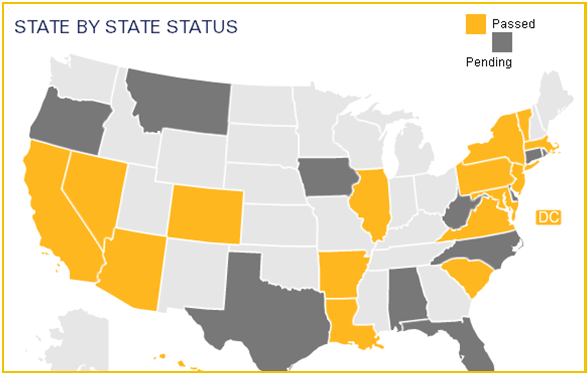
Similar legislation has already been passed and signed into law in California, Hawaii, Illinois, Louisiana, Massachusetts, Maryland, New Jersey, Pennsylvania, South Carolina, Vermont, and Virginia. It is pending in nine other states.

The bill (HB 6356) would have allowed businesses to legally incorporate as benefit corporations in Connecticut and was described as the most comprehensive piece of social enterprise legislation ever proposed in the United States.  It was designed to help social entrepreneurs protect their organization’s social mission, and provide a transparent, accessible, and simple mechanism for defining their business’s social goals.  Supporters said the legislation would also help drive job creation and increase the number of community-based partners benefit corpcommitted to solving some of Connecticut’s most pressing social issues without requiring additional state funding.

Here’s how Hartford Courant business editor Dan Haar described the bill in a column the day prior to legislative adjournment:  “The bill has few if any opponents, it would make it easier for private firms to do some good in the world and it wouldn’t cost the state any money (okay $62,000, once, to reprogram the computers).

Firms organized this way, known as type-B corporations, would have a stated social goal beyond profits for the owners — public health, perhaps, or promoting the arts or restoring the environment or creating economic opportunity for disadvantaged people. It’s the kind of stuff nonprofits tend to do, but allowing for-profit companies to set up with a social purpose simply adds an avenue.”

The bill not only required benefit corporations to publicly state their social mission within the business’s articles of incorporation, but it also would have created a culture of accountability within Connecticut’s social enterprise community by requiring that those businesses publish an annual benefit report detailing the public benefit that they have actually created, and make that information publicly available on their website.

It also would have given owners of social enterprises the option of locking in their commitment to the social mission that their business is designed to serve by electing to adopt its legacy preservation clause after a waiting period of two years. This would allow shareholders to ensure that their commitment to the creation of public good is maintained, even if ownership of that company changes over time.  But it was not to be.

“We did everything we could possibly do and we had a lot of great people working very hard to make it happen,” Emery said in an email to supporters of reSET across the state.  “It was a well fought battle and sooner or later we'll get it passed but for now we will have to take heart in knowing we did all we could.”

The broad coalition of supporters – all of whom submitted testimony during a public hearing on the bill -  included AARP, the Connecticut Association of Nonprofits, the Connecticut Conference of Independent Colleges and AT&T.  As Haar noted this week, Connecticut Innovations, the state’s technology investment arm, and the state Department of Economic and Community Development both supported it actively.  The Connecticut Bar Association, which opposed a similar bill last year, also supported this year’s revised version.

Benefit Corporations are a new class of corporation that 1) creates a material positive impact on society and the environment; 2) expands fiduciary duty to require consideration of non-financial interests when making decisions; and 3) reports on its overall social and environmental performance using recognized third party standards.

In her public hearing testimony, state Economic and Community Development Commissioner Catherine Smith said Connecticut “is poised to realize many benefits” from passage of the bill, which would “leave a lasting social and financial impact on our state for years to come.”

Increasing International Exports is Key to State's Economic Development Plan

A recent update on Connecticut’s Economic Development Strategy includes a strong focus on international economic development, including upcoming efforts to extend business in Israel, Canada and France as part of broader plans to strengthen Connecticut’s brand in the global markets and grow the state’s trade footprint abroad.

As described by Beatriz Gutierrez, director of international business development efforts at the state Department of Economic and Community Development (DECD), the department’s vision is “to position Connecticut as the destination of choice for companies looking to establish North American presence with preference to those in the areas of bioscience, precision manufacturing, fuel cells and renewable, and those looking to establish North American headquarters.”

The primary geographic targets for the state are China (which Gov. Malloy visited last year and Secretary of the State Denise Merrill visited last month), Germany and Western Europe (including the Paris Air Show this month), Israel (a CT-Israel Tech Summit will be held in Connecticut on June 12), and Brazil.  Goals include developing an international brand for the state, building an “opportunity pipeline,” and strengthening the relationship management process.

Meetings have been held with more than 50 companies and cluster associations in key industry segments, and a “concierge” program has been introduced in Europe.  During fiscal year 2012, DECD assisted in business exports to 39 countries for 62 state coCT boothmpanies, according to the DECD update.  The total assisted value of $548.6 million would equate to 2,785 jobs, according to DECD.  The department’s presentation added that unreported dollar amounts could account for “another 300 to 400 jobs, or more.”

The state has also been working closely with the U.S. Small Business Administration on international business growth, including the State Trade and Export Promotion (STEP) program.  Among the initiatives in Connecticut are a SBA pilot-grant to help small businesses increase exports, and efforts to assist businesses with participation in regional and industry focused export opportunities and international business development opportunities. Connecticut received grant awards of $546,822 in the first year and $339,319 in the second year, supporting 178 Connecticut companies with partial reimbursements for international business initiatives.

At a trade show in Hannover, Germany in April, for example, the state’s booth featured five Connecticut hydrogen and fuel cell companies, which officials say produced strong leads from both Germany and Canada. Later this month, Connecticut will have a presence at the Hydrogen + Fuel Cells Conference in Vancouver, with three state companies on hand, and at the Paris Air Show in Le Bourget, with 13 companies slated to be present at Connecticut’s booth.  It is the state’s eighth consecutive year at the air show, and $162 million in new business has been reported by the companies who exhibit under the Connecticut display umbrella.

Earlier this year, DECD reported that Connecticut is home to “691 foreign affiliates” employing 106,500 in the state.  At the time, exports were said to exceed $16 billion annually. More recent data indicate that exports dropped about two percent between FY 2011 and FY2012, from $16.21 billion to $15.86 billion.  Next steps outlined by the state in the May 22, 2013 update include implementing a statewide international activity scorecard, monitoring global trends and identifying potential “sweet spots,” and strengthening strategic partnerships.

Rebranding of Tweed-New Haven Seen as Key to Airport Growth

For a time, it seemed as if Tweed-New Haven Airport would be handling flights without the benefit of air traffic controllers.  That altered state of reality was averted – at least for the time being – when Congress intervened, after federal sequestration budget cuts called for eliminating the control tower personnel this spring.

But at a news conference earlier this month, members of Connecticut’s Congressional delegation stressed that Tweed-New Haven and other regional airports are not out of the woods yet. That means the facility needs to more aggressively state its case – to lawmakers and the public.  Which is precisely what’s being done, with a reinvigorated public information effort including a recently developed website and logo.Tweed

Last July, officials at Tweed launched a new user-friendly website to meet the needs of its expanding customer base. The new website www.flytweed.com makes it easier to price and track flights throughout the world. In addition to the website, a new logo was created and Tweed mobile applications were launched.

The initiative to refresh the airport's identity and branding online was aimed at changing travelers' search habits, placing the airport's code ("HVN") into prominence as the first step at accomplishing that goal.  The tagline “Southern Connecticut’s Airport” is also featured with the revised logo.  The airport is served several times a day by US Airways Express, through connecting flights via Philadelphia to over 130 national or international destinations.

A report issued last year indicated that more airline passengers flew out of Tweed in 2011 than in 10 of the previous 11 years – including a jump of 11% in 2011 over 2010. Figures for 2012 were not immediately available.  Total 2011 departures exceeded the average annual number of departures over the last 12 years by a strong 24%.   It also marked the third consecutive annual increase in the number of passengers flying from Tweed.

In addition to Tweed, the six airports that would have been impacted by the federal cuts include Hartford’s Brainard Airport and the airports in Danbury, Bridgeport, Groton-New London, Waterbury.

Officials have pointed out that with competitive fares, convenient parking and easy access from downtown New Haven and I-95, Tweed’s popularity has grown  from a decade ago. The growth also reflects thedestination_banner-938x333-938x333 increasing vitality of the New Haven business community, reflected in a growing and vibrant retail community and greater demand for residential space in the city. Airport officials have said they will continue working with airline representatives to  seek additional service and destinations.

Million Dollar Packages Routine Atop Connecticut Hospitals, CEO’s Receive Highest Pay at 26 of 30

Newly released data from the state Office of Health Care Access, which regulates hospitals in Connecticut, reflects that 18 Connecticut hospital executives received pay packages of over $1 million during fiscal year 2012.

Leading the top-compensated list – and exceeding $1.5 million in total compensation for their highest paid individual staff member - were William Backus Hospital ($3.4 million), Hartford Hospital ($3.3. million), and Yale- New Haven Hospital ($2.8 million).

In addition to the top three, there were seven other hospitals where the highest compensated official received a pay package exceeding one million dollars during FY2012.  Rounding out the top ten were officials at  Greenwich Hospital ($1.5 million), Saint Francis Hospital & Medical Center ($1.5 million), Stamford Hospital ($1.5 million), Hospital of Central CT ($1.5 million), Bridgeport Hospital ($1.1 million), Hospital of Saint Rafael ($1.8 million), and Middlesex Hospital ($1 million).

An analysis by Connecticut by the Numbers indicates that the top salary and benefit package at all but four of the state’s 30 hospitals went to top administrators, usually the President or CEO.  The exceptions included  Hospital signNew Milford Hospital, where the president’s total package ranked 5th and a lab physician led the list;  at Charlotte Hungerford Hospital, where the CEO also ranked 5th and a physician surgeon ranked first, and at Rockville General Hospital which was led by the Medical Director, with the CEO placing third in the salary hierarchy.    At Windham Community Memorial Hospital, the top administrator – the Vice President of Operations – placed 7th in salary and fringe benefits amongst hospital leadership.

Only five hospitals in the state saw the top ranked individual receive less than half a million dollars in compensation.  The lowest was at  Rockville General Hospital, where the Medical Director received $324,458, followed by Windham Community Memorial Hospital, where the top  Physician/Hospitalist earned $463,270, John Dempsey Hospital, where the CEO earned $477,518, New Milford Hospital, where the top package was $480,036 and Johnson Memorial Hospital, where the President’s pay package totaled $483,070.

The OHCA report did report the names of individual administrators, but listed the top 10 paid positions at the state's 30 acute care hospitals. The state's two largest hospitals—Hartford Hospital and Yale New Haven Hospital—each had four senior executives that received million-dollar plus pay packages last fiscal year, the Hartford Business Journal has reported, while Stamford Hospital had two administrators earn over $1 million.

The highest paid hospital executive in fiscal 2012 was the former president & CEO of William Backus Hospital, who received a total pay package of $3.4 million. That included $3.2 million in fringe benefits, the report said.  In addition, the President & CEO received compensation of $975,550 during the year.  The highest active paid hospital administrator was Hartford Hospital's vice president of academic affairs and chief academic officer, who received $3.4 million in compensation.


In 2007, there were seven hospital CEO’s earning in excess of $1 million in compensation, according to the Office of Legislative Research.  In fiscal year 2005, five of the top paid positions at the state’s 30 hospitals received more than $1 million, data from the Office of Legislative Research indicates – all of them CEO’s.

Hospitals are required to provide their top ten highest paid hospital positions annually to OHCA.  The full list for FY2012 is available on the OHCA website. The top salary at each hospital, according to the report:

Bridgeport Hospital, President & CEO: $1,101,139

Bristol Hospital, President & CEO: $605,526

Charlotte Hungerford Hospital, Physician Surgeon: $661,640

CT Children’s Medical Center, President & CEO : $748,347

Danbury Hospital, Chief Executive Officer: $955,838

Day Kimball Hospital, President & CEO: $514,375

Essent-Sharon Hospital, Chief Executive Officer: $736,907

Greenwich Hospital, President & CEO: $1,530,629

Griffin Hospital, Chief Executive Officer: $558,543

Hartford Hospital, VP, Academic Affairs & CAO: $3,351,507

Hospital of Saint Rafael, President  : $1,803,605

John Dempsey Hospital, CEO : $477,518

Johnson Memorial Hospital, President : $483,070

Lawrence and Memorial Hospital, President, CEO: $761,734

Manchester Memorial Hospital,CEO: $560,793

Middlesex Hospital, President/CEO:  $1,022,460

MidState Medical Center, President/CEO: $958,020

Milford Hospital, President: $579,475

New Milford Hospital, Lab-Physician: $480,036

Norwalk Hospital, President & CEO : $901,148

Rockville General Hospital, Medical Director:  $324,458

Saint Francis Hospital & Med Ctr., President: $1,521,090

Saint Mary’s Hospital, President & CEO: $791,256

Saint Vincent’s Medical Center, Chief Executive Officer:   $2,394,278

Stamford Hospital, President & CEO: $1,532,094

The Hospital of Central CT, President & CEO: $1,499,546

Waterbury Hospital, President: $520,298

William W. Backus Hospital, Former Pres. & CEO: $3,357,690

Windham Community Memorial Hospital, Physician/Hospitalist: $463,270

Yale-New Haven Hospital, President & CEO* : $2,803,228

*includes Yale-New Haven Hospital and Yale-New Haven Health System