Municipal Equality Index Finds CT Above Average for LGBT Residents

Connecticut cities continue to rank above-average when compared with municipalities across the country in the level of equality provided to lesbian, gay, bisexual, and transgender (LGBT) residents.  Bridgeport, Hartford, New Haven, Stamford and Storrs (Mansfield) were the five Connecticut municipalities included by the Human Rights Campaign (HRC), the nation’s largest LGBT civil rights organization, in an assessment of LGBT equality in 353 cities across the nation. index report

The 2014 Municipal Equality Index (MEI), the only nationwide rating system of LGBT inclusion in municipal law and policy, shows that cities across the country, including in Connecticut, continue to take the lead in supporting LGBT people and workers, even when states and the federal government have not.

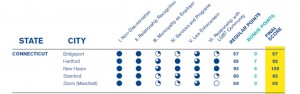
The average score for the five municipalities in Connecticut was 74 out of 100 points, comfortably above the national average of 59.  The individual scores in Connecticut, largely unchanged from a year ago, were New Haven: 100, Hartford: 92, Stamford: 62, Storrs (Mansfield): 59, and Bridgeport: 57.  The scores earned by Hartford and Bridgeport dropped slightly from a year ago, and New Haven scored at 100 for the second consecutive year.  Because of changes in the legal landscape from year to year, the MEI report has revised the scoring assessment criteria, which has impacted scores in some municipalities.

Cities are rated on a scale of 0-100, based on the city’s laws, policies, benefits, and services. Key findings contained in the 70-page MEI report, issued in partnershiphrc-logo with the Equality Federation, provide “a revealing snapshot of LGBT equality in municipalities of varying sizes, and from every state in the nation,” the report noted.

The MEI rates cities based on 47 criteria falling under six broad categories:

  • Non-discrimination laws
  • Relationship recognition
  • Municipality’s employment policies, including transgender-inclusive insurance coverage, contracting non-discrimination requirements, and other policies relating to equal treatment of LGBT city employees
  • Inclusiveness of city services
  • Law enforcement
  • Municipal leadership on matters of equality

The cities researched for the 2014 MEI include the 50 state capitals, the 200 most populous cities in the country, the four largest cities in every state, the city home to each state’s largest public university, and an equal mix of 75 of the nation’s large, mid-size and small municipalities with the highest proportion of same-sex couples.

The report found that “momentum for municipal equality is not a coastal trend or mega-urban phenomenon – it is something cities of all sizes in all parts of the country are doing because the people in those cities demand equality of treatment for all.”  Cities had an opportunity to review the draft scorecard and offer feedback prior to publication.

Equality and Economic Development

The report also indicates that “a growing body of research has shown that cities that have vibrant gay and lesbian communities have higher levels of income, life satisfaction, housing values, and emotional attachment to their community as well as higher concentrations of high-tech business. The Fortune 500 has long recognized that top talent is attracted to inclusiveness. In fact, the private sector has been using fair workplaces as a tool to recruit and retain top talent.”

The report adds that “Businesses will increasingly have to evaluate the legal landscape offered by a potential new location in its calculation of where to expand operations.”  Connecticut’s state laws – such as marriage equity and non-discrimination protections – provide a hospitable environment for its cities to employ equitable practices, officials said, but municipalities also have the capacity to take the lead, in Connecticut and elsewhere.  In ten states, cities fare well despite restricbusinesstive state laws.
“From Mississippi to Idaho, mid-size cities and small towns have become the single greatest engine of progress for LGBT equality--changing countless lives for the better,” said HRC President Chad Griffin. “In just three years, the number of municipalities earning top marks for their treatment of LGBT citizens has more than tripled. Simply put, in this country there is an ongoing race to the top to treat all people, including LGBT people, fairly under the law, and it’s time our state and federal laws caught up.”

According to the report, the New England, Mid-Atlantic, and Western regions of the United States – where marriage equality states have predominated – tend to do better than the national average when it comes to municipal equality. The reported pointed out, however, that every region has at least one 100-point city, such as New Haven. For example, in the Southeast, Florida boasts three 100-point scores, and Atlanta repeats its perfect score again in 2014; in the Southwest, Austin repeats its perfect score; and in the Plains, Iowa City joins two perfect scores in Missouri with St. Louis and Kansas City.

Thirty-eight cities earned perfect 100-point scores, up from 25 in 2013 and 11 in 2012, the first year of the MEI. New Haven earned a 100-point score, helping to set a standard of LGBT inclusiveness with exemplary policies ranging from non-discrimination laws and equal employee benefits, to cutting edge city services.

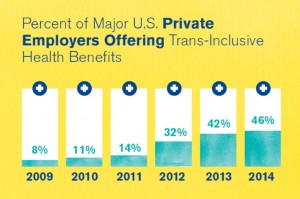
Among the report’s striking findings:  A dramatic increase in the number of cities offering transgender-inclusive healthcare benefits, and the fact that 32 million people have better protections from discrimination on the basis of gender identity at the local level then they do from state law. The full report is available online at www.hrc.org/mei.
CT stat

Network TV, National Advertising, Breakfast Food Boost UConn

UConn is making a splash these days in some unfamiliar places. Think iconic stadium, all the news that’s fit to print, and cereal– all of which have headlined the state’s flagship university in recent days.CBS This past Saturday, the Huskies football team played Army at Yankee Stadium – the University’s first appearance at the ballpark in the Bronx.  While UConn came up short on the scoreboard, the game was competitive and offered the school visibility in the New York metropolitan area and on CBS Sports Network, which televised the game. NYT ad

Fans who happened to be reading the print edition of The New York Times on Friday may be been surprised to see a full-page ad promoting the university.  The ad touted the university’s “unprecedented moves to unleash the solutions of tomorrow,” specifically highlighting a $3.6 billion investment in additive manufacturing, gnomic medicine and cybersecurity, the hiring of 300 faculty in fields including cognitive science human rights and intellectual inquiry, and recruiting 6,500 additional students to “lead their generation in addressing the most important challenges of our time.”

The ad was a one-time placement strategically timed to several significant events happening in New York City, including the Army-UConn game, an alumni gathering, and a meeting of the UConn Foundation board.  UConn has a very active and robust alumni network in New York City and the region, officials noted.

The ad was purchased at a negotiated rate and ran not only in New York City, but nationwide in The Times. It was paid for with funds from the university’s marketing budget (approximately $43,000) and private dollars (approximately $10,000), specifically designated by donors to elevate the University through advertising.  The UConn tagline, “Innovation unleashed,” was included in the ad, which featured text reading “Dear UConn, Thank you.  Sincerely, The Future.” Total average print circulation for The New York Times for Monday-Friday was 680,905, as of March 2014.

For those who read their morning paper with a bowl of cereal – there’s more UConn to come.

Just arriving on the market is a new, limited edition Husky Heroes cereal.  “The one and only cereal to honor both the UConn Women’s and Men’s National Championship basketball teams,” according to a newly launched website, is a honey nut toasted oat cereal and comes in a 14 oz. box.  Basketball coaches Geno Auriemma and Kevin Ollie are each featured on the commemorative cereal box, which is sold in a two-pack. husky_herOes

Marketed by Pittsburgh-based PLB Marketing, described as the “premier source for athlete-endorsed, quality food products,” there is a limited edition of 25,000 boxes being produced.  The company also is currently promoting Miggy’s Salsa, with a likeness of Detroit Tigers star Miguel Cabrera, Fastball Bars, a chewy chocolate chip granola bar featuring his teammate Justin Verlander, and Gronk Flakes, featuring New England Patriots’ tight end Rob Gronkowski.

The Husky Heroes cereal is available on-line at www.huskyhereoscereal.com, with delivery anticipated later this month.  The price is $14.97 for a two-box set, plus UPS shipping charge of $9.95, for a total of $24.92. The cereal is officially licensed by UConn through the university’s licensing agency, the Collegiate Licensing Company.  The university receives a standard 12 percent royalty on sales of all licensed products bearing UConn trademarks.

In addition to web purchases, the cereal will be distributed locally in the coming weeks to some Connecticut retail locations by Bozzuto’s (retailers to be announced).  It will also be sold at the UConn Coop.  For those inclined to stock up early, bulk orders of 500 boxes are eligible for special pricing directly from PLB.  Advance sales are just underway, and as of Monday afternoon there were 24,848 boxes remaining.


uconn web

Northwest Connecticut Economy on Cusp of Recovery; Workforce Factors Are Key

Nearly 60 percent of businesses in northwest Connecticut project an increase in total sales revenue in 2015, according to a new survey, although fewer than half of the businesses surveyed (46 percent) anticipate higher pre-tax profits next year. The 2014 Survey of Northwest Connecticut Businesses, conducted by the Connecticut Business & Industry Association (CBIA) and the Chamber of Commerce of Northwest Connecticut, “paints a picture of a regional economy that is recovering but also constrained by rising costs and workforce challenges,” according to the organizations.NW Chamber study

Two-thirds of northwest Connecticut businesses (67%) surveyed are somewhat or very concerned about the area’s aging population, in terms of maintaining an adequate workforce. That’s up 11 percentage points from 2012, when the survey was last conducted. Business leaders predicted the skills most in demand will be industry-specific in medical, utilities, manufacturing, and construction fields (37%) and computer/IT skills (28%).

Businesses are fairly evenly divided on the greatest advantage to doing business in northwest Connecticut, identifying the region’s proximity to New York, Boston, and Springfield markets and amenities (22%); local environment (17%); supportive chamber of commerce (14%); active local banks (11%); and arts, culture, and entertainment opportunities (10%).

While 36% say they will have more employees next year, nine percent anticipate having fewer employees, and the majority (55%) expect no change in the size of their workforce.  Top economic priorities are, in order, growing the local manufacturing base, regional collaboration to attract business investment, and retaining a skilled workforce. The cost of living (cited by 43% of executives surveyed) is considered to be the single greatest disadvantage. Three leading issues two years ago, fell from the issues of most concern now: credit availability, healthcare costs, and tight marketing budgets.priorities chart

By a ratio of 2:1, employers in northwestern Connecticut believe that schools in their area—and throughout the state—adequately prepare workers for entry-level jobs, according to the survey. Although confidence in Connecticut’s education system prepagingaring workers for higher-level jobs is not quite as strong, the majority of respondents nonetheless believe Connecticut schools and colleges provide an adequate education for mid-level employees (59% of employers surveyed); management workers (61% of employers); and executive-level employees (58%).
Nearly 200 companies, with an average of 55 employees and representing a variety of sectors participated in the survey, and their responses reflected dramatic changes in recent years in the way in which businesses are marketed to potential customers. While quality broadband is viewed as an issue for one-third of businesses surveyed, 56 percent use social media to market their products and services (and 60 percent do other web marketing)—edging out print advertisements (54 percent of businesses). Radio, billboards, sales representatives, and word of mouth are other key components of the marketing mix, the survey found.

The report concludes that “with GDP data and other indicators showing we are on the cusp of a stronger economic upswing, pressure on hiring has increased to meet demand.”   Noting the “increasing numbers of retirees, Northwestern Connecticut’s workforce challenges, which have always been serious, are now critical,” the report emphasizes.

Spur-Econ-Growth_103014-572x368

Construction of New Rail Stations Set to Begin in 3 Connecticut Communities

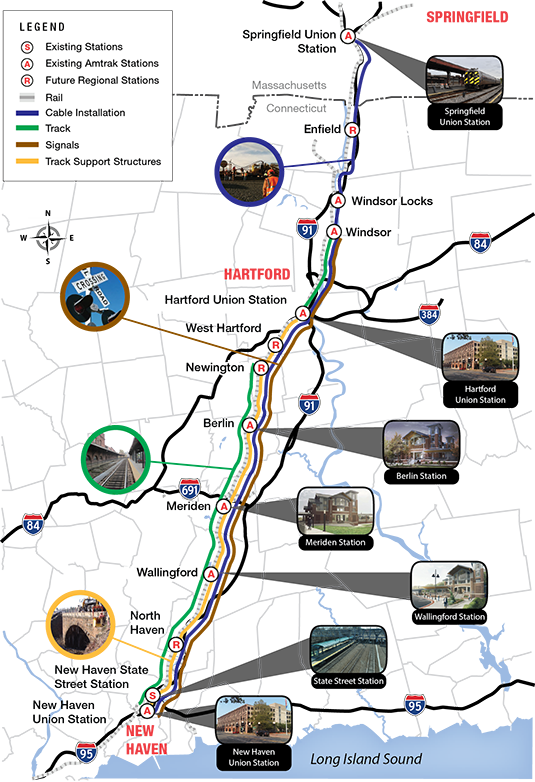
The start of construction is imminent this fall for new rail stations in Wallingford, Meriden and Berlin as part of the New Haven-Hartford-Springfield (NHHS) Rail Program.  The new, expanded commuter service, to debut in 2016, will be branded the “Hartford Line,” as a key component of an increasingly robust multi-modal regional transportation system being developed in the state and region. Improvements at the three stations include high-level platforms on both sides of the track, overhead pedestrian bridge with new elevators and stair towers, platform snow melt systems, electric vehicle charging stations, ticket vending machines and passenger information display systems,  high-resolution video surveillance systems, increased parking capacity and roadway access improvements, improved accessibility and bicycle racks.2014.10.22_Hartford_Line_s

Funded through the Passenger Rail Investment and Improvement Act (PRIIA) created under President Barack Obama in 2008, and State of Connecticut bonds proceeds, the NHHS Rail Program is aimed at providing significant new regional passenger rail service options.  Existing stations on the Hartford line are in New Haven, Wallingford, Meriden, Berlin, Hartford, Windsor Locks and Springfield.  Plans call for future stations in North Haven, Newington, West Hartford and Enfield. base_map

Officials point out that one of the primary objectives of the NHHS program is to serve as a catalyst for transit-oriented development (TOD) around the stations. The state Department of Transportation is working with towns to help leverage the investment in railroad infrastructure to capture local development benefits. TOD, in the form of compact, mixed-use districts, is pedestrian-friendly and contributes to vibrant and active communities. By promoting the use of transit, TOD also reduces reliance on automobiles, resulting in energy cost savings and improved air quality.

In June, officials from the U. S. Department of Transportation’s Federal Railroad Administration (FRA) toured parts of the NHHS Rail corridor, and state officials recently visited a proposed rail station site in Enfield.

The new NHHS rail service is expected to operate at speeds up to 110 mph, cutting travel time between Springfield and New Haven to as short as 79 minutes. Travelers  will be able to board trains every 45 minutes during the morning and evening peak hours and every 90 minutes during off-peak periods when the new system is operational.

A year ago, a West Haven rail station was added to the New Haven line.  Located midway between Milford and New Haven stations, West Haven was the first new station to open on the New Haven Line since Fairfield Metro Station was added in 2011. West Haven Station was designed by Vanasse Hangen Brustlin and built by a Connecticut company, Manafort Brothers of Plainville.

A New York City-based construction firm, Judlau Construction, has been awarded the $58.8 million contract to build the new railroad stations in Berlin, Meriden and Wallingford, the New Haven Register reported last month.  The firm specializes in large public works projects and design-build services, and currently ranks #132 on Engineering News Record’s list of the Top 400 Contractors, as well as #32 among Top Domestic Heavy Contractors. (In 2011, the company ranked #113 on the Top 400 list and #33 on the Top Domestic Heavy Contractors list.)

In June, the Chicago Tribune reported that the company was being awarded a $64 million construction contract by Illinois Tollway as low bidder for construction of new highway entrance ramps.  The Tribune also reported that Judlau “admitted improper hiring practices and paid a $7.5 million penalty in connection with an alleged minority hiring scheme” in New York, which the company said it had “self-reported” to the U.S. Attorney’s office.  The Tribune reported that “according to a 2012 civil lawsuit settlement with the U.S. attorney's office, Judlau and its partner in a Metropolitan Transportation Authority tunnel project admitted engaging in improper hiring practices involving minority- and women-owned businesses, otherwise known as disadvantaged business enterprises, or DBEs.”

Connecticut Ranks #6 in USA in Energy Efficiency, Continuing Top Ten Streak

Connecticut ranks as the #6 state in the nation in energy efficiency, according to an analysis by the American Council for an Energy-Efficient Economy (ACEEE).  A new report by the Council found that Massachusetts continues to edge out California as the most energy-efficient state in the nation for the fourth year in a row.  Connecticut has been a steady top-ten state since the annual survey began eight years ago, but dropped one slot this year.energymap Rounding out the top 10 are Rhode Island  (the state’s first time in top five), Oregon, and Vermont (all tied for #3); Connecticut (#6); New York (#7); Washington (#8); Maryland (#9); and Minnesota (#10).

Arkansas, the District of Columbia, Kentucky, and Wisconsin are the four most improved energy-efficiency states for 2014. Indiana and Ohio fell the furthest in the rankings due to decisions by legislators in both states to roll back energy savings targets.  They were among 23 states that dropped in the state-by-state rankings.  At the bottom of the rankings, the five states most in need of improvement on energy efficiency in 2014 are North Dakota, Wyoming, South Dakota, Mississippi, and Alaska.

Overall, states are ramping up their commitments to energy efficiency, the report indicated, as governors and lawmakers in state capitals across the nation continue to take major steps to lower energy costs, reduce pollution, and save consumers money by increasing their states’ energy efficiency.  Sixteen states rose in the rankings this year, in the 8th annual edition of the State Energy Efficiency Scorecard.ACEEE_logo_block

Connecticut was ranked fifth a year ago, and sixth the previous year.  In 2011, the state ranked #9 and in 2010, ranked #8.  State officials noted that Connecticut continues to be a leader in the nation, and the strong ranking is likely to improve in the coming year as increased funding for energy efficiency programs, not fully reflected in this year's survey, have an impact. Also noted was the state's decision to invest in infrastructure, such as charging stations throughout the state for vehicles, which was not an area of focus for the report but will be beneficial for Connecticut consumers.

The State Energy Efficiency Scorecard benchmarks states across six policy areas – utility policies and programs, transportation initiatives, building energy codes, combined heat and power development, state government-led initiatives, and state-level appliance standards. In total, states are scored on more than 30 individual metrics. Data is collected from publicly available sources and vetted by state energy offices and public utility commissions, according to the Council.  The 2014 report found that nationwide, total budgets for electricity efficiency programs in 2013 reached $6.3 billion. Adding that to natural gas program budgets of $1.4 billion, total efficiency program budgets were estimated to be more than $7.7 billion in 2013.

The leading states in utility-sector energy efficiency programs and policies were Rhode Island, Massachusetts, and Vermont, and the leading state in building energy codes and compliance was California. California and New York led the way in energy-efficient transportation policies.

Maggie Molina, director of ACEEE’s Utilitie2014-scorecard-map-01-620x310s, State, and Local Policy program, said: “Smart energy efficiency choices maintain the same comfort, convenience, and quality of life that consumers want and expect. Energy efficiency is also good for business. State action on energy efficiency improves bottom lines, drives investment across all sectors of the economy, creates jobs, and offsets the environmental harms created by the energy production system.”

The American Council for an Energy-Efficient Economy acts as a catalyst to advance energy efficiency policies, programs, technologies, investments, and behaviors.

Innovation and Impact of Manufacturing Companies in CT Is Focus of New CPTV Documentary

With Election Day less than two weeks away amid intensifying discussion of job growth in Connecticut, CPTV zeroes in on modern manufacturing and the role of innovation in companies. The CPTV Original documentary Made in Connecticut premieres Thursday, Oct. 23 at 8 p.m. on CPTV. Twelve businesses that exemplify the diversity of successful manufacturing “located and thriving right here in Connecticut” are featured in the program.made in CT

The documentary is part of a three-year, multi-platform initiative by Connecticut Public Broadcasting that celebrates Connecticut’s manufacturing future, from high-tech to hand-made.  The initiative includes additional special programming airing on CPTV and WNPR/Connecticut Public Radio.

Against the backdrop of such timely issues as outsourcing and a global economy, the Made in Connecticut documentary explores topics including:

  • the value that manufacturing provides to the state’s economy;
  • how the manufacturing sector is contributing to the creation of jobs in Connecticut;
  • how advances in technology have changed the nature of manufacturing and the skills needed to work successfully in the manufacturing environment; and
  • how science, technology and innovation are transforming manufacturing endeavors around the world, the nation and the state.

Featured in the documentary are:

  • Barnes Group headquartered  in Bristol, which started as a spring company in 1857 to supply the clock industry and has now exploded into a global leader in industrial and aerospace manufacturing;
  • Curtis Packaging in Sandy Hook, a nearly 170-year-old family-owned company that has reinvented itself as a world leader in luxury packaging and environmental stewardship;
  • Ola! Granola in Norwalk, where a mother of three produces hand-made granola in mouth-watering flavors such as vanilla almond, cranberry orange pecan and chocolate banana-chip;
  • Oxford Performance Materials in South Windsor, a plastics company on the edge of science fiction-like technology, using 3-D printing to create cranial implants for people who have suffered traumatic brain injury;
  • Pratt &Whitney in East Hartford, the industry leader in aerospace, creating breakthrough technology with its PurePower jet engine that will revolutionize air travel;
  • Protein Sciences in Meriden, which has a game-changing flu vaccine that takes just weeks to mass produce to fight pandemics worldwide;
  • Severance Foods in Hartford, a snack food company founded by three friends who invested in a tortilla-making machine in the 1980s, and now employs more than 85 people to produce 40,000 pounds of tortilla chips a day;
  • Tucci Lumber, which makes baseball bats in South Norwalk and was founded by a former Major leaguer.

Connecticut’s unemployment rate dropped to 6.4 percent last month as nonfarm jobs reached a new recovery high point. The unemployment rate last month was the lowest it has been in the state since November 2008, according to a state Department of Labor report.  The employment gain of 11,500 jobs in September is the largest since April 1994, the seventh monthly nonfarm employment gain this year and a "vigorous bounce-back" from the revised decline of 1,200 jobs in August, the Department of Labor said.  As the state takes proactive steps to ensure people are trained for manufacturing jobs, employment numbers are simultaneously rising. In the most recent data, manufacturing jobs increased from 163,500 last year to 164,100 this year, Fairfield County Business Journal reported.  The manufacturing industry plays a crucial role throughout Connecticut communities, U.S. Sen. Chris Murphy's office pointed out recently, noting that Connecticut’s 4,602 manufacturers account for 10.2% of the state’s jobs and 87% of the state’s total exports.

To prepare future workers, Manchester Community College will lead the state's 12 community colleges and Charter Oak State College in a federally funded effort to expand manufacturing education in the state as part of a $15 million grant from the U.S. Department of Labor, announced this month.  The grant  will support an expansion of the Connecticut Advanced Manufacturing Initiative, which trains students for jobs in the field. The grant will pay for equipment to provide hands-on training, new teachers and educational assistants and the development of registered apprenticeship programs for high-demand manufacturing occupations, among other investments.

CPTV_Logo

“In recent years, technological advances, as well as human innovation and creativity, have put Connecticut on the forefront of a manufacturing revolution. This revolution is not only exciting, it’s important to the local economy, as it’s helping to create jobs. Manufacturing has always been an important part of Connecticut’s culture and economy,” said Jerry Franklin, President and CEO of CPBN, who is to be honored next week by Hartford Business Journal with the publication’s Lifetime Achievement Award for his leadership in the broadcast industry.

The documentary Made in Connecticut is produced and hosted by Emmy Award-winning journalist Christina DeFranco. Funding was made possible by Founding Sponsor, KBE Building Corporation. KBE Building Corporation is a full-service, single-source commercial construction company strategically positioned to serve the Eastern and Mid-Atlantic, with offices in Connecticut and Maryland.

“We’re passionate about fostering innovation in Connecticut’s manufacturing and technology spaces, and we just happen to have built more technical high schools around the state than anyone else.  We’re thrilled to shine light on this critical aspect of the state’s current and future economy,” said Mike Kolakowski, KBE Building Corporation’s President and Principal Owner.

See preview on You Tube.   

CT Ranked #20 in U.S. in Commuters Driving Alone; Average Commute is 25 Minutes

In Connecticut, 78.6 percent of commuters drove alone in their own car, truck or van, ranking the state #20 in the nation.  Data compiled by the Bureau of Transportation Statistics of the U.S. Department of Transportation also indicated that 8.2 percent carpooled, 3 percent of the state’s commuters walk to work, 4.8 percent use public transportation, and 4.1 percent worked from home.dot logo The Bureau of Transportation Statistics (BTS) included the data in State Transportation Statistics 2014, a statistical profile of transportation in the 50 states. The data was included in the 12th annual edition of the report, a companion document to the National Transportation Statistics (NTS), which is updated quarterly on the BTS website.
Nationally, in comparison, 76.3 percent of Americans drove alone; 9.7 percent carpooled; 5 percent rode transit; 2.8 percent walked; 4.4 percent worked at home; and 1.8 percent used other modes.

The daily commute to work takes 24.8 minutes on average, for Connecticut residents.  The national average was 25.7 minutes using data compiled in 2012, the most recent year available. transreport

The smallest percentage driving along in their vehicle?  Alaska (66.2%), Hawaii (65.2%), Oregon (71.2%), Massachusetts (71.9%), and Washington (72.2%).  The highest?  Alabama (85.3%), Tennessee (83.6%), Mississippi (83.5%), Ohio (83.3%), South Carolina (82.9%), and Kentucky (82.7%).

Only seven states had a mean travel time to work of less than 20 minutes:  Alaska, Iowa, Kansas, Montana, Nebraska, South Dakota and Wyoming.  South Dakota’s 16.7 minutes was the quickest commute.


bridge hartford


CT's Captive Insurance Program Ranks #2 in US

The Connecticut Insurance Department’s Captive Insurance Program has been ranked the #2 program in the nation by an industry trade publication in only its third year of operations.   A captive insurer is an insurance company that is organized and owned by a parent firm or association to manage the owners’ risk and control costs. Captive insurance has become an increasingly important tool used by companies to manage their business risk and promote strategic initiatives.  Captives are best described as a form of self-insurance, but with all the advantages of traditional insurance. Once an alternative to the commercial insurance market, captives have evolved into strategic financial vehicles used for many different enterprises, such as manufacturing and health care, officials explain.captive association

Earlier this fall, the Connecticut Captive Insurance Association, along with the state Insurance Department and prominent industry sponsors, held the 2014 Symposium on Captive Insurance in Stamford.  The conference, “Captives Done Right:  Revolutionary Strategies for Optimizing Capital,” included sessions on risk mitigation strategies, corporate governance, risk retention and healthcare captives.  Participants included the chief financial officer of Frontier Communications, director of finance of the Archdiocese of Hartford, Chief Scientist Emeritus atcaptive Pitney Bowes, Senior Legal Counsel at Swiss Re America Holdings, and president & CEO of JANUS Associates.
According to the symposium’s website, the advantages of captive insurance include the opportunity to earn an underwriting profit, improved risk management and loss control, coverage for unusual or hard to place risks, direct access to reinsurance, and potential tax savings.

One of 37 states and U.S. territories that allow captives, Connecticut was ranked the second leading domicile by Captive Review, behind Vermont, in the magazine’s U.S. Captive Service Awards announced this week.  The annual awards recognize captive industry professionals who have demonstrated the highest levels of excellence over the past year.With 5,660 companies registered in captive domiciles across the world, according to the publication, the captive insurance sector remains a vital alternative risk transfer (ART) option and a significant part of the insurance sector.  Delaware was top-ranked a year ago.ctInsuranceDept

Connecticut currently has four licensed captive insurers and several more applications pending.

“Connecticut is taking a unique approach to the captive market,” said Connecticut Insurance Department Captive Unit Manager John Thomson. “We are working beyond a pure regulatory regime and are focusing on helping captive owners create sustainable risk financing vehicles. It is not about the CAPTIVE_web-300x81number of licensed captives but about an informed professional regulatory response.”
CT’s Regional Planning Agencies Consolidate, Realign and Disappear

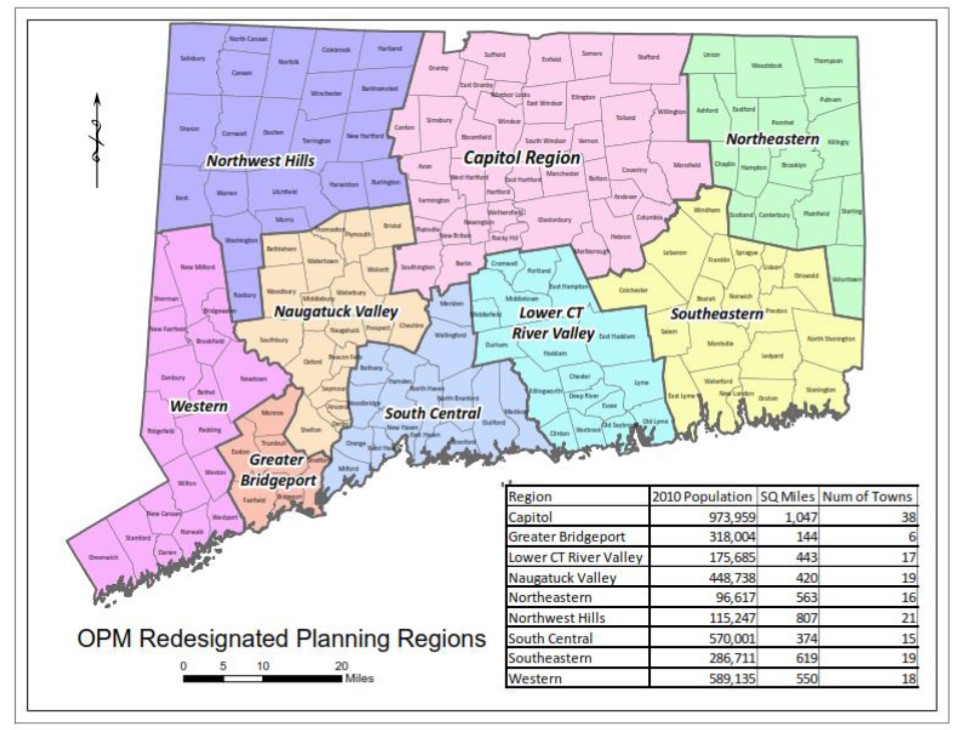
As the Central Connecticut Regional Planning Agency (CCRPA) prepares to go out of existence, the newly formed Naugatuck Valley Council of Governments is advertising for an Executive Director.  It’s all part of a major shake-up of regional planning agencies in central Connecticut, prompted by the state legislature’s decision to reduce the number of regional planning agencies in the state from 15 to 9, as of January 1.  Among the by-products:  Bristol and New Britain are parting company. The realignment is breaking up long-term relationships going back decades, and forcing municipalities to decide on new partners.  Regional planning agencies deal with a range of issues, but generally focus on transportation, land use, brownfield cleanup and environmental projects. For communities between two large cities that serve as anchors of regional planning agencies, it often comes down to deciding it they’d like to align to the east or the west.

The Central Connecticut Regionnew map RPAsal Planning Agency (CCRPA), for example, has been the regional and metropolitan planning organization for the cities of Bristol and New Britain and the towns of Berlin, Burlington, Plainville, Plymouth, and Southington. For over 45 years, CCRPA has worked with government, business, and the public to develop a vision for the region and resolve its challenges.  It will cease to exist at the end of the year.

The newly formed Naugatuck Valley Council of Governments (NVCOG) will replace the Council of Governments of Central Naugatuck Valley and the Valley Council of Governments plus add two towns from the Central Connecticut Regional Planning Agency – Bristol and Plymouth.

The other CCRPA towns, including New Britain, are headed elsewhere. Most of the towns in the CCRPA have opted to join with Hartford area municipalities in the Capitol Region Council of Governments, but Bristol officials decided to join the Waterbury agency instead.  New Britain is one of eight municipalities to join CRCOG in recent months, as part of the CCRPA break-up.250px-CT_regions

CRCOG will have grown to 38 member municipalities, with a total population of just under one million, and 1,047 square miles, the largest of the state’s regional planning agencies.  Joining CRCOG since July 1 are Berlin, Columbia, Coventry, Mansfield, Plainville, Southington, Willington and New Britain.  The new Naugatuck Valley Council of Governments will represent 19 towns and cities with a population of 448,738, over 420 square miles.

Ed Edelson and Kurt Miller, the current chairmen of the two councils of governments that had been covering the Naugatuck Valley, which will be subsumed by the new Council, said recently that “although our two current organizations have done high-quality work over the past four decades, we recognize they each have had different strengths and areas of focus.”

Edelson, the Democrat first selectman of Southbury, and Miller, the Republican first selectman of Seymour, added “we believe this step to align the 19 cities and towns around the urban center of Waterbury provides the best opportunity for all of our communities to combine resources, and bring significant new investment and cost savings to each of our communities.”  NVCOG held its first organizational meeting in late summer, and launched their Executive Director search last week.new map

Bristol Mayor Ken Cockayne recently said he “looks forward to strengthening existing ties to neighbors and building new relationships and cooperation with communities that share many of Bristol’s priorities and challenges.”

They also said they “recognize the importance of our new region’s major cities — such as Waterbury, Bristol and Shelton — as the economic engines. Their economic and social future is critical to all of the surrounding towns. We are all dynamically linked.”

For those who may be interested in the Executive Director position, topping the list of characteristics for the “ideal candidate” – “honest, trustworthy, diplomatic and ethical.”  And leading the “opportunities and challenges” – managing the consolidation, “sensitive to the cultural differences” of bringing the 19 towns together as a new council of governments.

The next challenge for the state, according to Edelson and Miller, is the consolidation of the Metropolitan Planning Organizations (MPOs), which are the federal regions that plan transportation systems and jointly allocate federal funds for these projects with the Connecticut Department of Transportation. There currently are eight MPOs in Connecticut, and the aim is to have fewer MPOs with boundaries that coincide with the new councils of governments’ boundaries.

CT’s 40 Fastest Growing Tech Companies Achieve Statewide Recognition

Connecticut’s fasted growing technology companies will be the center of attention Thursday evening as the Connecticut Technology Council (CTC) and Marcum LLP spotlight the 2014 Marcum Tech Top 40. Now in its 7th year, the annual list features privately and publicly held companies, including some newcomers to the top 40. The 2014 winners are predominantly privately held companies, but 12 public companies also made the list, including Rogers Corporation, Gartner Inc. and Alexion Pharmaceuticals. That’s a slight drop from a year ago, when 14 public companies made the list.

Geographically, Fairfield County is home to 16 winning companies this year, followed by Hartford County and New Haven County, both with ten companies. For Fairfield and New Haven counties, the count increased by two businesses from a year ago; for Hartford County, the number was unchanged from last year. top 40 logo

The selected companies have at least $3 million in annual revenue and a demonstrated record of growth in each of the preceding four years.  Four of the businesses have over $1 billion in revenue.

The Marcum Tech Top 40 recognizes technology leaders in six industry sectors, including Advanced Manufacturing, Energy/Environmental, Life Sciences, New Media/Internet/Telecom, IT Services, and Software. This year’s winners range from newcomer VRSim, Inc., a creator of virtual reality training tools for industrial and manufacturing applications, to Priceline.com, a leader in mobile travel.

Bruce Carlson, CTC’s President and CEO added, “Connecticut is proud of its remarkable heritage of innovation and invention. Job growth in Connecticut is going to come from the technology sector and these Tech Top 40 companies are a great example of the range of technology companies that are growing substantially in Connecticut.”

Among the names on this year’s list:  Frontier Communications, based in Stamford, providing communications services to residential and business customers across the country (in the news this year for the proposed purchase of AT&T’s business in Connecticut); and Bolt Technology Corporation, based in Norwalk, the leading worldwide developer and manufacturer of seismic energy sources, synchronizers and underwater connectors used in offshore seismic exploration for oil and gas; and Fitlinxx, based in Shelton,  an industry leading provider of wellness applications, wireless activity monitors, and health tracking devices that motivate people to live active and healthy lifestyles.

The city with the largest number of companies on the Top 40 list this year is Stamford, with six, followed by Norwalk with four, Shelton with three, and Wallingford, South Windsor, Simsbury and New Haven, each with two businesses on the list.  Other towns with a top 40 high tech busineconnecticut-technology-councilss are Torrington, Danbury, West Hartford, Cheshire, Guilford, Greenwich, Plainville, Middlebury, New London, Killingly, Middletown, Fairfield, Madison, Branford, Farmington, Glastonbury, Windsor, Orange and East Hartford.

“Technology companies have a set of shared challenges that range from capital-raising and complex revenue reporting to intellectual property management and international expansion.  Whether they are private enterprises or Fortune 500 companies, this year’s Marcum Tech Top 40 winners all demonstrate management excellence and market foresight,” said Alex Discepolo, a Tax Partner in Marcum’s New Haven office and Practice Leader of the Firm’s High Technology Services Group.

The October 2 awards program, being held at the Oakdale Theater in Wallingford, will include an exhibition featuring the Marcum Tech Top 40 companies. Six category winners will be announced, and one company will be named overall winner for demonstrating the greatest percentage growth in revenue across all the technology verticals.

The Connecticut Technology Council is a statewide association of technology oriented companies and institutions, providing leadership in areas of policy advocacy, community building and assistance for growing companies. Speaking for 2,500 companies that employ some 200,000 residents, the Connecticut Technology Council seeks to provide a strong and urgent voice in support of the creation of a culture of innovation.

 The Tech Top 40:

Advanced Manufacturing

  • APS Technology Inc – Wallingford
  • Bolt Technology Corporation – Norwalk
  • Dymax Corporation – Torrington
  • Revolution Lighting Technologies Inc. – Stamford
  • Rogers Corporation – Rogers six categories

Energy/Environmental/Green Technology

  • FuelCell Energy, Inc – Danbury
  • Proton OnSite – Wallingford

 IT Services

  • Cervalis LLC – Shelton
  • Datto Inc. – Norwalk
  • Gartner Inc. – Stamford
  • Information Services Group Inc. – Stamford
  • IT direct, LLC. – West Hartford
  • VLink Inc. – South Windsor

Life Sciences

  • Alexion Pharmaceuticals, Inc. – Cheshire
  • Bio-Med Devices, Inc. – Guilford
  • Metrum Research Group LLC. – Tariffville

 New Media/Internet/Telecom

  • Chief Executive Group – Greenwich
  • EasySeat, LLC – Plainville
  • Frontier Communications – Stamford
  • HealthPlanOne LLC – Shelton
  • iSend, LLC – Middlebury
  • Job Target, LLC – New London
  • M2 Media Group – Stamford
  • Priceline.com, Inc. – Norwalk
  • Reality Interactive, LLC. – Middletown
  • TVEyes Inc. – Fairfield

Software

  • Clarity Software Solutions, Inc. – Madison
  • Core Informatics, LLC – Branford
  • Evariant, Inc. – Farmington
  • Evolution1, Inc. – Simsbury
  • Fitlinxx, Inc. – Shelton
  • Higher One, Inc. – New Haven
  • KenCast, Inc. – Norwalk
  • Link Systems Inc. – Stamford
  • Shoptech Corporation – Glastonbury
  • Square 9 Softworks Inc. – New Haven
  • SS&C Technologies Holdings Inc. – Windsor
  • Tangoe Inc. – Orange
  • TicketNetwork - South Windsor
  • VRSim, Inc. – East Hartford