New Partners, Speakers Add to Momentum for Digital Citizenship Summit in CT

Billed as “a national gathering of the leading thinkers in the digital citizenship community,” plans are rapidly developing for the Digital Citizenship Summit to be held in Connecticut at the University of Saint Joseph (USJ) in West Hartford in October. Organizers have announced four new national partners, the National Association for Media Literacy Education, Common Sense Education, Media Literacy Now and Cyberwise, and added additional speakers to an impressive roster of experts from around the country.  Signing on as partners for the Summit:digcitsummitlogo

  • The National Association for Media Literacy Education (NAMLE) is a New Jersey-based national membership organization dedicated to advancing the field of media literacy education in the United States. NAMLE members “weave a diverse network of people and organizations committed to advancing media literacy education as a new vision of literacy for the 21st century.”
  • Cyberwise is described as “the go-to learning source for adults who want to help kids use technology safely and wisely.” The organization helps parents and educators understand online safety, privacy, digital citizenship.”
  • Common Sense Education, based in San Francisco, is dedicated to helping kids thrive in a world of media and technology, “empowering parents, teachers, and policymakers by providing unbiased information to help them harness the power of media and technology.”
  • Media Literacy Now provides policy and advocacy information, expertise, and resources to develop state laws to implement media literacy education in schools.

The aim of the Digital Citizenship Summit, to be held on October 3, is to create positive, practical solutions along with amplifying the overall message of improving tech usage. Topics for the all-day Summit include digital literacy, etiquette, wellness, security, and law. The term “digital citizenship” describes appropriate, responsible tech and Internet use. Similar to the rights and responsibilities involved in being a citizen, there are legal and ethical obligations with being a digital citizen, notes co-organizer David Ryan Polgar, a tech ethicist and digital lifestyle expert from West Hartford.

"The Digital Citizenship Summit is striking a nerve nationwide. There is a tremendous level of enthusiasm to collectively work towards better tech use standards,” Polgar explained.  “What the Summit is doing is bringing all of those voices together and amplifying the message. It has been gratifying to see the level of support so far, and we're proud that Connecticut is playing such an integral role in shaping the national conversation concerning digital citizenship."namle-web-logo2015
Registration for the day-long Summit has recently opened, and organizers are anticipating the limited capacity will sell out quickly.  Already, attendees and participants from Florida to California have signed on.  The organizing committee includes Polgar, Marlialice B.F.X. Curran, an Associate Professor at USJ, and JoAnn Freiberg, an educational consultant with the Connecticut Department of Education.

Speakers added recently include Janell Burley Hofman, an author, speaker and consultant on topics including technology, media, health, relationships and personal growth.  Janell is the author of the book, iRules: What Every Tech-Healthy Family Needs to Know About Selfies, Sexting, Gaming and Growing Up. She has also presented at TEDx San Diego with a talk titled “Parenting in the Screen Age.” Janell is an essayist and contributor to the Huffington Post, and a contributor to APR’s Marketplace Tech. CYBERWISE-logo-300x81

Also added to the speaker roster is Tanya Avrith, the Lead Pedagogical Consultant at Amplified IT. She is a Google Certified Teacher, Apple Distinguished Educator and holds a M.A. in Educational Technology.  She previously served as the Lead Educational Technology and Digital Citizenship Teacher at the Lester B. Pearson School Board in Montreal, Canada. While there she was instrumental in the vision and execution of the district wide Digital Citizenship Program (dcp.lbpsb.qc.ca) leading to her being invited to Facebook to discuss Digital Citizenship Education.comon sense

Speakers at the October event also include Reuben Loewy, Founder and Director of Living Online Lab, a nonprofit organization dedicated to preparing students to be informed, critical and active participants in our digital society, and Denise Lisi DeRosa, Program Manager for the Family Online Safety Institute. She is dedicated to empowering families with the tools needed to embrace the current social and digital technologies in meaningful, creative and positive ways.1391787304Media-Literacy-Now-Logo

The University of Saint Joseph, which will host the Summit, has offered two digital citizenship courses since 2010, created and taught by Dr. Curran, an Associate Professor in the School of Education. Curran and Tracy Mercier, a consultant for Responsive Classroom and a graduate of the University of Saint Joseph, co-founded the first digital citizenship #digcit chat on Twitter.

Transportation Seen As Key for Growing Senior Population in CT

Connecticut is the 7th oldest state in the nation with the 3rd longest-lived average life expectancy, at 80.8 years.  Transportation is “the vital link,” according to a new report, “that connects residents across the lifespan with their communities and the elements of a vibrant and engaged life.”  By 2025, at least 20 percent of the population in every Connecticut town (except Mansfield and New Haven) will be age 65 or older, according to projections. As the state considers a range of transportation options – all carrying considerable price-tags – the impact of various alternatives on the state’s fast-growing senior population was the focus of a statewide survey and report led by the Connecticut’s Legislative Commission on Aging.47 8

The Commission’s Transportation Policy Brief, issued last month, was prepared in partnership with the Connecticut Chapter of the American Planning Association and the Capitol Region Council of Governments. Among the key findings:

  • Connecticut’s older adults are currently more likely than any other age group to rely on their cars as their primary form of transportation. Currently, 82% of all Connecticut adults use their cars as their primary form of transportation, versus 92% of adults age 50 and older.
  • However, Connecticut residents want to become less car-dependent. Compared to today (82%), 10% fewer Connecticut adults (72%) plan to use their cars as their primary form of transportation in the future. Moreover, 47% of Connecticut adults reported currently living in a suburb where most people drive to most places, but only 8% of Connecticut adults want to live there in the future.bike

The report calls for the state and municipalities to create environments that promote equity, environmental sustainability and support healthier lifestyles for everyone; retrofitting car-dominated infrastructure for the safety of all users; rebuilding the street as a public space for social experience; supporting economic activity, and sustaining, coordinating and growing both fixed route and demand-responsive transportation options.

Connecticut residents, especially older residents, are looking for transportation alternatives, according to the online survey conducted for the Commission this year by the Harris Poll:

  • Connecticut residents intend to use public transit more in the future, especially older adults. Among adults 66 years of age and older, more (12 percentage point increase) plan to use the bus as their primary form of transportation in the future (14%), compared to today (2%).
  • More Connecticut residents plan to bike in the future, with the highest increases for the 50-65-year-old age group (13 percentage point increase) and 66 years and older age group (9 percentage point increase).
  • Creating a more walkable infrastructure is a top priority for Connecticut residents, second only to maintaining existing transportation systems (41%). Among new public investments, the strongest demand by Connecticut residents is for new sidewalks and pedestrians crossings (38%).

The survey also found that as economic uncertainty continues, 43% of Connecticut adults identified keeping transportation costs low to be a high priority.  The survey found that 28% of Connecticut adults said the quality of life, including community transportation features, was the single most important factor in choosing where to live, ranking higher than friends and family living there (17%) or job prospects (11%).

“The Commission recognizes that continued strategic investments, as well as critical policy expansions and transformations, are necessary to shape a transportation system that values community and much as it values mobility” said Julia Evans Starr, Executive Director of the Commission.

coupleFixed route transportation operates along a prescribed route and on a fixed schedule, and includes buses and light rail. In 2014 in Connecticut, buses provided over 43 million passenger trips and rail provided over 39 million passenger trips.  Demand-responsive transportation provides routes and scheduling more individually tailored to the needs of the user. The Americans with Disabilities Act (ADA) requires transit agencies to provide paratransit service, subject to certain parameters, to people with disabilities who cannot use the fixed route services. Paratransit ridership in Connecticut in fiscal year 2014 under the ADA totaled over one million rides, and dial-a-ride ridership neared 100,000 rides.

Among the report’s 12 recommendations were a call to “incentivize and enhance funding for municipalities to engage in transit-oriented development in conducive locations to ensure that compact, walkable, mixed-used, mixed-income cCommission on Agingommunities are located within a reasonable distance of quality, dependable public transportation.” In addition, policy makers were urged to “identify funding streams to sustain, coordinate, grow and make more convenient both fixed route and demand-responsive transportation options (including providing door-to-door service), and provide technical assistance to support regionalization efforts.”
The report also advocated efforts that would “enhance collaboration with non-transportation partners, including those in housing, health care, public health, planning and zoning, social services, law enforcement, and the business community, among others.”  Improved data collection regarding key risk factors in road traffic injuries, and research into self-driving vehicles were also recommended.

Between 2010 and 2040, Connecticut’s population of people age 65 and older is projected to grow by 57 percent, but its population of people age 20 to 64 is projected to grow by less than 2 percent.

For more information and to read the full report visit the Legislative Commission on Aging website at www.cga.ct.gov.coa


CT Drops in State Rankings of Startup Business Activity, Now 35th in US

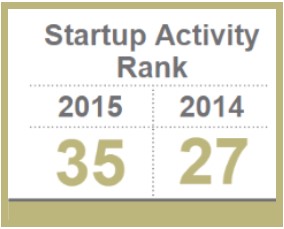
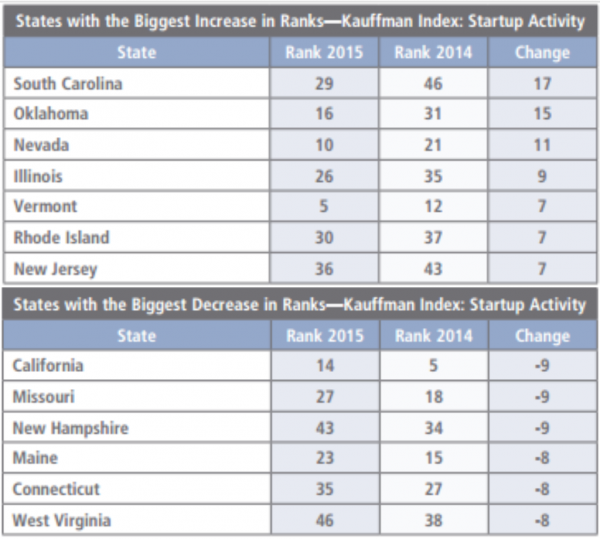
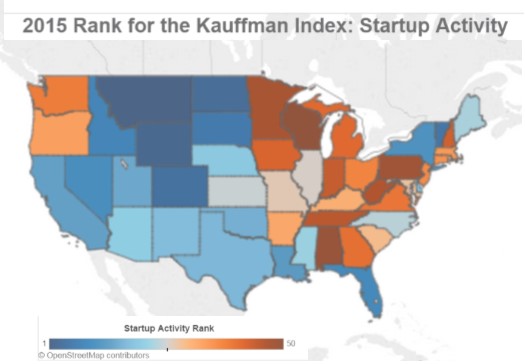
Connecticut dropped from number 27 a year ago to number 35 in the nation in business start-up activity, according to annual rankings developed by the Kauffman Foundation.  The drop of 8 positions was among the six worst among the 50 states, the analysis indicated.  Only New Hampshire, Missouri and California plummeted further, each dropping nine positions in the annual rankings. Nationally, the U.S. economy reversed a five-year downward trend in startup activity last year with a big jump in the number of new entrepreneurs - the largest year-over-year growth in two decades, according to the analysis.  New business creation increased in 32 states.  Connecticut was not among them.rank

The largest leaps forward came in South Carolina, jumping from 46th to 29th, Oklahoma, from 31st to 16th and Nevada, from 21st to 10th in the 2015 rankings, based on 2014 data.  Three components were used to make up the rankings:  the rate of new entrepreneurs, the opportunity share of new entrepreneurs and startup density.

states_insertThe top ranked states were Montana, Wyoming, North Dakota, Colorado, Vermont, South Dakota, Alaska, Idaho, Florida, Nevada and New York.
Connecticut dropped in two of the three key measures of startup activity used by Kaufman in the analysis.  The “Opportunity Share of New Entrepreneurs” fell from 76.9% to 74.9%.  The stat is described as “the percent of new entrepreneurs starting businesses because they saw market opportunities.”  The “Rate of New Entrepreneurs” fell from .31% to .29%.  That measure is the percent of the adult population that became entrepreneurs in a given month.

The final measure in the Kauffman formula, Startup Density, saw a slight uptick for Connecticut.  The stat consists of the number of startup firms per 100,000 residents, defined as firms less than one year old employing at least one person besides the owner.  Connecticut moved from 105.3 in the previous year to 110.4.USA map

For the past 10 years, the Kauffman Index has been "a trusted, early indicator for entrepreneurship in the United States," used by entrepreneurs and policy makers, from the federal to state and local levels.

UConn Brings Science to Downtown Hartford, In Informal Preview

A couple of drinks, some munchies and spirited discussion about an unlikely topic, “3D Printing:  Living Tissue to Human Organ.”  That was the recipe for the kick-off of a new panel series in downtown Hartford sponsored by UConn and the UConn Foundation aimed at facilitating conversations between science experts and the public. The “UConn Science Salon” series, taking place at downtown restaurants, is a precursor of the type of programming that is expected to pop up around the city when the UConn Hartford Campus takes up residence in the former Hartford Times building two years from now, just down the road from Front Street, where the June 4 event was held at Nix.ScienceSalon_Graphic-01-e1432649930237

The next event in the series, “SciFi Meets Reality,” will be held in Hartford on Sept. 17, from 6 to 8 p.m., at a location to be determined.

University Communications science writer Kim Krieger says UConn Science Salon series gives attendees easy access to top scientists and experts and “raise the profile of UConn research in a friendly, stylish way.  The purpose of the program is to enhance public discourse at the intersection of science and culture,” she told UConn Today. “Sure, people can read about research and technological developments, or watch some talking head opine about it on television. But how often does the average citizen get to ask a scientist a question?”

The initiative is not unique, but it is new for UConn, and Hartford.Salon150604d081

“The goal is to share exciting developments in technologies through an engaging and interactive format,” UConn Provost Mun Choi. “The insights from leading experts will lead to a greater understanding of the role of science and technology in our society.”

Science cafés are held all over the world, according to sciencecafes.org, a site run by NOVA as a resource for those interested in hosting or attending such events. The events, which have been around for about a decade, are typically casual gatherings held in places like coffeehouses, pubs, and libraries, and are focused on facilitating discussions about science.  In Connecticut, New Haven and Branford have seen science cafés.

“These are not long lectures with a passive audience listening to an expert,” the site points out. “Rather, they are dynamic, two-way interactions between a scientist and the public. In this way, the public feels empowered to learn, and the scientist speaker gains valuable perspective on his or her own work.”

Provost Choi adds that attendees will see how “UConn is playing a critical role in advancing science and engineering in areas such as genomics, manufacturing, and sustainability,” UConn Today reported. The June discussion focused on state-of-the-art initiatives in 3D printing and the potential for the technology – also known as additive manufacturing – particularly in the field of health care.Salon150604d177

Panelists at the inaugural event, attended by about 120 alumni, faculty, staff and members of the public, were Anson Ma, a UConn assistant professor of chemical and biomolecular engineering; Richard Langlois, a UConn economics professor; Dr. John Geibel, vice chairman of the Department of Surgery and director of surgical research at Yale University School of Medicine, who leads one of seven global teams competing to create a viable regenerative or bioengineered liver; and Dale Kutnick, senior vice president emeritus and distinguished analyst at the technology research firm Gartner Inc.  Lakshmi S. Nair – UConn assistant professor of orthopaedic surgery and chemical, materials, and biomolecular engineering – moderated the discussion.science cafe

Tickets for the events are $15 and can be purchased at UConnAlumni.com/ScienceSalon.  Drinks are extra.

(UConn photos by Peter Morenus)


17 CT Companies Reach Fortune 500, From #8 GE (Fairfield) to #487 Amphenol (Wallingford)

Connecticut has a total of 17 companies headquartered in the state that are now ranked on the Fortune 500, as the latest annual business list is published by Fortune magazine this week.  That includes one company, General Electric, in the top 10, a total of seven companies in the top 250, and two that reached the Fortune 500 list this year. The nation's largest companies ranked in the newly updated Fortune 500 list earned combined total annual revenue of $12.5 trillion last year — an all-time high that's up 2.6 percent from the year before.  Total market value of firms that made the 2015 list reached $17.4 trillion as of March 31, also an all-time high that's up 7.7 percent from the previous year, the publication announced.  This year's list of U.S. companies ranked by their 2014 revenue also employ 2fortune500logo6.8 million employees in all, more than ever, according to Fortune, whose issue with the 61st annual ranking is out this week.

The top 10:  Walmart, ExxonMobil; Chevron; Berkshire Hathaway; Apple; General Motors; Phillips 66; General Electric; Ford Motor and CVS Health.  CVS Health made the top 10 for the first time.  There were 19 companies that made their debut on the 2015 list of the nation’s top 500 companies, including Netflix, Salesforce.com, Expedia and News Corp., as 26 firms dropped out of the updated ranking.  Facebook, in its third year on the list, jumped into the top 250, at number 242, up from number 341 a year ago.

The 7 companies headquartered in Connecticut that rank among the 250 top businesses on the list:

  • 8. General Electric of Fairfield (up from 9 last year)
  • 45. United Technologies of Hartford (same as last year)
  • 49. Aetna of Hartford (up from 57)
  • 90. Cigna of Bloomfield (up from 97)
  • 143. Xerox of Norwalk, down from 137.
  • 160. The Hartford Financial Services Group of Hartford (down from 113)
  • 249. Praxair of Danbury (down from 233)

The 8 Connecticut-headquartered companies that remained in the Fortune 500, and 2 companies that earned a slot for the first time:

  • 261. Stanley Black & Decker of New Britain (down from 255)
  • 317. Charter Communications of Stamford (up from 331)
  • 339. Priceline Group of Norwalk (up from 383)
  • 377. Terex of Westport (down from 358)
  • 385. W.R. Berkley of Greenwich (up from 409)
  • 421. EMCOR Group of Norwalk (down from 407)
  • 442. Starwood Hotels & Resorts of Stamford (down from 424)
  • 461. United Rentals of Stamford (up from 500)
  • 486. Harman International Industries of Stamford (up from 576)
  • 487. Amphenol of Wallingford (up from 533)

harmanLogoOne of the two new entries on this year’s list that are headquartered in Connecticut is Harman International Industries, based in Stamford, the parent company behind an array of world-renowned audio brands including AKG®, Harman Kardon®, JBL®, Mark Levinson®, Lexicon®, and Infinity®.  Well established for six decades, since it was launched by audio pioneer Sid Harmon, the company’s founder, the current Chairman, President and CEO is Dinesh Paliwal. states

Amphenol-Corporation-logoAmphenol World Headquarters is in Wallingford, and a number of the international company’s divisions are also based in Connecticut: Amphenol Nexus Technologies Division is in Stamford, Amphenol Times Microwave and Times Fiber Communications in Wallingford, Spectra Strip in Hamden and Amphenol RF in Danbury.  Amphenol, founded in 1932, is one of the largest manufacturers of interconnect products in the world. The Company designs, manufactures and markets electrical, electronic and fiber optic connectors, coaxial and flat-ribbon cable, and interconnect systems.  The primary end markets for the company's products are communications and information processing markets, including cable television, cellular telephone and data communication and information processing systems; aerospace and military electronics; and automotive, rail and other transportation and industrial applications. (see company video)

Fortune 500 companies had revenues last year that equaled 71.9 percent of U.S. GDP—up from 58.4 percent two decades ago, and 35 percent in 1955, according to Fortune. “To be sure, much of that revenue comes from overseas operations. But these companies are still the guts of the U.S., and the global, economy,” the publication points out.greatest challenge

As part of the magazine’s research for the list, they sent a survey to all the Fortune 500 CEOs. One question asked: What is your company’s greatest challenge? “The rapid pace of technological change” topped the list, besting “cybersecurity” (a close second), as well as other traditionally popular responses, such as “increased regulation,” “shareholder activism,” and a “shortage of skilled labor.” Interestingly, 94 percent of those who responded said their companies would change more in the next five years than in the past five, Fortune reported.

New York is the state with the most companies on the list with 55, followed by Texas with 54 and California with 53.  There are 33 companies headquartered in Illinois, 23 in Ohio, 20 in Georgia, 19 in New Jersey and Virginia, 18 in Pennsylvania, 16 in Florida, and 10 in Wisconsin.

Walmart takes the top spot for the third year in a row and the eleventh time ever.Only three companies have held the number 1 spot on the Fortune 500 since its creation in 1955: General Motors, Exxon Mobil and Walmart, according to published reports.


New Leadership, Funds Preserved at Connecticut Trust

It has been a busy week for The Connecticut Trust for Historic Preservation.  The organization has announced the hiring of a new Executive Director – the first in nearly two decades – and seen its lobbying efforts pay off at the Capitol as the planned government raid of its funds has been stalled. The Trust has hired Daniel Mackay to be the organization’s Executive Director, to succeed retiring Executive Director of eighteen years, Helen Higgins. He will be responsible for furthering the Connecticut Trust’s mission of preserving, protecting and promoting buildings, sites, structures and landscapes that contribute to the heritage and vitality of Connecticut communities.40

"We are extremely fortunate Helen Higgins has been our Executive Director for the past 18 years. We cannot thank Helen enough for strong leadership and the advances the Trust has made during her tenure," said Board Chairman, Charlie Janson.

new guy“We are equally fortunate in bringing Daniel Mackay to the Trust. Dan has tremendous experience, vision and a passion for historic preservation. We also know that he will nurture the relationships of the Trust with the Governor's office, our legislature and the other organizations we partner with. We are very excited for a bright future led by Daniel.”

That future began with good news.  Governor Malloy had proposed a 100-percent sweep of Community Investment Act Funds from Jan. 1, 2016 to June 30, 2017 and in his deficiency bill proposed an additional sweep of $15 million.  The budget that was approved Wednesday by the state legislature added back 50 percent of the cut that begins on Jan. 1, officials said.  In addition, there is no sweep of funds to address the deficiency.

Mackay will come to Connecticut after fifteen years with the Preservation League of New York State as Director of Public Policy, where he was the lead advocate for implementation and expansion of the New York State Rehabilitation Tax Credit program, with key legislative victories along the way. He was also the lead author of extensive revisions and expansion of New York State model historic preservation law for local municipalities between 2012 and 2014.  He holds an undergraduate degree in Geography from the University of Chicago and a Masters in Environmental Education from Lesley College.ctt_pub_default

Upcoming on the CT Trust calendar is a guided ride through historic Ivoryton, Essex and Deep River on June 13 for the Preservation Pedal, with a few scenic stops including a brunch break at Whistle Stop Cafe in Deep River before returning to Ivoryton. The event is a fundraiser and bike tour, honoring the organization's 40th anniversary.pedal

The Connecticut Trust is a nonprofit, member supported organization, one of the foremost statewide preservation organizations in the country. The organization provides technical assistance, financial assistance, workshops, publications and advocacy in preservation matters and issues. The Trust receives daily requests for technical restoration information including the names of contractors, architects, consultants and craftsman who have experience with historic buildings, and has compiled a Restoration Services Directory for use by those seeking restoration professionals and suppliers in Connecticut and surrounding areas.

CT Ranks #15 in USA in Job Growth This Year

Connecticut’s job growth during the first four months of the year ranked fifteenth among the states, according to data compiled by Governing magazine.  Connecticut average employment between January 1 and April 30, 2015 increased by eight-tenths of one percent from the previous four-month period.  Average employment was 1,685,375, an increase of 13,500 from the four months ending 2014.jobs Idaho recorded the largest percentage increase over the four-month period (+2.2 percent), followed by Utah (+1.8 percent). The other leading job growth states, by percentage, were Washington, Oregon, Michigan, South Carolina, Florida, Nevada, California, North Carolina, Arizona and Vermont.  In West Virginia, Louisiana and Maine, average monthly employment declined slightly.

job growthMuch of how state economies are performing is due to the individual sectors making up their employment base, Governing reported, as several industries experienced weak growth to start the year. Nationally, construction and manufacturing employment expanded little over the first four months, and government employment (local, state and federal), similarly remained essentially unchanged since January, the analysis pointed out.

Nationally, total state and local government employment peaked during the early stages of the recession in the summer of 2008, reaching about 19.8 million jobs. The U.S. Labor Department's most recent estimates indicate the sector remains about 630,000 jobs below this level.  By sector nationally, construction jobs led the way, with government jobs the slowest growing sector.

In April in Connecticut, according to the state Department of Labor (DOL), the private sector lost 300 (-0.02%) positions, although Connecticut private sector firms have increased employment by 21,300 (1.49%) jobs from a year ago, according to state data.  Four of the ten major industry supersectors added jobs in April and just three declined, according to DOL. Financial Activities, Other Services, and Information came in unchanged. Government(1,500, 0.6%) led all industry supersectors in April, with local government (1,400, 0.9%) entities providing the majority of the increase. Manufacturing (1,400, 0.9%) also posted a good-sized monthly increase in April with the durable goods components (1,200, 1.0%) being the strongest performer. The combined Construction and Mining (1,300, 2.4%) supersector experienced healthy April gains as well in a potentially good sign for the home building sector, the DOL analysis pointed out. Education and Health Services (200, 0.1%) showed a small gain, primarily driven by private educational services (400, 0.6%).dol_v4_header_01

In a year-by-year comparison for the month of April, Connecticut (nonfarm) jobs have grown by a seasonally adjusted 9,100 in 2015, which compares to 11,000 in the first four months of 2014, 7,000 for the same timeframe in 2013, 5,000 for 2012, and 10,500 for 2011, according to DOL data.

Connecticut Is Part of ESPN’s Strategic Focus on Corporate Citizenship Targeting Youth

There’s a change at ESPN.  The sports giant has launched a new citizenship strategy focused on using the power of sports for social good, and Connecticut is very much a part of the strategy. The launch includes a new name change (from Corporate Outreach to Corporate Citizenship), as well as a new website that highlights ESPN’s commitment to the community, www.ESPN.com/Citizenship,  Ed Durso, ESPN’s Executive Vice President of Administration, in explaining the overall strategy, said ESPN has “a tremendous legacy of giving and as our brand and reach have grown, so too has our commitment to the community. We are now taking a more strategic approach that focuses on using sports to transform lives and uplift communities.”

Durso explained that ESPN will focus in five key areas:espn

  • Access to Sports
  • Leadership Through Sports
  • The V Foundation
  • Good Neighbor grants
  • Sustainability

He noted that “ESPN can offer meaningful help to many in need. For example, it may be surprising to some, but youth sports participation in the U.S. has been on the decline since 2008. The decline is due to many factors and the problem is especially prevalent in underserved communities.

This is worrisome because sports is so important to development.”

teamespn_info_002“Studies show that kids who are physically active have higher test scores, are more likely to go to college, and smoke and drink less,” he added. ”Sports can also help build life skills, including enhancing self-esteem, unifying teams and driving social inclusion. By driving support to entities enhancing access to sports, we can help.”

Earlier this year, ESPN announced it would team up with the National Recreation and Park Association (NRPA) to award grants to seven local park and recreation departments in the U.S. that improve and expand their youth sports programs, especially in underserved communities.  The $150,000 grant would be targeted to purchase needed equipment, make improvements in facilities and help local parks expand their programs to give more children the opportunity to participate in community-based sports.

The communities receiving grants included Hartford, Los Angeles, Charlotte, Coral Gables, New York City and Austin.  In Hartford, the parks department set out to introduce 1,000 kids, ages 3-6 years, to the sport of soccer throughout the winter at inside recreation centers, with the objective of launching the "Litter Soccer Stars" league this spring, according to ESPN.

We believe that everyone should have the opportunity to play sports and be able to take advantage of its many benefits. ESPN is working with nonprofits to develop sports curriculum, distribute sports equipment and create safe spaces to play sports. We’re also finding ways to foster physical development, leadership and life skills through sports. We’re working with others who share this vision, and together hope to make sports more accessible, especially to those in underserved communities,” Durso explained.

A 2014 study from the University of Kansas suggests that if students are given a compelling reason to come to school—even if that reason has nothing to do with academics – they will. University of Kansas’s Angela Lumpkin and Rebecca Achen analyzed high-school testing, graduation, and attendance data and found that Kansas’s student athletes go to school more often than non-athletes. They also have higher graduation rates: 98 percent of athletes in Kansas’s class of 2012 graduated, compared with 90 percent of non-athletes.

An article published in The Atlantic pointed out “The higher graduation rates could be explained away by the theory that teachers have lower standards for athletes—that they’re willing to let athletes pass without doing all the work. But state test data challenges that theory: Athletes also score highfuture filmmakerer on the Kansas state assessments than non-athletes, in all subject areas. They are clearly learning something in their classes.”

ESPN has also included 32 colleges and universities across the country in a new initiative with the legendary Tribeca Film Institute for budding filmmakers.   Connecticut’s Quinnipiac University, University of Hartford, and Connecticut College are among the eligible institutions.   The TFI/ESPN Future Filmmaker Prize will award three graduate level media makers devoted to creating short-form documentaries highlighting the exceptionally creative work of an athletic community or organization that is working towards solving social issues in the United States or around the world. Submissions opened May 5 and close July 5.

The prize aims to support the next generation of filmmakers in producing creative, story-driven films that highlight issues of social importance through the lens of sports, athletics and or competition with a $25,000 production grant.

Recipientsteamespn_icons_008 will also receive professional guidance and mentorship from TFI staff and select media professionals. Along with the monetary grant, the three filmmaking teams will participate in a two-day workshop in the fall with activities tailored to their needs and culminating with an industry showcase to both celebrate their work and introduce them to the filmmaking community at large.

The workshop will include pitch training, story structure lectures, footage critiques, master classes led by industry leaders and one-on-one meetings with industry professionals and nonprofit athletic institutions. Also, each grantee will be paired with a current or former Tribeca Film Fellow. They will work closely together throughout all aspects of the filmmaking process from production to editing.


Governor Travels to Iowa for Insurance Industry Keynote

When “attendees from around the world” convened in the “insurance hub of Des Moines, Iowa,” for the second annual Global Insurance Symposium, the keynote speaker was an individual from a state long considered as the hub of the industry, Governor Dannel Malloy of Connecticut. The symposium, being held this week, was designed to “provide a forum for insurance professionals and regulatory authorities to share insights into challenges facing the insurance industry,” and includes “some of the most knowledgeable experts in the insurance field and discuss important issues facing the industry, such as cybersecurity and big data,” according to conference organizers.

Why Des Moines, Iowa?  The conference website points out that “for decades, Iowa has been committed to policy that creates favorable conditions for the insurance industry to thrive. As home to more than 200 insurance companies, Iowa is uniquely suited to host the Global Insurance Symposium and assemble global leaders to discuss these important issues.”

The symposium will  also serve as a coming out for six start-ups completing Iowa's Global Insurance Accelerator, a fast-track business development program focused on insurance innovation. The accelerator brought together startups from Iowa, Nebraska, California, Germany and Brazil, for 100 days of fast-paced business development, and mentoring.  The initiative was launched in February.

global insuranceIowa Governor Terry Branstad provided opening remarks at Wednesday’s session, followed by Malloy’s keynote address.  Branstad, a Republican, and Malloy, a Democrat, were re-elected by voters in their respective states last fall.


The 2014 Connecticut Insurance Market Brief reports that Connecticut ranks #1 in the U.S. for insurance carrier employment as a percentage of total employment, #1 in the U.S. for insurance payroll as a percentage of total payroll (5.6 percent) and that one new job in the insurance industry results in 1.73 additional jobs to the Connecticut economy.  The insurance sector accounts for 5.7 percent of Connecticut’s Gross State Product, ranking #2 in the U.S. as a percentage per capita. CT map insurance

A 2012 report by the Connecticut Insurance and Financial Services (IFS) Cluster and PwC US indicated that an increase of $1 in insurance labor income puts an additional $0.78 into state commerce; and every year the insurance industry purchases an average of $2 billion in goods and services from other industries in Connecticut.

The Iowa Economic Development Authority reports that “Iowa’s insurance industry grew by 11 percent during the past 15 years, while industry throughout the entire U.S. was flat.”  The agency indicates that while Iowa has 1.6 percent of the nation’s finance and insurance jobs, it generates 2.9 percent of the nation’s insurance GDP.

FIT01_InsuranceLocationMap

In a op-ed co-authored by the two Governors and published in 2012 by the Connecticut Post, Malloy and Branstad pointed out that “in Connecticut and Iowa, the multibillion-dollar insurance industry remains one of the essential anchors for sustained prosperity and quality of life. Both states are among the top four in the nation for the share of insurance and financial services jobs when compared to the entire workforce. In addition, the U.S. insurance industry is a titan in the world marketplace, accounting for nearly 34 percent of the worldwide market share.”

“Unique and fundamentally stable, insurance would top the list of industries for any governor to nurture and grow in his or her state,” the states’ chief elected officials noted. “The industry attracts a well-educated, well-paid work force of actuaries, financial analysts, attorneys, certified accountants and skilled support staff.”

The text of remarks by Branstad and Malloy at the Global Insurance Symposium were not immediately available, but The Hartford Courant reported that Malloy advocated continued state regulation of the industry, rather than an increased federal regulatory scheme.  "Our states, our commissioners and our governors need to be more actively involved if we are going to protect our industry as we know it, and not be dictated to, not simply by people in Washington but people abroad as well," the Courant quoted Malloy as stridently urging those gathered for the symposium.

https://youtu.be/R_aApLrqy5o

https://youtu.be/CmDCxvRIC3I

Agencies, Organizations to be Honored for Efforts Advancing Local Downtowns

A high school AP economics class that engages students in proactive land-use planning, the owners of a downtown Segway tour company that let the community help name their new business, and the state’s Department of Transportation are among the organizations and initiatives chosen to receive a 2015 Award of Excellence from the Connecticut Main Street Center (CMSC). Seven recipients were selected for the prestigious award, representing initiatives in Mansfield, New London, Putnam, Simsbury, Waterbury, and Upper Albany in Hartford.segway

The other winning entries included a First Fridays series that draws thousands of visitors with its hands-on arts and cultural events; a massive, multi-cultural downtown gathering of dozens of ethnic groups to celebrate a common community pride; a multi-year, multi-million dollar public/private partnership to design and build a brand-new town center; and a local merchant who remains committed to the neighborhood and the state despite becoming an international success.

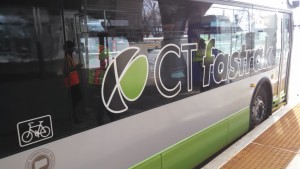
wpid-img_20150311_152459_058For the first time in the history of the awards program, a state agency was also selected to receive an award. The CT Department of Transportation received a special award for Starting a Revolution: Integration of Land Use and Transit in recognition of the progressive nature of CTfastrak, the bus rapid transit system opened earlier this year. The awards jury that selected the winners gave the award because they felt the new busway represents a cultural shift in how Connecticut views transit, and wanted to acknowledge the future promise of transit oriented development that will hopefully result around the station locations.



The Connecticut Main Street Awards annually celebrate and communicate the most successful and innovative efforts in Main Street revitalization in Connecticut. A jury comprised of industry-related professionals and CMSC staff judged the submissions on criteria that included innovation, replication, representation, partnerships utilized, and outcomes.20150507_townsquare_pavilion

"Our members continue to impress us with how they support, encourage and implement new ideas from the ground up," said CMSC President & CEO John Simone. "They're constantly forming partnerships with new groups, working to sustain local merchants, and tirelessly promoting how wonderful our downtowns and Main Streets are. We're proud of their efforts and excited to share their achievements with everyone else."putnam

The awards will be presented at the 2015 Connecticut Main Street Awards Gala on June 8th at Trinity-on-Main in downtown New Britain. This year's event will feature guided tours of downtown New Britain, including a Downtown Arts, Heritage & Culture tour, a tour of Walnut Hill Rose Garden & New Britain Museum of American Art, and a tour of CTfastrak in New Britain: Transportation, Housing & Main Street.

The full list of 2015 Awards of Excellence winners:

2015 Connecticut Main Street Awards of Excellence                 

Main Street Partnership

▪   Simsbury High School AP Economics Course, to Simsbury Main Street Partnership and Simsbury High School.

Planning

▪   Step by Step: Building a Downtown from Scratch (Storrs Center), to Mansfield Downtown Partnership, the Town of Mansfield, UConn, LeylandAlliance and the Citizens of Mansfield. (photo, above right)

Events & Programming  (Sponsored by Webster Bank)

▪    The Gathering (Downtown Waterbury), to the City of Waterbury, the Waterbury Observer, and Main Street Waterbury.

Award of Merit for Events & Programming

▪   First Fridays (Downtown Putnam), to the Town of Putnam, Putnam Business Association, and the Putnam Arts Council.

Business Owner of the Year

▪   Dawn & Kristin Harkness / Wheeling City Tours (New London), Submitted by New London Main Street.

2015 Main Street Pioneer: Outstanding Commitment to The Avenue  (Sponsored by Webster Bank)

▪    Vivian Akuoko / Evay Cosmetics (Upper Albany Avenue, Hartford), Submitted by Upper Albany Main Street.

Starting a Revolution: Integration of Land Use and Transitphoto_center_01

▪   CTfastrak, to the State of Connecticut Department of Transportation and the Capitol Region Council of Governments (CRCOG).

The Connecticut Main Street Awards of Excellence were created in 2003 to recognize outstanding projects, individuals and partnerships in community efforts to bring traditional downtowns and neighborhood commercial districts back to life, socially and economically.  In recent years, the Awards Gala has been held in New Haven, Hartford, Manchester, Torrington and Bridgeport.