CT Cities Above Average in Pursuing Equal Rights for LGBT Residents, Led by New Haven, Stamford

The Human Rights Campaign (HRC), the nation’s largest lesbian, gay, bisexual, and transgender (LGBT) civil rights organization, has released its fourth annual report assessing LGBT equality in 408 cities across the nation, including seven in Connecticut. The average score for cities in Connecticut is 74 out of 100 points, above the national average of 56. The 2015 Municipal Equality Index (MEI), the only nationwide rating system of LGBT inclusion in municipal law and policy, shows that cities across the country, including in Connecticut, continue to take the lead in supporting LGBT people and workers, even when states and the federal government have not.MEI-cover-1600x900

Connecticut’s municipal scores are: New Haven: 99, Stamford: 91, Hartford: 91, Waterbury: 70, New Britain: 63, Storrs (Mansfield): 54, and Bridgeport: 51.  Across the country, 47 cities earned perfect 100-point scores, up from 38 in 2014, 25 in 2013 and 11 in 2012, the first year of the MEI. This year’s MEI marks the largest number of 100-point scores in its history.  Stamford scored the biggest jump in Connecticut from last year's analysis, advancing nearly 30 points while four other Connecticut cities also included last year earned similar scores in 2015.

For LGBT Americans, legal protections and benefits vary widely from state to state, and city to city. The MEI rates cities based on 41 criteria falling under five broad categories:

  • Non-discrimination laws
  • Municipality’s employment policies, including transgender-inclusive insurance coverage, contracting non-discrimination requirements, and other policies relating to equal treatment of LGBT city employees
  • Inclusiveness of city services
  • Law enforcement
  • Municipal leadership on matters of equality

The review indicates that in 31 states, LGBT people are still at risk of being fired, denied housing or refused service because of who they are, and who they love. The lack of legal protection in many states is driving the HRC effort to pass the Equality Act, which would extend nationwide non-discrimination protections to LGBT Americans. Officials say that the MEI is a crucial tool in evaluating the patchwork of LGBT policies and practices in cities and towns across the nation.

New Haven received an initial score of 94, before receiving 5 bonus points for municipal services and being a “welcoming place to work.”  The Elm City earned perfect scores in 4 of the 5 categories - for non-discrimination laws, municipal services, law enforcement and the relationship with the LGBT community.  Hartford earned a perfect score in three categories, but fell short in “law enforcement” and “municipality as an employer”.  The city has an initial score of 84, before receiving 7 bonus points, for providing services to LGBT elderly, youth, homeless, and people living with HIV/AIDS. muni index

Bridgeport earned a perfect score in one category, non-discrimination laws, but a 0 in the “municipality as employer” category.  The city did, however, receive 2 bonus points for being a “welcoming place to work.”

In 2014, the MEI included only five cities in Connecticut – Bridgeport, Hartford, New Haven, Stamford and Storrs (Mansfield). Stamford jumped 29 points in a year, while New Haven and Hartford each lost a point between last year and this year’s survey.  Bridgeport and Storrs also dropped slightly in the new ratings. The scores last year:  New Haven: 100, Hartford: 92, Stamford: 62, Storrs 59, Bridgeport: 57. Stamford’s much higher rating was driven by three categories: non-discrimination laws, where the score moved from 18 to 30, relationship with the LGBT community, which increased from 2 to 8 and also picked up 7 bonus points, and municipal services, which increased from 10 to 16.

“Across our country, cities and towns both big and small aren’t waiting for state or national leaders to move LGBT equality forward,” said HRC President Chad Griffin. “Instead, these municipalities are taking action now to improve the lives of countless LGBT Americans. In what has been an historic year for equality, a record-breaking number of municipalities this year have earned top scores in our Municipal Equality Index for their inclusive treatment of their LGBT citizens and workers. They are making a powerful statement that no one should have to wait for full equality - the time is now.”

Key findings contained in the MEI, issued in partnership with the Equality Federation, provide a revealing snapshot of LGBT equality in 408 municipalities of varying sizes, and from every state in the nation. The cities researched for the 2015 MEI include the 50 state capitals, the 200 most populous cities in the country, the five largest cities in every state, the city home to the state’s two largest public universities, and an equal mix of 75 of the nation’s large, mid-size and small municipalities with the highest proportion of same-sex couples.

"This year, an unprecedented wave of discriminatory legislation attempted to roll-back our efforts for LGBT equality,” said Rebecca Isaacs of the Equality Federation. “Despite that challenge, over 20 towns and municipalities passed non-discrimination ordinances, some in the most unexpected places. These wins, along with historic LGBT visibility, speak to the tenacity of our advocates all across the country, many of whom donate their time to achieve fairness and equality. The MEI is an important tool for our movement that illustrates our successes and the work ahead of us. We will not stop until all Americans have a fair opportunity to provide for themselves and their families, free from the scourge of discrimination."

The 2015 MEI revealed that 32 million people now live in cities that have more comprehensive, transgender inclusive non-discrimination laws than their state or the federal government. Cities with a higher proportion of same-sex couples tended to score better, officials said, and the presence of openly-LGBT city officials and LGBT police liaisons also were correlated with higher scores.  The average city score was 56 points, with half of the cities researched scoring over 61 points. Eleven percent scored 100 points; 25 percent scored over 77 points; 25 percent scored under 31 points; and five percent scored fewer than 10 points.

At the state level, earlier this year, the Connecticut legislature approved a new law ensuring that transgender people can change their birth certificates to reflect their correct name and gender without unnecessarily expensive and invasive obstacles. The new law simplifies the process by empowering transgender people to change their birth certificate by providing a statement of appropriate treatment by a healthcare provider.  It took effect on October 1.  Similar laws have been approved in Hawaii, California, Iowa, New York and Vermont.

The full Human Rights Campaign report, including detailed scorecards for every city, as well as a searchable database, is available online at www.hrc.org/mei.

Child Poverty on the Rise; State Budget Percentage for Children Dropping, Advocacy Group Says

When the state legislature in Special Session this month restored planned budget cuts that would have adversely impacted Connecticut children and families, advocates for those segments of society praised the action.  But they also took the opportunity to highlight continued disparities and shortfalls in the level of state resources allocated to programs and policies impacting children in the state. “Alleviating the wide disparities left in the wake of the economic recovery, including record-high child poverty, requires a state budget that reflects the needs of our children and families,” pointed out Connecticut Voices for Children, an organization marking two decades of advocating for Connecticut children. CV chart

They went on to point out that a recent update to their Children’s Budget finds “continued long-term disinvestment in programs that serve children and families,” such as K-12 education, developmental services, and health coverage - down nearly 10 percentage points from the early 1990s when the state spent nearly 40% of the General Fund on such programs.

They also noted that while child poverty has increased by more than 16.4 percent since the economic recovery began in 2010 (from a rate of 12.8 percent to 14.9 percent), the share of the state budget that is appropriated to the Children’s Budget has declined by 5.7 percent (from 32.4 percent of General Funds to 30.6 percent).

“We believe that more can and must be done in the upcoming session and in the years to come to reverse the long term decline in state investment in children and youth and to prioritize the establishment of equitable opportunity across race, ethnicity and zip code,” said Ellen Shemitz, executive director of Connecticut Voices for Children.  The legislature’s 2016 session convenes in February.

Among the aspects of the budget impacted in the Special Session were a series of “short-term fixes,” according to published reports, such as transferring $5.7 million from various accounts to the state's general fund, including the school bus seat belt account, and $15.1 million from public colleges and universities. voices logo

A November report by Connecticut Voices for Children found that "despite lower levels of unemployment, the recovery has left behind many of our state’s residents, including people of color, young workers, those paid low wages, and many with relatively low levels of education. These trends have  made it more difficult for families to afford their most basic needs."  The report stressed that "failure to address the needs of our children sets us up for an intergenerational cycle of poverty that will undermine preparedness for work in a state that has long boasted one of the nation’s most productive and highly educated workforces."

childenThis summer, Shemitz was among those appointed to serve on the state’s Commission on Economic Competitiveness, created by the legislature amidst concerns in the state’s business community about the perceived lack of competitiveness.  The Commission is considering steps to improve Connecticut’s employment and business climate including measures to support workforce development and family and economic security.  Recommendations are anticipated for legislative action next year.

Writing recently in the Hartford Business Journal, Shemitz stressed that the state needs “a healthy economy to assure gainful employment and economically secure families.”  She noted that “business climate is about more than taxes.  A healthy business climate requires good transportation and a highly educated workforce, both of which depend upon strategic planning and public investment.”  The Commission’s organizational meeting was held in September.  (CT-N coverage)  It is co-chaired by State Rep. William Tong (D-Stamford) and Joe McGee, Vice President of the Business Council of Fairfield County.

Based in New Haven, the mission of Connecticut Voices for Children is to “promote the well-being of all of Connecticut's young people and their families by advocating for strategic public investments and wise public policies.”


Fairfield County’s Community Foundation Strives to Create Opportunities for Young Adults Close to Home

For Fairfield County’s Community Foundation, two local trends are unmistakable.  Connecticut’s population is aging, and too many young people are unable to become self-sufficient by age 25. The recognition that as older, experienced workers retire, Connecticut’s economy will increasingly rely on young adults to provide goods and services, lead companies, and start new businesses has been the impetus for action, and a new initiative underway this fall.thrive

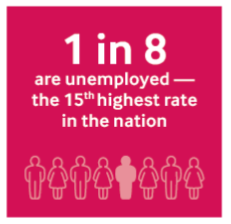
Fairfield County’s 100,000 young people ages 16 to 24 face youth unemployment rates between 13.6 percent and 49.5 percent, one of the nation’s most expensive housing markets, and a shortage of living-wage entry jobs.

A multi-faceted initiative, Thrive by 25, has begun with the clear goal of advancing opportunity for the region’s young adults – no easy task in Fairfield County.thrive

“If our young people are not prepared for tomorrow’s jobs, or they relocate to find quality jobs and housing they can afford, employers will recruit from other states or leave. Businesses will struggle. Unemployment will rise, our tax base will shrink, and the need for government services will increase,” the organization’s website sums up the challenge.

“Our vision is for every young person in Fairfield County to achieve self-sufficiency, thrive by 25, and enrich their communities. We see three paths to this accomplishment: college readiness and scholarships, vocational education, and quality internships,” the website indicates.fccf_large

The program brochure is encouraging, noting that in a local survey 95 percent of respondents ages 18 to 25 have some vision of what they want to achieve in a career and many are interested in completing a master’s degree.  In addition, the “intersection of jobs and education” is highlighted:  “a growing body of research suggests that low-income teens who participate in after-school internships and summer jobs during high school are likely to have higher grades, better attendance, a greater likelihood of graduation, and a higher average salary throughout their lifetime.”

unemploy statThe action plan is spurred by clear concerns: “When young people are not attending school or working, they cannot attain necessary education or work experience, support themselves, save for their future, or contribute to the economy. What future do they face? What future does Fairfield County face?”
Seven steps have been developed to guide the effort:

  1. Listen to Fairfield County’s young adults.
  2. Reach out to others who have a role in making an impact on these issues.
  3. Make vocational-technical secondary school programs, apprenticeships and personalized training more widely available to high school students.
  4. Enhance early college programs and the transition from high school to college
  5. Tap into the lessons learned from other local and national efforts
  6. Ensure local nonprofits are prepared to be key participants in Thrive by 25
  7. Focus the Community Foundation’s resources as effectively as possible

A highly attended Kick-off Breakfast at the Trumbull Marriott launched the initiative, with JPMorgan Chase & Co. announcing an expansion in their commitment to Connecticut, joining the Community Foundation in supporting the Pathways to Careers Fairfield County pilot with a $200,000 grant. The grant is part of JPMorgan Chase & Co.’s New Skills at Work initiative, which seeks to address the skills gap that exists across many industries, where not enough trained workers have the specific skills to fill the jobs available.800

Pathways to Careers Fairfield County is a multi-sector partnership with high-opportunity and high-growth employers and is based on Our Piece of the Pie’s Pathways to Careers model. Our Piece of the Pie, a Hartford-based, urban youth development and workforce opportunity non-profit organization, has developed the successful upstate CT Pathways to Careers program into a best-practice model for moving young people quickly into jobs with career pathways.

Fairfield County’s Community Foundation promotes philanthropy as a means to create change in Fairfield County, with a particular focus on innovative and collaborative solutions to critical issues impacting the community. Individuals, families, corporations and organizations can establish charitable funds or contribute to existing funds.

The vision of the Thrive by 25 initiative is “to give all Fairfield County youth the opportunity to thrive by age 25 – no matter their family income, school district or zip code.”  For more information, visit www.FCCFoundation.org.


Is TV Traffic Reporting in Connecticut For Women Only?

Three of the women who deliver traffic reports each weekday morning on Connecticut's four network-affiliated television stations have backgrounds in television news reporting, and the fourth has made traffic her specialty on local radio stations as well as television.   They are unquestionably hard-working professionals whose reporting is seen, and relied upon, by thousands of commuters each day.  They hold jobs, however, that appear to be reserved for women. Few recall the last time  that a man was the regular morning traffic reporter on a local television station in the sate, although men and women serve, or have served as anchors, reporters, sports reporters, and meteorologists.  At a time when more attention is being paid to the gender-centered nature of some positions in the workplace, televised traffic reporting in Connecticut remains squarely the domain of women.  traffic

Heidi Voight, the traffic reporter for NBC Connecticut, is a Connecticut native, has television news experience in Springfield, Mass., and is a national spokesperson for the M.I.A. Veterans Recovery Project.  The station points out that Voight “has been exposed to nearly every position in the newsroom and has experience reporting, anchoring, shooting video, working on the assignment desk and producing newscasts.”  Voight succeeded Kayla James.

Nicole Nalepa came to WFSB from WWLP-TV/22News in Springfield, MA where she anchored the early morning weekday newscast. She also served as the senior weekday morning reporter and early morning show producer in Springfield, and was one of the first live, on-scene reporters from Western Massachusetts during the manhunt for the Boston Marathon bombing suspect.  Previously, Nalepa was selected for a post-grad summer internship at CBS News on the "CBS Evening News with Katie Couric." She also interned at WFXT-Fox 25 in Boston.  Nalepa succeeded Olessa Stepanova, who moved on to handle traffic chores for Boston's WCVB after three years in Hartford.   traffic

Teresa DuFour has been working in the news and entertainment industry since 2003. The morning traffic reporter for  WTNH News 8’s Good Morning Connecticut started off behind the camera, and worked her way up from the assignment desk to the news desk.  After DuFour graduated from the University of Connecticut in 2001 with her bachelor’s degree in broadcast journalism, she worked at a number of radio stations across the state. She anchored and reported daily newscasts for KISS 95.7 and Westwood One Radio Network. Between 2004 and 2006, she was a reporter and anchor for KTVE and KARD in New Orleans, covering Hurricane Katrina, among other stories.  A native of Middlebury, she had her first child earlier this year, and serves as co-host of the WTNH program Connecticut Style.  She succeeded Desiree Fontaine in both roles.

While DuFour was on maternity leave, traffic was reported by Marysol Castro.  A New York City native and Wesleyan University graduate, Castro previously was an anchor at WPIX-TV in New York City and  weather anchor for the CBS News morning program 'The Early Show.'

Fox CT’s traffic reporter Rachel Lutzker gave birth to her third child earlier this year, is a native New Yorker who first came to Connecticut to attend the University of Hartford. While there she began interning at KISS 95.7 and decided to make a career in media. She is also heard each morning on iHeartMedia Connecticut stations providing up-to-date traffic reports, and doing the same on the drive home each workday on The River 105.9.  Rachel’s career has included stops at WCBS New York as traffic reporter, WFSB-TV and now WTIC-TV.traffic

The website payscale.com reports that 59 percent of traffic reporters nationwide are women.   When the CBS affiliate in Chicago was seeking a new traffic reporter a few years ago, they held open tryouts among viewers.  The winner of the  CBS 2 Chicago Traffic Tryouts competition, Derrick Young, was awarded a contract and continues to report the traffic alongside the station's morning news team.

PHOTOS:  Nicole Nalepa,  Teresa Dufour, Heidi Voight, Rachel Lutzker (credits: station websites)

NOTE:  This story will be updated as additional information becomes available.


Despite Drop in Summer Passengers, Bradley Continues Year-Over-Year Growth

For the month of October, there was a 3.6 percent year-over-year increase in passengers at Bradley International Airport, the strongest month thi syear, resulting in an overall 1.1 percent increase over the first ten months of the year, compared with 2014.   Save for a slight dip in July and August (and a minimal drop in February) – compared to record numbers in the  summer months a year ago – Bradley continues to see steady year-over-year increases in passenger traffic. The October uptick follows September’s 1.2 percent a percent increase, reflecting increases in passenger traffic in and out of Bradley during seven of the first ten months of the year, compared with a year ago. BDL

Bradley saw 17,000 fewer passengers in August 2015 compared with the previous August, after a drop of 5,142 passengers in July as compared with July a year ago.  The numbers are included in the minutes of the Connecticut Airport Authority, which oversees Connecticut’s airports including Bradley, the region’s second largest airport after Boston’s Logan Airport.

Since then however, the steady growth has resumed. From January through March, the passenger numbers at Bradley reflected a slight increase of 1.4 percent over the same period in 2014.  If the September and October growth continues in November and December, the airport’s passenger traffic is expected to once again exceed the previous year.

At New England’s other major airports, Logan Airport in Boston showed a passenger increase of 3.8 percent in the first quarter of 2015 above the same period the previous year.  At T.F. Green Airport in Providence, RI, passenger traffic declined by 2.3 percent in the year-over-year comparison.Picture6

In April, passenger traffic was up 1.3 percent above 2014 levels.  In May, Bradley again saw a slight uptick from May 2014, with passenger numbers increasing by 3.3 percent to 542,888.  Boston’s Logan Airport was up 4.9 percent from the previous May, and Providence’s T.F. Green Airport was virtually unchanged, up by 63 passengers.

Another increase in June, 1.5 percent above the previous June, continued Bradley’s strong performance.  The same was true of Logan Airport, where passenger numbers were up 5.7 percent in June 2015 as compared with the previous June.

Overall, from January to June, as compared with 2014, passenger numbers at Bradley were up 1.5 percent.  Logan Airport passenger numbers were up 4.4 percent from the previous year, while T.F. Green saw a decline of 1.3 percent.

July saw a decline in passengers at Bradley in the year-over-year comparison.  Bradley’s passenger numbers were down 1 percent for the month – 534,071 in July 2015 versus 539,213 the previous year.  T.F. Green Airport was also down, by 1.7 percent, while Logan saw its passenger numbers higher this year than last, by a considerable 6.8 percent.

In August, passenger numbers at Bradley were down again in 2015 as compared with 2014.  The decline was 3.2 percent, dropping by more than 17,000 passengers, from 538,442 to 521,000.  Logan was up again, by 6 percent, while T.F. Green’s numbers were virtually identical.

Even with the decline in slight declines in February, August and July, however, Bradley still showed a narrow net gain in passengers this year when compared with the first ten months of 2014, just over one percent.  Through September, the calendar year total was 4,435,206.  Among the carriers at Bradley, Southwest (621.027), Delta (489,853), the merged US Air/American (356,209) and JetBlue (310,432) saw the largest number of passengers boarding flights.

Earlier this fall, CAA officials announced the return of trans-Atlantic flights from Bradley, beginning in September 2016.  Bradley will be one of three new aerlocations in the United States to offer Aer Lingus flights to Ireland.  The daily service will include one evening departure from Bradley and one afternoon departure from Dublin.  Published reports indicate that the State offered a $4.5 million guarantee against losses in each of the first two years, plus $5 million in other inducements to establish the Bradley-Dublin route. The financial inducements to Aer Lingus could reach $14 million: up to $9 million in loss protection from the state Department of Economic and Community Development and $5 million from the CAA, including $3.8 million in marketing over three years and about $1.2 million in waivers of various fees at the airport over two years, reports have indicated.

bdl demoThe demolition of the half-century old Terminal B is underway at Bradley, with plans for a transportation center, additional parking (for cars and planes), and free shuttle service from the airport to the train station in Windsor Locks in the planning stages.
The CAA also governs airports in Groton/New London, Danielson, Windham, Waterbury/Oxford, and Hartford/Brainard.  The Authority’s November meeting was cancelled.  It is next scheduled to meet on December 14. The CAA is led by a volunteer Board comprised of regional leaders in transportation, aviation, business, law, politics, economic development, and other areas of industry.  The chair is Mary Ellen Jones of Glastonbury; the vice-chair is Michael T. Long of Simsbury.

Wanna Buy A Ghost Town? Connecticut Has One Ready and Waiting

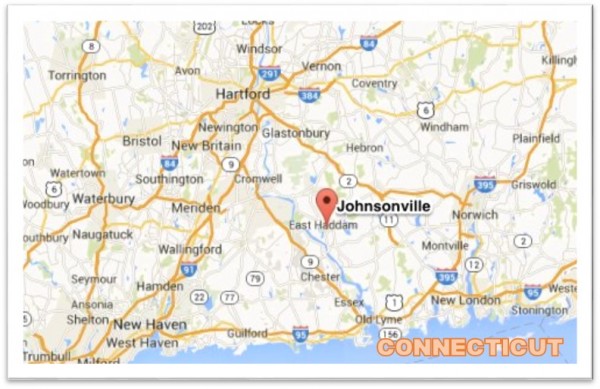
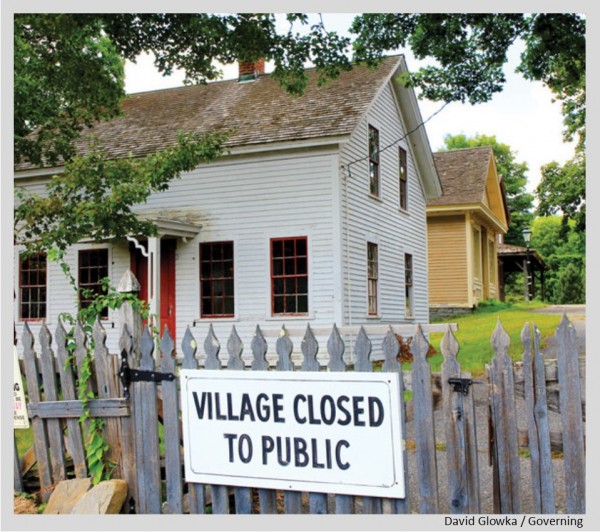
For $2.4 million, an adventurous buyer can become the proud owner of Johnsonville Village, Connecticut. The once bustling hamlet, now a virtual ghost town, is for sale -- again. Originally home to Connecticut’s twine industry in the 1830s, Johnsonville Village, which is located in the Moodus section of East Haddam, along Johnsonville Road just 30 minutes from Hartford and two hours from Boston and New York City, has sat mostly deserted since the Industrial Revolution put it out of business, according to Governing magazine.village

Industrialist Raymond Schmitt bought the property in the 1960s and began traveling New England looking for period buildings in an effort to turn the place into an 18th-century Victorian village, Governing reported. Today, its 62 acres house eight antique buildings, including a schoolhouse, general store, chapel and livery stable. All empty, and awaiting what’s next.

Johnsonville never took off as a tourist attraction, and after a disagreement with local officials, Schmitt abandoned the village in 1994.  It has had its moments, according to published reports.  Lightning struck the mill in the 1970s and burned it down. The village appeared in Billy Joel's music video for the 1993 song "The River of Dreams (In the Middle of the Night)," which topped Billboard’s music charts are received four Grammy nominations, according to Wikipedia.

The current owner, Meyer Jabara Hotels of Danbury, initially put the town up for auction last October. It sold for $1.9 million, but the winning bidder was unable to secure financing.

Now Johnsonville is back on the market, and according to the listing earlier this year, “presents a unique redevelopment opportunity to combine the historic value of the 19th-century village with 21st-century living.”map

"We've got buyers at the table, from developers to summer camps and beyond," the current owners told The Hartford Courant earlier this year.  But a sale and closing has yet to be announced.  The property has eight historic buildings on the western side of Johnsonville Road and, on the eastern side of the road, Johnsonville Mill Pond with a covered bridge, a wooden dam and a waterfall.

Interested parties run the gamut from individual investors to outdoor organizations and religiously affiliated summer camps. There was also an effort by “a bunch of people on Twitter, led by a man named Dan Sinker, trying to pool their money and buy Johnsonville,” according to a report published by Business Insider. The film industry, utility companies, local vineyards and hotel companies are thought to be among the possible buyers.

But not yet.

https://youtu.be/o6fTivyBNak

https://youtu.be/hSq4B_zHqPM

Sciences at Southern Get Dynamic New Home; Local Companies Help Along the Way

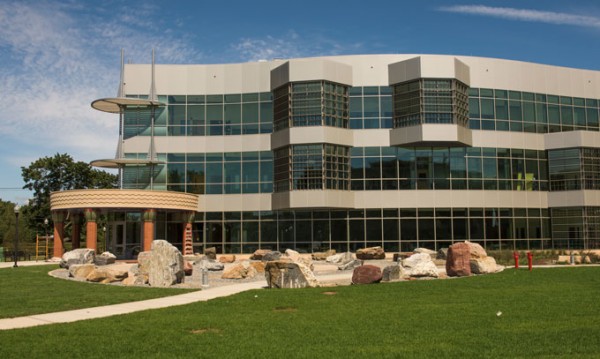
Students attending Southern Connecticut State University this semester are the first to use the campus’ new Academic Science & Laboratory Building, opened this fall, with local companies playing an integral role from design and construction to providing scientific equipment for the new facility. Officials say Southern's ongoing expansion of its science programs has been greatly enhanced with the construction of the 103,608-square-foot, four-level academic and laboratory science building. Situated adjacent to Jennings Hall, the existing home for the sciences on the New Haven campus, the new building extends the university’s capacity to educate more students in the STEM disciplines – science, technology, engineering and mathematics.15_ScienceBuilding-1161-680px

The new science building also features a high-performance computing lab for research in theoretical science, bioinformatics, and computer science, two aquaria, and six rooftop telescope stations.  A collaboration between Southern and PerkinElmer, based in Massachusetts and with offices in Shelton, has also provided a boost. Equipment includes several analytical instruments to improve research capabilities and provide students with opportunities to do cutting-edge work.

Configured in the shape of an “L,” the new building works in concert with two pre-existing science buildings — Jennings and Morrill halls — to enclose a new “science enclave.” With very visible scientific displays and instrumentation inside and outside the building, the new center has quickly assumed a symbolic as well as actual role for the sciences on campus.students at sci bldg

Embracing innovative sustainable design, it houses teaching and research training laboratories for nanotechnology, physics and optics, the earth sciences, the environmental sciences, cancer research, astronomy, molecular biology and chemistry.

“Built to the latest standards in sustainability, this signature building will truly enhance our ability to foster the next generation of Connecticut scientists,” Southern president Mary A. Papazian said at last month’s ribbon-cutting ceremony.

The Werth Center for Marine and Coastal Studies –named in honor of the Werth family following a $3 million gift from the Werth Family Foundation -- is housed on the second floor.  The center will have several new labs, including an analytic lab (where mercury levels can be determined) and a sediment coastal science lab (where levels of sediment can be tested).

The Center for Nanotechnology will be located on the ground floor, where the laboratory space is designed to isolate the building's vibrations -- considered important when dealing with microscopic materials.  A saltwater aquaria room with a touch tank is featured in the new building, providing a “centerpiece of outreach to area schools and the community.”

science buildingThe building includes expanded wings for Earth Science, Environmental Science, Molecular Biology, Chemistry, and Physics teaching and research laboratories.  There are scientific displays throughout, illustrating the research interests of faculty and the students, including a replica of a nanotube — a focal point in the center of the building.  Rain water collection, which is being used to water the science quad and faculty garden was also integrated into the design. Designed for LEED Silver certification, many sustainable design features can be seen throughout the building’s footprint.

PerkinElmer delivered instruments and services “designed to help improve human and environmental health,” Christine Broadbridge, SCSU’s director of science, technology, engineering and math initiatives, recently told the Fairfield County Business Journal. “At Southern, we are proud to have a strong relationship with PerkinElmer, an important leader of business and science here in Connecticut.”

Ted Gresik, senior director of PerkinElmer, expressed his appreciation in being given the opportunity to work with Southern and accelerating its science through access to its innovative technologies.  At the ribbon-cutting, he said “We recognize the opportunity for Southern Connecticut State University and Perkin Elmer to work together on research, and technology initiatives toward developing programs where students can acquire a diverse set of scientific and technical skills which will facilitate a transition to career opportunities within the science industry.”

CSU2020_002Plans for the new Academic Science & Laboratory Building at Southern began back in 2007 with a comprehensive 10-year capital improvement plan, dubbed CSUS 2020, for upgrading the four institutions of the Connecticut State University System.  Approved by the state legislature and signed into law by Gov. M. Jodi Rell, the plan was developed during the administration of Chancellor David G. Carter.  It included upgrades and repairs to existing facilities, as well as construction of a new Visual & Performing Arts Center at Western Connecticut State University, which opened in September 2014, a new academic and classroom building at Central Connecticut State University, which opened two years ago, and a Fine Arts Instructional Center at Eastern Connecticut State University, scheduled to open early next year.
The Science Building at Southern was designed by Centerbrook Architect and Planners of Centerbrook, CT, with construction by FIP Construction of Farmington.  (see video about the Academic Science & Laboratory Building)

Hartford, Stamford Among Nation's Most Congested Highways

A new study by the American Highway Users Alliance identifies America’s 50 worst bottlenecks and finds that the very worst bottleneck, as measured by hours of delay, is in Chicago, IL. Los Angeles, CA owns the next six of the top 10.  While Connecticut’s highways did not reach the top 50, two bottlenecks did receive honorable – or dishonorable – mention. The I-84 section in Hartford between Trumbull Street and Park Street, and the I-95 section in Stamford between Fairfield Avenue and Elm Street, both made the list of 43 “Other Zones of Congestion” in the U.S. -thereby earning status as among the nation's 100 most congested traffic tie-ups.  According to the data, the average length of the back-up in Hartford is 1.4 miles; in Stamford 1.3 miles.  The average total annual delay at the Hartford bottleneck is 705,000 hours; in Stamford 494,000 hours of lost productivity.84-west-closed-backup-6-28-11

Speaking at the American Highway Users Alliance press conference where the report was released, U.S. Transportation Secretary Anthony Foxx said, “This report furthers the unassailable truth that America is stuck in traffic. The good news is that this problem is solvable, and Congress can be part of the solution. As a long-term surface transportation bill moves through conference, I urge our elected leaders to provide the funding growth and policies that are necessary to improve commutes, to raise the bar for safety, and to keep the country moving in the 21st century.”

Hartford and Stamford were among 43 “zones of congestion” around the country that were noted in the report in addition to the top 50.  The report indicated that “although congested, the worst segments of highway do not have the same severe delays/mile as the nationally ranked bottlenecks.”  They are, the report points out, in many cases “the most congested in their states.”report

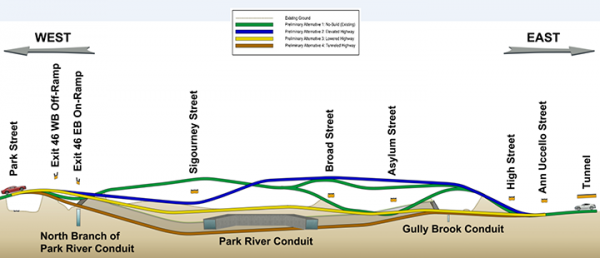
I-84 in Hartford may be receiving a re-make over the next decade.  The Department of Transportation is in the midst of determining the preferred option among three possibilities - to replace the I-84 raised viaduct or replace it with a ground-level highway or dig a tunnel.  The various options have been presented in a series of public meetings in recent months, and a decision is anticipated early next year.

into_graphic_profile02The work, which has yet to be funded, is likely to include moving or eliminating some exits and entrances – and possibly adding others in new locations - to improve traffic flow.  Cost estimates range from $4 billion to $12 billion, depending on the option selected. Upcoming public meetings are to be held in East Hartford on Dec. 2 and Hartford on Dec. 10.

In the top-ranked Chicago traffic bottleneck highlighted in the report, the Kennedy Expressway (I-90) between the Circle Interchange (I-290) and Edens junction (I-94), was found to extend 12 miles, costing motorists 16.9 million hours’ worth of time, equivalent to $418 million in 2014. More than 6.3 million gallons of fuel is wasted on I-90 while cars idle or crawl in traffic.i84

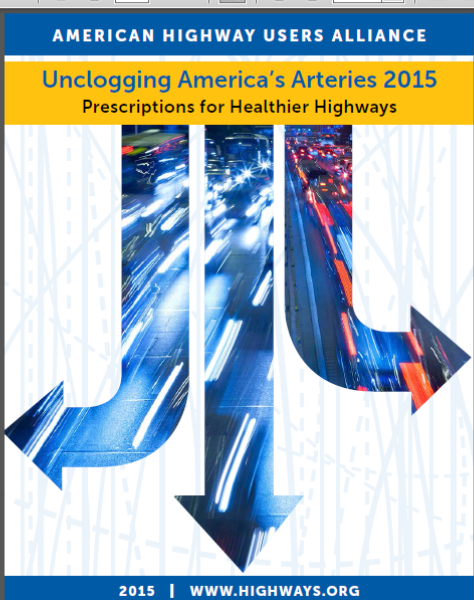
Besides identifying and ranking the nation’s 50 worst traffic bottlenecks, the study, Unclogging America’s Arteries 2015, examines the top 30 chokepoints closely and details many of the major benefits that will accrue to society by fixing them. In addition to improving mobility and quality of life for motorists, the report indicated that fixing the top 30 bottlenecks alone would, over 20 years:

  • Save $39 billion due to lost time,
  • Save 830 million gallons of fuel,
  • Reduce over 17 billion pounds of greenhouse gas emissions (CO2), and
  • Prevent 211,000 vehicle crashes

“These findings are critically important and mean that our nation will derive huge benefits from fixing the worst gridlock in our nation’s highway system: benefits that go way beyond improving mobility for highway users,” states Greg Cohen, President and CEO of the American Highway Users Alliance.

Amongst the top 10 was New York City with the 8th and 9th worst bottleneck at the notorious Lincoln Tunnel and on I-95 from Manhattan across the Bronx. Metropolitan New York also had the 18th, 19th, 21st, 31st, 33rd, 37th, and 42nd – ranked chokepoints.

As for the bottlenecks themselves, the study’s top 50 list includes trouble spots in the following Metropolitan Areas: 12 in Los Angeles, 9 in and around New York City, 3 in Chicago, 3 near Washington DC, 3 in Houston, 3 in Boston, 3 in Dallas, 3 in Miami, 2 in Atlanta, 2 in Philadelphia, and 2 in San Francisco/Oakland.

The report notes that bottlenecks can be fixed and points to specific chokepoints that have been addressed and, as a result, were not included in the rankings. Projects cited include the Woodrow Wilson Bridge replacement on I-495 in the Washington, DC area, the Marquette Interchange in Milwaukee, and the Katy Freeway reconstruction in Houston.

Millennials Work Wish List Omits Economy-Driving Industries; Career Opportunities, Flexible Schedules Are Key

Companies looking to recruit Gen Y employees have a new roadmap to hiring, courtesy of The Hartford’s annual Millennial Leadership Survey, which revealed that the best way to do so is to provide a variety of career opportunities.  In the national survey, nearly half, 46 percent cited that approach.   Additional recruiting tips from Millennials include offering:Five business people sitting at a conference table

  • Flexible work schedules (43 percent)
  • Benefits, such as health, life, and disability insurance (40 percent); and
  • Career advancement and leadership opportunities (33 percent).

A vast majority of Millennials (80 percent) consider themselves as leaders today and want to be leaders in the next five years (69 percent), according to The Hartford’s 2015 Millennial Leadership Survey.work wish list

Key industries driving the U.S. economy, including retail, construction and manufacturing, are failing to attract a giant generation of leaders – the 80 million Millennials (ages 18-34) in the United States.  Only 7 percent of young leaders in the third annual survey said they are interested in working in construction, retail or manufacturing. Other industries that rated low on the Gen Y work wish list are insurance, which four percent of Millennials said they’re drawn to, and wholesaling and utilities at 3 percent each.

Arts and entertainment topped the Millennials’ work wish list, with 40 percent of Gen Y survey participants saying they want to work in this industry. Second on the list was education at 36 percent, and technology at 36 percent.

“Year over year, our research shows that the right benefits play a pivotal role in attracting and retaining employees,” said Mike Concannon, executive vice president of The Hartford’s Group Benefits business.leaders

“The results reveal a quiet crisis – a generation of leaders who aren’t interested in many businesses that drive our nation’s economy,” said The Hartford’s Millennial Workplace Expert Lindsey Pollak.

“Millennials can help close this leadership gap by widening their career searches and exploring jobs, salaries and benefits before writing off whole sectors of the U.S. job market.”

As a leading provider of group benefits, The Hartford protects the lives and incomes of more than 12 million working Americans. For more than three years, The Hartford has partnered with Pollak to help Millennials, the largest generation in the U.S. workforce today, make informed benefit choices.

atracting


Local Nonprofits Receive Funding From First Niagara As Bank Prepares for Sale to Key Bank

First Niagara Foundation’s Mentoring Matters™ program has announced it will be providing grants  that support local nonprofit organizations throughout Connecticut.  With the pending sale of First Niagara to Cleveland-based Key Bank, the fate of the Foundation’s local support seems strong, as Key Bank has announced it will make a $20 million contribution to the First Niagara Foundation “to continue its important community initiatives.” The charitable not-for-profit entity of First Niagara Bank  allocates $1 million annually in charitable grants specifically targeted to support quality mentoring programs across the bank’s seven regional market centers, including its New England and Tri-State regional offices, which between them share coverage of Connecticut.logo-lockup

The New England Region receives $150,000 in grant money for distribution, and for a region that includes Greater New Haven, north into Western Massachusetts.  The foundation’s Tri-State region receives $50,000 and covers the service footprint in Fairfield County and the lower Hudson Valley.

In each region, the Foundation partners strategically with mentoring organizations that offer “the best impact with our mentoring dollars, and grant decisions are made by local leaders in each market,” according to foundation officials.  In Connecticut, the organizations that received 2015 Mentoring Matters grants were:awarded grants

  • Governor’s Prevention Partnership for the CT Mentoring Partnership, which serves a network of more than 150 mentoring programs across Connecticut -- $75,000
  • New Haven Reads to fund their summer tutor camp program which serves more than 300 low and moderate income New Haven students-- $15,000
  • Norwalk Community College Foundation for the ConnCAS Program, a College Pathway Program that mentors disadvantaged NCC students to successfully transition from high school to college -- $28,000
  • Junior Achievement of Southwest New England to support financial literacy and business entrepreneurship mentoring - $10,000
  • Stamford Public Education Foundation to support their Mentoring and Career Readiness program - $5,000
  • Bridgeport Public Education Foundation to support the Mentoring for Academic Achievement and College Success (MAACS) program -- $5,000
  • Norwalk Human Services Council to support the Norwalk Mentor Program -- $5,000

In addition, the Foundation’s New England region also granted $50,000 in Western MA and the Tri-state region granted $20,000 in Hudson Valley, NY.

Along with the $200,000 in Mentoring Matters funding, the two regions have been allocated a combined additional $935,000 in charitable funding from First Niagara Foundation for distribution this year. Many of the grant recipients are other youth and education organizations, along with economic development, neighborhood revitalization, health and human services, and arts/cultural organizations serving local communities.

KeyCorp, the holding company for KeyBank, recently announced an agreement to acquire First Niagara Financial Group for $4.1 billion. First Niagara, headquartered in Buffalo, N.Y., has $39 billion in assets and $29 billion in deposits and 394 banking offices in New York, Pennsylvania, Connecticut and Massachusetts. With approximately $135 billion of assets, the combined bank would be the 13th largest commercial bank headquartered in the U.S.

Based in the mid-west, Key Bank has branches in Alaska, Colorado, Idaho, Indiana, Kentucky, Maine, Michigan, New York, Ohio, Oregon, Utah, Vermont, and Washington. The transaction is expected to close in the third quarter of 2016, according to Key Bank officials. Its roots trace back to Commercial Bank of Albany, New York in 1825 and Cleveland's Society for Savings, founded in 1849, according to Wikipedia.

First-Niagara-Foundation“Key and First Niagara are a powerful combination, driven by a shared commitment to the clients and to the communities we serve,” KeyCorp Chairman and CEO Beth Mooney said.  “This transformational opportunity will bring compelling and complementary capabilities to our shared three million clients, while driving meaningful synergies and enhancing shareholder value. KeyBank and First Niagara both have values-based cultures and a long-term commitment to and experience with the region.”

Mooney, who began her banking career as a secretary at Republic Bank in Dallas, rose through the ranks in Texas before landing at Key Bank as a vice chair focused on community banking, next being named as CEO in 2011, making her the first female chief of a top-20 U.S. bank and quickly earning a slot at No. 96 on the Forbes list of the world’s 100 most powerful women.

The First Niagara Foundation is a not-for-profit charitable entity. Founded in 1998, the First Niagara Foundation is committed to supporting organizations in the communities in which we live and work, with specific focus on Youth and Education, Community Development and Neighborhood Revitalization.

“We have known First Niagara for a long time and have always been impressed by the quality of their people and their commitment to the community. We look forward to welcoming First Niagara clients and employees to Key,” added Mooney.