Health Care Seen as Economic Driver in Connecticut, Propelling Growth

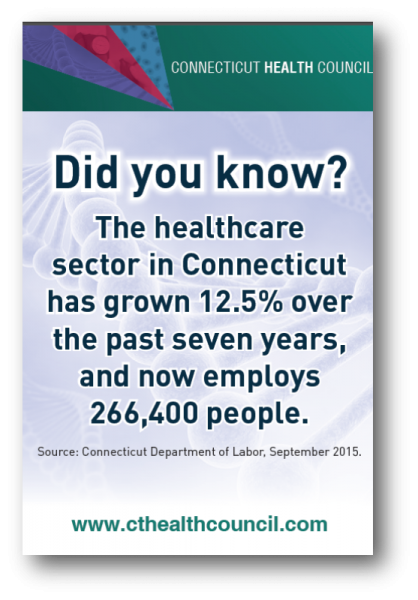
The first thought that comes to mind when someone mentions health care is likely not “economic driver.”  If a new marketing initiative by the Connecticut Health Council succeeds, that may be changing. Newly launched in January 2016, the Connecticut Health Council's "Did You Know" campaign is a multichannel content marketing program designed to raise awareness of the health sector's importance as an economic and employment driver in Connecticut. The initiative highlights data that may have escaped widespread attention across the state, with the aim of “promoting Connecticut as a center of health excellence.”connecticut-health-council-logo
The campaign includes a series of informational posters, now on display at the State Legislative Office Building in Hartford through the end of January, along with “traditional print and broadcast media content, social media alerts, and thought leadership.”  Among the stats highlighted:

  • The healthcare sector in Connecticut has grown 12.5% over the past seven years, and now employs 266,400 people.
  • There are 20,434 registered healthcare employers in the State of Connecticut.
  • From 2007 to 2014, healthcare and social services was the fourth fastest growing employment category in the state.
  • Connecticut’s healthcare sector generated $29.6 billion in estimated total before-tax revenue in 2012.
ozIn addition, the marketing campaign also highlights that thee of the top 10 fastest growing companies headquartered in Connecticut in 2014 were healthcare related companies, and that Connecticut’s healthcare sector has the fifth highest number of sole proprietorships of any sector in the state, with the seventh highest revenues. Connecticut’s “unique base of health sector assets” include health insurance companies, hospitals, medical schools, research capacity, and specialty practices, according to the organization’s website. hartford-logo
Founded in 2012 by the MetroHartford Alliance, the Connecticut Health Council is an association of health sector leaders who work to advance the development of businesses, initiatives and technology that improve health care and wellness both nationally and in the State.  The organization, which currently has 90 partners, fosters “collaboration, education, entrepreneurship and networking among leaders of for-profit and non-profit health sector entities.”

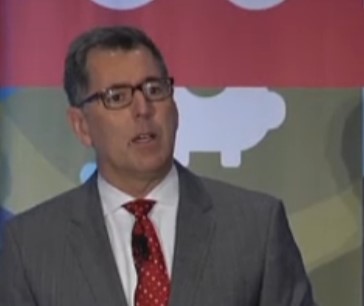
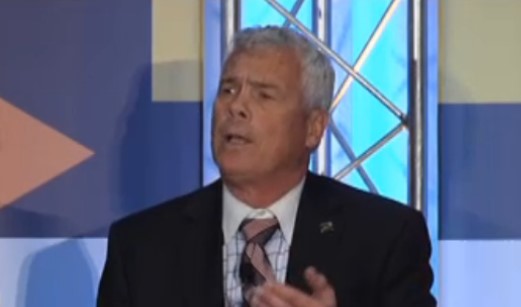
Speaking at this month’s Economic Summit & Outlook in Hartford, Oz Greibel, President & CEO of the MetroHartford Alliance, spoke to the need to highlight the data at the State Capitol, where the info-posters are on display.  “(The campaign) is based on the notion of the health sector as an economic and employment driver – and a place for additional capital investment.  Making sure that people at the legislature understand the importance of this sector, and that the actions that they take can be either helpful or detrimental, to long-term growth.”
posterThe Council's primary activity is to host programs focused on health sector topics that feature speakers of regional, national and international renown, the website points out. The Council also provides “a forum for a robust network of experts, professionals and other parties interested in promoting Connecticut as a center of health excellence and the health sector as a primary driver of economic and employment growth in our State.”

As Greibel described it, the Council’s activities are designed specifically “to leverage the extraordinary resources we have in Connecticut in the health care disciplines.”

Highlighting the impact of the state’s hospitals, the Council points out that Connecticut hospitals provide jobs to 55,000 full-time employees and spend $4.2 billion on goods and services.  Overall, Connecticut hospitals contribute $21.9 billion annually to the state and local economies.

The Connecticut Health Council is co-chaired by Marty Gavin, President & CEO of Connecticut Children’s Medical Center, and Bob Patricelli, Chairman & CEO of Women’s Health USA.  The executive director is Amy Cunningham.CT Health Council

GE Leaves Wisconsin for Canada, Blames Government; Cuts Thousands of Former Alstom Jobs Across Europe

Virtually unnoticed amidst the attention given to the months long saga of GE’s decision to move its corporate headquarters from Fairfield was another relocation by the company – this time not only leaving a state, but the United States.  And in that instance as well as the latest decision, government was cited as a reason for the departure. Less than four months ago, GE announced it was leaving Waukesha, Wisconsin for Canada, and moving 350 jobs north of the border.  GE closed a long-time engine manufacturing plant in Wisconsin and announced plans to invest $265 million to build a new one in Canada in order to take advantage of Canadian export credit financing.  The new plant was expected to be completed in 20 months and was described by GE as “a flexible production facility that can expand over time and also support manufacturing requirements for other GE businesses.”GE

The company said the new state-of-the-art plant in Canada and will be a flexible facility that can expand over time and also support manufacturing requirements for other GE businesses. GE notified employees in Waukesha and more than 400 U.S. suppliers of its plans. In Wisconsin alone, suppliers generated almost $47 million in revenue from the plant, GE said at the time.

“We know these announcements will have regrettable impact not only on our employees but on the hundreds of U.S. suppliers we work with that cannot move their facilities, but we cannot walk away from our customers,” said John Rice, Vice Chairman, GE, when the Wisconsin move was announced.

The blame, according to a GE news release, rested on Congress, which allowed the nation’s Export-Import Bank to cease functioning.  Last week, in an effort to break a political logjam in the Republican-controlled Congress, the White House announced it would nominate a Republican to lead the agency.canada

When the company announced its decision to leave Wisconsin for an unnamed Canadian city, it pointed the finger squarely at Congress:

“GE is currently bidding on $11 billion of projects that require export financing. While more than 60 other countries have export credit agencies (ECAs) that support domestic manufacturing for export, the US does not. The authorization for the U.S. export credit agency – the Export-Import Bank, or Ex-Im – lapsed on July 1. For the last year, exporters and suppliers have called upon Congress to reauthorize the U.S. Export-Import Bank to support manufacturing jobs and level the playing field for U.S. companies that compete globally. Most countries are hungry for manufacturing and export jobs. The U.S. remains the only major economy in the world without an export bank.”

The headquarters move to Boston was not GE’s only major announcement this week.  The company also announced plans to cut 6,500 jobs in Europe as it moves to integrate Alstom SA’s power business and push through cost savings from the acquisition, made last year.  The acquisition included facilities in Windsor and Bloomfield in Connecticut, including about 1,000 jobs.  No word on whether cuts may be coming there as well.  Published reports indicated that GE has not yet announced how many jobs it could eliminate in the Americas, Africa and Asia, where it is also working to integrate Alstom’s operations with its own power business.


roads


Award-Winning Start-Up Accelerator to Launch Largest Class of Social Enterprises, Fledgling Businesses

When the Hartford-based Social Enterprise Trust, known as reSET, was among the winners of the U.S Small Business Administration’s Growth Accelerator Competition last year – the only Connecticut organization to do so and one of 80 nationwide – it was not known what earning that designation, and  the $50,000 that came with it, would mean for reSET’s Impact Accelerator program. Now, the picture is becoming clearer – and boosting Hartford’s reputation as a city for socially committed entrepreneurial start-up businesses.  The expanding initiative is attracting not only home grown companies, but start-ups from elsewhere across the country, including as far away as California.

Tailored for impact-driven businesses but available to all early-stage ventures, reSET’s Impact Accelerator, now beginning its fourth year, has as its primary objective to test and hone entrepreneurs’ models, and to connect them to networks, mentors, customers, and resources.

A cohort of 22 businesses have been accepted to the program and most of their models are impact focused, serving the educational technology, health and health tech, energy, and agriculture industries. More than 60 percent of them are already generating revenue.  It is the largest group of companies to take part in the accelerator program at reSET, and the first to include a handful of out-of-state participants.cohort 2016

Running from January 20 to June 2, reSET’s accelerator will feature a more flexible program designed for busy, full-time entrepreneurs, as well as a ‘pay what you can’ model.  Entrepreneurial teams will attend five weekend summits, with 30+ optional workshops, mentor office hours, and consultations with an Entrepreneur in Residence conducted during the week.

At program’s end, a $25,000 accelerator funding pool will be available to the cohort, and they'll have priority access to reSET’s investment fund as well, via mentors and advisors that can help them put their best foot forward with their applications, according to reSET officials.

The 2016 cohort includes: Agyncy (www.agyncy.com), AmRide (www.amride.com), Asarasi (www.asarasi.com), BLT Robotics (www.bltrobotics.com), Doors to Explore (www.doorstoexplore.com), DopaFit (www.mydopafit.com), Enviro Power, LLC (www.enviropowertec.com), Keep Sight (www.keepsight.com), Lion’s Heart (www.lionsheartservice.org), Mivy (www.mivyapp.com), Movia Robotics (www.moviarobotics.com), Muni (www.muni.info), myHomeProNetwork (https://myhomepronetwork.com), Plucked (www.pluckedadmissions.org), RepVisits (www.repvisits.com), ScripFlip (www.scriptflip.org), SnapSeat (www.snapseatbooths.com), Tainted Inc. (www.tainted-beauty.com), Text Engine (www.textengine.info), The TubieGuard (the-tubieguard.myshopify.com), Trekeffect (https://trekeffect.com), and Untapped Potential (www.upotential.org).

“We’ve made a strategic shift with our accelerator model so it can accommodate more participants at one time, which we feel will really encourage more collaboration,” said Rosie Gallant, reSET’s Director of Programs. “The shift will help tee up the accelerator for our annual Impact Challenge as well, since the program will wrap in the spring right around when applications will open for the competition in which participants will vie for this year’s $100,000 prize purse.”

reSET is a non-profit organization whose mission is to advance the social enterprise sector.  Its strategic goals are threefold: to be the “go-to” place for impact entrepreneurs, to make Hartford the Impact City, and Connecticut the social enterprise state.  reSET aims to inspire innovation and community collaboration, and to support entrepreneurs in creating market-based solutions to community challenges.  reSET’s goal is to meet entrepreneurs wherever they are in their trajectory and to help them take their businesses to the next level.

Health Care Providers, Insurers Need to Collaborate to Improve Care, Rein in Costs

When Eric Schultz began his keynote remarks, the President and CEO of Massachusetts-based Harvard Pilgrim Health Care made sure to alert his audience to his homegrown pedigree.  Whether his youth in the Naugatuck Valley, college years (five of them) at UConn, or graduate work at Yale contributed to Harvard Pilgrim’s more-than-solid inaugural years doing business in Connecticut isn’t certain, but the above-expectations numbers are indisputable.  And Schmitt made clear that his nonprofit health insurance company is looking for even greater achievements in his home state.schultz Since entering the Connecticut market in the summer of 2014, the company has been aggressively growing its customer base in a competitive market while working diligently to grow and expand its network of doctors.  Harvard Pilgrim Health Care announced recently that its Connecticut membership has grown to more than 24,000, exceeding expectations for 2015. It now serves more than 800 Connecticut businesses.  Twenty-nine of the state’s 30 hospitals are now in-network.

logo_harvard-pilgrimWith more than 500 business leaders in attendance at an annual Economic Summit & Outlook last week, brought together by the Connecticut Business and Industry Association and MetroHartford Alliance, Schmitt spent some time touting a new model launched in the state of New Hampshire that he believes may be a glimpse into the direction the industry is moving. Harvard Pilgrim Health Care’s footprint in New England now covers “where 90 percent of New Englanders live,” in Massachusetts, Connecticut, Maine and New Hampshire. quote
Schultz, who succeeded now-Massachusetts Governor Charlie Baker in leading the organization five years ago, pointed to what he described as “a practical example of how an insurance company and groups of providers can work together to get control of medical cost trends and to help improve medical outcomes and help create better experiences for physicians and their patients.”

The goals, Shultz explained, are to reduce insurance premium trends by 10 to 15 percent, to improve clinical outcomes, to create a better “practice environment” for medical staff and to grow business.  The partnership is driven to “produce something that’s better than what we have today, because we know the financing of health care is largely broken in the U.S.”

economic summitLaunched in October 2015 and in business as of January 1, Benevera Health, a joint venture led by senior leadership at Harvard Pilgrim Health Care and Dartmouth-Hitchcock, is a population health company, centered around “clinical and medical informatics.”  Dartmouth-Hitchcock, a nonprofit academic health system that serves a patient population of 1.2 million in New Hampshire and Vermont, is led by Dr. James Weinstein, recently named as one of “100 Physician Leaders to Know” by a national health care trade publication.

“We are combining insurance data with clinical data,” Schultz said, “from their electronic medical records and our claims system, and creating a very powerful source of information.”  That information, he stressed, could be used to better understand what’s happening in regards to patient care, and it can help to redesign and improve clinical care.  This has the potential to be especially important in chronically ill patients, noting that 10 percent of patients drive 50 percent of health care costs.  “It is a great financial opportunity and a great clinical opportunity.”

“The magic,” Shultz noted, is in having the provider and the payer sit down together and figure out” what should be done.  Too often in the past, he said, providers and insurers haven’t gotten together – a lack of cooperation and collaboration that contributes to higher costs and to disconnects regarding patient care.  His expectation is the Benevera will “reduce headaches” that insurance companies often cause providers, reduce duplication and costs, and improve patient care. cbia alliance

In fact, when the new venture was launched last fall, officials from the two companies stressed that the groundbreaking entity, “will take health care coordination to a new level by bringing together clinical, financial and operational data from across partner institutions to provide actionable analytics for clinicians to further improve the quality and efficiency of patient care.”  They added that  “at the center of this approach will be locally-based care advocates who will identify early opportunities to engage patients – especially those with chronic, complex or emerging conditions - and provide them with one-on-one support.”

Schultz noted that insurance companies tend to resist providers suggesting how insurance plans ought to be designed.  He disagrees with that resistance.  “If more insurers took more input from providers on plan design, we’d be a lot better off.”

Harvard Pilgrim is the only not-for-profit, regional health plan operating in four contiguous New England states.  Harvard Pilgrim’s flagship health plans in New England provide health coverage to 1.3 million members, while another 1.4 million individuals are served through Health Plans, Inc., a subsidiary that provides integrated care management, health coaching and plan administration solutions to self-funded employers nationwide.  Schultz holds an MBA in Health Care Leadership from Yale University’s School of Management, as well as a bachelor of science degree in biology and a bachelor of arts degree in economics from the University of Connecticut.

“We’re about change and driving change,” Schultz told those attending the Hartford summit, “and I believe we need to do more of that.”  He’s hoping to build a similar structure in Connecticut, and in other states around the country, because “it’s exactly what we need to do.”

Link to CT-N video of Economic Summit & Outlook.

CT Start-Up Wins MassChallenge, Takes Home $300,000 to Advance Work in Glucose Monitoring

Connecticut-based Biorasis, with roots at UConn, was recently awarded the MassChallenge’s top prize at their annual awards ceremony in Boston.  The company was one of only four “Diamond Winners,” receiving a cash prize of $100,000. They were also one of two teams to receive the Sidecar Award, providing an additional $200,000 in non-dilutive funding. Biorasis Inc. is a rapidly growing medical device company committed to advancing the field of metabolic monitoring through development of implantable biosensor platforms and basic research in the areas of drug delivery, nanotechnology and microelectronics.  The company’s goal is to vastly improve the quality of life of diabetics.biorasis-inc-logo

The technology developed by Biorasis, the Glucowizzard™, is an ultra-small implantable biosensor for continuous, reliable glucose monitoring. This needle-implantable device wirelessly transmits glucose levels to a watch-like unit for real-time display, which in turn communicates with personal digital accessories like a smartphone. Continuous metabolic monitoring “holds great potential to provide an early indication of various body disorders and diseases,” the company website explains, adding that Biorasis’ implantable multi-sensor platform is “capable of such real-time, continuous monitoring.”MC

Biorasis is in the business of developing a miniaturized, hypodermic-injectable biosensor for reliable continuous glucose monitoring (CGM) with autonomous operation for 3-6 months that requires no user intervention.

Their solution “eliminates surgery for sensor implantation and extraction, restores active life style, enables remote care for juveniles and the elderly, enhances compliance, and saves 50-70% in annual healthcare costs.”

The company’s co-founders and scientific advisors are:

  • Faquir Jaina, a Professor of Electrical & Computer Engineering at the University of Connecticut. He has over 35 years of experience in design, modeling and fabrication of micro/opto-electronic devices, integrated circuits and multiple quantum-well light valves/modulators.
  • Fotios Papadimitrakopoulos, a Professor of Chemistry and Associate Director of the Institute of Materials Science at University of Connecticut. He has over 20 years of experience in the areas of polymers, nano/bio-systems and supramolecular assembly of nanostructures.

The company continues to grow, and their scientific team is currently expanding. The Biorasis website indicates that the company is seeking individuals with “a proven track record and experience in the areas of medical devices, electrochemistry, polymer science, pharmaceutics, animal studies, microelectronics and device packaging.” Inquiries can be directed to Biorasis at the UCONN Technology Incubation Program in Storrs.  Additional investors are also being sought.

mass challengeMassChallenge, an independent nonprofit organization, envisions “a creative and inspired society in which everyone recognizes that they can define their future, and is empowered to maximize their impact.” They note that “novice entrepreneurs require advice, resources and funding to bring their ideas to fruition. Currently there is a gap between the resources these entrepreneurs need and the ability of the entrepreneurial ecosystem to provide them.” To bridge that gap, the organization’s primary activities include running an annual global accelerator program and startup competition, documenting and organizing key resources, and organizing training and networking events.  They “connect entrepreneurs with the resources they need to launch and succeed immediately.”
 

Hartford Radio Ratings Reflect Dominance of FM Stations

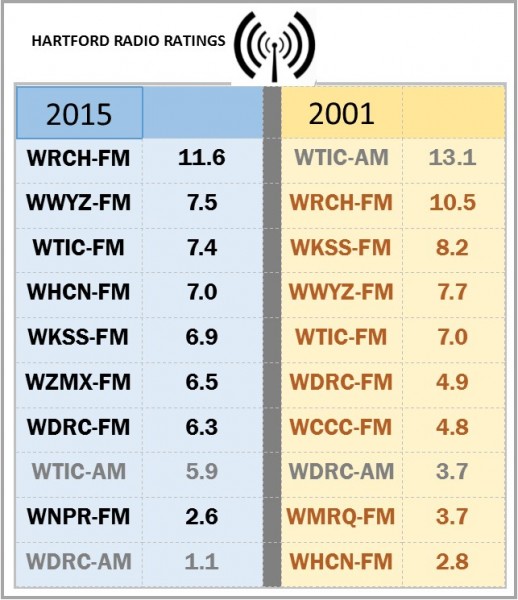
The most recent radio ratings in the Hartford market confirm the dominance of FM radio and the continued long slide of AM radio and audience levels overall.  The top seven most listened-to stations in the market are FM, led by perennial ratings leader WRCH-FM, a CBS Radio owned Adult Contemporary format station, with an 11.6 rating. Tightly bunched behind WRCH-FM are WWYZ-FM (country music), with a rating of 7.5, WTIC-FM (hot adult contemporary) at 7.4, WHCN-FM (classic hits) at 7.0 and WKSS-FM (contemporary hits) at 6.9. on air

Rounding out the top eight are WZMX-FM at 6.5, WDRC-FM at 6.3, and WTIC-AM at 5.9.

Then the ratings drop down to WNPR-FM at 2.6, WDRC-AM at 1.1, WFCR-FM (based in Amherst, MA) at 0.9 and WPOP-AM at 0.1.  WPOP recently switched to a news/talk format, and plans to broadcast Hartford Yard Goats minor league baseball games.  WDRC-FM switched to a Classic Rock format, similar to the music that played a decade ago on WCCC and WHCN.

The ratings profile, covering listening habits in November 2015, contains an quarter hour share (AQH) rating -- the average number of persons, ages 6+, who listened during any average quarter hour from 6am to midnight, Monday through Sunday in the Survey Area, Metropolitan Hartford.radio ratings

Fifteen years ago, before smart phones, internet radio, satellite radio and a limitless supply of alternate listening options, the numbers were higher across the board, and AM radio – in the case of WTIC – was often at the top of the list, or not far behind.

Here’s what the ratings looked like in April 2001:

WTIC-AM1080 was the most-listened-to radio station in the Hartford market, posting a 13.1 share in the winter rating period, up from the 10.3 it logged in the fall ratings.  WRCH fell from 11.8 to 10.5 to finish second. WKSS-FM also suffered a ratings drop, as reported at the time by the Journal Inquirer. The station racked up an 8.2 rating, down from the 9.7 it chalked up during the fall ratings period.

WWYZ-FM advanced from a 6.6 to a 7.7 to finish fourth overall.  WTIC-FM enjoyed a slight improvement, advancing from 6.8 to 7.0.  Rounding out the Top 10 were WDRC-FM (4.9), WCCC-FM (4.8), WDRC-AM (3.7), WMRQ-FM (3.) and WHCN-FM (3.1, up from 2.8).

Finishing 11th was WZMX-FM, which slid from a 3.1 in the fall to a 2.7 in the winter. WAQY-FM (West Springfield,MA), , finished 12th with a 1.9 rating.  The area's all-sports station, WPOP-AM1410, was far back in the pack with a 0.7 share.

Among the morning programs, in overall ratings, WTIC's Ray Dunaway and Diane Smith attained a 17.2 rating. WRCH was second with an 8.8 share. WTIC-FM was third with an 8.4 share, followed by WWYZ and WKSS. WCCC-FM gained a half-point to finish sixth with a 6.4 share.WRCH1

A new station took high honors among the 25-54 demographic among morning shows. WTIC-FM and host Gary Craig posted an 11.3 to grab the No. 1 spot.  WTIC-AM was second with a 10.4 rating.  WRCH was third, followed by WCCC.howard stern

In the 18-34 age bracket, WKSS was No. 1, WCCC was second overall in the young demographic. In morning shows, WCCC and Howard Stern continued in the No. 1 position. WCCC grabbed a 15.6 share in the morning, WKSS was second, at 12.8.  WMRQ and its morning host, former Twisted Sister lead singer Dee Snider, attained a 10.7 rating.

Courant Community Replaces Reminder News in Eastern, Northern Connecticut

Nearly two years ago, the Hartford Courant purchased Reminder Media Inc., long-time publisher of 15 free weekly Reminder News publications distributed in eastern and northern Connecticut. The 15 Reminder News weeklies were in Colchester, East Hartford, Enfield, Glastonbury, Hebron/Columbia, Jewett City, Killingly/Plainfield, Manchester, Putnam, South Windsor, Stafford, Vernon, Windham/Mansfield, Windsor and Windsor Locks.  Soon-to-depart publisher Nancy Meyer said at the time that the purchase “reinforces our commitment to reporting and delivering local news in Connecticut."courant community cover

Now those publications have a new look and a new name.  Beginning with the Thanksgiving week issue, the publication was redesigned and renamed “Courant Community.”  The tagline “powered by Reminder News” remains on the front page.  Existing “Courant Extra” publications in Manchester and Enfield have been “consolidated” into the new-look publications.

In a message to readers, Courant Publisher Richard J. Daniels explained the “major makeover” as key to The Hartford Courant Media Group’s “print and digital operations designed to deliver more local news to readers.”  The “sweeping redesign” of the Reminder News and Courant Extra weeklies will offer “enhanced coverage of local business, dining and entertainment, real estate, community events and more.”

The redesign doesn’t stop there.  “The makeover has extended to the Courant’s digital universe as well,” Daniels points out, “with redesigned community-based pages online (at courant.com/community)” and “more opportunities for reader interaction.”courant community

Courant Community Group Editor is Bonnie Phillips; Deputy Editor is Erin Quinlan.  Offices are based in Manchester.

On the website of The Hartford Courant, news articles submitted by readers now are categorized under the Courant Community moniker.  An interactive map, on which readers can select their town and be guided to local news, also seeks contributions ranging from birthdays and engagements to local news and events.

The list of Hartford Courant Media Group entries now includes the Courant, CTNow (which previously subsumed the Hartford Advocate), Hartford magazine (previously purchased from an independent company), New Haven Living, Courant Community and ValuMail.

CT Cities Above Average in Pursuing Equal Rights for LGBT Residents, Led by New Haven, Stamford

The Human Rights Campaign (HRC), the nation’s largest lesbian, gay, bisexual, and transgender (LGBT) civil rights organization, has released its fourth annual report assessing LGBT equality in 408 cities across the nation, including seven in Connecticut. The average score for cities in Connecticut is 74 out of 100 points, above the national average of 56. The 2015 Municipal Equality Index (MEI), the only nationwide rating system of LGBT inclusion in municipal law and policy, shows that cities across the country, including in Connecticut, continue to take the lead in supporting LGBT people and workers, even when states and the federal government have not.MEI-cover-1600x900

Connecticut’s municipal scores are: New Haven: 99, Stamford: 91, Hartford: 91, Waterbury: 70, New Britain: 63, Storrs (Mansfield): 54, and Bridgeport: 51.  Across the country, 47 cities earned perfect 100-point scores, up from 38 in 2014, 25 in 2013 and 11 in 2012, the first year of the MEI. This year’s MEI marks the largest number of 100-point scores in its history.  Stamford scored the biggest jump in Connecticut from last year's analysis, advancing nearly 30 points while four other Connecticut cities also included last year earned similar scores in 2015.

For LGBT Americans, legal protections and benefits vary widely from state to state, and city to city. The MEI rates cities based on 41 criteria falling under five broad categories:

  • Non-discrimination laws
  • Municipality’s employment policies, including transgender-inclusive insurance coverage, contracting non-discrimination requirements, and other policies relating to equal treatment of LGBT city employees
  • Inclusiveness of city services
  • Law enforcement
  • Municipal leadership on matters of equality

The review indicates that in 31 states, LGBT people are still at risk of being fired, denied housing or refused service because of who they are, and who they love. The lack of legal protection in many states is driving the HRC effort to pass the Equality Act, which would extend nationwide non-discrimination protections to LGBT Americans. Officials say that the MEI is a crucial tool in evaluating the patchwork of LGBT policies and practices in cities and towns across the nation.

New Haven received an initial score of 94, before receiving 5 bonus points for municipal services and being a “welcoming place to work.”  The Elm City earned perfect scores in 4 of the 5 categories - for non-discrimination laws, municipal services, law enforcement and the relationship with the LGBT community.  Hartford earned a perfect score in three categories, but fell short in “law enforcement” and “municipality as an employer”.  The city has an initial score of 84, before receiving 7 bonus points, for providing services to LGBT elderly, youth, homeless, and people living with HIV/AIDS. muni index

Bridgeport earned a perfect score in one category, non-discrimination laws, but a 0 in the “municipality as employer” category.  The city did, however, receive 2 bonus points for being a “welcoming place to work.”

In 2014, the MEI included only five cities in Connecticut – Bridgeport, Hartford, New Haven, Stamford and Storrs (Mansfield). Stamford jumped 29 points in a year, while New Haven and Hartford each lost a point between last year and this year’s survey.  Bridgeport and Storrs also dropped slightly in the new ratings. The scores last year:  New Haven: 100, Hartford: 92, Stamford: 62, Storrs 59, Bridgeport: 57. Stamford’s much higher rating was driven by three categories: non-discrimination laws, where the score moved from 18 to 30, relationship with the LGBT community, which increased from 2 to 8 and also picked up 7 bonus points, and municipal services, which increased from 10 to 16.

“Across our country, cities and towns both big and small aren’t waiting for state or national leaders to move LGBT equality forward,” said HRC President Chad Griffin. “Instead, these municipalities are taking action now to improve the lives of countless LGBT Americans. In what has been an historic year for equality, a record-breaking number of municipalities this year have earned top scores in our Municipal Equality Index for their inclusive treatment of their LGBT citizens and workers. They are making a powerful statement that no one should have to wait for full equality - the time is now.”

Key findings contained in the MEI, issued in partnership with the Equality Federation, provide a revealing snapshot of LGBT equality in 408 municipalities of varying sizes, and from every state in the nation. The cities researched for the 2015 MEI include the 50 state capitals, the 200 most populous cities in the country, the five largest cities in every state, the city home to the state’s two largest public universities, and an equal mix of 75 of the nation’s large, mid-size and small municipalities with the highest proportion of same-sex couples.

"This year, an unprecedented wave of discriminatory legislation attempted to roll-back our efforts for LGBT equality,” said Rebecca Isaacs of the Equality Federation. “Despite that challenge, over 20 towns and municipalities passed non-discrimination ordinances, some in the most unexpected places. These wins, along with historic LGBT visibility, speak to the tenacity of our advocates all across the country, many of whom donate their time to achieve fairness and equality. The MEI is an important tool for our movement that illustrates our successes and the work ahead of us. We will not stop until all Americans have a fair opportunity to provide for themselves and their families, free from the scourge of discrimination."

The 2015 MEI revealed that 32 million people now live in cities that have more comprehensive, transgender inclusive non-discrimination laws than their state or the federal government. Cities with a higher proportion of same-sex couples tended to score better, officials said, and the presence of openly-LGBT city officials and LGBT police liaisons also were correlated with higher scores.  The average city score was 56 points, with half of the cities researched scoring over 61 points. Eleven percent scored 100 points; 25 percent scored over 77 points; 25 percent scored under 31 points; and five percent scored fewer than 10 points.

At the state level, earlier this year, the Connecticut legislature approved a new law ensuring that transgender people can change their birth certificates to reflect their correct name and gender without unnecessarily expensive and invasive obstacles. The new law simplifies the process by empowering transgender people to change their birth certificate by providing a statement of appropriate treatment by a healthcare provider.  It took effect on October 1.  Similar laws have been approved in Hawaii, California, Iowa, New York and Vermont.

The full Human Rights Campaign report, including detailed scorecards for every city, as well as a searchable database, is available online at www.hrc.org/mei.

Child Poverty on the Rise; State Budget Percentage for Children Dropping, Advocacy Group Says

When the state legislature in Special Session this month restored planned budget cuts that would have adversely impacted Connecticut children and families, advocates for those segments of society praised the action.  But they also took the opportunity to highlight continued disparities and shortfalls in the level of state resources allocated to programs and policies impacting children in the state. “Alleviating the wide disparities left in the wake of the economic recovery, including record-high child poverty, requires a state budget that reflects the needs of our children and families,” pointed out Connecticut Voices for Children, an organization marking two decades of advocating for Connecticut children. CV chart

They went on to point out that a recent update to their Children’s Budget finds “continued long-term disinvestment in programs that serve children and families,” such as K-12 education, developmental services, and health coverage - down nearly 10 percentage points from the early 1990s when the state spent nearly 40% of the General Fund on such programs.

They also noted that while child poverty has increased by more than 16.4 percent since the economic recovery began in 2010 (from a rate of 12.8 percent to 14.9 percent), the share of the state budget that is appropriated to the Children’s Budget has declined by 5.7 percent (from 32.4 percent of General Funds to 30.6 percent).

“We believe that more can and must be done in the upcoming session and in the years to come to reverse the long term decline in state investment in children and youth and to prioritize the establishment of equitable opportunity across race, ethnicity and zip code,” said Ellen Shemitz, executive director of Connecticut Voices for Children.  The legislature’s 2016 session convenes in February.

Among the aspects of the budget impacted in the Special Session were a series of “short-term fixes,” according to published reports, such as transferring $5.7 million from various accounts to the state's general fund, including the school bus seat belt account, and $15.1 million from public colleges and universities. voices logo

A November report by Connecticut Voices for Children found that "despite lower levels of unemployment, the recovery has left behind many of our state’s residents, including people of color, young workers, those paid low wages, and many with relatively low levels of education. These trends have  made it more difficult for families to afford their most basic needs."  The report stressed that "failure to address the needs of our children sets us up for an intergenerational cycle of poverty that will undermine preparedness for work in a state that has long boasted one of the nation’s most productive and highly educated workforces."

childenThis summer, Shemitz was among those appointed to serve on the state’s Commission on Economic Competitiveness, created by the legislature amidst concerns in the state’s business community about the perceived lack of competitiveness.  The Commission is considering steps to improve Connecticut’s employment and business climate including measures to support workforce development and family and economic security.  Recommendations are anticipated for legislative action next year.

Writing recently in the Hartford Business Journal, Shemitz stressed that the state needs “a healthy economy to assure gainful employment and economically secure families.”  She noted that “business climate is about more than taxes.  A healthy business climate requires good transportation and a highly educated workforce, both of which depend upon strategic planning and public investment.”  The Commission’s organizational meeting was held in September.  (CT-N coverage)  It is co-chaired by State Rep. William Tong (D-Stamford) and Joe McGee, Vice President of the Business Council of Fairfield County.

Based in New Haven, the mission of Connecticut Voices for Children is to “promote the well-being of all of Connecticut's young people and their families by advocating for strategic public investments and wise public policies.”


Fairfield County’s Community Foundation Strives to Create Opportunities for Young Adults Close to Home

For Fairfield County’s Community Foundation, two local trends are unmistakable.  Connecticut’s population is aging, and too many young people are unable to become self-sufficient by age 25. The recognition that as older, experienced workers retire, Connecticut’s economy will increasingly rely on young adults to provide goods and services, lead companies, and start new businesses has been the impetus for action, and a new initiative underway this fall.thrive

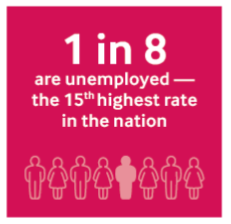
Fairfield County’s 100,000 young people ages 16 to 24 face youth unemployment rates between 13.6 percent and 49.5 percent, one of the nation’s most expensive housing markets, and a shortage of living-wage entry jobs.

A multi-faceted initiative, Thrive by 25, has begun with the clear goal of advancing opportunity for the region’s young adults – no easy task in Fairfield County.thrive

“If our young people are not prepared for tomorrow’s jobs, or they relocate to find quality jobs and housing they can afford, employers will recruit from other states or leave. Businesses will struggle. Unemployment will rise, our tax base will shrink, and the need for government services will increase,” the organization’s website sums up the challenge.

“Our vision is for every young person in Fairfield County to achieve self-sufficiency, thrive by 25, and enrich their communities. We see three paths to this accomplishment: college readiness and scholarships, vocational education, and quality internships,” the website indicates.fccf_large

The program brochure is encouraging, noting that in a local survey 95 percent of respondents ages 18 to 25 have some vision of what they want to achieve in a career and many are interested in completing a master’s degree.  In addition, the “intersection of jobs and education” is highlighted:  “a growing body of research suggests that low-income teens who participate in after-school internships and summer jobs during high school are likely to have higher grades, better attendance, a greater likelihood of graduation, and a higher average salary throughout their lifetime.”

unemploy statThe action plan is spurred by clear concerns: “When young people are not attending school or working, they cannot attain necessary education or work experience, support themselves, save for their future, or contribute to the economy. What future do they face? What future does Fairfield County face?”

Seven steps have been developed to guide the effort:

  1. Listen to Fairfield County’s young adults.
  2. Reach out to others who have a role in making an impact on these issues.
  3. Make vocational-technical secondary school programs, apprenticeships and personalized training more widely available to high school students.
  4. Enhance early college programs and the transition from high school to college
  5. Tap into the lessons learned from other local and national efforts
  6. Ensure local nonprofits are prepared to be key participants in Thrive by 25
  7. Focus the Community Foundation’s resources as effectively as possible

A highly attended Kick-off Breakfast at the Trumbull Marriott launched the initiative, with JPMorgan Chase & Co. announcing an expansion in their commitment to Connecticut, joining the Community Foundation in supporting the Pathways to Careers Fairfield County pilot with a $200,000 grant. The grant is part of JPMorgan Chase & Co.’s New Skills at Work initiative, which seeks to address the skills gap that exists across many industries, where not enough trained workers have the specific skills to fill the jobs available.800

Pathways to Careers Fairfield County is a multi-sector partnership with high-opportunity and high-growth employers and is based on Our Piece of the Pie’s Pathways to Careers model. Our Piece of the Pie, a Hartford-based, urban youth development and workforce opportunity non-profit organization, has developed the successful upstate CT Pathways to Careers program into a best-practice model for moving young people quickly into jobs with career pathways.

Fairfield County’s Community Foundation promotes philanthropy as a means to create change in Fairfield County, with a particular focus on innovative and collaborative solutions to critical issues impacting the community. Individuals, families, corporations and organizations can establish charitable funds or contribute to existing funds.

The vision of the Thrive by 25 initiative is “to give all Fairfield County youth the opportunity to thrive by age 25 – no matter their family income, school district or zip code.”  For more information, visit www.FCCFoundation.org.