Commitment to Children Honored in CT

Connecticut Voices for Children has honored community leaders, policymakers and advocates for children at its 14th annual “First for Kids” awards ceremony. The awards recognize individuals and organizations that have worked to make a difference in the lives of children in the state of Connecticut. This year’s honorees are:

  • Priscilla Canny Research Award - Judith Meyers, President and Chief Executive Officer of the Children’s Fund of Connecticut and its subsidiary, the Child Health and Development Institute of Connecticut., for her leadership to ensure that all children have the opportunity to thrive. The Children’s Fund of Connecticut, a public charitable foundation and supporting organization of Connecticut Children’s Medical Center, is dedicated to ensuring that children in Connecticut have a strong start in life with ongoing supports to promote their optimal health and well-being. For over 17 years she has led the organizations' efforts to improve the health, mental health and early care systems for children in Connecticut.
  • Public Service Award - Myra Jones-Taylor, former Commissioner of the Connecticut Office of Early Childhood, for her efforts to coordinate and improve the state’s early childhood system. Jones-Taylor, a California native who was the first in her family to graduate from college, came to Hartford in 2012 to lead the planning effort for the newly forming state office. She left the agency in September 2016 and is currently Entrepreneur in Residence at Dalio Foundation.
  • Statewide Child Advocacy Award - Sarah Eagan, Connecticut’s Child Advocate, for her work advancing honoreesthe right of abused and neglected children and children with disabilities. She was appointed by Governor Dannel Malloy to serve as Connecticut's Child Advocate on August 1, 2013. As Child Advocate, she sets priority reviews for the OCA, manages office operations, and publishes vital information regarding the well-being of children and recommendations for system reform. Prior to this appointment, she served for several years as the Director of the Child Abuse Project at the Center for Children's Advocacy in Hartford.
  • Youth Voice Award - Kate Matos and her Fourth-Grade Students at Avon’s Pine Grove Elementary, 2015-2016, for their efforts to raise funds for advocacy through kindness and team work.

“Each of us wants our children to have an opportunity to achieve their full potential. Today, at our annual First for Kids celebration, Connecticut Voices for Children is proud to honor four champions who have worked tirelessly to ensure that opportunity is available to all children in our state, regardless of race, ethnicity or family income,” says Ellen Shemitz, Connecticut Voices for Children’s Executive Director. “Children need champions willing to raise their voices to make universal opportunity a public priority. Today’s honorees have led the way.”voices

“Many children in Connecticut still face considerable challenges to succeed,” says Sharon Langer, Advocacy Director at Connecticut Voices for Children. “Nearly 1 in 3 of our children of color live in poverty, compared to 1 in 20 white children. Our state has one of the largest achievement gaps in the nation based on family income and race. There is a lot of work to be done to close these gaps. We are optimistic that together we can improve the lives of children.”

Connecticut Voices for Children is a research-based policy think tank based in New Haven. The organization “produces research and analysis, promotes citizen education, advocates for policy change at the state and local level and works to develop the next generation of leaders.”

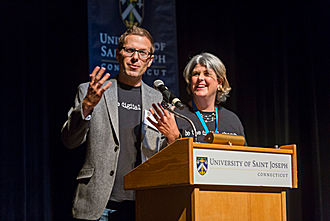
PHOTO:  Judith Meyers, Sarah Eagan, Myra Jones-Taylor

CT 5th Graders Elect State's New Kid Governor

Jessica Brocksom of John F. Kennedy School in Milford has been elected by 5th graders across the state as Connecticut's next Kid Governor.   Connecticut’s Kid Governor is a national award-winning statewide civics program for 5th graders created by the Connecticut Public Affairs Network at Connecticut’s Old State House. Jessica ran on a platform focused on stopping animal cruelty. She plans to lobby state leaders for tougher animal cruelty laws, educate her peers on tkid-governorhis important issue and help animals by organizing fundraisers in Connecticut communities.  The announcement of her election, after more than 4,000 ballots were cast earlier this month by 5th graders, was made at her school in Milford.  She was one of seven candidates on the ballot; only 5th graders were eligible to vote.

In November 2015, hundreds of 5th graders across the state participated in the election of the first ever Connecticut’s Kid Governor. After an exciting race, students elected Elena Tipton of East Hartford who ran on a Campaign for Kindness platform. During her term as Connecticut’s Kid Governor, Elena’s has shared her 3-point plan of action through video messages to constituents, a Kindness is Kool blog, public appearances, and additional activities.  She had an "office" at the Old State House, and met with elected officials including Gov. Dannel Malloy and Congressman John Larson.

The Kid Governor program was designed to teach fifth-graders about government, elections and the importance of civic involvement, and complements the state's social studies curriculum.  It was created by the Connecticut Public Affairs Network and is sponsored by the Connecticut Council for the Social Studies and the State Department of Education. Connecticut’s Kid Governor serves his or her constituents for one year in an active leadership role.

Her teacher, Donna Stuart, told her, “I’m so so unbelievably happy for you. I know you are going to do an amazing job serving all fifth graders in the great state of Connecticut," the Milford Mirror reported.  “You are such a perfect candidate and you inspire me every day, and I am so thrilled that you are now going to be inspiring sokid many others,” Stuart added.

Leaders of the initiative said "We would also like to congratulate the other final candidates for their incredibly inspiring campaigns, which shined a light on many issues important to the children of Connecticut. The 5th grade teachers and students of our state deserve a big thank you for taking part in the 2016 CKG Election - where student participation more than quadrupled from the previous year."


https://youtu.be/u51CzOW0lKI

https://youtu.be/FSXfVW-239c

Superintendents on the Move as Revamped Education Funding is on State's Agenda

With a major overhaul of education funding to Connecticut communities on the state legislature's agenda when the newly elected legislature convenes in January in order to comply with a court order, some of the state’s largest school districts are undergoing seismic changes of their own, as superintendents are moving at what appears to be an unprecedented rate in the midst of a school year. Torrington selected a new superintendent just a week ago, even as vacancies were imminent or in place in Hartford, New Haven and Bridgeport, and a new Stamford superintendent is just settling in.superintendent2

Denise Clemons was appointed as the new superintendent of the Torrington public schools, returning to Connecticut after serving as superintendent in Gardner, MA. Previously she was assistant superintendent of curriculum and instruction in Groton, MA; the assistant superintendent of secondary education in Bridgeport; and an English teacher in New Haven.

“I hope to kind of bridge the gap between the community and the schools — kind of open it up. I think that we need to work together, and with that, we’ll be better,” Clemons told the Torrington Register- Citizen. “I’m glad to be here because I think that this is a great community, and I think it’s ready for change, and I’m ready to change with them.”

In Bridgeport, the city school board will soon be identifying someone already working in the district, who holds a superintendent certificate and preferably a doctorate degree, to take over for the current interim superintendent until a permanent replacement can be hired next year, the CT Post is reporting.  Fewer than a handful of current district leaders hold the superintendent certification according to the State Department of Education. They include Career and Craftsmanship principal Wayne Alexander, who was a finalist this fall for the interim superintendent position in New Haven.  Applicants in Bridgeport have until November 28 to apply and will be interviewed the first week in December. The board hopes to have made a selection before current Interim Schools Superintendent Fran Rabinowitz leaves on December 30, 2016.

New Haven Superintendent of Schools Garth Harries announced at the end of September that he would be leaving that post in November, after three years in that position, and more than a year before the end of his contract.  A buyout was worked out, reportedly due to clashing priorities and personalities inthe district.  Last month, the Board appointed Reginald Mayo, the longtime superintendent of New Haven Public Schools and the immediate predecessor to departing superintendent Harries, as the school district’s interim superintendent. Mayo worked in the district’s schools for 46 years, 21 of them as superintendent.  A search committee in New Haven has begun work to select a new superintendent, the New Haven Register has reportedglass

Beth Schiavino-Narvaez, the superintendent of Hartford public schools, announced in early September that she is stepping down to take a job with the United States Department of Defense Schools in Okinawa, Japan. She will be the Chief of Instructional Leadership Development with the United States Department of Defense Schools, which is a newly-created position.  The announcement came just weeks into the new school year, and years before her contract was due to expire.  She leaves the district on Dec. 8.  An interim superintendent is expected to be named shortly, the Hartford Courant has reported.

Stamford began the year with an interim Superintendent, James Connelly, who began his stewardship of the district in January.  Earl Kim, a Hawaii native, became Superintendent of Stamford Public Schools in July 2016, after his appointment by the Board of Education in March. Prior to arriving in Stamford, Kim served as Head of School, Kamehameha Schools – Kapālama, and prior to that as Superintendent of Schools in Montgomery Township New Jersey from 2008 to 2012, and in Verona Township New Jersey from 2003 to 2008, according to the district’s website.

Connecticut’s major urban communities are not the only districts seeing superintendent transitions.

The town of Killingly saw its superintendent depart in July, and in September the local board chose Lynne Pierson, most recently the interim superintendent for the Darien school system, to oversee the Killingly district, beginning Oct. 1. She is expected to serve through March 1, or until a new superintendent is chosen, the Norwich Bulletin reported.

And Dr. Toni Jones was appointed the new superintendent of Fairfield Public Schools by the local Board of Education in September.  Jones, who has been serving as the superintendent in the Falls Church City school district in Virginia, will begin serving in her new role in Fairfield on Dec. 5.

Absenteeism Continues to Decline in CT Schools, Nation Looks to CT Approach

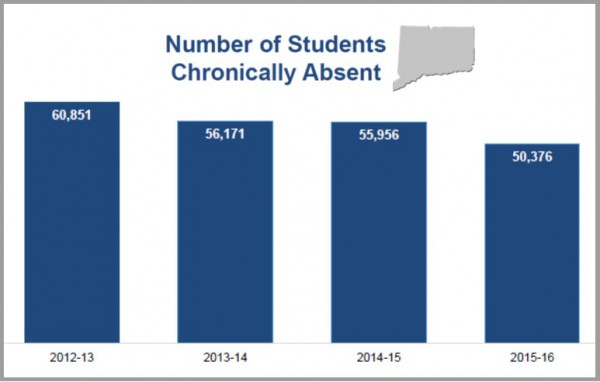
Chronic absenteeism is down across the state, according to new data released by the State Department of Education (SDE), a trend that is gaining notice beyond Connecticut and a sign that collaborative efforts to keep students across Connecticut in school and engaged are having a positive impact. The number of chronically absent students in Connecticut dropped to 9.6 percent in 2015-16, down from 10.6 percent the year before and down from a high of 11.5 percent in 2012-13. The decline in Connecticut’s chronic absenteeism rate means that over 10,000 more students are attending school on a daily basis than four years ago. Nationally, missing too much school is a coast-to-coast crisis that affects more than 6.5 million students.

Connecticut's work is gaining attention at the national level, and was subject of an article in the education publication Kappan Magazine.  The article, “Chronic early absence: What states can do” was co-authored by Hedy Chang, executive director of Attendance Works, Charlene M. Russell-Tucker, chief operating officer of the Connecticut State Department of Education, and her colleague Kari Sullivan,  state attendance lead at SDE.missing

The data also shows that while minority students have disproportionately high rates of chronic absenteeism when compared with their white peers, rates of chronic absenteeism are decreasing for black and Hispanic students in Connecticut.

In 2015-16, the chronic absenteeism rate for Hispanic students was 15.7 percent, down from 19.1 percent in 2012-13. For black students, the rate was 14.5 percent in 2015-16, down from 16 percent in 2012-13. (The new data is available on the CSDE’s data portal, EdSight. The data was released as part of a Chronic Absenteeism presentation delivered this month to the State Board of Education.)  The magazine article notes that “Low-income students are four times more likely to be chronically absent than others, often for reasons beyond their control, such as unstable housing, unreliable transportation, and a lack of access to health care.”

Chronic absenteeism is defined as missing 10 percent or more days of school for any reason, including excused absences, unexcused absences, suspensions, and other disciplinary actions.

“We have identified several areas where we are shifting our focus to fulfill our promise of an excellent public education for every Connecticut child. One of those focus areas is chronic absence,” said Commissioner of Education Dianna R. Wentzell. “We want every public school student in our state to be in school and engaged. That means we have to work with families, educators, and community stakeholders to decrease the number of days that students are out of school.”

Earlier this year, the State Board of Education adopted its Next Generation Accountability System, which uses multiple academic and non-traditional indicators to assess how well a school is performing toward the goal of preparing all students for success in college, career, and life. Chronic absenteeism is one of the new indicators included in the system, which means school districts will have to pay close attention to the problem of chronic absenteeism and take steps to ensure more students attend school on a daily basis.graph

Research shows that chronic absenteeism is inextricably linked with student performance, and students who are chronically absent are less likely to read on grade level, are less likely to perform well academically, and are at a greater risk for dropping out of high school. Risk factors for chronic absence include poverty, homelessness, chronic health conditions, frequent moves, and disabilities.

The article notes that “Most school districts and states don’t look at all the right data to improve school attendance. They track how many students show up every day and how many are skipping school without an excuse but not how many are missing so many days in excused and unexcused absence that they are headed off track academically.”

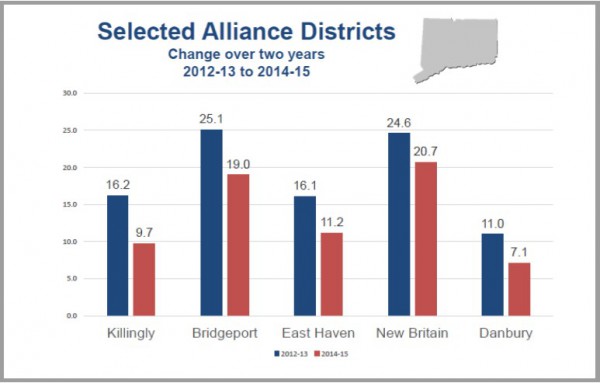
Among the communities being highlighted by SDE are Killingly, where chronic absenteeism dropped from 16.2% to 9.7%; Bridgeport, where the reduction was from 25.1% to 19.0%; East Haven, where the drop was from 16.1% to 11.2%; New Britain, where absenteeism was reduced from 24.6% to 20.7%; and Danbury, which saw a reduction from 11% to 7.1% between 2012-13 and 2014-15.  Attendance Works,  a national and state initiative that promotes awareness of the important role that school attendance plays in achieving academic success, is also highlighting specific Connecticut districts where progress is being made, including New Britain, Middletown and Vernon.  alliance

The SDE has been working with key partners such as the Governor’s Prevention Partnership, Attendance Works, the Campaign for Grade-Level Reading, and the Legislature’s Committee on Children. Chronic absenteeism is addressed in the annual Alliance District grant application for participating districts. The state is also expanding restorative justice programs, such as the Connecticut School-Based Diversion Initiative, and positive behavioral interventions and supports. Additionally, districts are increasing utilization of the Department of Children and Families’ Emergency Mobile Psychiatric Services to respond to mental health crises.

“It is critical that we all understand the importance of daily school attendance. Even in the early grades, lost time in school can put students at risk of becoming disengaged or dropping out of school down the road,” said Commissioner Wentzell.  The state approach focuses on six "high-impact" strategies:

#1: Build Awareness #2: Use Data to Promote Action #3: Cultivate Champions to Build a State-Level Infrastructure #4: Build Capacity #5: Identify and Leverage Bright Spots #6: Foster Accountability

The magazine article co-authors stress that “By monitoring chronic absence in grades K-12 — and paying particular attention to the youngest students — states can address the needs of students and their families before they require more expensive intervention and remediation.”

UConn Study Questions Marketing, Ingredients in Food Advertised to Young Children

It would be disingenuous to describe the results as surprising, but a new study has found that marketing for baby and toddler food and drinks often contradicts the advice of health professionals. According to the study by the Rudd Center for Food Policy and Obesity at the University of Connecticut, companies tend to use marketing messages that may lead parents to believe that these commercial products are healthier alternatives to breastmilk or homemade food.baby-facts

The new Baby Food FACTS report found that companies spent $77 million in 2015 to advertise infant formula, baby food, and toddler food and beverages to parents, primarily through TV, magazines, and the internet. By comparison, companies spent $98 million to advertise fruits and vegetables in 2015 – products intended for the entire U.S. population.

“Our analysis shows that marketing for baby and toddler food, infant formula, and toddler milk and nutritional supplements often contradicts expert guidance and in some cases encourages parents to feed their young children products that may not promote healthy eating habits,” said Jennifer Harris, UConn Rudd Center Director of Marketing Initiatives and the report's lead author.

The report analyzed companies spending $100,000 or more in total advertising in 2015 and documented changes in advertising over the past five years. Eight brands from three companies (Nestle, Abbott and Mead Nohnson) were responsible for 99 percent of advertising spending. Four additional baby and toddler food brands spent $100,000 or more in advertising in magazines and online, including Plum Organics (Campbell Soup Company), Beech-Nut (Hero A.G.), and Happy Baby and Happy Tot (Nurture Inc.).rudd-logo-300x77

Among the findings:

  • Infant formula brands had the most internet advertising and were most active in social media and on mom blogs.
  • Nearly 60 percent of advertising dollars promoted products that are not recommended for young children, including sugar-sweetened toddler drinks and nutritionally poor snack food.
  • Beech-Nut and Gerber marketed their baby food products in a way that supported most expert recommendations on best practices for feeding infants.
  • Toddler milk products including Enfagrow, Gerber Good Start Grow, Nido 1+, Similac Go & Grow, and Happy Tot Grow & Shine, contained added sweeteners, including sugar, glucose syrup solids, honey, and corn syrup solids.
  • Pediasure Grow & Gain, a nutritional supplement aimed at toddlers, had 240 calories per serving and as much sugar as an 8-ounce sports drink.
  • In contrast to nutritious baby and toddler fruit, vegetable, and meal products, just four of 80 baby and toddler snack foods, such as cookies, cereal bars, puffs, and fruit snacks, were nutritious choices for young children.
  • Fifty percent of baby and 83 percent of toddler snacks contained added sugars.

kids-eatingThe findings included in this report “provide policymakers, health professionals, public health advocates, industry representatives, and parents an opportunity to address misinformation conveyed through marketing of baby and toddler food and drinks.”

The study also found that traditional advertising spending (primarily on TV and magazines) by infant formula brands declined substantially—from more than $30 million in 2011 to less than $10 million in 2015.

Among the recommendations, the Rudd Center researchers indicated that toddlers’ diets should help them develop gross and fine motor skills and learn to enjoy the taste, flavors, and textures of real fruits and vegetables. By age two, toddlers should be eating the same food as the rest of the family. For all children, they stated, a healthy diet should include a variety of fruits and vegetables every day, and limited consumption of saturated fat and sodium. Children under two should not consume any food with added sugars.

The report called on the U.S. Food and Drug Administration to issue final guidance on claims on infant formula packaging, including claims that compare infant formula to breastmilk, and also regulate claims on toddler milk packaging. The Federal Trade Commission should similarly regulate claims made in advertising, the report advised. The food industry was also urged to expand the Children’s Food and Beverage Advertising Initiative (CFBAI) self-regulatory program for improving food advertising to children to incorporate marketing of baby and toddler food and drinks.

The study was funded by a grant from the Robert Wood Johnson Foundation and presented Nov. 1 at the American Public Health Association’s 2016 Annual Meeting and Expo in Denver.  The Rudd Center for Food Policy & Obesity at the University of Connecticut is a multi-disciplinary research center dedicated to promoting solutions to childhood obesity, poor diet, and weight bias through research and policy. For more information, visit www.UConnRuddCenter.org.

New London’s Hearing Youth Voices is Finalist for Region’s First-Time $50,000 Prize

Hearing Youth Voices, a youth-led social justice organization working to create systemic change in the education system in New London, is one of seven youth organizations in New England with a chance to win a $50,000 grant from The Nellie Mae Education Foundation, the largest philanthropic organization in the region focused exclusively on education. The first-ever Nellie Mae Education Foundation Youth Organizing Award honors a New England youth organizing group that has shown tremendous commitment to advancing student-centered learning or redesigning education to meet the needs of all students - specifically focused on public secondary education.hearing-youth-voices-logo

At Hearing Youth Voices (HYV), youth leaders identify issues, research solutions, and run campaigns aimed at making concrete, meaningful changes in their public schools. The core membership and leadership are working class youth of color, many of whom are also LGBTQI, and/or immigrant, and/or have been pushed out of school.

The winner from among the finalists will be decided by online votes of the public, during a month of balloting.  From November 1 at 12:00 PM EST – November 30 at 12:00 PM EST, the public is invited to vote for finalists through email on the Students at the Center Hub and via text message. The organization with the most votes will receive a $50,000 grant to continue the organization's work around advancing student-centered learning or redesigning education to meet the needs of all students.picture3

Hearing Youth Voices describes itself as “a youth-led organization that trains young people of color to organize, fight, and deconstruct systems of oppression in our community.” Recently, HYV youth ran the “We Want to Graduate Campaign,” which focused on systemic obstacles to students graduating, specifically absence-based credit loss and suspensions.

After two years of hard work on the part of hundreds of youth, the New London Public Schools (NLPS) revised its attendance policy to offer supportive interventions instead of punishments for absent students, a change that affected the more than 3,000 students and families in NLPS. Additionally, HYV youth worked alongside a broader coalition of parent advocates, school staff, and Board of Education members to create the district's first-ever Restorative Practices pilot project.

Most recently, HYV successfully advocated for students to become voting members of the Board of Education's Policy Committee, integrating student voice into the highest level of policy decision-making in the district. Youth leaders identify issues, research solutions, and run campaigns aimed at making concrete, meaningful changes in their public schools.

“Our seven Youth Organizing Award finalists are leaders in promoting student ownership and voice as part of school decision-making in New England,” said Nick Donohue, president and CEO of the Nellie Mae Education Foundation. “These students have committed themselves to improving educational experiences for their peers while building the knowledge and skills which will serve them long after graduation. I’m proud to offer a well-deserved congratulations on the great work they’ve achieved as well as the impact they are making for future students.”

In a student-centered environment, learning is personalized, competency-based, happens anytime, anywhere and allows students to take ownership of their education. Student-centered learning prepares students to master the academic knowledge, critical thinking, problem solving and communication skills they need to thrive.

Also vying for the prize are Portland Empowered (Maine), Sociedad Latina (Boston), Granite State Organizing Project (New Hampshire), Young Voices (Providence), Providence Student Union (Providence), and UP for Learning (Vermont).

The HYV website explains that “our work is different- it is about collective action to solve systemic problems. We don't want to make life easier for one young person or one family. We want to go right down to the root of the problem and fix the system so that no more youth and families have that problem! And we believe that the people who have lived the problem are experts on it and need to help define what the solution could be.......and lead the charge to make that change happen.”

The Nellie Mae Education Foundation supports the promotion and integration of student-centered approaches to learning at the high school level across New England—where learning is personalized; learning is competency-based; learning takes place anytime, anywhere; and students exert ownership over their own learning. To elevate student-centered approaches, the Foundation utilizes a four-part strategy that focuses on: building educator ownership, understanding and capacity; advancing quality and rigor of SCL practices; developing effective systems designs; and building public understanding and demand.

https://youtu.be/WtTuHED6TM4

Children Who Primarily Attended Early Childcare Centers Before Kindergarten Start School Stronger in Math, Reading

Young children who attended day care, preschool and other types of center-based care in the year before kindergarten earned higher scores in math and reading and had stronger learning and cognitive flexibility skills than their peers who did not participate in such activities, according to a national report by Institute of Education Sciences (IES). The study revealed racial and ethnic disparities in early care arrangements. The percentages of first-time kindergartners who received center-based care as their primary early care and education arrangement the year before kindergarten were lower for Hispanics (48%) and Pacific Islanders (28%) than for whites (58%), blacks (56%), Asians (62%), American Indians/Alaska Natives (57%) and kindergartners of two or more races (61%).cover

About 36 percent of kindergartners from households where a primary language other than English was spoken had no regular early care and education arrangement in the year before kindergarten, compared with 18 percent of kindergartners whose primary home language was English. The data of the study, released this year, is from the fall of 2010.

The 60-page report, produced by the American Institutes for Research (AIR) for the U.S. Department of Education’s National Center for Education Statistics (NCES), drew from a nationally representative sample of U.S. kindergartners as they entered school.

Connecticut's Office of Early Childhood, established in 2014, notes that "Study after study confirms the value of high-quality early childhood education for developing the cognitive, social and emotional skills that children need to succeed in kindergarten."

Major findings from the study, which examined children’s performance as they entered kindergarten in fall 2010, include the following:

childrenReading: children who had no regular early care and education arrangements the year before kindergarten and those whose primary arrangements were home-based relative care or non-relative care tended to score lower than children who were primarily in center-based care or who spent the same amount of time in multiple care arrangements.

Math: children who had no regular early care and education arrangements the year before kindergarten tended to score lower than children who attended any type of arrangement outside of parental care. Children who were primarily in home-based relative care scored lower than children who were primarily in home-based non-relative care, center-based care or multiple care arrangements for equal amounts of time.

Cognitive flexibility scores were lower, on average, for children who had no regular early care and education arrangements the year before kindergarten and for those whose primary arrangements were home-based relative care than for children who primarily attended center-based care. (These scores measure a child’s ability to adjust behavior or attention in response to changes in the environment.)

Approaches to learning—in which teachers rated students on attentiveness, task persistence, eagerness to learn, learning independence, flexibility, organization and ability to follow classroom rules—tended to be lower for children who had no regular early care and education arrangements the year before kindergarten than for those who were primarily in home-based non-relative care, center-based care or multiple care arrangements for the same amount of time.

The report examined five categories of primary early care and education arrangements for children:

  1. center-based care, including day care centers, Head Start programs, preschool, prekindergarten and other early childhood programs;
  2. home-based relative care;
  3. home-based non-relative care;
  4. multiple arrangements for equal amounts of time;
  5. no regular early care arrangement (i.e., mainly parental care only)

It found that the percentage of children who attended center-based care as their primary arrangement before kindergarten has increased only slightly over nearly two decades, from 55 percent in 1995 to 58 percent in 2012.

The American Institutes for Research (AIR) is a nonpartisan, not-for-profit organization that conducts behavioral and social science research and delivers technical assistance both domestically and internationally in the areas of health, education and workforce productivity.


https://youtu.be/bs_Svx6JPro

Digital Citizenship Summit, Born in CT, Grows on Twitter

A year ago, the first annual Digital Citizenship Summit was held in West Hartford, hosted by the University of Saint Joseph.  This Friday, the second annual Summit will be held in San Francisco, hosted by Twitter at their global headquarters.  The livestream is expected to reach 3.2 million people globally via Twitter Livestream. The mission of the initiative hasn’t changed as the reach has grown - to unite people, organizations, and companies around the world committed to the safe, savvy, and ethical use of social media and technology. The Digital Citizenship Summit, being held on October 28, is described as a global event, with speakers from Australia, Spain, England, Ireland, Canada, and Kenya.  Attendance can be in-person or virtual.digcitsummit-logo-twitter

The event includes a diverse range of well-known and emerging voices with “quick and powerful” 10-minute talks, along with a range of panels covering the breadth of digital citizenship.  The three themes for the Summit are: Citizenship, Literacy, and Advocacy.

Organizers say “the Digital Citizenship Summit isn’t a conference, it is a movement - away from fear and distrust, and towards educating, empowering and engaging all groups.”  The Summit will share best practices and insights, and promote collaboration, bringing together educators, parents, students, organizations and industry.

The initiative was launched by West Hartford’s David Ryan Polgar and academician Marialice B.F.X. Curran.  Dr. Curran's teaching, scholarship and service focus on digital citizenship and social media in K-12 teacher education. She was named one of the Top 10 Digital Citize65ea16_1edb198f98dd4c51bfd32665595a5f99-mv2nship bloggers to follow in 2014 by Common Sense Media. Polgar, an attorney and college professor, is a frequent speaker (three-time TEDx) and tech commentator on television and in print, focusing on digital citizenship, creativity, cyber ethics, tech balance and humanizing the online experience.

“Millions of people are struggling with modeling safe, savvy and ethical behavior online.  Beneath the surface, there are major conflicts between parents, students, educators and administrators that span personal safety to politics.  The Digital Citizenship Summit bridges the gap between what we want to see online and how to actually be the digital change,” organizers point out.

The event will be emceed by Kelly Wallace, a digital correspondent and editor-at-large for CNN. It is also serving as the kick-off for US Media Literacy Week. The Digital Citizenship Summit will be livestreaming from Twitter headquarters from 9 AM PST to 5:00 PM PST. It can be seen on the Summit website or from Twitter's @Safety account. Individuals do not need to register in order to watch the live stream, but all registrants will receive post-event videos and resources, according to organizers.

2fbe44_14adf49eed2f4d16a1a2b224de945ee0-mv2Joining internationally renowned speakers, there will be student voices – “passionate voices from elementary school students to college-age advocates who are already leading us into the future as positive role models.”  Among the speakers is Jim Steyer, Founder and Chief Executive Officer of Common Sense Media, the nation’s leading non-partisan organization dedicated to improving media and technology choices for kids and families. He is also the Co-Founder and Chairman of the Center for the Next Generation.

In addition to the annual flagship summit event, past digital summits have been held in Ireland and the United Kingdom, with plans for a summit in Australia later this year.

Javier Colon Music Video Collaboration for NASA Takes Off, Includes CT Science Center, UHart

An Atlas V rocket blasted off with NASA's Lunar Reconnaissance Orbiter from Cape Canaveral in Florida on June 18, 2009. Two years later, on June 29, 2011, West Hartford’s Javier Colon won the inaugural season of the NBC-TV hit “The Voice.” It’s doubtful that anyone would have predicted that the trajectories of those two orbits would coincide.webpage

However, they have – with the release this month of a new music video co-performed by Colon, along with Matt Cusson.  The new song, “The Moon and More,” was inspired by the Lunar Reconnaissance Orbiter (LRO) mission, and produced in collaboration with NASA’s Goddard Space Flight Center in Greenbelt, Maryland and veteran video producer/editor David Ladd.

Colon, who earned a Bachelor of Music in Music Education from the Hartt School at the University of Hartford, said: “This project brought me back to when I was a kid watching NASA launch the shuttle missions.  Every kid at some point wants to fly, and I think that dream has a lot to do with NASA’s exploration of space and discoveries.”

The song and music video focuses on the inspirational nature of studying the moon -- the cornerstone to learning more about the solar system -- and how LRO has ushered in a new era of lunar science. The mission is expected to relay more information about the lunar environment than any other previous mission to the moon.javier_and_matt_still_image_print

The video appears on the NASA LRO website, and is available on You Tube, where comments have been overwhelmingly positive, and numerous space exploration websites.  Filming locations included the Hartt School of the University of Hartford and Connecticut Science Center;  the Intrepid Sea, Air and Space Museum in New York; the National Air and Space Museum in Washington, D.C.; and the “Living on Mars” mural in the Bronx, New York.

“I wanted to create a unique production for the LRO mission that centered around music as a way to engage kids, parents and educators,” said Ladd. “A major focus was also to convey an important and encouraging message to kids, particularly children of color—that nothing is beyond their reach. You can achieve the goals you set and take yourself to places you never thought possible — just as NASA has done in going back to the moon with LRO and its continued journey into the solar system.”

Ladd conceived of the project, and selected Cusson and Colon to write the song and perform the music.  The project came together with a strong sense of destiny.  Ladd had heard Cusson’s music previously, through a mutual friend, and had been of fan of Colon’s since the voice.  When he contacted Cusson to gauge his interest, he learned that Cusson and Colon were friends, musically and otherwise.  The connection was made, and Cusson and Colon set out to create a song that matched – or, as it turned out, exceeded, the story board that Ladd had in mind.

nasalogo-570x450“I picked out five of each of their songs that I liked, and that I thought had a sound that would work.  Then I let them have at it.” Ladd recalled.  When he received the first rough videos from them of the words and music, his response was succinct:  “This is perfect.  Keep running with it.”


They did, and the song was completed earlier this year and debuted in recent weeks.  Ladd hopes the song will boost awareness of the LRO, and transcend it.  “Some have described it as the ‘Frozen’ of space exploration in its majestic feel.  We hope it will have broad appeal, a song that you’ll enjoy on the radio, and be inspired by.”photo

Ladd explained that the casting in the music video, which features people of color (including members of the same family to highlight authenticity) was intentional, so that “kids that don’t always see themselves,” can better connect to the possibilities that science and exploration can offer. (PHOTO:  Javier Colon, David Ladd, Matt Cusson)

The LRO mission team believes “The Moon and More” will have a lasting impact, adding a popular element to an array of education programs that are already part of the LRO mission. The LRO Lunar Workshops for Educators are an award-winning professional development program focused on lunar science and exploration for grade 6-9 science teachers, and programs for grade levels beginning with elementary school have been made available to teachers nationwide.

“It was exciting to have this chance to work with NASA,” said Cusson, a Pittsfield, MA native. “As a musician, you don’t usually think that this is something you could do. But I was honored to offer up my skills and music, and to bring the worlds of science and music together.”

“A number of us working on LRO have had something inspire us to pursue careers in science and engineering,” said LRO Deputy Project Scientist Noah Petro at Goddard. “This video serves as an opportunity to inspire future generations to follow their dreams into the sciences or the arts.”  Ladd expressed appreciation for the supportive efforts of both the Hartt School and the Connecticut Science Center, and indicated that some of the videos best segments were filmed at the Connecticut locations.346876main_lrologo_full

LRO is managed by NASA's Goddard Space Flight Center in Greenbelt, Maryland, as a project under NASA’s Discovery Program. The Discovery Program is managed by NASA’s Marshall Spaceflight Center in Huntsville, Alabama, for the Science Mission Directorate at NASA Headquarters in Washington, D.C.

https://youtu.be/PPB1ZHb9FKA


Almond Joy, Born in Connecticut, Is State's Candy Sales Champion

Almond Joy, Milky Way and M&Ms are the likely candies to be greeting Connecticut trick-or-treaters as they move from door to door later this month.  That’s according to candystore.com, which sells bulk candy on-line, in their review of sales data from 2007 through 2015.ct-joy Connecticut's favorite Halloween candy is Almond Joy, with 2,619 pounds of it, on average, ordered each year, the website indicated. Milky Way is Connecticut's second favorite Halloween candy, with 1,366 pounds ordered. M&M's placed third, at 910 pounds on average.

Among Connecticut’s neighboring states, the candy favorite in Massachusetts is Butterfingers; in New York it is Sour Patch Kids, in Rhode Island candy corn topped the list.  Connecticut was the only state where Almond Joy ranked first in candy sales.

Industry research shows that since 2015, online candy sales have increased by 15 percent, according to candystore.com.

The Almond Joy candy bar was introduced in 1946, just after the World War II, when sugar, tropical coconuts and chocolate became more readily available, by the New Haven-based Peter Paul Manufacturing Company,  which was already well-known for its popular Mounds bar introduced in 1921. Today, the Peter Paul Candy Manufacturing Company is a candy-making division within the Hershey Company. It was originally founded in the Elm City in 1919 by six Armenian immigrants led by Peter Paul Halajian, with a manufacturing plant in nearby Naugatuck.

"Almond Joy has seen a resurgence in popularity over the past few years.  No where is that more apparent than Connecticut.  While it cracked the top 3 in a few other states (MN, SD, TX), it was the #1 candy in Connecticut, " said co-CEO of CandyStore.com, Tom Hoeck.

CandyStore.com is an industry leader in candy sales in the United States and Canada, and offers candies of all shapes, sizes, colors, and brands. To determine the best sellers by state, the company reviewed sales from 2007–2015, focusing on the three months leading up to Halloween.candy-map

“Since we sell candy to all 50 states (and Canada), it was easy for us to see a state-by-state breakdown of candy trends and top orders. And we have relationships with all the major candy companies, so they helped us verify as well. Based on this analysis, we determined the Halloween best-sellers that people all over the country love to use in Halloween crafts and treats and give out to trick-or-treaters.”

The company also provides “candy trivia” on its website, noting that during the 1981 inauguration of Ronald Reagan, three tons of jelly beans were served, candy corn is the top selling candy, and two-thirds of American candy bars were introduced more than 50 years ago.