Hartford Is Top-50 City for Volunteers, Survey Finds

A survey of the level of volunteering in 75 American cities  places Hartford in the top 50, finishing in a tie for 47th, with 26 percent of adults having participated in volunteer work, volunteering programs or volunteering organizations in the past 12 months.  That’s just slightly below the national average of 27 percent.  Hartford, which tied with Albany, Memphis, Oklahoma City, Greensboro and Sacramento, was the only Connecticut city on the list, developed by Scarborough Research. The top local markets were Salt Lake City, UT (42%); Minneapolis, MN (34%); Des Moines, IA (volunteers34%); Portland, OR (34%) and Grand Rapids, MI (33%).

The generational breakdown of volunteers, according to the survey: Millennials (20% of adults participated in volunteer work in the past 12 months), Generation X (27%), Baby Boomers (34%) and the Silent Generation (18%).

The survey also revealed additional demographic information about volunteers. Adults who are self-employed or small business owners are 12 percent more likely than all U.S. adults to be volunteers. While 43 percent of volunteers are employed full-time, they are 16 percent more likely to hold white collar employment and 34 percent more likely to have a college degree or higher.

Volunteers are not only generous with their time; they are financially charitable as well. They are:

  • 84 percent more likely than all U.S. adults to have contributed to an arts/cultural organization in the past 12 months,
  • 61 percent more likely to donate to an environmental organization and
  • 60 percent more likely to contribute to a political or social care/welfare organization in the same time period.

Fifty-seven percent of volunteers contributed to a religious organization in the past year.

For nonprofit organizations seeking to communicate with and reach out to potential volunteers, the survey suggests where and how to do so.  The survey reported that 56 percent of volunteers read the local news section of their newspaper and 38 percent read the international/national sections.

Regarding television and radio habits, the survey found that volunteers are 17 percent more likely than all U.S. adults to tune in to HGTV, 16 percent more likely to watch PBS and 13 percent more likely to watch TLC. The top radio formats for volunteers are Adult Contemporary (26% of volunteers listen), Pop Contemporary (26%) and Country (25%).

The survey was conducted in November 2012, covering the previous 12 months.  Scarborough Research, based in New York City, is a joint venture between Arbitron Inc. and The Nielsen Company.


Pilot Proposed to Track High School Sports Injuries; Prospects in Doubt

Even with increased attention of late on the prevalence of concussions in youth sports, the Connecticut Athletic Trainers Association (CATA) says there is no reliable sports-related injury data compiled by secondary schools across Connecticut – for concussions or other injuries. They’d like to change that, and are urging legislators to  The goal is to “make recommendations to decrease the number” of injuries, and to quantify the need for appropriate medical coverage for secondary school student-athletes.

The proposal is opposed by the state Department of Public Health (DPH), citing a lack of funding for such a pilot.  In testimony earlier this month for the legislature’s Public Health Committee, Commissioner Jewel Mullen said “DPH does not have resources to conduct a pilot program solely for the purpose of studying injury rates in school athlcata_invertedLOGOetic programs.”

She went on to offer that “the DPH can assist in providing support to statewide injury prevention initiatives that would address systems and environmental change to prevent injuries and disabilities to Connecticut residents.”

The department’s Office of Injury Prevention (OIP) “ceased to exist” in August 2010, after 17 years, when it was unsuccessful in obtaining federal funds from the Centers for Disease Control and Prevention (CDC).  A five-year grant from CDC, which had supported operations of the OIP, expired in 2010.

The new pilot program being proposed by CATA and a coalition of statewide organizations would:

  • Collect injury data from 20 schools over a 2-year period
  • Identify injury rates, patterns and trends among high school sports participants in CT
  • Assist with the development of evidence-based interventions to improve the health and safety of participants by lowering the number and/or severity of injuries and illnesses
  • Provide evidence that may drive rule or policy change to ensure athlete safety
  • Quantify the need for appropriate medical coverage for secondary school student –athletes

Thomas H. Trojian, Sports Medicine Fellowship Director at the UConn Health Center and a member of the Connecticut Concussion Task Force, described the plan as “vital to the health and safety of the children of the state of Connecticut.”  He told the committee that “due to the lack of a data collecting process, both physicians and those involved in these sports at a regulatory level cannot make fully educated decisions regarding interventions or rule changes to protect the health and safety of our student athletes in Connecticut.”

A multi-disciplinary group has begun collaborating, and supports the initiative.  Included are the Connecticut Athletic Trainer’s Association, Connecticut Interscholastic Athletic Conference, Connecticut State Medical Society, Connecticut Children’s Medical Center and University of Connecticut School of Medicine.

Nationally, there are 30 million high school students participating in organized sports, with more than 2 million sports-related injuries each year.  The Connecticut State Medical Society said the pilot program proposed in Connecticut is “the appropriate first step by putting in place the appropriate entities to study and report on incidence of injuries and concussions at the high school level.”  The organization added that “it has been estimated that up to 50% of injuries may be preventable or at least have the long-term consequences lessened if tracking and reporting occurred.”

In her testimony, Mullen noted that “unintentional injuries cause 25% of all deaths among Connecticut children 1 to 14 years of age and approximately half of all deaths among young persons between the ages of 15 to 24 year.”

Connecticut athletic trainers are licensed health care professionals who collaborate with physicians to optimize activity and participation of patients and clients.  Athletic training encompasses the prevention, assessment and intervention of emergency, acute and chronic medical conditions involving impairment, functional limitation and disabilities.

The National Athletic Trainers’ Association has formed a Youth Sports Safety Alliance, with more than 100 health care and sports organizations and parent activities involved.  Their goal:  to make America’s sports programs safer for young athletes.

The organization has developed a “Secondary School Student Athletes’ Bill of Rights,” and urges schools to adopt safety measures to protect students from injury or illness, particularly cardiac events, neurological injuries, environmentally-induced conditions and dietary/substance-induced conditions.


Immigration Becomes Focus at State Capitol

Immigration continues to be not only part of the American historical fabric, but one of the current hot button issues in Congress and the country. The Connecticut Immigrant Rights Alliance (CIRA) is organizing a rally that will march from the Old State House to the State Capitol on April 10, beginning at 3:30 PM.  Organizers say “the time is now” for a “realistic path to citizenship” and “reform that keeps families together, raises standards for all working people, and keeps the economy strong.”  They will be urging President Obama and Congress to pass “common sense immigration reform” this year.


The following day, April 11, the Connecticut Immigrant and Refugee Coalition will host the 16th annual Connecticut Immigrant Day ceremony at the State Capitol’s Old Appropriations Room from 1:00 to 2:30 PM.  The keynote speaker will be Jose B. Gonzales of New London, associate professor of English at the U.S. Coast Guard Academy, and the recipient of the Connecticut Department of Education's Faculty of the Year Award in higher education.  A native Spanish speaker, he was born in San Salvador, and is an Essayist and Poet.immigration

In a recent public opinion poll, sixty-eight percent (68%) of likely U.S. voters think immigration - when done within the law - is good for America. The Rasmussen Reports national telephone survey fund that only 19% disagree and feel legal immigration is bad for the country. Thirteen percent (13%) are not sure.

The recently formed CIRA is comprised of immigrant families, community leaders and elected officials -  a new statewide coalition calling for a path to citizenship for all undocumented immigrants, an end to family separations, and a moratorium on deportations.

The nonprofit Connecticut Immigrant and Refugee Coalition (CIRC) was established in 1996 as a broad-based network of community agencies, religious groups, legal service providers and immigrant rights activists committed to protecting the rights and welfare of refugee and immigrant communities in the state. Within this network, numerous refugee and immigrant groups are represented.

Amidst all the policy discussion, the Hartford Public Library conducts free citizenship classes on Saturday mornings, 10 am- 12 pm, for a 12-week cycle, at the branch at 1250 Albany Avenue.  They also offer DVDs, CDs and books to support the classes, and volunteer tutors are available on request.  The classes are funded in part by the U.S. Citizenship and Immigration Service, according to the Library.

More Social Capital = Fewer Traffic Accidents, Research Study Finds

If you’ve never made a connection between traffic accidents and social capital, you’re probably not alone.  However, the Harvard Business Review (HBR) is reporting on research by Matthew G. Nagler of the City College of New York which found, perhaps surprisingly, that a 5% increase in the average level of agreement with the statement "most people are honest" within a U.S. state results in a decline in traffic fatalities in that state by about 11%. The “most people are honest” statement is a measure of trust in others that is an indicator of the state's level of social capital, sometimes defined as a willingness to engage in community activities. Less-conscientious people who reject civic engagement presumably drive more recklessly, HBR reported.

Nagler’s abstract for the researchCarAccidentSafety_main_022, to be published next month in the journal Economic Inquiry, explains thatevidence that social capital reduces traffic accidents and related death and injury, using data from a 10‐year panel of 48 U.S. states show that social capital has a statistically significant and sizable negative effect on crashes, traffic fatalities, serious traffic injuries, and pedestrian fatalities that holds up across a range of specifications.”

In case you were wondering, Nagler – an Associate Professor in the Department of Economics - did not want the research unduly impacted by snow-related accidents, so he used only data from summer months.  The research data used was from 1997 to 2006. His research paper is entitled “Does Social Capital Promote Safety on the Roads?”

The death toll in the U.S. from traffic accidents has been approximately 43,000 deaths annually, according to the report. Traffic fatalities remain a major cause of death at all ages and the leading cause for persons under the age of 44.

In the paper’s conclusion, Nagler notes that the results of his study “parallel prior findings with respect to social capital’s beneficial effects on economic growth and various health outcomes.”  In 2004, a study by three University of Connecticut researchers found that social capital is associated with decreased risk of hunger.“Households may have similarly limited financial or food resources, but households with higher levels of social capital are less likely to experience hunger,” they concluded.

Health Analysis Ranks Tolland, Middlesex, Fairfield Counties At Top of List

If you’re looking for the healthiest counties in Connecticut, look no further than Tolland and Middlesex Counties.  According to a report released by the Robert Wood Johnson Foundation and the University of Wisconsin Population Health Institute, Connecticut’s eight counties vary across a range of health categories and indices. In the report’s analysis of health outcomes, the order of ranking was Tolland, Fairfield, Middlesex, Litchfield, New London, Hartford, Windham, and New Haven.

The report – County Health Rankings & Roadmaps - also includes a ranking by Health Factors, which finds a slightly altered order:  Middlesex, Tolland, Litchfield, Fairfield, New London, Hartford, New Haven, and Windham. Factors included in the analysis are health behaviors, clinical care, social & economic factors, and physical environment.

The Rankings look at a variety of measures that affect health such as the rate of people dying bCounty-Health-Rankings-logoefore age 75, high school graduation rates, unemployment, limited access to healthy foods, air and water quality, income, and rates of smoking, obesity and teen births.

The report relies on a robust set of data and analysis that allows counties to see what it is that is making residents sick or healthy and how they compare to other counties in the same state. A dynamic, interactive website shows the rank of the health of nearly every county in the nation and illustrates “that much of what affects health occurs outside of the doctor’s office.”

It examines25 factors that influence health, including rates of childhood poverty, rates of smoking, obesity levels, teen birth rates, access to physicians and dentists, rates of high school graduation and college attendance, access to healthy foods, levels of physical inactivity, and percentages of children living in single parent households.

The data has been used to garner support among government agencies, healthcare providers, community organizations, business leaders, policymakers, and the public for local health improvement initiatives. The website’s Action Center offers access to free personalized assistance to places that need guidance on what steps to take to make their communities healthier places to live, learn, work, and play.

This year’s Rankings show significant new national trends:

  • Child poverty rates have not improved since 2000, with more than one in five children living in poverty.
  • Violent crime has decreased by almost 50 percent over the past two decades.
  • The counties where people don’t live as long and don’t feel as well mentally or physically have the highest rates of smoking, teen births, and physical inactivity, as well as more preventable hospital stays.
  • Teen birth rates are more than twice as high in the least healthy counties than in the healthiest counties.
  • Access to health care remains an important factor and this year, the Rankings include residents’ access to dentists, as well as primary care doctors. Residents living in healthier counties are 1.4 times more likely to have access to a doctor and dentist than those in the least healthy counties.

The County Health Roadmap, which accompany the rankings, are designed to help bring people together from all walks of life to look at the many factors that influence health, focus on strategies that work, learn from other communities so as not to reinvent the wheel, and make changes that will have a lasting impact on health.

The Robert Wood Johnson Foundation focuses on the pressing health and health care issues facing our country. As the nation’s largest philanthropy devoted exclusively to health and health  care, the Foundation works with a diverse group of organizations and individuals to identify solutions and achieve comprehensive, measurable, and timely change.

The University of Wisconsin Population Health Institute is the focal point within the University of Wisconsin School of Medicine and Public Health for translating public health and health policy research into practice.


Being A Good Neighbor, Connecticut Exceeds National Average

Do you trust your neighbors?  Data compiled by the National Conference on Citizenship indicates that Connecticut residents outpace the national average on the neighborliness scale.  The report indicates the 17.9% of Connecticut residents trust “all of the people” in their neighborhood, compared with 15.6% nationally.  In addition, 43.6% of Connecticut residents trust “most of the people” in their neighborhood, slightly higher than the national average of 41.1%. The study, done in conjunction with the Corporation for National & Community Service, also found that 72.8 percent of Connecticut residents “do favors for their neighbors” – again exceeding the U.S. average of 65.1%.

Social cohesion, highlighted in the NCoC report Volunteering and Civic Life in America,  is made up of key indicators of how individuals engage with their neighbors—how often do we talk with one another, help each other out, and how much do we trust the people in our communities? High levels of social cohesion are critical to individual and community well-being.

The data shows that these areas are worth exploring and strengthening further across the country, the organization reported. Just 13.3% of Americans said that they talk with their neighbors every day and 30.4% do a few times a week. However, a full 13.5% of Americans report never talking with their neighbors. neighbors When asked if they exchange favors with neighbors, such as watching each other’s children, helping with shopping, or lending garden or house tools, only 14% of Americans do so everyday or a few times a week. A striking 35% of Americans report never engaging in this behavior.

Looking out for one’s neighbors often connects directly to levels of trust in a neighborhood. Of individuals that indicated they trust all or most of their neighbors, approximately 4 in 5 (77%) said they do favors for their neighbors a few times per year or more. In contrast, of individuals that indicate they trust none of their neighbors, only 24% said they do favors for their neighbors.

Nationally, 15.6% of Americans report they trust all of their neighbors, 41.1% report they trust most, 34.6% report they trust only some, and 8.7% trust no one in their neighborhood.

The 2013 National Conference on Citizenship will be held September 19-20 in Washington D.C. The theme for this year's conference is "America's Charter: Past, Present, and Future." Throughout 2013, NCoC celebrates the 60th anniversary of the organization’s Congressional charter, which charged them to explore the meaning of and find ways to increase active citizenship in America. The event and celebration will help participants “understand the significance of where we've been as a country, the civic reawakening we are experiencing now, and how we carry this revitalized sense of purpose forward.”

After-School Network Highlights Accomplishments, Fights for Budget

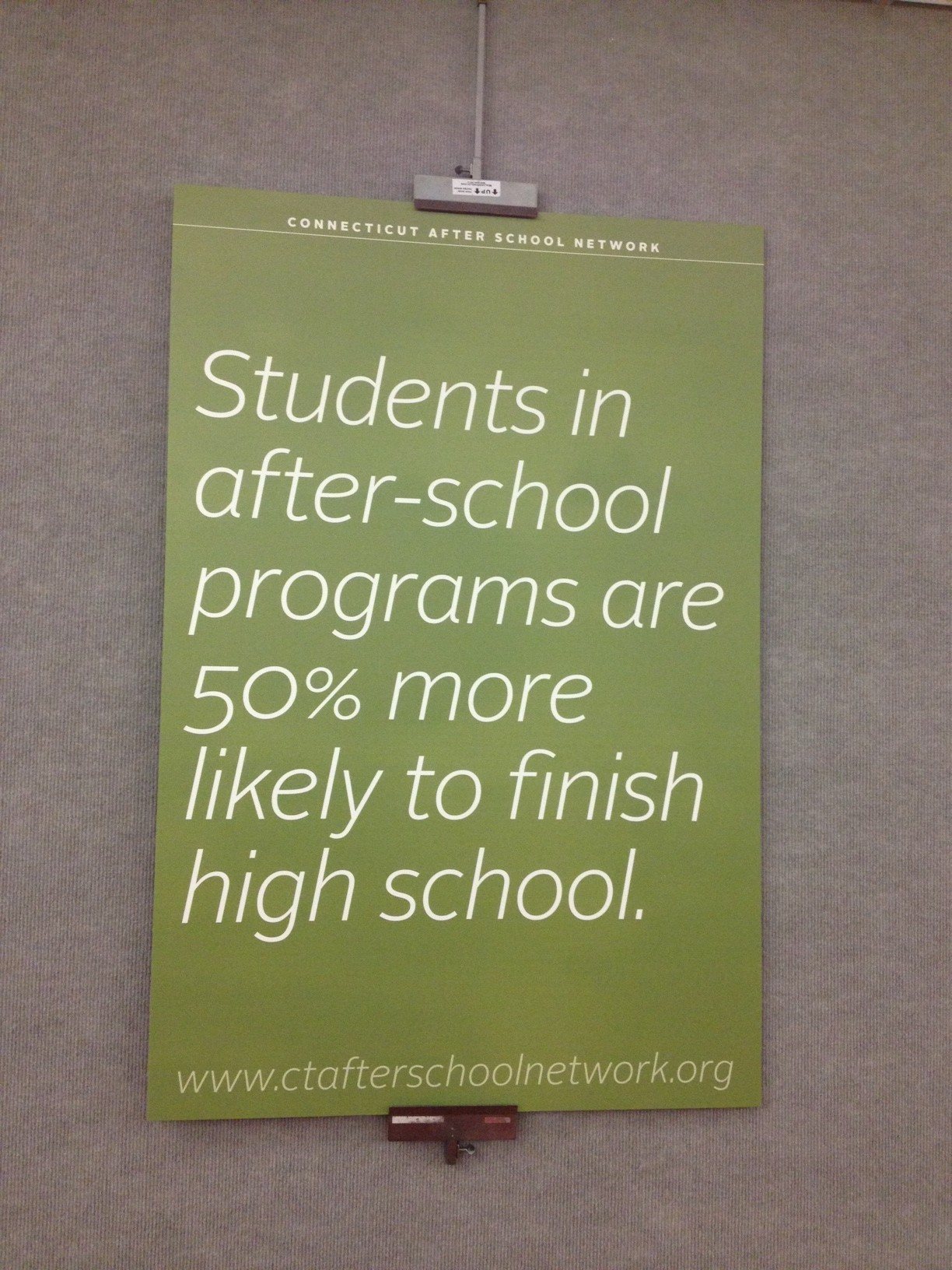
The lengthy corridor between the State Capitol building and the Legislative Office Building routinely hosts informational poster displays on its walls, in two-week cycles, from a broad range of agencies, organizations and associations, highlighting their work and the impact it has on the state.  Reservations for the space are routinely made weeks in advance. One of the current displays, coordinated by the Connecticut After School Network, comes at a time when they – like many other nonprofit organizations and state agencies – are facing a potential budget cut from the state, at the urging of Gov. Malloy.  Ultimately it is the state legislature that will determine the parameters of the budget, a debate underway throughout the Capitol complex amongst legislators who pass by the posters each day, with messages and statistics that are hard to miss.  Among them:after school

  • After-school programs cut the risk of juvenile crime by as much as 75%
  • In Connecticut, 19% of children under the age of 18 experience food hardship.  Many rely on the meals they get at school and in after-school programs as a primary source.
  • $1.7 to $2.3 million is saved by putting one high-risk youth on the right path.
  • 73% of working parents miss less work when their children attend an after-school program.
  • Students in after-school programs are 50% more likely to finish high school
  • One in five Connecticut children (21%) regularly spends time after school unsupervised. This trphotoanslates to more than 80,000 Connecticut children
  • Children and youth involved in after-school programs have fewer absences from school.

March 7 was “After School Day at the Capitol.” The organization released a major report "Supporting Student Success in Connecticut: A BluePrint for Expanded Learning Opportunities".   The report calls on the state to make “7 smart, strategic investments,” reflecting that “after-school not be an after thought.”  The recommendations include addressing the issues of summer learning loss, incorporating expanded learning opportunities into the state’s education reform strategies, increasing alignment between systems and funding sources, rethinking the relationship between time and learning, and strengthening quality and accountability.

Their website currently features a petition urging restoration by legislators of the $4.5 million proposed cut and is promoting the organization’s 7th Annual Literacy Essentials Conference, to be held on Saturday, April 6 in conjunction with Central Connecticut State University.

The organization’s web site also points out that “every dollar invested in after school programs will save taxpayers approximately $3, not including the savings from reduced crime.”

The Connecticut After School Network is a nonprofit 501(c)(3) organization originally founded in 1989 and incorporated in 1990 under the name Connecticut School Age Care Alliance (CSACA). In 1990, CSACA became affiliated with the National School Age Care Alliance (now the National After-School Association).

Following similar action by the national organization, CSACA changed its name and broadened its mission in 2006, becoming the Connecticut After School Network.  It is a partnership of individuals and organizations working to ensure that every Connecticut child and youth will have the opportunity to participate in high quality, affordable after school programs.

The State Department of Education is a significant partner and major funder of the Network, providing leadership, support and technical assistance. SDE also oversees the CT After-School Advisory Council which provides advice and direction to the Network.

Early Childhood Education Cabinet to Meet Amidst Changing Landscape

The Connecticut Early Childhood Education Cabinet next meets on March 28 in Middletown, less than two months after Governor Dannel Malloy announced the establishment of an Office of Early Childhood (OEC) by merging functions previously under the jurisdiction of five different agencies. The new agency is designed to provide a comprehensive, collaborative system for delivering improved programs and services to children ages zero to five and their parents. The meeting also comes a year after the Cabinet, which was reformed by former Gov. M. Jodi Rell in 2010, issued a Needs Assessment report, which included the following sit-up-and-take-notice statistics:

  • There are approximately 212,504 children from birth to age five in Connecticut; 29,379 of those children live in poverty and 78,803 children are from low income families.
  • Approximately 161,013 of children under the age of six are potentially in need of child care.
  • The state currently has 2,173 child care centers, with 25% of the centers nationally accredited .
  • The annual cost of center-based care for an infant is $12,469, approximately 15% of the state’s median family; income.  The annual cost of care for an infant in a family child care setting is $9,230, 11% of the median family income.
  • According to the National Center for Children in Poverty, 6% of Connecticut’s children under the age of six are experiencing extreme poverty.
  • The percent of Connecticut children living in families where no parent has full-time, year-round employment is 26%, with 10% of children having at least one unemployed parent.
  • The number of children served in Connecticut’s emergency shelters increased by 15% between 2010 and 2011.

The new Office of Early Childhood is a product of work by agency commissioners, early childhood education and development advocates, parents, caregivers, and other stakeholders, the Malloy administration explained.  It is comprised of related programs that were previously housed in five separate state agencies, and builds on work done in 2012 when Connecticut invested $9.8 million in early childhood initiatives, created 1,000 new spots for early learners, invested early$3 million for a tiered quality rating and improvement system.

The purpose of the Early Childhood Education Cabinet has been to develop a high-quality, comprehensive system of early childhood education among the wide array of early childhood programs in the state (including Head Start, child care and School Readiness). It is chaired by Fairfield Schools Superintendent David Title. The Cabinet’s 2012 report concluded by stating their commitment to serve as “the catalyst for ongoing coordination and collaboration with statewide stakeholders to ensure that Connecticut’s youngest children have increased access to high quality early learning experiences as a foundation for lifelong success.”

Under Gov. Malloy’s revamped Office of Early Childhood, 71 staff will move to the new office, and four new positions will be created—an Executive Director and three staff positions.  The OEC will require a $370,000 investment in fiscal year 2014, and will use the Department of Education administrative and back office support. It will phase in over two years.

The planning of the OEC was made possible by support from the William Casper Graustein Memorial Fund, the Early Childhood Collaborative funders, and the Early Childhood Alliance.


First-in-Nation Audio Service for Hospitalized Children Launched in Connecticut

In what may be the first program of its kind in the nation, CRIS Radio and Connecticut Children's Medical Center are working together to offer children who are patients at the hospital a new way to pass their time while receiving medical treatment. Connecticut Children's patients may now listen to CRISKids, a service that provides audio versions of articles published in nearly 20 award-winning children's magazines, through the hospital's in-house television system.  The audio alternative to printed magazines - through an in-house system streamed to each patient TV – can be tremendously comforting for young patients unable to read or turn pages of a magazine due to their condition or medical treatment.

CRIS (Connecticut Radio Information System) is a 34-year-old nonprofit based in Windsor and is Connecticut's only radio-reading service providing audio access to news and information for people who are blind or print-handicapped, including those unable to read due to physical, learning, intellectual or emotional disabilities.

CRISKids, the only extensive line-up of audio versions of children's magazines in the nation and Canada, was launched in December 2011.  More than a dozen titles are available, mostly for children aged 4 to 15, including National Geographic for Kids, Science World, Ranger Rick,  Junior Scholastic, Sports Illustrated for Kids and Scholastic News. CRIS radio

CRIS Board Chairman William H. Austin said that the Board “is excited to form a partnership with Connecticut Children's and thankful for the funding support received to bring this project to life.  Comcast provided technical assistance and a donation of special equipment necessary for the project. Other funders of the project include the Ellen Jeanne Goldfarb Memorial Charitable Trust, and the Ahearn Family Foundation.

"The availability of CRISKidsTM in patient rooms will allow children to enjoy educational entertainment, which is an extremely valuable offering and can be a helpful component of the healing process," said Martin J. Gavin, President and CEO of Connecticut Children's Medical Center.

The CRISKids initiative has received financial support from several foundations, including: Help for the Blind of Eastern Connecticut, Fund for Greater Hartford, The Gibney Family Foundation, and the Hartford Foundation for Public Giving.

CRIS Radio records more than 70 newspapers and magazines to provide audio access to printed material for people who are blind and print-handicapped. The audio recordings can be heard with a special CRIS radio, toll-free through the CRIS Telephone Reader, online streaming live or on-demand at the CRIS Radio website, www.crisradio.org, or with any mobile device, including tablets or smartphones.  CRIS operates with nearly 350 volunteers at its broadcast center in Windsor and four satellite studios located in Danbury, Norwich, Trumbull and West Haven.  The CRISKids program is also available for individual subscription.

Connecticut Children's Medical Center is a nationally recognized, 187-bed not-for-profit children's hospital serving as the primary teaching hospital for the Department of Pediatrics at the University of Connecticut School of Medicine. Named among the best in the nation for several of its pediatric specialties in the annual U.S. News & World Report "Best Children's Hospitals" rankings.


CT AARP Steps Up Focus on Entrepreneurs, Business Development

Next month, AARP and the U.S. Small Business Administration (SBA) are teaming up to host National Encore Entrepreneur Mentor Month, targeted at new business owners age 50 and over and those interested in starting a business.  The goal is to match these “encore entrepreneurs” with experienced business owners and community leaders for advice and assistance, and to link them to the resources they need to successfully start and grow their businesses and create jobs. Consistent with the organizations’ mission, the Connecticut AARP chapter views social enterprise as a valuable opportunity for age 50+ entrepreneurs – also known as “Encore Entrepreneurs” – and active retirees with sharp business and entrepreneurial acumen.  With one in four Americans ages 44 to 70 interested in becoming entrepreneurs, and a large majority planning to work during retirement, small business ownership is described as a solid option.

In addition to planned programs during April, the Connecticut AARP has announced support for legislation proposed by Governor Malloy’s (SB6356) which would help AARP members formalize their commitment to creating public good. The bill is designed to help address a variety of social concerns, through business rather than public funds or philanthropy, that are core to AARP’s mission, such as hunger, economic insecurity, housing and isolation.  AARP has ongoing partnerships with the U.S. Small Business Association (SBA), nationally and state-wide, and with co41592_130564031656_4369100_nmmunity partners in Connecticut including Social Enterprise Trust (reSET) and the Women’s Business Development Center (WBDC).

The bill before the legislature aims to help attract and keep social entrepreneurs and social enterprise investors in Connecticut and provides a heightened level of transparency and protection as compared to other states with similar legislation, according to AARP. Among the beneficiaries:  “Encore Entrepreneurs” seeking purpose beyond profit, community based organizations seeking to partner for social benefits, age 50+ workers seeking employment opportunities in a down economy, and the State by creating a new source of revenue through the payment of up-front incorporation filing fees and annual taxes.

National Encore Entrepreneur Mentor Month is part of a larger effort by AARP and SBA to promote entrepreneurship among individuals ages 50+.  It will consist of events across the country, including two in Connecticut, on April 16 in Waterbury and April 18 in Bridgeport, that will link individuals with local resources and mentor opportunities to help them successfully start and grow a small business.

The initiative includes AARP’s Work Reimagined, a unique new way for experienced workers to advance themselves in today’s tight job market.  Work Reimagined is a social network based jobs program that connects employers seeking experienced workers with qualified professionals searching for new or more satisfying careers.  The site, www.workreimagined.org, leverages the platform of professional networking site, LinkedIn, which is used by more than 15 million people aged 45-64.

AARP’s Work Reimagined and other resources for experienced workers over age 50 are slated to be highlighted in a segment on WTNH’s Connecticut Style program airing Wednesday, April 3, 2013 at 12:30 p.m.

The in-person AARP/SBA workshops in April will feature presentations by SBA, SCORE, reSET (Social Enterprise Trust), The Women’s Business Development Council (WBDC), People’s Bank and local economic development agencies.  Attendees will have the opportunity to ask questions and speak individually with representatives, as well as network with other small business owners and “would be” entrepreneurs. Registration is required.

April 16, 2013 in Waterbury   9 a.m. – 12 p.m. (noon)

Silas Branson Library, 267 Grand Street, Waterbury, CT

To register, call 1-877-926-8300 or register online

April 18, 2013 in Bridgeport   9 a.m. – 12 p.m. (noon)

City Hall Annex, 999 Broad Street, Bridgeport, CT

To register, call 1-877-926-8300 or register online.