CT, NY, NJ Should Expect Unprecedented Flooding by Mid-Century, Scientists Predict
/
It will get worse, not better, for shoreline residents and businesses in Connecticut, New York and New Jersey within range of the Atlantic Ocean. That’s the likely scenario based on newly completed research by a team of geoscientists who are predicting that the New Jersey shore will likely experience a sea-level rise -- about 1.5 feet by 2050 and of about 3.5 feet by 2100 – that will be 11 to 15 inches higher than the average for sea-level rise globally over the century.
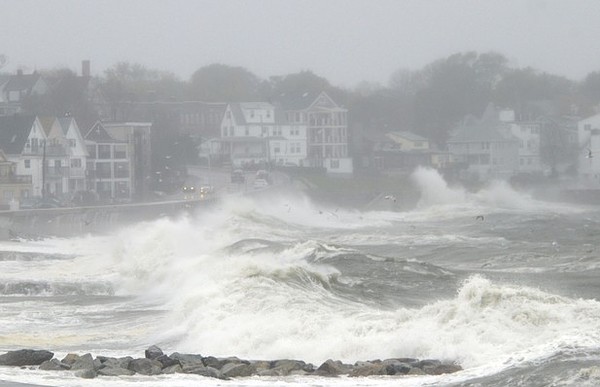 That would mean that by the middle of this century, the one-in-10 year flood level at Atlantic City, for example, would exceed any flood level seen previously, including the natural disaster that was Superstorm Sandy. The scientists suggest, based on their research, that “planners should account for rising sea levels,” noting that “where the consequences of flooding are high, prudent planning requires consideration of high-end projections” outlined in their study.
Geoscientists at Rutgers University and Tufts University base their projections in part upon an analysis of historic and modern-day records of sea-level rise in the U.S. mid-Atlantic region. Their research appears in the inaugural issue of the journal Earth's Future, published this month by the American Geophysical Union (AGU).
While much to the work centers on the New Jersey shore and The Battery in Lower Manhattan, Rutgers researcher Ken Miller told Connecticut by the Numbers that their analysis included both Montauk on Long Island and Bridgeport. Since Connecticut lies on bedrock, Miller said, it will largely behave like The Battery in New York City . “I believe that the projections for bedrock locations are applicable throughout Connecticut,” said Miller, a professor of earth and planetary sciences in Rutgers' School of Arts and Sciences.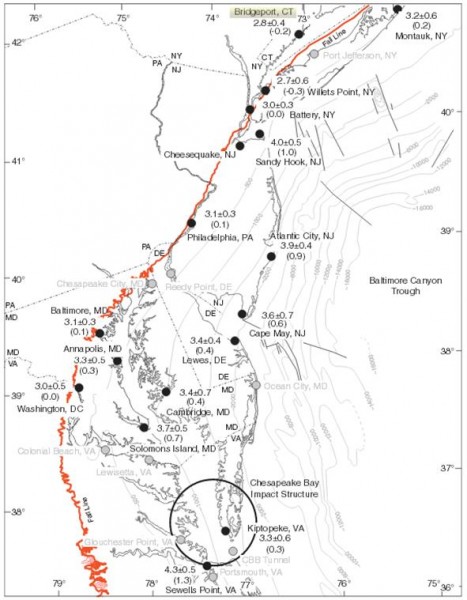
Miller collaborated in the study with colleagues Robert Kopp, Benjamin Horton and James Browning of Rutgers and Andrew Kemp of Tufts. Kemp, an assistant professor of earth and ocean sciences at Tufts since May, joined the faculty from Yale University, where he was a Postdoctoral Associate at the Yale Climate and Energy Institute (YCEI). The new research builds upon a recent study by Kemp, Horton and others that reconstructed a 2,500-year record of sea level at the New Jersey shore. Horton is a professor of marine and coastal sciences in Rutgers' School of Environmental and Biological Sciences.
"It's clear from both the tide gauge and geological records that sea level has been rising in the mid-Atlantic region at a foot per century as a result of global average sea-level rise and the solid earth's ongoing adjustment to the end of the last ice age," Miller told Rutgers Today. "In the sands of the New Jersey coastal plain, sea level is also rising by another four inches per century because of sediment compaction -- due partly to natural forces and partly to groundwater withdrawal. But the rate of sea-level rise, globally and regionally, is increasing due to melting of ice sheets and the warming of the oceans."
The researchers suggest that “additional work is needed to integrate site-specific sea-level rise projections with storm tide statistics to guide planning decisions and investments that may have time frames of 20 years, 40 years, or longer.” They indicate that sea-le vel rise in the mid-Atlantic region also results from changes in ocean dynamics. The researchers said sea-level rise could be higher -- 2.3 feet by mid-century and 5.9 feet by the end of the century -- depending on how sensitive the Gulf Stream is to warming and how fast the ice sheets melt in response to that warming.
The study found that the eight inches of climate change-related regional sea-level rise in the 20th century exposed about 83,000 additional people in New Jersey and New York City to flooding during 2012's Superstorm Sandy. The research was supported by a grant from the National Science Foundation.
Earth’s Future, with its inaugural issue, joins AGU’s prestigious portfolio of peer-reviewed research publications, including Geophysical Research Letters and Journal of Geophysical Research – Atmospheres. Both are ranked among the top ten most-highly cited research publications on climate change over the past decade. The American Geophysical Union is dedicated to advancing the Earth and space sciences for the benefit of humanity through its scholarly publications, conferences, and outreach programs. AGU is a not-for-profit, professional, scientifi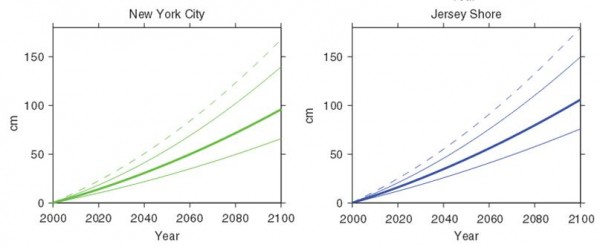 c organization representing more than 62,000 members in 144 countries.

 in mixed-use neighborhoods are one-third to one-half lower than in suburban areas. It has been estimated that every downtown in Connecticut has at least one building that is under-utilized, containing a store or restaurant on the first floor, but with upper floors that are vacant or used for storage that could instead generate income if converted to apartment homes.
 ent, they are often not enough to enable mixed-use growth. Favorable zoning regulations are important, but they cannot create mixed-use development by themselves. Each of the pilot communities had zoning policies that allowed for buildings with a mix of uses - a practice which should be commended and encouraged - but there were still significant impediments to promoting this type of growth. In addition, lessening current on-site parking requirements as a whole will also help promote housing in our downtowns.
 ich Time
 they immediately got involved. School administrators in Manchester last month suspended four Manchester High School students suspected of creating and posting degrading descriptions of female students,
  Young people are drinking more coffee than in recent years, according to the data compiled by the
  he National Coffee Association data indicates that 76 percent of adult Hispanic-Americans said they drank coffee yesterday, 13 percentage points ahead of the total population. By comparison, 47 percent of African-Americans and 64 percent of Caucasian-Americans said they drank coffee yesterday.
 t the program focus on learning about one’s own leadership personality, participatory decision- making, effective group dynamics and leadership practices, including change leadership. The field experiences allow participants to meet the area’s key players and organizations, better understand the region’s assets and challenges, and gain a greater understanding of creative problem solving while leveraging limited resources.
 Consortium for Higher Education (HCHE) to create a media device that would tell the story of the Career Beginnings program, which connects Hartford-area high schools, businesses, volunteers/mentors and parents in a coordinated effort to increase the percentage of Hartford teenagers who graduate from high school, pursue higher education and fulfill career goals.
 ).
).
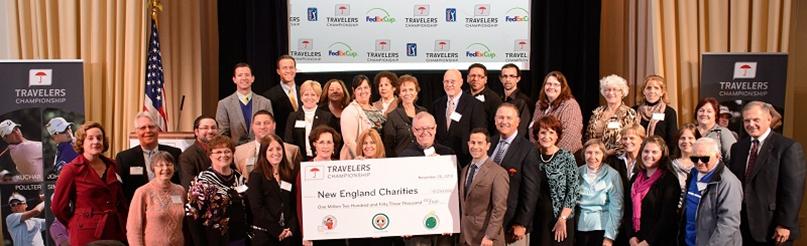 llars raised in the Birdies for Charity pledge-based fundraiser and the Chip In for Charity ticket-sales fundraiser. Additionally, the Travelers Championship raised awareness and funds for local charities through a variety of special events like the Birdies for the Brave Golf Outing, BlumShapiro 5K for Charity, Premier Limo First Tee Classic, Military Appreciation presented by Saint Francis Care, Golf Digest Junior Pro-Am, Northstar Wealth Partners Celebrity Mini Golf Tournament, Women's Day presented by Travelers, Powerstation Events Concert Series, and the LEGO® Children's Charity Golf Tournament.
 sbury in 2013 and 2011, and Cheshire in 2013 and 2011. Single appearances were made by Norwalk, Stamford, Portland, Tolland, Greenwich, South Windsor, Fairfield, and most recently, Brookfield.
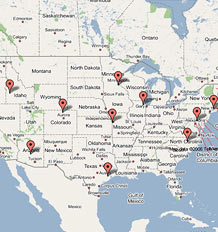 Hartford at #55. The town was joined by Stamford at #78, Hamden at #87, and Norwalk at #90.
 well among the top 101, with no less than five pizza selected – including another top ten selection – the Tomato Pie at
  he sausage pie from
  crust! It's coal-fired perfection, thin yet substantial - a true feat of pizza engineering. You can pick up a slice, and it won't flop over like most new-school Neapolitan pies. The most justly famous option is the white clam, piled with out-of-the-shell longnecks and a healthy dose of garlic - it's briny, creamy, chewy and a true revelation,” Zagat pointed out.
 om Rhode Island, on the half shell, as an appetizer. This occurred around the mid 1960's, the website explains, and gradually became popular through the years.
 ts from the U.S. and beyond will exchange knowledge about voluntary action, nonprofit organizations, and philanthropy – and Connecticut will be well represented among participants. David Nee, representing the Connecticut Data Collaborative and Terry Edelstein, nonprofit liaison to the Governor will be among the panelists for a plenary session of the Conference. Among those attending the national conference close to home are Kyle Barrette (UConn), Mary Bernstein (UConn), Ron Cretaro (Connecticut Association for Nonprofits), Robert Fisher (UConn), Richard Frieder (Hartford Public Library), Maggie Gunther Osborn (Connecticut Council for Philanthropy), Reinaldo Rojas (UConn), Homa Naficy (Hartford Public Library), Nmarasimhan Srinivasan (UConn), Rebecca Thomas (UConn) and Jun Yan (UConn).
 d all aspects of civil society, as well as to meet the needs of those who study and lead “the social sector.”