First Time Home Buyers: New Hartford, Westbrook, Coventry Most Attractive
/In Connecticut, as elsewhere across the country, it is a home buyers’ market. And that is especially prevalent in some of Connecticut’s smaller communities, and those in the central and northern parts of the state, according to an analysis by NerdWallet, a national finance website, which determined the top places for first-time homebuyers in Connecticut.
The site identified the top communities for new home buyers, considering how much individuals would need to spend on a mortgage and examining the data on appreciation “to find the best locations, based on the health of the local housing market, the costs of housing, and the prosperity and safety in each community.”
“To be sure,” the website noted, “the state is not a magnet for first-time buyers based on affordability, but the places we identified stand out as being the most suitable for those looking for a foothold in the housing market.”
The top community was New Hartford, which was described as having “a population of just over 6,900, this small community was the 11th-safest among the 116 in the state we analyzed. Additionally, the select monthly ownership costs were the second-lowest among the top 10 cities, at $1,813; that’s $235 less than the median for all 116 communities.”
Runner-up was Westbrook, along the Connecticut shoreline. Westbrook had “the second-most expensive home value among the top 10. But it also had the strongest home value growth rate among all 116 communities analyzed — a positive economic sign for homebuyers,” the website indicated. “Although home values in many areas of the state fell between 2011 and 2014, they grew by 4.87% in Westbrook; that’s well above the median decline of 6.8% for all communities analyzed. Westbrook also had the lowest real estate tax rate among the top 10, at 1.15% of assessed value per year.
The top ten communities:
- New Hartford
- Westbrook
- Coventry
- Berlin
- Colchester
- Windsor Locks
- Durham
- Ellington
- Marlborough
- Windsor
Of Coventry, the third-ranked community, the website said: “Homeowners here see median monthly ownership costs of $1,883, which is $165 less than the median of all communities analyzed. Among the top 10 locations, it takes the third-shortest amount of time to save for a down payment in Coventry (19.86 years). With a crime rating of "safe," low poverty rates and home values nearly $20,000 less than the state median, Coventry could be an ideal location for first-time homebuyers if they can find employment within commuting distance.”
The fourth-ranked town, Berlin, was cited for its population growth, “the third-highest of all 116 communities analyzed, rising 3.34% between 2011 and 2014 — much higher than the median population growth of 0.5% for all places analyzed. The median home value here as of 2014 was $286,800, slightly higher than the median of all places analyzed.”
Colchester, with a median age of 39, was described as the youngest among the to 10, and Windsor Locks, home of Bradley International Airport, was highlighted for the affordability of its homes, “the least expensive” among the top communities.
Rounding out the top twenty were South Windsor, Canton, Haddam, Suffield, Glastonbury, Burlington, Tolland, East Hampton, Southington and Lebanon. A total of 116 communities were ranked in the analysis, with Stamford, Ansonia, Waterbury, New Haven, and Bridgeport at the bottom of the list. 
For their calculations, the website assumed a first-time homebuyer in Connecticut earns an annual income of $73,361, the 2014 state median for households headed by residents ages 25 to 44. They also assumed a personal savings rate of 4.8 percent, based on the U.S. 10-year average as measured by the Federal Reserve Bank. Assuming the homebuyers are starting with nothing in the bank, they then estimated how many years it would take to save for a 20 percent down payment
By following the Consumer Financial Protection Bureau's recommendation that homeowners shouldn't allocate more than 28% of their gross monthly income to housing costs, NerdWallet analysts determined that a first-time homebuyer in Connecticut could afford to spend $1,712 a month on ownership costs — mortgage, taxes, utilities and insurance.
 Overall scores were based on eight categories: Search Capabilities, Complaint and Board Information, Identifying Doctor Information, Board Disciplinary Actions, Hospital Disciplinary Actions, Federal Disciplinary Actions, Malpractice Payouts and Convictions.



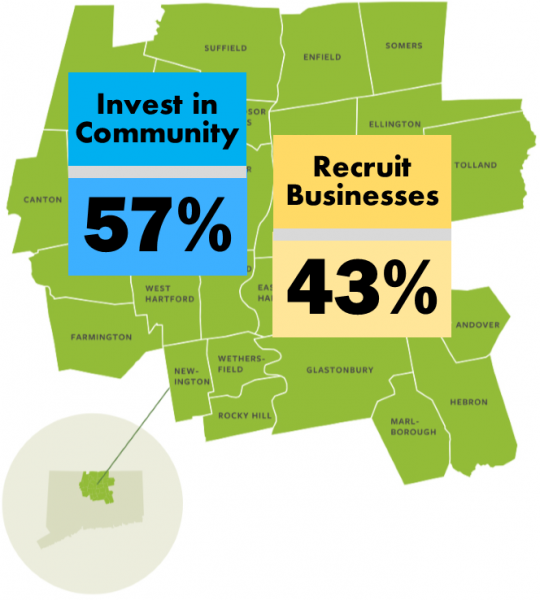 The data from the survey reflect a difference of opinion among older residents of the region. Individuals over age 46 took the opposite view from younger residents, with a majority expressing a preference for spending skewed toward recruiting companies. The reversal was dramatic, with two-thirds of those age 36-45 preferring investing in communities, by a margin of 67%-33%, and individuals age 46-55 expressing a preference for resources to be aimed at recruiting companies, with two-thirds holding the opposite view, 63%-38%.


 Chinese made up 35 percent of the 92,000 foreign secondary school students in the United States in 2015, according to the US Department of Homeland Security, by far the largest group studying here, the Boston Globe


 The issue brief indicated that a disadvantage of a distance toll system on all limited access highways in Connecticut would be that it “could create an incentive for people to use alternative roadways. The increased use of these roadways could shift the burden of maintenance and congestion to municipalities.” The advantage would be that distance tolls “could help to more efficiently allocate the cost of these roadways to drivers who use them the most.”
 Congestion pricing, which provides for higher toll charges at peak traffic times, “helps to limit traffic on major roadways and create an incentive for people to use more environmentally friendly forms of public transportation,” the policy paper indicates. However, a congestion pricing system “could polarize roadway use by displacing low income commuters during peak driving hours. Congestion pricing could also create displacement effects whereby the increased use of local roadways could shift the burden of maintenance and congestion to municipalities.”


 In Connecticut, a person is guilty of trafficking in persons when such person compels or induces another person to engage in sexual contact or provide labor or services by means of force, threat of force, fraud or coercion. Anyone under the age of 18 engaged in commercial sexual exploitation is deemed a victim of domestic minor sex trafficking irrespective of the use of force, threat of force, fraud or coercion.
 The need for stronger action is underscored by recent statistics. In Connecticut, one of every three kindergartners is overweight or obese, as is one of every three low-income children. Children who are overweight or obese are more likely, according to the policy brief, to have:
 A number of the proposals have been successfully implemented in other jurisdictions, including states and cities. Marlene Schwartz, Director of UConn's Rudd Center for Food Policy and Obesity, noted that Connecticut has long been a leader in providing nutritional lunches in schools, and said that now the state’s attention needs to move to the earlier years of childhood. “The field has realized that we need to start even earlier,” she said. Rudd also indicated that determining "policy changes that might help reduce the disparities" in Connecticut, which are apparent in race, ethnicity and socioeconomic data, is also essential.

 The recommendations, described as “affordable, achievable, common sense measures,” were prepared for CHDI as part of a grant to the UConn Rudd Center for Food Policy and Obesity, funded by the Children’s Fund of Connecticut. The author was public health policy consultant Roberta R. Friedman, ScM.
 IMPACT “Preventing Childhood Obesity: Maternal-Child Life Course Approach” in 2014. The report reviewed scientific research on the causes of obesity and explored implications for prevention and early intervention. In 2015, the Children’s Fund of Connecticut funded four obesity prevention projects in Connecticut that addressed health messaging, data development, policy development and baby-friendly hospitals.