CT Families Continue to Struggle Financially, United Way Report Reveals

More Connecticut households are struggling to pay for their most basic needs, according to a new report from United Way.  More than one out of four households - in one of the wealthiest states in the U.S. - are employed, yet still fall below what is needed to thrive financially.  That is an increase in both the number and percentage of such households in 2014 as compared with 2012, according to the updated ALICE report. Two years ago, United Ways introduced ALICE, which stands for - Asset Limited Income Constrained Employed - to place a spotlight on a large population of residents who are working, but have difficulty affording the basic necessities of housing, food, child care, health care and transportation.pie
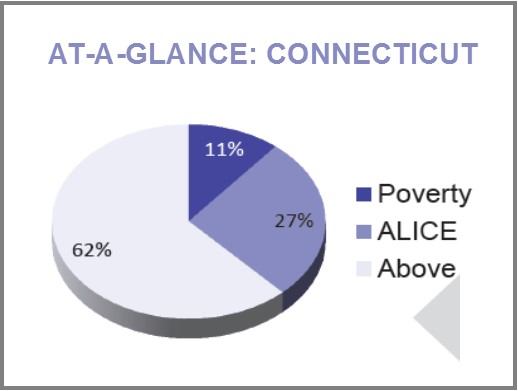
In those two years, the problem has grown worse, even has the recession has given way to a slow economic recovery, in Connecticut and nationwide.  ALICE and poverty households combined account for 38 percent of households in the state that struggle to make ends meet.

A total of 361,521 Connecticut households fall into what the study describes as the ALICE population. These are households earning more than the official U.S. poverty level, but less than the basic cost of living. This is more than 2.5 times the number of households that fall below the federal poverty level. ALICE households make up 20% or more of all households in 114 (67%) of Connecticut’s 169 cities and towns.

The highest levels (ALICE and poverty households) were in Hartford (74%), New Haven (65%), Waterbury (63%), Bridgeport (63%) and New Britain (63%).  Also above 50 percent are Meriden, West Haven, East Hartford and New London.  From 2007 to 2014, two cities, Danbury and Waterbury, saw their total household population decrease, by 7 and 9 percent respectively, while the rest experienced an increase in households, with the largest increase of 8 percent in Stamford, according to the report. The number of household below the ALICE Threshold increased in every one of the nine largest cities and towns with Norwalk seeing the largest percent increase (38 percent).
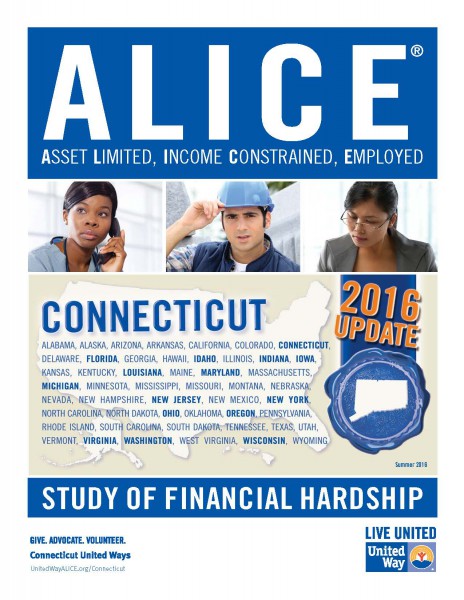
2016-alice-report-update-coverWhile the prevalence of low-wage jobs still defines Connecticut’s economy for ALICE, for the first time in the past decade, the percent of jobs paying less than $20 per hour fell below 50 percent of all jobs.  The report also highlights a number of trends in Connecticut, including:

  • The population is aging, and many seniors do not have the resources they need to support themselves.
  • Differences by race and ethnicity persist and ethnicity persist, creating challenges for many ALICE families, as well as for immigrants in Connecticut.
  • Low-wage jobs are projected to grow faster than higher-wage jobs over the next decade.
  • Technology is changing the workplace, adding some jobs, replacing many others, while also changing where people work, the hours they work, and skills required. The report notes that technology creates opportunities as well as challenges for ALICE workers.

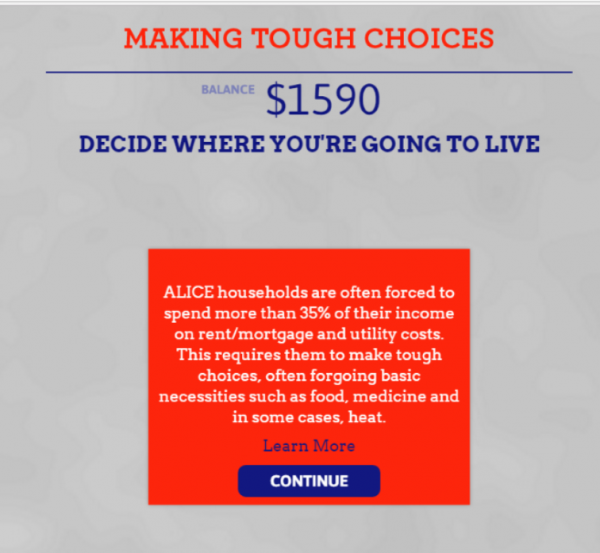
For the first time, an online simulator is also available to experience the financial challenges that ALICE households in Connecticut face at www.MakingToughChoices.org.  The updated Report uses data from a variety of sources, including the U.S. Census and the American Community Survey to provide tools that quantify the number of households in Connecticut's workforce that are struggling financially. The updated United Way ALICE Report reveals:

  • The composition of the ALICE population is men and women, young and old, of all races.
  • The breakdown of jobs in Connecticut by hourly wage (51% of jobs pay more than $20/hour) compared to what it costs to survive for a family of four (2 adults, 1 infant, 1 preschooler) - $70,788.
  • Every city and town in Connecticut has ALICE households. More than two-thirds of Connecticut's cities and towns have at least 1 in 5 households that fit the ALICE definition for financial hardship.cropped-alicemicrositelogo2

Poverty and ALICE households exist in every racial and ethnic group in Connecticut, but the largest numbers are among White non-Hispanic households. There were about one million White households in 2014, compared to 328,000 households of color (Figure 4 shows the populations of color for whom there is income data: Hispanic, Black and Asian). However, these groups made up a proportionally larger share of households both in poverty and ALICE: 64 percent of Hispanic households, 58 percent of Black households, and 30 percent of Asian households had income below the ALICE Threshold in 2014, compared to 31 percent of White households.

The largest population of color in Connecticut, Hispanics, has been growing since 2007, totaling 156,837 households in 2014, a 25 percent increase. As the number of Hispanic households increased, so did the number and proportion of Hispanics living below the ALICE threshold. The percentage of Hispanic ALICE households rose from 34 percent in 2007 to 39 percent in 2010 and then to 43 percent in 2014. Together Hispanic households in poverty and ALICE made up more than two-thirds of Hispanic households in 2014.
making-tough-choicesThere are some signs of improvement in the education gap among racial and ethnic groups, suggesting that some structural changes are occurring in Connecticut. In K-12 education, the Education Equality Index (EEI) shows that the achievement gap – the disparity in educational measures between socioeconomic and racial or ethnic groups – narrowed slightly between 2011 and 2014 in Connecticut.

Achievement gaps impact graduation rates and college performance. Among the Class of 2013, 64 percent of Black students and 59 percent of Hispanic students in the state went on to college within a year after graduating from high school, compared to 78 percent of White students. They also had lower 6-year college graduation rates: While 54 percent of White students got a college degree within 6 years, only 24 percent of Black students and 21 percent of Hispanic students did the same (Connecticut State Department of Education, 2015).

The updated ALICE Report recommends both short-term and long-term strategies to help ALICE families and strengthen our communities. United Ways work with many community partners to provide support to ALICE families to help them get through a crisis and avoid a downward spiral into even worse circumstances such as homelessness as well as assisting with financial literacy, education and workforce readiness.

Further, United Ways in Connecticut have invested more than $8.5 million in child care and early learning; $1.3 million in housing and homeless prevention work; $5 million in basic needs programs; and, have assisted working families in obtaining nearly $40 million in EITC and tax refunds and credits in 2016.

The updated Connecticut ALICE Report was funded by the 16 Connecticut United Ways. For more information or to find data about ALICE in local communities, visit http://alice.ctunitedway.org.  Connecticut United Ways are joining with United Ways in fifteen other states to provide statewide ALICE Reports. The updated Connecticut ALICE Report provides analysis of how many households are struggling in every town, and what it costs to pay for basic necessities in different parts of the state (Household Survival Budget).

https://youtu.be/u7gPJGu2psw

 [2014 ALICE introductory video]

First Niagara Transitions to KeyBank This Weekend

For customers of the soon-to-be-history First Niagara Bank, this will be a holiday weekend of banking transition, as KeyBank becomes the new name on the door on Tuesday morning after a host of changes inside. First Niagara branches, converting to KeyBank, will close at 3 p.m. Oct. 7 and reopen for business the morning of Oct. 11, the day after Columbus Day. The company promises a smooth transition, and has been providing customers of the bank’s more than 60 branches in Connecticut with step by-step previews of what to expect. The changes represent the completion of the $4.1 billion KeyCorp purchase of First Niagara.logo-lockup

“As KeyBank and First Niagara come together you can continue to bank as you currently do, using your same account number, checks, debit card, ATM card, credit card, telephone banking, online access and branches,” the company website points out.

First Niagara has 65 branches in Connecticut that will be transitioned to KeyBank branches. There were no existing KeyBank branches in the state prior to the merger, so there was no overlap that required branch closings, as is often the case with bank mergers.

Headquartered in Cleveland, KeyBank’s footprint includes 15 states via a network of more than 1,200 branches and more than 1,500 KeyBank ATMs. The company’s roots trace back 190 years to Albany, New York. Since then, KeyCorp has grown into one of the nation's largest bank-based financial services companies, among the top 15, with assets of approximately $135 billion, according to the company.

keybank-mapIn recent months, First Niagara did consolidate five Connecticut branches (Woodstock, Dayville, Hamden, East Haven and Madison), and all of the employees who worked at those branches were offered positions within the bank, officials indicated, and no layoffs were associated with that consolidation.

"By asset size, this is the largest bank merger since the financial crisis,” Beth E. Mooney, Key’s chairwoman and CEO, told the Buffalo News last month, during a visit to Key’s Northeast regional headquarters in Buffalo, which had been First Niagara’s corporate headquarters.

“So there is a significance and an importance for us to do it well that’s critical for our communities, our clients, our employees and our shareholders. But from an industry perspective, this is actually one that there’s a fair amount of eyes on us, as well.”

The conversion of First Niagara accounts and services to KeyBank will begin at with a 3 p.m. close of business on Friday, October 7.  Due to Online Banking updates, customer balances that appears online on Thursday, October 6 at 11:59 p.m. will not change until Saturday, October 8, at 6 a.m., so any purchases or deposits made during that time will not be reflected on online balances until Saturday. Customers can continue to use current First Niagara ATM/debit card, account numbers and PINs will not change.

The acquisition of First Niagara by Keycorp was announced on Oct. 30, 2015, and includes the addition of approximately 300 First Niagara branches in New York, Pennsylvania, Connecticut and Massachusetts.  First Niagara had entered the Connecticut market in 2011 with the purchase of New Alliance Bank.

Global Health and Innovation Conference, World's Largest, in New Haven in April

The Innovation Prize is a $10,000 and a $5,000 cash prize that is awarded to the two best social impact pitches that are presented at the 2017 Global Health & Innovation Conference, to be held in New Haven at Yale University on April 22-23, 2017. The Global Health & Innovation Conference (#GHIC) is the world's leading and largest global health conference as well as the largest social entrepreneurship conference, with 2,200 professionals and students from all 50 states and more than 55 countries, according to conference organizers.

The conference was developed by Unite for Site, a 501(c)(3) nonprofit global health delivery organization that is free of commercial interests and committed to promoting high-quality health care for all. GHIC 2017 will be Unite For Sight's 14th annual conference, having grown from a conference of about 100 participants in its first year.unite-for-sight-logo

Unite For Sight, headquartered on Church Street in New Haven, supports eye clinics worldwide by investing human and financial resources in their social ventures to eliminate patient barriers to eye care. Unite For Sight applies best practices in eye care, public health, volunteerism, and social entrepreneurship to achieve our goal of high-quality eye care for all. The programs are locally led and managed by ophthalmologists at Unite For Sight's partner eye clinics.

unite-2Unite For Sight's international eye care services with partner local eye clinics are provided year-round and are comprehensive, including examinations by local eye doctors, diagnosis and care for treatable conditions, education, and preventative care. The organization’s website indicates that Unite For Sight has provided eye care services to more than 2.1 million people worldwide, including more than 93,166 sight-restoring surgeries.

The conference is expected to include 300 speakers, including keynote addresses from:

  • Vanessa Kerry, Founder and CEO, Seed Global Health
  • Jeffrey Sachs, PhD, Director of Earth Institute, Columbia University; Quetelet Professor of Sustainable Development, Professor of Health Policy and Management, Columbia University; Special Advisor to Secretary-General of the United Nations Ban Ki-moon
  • Sonia Sachs, Director, Health Sector, Earth Institute, Columbia University; Health Coordinator, Millennium Village Project
  • Leana Wen, Baltimore City Health Commissioner

Unite for Sight was founded in 2000 by Jennifer Staple-Clark, then a sophomore at Yale University, in her dorm room. Unite For Sight is now a leader both in global health education and in providing cost-effective care to the world's poorest people. Staple-Clark, the organization’s Chief Executive Officer, is being honored in November by the Greater New Haven Chamber of Commerce as a Millennial Move Maker.unite

She is the recipient of the 2011 John F. Kennedy New Frontier Award, presented by the John F. Kennedy Library Foundation and the Institute of Politics at Harvard's Kennedy School of Government to "an individual whose contributions in the realm of community service, advocacy or grassroots activism have elevated the debate or changed the landscape with respect to a public issue or issues." In 2015, Middlebury College's Center for Social Entrepreneurship presented Jennifer with the Vision Award "to recognize leadership and vision in the world of social entrepreneurship."

Topics at the April conference will also include design thinking; education and school-based programs; environment health, energy, food and agriculture; healthcare delivery, university education initiatives; health policy, mental and neurological health; patient-centered initiatives; marketing communications; social entrepreneurship; surgery & global health; technology in global health; and non-communicable diseases.

unite-3The conference also includes Social Impact Labs, which provide an opportunity for selected speakers to present their new idea in the format of a 5-minute pitch. All of the presentations are ideas that are being developed, meaning that the ideas are in the brainstorming, early development, or early implementation stage.  Following each presenter’s 5-minute pitch, there is a 15-minute period for discussion and coaching with two expert speakers, questions, answers, and feedback from the audience.
For Innovation Prize at the 2017 GHIC, there are two categories: Early Stage (idea, program, or organization is less than 3 years old, and ideas in the brainstorming stage are also eligible) and Established Stage (program or organization is 3-6 years old). A newer program (0-6 years old) that is within an established (7+ year old) organization qualifies for the Social Impact Lab category as well.

https://youtu.be/Lt818tE5AUc

https://youtu.be/NtTtFAv-uTQ

Ridgefield, Wilton, Weston Are Connecticut's Safest Communities, Analysis Says

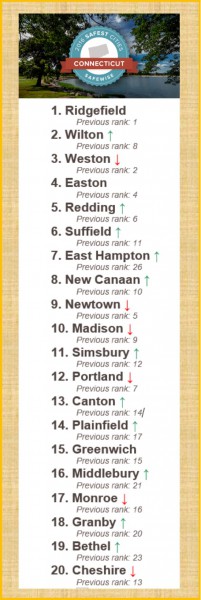
Ridgefield, Wilton, Weston, Easton and Redding top the list of Connecticut’s safest communities, according to an analysis from Safewise.  Rounding out the top 10 are Suffield, East Hampton, New Canaan, Newtown and Madison. The analysis explains that “one of Connecticut’s positive attributes is a relatively low crime rate.” Based on the most recent FBI Crime Report, the violent crime rate in Connecticut is nearly 40 percent lower than the national average and the property crime rate is over 25 percent lower, according to the Safewise report.

listIn 2014, roughly 30 out of every 1,000 people across the U.S. were victims of crime, while Connecticut’s crimes affected only 21 out of 1,000 people. Among the state’s 20 safest cities, however, only about three crimes were reported for every 1,000 citizens.
Ridgefield topped the list for the second consecutive year.  Among the biggest jumps on the list was East Hampton, which moved from #26 to #7.

According to the data, 70% of the 20 safest cities in Connecticut reported less than five violent crimes and 55% reported less than 100 property crimes. These figures are especially impressive considering the average population of the cities on our list is almost 19,000.

To identify the 10 safest cities in Connecticut, Safewise reviewed the most recent FBI Crime Report statistics from 2014, along with population data. Eliminated from the analysis were communities with fewer than 5,000 residents as well as any cities that failed to submit a complete crime report to the FBI.

Connecticut’s cities ranked at the bottom of the list.  Between #85 and #91 were New Britain, New London, Bridgeport, Waterbury, New Haven and Hartford.  Also among the towns ranked towards the bottom of the list were Derby, Plainville, Manchester, West Haven, and East Windsor.

SafeWise is a home security and safety brand committed to increasing safety education, awareness, and preparedness in American communities.

State Resident Published by National Magazine Concludes "Connecticut's Bad for Business"

The headline in the story posted over the weekend at the National Review website says simply, “Connecticut’s Bad for Business.” The article explains that “the state’s perpetual budget crisis has continued unhindered, with no resolution on the horizon,” and points to “a long list of causes” for the adverse business climate: “burdensome regulations, the second-highest tax burden in the country, restrictive zoning rules, high costs of labor, a lack of meaningful regional cooperation, clogged highways, crowded trains, and overall inadequate public transportation.”

The National Review focus on Connecticut launches into a discussion of “the educational disparities that characterize the school systems” including this spending review:national-review

“New Haven, featuring a perpetually beleaguered and fairly depleted school system, spends $17,200 per student. Fairfield, the wealthy town right next door to Bridgeport, actually spends less — just under $16,000. Waterbury, one of the poorest cities in the state, spends $15,000 per student; West Hartford, regarded by all as some sort of suburban Zion, spends $500 less. Hartford spends $19,400 per student, more than the New York exclaves of New Canaan and Darien and more than the shoreline oases of Madison and Guilford.”

The article suggests that among the factors adversely impacting the quality of education in urban districts is “stunningly dysfunctional boards of education” that feature “bitterly personal partisan acrimony” and “an inability to rise above petty, factionalist squabbling.”  Some examples are outlined.

Education funding, likely to be front and center in the 2017 state legislative session following a sweeping court decision now being appealed by the state, drew this observation:  “Wealthy towns may, on average, spend more per student than poorer towns and cities do, but it’s not a hard-and-fast rule; sometimes poor towns spend more, and sometimes they spend less. In any case, spending can’t explain it all.”

bearingsRecent articles by The New York Times and Atlantic are referred to, noting that they also reflected poorly on the state’s current condition.  National Review adds to the journalistic observations of a state filled with seemingly intractable dilemmas, noting that “Connecticut’s tax system is currently so dependent on the incomes of Fairfield County high-earners — as Governor Malloy has often made clear — that even the slightest variations can trigger a budget crisis.”  The article adds, however, that “finance lies somewhere near the bottom of a long list of factors in explaining the current state of Connecticut.”
The article suggests that GE’s departure and Sikorsky’s recent decision to stay in the state both reflect Connecticut’s weakness.

“That Sikorsky probably would have followed GE’s path out of the state without (state subsidies) suggests to me that Connecticut just isn’t a good place for business anymore — unless the state opens the coffers. The lack of middle-class jobs in Connecticut cannot be explained by an overreliance on finance in one of the state’s eight counties; rather, it has far more to do with Connecticut’s long-decaying business climate.”

The article was authored by National Review intern Noah Daponte-Smith, who is also a Yale University student and staff reporter and writer for the Yale Daily News, described as a “student of modern history and politics.”  Smith has also written - last summer - for Forbes, focusing on “British politics in the domestic and European spheres.” He is a graduate of the Hopkins School in New Haven.

Daponte-Smith indicates that Connecticut’s “problem can be solved,” but concludes that “blaming inequalities in education funding or the prominence of finance in Fairfield County’s economy are poor places to start.”

Heart Disease, Cancer Leading Causes of Death in CT; Septicemia Deaths Among Highest in USA

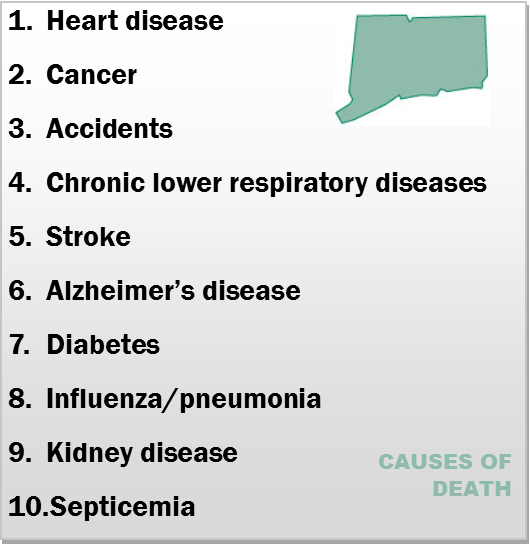
Heart disease, cancer and accidents were the leading causes of death in Connecticut according to data released by the National Center for Health Statistics of the Centers for Disease Control and Prevention.  The other major causes of death in Connecticut include chronic lower respiratory diseases, stroke, alzheimer’s disease, diabetes, influenza/pneumonia, kidney disease and septicemia. In all but two instances, Connecticut ranked in the lowest quintile among the states, ranking 40th in the rate of heart disease deaths, 43rd in cancer deaths, 48th in dCDC_logo2eaths due to diabetes, and 48th in deaths caused by stroke.  The state ranked 15th, however, in deaths caused by septicemia and 35th in accidental deaths.
Septicemia, or sepsis, is a life-threatening complication of an infection in the bloodstream. Sepsis is the body’s overwhelming response to infection which can lead to tissue damage, organ failure, and death. It kills 258,000 Americans each year, according to the Sepsis Alliance, but remains largely unknown. Although it is among the 10 most frequent causes of death nationwide, in a 2015 online survey of 2,000 participants, only 47 percent of Americans were aware of sepsis, the Alliance reported. The deaths this year of actress Patty Duke and boxing legend Muhammad Ali have brought some increased attention to sepsis.causes

Connecticut had 578 recorded deaths caused by septicemia, a rate of 12.6 per 100,000 total population, in 2014, according to the CDC data.  The United States rate was 10.7.  The highest death rates from septicemia were in Mississippi, Louisiana, Alabama, Texas, New Jersey, Kentucky, Arkansas, Maryland, Georgia, and Virginia.

There were 7,018 deaths from heart disease and 6,621 from cancer in Connecticut in 2014, according to the data.  The next most frequent cause of death, accidents, totaled 1,642, followed by chronic lower respiratory diseases, which caused, 1,368 deaths, and stroke, which caused 1,266.

Connecticut’s rate of deaths per thousand population by stroke, 26.3, is among the nation’s lowest.  The national rate is 36.5.  The only states with lower rates of stroke deaths are Rhode Island and New York.  Connecticut is tied with Arizona, just ahead of Massachusetts, New Hampshire and Wyoming.  The highest rate of deaths from stroke are in Mississippi, Alabama, Tennessee, Louisiana and Arkansas.

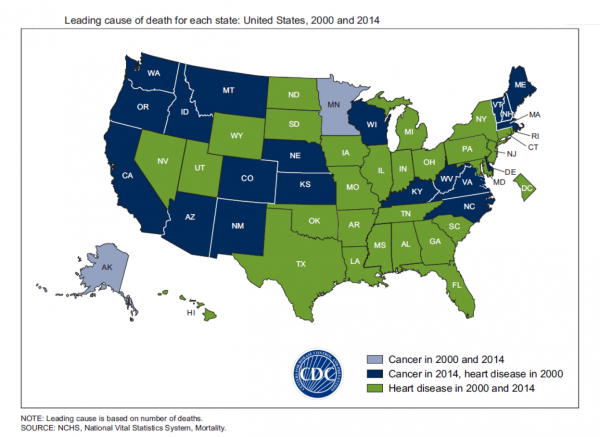
Heart disease has long been the leading cause of death for all U.S. states, with cancer as the second leading cause, according to the CDC. In 1990, Alaska became the first state to experience a switch in ranks between these two causes. In 2000, Minnesota experienced the same switch. As of 2014, there are now 22 states with cancer as the leading cause of death.  Heart disease remains the leading cause in Connecticut.

In 2013, the leading causes of death in Connecticut were heart disease (7.090), cancer (6,619), chronic lower respiratory diseases, accidents, stroke, alzheimer's disease, diabetes, influenze/pneumonia, kidney disease and suicide.

cdc-map

Opponents to Natural Gas Pipeline Rally to Grow Public Interest

A planned natural gas pipeline in Connecticut and neighboring states brought protesters out in Suffield and East Granby, calling attention to potential adverse environmental impacts. Kinder Morgan’s natural gas project, Connecticut Expansion, is scheduled to begin construction in Suffield and East Granby shortly, according to the Connecticut Sierra Club, which organized the protest and has been conducting a public education initiative opposing the plans. The People Over Pipelines March, held Saturday, mirrors similar efforts held in Massachusetts, aimed at drawing attention the ratepayer subsidized gas pipeline expansion.  Participants followed the Kinder Morgan pipeline route in Suffield and East Granby.  Co-sponosrs of the effort included 350 CT, Toxics Action Center, Bethlehem Ecodefense and Berkshire Environmental Action Team.protest

At  an accompanying rally, Sierra Club’s Martha Klein said, “We’re here today to fight for the future of our planet, but the real reason to oppose this new pipeline is that it’s expensive, unneeded and what’s worse we’re paying for it!” The high pressure, large diameter fracked gas pipeline is being built in three states Sierra Club officials point out, noting that methane (natural gas) causes global heating that is 100 times worse than carbon dioxide in the near term.

Diane Lentakis of 350 CT added, “I’m marching here today to oppose a new taxpayer-funded pipeline because natural gas presents many of the same problems as oil and coal: toxic emissions, huge transport costs, and huge risks of accidents. I want Connecticut to be a leader in our country’s transition to clean energy.  We can take a major step towards this goal by opposing this costly pipeline and instead investing in renewable and clean energy. “

Sierra Club officials explain that Connecticut residents have been paying for the expansion of fracked gas in the state through ratepayer increases on their electric bill since 2013, as a result of state lawmakers approving a “Comprehensive Energy Strategy.”  In 2015, the General Assembly passed a law that mandated future ratepayer subsidies for multi-state gas pipeline projects, which will lead to ratepayers subsidizing the construction of interstate gas pipelines.people-over

The state Department of Energy and Environmental Protection (DEEP)  “is the agency in the state that both procures large natural gas projects, and also issues permits for aspects of the construction. The aim of the State energy plan is to create thousands of new gas customers, through advertising and ratepayer subsidies. Only the two large corporations, Eversource and Iberdrola, will benefit from the expansion.  They have a monopoly on gas distribution in the area,” Sierra Club pointed out in a news release highlighting the issue.  Eversource owns Yankee Gas; Iberdrola owns Connecticut Natural Gas and Southern CT Gas.

Sierra Club officials indicate that it is “not likely” that Connecticut citizens will benefit from the pipeline, stating that “Natural gas is not cheaper, cleaner or safer than other fuels. Gas, which is methane, is currently more expensive than heating oil in Connecticut and according to the International Governmental Panel on Climate Change (IPCC), worse for the environment than oil or coal. Methane extraction (fracking), use, and transport produce significantly more greenhouse gas emissions causing worse climate change than other fossil fuels.”

highres_449878739Studies show that there is no unmet demand for natural gas in Connecticut, opponents of the planned pipeline said, stressing that gas pipelines are routinely only half full now and electricity demand in New England has remained virtually flat over more than 10 years.  Proponents have stated otherwise.

According to DEEP, there are approximately 590 miles of transmission pipeline in Connecticut, including 16 miles in Long Island Sound.  These pipelines range in size from 2” to 36”. Pressures range from 750 pounds per square inch gauge (psig) to 1,440 psig. There are 5 compressor stations in Connecticut with a total of approximately 110,300 horsepower. The pipelines currently in place:

  • Algonquin Gas Transmission (AGT - Spectra Energy Corporation) originates in New Jersey where it connects to Texas Eastern and runs from Danbury northeasterly to Thompson, with major spurs to North Haven and New London.
  • Iroquois Gas Transmission System (IGT) starts at the Canadian border, enters Connecticut at Sherman and runs southeast through Milford, then offshore to Long Island.
  • Tennessee Gas Transmission (TGP -Kinder Morgan) starts in the Gulf, enters Connecticut in Greenwich, runs northeasterly leaving Connecticut in Suffield, with a spur from Massachusetts to Torrington.

The Sierra Club will be conducting a public education session on the pipeline at Quinebaug Valley Community College on Thursday, Sept. 29 at 1 p.m.

Hate Words in School Setting Increasingly Target Race, Ethnicity and Sexual Orientation

It has been estimated that 160,000 teens nationwide skip school every day because of bullying.  Words of hate are a reason why. A recent report by the U.S. Department of Education indicates that among students ages 12 through 18 who reported being called a hate-related word at school, the percentage of students called a gender-based hate word decreased from 2001 to 2013, while the percentages of those students called race-, ethnically-, and sexual orientation-based hate words increased.

The report found that:

  • The percentage of students who were called hate words associated with race was greater in 2013 (50 percent), as compared to 2001 (34 percent).
  • The percentage of students who reported being called ethnically based hate words was greater in 2013 (29 percent), as compared to 2001 (22 percent).
  • The percentage of students who reported being called a hate word associated with sexual orientation was greater in 2013 (16 percent), as compared to 2001 (10 percent).
  • The percentage of students who were called gender-based hate words was lower in 2013 (15 percent), as compared to 2001 (23 percent).

hate-wordThe U.S. Department of Education July 2016 Data Point report from the National Center for Education Statistics includes data from the School Crime Supplement (SCS) to the National Crime Victimization Survey, a nationally representative sample survey of students ages 12 through 18, which were used to analyze trends in hate-related words. The SCS study is completed every other year.

In the study, students were asked if they had been called a hate-related word in the school building, on school property, on the school bus, or going to or from school, or if they had seen hate-related graffiti in school. Specifically, students were asked if during the school year anyone called them an insulting or bad name at school having to do with their race, religion, ethnic background or national origin, disability, gender, or sexual orientation (hate-related words). Students were also asked if they had seen any hate-related words or symbols (graffiti) written in school classrooms, school hallways, or outside of the school building.

The Southern Poverty Law Center (SPLC) has reported this year that “the gains made by years of anti-bullying work in schools have been rolled back in a few short months,” due to comments made as part of the Presidential campaign.  “Teachers report that students have been ‘emboldened’ to use slurs, engage in name-calling and make inflammatory statements toward each other,” explaining that “students have been emboldened by the divisive, often juvenile rhetoric in the campaign. Teachers have noted an increase in bullying, harassment and intimidation of students whose races, religions or nationalities have been the verbal targets of candidates on the campaign trail.”

The federal government’s stopbullying.gov website defines bullying actions to include “making threats, spreading rumors, attacking someone physically or verbally, and excluding someone from a group on purpose.”  The Bullying Prevention and Response Training and Continuing Education Online Program develschool-wordsoped by the federal Health Resources and Services Administration notes that “indirect bullying” includes “rumor spreading or encouraging others to exclude a peer.” Bullying is described as “a public health problem and requires a coordinated community response.”

“Harassing conduct may take many forms, including verbal acts and name‐calling” the U.S. Department of Education Office of Civil Rights pointed out in 2010 correspondence to the nation’s schools from Assistant Secretary of Civil Rights Russlynn Ali. The information provided pointed out that such behavior “fosters a climate of fear and disrespect that can seriously impair the physical and psychological health” of those subjected to it, and can “create conditions that negatively affect learning, thereby undermining the ability of students to achieve their full potential.”

The SPLC highlights the impact on students: “Every student, from preschoolers up through high school, is aware of the tone, rhetoric and catchphrases of this particular campaign season. Students are hearing conversations at home. They’re chatting, posting and joking on social media. Whether teachers decide to bring it into the classroom or not, kids are talking about it, modeling their behavior on that of political candidates and bringing heightened emotion to school along with their backpacks.”

Back to the Future: Permanent Commission on Status of Women Resurrected as Nonprofit

When the state legislature surprisingly eliminated the landmark Connecticut Permanent Commission on the Status of Women (PCSW) on the heels of one of the agency’s most successful advocacy efforts on an array of pivotal issues, the dismay from an array of organizations across the state was strident and unified, but ultimately unsuccessful. The 2016 Legislative Session, which ended in June, had seen four of the largest gains for women’s rights. Bills to protect women from human trafficking, intimate partner homicide, campus sexual assault, and being forced to parent with a rapist all passed with bi-partisan support, with PCSW among the organizations leading the fight.

The agency, active and effective for 43 years, was no longer “permanent.”  It was history.  Unfazed, the legislature, pressed to find budgetary savings, merged it into a new structure, combined with former commissions on children and the elderly. For those involved with, and committed to, the work of the former PCSW, the legislature's approach fell short.  So they took matters into their own hands.  pcsw

The tone was considerably more upbeat this week as it was announced that PCSW was back in business, new and improved, with an educational nonprofit and a companion advocacy organization formed to continue the work on issues that remain on the front burner – or ought to.

A group of former State Commissioners and former key employees of the previous PCSW, dismantled at the start of the new fiscal year on July 1, announced the formation of a new non-profit initiative to advance the work of the former state agency, which was among the oldest and largest women’s commissions left in the United States.

The Commission’s legacy of developing landmark legislation and research in the areas of sexual harassment, domestic violence, family medical leave protections, pay equity, and human trafficking will continue, advocates stressed, only now emanating from outside of state government.

“We will partner with leaders in Hartford, CWCS, and organizations around the state to ensure that the public policy agenda for women and girls addressed by the former PCSW continues to move forward. We will provide expertise, research, resources, and advocacy to improve the lives of women and girls in this state,” said Mary Lee Kiernan, former Chair of the PCSW and President of the newly formed Permanent Commission on the Status of Women in Connecticut Education Fund, Inc. (PCSW Education Fund, Inc.). PCSW Education Fund, Inc. is applying for 501(c)(3) tax status with the IRS.

A new website, www.ctpcsw.org, was launched along with the new organizations.  The new initiatives were announced at a State Capitol news conference, alongside the statue of Prudence Crandall, Connecticut’s state heroine. news-conf

“Our new initiative will advocate in the same key policy areas addressed by the former PCSW, including economic security; health and safety for women of all ages; discrimination in all forms; education; and women’s leadership,” explained Carolyn Treiss, Executive Director of the former PCSW and President of the newly formed Permanent Commission on the Status of Women in Connecticut, Inc. (PCSW, Inc.). PCSW, Inc. is applying for 501(c)(4) tax status with the IRS and intends to advocate for an annual legislative agenda in these key policy areas. 501(c)(4) tax status allows for unlimited advocacy on legislation.

The board members of these two entities currently consist of eleven of the sixteen former PCSW commissioners, the former PCSW Executive Director and the former PCSW Policy Director. These individuals provide expertise on a wide variety of issues affecting women and girls, and they represent all regions of the state.

“I am impressed with the expertise that our board members bring, particularly around the intersection of gender with issues of race, ethnicity, age, religion, and socio-economic status,” explained Catherine Ernsky, President of the Ernsky Group and Vice President of the PCSW Education Fund, Inc. Board members also bring experience in the areas of law, finance, medicine, insurance, communications, philanthropy, health equity, criminal justice, state and local government, legislation, education, environmental justice, organized labor, and non-profit leadership.

An advisory board to the PCSW Education Fund, Inc. has been established that includes Senator Richard Blumenthal; Congresswoman Rosa DeLauro; former PCSW Executive Director and current President of the Ms. Foundation, Teresa Younger; former PCSW Honorary Commissioner and Executive Director of the Women’s Campaign School at Yale, Patricia Russo; former PCSW Honorary Commissioner Patricia Hendel; and former PCSW Honorary Commissioner Barbara DeBaptiste.  Pro-Bono legal services are being provided by Wiggin & Dana, LLP. PFK O’Conner Davies, LLP will serve as auditors.

PCSW Education Fund, Inc. and PCSW Inc. intend to collaborate with non-profit partners from around the state, the new CWCS, and state leaders to “continue the long legacy of progress for women and girls” that characterized the former state agency.

“Collaboration in this space is key,” explained Fran Pastore, President of the Women’s Business Development Council, a frequent collaborator with the former PCSW. “The board members of these entities are well-known for building effective coalitions. I hope to work with them to improve financing for women-owned businesses and workplace practices impacting women. Ultimately, these issues spur economic growth and improve the lives of everyone in the state.”

In 1973, the CT General Assembly passed, and Governor Thomas Meskill signed into law, Public Act 73-559, establishing the Permanent Commission on the Status of Women. The PCSW was charged with providing research and analysis on issues related to gender discrimination, women’s health and safety, and economic security. “In its 43 year history, the PCSW has informed many important public policies that make Connecticut a desirable place for women to live and work today,” the Commission explained in its final legislative report, issued in June.  The list of highlight legislative victories runs six pages, single spaced, in small type.

Back in February, Kiernan testified at the legislature, explaining that "The empirical evidence on gender in Connecticut is very clear. Women still face widespread discrimination in the workplace and beyond. Women continue to face far greater barriers to educational success than men. Women face wage inequality, occupational segregation and barriers to credit in the business sector. Women still struggle for basic economic self-sufficiency and fail to build the assets needed for retirement at greater rates than their male counterparts. And women and girls face increasingly complex threats to their health and safety. All of these issues are compounded and complicated by race and ethnicity."

Now, a new chapter begins, with experienced hands at the helm.


Leadership Greater Hartford Launches New Brand Identity As 40th Anniversary Approaches

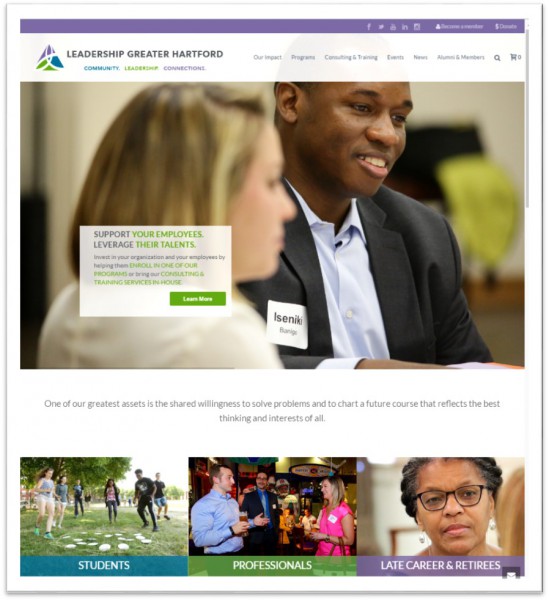
Leadership Greater Hartford (LGH), the region's highly regarded go-to source for tackling community challenges through knowledge and cooperation, has unveiled its new logo and visual identity, which reflects the organization’s growth and prominent role in strengthening community leadership connections. Three pillars, “Community. Leadership. Connections,” informed the design of the organization’s new logo and form the backbone and structure of the new website, www.leadershipgh.org. "We are proud of our past and look forward to the future. While our logo is changing, one thing that will never change is our purpose and lgh-websitemission,” said Ted Carroll, President of Leadership Greater Hartford. “It is important that our brand reflect the organization we have become and where we will continue to be headed in the future - making our communities better and stronger.”


The website points out that “more than 600 employers have enriched the development of their staff and become involved with civic progress; 2500+ students from four dozen schools across the region have gained broader perspectives and wider circles of friends; more than 500 seniors gained the opportunity to continue giving back to the communities they’ve seen undergo so much change in their lifetimes.”

As Leadership Greater Hartford has grown and evolved, broadening participation and developing an array of effective programs and initiatives, the organization notes that the business landscape has changed, including in market demographics, competitive environment, and the acceleration of social media.

LGH will celebrate its 40th anniversary on November 15, with their annual Polaris Awards Gala.  As the organization enters its milestone fortieth year, it is “well-prepared and firmly engaged to be a relevant, forward-thinking resource for the community – both the private and public sectors – for the next 40 years,” officials said, as the website highlights that “our program participants have completed more than 200 community impact projects, we have trained and placed more than 450 individuals on more than 125 nonprofit boards, and program graduates volunteer at a rate of 137% higher than that of the rest of the country.”

The web redesign and visual identity was developed by MRW Connected, Inc. “All of us at MRW Connected engaged with Leadership Greater Hartford in the exciting process of re-branding and re-messaging this important organization in their 40th anniversary year,” explained MRW Connected president and founder Tom Willits.lgh-logo

Officials indicated that LGH staff, organization leadership and Board members, program participants as well as the Greater Hartford community, were involved in the process “to better understand their organizational objectives and accomplishments.  In this way we helped Leadership Greater Hartford realize their goals of creating an updated look and responsive, engaging website that truly represents the inspired leadership development work they do and allows the community-at-large easier access to their programs and their network," Willits added.

Leadership Greater Hartford (LGH) is a mission-driven, nonprofit organization that supports and strengthens the local community by training and connecting aspiring and established leaders.  The well-known LGH programs for professionals include Quest, Executive Orientation, Hartford Encounters, Leaders on Board and Summit.  Encore Hartford and Third Age Initiative are aimed at late-career individuals and retirees; Common Ground, Leading Off Campus and Summer Nexus are designed for high school and college students.

For more information about how to be a participant or sponsor, or to inquire about customized training with Leadership Greater Hartford, call 860-951-6161 (x1800), email info@leadershipgh.org visit .leadershipgh.org, or follow LGH on Facebook and Twitter @leadershiphtfd.