Longstanding Coverage of State Government to End; Drastic Reduction in Funding, Imposition of Content Limitations Cited
/CT-N, which has provided coverage of State Senate and House sessions and all three branches of state government for nearly two decades, will cease operations on Friday, November 3, due to severe budget cuts and limitations on coverage being imposed by the legislature on the network’s operator, the Connecticut Public Affairs Network (CPAN).
CPAN has operated the network, under a series of contracts with the legislature’s Joint Committee on Legislative Management (OLM), since March, 1999, and was among the first in the nation to provide comprehensive coverage of state government.
“CPAN was created with a nonpartisan, educational mission to run CT-N as a three- branches network, at arm’s length from the government,” CPAN Executive Director Paul Giguere wrote in a letter notifying the non-partisan OLM that CPAN would be ending coverage. “It was a mission and purpose once supported by the Leadership of the General Assembly. Even the state statute governing CT-N’s revenue intercept refers broadly to coverage of ‘state government deliberations and public policy events.’ The thinking has clearly changed.”
At least one of those contracts, covering November 2003 - October 2006, clearly delineates that CPAN’s operation of CT-N would provide coverage of “the legislature, events of public interest in the Executive and Judicial Branches and other events of statewide interest.” That contract also indicates that “many of the executive branch events to be covered will be taking place at locations away from the Capitol Complex.” A subsequent contract, which ran through last year, also stated that “CPAN retains full editorial discretion regarding day-to-day programming.” CT-N broadcasts seven days a week, 24 hours a day.
 CPAN’s most recent contact expired in September, was extended through October, and was on a day-by-day basis this week. The 33-person staff worked with an annual operating budget that was unexpectedly reduced by 65 percent in the budget approved by the legislature this week for the current fiscal year. At the same time, the legislature sought reductions in coverage of state government outside the State Capitol, limitations on editorial content decisions, and cutbacks on public affairs programming. Those changes, which were revealed in the RFP for a new five-year in April, drew sharp criticism at that time, which were renewed this week.
“For some time now, we have contended with encroachments on our editorial independence, despite our best efforts to be responsive to concerns while continually working to improve the CT-N service and over-delivering on every contract we have ever signed,” Giguere wrote.
The National Alliance of Public Affairs Networks (NAPAN), points out that while many variations exist in programming and operating models among state public affairs networks, a series of “Best Practices” can be drawn from “the most effective strategies used by highly regarded networks across the country.”
NAPAN points out that “citizens’ trust in all three branches of government is at all-time lows,” and “while the judicial, executive and legislative branches actively operate in states daily, the understanding of what and how decisions are being made at the highest levels go largely unreported and consequently unnoticed by the general public.” CT-N coverage was available on television and on-line, both live and in archives that are easily accessible to the public. CPAN also has provided educational materials for classroom teachers and the general public.
In his letter, Giguere, who brought the concept for such a network to the Connecticut legislature in the 1990’s and led its launch and development, said “the scope at which we would be obliged to operate CT-N would cease to provide any meaningful level of transparency: even less so, if the few coverage decisions we would have the opportunity to make were controlled by the CGA (Connecticut General Assembly) to the extent that recent events convince us they would be.” He continued: “at best, CT-N would provide the façade of transparency, cloaked – at least temporarily – in the credibility and reputation that CPAN has spent 18 years building. We will not abet that course of action by the CGA by participating in it.”
In recent days, CT-N has provided coverage of Gov. Malloy’s news conference announcing he had signed the state budget into law, a news briefing on state infrastructure and resiliency improvements since Super Storm Sandy, meetings of the Connecticut Board of Firearms Permit Examiners and the Governor’s Nonprofit Health & Human Services Cabinet, and a hearing by the legislature’s Judiciary Committee considering nominations of individuals to serve on the State Supreme Court and Appellate Court.
Earlier this year, Danbury State Rep. Bob Godfrey cited the role of CT-N in providing the public with access to government, noting that "The General Assembly itself has provided more public access to lawmaking through both our web site (www.cga.ct.gov) and the Connecticut Television Network (CT-N, at www.ct-n.com)."
-----
Five best practices for state public affairs networks are described on the NAPAN website:
1. Accessible to All: 24/7 programs on a dedicated channel across multiple platforms
A state public affairs network is most effective in connecting citizens to state government when it is available full-time to the maximum number of citizens possible, including a robust online presence with strong searchable streaming and on-demand content, accessibility enhancements such as closed captioning for the hearing impaired and a permanent archive of programming produced.
2. All Three Branches of State Government
A state public affairs network is most effective in connecting citizens to state government when it provides a nonpartisan, unbiased and unfiltered window on all official state business.
3. Operating at Arm’s Length
A state public affairs network is most effective in connecting citizens to state government when it is structured with an independent governing body using a set of agreed-upon operating guidelines to make programming and operational decisions free from political influence.
4. Citizen Engagement
A state public affairs network is most effective in connecting citizens to state government when it seeks to demystify the process of governing by providing additional information and context through on-screen graphics, online reference materials and links to other resources.
5. Programming Breadth
A state public affairs network is most effective in connecting citizens to state government when it provides a broad range of high-quality public affairs programming beyond gavel to gavel coverage of government proceedings, as well as official emergency information from appropriate state public safety agencies.


 The 21 honorees were selected by economic development officials in each of 10 regions across Connecticut for their contribution to the state’s economy – such as consistent or growing employment levels, playing a critical role in changing the character of its community or civic engagement, strong public/private collaboration to encourage new investment, or leadership resulting in growth or improvements.


 Sitrep, based in Cheshire, was founded in 2014 to “develop monitoring systems that are intuitively usable.” Principals are Harland Christofferson, Gary Martin and Michael Byrne.
 The mission of Stratford-based FallCall Solutions, LLC is “to become the premier innovator in simplified communication solutions for the geriatric population and their caregivers.” The company website explains that the company aims to maximize elder independence and caregiver peace of mind by “building software based solely on the needs of the consumer rather than the trying to create and introduce new ecosystems into our customers’ lives.”




 “It’s a scene repeating itself in dying suburban malls around the country,” the Globe reported, “a sweeping economic disruption known as the Amazon effect.” Industry analysts have predicted that 20 percent of the 1,200 shopping malls in the U.S. will “meet their demise,” the Globe indicated.
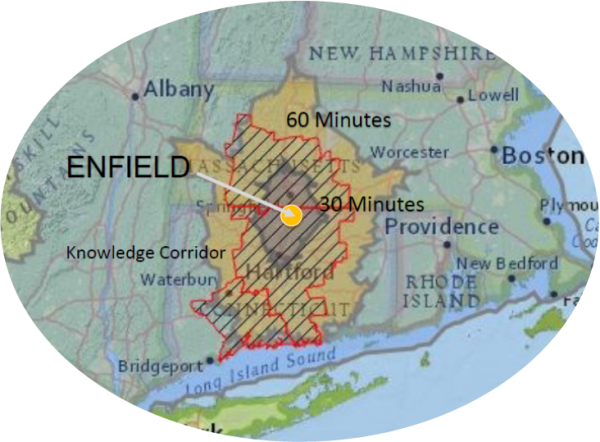 Knowledge Corridor, Enfield provides quick and easy access to several US Highways, airports and rail systems," the 12-page Enfield proposal explained. "Tax Increment Financing (TIF) districts are being created in Enfield and surrounding towns to support new development and growth. Abatements and Regional Revenue Sharing are all available to sweeten the deal. Connecticut has the lowest corporate tax rate in the North East."



 Pieratti, who teaches English at South Windsor High School, relocated to Connecticut from upstate New York five years ago. She said “I have been nurtured by this state since I moved here,” and expressed appreciation to her colleagues in South Windsor. She has taught at the college and high school level, and was recipient of the Idaho prize for Poetry in 2015. Her


 In Connecticut, individuals earning more than $200,000 gave 66.4 percent of all Connecticut giving, down 1.7 percent from 2012, according to the Chronicle analysis. The portion of all givers in this income bracket in Connecticut down 0.2 percent while the giving per itemizer is down 20.6 percent. In looking at the state’s major metropolitan areas, greater Bridgeport, Hartford, and New Haven, the analysis round that giving rates for taxpayers at four income levels fell below the average for the size group in each of the metropolitan areas.