Summer Olympics May Come to CT if Boston Bid for 2024 Succeeds

Boston is one of four cities being considered to be the United States entry in the international competition to host the 2024 Olympic Games.  If Boston's bid were to become a reality, at least one Olympics observer is suggesting that Connecticut may have an Olympic supporting role to play. Boston, San Francisco, Washington D.C. and Los Angeles have been selected to develop bids to be considered by the U.S. Olympic Committee, which would decide which  city - if any - to support and present to the International Olympic Committee (IOC), which will decide in 2017 on the host city for the 2024 Olympics.2024

Rosanna Garcia, associate professor of marketing in the D’Amore-McKim School of Business at Northeastern University in Boston, who has attended the past eight Summer Olympics, sees the city turning to Connecticut and Rhode Island to host some events.

“With more than 300 events that typically occur at the Olympics, many cities around Massachusetts, and even Rhode Island and Connecticut, will need to partner with the International Olympic Committee to host these events,” Garcia points out.

garcia1501“Many preliminary competition events would need to take place outside of the main Olympic Park areas so events may occur as far away as Connecticut. This also is an opportunity for more people to get involved with the Olympic Spirit,” Garcia adds.Olympic_rings_without_rims.svg

The Boston Globe has reported that the U.S. Olympic Committee is expected to decide early next year whether to enter a U.S. city in the international competition to host the 2024 Olympics.  That would be just after the IOC acts on recent recommendations to reform its selection process, which would take effect with the 2024 Summer Games host selection.  The IOC meets next month to consider the series of recommendations.

Members of the U.S. Olympic Committee were in Boston last week, meeting with representatives of the Boston bid and area colleges which would participate, potentially providing sports venues, dorms, and other support services.  Last month, a promotional video advocating a Boston bid was released, and a website was launched. With an eye toward innovation and efficiency, the video highlights Boston’s bid “to create a sustainable model for hosting the Olympic and Paralympic Games that can become the blueprint for future host cities.”

The Connecticut Convention & Sports Bureau, the state’s official meetings and sports event sales and marketing organization, "supports Boston’s bid for the 2024 Olympics," said Interim President H. Scott Phelps.  "Regardless of whether or not Boston wins the Olympics, the City’s bid has helped to elevate the Boston and other New England brands to sports event planners from all over the world."  Officials noted that if the Olympic Games decide to come to Boston, "it could be great for tourism in nearby Connecticut as well, as spectators and competitors would be encouraged to come visit our State’s attractions," adding that "there might be opportunities for our state to host pre-Olympic competitions and ... athletes."

bsd_usoc_SiteGraphic_BidAnnouncement_800x375_al2

The Globe noted that if the International Olympic Committee, meeting in Switzerland in December, decides that its preference is for compact venues, as is expected, Boston is seen as a strong candidate and could gain an advantage over Los Angeles, San Francisco, and Washington, whose plans offer less intimate settings, according to the Globe.  Supporters of the San Francisco bid have noted that the chairman of the U.S. Olympic Committee, Larry Probst, lives in nearby Burlingame, CA.  The San Francisco effort is being led by Larry Baer, the chief executive officer of baseball's World Series champion Giants, according to published reports.la2024logo

It is the first time that Boston has prepared a bid to host the Games, and it is being led by an organization called the Boston 2024 Partnership, a nonprofit organization formed to prepare the bid materials. The group is governed by a 36-member executive committee, and has launched a series of subcommittees aimed at master planning, fundraising, outreach, and engagement. Organizers note that no tax dollars have been spent on Boston 2024, and tax dollars will not be used to build venues or pay for the operation of the Games. Public investment will be confined to roadway, transportation and infrastructure improvements, most of which are already planned and are needed with or without the Olympics.

fenwayAn Olympic games in Boston would utilize existing sports venues of both professional teams and area colleges, which could reduce potential costs.  Infrastructure improvements, such as in transportation, are already on the drawing board, and could accelerate with a Boston bid.U.S.-Olympic-Committee-logo
The U.S. last hosted a Summer Olympiad in Atlanta in 1996; a Winter Olympics in 2002.  St. Louis hosted in 1904 and Los Angeles held the Games in both 1932 and 1984. In recent years, the unsuccessful U.S. bids to the IOC was to host the Summer Games were New York (2012) and Chicago (2016).  The 2016 Games will be held in Rio de Janeiro and the 2020 Summer Olympics are scheduled to be held in Tokyo, Japan.  Other potential contenders, according to published reports, include Paris, Rome,Doha, Istanbul and either Hamburg or Berlin in Germany.

“Holding the Games in the Boston area would serve as a catalyst for growth in the region,” said John Fish, CEO of Suffolk Construction and driving force in the initiative. “We are also excited for the chance to deliver something that is both powerful and meaningful for the worldwide Olympic and Paralympic movements that will also connect more youth to sport.”

Picture4


Western CT State Ranks #1 in CT and #11 Nationwide in Promoting Social Mobility

The increasing gap between rich and poor in the United States has led CollegeNET and PayScale to create a social mobility index (SMI) to “comparatively assess the role of our higher education system in providing a conduit for economic and social advancement.” The results placed Western Connecticut State University #1 in Connecticut and #11 nationwide, in an analysis of more than 530 colleges and universities using these criteria.  The SMI survey measured five factors relating to higher education: cost of tuition, opportunities provided to low-income students, graduation rate, early career salary for graduates, and the status of the university’s endowment.western logo

Ranked at #11, Western was one of only three universities located in the New England states to break the Top 100 on the national list (the others were Babson College at #96 and Wentworth Institute of Technology at #98).

Western’s presence at the top of the list for Connecticut was by a sizable margin: the second-highest ranked Connecticut institution – UConn – came in at #143 on the national list, followed by Southern Connecticut State University at #195, the University of Hartford at #232, Sacred Heart University at #323, Connecticut College at #383 and Fairfiewestern studentsld University at #396.  Outside the top 400 from Connecticut were Wesleyan University, Yale University, Quinnipiac University and Trinity College.

“This analysis demonstrates that Western is indeed fulfilling its goal to change the lives of our students,” said Western President James W. Schmotter. “When we succeed at helping students succeed, we also create positive, long-lasting change in our state and the nation as these young people move into their communities as employees and citizens.”

According to the published findings of the study, a “high SMI ranking means that a college is contributing in a responsible way to solving the dangerous problem of economic immobility in our country.”

Western officials indicated that the university’s ranking reflects a “desirable combination of low tuition, enrollment of a high proportion of students from low-income families, a good graduation rate with students obtaining desirable early-career salaries, and a commitment from the university to disburse financial aid, scholarships and grants to level the playing field for students whose families might not otherwise be able to afford a college education.”

The top-ranked institutions on the newly developed SMI rankings were Montana Tech of the University of Montana, Rowan Universpayscaleity in New Jersey, Florida Agricultural and Mechanical University, Florida International University, and six institutions in California, including California State Polytechnic University, the University of California and Cal State.

The report indicated that “while the much publicized student debt overhang, now in excess of $1 trillion, imposes distress and financial burden on millions of students and families, it is a symptom of the much greater problem of economic and social divergence in our country. The good news is that colleges and universities carry great potential to powerfully address this problem.”

Income Inequality Ranked as World’s Top Challenge; CT Has Among Widest Disparities

Income disparity increased in all 50 states in the last few decades, including Connecticut, according to a study released earlier this year.  Now, new data indicates that the problem of inequality goes well beyond the borders of Connecticut and the United States, and is increasingly viewed as the world’s top trend requiring attention. Connecticut’s top 1 percent captured 63.9 percent of the total income growth from 1979 to 2007 and 50 percent from 2009 to 2011, the study from the Economic Analysis and Research Network found. The top 1 percent in Connecticut also ranked number 1 out of all 50 states for the most income growth from 1979-2007 with 414.6 percent growth - over 14 times the income growth for the bottom 99 percent over the same period.  They experienced 29 percent growth. inequality

New York and Connecticut had the largest gaps between the average incomes of the top 1 percent and the average incomes of the bottom 99 percent. In both states, the top 1 percent earned roughly 40 times that of the bottom 99 percent.

Looking at inequality worldwide, Crédit Suisse reports people with a net worth of more than $1 million represent just 0.7 percent of the global population, but they have 41 percent of the world’s wealth. Meanwhile, those with a net worth of less than $10,000 represent 69 percent of the population, but just 3 percent of global wealth.WEFLogoofTerra1

A new report by the World Economic Forum ranks rising inequality as the top trend facing the globe in 2015 (it was ranked #2 last year), according to a survey of 1,767 global leaders from business, academia, government and non-profits.

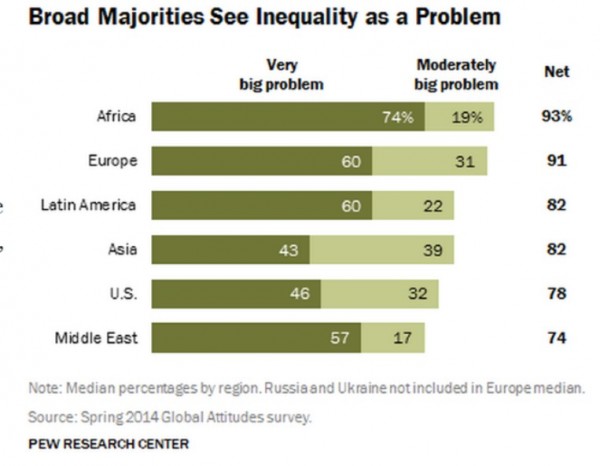
A recent Pew Research Center survey highlights the extent to which people across the globe agree that inequality is a serious challenge. In all 44 nations polled, majorities say inequality is a big problem facing their country, and majorities in 28 nations consider it a very big problem. Concerns about inequality are widespread in nations that were deeply affected by the Great Recession. For instance, more than seven-in-ten in Greece (84%), Spain (74%) and Italy (73%) say the gap between rich and poor is a very big problem.

In the United States, 46 percent view inequality as a very big problem and another 32 percent consider it to be a problem – a total of 78 percent.MultiMedia_Logo300px_400x400

The World Economic Forum’s global agenda for 2015 concluded “The inherent dangers of neglecting inequality are obvious. People, especially young people, excluded from the mainstream end up feeling disenfranchised and become easy fodder of conflict. This, in turn, reduces the sustainability of economic growth, weakens social cohesion and security, encourages inequitable access to and use of global commons, undermines our democracies, and cripples our hopes for sustainable development and peaceful societies.”


Economic Survival is Daily Struggle for 35 Percent of State Households, Report Reveals

For more than a generation, the federal poverty level has been the threshold driving policy conversations about the working poor nationwide.  Now, led by United Way agencies in six states including Connecticut, the income level below which working families cannot make ends meet is being redefined. The result reveals what is described as a more realistic income threshold that is three times higher than the traditional poverty level.  And that means more than one-third of Connecticut’s population (35 percent) is facing very real, daily financial hardship, struggling to make financial ends meet.

The numbers have been hiding in plain sight, official say. The first-of-its-kind report documents that the number of ConnecticuALICEt households unable to afford all of life’s basic necessities far exceeds the official federal poverty statistics. United Way calls this newly revealed demographic ALICE, an acronym for Asset Limited, Income Constrained, Employed.

Statewide, there are nearly half a million households (474,445) unable to pay for the costs of basic household needs in Connecticut, according to the study.

Every city and town in Connecticut has ALICE households. More than two-thirds of Connecticut's cities and towns have at least 1 in 5 households that fit the ALICE definition for financial hardship.  In four of Connecticut’s six largest cities – New Haven, Bridgeport, Hartford, and Waterbury – more than 50 percent of households have income below the ALICE threshold.

Even with one of the country's highest median hourly wages, 51 percent of all jobs in Connecticut pay less than $20/hour ($40,000/year if full-time). The average annual income needed by a family of four (2-adults with 1-infant and 1-pre-K child) in order to survive in Connecticut is $64,889. This is more thhousehold survivalan double the official U.S. poverty level.

Connecticut has joined with five other states (California, Florida, Indiana, Michigan, and New Jersey) to release statewide ALICE Reports in 2014. The Connecticut ALICE Report is sponsored by the sixteen Connecticut United Ways.  The original ALICE project was undertaken in New Jersey in 2009.  The reports are researched and coordinated by Rutgers University-Newark’s School of Public Affairs and Administration.

There are 35 municipalities in Connecticut with more than one quarter of their population under the ALICE threshold – struggling to pay for basic needs such as housing, healthcare, childcare, transportation and education.  They include the cities of Hartford, New Britain, New London, New Haven, Waterbury, Bridgeport, as well as communities including Windham, Ansonia, Norwich, North Canaan, West Haven, East Hartford, Putnam, Meriden, Killingly Torrington, Derby, Canaan, Naugatuck, Vernon and Groton.  Also among the 35 communities are Bristol, Winchester, Griswold, Sprague, East Haven, Middletown, Manchester, Thompson, Windsor Locks, Westbrook, Hamden, Plainfield, Canterbury and Southbury.

The ALICE threshold and report places a spotlight on a “large population of hardworking residents who work hard, but still struggle to make ends meet,” the report points out. “For some, this means not being able to save for their family's future or to weather an emergency without falling into poverty.”map

The 129-page report is the most comprehensive depiction of financial need in the state to date, using data from a variety of sources, including the U.S. Census and the American Community Survey. The Report unveils new tools based on income levels and expenses, that quantify the number of households in Connecticut's workforce that are struggling financially. And the ALICE Report also seeks to analyze in more detail why many working families continue to struggle.

A total of 332,817 Connecticut households fall into what the study describes as the ALICE population. These are households earning more than the official U.S. poverty level, but less than the basic cost of living.

Noting that “the cost of basic housing, child care, transportation, food, and health care in Connecticut increased by 13 percent during this 5-year period,” the report points out that “there are serious consequences for both ALICE households and their communities when these households cannot afford the basic necessities. ALICE households are forced to make difficult choices such as forgoing preventative health care, accredited child care, healthy food, or car insurance. These “savings” threaten their health, safety, and future – and they reduce Connecticut’s economic productivity and raise insurance premiums and taxes for everyone. The costs are high for both ALICE households and the wider community.”

Among the key areas of concern highlighted in the report is housing.  “The cost of housing is especially high in Connecticut, and the units that are affordable to ALICE households are often far from jobs or older and in disrepair,” the report explained. “Structural changes that make quality affordable housing more available would ease the housing burden on many Connecticut families.”

Watch You Tube video.

Municipal Equality Index Finds CT Above Average for LGBT Residents

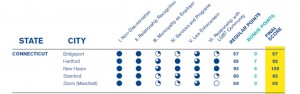
Connecticut cities continue to rank above-average when compared with municipalities across the country in the level of equality provided to lesbian, gay, bisexual, and transgender (LGBT) residents.  Bridgeport, Hartford, New Haven, Stamford and Storrs (Mansfield) were the five Connecticut municipalities included by the Human Rights Campaign (HRC), the nation’s largest LGBT civil rights organization, in an assessment of LGBT equality in 353 cities across the nation. index report

The 2014 Municipal Equality Index (MEI), the only nationwide rating system of LGBT inclusion in municipal law and policy, shows that cities across the country, including in Connecticut, continue to take the lead in supporting LGBT people and workers, even when states and the federal government have not.

The average score for the five municipalities in Connecticut was 74 out of 100 points, comfortably above the national average of 59.  The individual scores in Connecticut, largely unchanged from a year ago, were New Haven: 100, Hartford: 92, Stamford: 62, Storrs (Mansfield): 59, and Bridgeport: 57.  The scores earned by Hartford and Bridgeport dropped slightly from a year ago, and New Haven scored at 100 for the second consecutive year.  Because of changes in the legal landscape from year to year, the MEI report has revised the scoring assessment criteria, which has impacted scores in some municipalities.

Cities are rated on a scale of 0-100, based on the city’s laws, policies, benefits, and services. Key findings contained in the 70-page MEI report, issued in partnershiphrc-logo with the Equality Federation, provide “a revealing snapshot of LGBT equality in municipalities of varying sizes, and from every state in the nation,” the report noted.
The MEI rates cities based on 47 criteria falling under six broad categories:

  • Non-discrimination laws
  • Relationship recognition
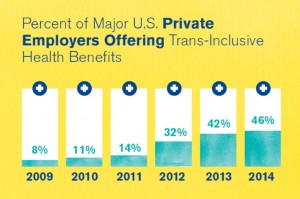
  • Municipality’s employment policies, including transgender-inclusive insurance coverage, contracting non-discrimination requirements, and other policies relating to equal treatment of LGBT city employees
  • Inclusiveness of city services
  • Law enforcement
  • Municipal leadership on matters of equality

The cities researched for the 2014 MEI include the 50 state capitals, the 200 most populous cities in the country, the four largest cities in every state, the city home to each state’s largest public university, and an equal mix of 75 of the nation’s large, mid-size and small municipalities with the highest proportion of same-sex couples.

The report found that “momentum for municipal equality is not a coastal trend or mega-urban phenomenon – it is something cities of all sizes in all parts of the country are doing because the people in those cities demand equality of treatment for all.”  Cities had an opportunity to review the draft scorecard and offer feedback prior to publication.

Equality and Economic Development

The report also indicates that “a growing body of research has shown that cities that have vibrant gay and lesbian communities have higher levels of income, life satisfaction, housing values, and emotional attachment to their community as well as higher concentrations of high-tech business. The Fortune 500 has long recognized that top talent is attracted to inclusiveness. In fact, the private sector has been using fair workplaces as a tool to recruit and retain top talent.”

The report adds that “Businesses will increasingly have to evaluate the legal landscape offered by a potential new location in its calculation of where to expand operations.”  Connecticut’s state laws – such as marriage equity and non-discrimination protections – provide a hospitable environment for its cities to employ equitable practices, officials said, but municipalities also have the capacity to take the lead, in Connecticut and elsewhere.  In ten states, cities fare well despite restricbusinesstive state laws.

“From Mississippi to Idaho, mid-size cities and small towns have become the single greatest engine of progress for LGBT equality--changing countless lives for the better,” said HRC President Chad Griffin. “In just three years, the number of municipalities earning top marks for their treatment of LGBT citizens has more than tripled. Simply put, in this country there is an ongoing race to the top to treat all people, including LGBT people, fairly under the law, and it’s time our state and federal laws caught up.”

According to the report, the New England, Mid-Atlantic, and Western regions of the United States – where marriage equality states have predominated – tend to do better than the national average when it comes to municipal equality. The reported pointed out, however, that every region has at least one 100-point city, such as New Haven. For example, in the Southeast, Florida boasts three 100-point scores, and Atlanta repeats its perfect score again in 2014; in the Southwest, Austin repeats its perfect score; and in the Plains, Iowa City joins two perfect scores in Missouri with St. Louis and Kansas City.

Thirty-eight cities earned perfect 100-point scores, up from 25 in 2013 and 11 in 2012, the first year of the MEI. New Haven earned a 100-point score, helping to set a standard of LGBT inclusiveness with exemplary policies ranging from non-discrimination laws and equal employee benefits, to cutting edge city services.

Among the report’s striking findings:  A dramatic increase in the number of cities offering transgender-inclusive healthcare benefits, and the fact that 32 million people have better protections from discrimination on the basis of gender identity at the local level then they do from state law. The full report is available online at www.hrc.org/mei.

CT stat

Network TV, National Advertising, Breakfast Food Boost UConn

UConn is making a splash these days in some unfamiliar places. Think iconic stadium, all the news that’s fit to print, and cereal– all of which have headlined the state’s flagship university in recent days.CBS This past Saturday, the Huskies football team played Army at Yankee Stadium – the University’s first appearance at the ballpark in the Bronx.  While UConn came up short on the scoreboard, the game was competitive and offered the school visibility in the New York metropolitan area and on CBS Sports Network, which televised the game. NYT ad

Fans who happened to be reading the print edition of The New York Times on Friday may be been surprised to see a full-page ad promoting the university.  The ad touted the university’s “unprecedented moves to unleash the solutions of tomorrow,” specifically highlighting a $3.6 billion investment in additive manufacturing, gnomic medicine and cybersecurity, the hiring of 300 faculty in fields including cognitive science human rights and intellectual inquiry, and recruiting 6,500 additional students to “lead their generation in addressing the most important challenges of our time.”

The ad was a one-time placement strategically timed to several significant events happening in New York City, including the Army-UConn game, an alumni gathering, and a meeting of the UConn Foundation board.  UConn has a very active and robust alumni network in New York City and the region, officials noted.

The ad was purchased at a negotiated rate and ran not only in New York City, but nationwide in The Times. It was paid for with funds from the university’s marketing budget (approximately $43,000) and private dollars (approximately $10,000), specifically designated by donors to elevate the University through advertising.  The UConn tagline, “Innovation unleashed,” was included in the ad, which featured text reading “Dear UConn, Thank you.  Sincerely, The Future.” Total average print circulation for The New York Times for Monday-Friday was 680,905, as of March 2014.

For those who read their morning paper with a bowl of cereal – there’s more UConn to come.

Just arriving on the market is a new, limited edition Husky Heroes cereal.  “The one and only cereal to honor both the UConn Women’s and Men’s National Championship basketball teams,” according to a newly launched website, is a honey nut toasted oat cereal and comes in a 14 oz. box.  Basketball coaches Geno Auriemma and Kevin Ollie are each featured on the commemorative cereal box, which is sold in a two-pack. husky_herOes

Marketed by Pittsburgh-based PLB Marketing, described as the “premier source for athlete-endorsed, quality food products,” there is a limited edition of 25,000 boxes being produced.  The company also is currently promoting Miggy’s Salsa, with a likeness of Detroit Tigers star Miguel Cabrera, Fastball Bars, a chewy chocolate chip granola bar featuring his teammate Justin Verlander, and Gronk Flakes, featuring New England Patriots’ tight end Rob Gronkowski.

The Husky Heroes cereal is available on-line at www.huskyhereoscereal.com, with delivery anticipated later this month.  The price is $14.97 for a two-box set, plus UPS shipping charge of $9.95, for a total of $24.92. The cereal is officially licensed by UConn through the university’s licensing agency, the Collegiate Licensing Company.  The university receives a standard 12 percent royalty on sales of all licensed products bearing UConn trademarks.

In addition to web purchases, the cereal will be distributed locally in the coming weeks to some Connecticut retail locations by Bozzuto’s (retailers to be announced).  It will also be sold at the UConn Coop.  For those inclined to stock up early, bulk orders of 500 boxes are eligible for special pricing directly from PLB.  Advance sales are just underway, and as of Monday afternoon there were 24,848 boxes remaining.


uconn web

Northwest Connecticut Economy on Cusp of Recovery; Workforce Factors Are Key

Nearly 60 percent of businesses in northwest Connecticut project an increase in total sales revenue in 2015, according to a new survey, although fewer than half of the businesses surveyed (46 percent) anticipate higher pre-tax profits next year. The 2014 Survey of Northwest Connecticut Businesses, conducted by the Connecticut Business & Industry Association (CBIA) and the Chamber of Commerce of Northwest Connecticut, “paints a picture of a regional economy that is recovering but also constrained by rising costs and workforce challenges,” according to the organizations.NW Chamber study

Two-thirds of northwest Connecticut businesses (67%) surveyed are somewhat or very concerned about the area’s aging population, in terms of maintaining an adequate workforce. That’s up 11 percentage points from 2012, when the survey was last conducted. Business leaders predicted the skills most in demand will be industry-specific in medical, utilities, manufacturing, and construction fields (37%) and computer/IT skills (28%).

Businesses are fairly evenly divided on the greatest advantage to doing business in northwest Connecticut, identifying the region’s proximity to New York, Boston, and Springfield markets and amenities (22%); local environment (17%); supportive chamber of commerce (14%); active local banks (11%); and arts, culture, and entertainment opportunities (10%).

While 36% say they will have more employees next year, nine percent anticipate having fewer employees, and the majority (55%) expect no change in the size of their workforce.  Top economic priorities are, in order, growing the local manufacturing base, regional collaboration to attract business investment, and retaining a skilled workforce. The cost of living (cited by 43% of executives surveyed) is considered to be the single greatest disadvantage. Three leading issues two years ago, fell from the issues of most concern now: credit availability, healthcare costs, and tight marketing budgets.priorities chart

By a ratio of 2:1, employers in northwestern Connecticut believe that schools in their area—and throughout the state—adequately prepare workers for entry-level jobs, according to the survey. Although confidence in Connecticut’s education system prepagingaring workers for higher-level jobs is not quite as strong, the majority of respondents nonetheless believe Connecticut schools and colleges provide an adequate education for mid-level employees (59% of employers surveyed); management workers (61% of employers); and executive-level employees (58%).
Nearly 200 companies, with an average of 55 employees and representing a variety of sectors participated in the survey, and their responses reflected dramatic changes in recent years in the way in which businesses are marketed to potential customers. While quality broadband is viewed as an issue for one-third of businesses surveyed, 56 percent use social media to market their products and services (and 60 percent do other web marketing)—edging out print advertisements (54 percent of businesses). Radio, billboards, sales representatives, and word of mouth are other key components of the marketing mix, the survey found.

The report concludes that “with GDP data and other indicators showing we are on the cusp of a stronger economic upswing, pressure on hiring has increased to meet demand.”   Noting the “increasing numbers of retirees, Northwestern Connecticut’s workforce challenges, which have always been serious, are now critical,” the report emphasizes.

Spur-Econ-Growth_103014-572x368

Transfer Credit Policy, Job Placement Key to Online Students, Distance From Institution Matters Less

A national study of students pursuing on-line degrees found that cost and financial aid are important, but not critical in the decision-making process for those considering an on-line program of study.  In addition, the data indicates that job placement messaging resonates, and transfer credit policy makes a difference in attracting online students. The “Online College Students 2014: Comprehensive Data on Demands and Preferences” report, is a joint project of Learning House and Aslanian Market Research, a division of EducationDynamics.  The standard benefits of an online program, such as convenience and flexibility, are no longer enough for colleges and universities to differentiate themselves, according to the study. Instead, students are looking for value, both in earning their degree and in how the degree will help their career. Among the key findings:pie

  • Although students reported that cost was a primary selection factor when choosing an online degree program, approximately two-thirds of respondents said they did not choose the most inexpensive program. Only 20% said they would not attend an institution if financial aid was not offered, although approximately half said they would need financial aid.
  • When given a choice of 18 marketing messages, the overwhelming favorite was “90% job placement.” The top-ranked marketing message categories were:  Career Opportunities (28%), Personalization (19%), Speed to degree (17%), Scholarships/Promotions (17%), Quality/Reputation (11%), and Student Support (8%).
  • Approximately 80% of students have earned credit elsewhere, and those students want to bring that credit with them. Having a clearly defined, generous, and easy-to-navigate transfer credit policy can help institutions stand apart.OCS2014-LPimage-TLH3

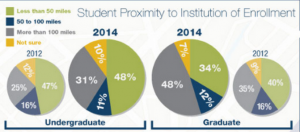
Overall, the study found that 54 percent of students attend an institution within 100 miles of where they live, showing a three-year trend of students increasingly willing to attend an institution farther from home. (In 2012, 80% reported attending an institution within 100 miles of where they lived. This declined to 69% in 2013.)

The number of individuals working full time declined from 60% in 2012 to 46% in 2014, while the number of those who are unemployed rose from 16% to 30% over the three past consecutive studies.

“For institutions looking to expand their online footprint, it’s critical to communicate the right message to students,” said Dr. David Clinefelter, Chief Academic Officer at Learning House and coauthor of the report. “Colleges and universities need to not only think about what sets their institutions apart, but also track student outcomes to provide quantifiable data about the value of their degrees.”

In Connecticut, Charter Oak State College's degree completion programs enable adults, who already possess college credits or work experience, to complete the Associate or Bachelor's (Baccalaureate) degree that meets their needs. Connecticut's public online college has been ranked number one in affordability among online degree programs in-state by AffordableCollegesOnline.org (AC Online). The  College offers a number of workforce relevant programs for adults who want to advance their careers, change careers, return to work, or validate their training and educational experiences.  Majors that can be completed using Charter Oak courses exclusively include Cyber Security, Health Care Administration and Health Information Management.

According to the National Center for Education Statistics, in 2012 approximately 2.6 million students were enrolled in fully-online degree programs, while 5.5 million were taking at least one online course.

Construction of New Rail Stations Set to Begin in 3 Connecticut Communities

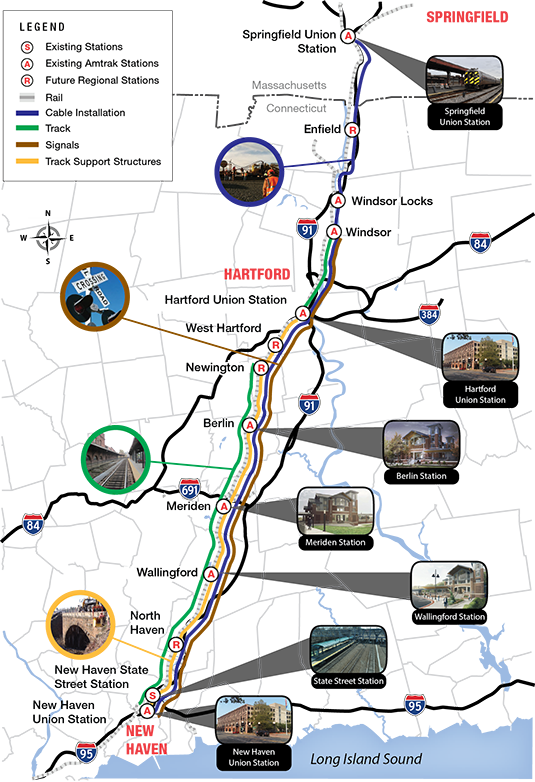
The start of construction is imminent this fall for new rail stations in Wallingford, Meriden and Berlin as part of the New Haven-Hartford-Springfield (NHHS) Rail Program.  The new, expanded commuter service, to debut in 2016, will be branded the “Hartford Line,” as a key component of an increasingly robust multi-modal regional transportation system being developed in the state and region. Improvements at the three stations include high-level platforms on both sides of the track, overhead pedestrian bridge with new elevators and stair towers, platform snow melt systems, electric vehicle charging stations, ticket vending machines and passenger information display systems,  high-resolution video surveillance systems, increased parking capacity and roadway access improvements, improved accessibility and bicycle racks.2014.10.22_Hartford_Line_s

Funded through the Passenger Rail Investment and Improvement Act (PRIIA) created under President Barack Obama in 2008, and State of Connecticut bonds proceeds, the NHHS Rail Program is aimed at providing significant new regional passenger rail service options.  Existing stations on the Hartford line are in New Haven, Wallingford, Meriden, Berlin, Hartford, Windsor Locks and Springfield.  Plans call for future stations in North Haven, Newington, West Hartford and Enfield. base_map

Officials point out that one of the primary objectives of the NHHS program is to serve as a catalyst for transit-oriented development (TOD) around the stations. The state Department of Transportation is working with towns to help leverage the investment in railroad infrastructure to capture local development benefits. TOD, in the form of compact, mixed-use districts, is pedestrian-friendly and contributes to vibrant and active communities. By promoting the use of transit, TOD also reduces reliance on automobiles, resulting in energy cost savings and improved air quality.

In June, officials from the U. S. Department of Transportation’s Federal Railroad Administration (FRA) toured parts of the NHHS Rail corridor, and state officials recently visited a proposed rail station site in Enfield.

The new NHHS rail service is expected to operate at speeds up to 110 mph, cutting travel time between Springfield and New Haven to as short as 79 minutes. Travelers  will be able to board trains every 45 minutes during the morning and evening peak hours and every 90 minutes during off-peak periods when the new system is operational.

A year ago, a West Haven rail station was added to the New Haven line.  Located midway between Milford and New Haven stations, West Haven was the first new station to open on the New Haven Line since Fairfield Metro Station was added in 2011. West Haven Station was designed by Vanasse Hangen Brustlin and built by a Connecticut company, Manafort Brothers of Plainville.

A New York City-based construction firm, Judlau Construction, has been awarded the $58.8 million contract to build the new railroad stations in Berlin, Meriden and Wallingford, the New Haven Register reported last month.  The firm specializes in large public works projects and design-build services, and currently ranks #132 on Engineering News Record’s list of the Top 400 Contractors, as well as #32 among Top Domestic Heavy Contractors. (In 2011, the company ranked #113 on the Top 400 list and #33 on the Top Domestic Heavy Contractors list.)

In June, the Chicago Tribune reported that the company was being awarded a $64 million construction contract by Illinois Tollway as low bidder for construction of new highway entrance ramps.  The Tribune also reported that Judlau “admitted improper hiring practices and paid a $7.5 million penalty in connection with an alleged minority hiring scheme” in New York, which the company said it had “self-reported” to the U.S. Attorney’s office.  The Tribune reported that “according to a 2012 civil lawsuit settlement with the U.S. attorney's office, Judlau and its partner in a Metropolitan Transportation Authority tunnel project admitted engaging in improper hiring practices involving minority- and women-owned businesses, otherwise known as disadvantaged business enterprises, or DBEs.”

Connecticut Ranks #6 in USA in Energy Efficiency, Continuing Top Ten Streak

Connecticut ranks as the #6 state in the nation in energy efficiency, according to an analysis by the American Council for an Energy-Efficient Economy (ACEEE).  A new report by the Council found that Massachusetts continues to edge out California as the most energy-efficient state in the nation for the fourth year in a row.  Connecticut has been a steady top-ten state since the annual survey began eight years ago, but dropped one slot this year.energymap Rounding out the top 10 are Rhode Island  (the state’s first time in top five), Oregon, and Vermont (all tied for #3); Connecticut (#6); New York (#7); Washington (#8); Maryland (#9); and Minnesota (#10).

Arkansas, the District of Columbia, Kentucky, and Wisconsin are the four most improved energy-efficiency states for 2014. Indiana and Ohio fell the furthest in the rankings due to decisions by legislators in both states to roll back energy savings targets.  They were among 23 states that dropped in the state-by-state rankings.  At the bottom of the rankings, the five states most in need of improvement on energy efficiency in 2014 are North Dakota, Wyoming, South Dakota, Mississippi, and Alaska.

Overall, states are ramping up their commitments to energy efficiency, the report indicated, as governors and lawmakers in state capitals across the nation continue to take major steps to lower energy costs, reduce pollution, and save consumers money by increasing their states’ energy efficiency.  Sixteen states rose in the rankings this year, in the 8th annual edition of the State Energy Efficiency Scorecard.ACEEE_logo_block

Connecticut was ranked fifth a year ago, and sixth the previous year.  In 2011, the state ranked #9 and in 2010, ranked #8.  State officials noted that Connecticut continues to be a leader in the nation, and the strong ranking is likely to improve in the coming year as increased funding for energy efficiency programs, not fully reflected in this year's survey, have an impact. Also noted was the state's decision to invest in infrastructure, such as charging stations throughout the state for vehicles, which was not an area of focus for the report but will be beneficial for Connecticut consumers.

The State Energy Efficiency Scorecard benchmarks states across six policy areas – utility policies and programs, transportation initiatives, building energy codes, combined heat and power development, state government-led initiatives, and state-level appliance standards. In total, states are scored on more than 30 individual metrics. Data is collected from publicly available sources and vetted by state energy offices and public utility commissions, according to the Council.  The 2014 report found that nationwide, total budgets for electricity efficiency programs in 2013 reached $6.3 billion. Adding that to natural gas program budgets of $1.4 billion, total efficiency program budgets were estimated to be more than $7.7 billion in 2013.

The leading states in utility-sector energy efficiency programs and policies were Rhode Island, Massachusetts, and Vermont, and the leading state in building energy codes and compliance was California. California and New York led the way in energy-efficient transportation policies.

Maggie Molina, director of ACEEE’s Utilitie2014-scorecard-map-01-620x310s, State, and Local Policy program, said: “Smart energy efficiency choices maintain the same comfort, convenience, and quality of life that consumers want and expect. Energy efficiency is also good for business. State action on energy efficiency improves bottom lines, drives investment across all sectors of the economy, creates jobs, and offsets the environmental harms created by the energy production system.”


The American Council for an Energy-Efficient Economy acts as a catalyst to advance energy efficiency policies, programs, technologies, investments, and behaviors.