Majority of Students in 17 States Are Low Income, Study Finds; Connecticut Schools Among Most Income Diverse, Except in Cities

Echoing concerns that “a house divided against itself cannot stand,” a new study is raising alarm about the dramatically increasing percentage of low income students in American public schools – and the implications for the education of a generation of school children.

A new study from the Southern Education Foundation shows that 17 U.S. states have reached an unenviable tipping point: the majority of students in their public school systems receive free lunches — effectively indicating that the public school systems in these states can now be described as institutions that mostly serve the poor, rather than public institutions that serve a representative cross-section of their state’s population.

As states coast-to-coast reach that new imbalance – particularly in the South and West – the Northeast, including Connecticut, continue to have the smallest percentages of low income students in their public schools, according to the most recent data used in the study, from 2011. The states with majority-poor school systems include almost the entire South, as well as Oregon, Nevada, and California.

The study pointed out that “from 2001 through 2011, the numbers of low income students in the nation’s public schools grew by 32 percent – an increase of more than 5.7 million children. As a result, low income students attending the nation’s percent low income in schoolspublic schools moved from 38 percent of all students in 2001 to 48 percent in 2011.”
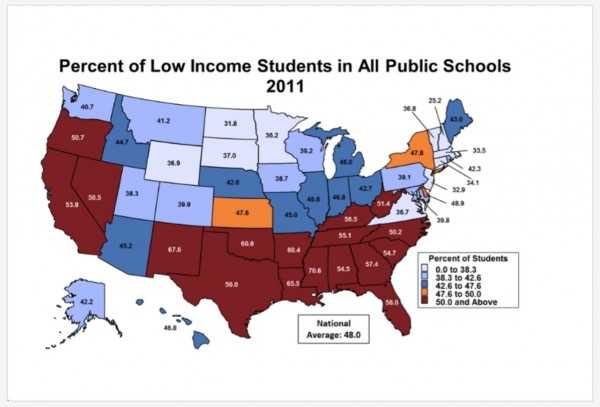
In Connecticut, the percentage of low income students in public schools was only 34 percent, among the lowest percentages in the nation.  Only four states had a lower or equal percentage – New Hampshire (25%), North Dakota (32%), New Jersey (33%) and Massachusetts (34%).

The largest percentage of low income students were in Mississippi (71%), New Mexico (68%), Louisiana (66%), Oklahoma (60%), Arkansas (60%), Georgia (57%), Kentucky (57%), Florida (56%), Alabama (55%), Tennessee (55%), South Carolina (55%) and California (54%).

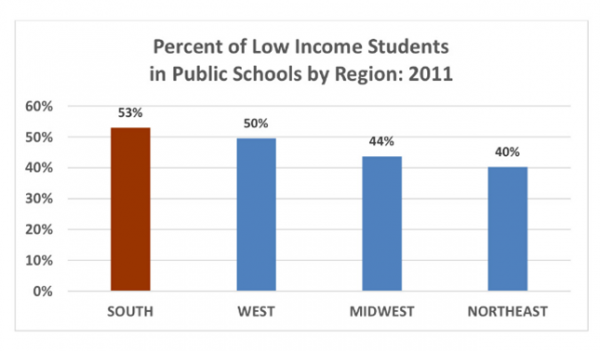
Overall, the rates of low income students in the public schools, by region, was 53 percent in the South, 50 percent in the West, 44 percent in the Midwekids at school-st and 40 percent in the Northeast.  The national average was 48 percent. As the report pointed out, “in 2011 the nation stood within only two percentage points of enrolling a majority of low income students in public schools across 50 states.”

The study  also compared the rates of low income students in cities, suburbs and rural areas in each state.  In each of the nation’s four regions, a majority of students attending public schools in the cities were eligible for free or reduced lunch.

The Northeast had the highest rates for low income school children in cities: 71 percent. The next highest rate, 62 percent, was found in Midwestern cities. The South had the third highest percentage of low income students in the cities – 59 percent.  In Connecticut, 62 percent of students in the cities were low income students, compared with 26 percent in the suburbs and 13 percent in rural areas.

“Low income students are concentrated in the nation’s cities but are by no measure confined to only cities,” the study noted.  “Forty percent or more of all public school children in the nation’s suburbs, towns and rural areas are low income students.”
by region The report, released in October 2013,  indicated that low income students “generally are more likely to score lowest on school tests, fall behind in school, fail to graduate, and never receive a college degree,” and yet “the growth in the number of low income students far out-stripped the growth in per pupil spending in public schools during the last decade in every region of the country, except the Northeast.”  The nations per pupil expenditure (adjusted for inflation) in public schools increased by only 14 percent – less than half the rate of growth in the numbers of low income students,” according to the report.

The study concludes by stating that “The trends of the last decade strongly suggest that little or nothing will change for the better if schools and communities continue to postpone addressing the primary question of education in America today: what does it take and what will be done to provide low income students with a good chance to suc556419_282077021867473_1934636139_nceed in public schools? It is a question of how, not where, to improve the education of a new majority of students.”

The Southern Education Foundation’s mission is to advance equity and excellence in education for low income students and students of color.  The Foundation’s “core belief is that education is the vehicle by which all students get fair chances to develop their talents and contribute to the common good.”

CT Drops Among States But Exceeds National Average in Opportunities Available to Residents

A new report and analysis focusing on four “impact areas” of daily life – opportunity, economy, education and community - has determined that Connecticut exceeds the national average in each category, by at least five percentage points and as much as nearly seven.  Overall, the state ranked 13th in the U.S., with a score of 56.9 out of 100 in the study's index, designed to measure economic, academic, civic and other key factors.  The state ranked 10th a year ago, and is the only state to fall out of the top 10.

The top 10 states in the latest analysis are Vermont, Minnesota, North Dakota, New Hampshire, Nebraska, Iowa, Massachusetts, New Jersey, South Dakota and Maryland.   In addition to Connecticut, three other states (Montana, Oregon and Pennsylvania) dropped as many as three slots in the state-by-state rankings.

According to the report, developed by Measure of America  and Opportunity Nation, Connecticut did better than the national average in  mean household income, the number of banking institutions, and the percentage of households with high speed internet.  The state also exceeded the national average in the percentage of 3- and 4-year olds attending preschool and the percentage of the population (age 25 and older) with an associate degree or higher.  The unemployment rate in Connecticut was higher than the national average, but the percentage of the population with earnings below the poverty line was less than the average nationally.

Perhaps surprisingly, the percentage of students who graduate from high school on time (within four years) is below the national average – 75.1 percent in Opportunity-Nation-LogoConnecticut as compared with 78.2 percent nationally.
The Opportunity Index focuses on the conditions present in different communities and is designed to connect economic, academic, civic and other factors together to help identify solutions to lagging conditions for opportunity and economic mobility.  From preschool enrollment to income inequality, from volunteerism to access to healthy food, expanding opportunity depends on the intersection of multiple factors, Opportunity Nation's website explains.  The Index is designed to provide policymakers and community leaders with a powerful tool to advance opportunity-related issues and work, advocate for positive change and track progress over time.  

In the area of community health and civic life, the level of volunteerism among Connecticut residents exceeds the national average, as does the   number of primary care providers (per 100,000 population) and the percentage of adults who are involved in social, civic, sports and religious groups.  Violent crime is below the national average and the percentage of youth, ages 16-24, not in school and not working is also below the national average, at 12.3 percent as compared with 14.6 percent nationwide.

Nationally, almost 6 million young people are neither in school nor working, according to the study - almost 15 percent of those aged 16 to 24 nationwide who are neither employed or in school, the Associated Press reported.  In Connecticut, 12.3 percent of those aged 16 to 24 are not working either at a job or in class, the study found.

The study also determined that 49 states have seen an increase in the number of families living in poverty and 45 states have seen household median incomes fall in the last year, the AP reported.

13

MOOCs Started, Not Finished, in Massive Numbers; Rapid Growth Raises Questions

A massive open online course (MOOC) is an online course aimed at unlimited participation and open access via the web.  Even as MOOCs continue to accelerate in popularity - enrollment in all online courses is reportedly up 29 percent since 2010 - and variety of offerings institutions and courses, there are some speed bumps worth considering – led by the very high percentage of courses that are started but not completed.  The reasons why are unclear.

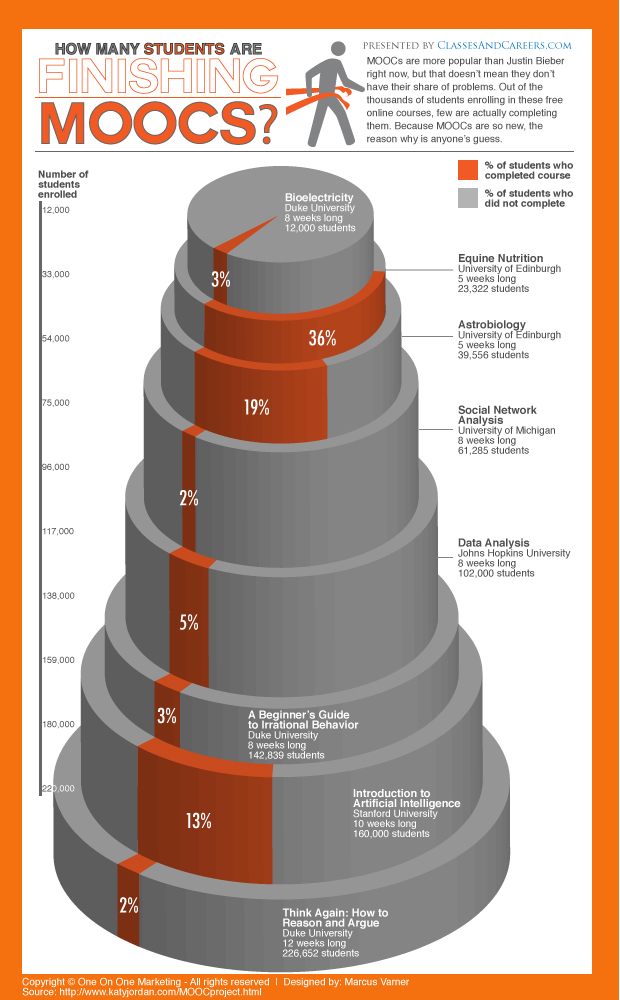
An infographic illustrates the current reality, and suggests that the lack of enthusiasm in some higher education circles for offering MOOCs may have justification – even if data in the relatively new field remains short of robust. Courtesy of the blog Classes and Careers (Marcus Varner) and education blogger Katy Jordan, the completion percentage of extremely popular courses becomes evident – as low as two percent in soMOOC-completion-rate-infographic1me cases.  Given the often massive numbers of enrollees, the small percentage may belie the raw numbers – and the benefits to those students, as well as to those who may have decided not to see a course through to the end.

The recently issued 2013 Campus Computing Survey by The Campus Computing Project, the largest continuing study of the role of computing, eLearning, and information technology in American higher education, found that CIOs and senior campus IT officers “are not overly optimistic about MOOCs as a viable strategy for instruction or for revenue.”  The survey indicated that just over half (53 percent) agree that MOOCs “offer an effective academic model for the effective delivery of online education” while less than a third (29 percent) view MOOCs as offering “a viable business model” for campuses to secure new revenue from online courses.

In Connecticut, Wesleyan University led the way into the MOOC world, announcing last September its partnership with Coursera, one of the leading companies in the field. Wesleyan was Coursera's first small liberal arts college and offered six courses, The Hartford Courant reported earlier this year. Among those teaching a MOOC course was Wesleyan President Michael Roth, who told the Courant that the class "has been a wonderful surprise. I have been so impressed by the level of discourse among the students and by their excellent questions back to me … I will offer the class again for Coursera, and my teaching at Wesleyan in the future will be informed by my online experience."

According to Wall Street Journal reporting by the publication’s deputy technology editor, “Early studies highlight a number of problems with the learning experience in online courses that educators are scrambling to solve. Perhaps most important: Staring at a screen makes some students feel isolated and disengaged, which can lead to poor performance or dropping out altogether. Often, more than 90% of people who sign up for a MOOC don't finish, though many come to online learning with a different intent than would students at a traditional university.”

Writing last year in UConn Today, a publication of the university, Jeremy Teitelbaum, dean of the College of Liberal Arts and Sciences, said of the wave of institutions adding MOOCs:  “I tend to be skeptical of predictions of doom for universities, and I’m especially skeptical of claims that online education will put an end to the classroom experience. After all, the university as an institution has successfully evolved through the inventions of the printing press, the steam engine, the telegraph, radio, television, and the atomic bomb; given that record, it is likely to survive the Internet as well.”

The largest provider, Coursera, has five million participants, and nonprofit provider edX more than 1.3 million, according to the Wall Street Journal.  While the majority are based in the U.S., their learners come from all over the globe: among edX's students, 9% came from Africa and 12% from India, the Journal reported.

The Courant reported that Yale has long had a presence online, most notably with its Open Yale Courses program, which began in 2006 and made free noncredit courses available worldwide. In mid-May Yale announced that it would partner with Coursera to begin offering classes during the upcoming academic year.  Other Connecticut schools — UConn, Quinnipiac, Trinity, the University of New Haven and the University of Hartford — have been exploring and offering various online options but have no immediate plans to offer MOOCs, according to The Courant.

UConn’s view appears not to have substantially changed since Teitelbaum, a year ago, concluded: “For individuals working in higher education, staring at technological change and reading alarming editorials and features in the newspapers, there’s a temptation to panic. That’s a mistake. Good universities confronting technological change should play to their strength: a talent pool with a broad perspective and deep expertise. If we stay current, try new things, and keep a critical, but not overly critical eye on the opportunities, we’ll find that technology only makes us stronger.”

Biking, Walking Gain Traction Around Connecticut; Training, Gala Upcoming

November is shaping up to be another busy month for Bike Walk CT, a member-supported non-profit organization making cycling and walking safe, feasible and attractive for a healthier, cleaner Connecticut. Bike Walk CT is owalkit_ct2nce again offering the League of American Bicyclist-designed Traffic Skills 101 program, a day long course to give cyclists the skills, knowledge and confidence to handle on-road cycling in traffic. The program will be held on Sunday, November 10 at Bishops Corner in West Hartford.

Just days later, bicycling and walking enthusiasts will celebrate the progress made by Bike Walk CT at the organization’s Annual Dinner and Silent Auction, to be held on Tuesday, November 12 at Central Connecticut State University.bike lane

During the evening celebration, Department of Economic and Community Development Deputy Commissioner Kip Bergstrom will lead a discussion of the important and growing role of active transportation and bikeable, walkable communities in Connecticut's economy and tourism industry.

Bike Walk CT works locally to increase grassroots efforts to make communities better places to bike and walk; at the state legislature to advance laws that protect the rights of cyclists and walkers, and at the DOT to make sure that policies and engineering practices that will improve conditions for cyclists are implemented. The organization is also active at the federal level, working cooperatively with national organizations to ensure continued funding for biking and walking projects.

Bergstrom has 30 years of experience as a strategist, business executive, economic development professional and place-maker. His DECD portfolio includes the development of the innovation economy, statewide branding, as well as the arts and culture, historic preservation and tourism functions.biking

Bike Walk Connecticut was formed in 2005 as the Central Connecticut Bicycle Alliance (CCBA), with a mission to advocate for bike-friendly facilities and policies in central Connecticut to benefit all bicyclists, both recreational riders and commuters. CCBA received 501walk(C)(3) status in January 2006. In April 2010, CCBA broadened its mission to include walking issues, adopted a statewide focus, and changed its name to Bike Walk Connecticut.

The National Highway Traffic Safety Administration (NHTSA) reports that 618 cyclists were killed in the United States in automobile accidents in 2010 (the last year for which statistics are available). That same year, 32,885 bikers were injured in traffic crashes. Although the numbers have declined since 2005 — when 43,510 bikers were injured, 786 of them fatally — these rates of injuries and deaths highlight cyclists' continued exposure to serious risks.

From West Hartford to Widespread Acclaim, Local Talent Resonates

On back-to-back nights, an indie/roots rock band and a singer/songwriter, each gaining increasing notoriety, performed just a stone’s throw from the West Hartford – Hartford town line.

Bronze Radio Return, a six member band that was formed when the musicians were students at the University of Hartford only a handful of years ago, returned to their roots in West Hartford just after completing a 15-city tour that brought them through the West and Southwest, including dates in California, Oregon, Arizona, New Mexico and Texas.  A special performance at their alma mater, as part of the university’s homecoming weekend, was albronze radio returnso a precursor to upcoming performances in Portland, Burlington and Boston.

Just a day earlier, singer/songwriter Kate Callahan, fresh from being selected as Best Singer/Songwriter at the Connecticut Music Awards, performed with her band Echo Joy.  The evening performance at the Hartford Seminary was highlighted by songs from her recently released third album, Two Doors, which evokes folk sound with textures of indie, country, and soul.

Callahan took top honors at the 2nd annual Connecticut Music Awards that were held last month at the Bushnell Center for the Performing Arts in Hartford.  Shekate callahanhas been named the Hartford Advocate’s “Best Solo Performer” three times.  Next on her performing schedule is a trip to New York City, followed by local performance dates in Connecticut early next month.

Bronze Radio Return has clearly been on the ascendency, as FOX Sports recently selected their recent single “Further On” for use in the network’s NFL, college football and NASCAR game-day coverage.   During the summer, the band’s “Shake, Shake, Shake” surpassed 500,000 views on YouTube, and their latest album, Up, On & Over reached the Billboard magazine “Heatseekers Albums” list at number 17.

They have performed at music festivals nationwide, and their music has also proven extremely popular for television commercials and programs, among them a worldwide Nissan Leaf commercial and a national Behr Paint/Home Depot ad. In addition, HBO, ESPN, NBC, MTV, the CW, American Idol, ABC Family, USA, and more licensed their music for shows, promos and bumpers.

The band’s website noted that “their story starts in Hartford, where members orbited each other at The Hartt School, one of the country’s top music conservatories. After finding each other and solidifying their line-up in 2008, they began writing music and found that their surroundings played a hbronze radio  mapuge part in their creative energies.”   The band includes lead singer and guitarist Chris Henderson, drummer Rob Griffith, lead guitarist Patrick Fetkowitz, keys player Matthew Warner, bassist Bob Tannen, and harmonica/banjoist extraordinaire Craig Struble.

 Kate Callahan, acoustic guitarist as well as singer/songwriter, has opened shows for folk legends Judy Collins and Noel Paul Stookey (Peter, Paul & Mary), and troubadours Aztec-Two Step, Mustard’s Retreat, tPrinthe late Bill Morrissey, and Rachael Sage. Callahan says a defining element of her music is innocence and she’s unapologetically optimistic in concert.  From West Hartford, and now Hartford, she has been recognized by the Hartford Courant as a "Woman of Character," and has a longstanding relationship with the West Hartford Public Schools as an  Artist in Residence.

In 2011, Javier Colon, also of West Hartford, trying for a second shot at a recording career that had stalled, won the first season of "The Voice," the NBC singing competition.   Colon is a graduate of the University of Hartford's Hartt School of Music, and returned to his alma mater to perform later that year.  Since winning “The Voice,” Colon has released an album, “Come Through For You,” and has performed at concerts and charitable events around the nation, including locally at the Travelers Championship last year.

CT Should Look to New York, Aging Workforce, Urban Centers to Rebuild Economy

Connecticut would be foolish not to take greater advantage of the fact that nearly one-third of the state is within the financial orbit of New York City as it looks to rebuild its economic strength – while not overlooking the potential for entrepreneurial activity across the state.

Those were among the lead suggestions of a panel of economists and entrepreneurs at the University of Hartford looking at job prospects for today’s 20-somethings, in a program sponsored by CT Mirror.

Daniel Kennedy, Senior Economist in the Office of Research at the state Department of Labor emphasized that the strongest economic growth in the state in the years to come will be in Fairfield County, and evidence of that trend is already present in the current economic recovery.

Wayne Vaughn, president of Hartford-based Fuscient, which he launched in 1997, said the state should “play to its strengths,” in looking to Fairfield County.  He said that New York City's immense economy "bleeds over into one-third of our state."  He also called on the state’s colleges and universities to step up efforts to match students with mentors in the business community, to improve their workforce readiness.

The state’s college graduates should not sell the state short, offered Katelyn Anton, Community Manager of New Haven-based Independent Software, and a key contributor to Whiteboard, a popular blog for the technology and entrepreneurial community in the state.  “Connecticut is one of the ripest locations in the world,” for start-up ventures, she said, panelnoting the growth of co-working spaces in New Haven, Hartford, Bridgeport, Manchester and other communities, and the numerous incubator opportunities that individuals “can tap into.”

Connecticut Business and Industry Association (CBIA) economist and vice president Peter Gioia predicted that the state’s economy is “on the cusp of turning the corner,” noting that between 15 and 20 percent of today’s workforce will be retired within five years – creating job vacancies and opportunities for young people.  He predicted that as the workforce ages out of the market, the state’s workforce will need electrical line workers, plumbers, electricians, commercial loan officers, actuaries and financial planners, and some of that need is already apparent.

Gioia praised the state’s recent efforts to bolster the University of Connecticut and the state’s community colleges, underscoring the correlation between “where students go to school and where they get their first job.”  If students stay in the state for college, Connecticut businesses will ultimately benefit.

Kennedy said the state’s prolonged economic recovery is characterized by continued “demand deficient unemployment,” which is more structural than merely a reaction to the national downturn that began in 2008.  He indicated that even as some sectors are improving, many millennials remain underemployed -college graduates working in service, rather than professional, industries.

“More people are working, but they’re not making as much,” said Orlando Rodriguez, a senior policy fellow at Connecticut Voices for Children.  “For every job we lose in the financial industry, it takes eight and a half jobs in the restaurant industry.”

Rodriguez also raised a cautionary note, stating that Connecticut should be particularly concerned about young people in the state’s urban centers who do not attend college, and often are unable to obtain a first job. While statewide unemployment hovers around 8 percent, it can run as high as 40 percent among 18-24 year olds in Bridgeport and other urban communities. “Connecticut’s future,” Rodriguez said, “is in urban areas.”

Gioia was strongly critical of Congressional inaction on immigration reform, stating that the nation’s economy would be strengthened by a comprehensive policy.  “Immigrants are much more likely to start a business, and become net employers of Americans.”  He said the policy of educating foreign students, but not permitting them to then remain in the U.S., as “ridiculous.”  He also cited Canada as an example of a nation that has been more welcoming of immigrants, to the benefit of the nation’s economy.

Vaughn said that while his biggest challenge in doing business in Connecticut is retaining talent, the growth of technology in business transactions offers businesses here significant opportunities.  “Where your business is located doesn’t dictate who your customers are,” he said.

The discussion was the second of nine panels on a range of topics sponsored by The Connecticut Mirror to be held around the state in coming months.  It was moderated by Brett Ozrechowski, CEO-Publisher of the CT News Project, which operates CT Mirror.  Next month, discussions will be held  Nov. 7 at Fairfield University focused on measuring good teaching and Nov. 18 at the University of New Haven on the topic of the clean energy economy.

Mental Health and Community Well-Being Is Focus of Initiative Honoring Memory of Ana Grace Márquez-Greene

The  parents of Ana Marquez-Greene, one of the students whose life was tragically ended at Sandy Hook Elementary School nearly a year ago, have announced plans to convene "Love Wins,"  a day-long conference for those concerned with mental health and community well-being to help build connections that prevent and cope with trauma.

 To be held on December 2 at the University of Hartford, the conference is the inaugural initiative of The Ana Grace Project, and is designed to “promote love, community and connection for every child and family,” and a day dedicated to honoring Ana Grace.

Nelba Márquez-Greene and Jimmy Greene have dedicated themselves to creating real solutions to the kind of violence that took their daughter’s life.  They have developed The Center for Community and Connection in partnership with the Klingberg Family Centers as a transformational initiative of The Ana Grace Project to identify the most effective ways to build community and interpersonal connection to prevent violence and promote recovery. The Center aims to accomplish this objective through research, practical tools, professional development and public policy.

The Center was inspired by the heart and soul of Ana Grace’s mother, Nelba Márquez-Greene, LMFT, a licensed Marriage and Family Therapist employed by Klingberg Family Centers. Nelba Márquez-Greene and Jimmy Greene “believe that love and community are the antidotes for violence and are spurred on not onAna Gracely by their loss but by their faith and the belief that it is always best to “Overcome Evil with Good,” according to the organization’s website.

Nelba Márquez-Greene and Jimmy Greene are both alumni of the University of Hartford.

The program on Dec. 2 will feature Bruce Perry, MD, Ph.D., as its keynote speaker and is a collaboration of the resources of Western Connecticut State University, Central Connecticut State University, the University of Hartford, Klingberg Family Centers and Stanley Black and Decker.  Perry is the Senior Fellow of The Child Trauma Academy, a not-for-profit organization based in Houston, TX, and adjunct Professor in the Department of Psychiatry and Behavioral Sciences at the Feinberg School of Medicine at Northwestern University in Chicago.

A workshop on Creating Compassionate Communities by Christopher Kukk will address weaving compassion into the fabric of learning (schools) and living (cities and towns) communities, drawing upon ideas from neuroscience, psychology, evolutionary biology, economics and other social sciences. Dr. Kukk is Professor of Political Science at Western Connecticut State University and founding Director of the Center for Compassion, Creativity and Innovation.

A session to be led by Alice Forrester will describe New Haven's efforts to reduce the impact of adverse childhood experiences using a two-generational approach.  Participants will discuss how collaboration and grass roots activism can impact children and families facing mental health challenges.  Dr. Forrester is the Executive Director of the Clifford Beers Child Guidance Clinic in New Haven, a community-based, mental health center for excellence for the treatment of children and families.  She was appointed by Governor Malloy to sit on the Sandy Hook Commission and has served as the Project Director of two National Child Traumatic Stress Network grants.

“For anyone whose child has been the victim of senseless violence it can seem almost impossible to go on. Grappling with anger and despair, you search for a way to redeem what has been lost, said Nelba Márquez-Greene on the organization’s website.  “And here we stand, knowing we must do something, something meaningful, to help all of us turn the page and begin the next chapter. Our hope as a family is to invest in creating solutions that will draw these individuals away from violence and replace it with the powerful love and connection that can only be found in a healthy community of caring.”

Additional session topics include the human cost of unmet mental needs in our cities, Mental Health First Aid, Circle of Security Parenting and Teaching and Learning with Compassion.

Conference participants will learn about and contribute to best practices in building community and interpersonal connections to prevent violence and promote recovery. Organizers anticipate that conference outcomes will contribute to a shared body of knowledge for community members, parents, and professionals to create their own roles in building connections that “will enable love to win.”

The program will also include presentations by Steven Girelli, Ph.D., President & CEO, Klingberg Family Centers; Bryan Gibb, M.B.A., National Council of Behavioral Health; Deborah McCarthy, O.T., Mindfullness Collaborative for Youth and Schools; Adi Flesher, M.Ed., Garrison Institute; Isabel Pacheco Logan, L.C.S.W., Office of the Public Defender;  Keith Gaston, M.S.W.,  Village for  Families and Children;  Charlie Slaughter, M.P.H., R.D., Department of Children and Families; Geoffry Scales, Hartford Juvenile Probation;  Karl Koistein, L.C.S.W., DCF;  and Iran Nazarrio, COMPASS Youth Collaborative.

There will also be a performance piece about gun violence by Janis Astor del Valle and Lara Herscovitch, and a performance by the Connecticut Children’s Chorus.  CEUs will be available for teachers.  Registration and additional information is available at

http://events.constantcontact.com/register/event?llr=kdmy5ioab&oeidk=a07e8bf8e4yaa208d5f

Founded in 1903, Klingberg Family Centers is a private nonprofit charitable organization offering an array of treatment programs. The organization’s programs are designed to serve children and families whose lives have been affected by trauma in its various forms, family difficulties, and mental health issues.

Independent Colleges Produce Majority of Graduates for State's Key Industries

The 16 institutions of higher education in Connecticut that are members of the Connecticut Conference of Independent Colleges are playing a pivotal role in producing graduates with expertise in precisely the industry clusters that Connecticut businesses view as the fields most likely to propel economic growth in  the state.

In one critical field, Computer & Information Sciences, three-quarters of the degrees granted in the state aCCIC chartre awarded by the independent institutions.  And in seven key industry clusters – essential to building the state’s economic strength and job opportunities – the independent institutions award more than half of the degrees granted by colleges and universities in the state.

By offering strong academic programs – and attracting top students – the independent colleges and universities are advancing a focus on industry areas with the greatest economic growth potential in Connecticut.

The percent of statewide industry cluster degrees awarded by Connecticut independent colleges in 2012:

  • Computer & Information Sciences & Support Services, 75%
  • Health Professions & Related Programs, 62%
  • Physical Sciences, 59%
  • Engineering Technology & Related Fields, 55%
  • Engineering, 53%
  • Biological& Biomedical Sciences, 53%
  • Business Management, Marketing & Related Fields, 52%

The 16 member institutions of CCIC are Albertus Magnus College, Connecticut College, Fairfield University, Goodwin College, Mitchell College, Quinnipiac University, Rensselaer University, Sacred Heart University, St. Vincent’s College, Trinity College, University of Bridgeport, University of Hartford, University of New Haven, University of Saint Joseph, Wesleyan University, and Yale University.

Independent institutions award 46 percent of all degrees granted in Connecticut, and enroll 30 percent of all college students statewide, including 45 percent of all minority students enrolled at four-year institutions in the state, according to a study last year by the Institute for Research & Public Service.

The study also found that Connecticut’s private not-for-profit college and university sector, on the state economy in 2010, had a total impact of $6.19 billion in sales of goods and services.  In the aggregate, the independent sector of higher education is Connecticut's third largest employer, with only the State itself and United Technologies employing larger workforces.

Connecticut Innovation Summit to Highlight Emerging Entrepreneurial Businesses

Hundreds of people who from across the spectrum of Connecticut’s innovation ecosystem — from C-level executives to emerging entrepreneurs, investors to entrepreneurial support organizations, service providers to students, will gather to share ideas and promote and celebrate innovation at the Connecticut Innovation Summit, convening for the seventh year on November 7.

The expanded Summit agenda includes:

Mentor Meetings where 75 entrepreneurs will get the unprecedented opportunity to meet one-on-one with three tech experts of their choosing — executives, investors, and serial entrepreneurs who built and sold companies — to share their experiences, knowledge and expertise.

The Funding Fair where funders and entrepreneurial resources including angels, VCs, corporate VCs, investment bankers, InnovationSummitLogo_V2_sm_001lenders, family offices, government programs, private investors, incubators and co-working spaces will be on-hand to offer individual guidance and advice.

The Pitch Fest where each of the 75 companies deliver a three-minute pitch to a panel of judges. The top ten pitchers will compete at the Pitch-Off where the audience, by way of electronic voting, determines the best of the best.

Poster Expo enabling deal makers and movers and shakers face-to-face time with each of the 75 Tech Companies to Watch.

Described as “Connecticut's Largest Networking Event for Innovative, Emerging and Start-up Companies,” the expanded agenda also recognizes Tech Companies to Watch - 75 tech start-ups representing cutting edge, early stage and emerging growth companies.  Companies that reflect innovation, and have the potential to grow quickly and do not exceed $3M in revenue, are urged to apply to be a Tech Company to Watch.

Five of the 75 companies will receive awards in categories including green tech, internet / new media, life sciences, software and technology product / service. The Connecticut Innovation Summit is presented by Angel Investor Forum, Connecticut Technology Council, Crossroads Venture Group, CTNext, and CURE. Registration is now available.

Concussions in NFL, Youth Sports Earn Attention from Media, Government, Coalition

A number of the nation’s most prominent youth sports organizations announced this week that they will be partnering with concussion specialists, sports medicine professionals and leaders at other levels of sports to create an unprecedented coalition to focused on concussions among young athletes.

The announcement comes the same week as a major report on the NFL’s two decades of denial of a connection between football and brain injury, aired on Public Broadcasting System (PBS) stations across the country, including in Connecticut, as part of the investigative “Frontline” series.

The National Sports Concussion Coalition expects to be "the most comprehensive alliance of its kind", with science and medical leaders in the fields of concussions, brain injHeads-Up-Concussion-In-Youth-Sports-CDCury and sports medicine working directly with a cross-section of organizations and governing bodies that represent millions of athletes across major organized sports in the United States. The partnership aims to share data and identify best safety practices that can assist in coaching, playing and officiating across sports.

To help ensure the health and safety of young athletes, this past spring the federal government's Centers for Disease Control and Prevention developed the Heads Up: Concussion in Youth Sports initiative to offer information about concussions to coaches, parents, and athletes involved in youth sports. The  initiative provides important information on preventing, recognizing, and responding to a concussion.  A series of fact sheets and an informational video for players, coaches and families are available on the CDC website, www.cdc.gov/concussion.

The founding youth sports and medical members of the newly formed coalition include the National Council of Youth Sports (NCYS), Pop Warner Little Scholars, Sports Concussion Institute (SCI), US Lacrosse, US Youth Soccer, USA Hockey, American College of Sports Medicine (ACSM), Amateur Softball Association/USA Softball, USA Basketball, USA Football and the Datalys Center for Sports Injury Research and Prevention. Coalition partners at the professional, college and foundation levels include the NCAA, NFL, NFLPA and National Football Foundation.

Connecticut Law

Just two weeks ago, Connecticut Governor Dannel P. Malloy and Attorney General George Jepsen issued a news release reminding student athletes, parents and coaches that head injuries and concussions are serious and that Connecticut law requires students who suffer a blow to the head or receive a concussion diagnosis to sit out games and practices until cleared by a licensed medical professional.

“A concussion is a very serious injury, and an athlete who has suffered a concussion needs time to heal,” said Attorney General Jepsen. “While proper use of helmets and protective equipment is important, it’s critical to remember that no helmet can fully prevent a concussion. Preventing head injuries by limiting contact is key. Parents, athletes and coaches should educate themselves in order to recognize the signs of injury and prevent concussions in youth sports.”frontline

Under Connecticut law, anyone who has a state-issued coaching permit and who coaches intramural or interscholastic athletics must be periodically trained in how to recognize and respond to head injuries and concussions. State law also requires coaches to take a student athlete out of any game or practice if the athlete shows signs of having suffered a concussion after an observed or suspected blow to the head or if the athlete is diagnosed with a concussion. Coaches must keep athletes out of games and practices until receiving written clearance from a licensed medical professional.  Connecticut's youth sports concussion safety law was signed on May 18, 2010 by Governor M. Jodi Rell, and the state was among the first in the nation to enact a comprehensive policy.

 “Sports have the power to change the lives of millions of young people in this country by encouraging a physically active lifestyle and by teaching lifelong lessons. We want to make sure no child loses that opportunity due to fear of injury,” said Jon Butler, executive director of Pop Warner Little Scholars. “By coming together in this very important fight against concussions we believe our collective efforts will transcend our individual sports and benefit everyone.”

"The NCAA is committed to broad concussion education outreach, and to research that will identify objective biomarkers and sound management guidelines. We are excited about our partnership in this important alliance," said Brian Hainline, M.D., chief medical officer of the NCAA.

Documentary Production

The PBS program “League in Denial” began as a joint effort between PBS and the ESPN program “Outside the Lines,” announced in 2012.  Earlier this year, ESPN removed itself from the collaborative endeavor.

In a statement at the time, the network said “Because ESPN is neither producing nor exercising editorial control over the Frontline documentaries, there will be no co-branding involving ESPN on the documentaries or their marketing materials. The use of ESPN's marks could incorrectly imply that we have editorial control. As we have in the past, we will continue to cover the concussion story through our own reporting.”

The Bristol-based sports network has initiated major stories on the concussion issue in recent years, and ESPN reporters Mark Fainaru-Wada and Steve Fainaru have written a book – published this week - about football and brain injuries -- "League of Denial: The NFL, Concussions and the Battle for Truth," and are prominently featured in the PBS program.