Innovation and Impact of Manufacturing Companies in CT Is Focus of New CPTV Documentary

With Election Day less than two weeks away amid intensifying discussion of job growth in Connecticut, CPTV zeroes in on modern manufacturing and the role of innovation in companies. The CPTV Original documentary Made in Connecticut premieres Thursday, Oct. 23 at 8 p.m. on CPTV. Twelve businesses that exemplify the diversity of successful manufacturing “located and thriving right here in Connecticut” are featured in the program.made in CT

The documentary is part of a three-year, multi-platform initiative by Connecticut Public Broadcasting that celebrates Connecticut’s manufacturing future, from high-tech to hand-made.  The initiative includes additional special programming airing on CPTV and WNPR/Connecticut Public Radio.

Against the backdrop of such timely issues as outsourcing and a global economy, the Made in Connecticut documentary explores topics including:

  • the value that manufacturing provides to the state’s economy;
  • how the manufacturing sector is contributing to the creation of jobs in Connecticut;
  • how advances in technology have changed the nature of manufacturing and the skills needed to work successfully in the manufacturing environment; and
  • how science, technology and innovation are transforming manufacturing endeavors around the world, the nation and the state.

Featured in the documentary are:

  • Barnes Group headquartered  in Bristol, which started as a spring company in 1857 to supply the clock industry and has now exploded into a global leader in industrial and aerospace manufacturing;
  • Curtis Packaging in Sandy Hook, a nearly 170-year-old family-owned company that has reinvented itself as a world leader in luxury packaging and environmental stewardship;
  • Ola! Granola in Norwalk, where a mother of three produces hand-made granola in mouth-watering flavors such as vanilla almond, cranberry orange pecan and chocolate banana-chip;
  • Oxford Performance Materials in South Windsor, a plastics company on the edge of science fiction-like technology, using 3-D printing to create cranial implants for people who have suffered traumatic brain injury;
  • Pratt &Whitney in East Hartford, the industry leader in aerospace, creating breakthrough technology with its PurePower jet engine that will revolutionize air travel;
  • Protein Sciences in Meriden, which has a game-changing flu vaccine that takes just weeks to mass produce to fight pandemics worldwide;
  • Severance Foods in Hartford, a snack food company founded by three friends who invested in a tortilla-making machine in the 1980s, and now employs more than 85 people to produce 40,000 pounds of tortilla chips a day;
  • Tucci Lumber, which makes baseball bats in South Norwalk and was founded by a former Major leaguer.

Connecticut’s unemployment rate dropped to 6.4 percent last month as nonfarm jobs reached a new recovery high point. The unemployment rate last month was the lowest it has been in the state since November 2008, according to a state Department of Labor report.  The employment gain of 11,500 jobs in September is the largest since April 1994, the seventh monthly nonfarm employment gain this year and a "vigorous bounce-back" from the revised decline of 1,200 jobs in August, the Department of Labor said.  As the state takes proactive steps to ensure people are trained for manufacturing jobs, employment numbers are simultaneously rising. In the most recent data, manufacturing jobs increased from 163,500 last year to 164,100 this year, Fairfield County Business Journal reported.  The manufacturing industry plays a crucial role throughout Connecticut communities, U.S. Sen. Chris Murphy's office pointed out recently, noting that Connecticut’s 4,602 manufacturers account for 10.2% of the state’s jobs and 87% of the state’s total exports.

To prepare future workers, Manchester Community College will lead the state's 12 community colleges and Charter Oak State College in a federally funded effort to expand manufacturing education in the state as part of a $15 million grant from the U.S. Department of Labor, announced this month.  The grant  will support an expansion of the Connecticut Advanced Manufacturing Initiative, which trains students for jobs in the field. The grant will pay for equipment to provide hands-on training, new teachers and educational assistants and the development of registered apprenticeship programs for high-demand manufacturing occupations, among other investments.

CPTV_Logo

“In recent years, technological advances, as well as human innovation and creativity, have put Connecticut on the forefront of a manufacturing revolution. This revolution is not only exciting, it’s important to the local economy, as it’s helping to create jobs. Manufacturing has always been an important part of Connecticut’s culture and economy,” said Jerry Franklin, President and CEO of CPBN, who is to be honored next week by Hartford Business Journal with the publication’s Lifetime Achievement Award for his leadership in the broadcast industry.

The documentary Made in Connecticut is produced and hosted by Emmy Award-winning journalist Christina DeFranco. Funding was made possible by Founding Sponsor, KBE Building Corporation. KBE Building Corporation is a full-service, single-source commercial construction company strategically positioned to serve the Eastern and Mid-Atlantic, with offices in Connecticut and Maryland.

“We’re passionate about fostering innovation in Connecticut’s manufacturing and technology spaces, and we just happen to have built more technical high schools around the state than anyone else.  We’re thrilled to shine light on this critical aspect of the state’s current and future economy,” said Mike Kolakowski, KBE Building Corporation’s President and Principal Owner.

See preview on You Tube.   

Tri-State Weather Conference at WestConn Features Local Meteorologists

For weather experts and enthusiasts, all roads lead to Danbury on Saturday. The Fifth Tri-State Weather Conference will be held on from 8:45 a.m. to 5 p.m. in the Science Building on the mid-town campus of Western Connecticut State University on White Street in Danbury. The conference is presented by the Meteorology Program at Western Connecticut State University and co-sponsored by the WestConn Student Chapter of the American Meteorological Society (AMS), the New York City/Long Island Chapter of the AMS, NOAA/National Weather Service/Upton, N.Y and NOAA/National Weather Service/Taunton, MA.5th-tristate-weather-conference-final[1]

The purpose of the conference is to enhance education, professional development and communication among private and public sector meteorologists, researchers, educators, students, emergency management officials, and weather enthusiasts.

Research posters highlighting high impact weather events that affected the Tri-State region of New York, New Jersey, and Connecticut will be on display.

The master of ceremonies for the conference will be Lonnie Quinn, the chief weathercaster of CBS 2 News at 5, 6 and 11 p.m. weekdays. He also serves as the national weather anchor for “CBS This Morning” Saturday. Quinn is a native of Cheshire, who joined WCBS-TV in 2007 after a five year run at WTVJ in Miami.

Among the presenters at the conference will be Ryan Hanrahan, a Connecticut native from Guilford who joined the NBC 7a680fafcf844b6b1245b9dc1e0ecf3cConnecticut First Alert Weather Team in December 2005 and currently serves as the weekend evening meteorologist and as a general assignment reporter on weekdays. His interest in the weather was sparked by the 1989 Hamden tornado, hurricanes Gloria and Bob, along with the blizzards of '93 and '96, according to the station’s website.

Topics of presentations during the conference include:

Doppler Radar Signatures Associated with Connecticut Tornadoes 1995 – present. Ryan Hanrahan, NBC Connecticut – West Hartford, CT

Exploring Tri-State Climate Variability and Change Dr. David A. Robinson, New Jersey State Climatologist, Rutgers University

Hurricane Sandy - Boundary Layer Structure Affects on Winds and Storm Surge  Jeffrey S. Tongue, NOAA/National Weather Service, Upton, NY

NWS Weather Ready Nation initiative and how science is a critical and integral partradar Dr. Jason Tuelll, Director, Eastern Region NWS, Bohemia, NY
Operational Applications of GIS - The Development of A Flash Flood Potential Index for the Tri-State Area Nancy L. Furbush and Adrienne Leptich, NOAA/National Weather Service, Upton, NY

The GOES-R Satellite:  A New Eye in the Sky Eleanor Vallier-Talbot, NOAA/National Weather Service, Taunton, MA

Tornado Outbreak Quincy Vagell, Freelance Meteorologist – Naugatuck, CT

Tracking Hurricanes and Saharan Dust Storms from Space Jason Dunion, NOAA Hurricane Research Division in Miami, FL

Winter 14-15...Will Our Long Standing Ideas Win Out? Joe D'Aleo, Weatherbell Analytics LLC

Conference registrations are open to the public and may be submitted online atwww.wcsu.edu/weatherconference. The registration fee is $30 per person, and includes a continental breakfast, lunch and refreshments during breaks.

Quinn is not the only Cheshire native to handle weather forecasting on local television in the region.  The Western Connecticut campus is familiar turf for meteorologist Dan Amarante, who has been with FoxCT since January 2011.  He remembers being 8 years old and venturing outside during thunderstorms, much to his mother’s dismay, according to the station’s website. He spent a good chunk of his childhood reading weather books and watching tornado chasing videos.Dan_Amarante_Pic_opt

Dan graduated from Western Connecticut State University with a Bachelor of Science in Meteorology. While at WCSU, he produced and anchored many school run weather broadcasts for the University’s website, as well as forecasts for the school’s radio station. After college, he began working at WGGB ABC40/FOX6 in Springfield, MA, where he was the weekend weather anchor. He also has filled in as a weather producer at CBS 2 in New York City, and became snowed in at the station during the Blizzard of 2010.

Yale University Breaks into Top 10 in World University Rankings

Yale University edged into the top 10 in the annual World University Rankings for the first time, ranking tied for 9th place on the 2014-2015 list with Imperial College in London.  For the three previous years, Yale was ranked #11. Leading the new list were California Institute of Technology, Harvard University, University of Oxford, Stanford University and University of Cambridge.  The next five are Massachusetts Institute of Technology, Princeton University, and University of California - Berkley, just ahead of Yale and Imperial College.  The University of Chicago slipped from 9th to 11th in the rankings.24677_wur-2014-2015-news

Eight of the top 10 universities are in the United States, the other two in the United Kingdom.

From other nations, the top finishers were Swiss Federal Institute of Technology at #13, University of Toronto at #20, University of Tokyo at #23, Ludwig-Maximilins-Universitat (Germany) at #29, and University of Melbourne at #33.

The Times Higher Education World University Rankings 2014-2015, powered by Thomson Reuters, are the only global university performance tables to judge world-class universities across all of their core missions - teaching, research, knowledge transfer and international outlook.

The top universities rankings employ 13 performance indicators to provide “the most comprehensive and balanced comparisons available,” which are “trusted by students, academics, university leaders, industry and governments,” the organization’s website points out.  Institutions provide and sign off on their institutional data for use in the rankings.Yale ranking

The 13 performance indicators are grouped into five areas:

  • Teaching: the learning environment (worth 30 per cent of the overall ranking score)
  • Research: volume, income and reputation (worth 30 per cent)
  • Citations: research influence (worth 30 per cent)
  • Industry income: innovation (worth 2.5 per cent)
  • International outlook: staff, students and research (worth 7.5 per cent).

The U.S. has 74 universities in the top 200, down from 77 last year. Some 60 per cent of those institutions rank lower than they did 12 months ago, with an average fall of 5.34 places per university, according to Times Higher Education. Canada and the United Kingdom also slipped slightly in the overall rankings, while Asian universities trended higher, with 24 universities in the world top 200, four more than last year.

When the top world universities are broken down by academic disciplines, Yale ranks #7 in arts and humanities, #7 in life sciences, #7 in social sciences, #10 in clinical, pre-clinical and health, and #13 in physical sciences.  Yale finishes outside of the top 100 in engineering & technology.

Times Higher Education, which produces the rankings, is based in the United Kingdom.

THE  Watch the video presenting top 10.


For 3rd Consecutive Year, Connecticut Resident Is Named White House Fellow

Lindsay Rodman, a Captain in the United States Marine Corps,  judge advocate, and foreign area officer (Latin America) from Kent, Connecticut, has been named as one of 15 White House Fellows for 2014-15. She is the only Connecticut resident named to the prestigious fellowship for the coming year, and the third state resident in the past three years.  The Fellows come from diverse backgrounds, varied professions, and have demonstrated a strong commitment to public service and leadership.1373887640000-IMG-3564-1307150728_4_3

Rodman most recently served as Deputy Legal Counsel in the Office of the Legal Counsel to the Chairman of the Joint Chiefs of Staff, where her portfolio included military justice, space law and human rights law issues. Her placement during her service as a White House Fellow will be with the National Security Council.

Before moving to the Joint Staff, Lindsay was assigned to Judge Advocate Division, Headquarters Marine Corps. From 2010-2011, she was deployed to Afghanistan as an operational law attorney. She previously served as a defense counsel and legal assistance attorney in Okinawa, Japan.

Founded in 1964, the President’s Commission on White House Fellowships is one of America’s most prestigious programs for leadership and public service. White House Fellowships offer exceptional young men and women first-hand experience working at the highest levels of the Federal government.

Selected individuals typically spend a year working as a full-time, paid Fellow to senior White House Staff, Cabinet Secretaries and other top-ranking government officials. Fellows also participate in an education program consisting of roundtable discussions with renowned leaders from the private and public sectors, and trips to study U.S. policy in action both domestically and internationally. Fellowships are awarded on a strictly non-partisan basis.white house fellows

Prior to joining the Marine Corps, Rodman worked as an associate at Arnold & Porter LLP in Washington, DC. In early 2014 she was selected as a Center for New American Security Next Generation National Security Leader. She has been a member of the Warlord Loop, and a term member at the Council on Foreign Relations.

Rodman graduated in 2003 from Duke University with an A.B. in Mathematics and in 2007 from Harvard Law School with a J.D. and the Kennedy School of Government with a Masters in Public Policy.  She has volunteered at the DC Rape Crisis Center, and authored an article on sexual assault in the military that was published in 2013 by the Wall Street Journal.

The class of White House Fellows for 2014-15 includes individuals from New York, San Diego, San Francisco, Woodside (CA), Naperville (IL), Miami, Norfolk (VA), Midland (MI), Missoula (MT), Los Angeles, Voorhees (NJ), Penn Valley (PA), McAllen (TX), and Irvine (CA).

It is the third consecutive year that Connecticut has had a resident appointed as a White House Fellow.  Last year, Justin Finnegan of Darien was selected, following Anne O’Connell of West Haven the preceding year.

The first class of White House Fellows, in 1965, included William R. Cotter, later elected to Congress representing Connecticut’s First District.  He was joined in that class by Robert E. Patricelli, who would go on to become one of Connecticut’s prominent health care entrepreneurs and business leaders.  The Patricelli Center for Social Entrepreneurship at Wesleyan University bears his name.

More information on the White House Fellows program is available at whitehousefellows@whf.eop.gov 

See White House Fellow video. 


Number of CT Students Taking ACT Exam Jumps 15 Percent in 4 Years

The number of Connecticut high school students taking the ACT college readiness assessment exam as a means of demonstrating their academic ability to prospective colleges jumped 15 percent from 2010 to 2014, reflecting the increasing popularity of the test, the major national competitor to the Scholastic Aptitude Test, or SAT.  The average composite score of Connecticut students taking the exam ranked #2 in the nation, behind Massachusetts and just ahead of New Hampshire, Maine and New York. In 2010, there were 10,453 students who took the ACT exam in Connecticut.  By the graduating class of 2014, that number had increased to 12,044, reflecting a steady increase.  In 2011, 10,809 students took the ACT, followed in 2012 by 11, 192 students and 11.551 a year later. act_logo

The average score of state students has also climbed, from an average of 22.9 in 2010 to 23.6 in 2014.  The national average has remained steady, at 21.0.  The scores of Connecticut students rose in all four components:  from 23.8 to 24.2 in English, 23.5 to 24.1 in Math, 23.9 to 24.5 in Reading and 22.9 to 23.6 in Science.  All four exceed the national average among the class of 2014 taking the ACT.

Through the years, the ACT exam has traditionally been the college entrance exam of choice mainly by students in the western and mid-west states, while the SAT dominated in the east.  In recent years, that has begun to change, as colleges look to determine which exam, among other factors, are the most reliable predictors of academic performance in college.ACT exam

The percentage of graduates taking the SAT in Connecticut in 2014 was 29 percent.  In Massachusetts it was 23 percent, in New Hampshire 20 percent and in New York 27 percent.  In Maine, only 9 percent took the exam.  By contrast, 76 percent of the Class of 2014 in Minnesota took the exam, 73 percent in Wisconsin, and 86 percent in Nebraska.  A dozen states require students to take the exam.

The ACT and SAT have different areas of emphasis and approach.  ACT is an achievement test, measuring what a student has learned in school. The SAT is more of an aptitude test, testing reasoning and verbal abilities. According to the Princeton Review, among the differences between the tests include that ACT questions tend to be more straightforward, math concepts tested are more advanced, and it includes a science section.  The SAT has a stronger emphasis on vocabulary.

More than 1.84 million 2014 graduates—a record 57 percent of the national graduating class—took the ACT. This is a 3 percent increase from 2013 (despite a smaller total number of U.S. graduates nationally) and an 18 percent increase compared to 2010.

Connecticut students in the Class of 2014 taking the ACT exam exceeded the national average in the percentage of students ready for college-level coursework, according to the ACT criteria.  A benchmark score is the minimum score needed on an ACT subject-area test to indicate a 50% chance of obtaining a B or higher or about a 75% chance of obtaining a C or higher in the corresponding credit-bearing college course.

For Connecticut students taking the ACT, 86 percent surpassed the benchmark in English Composition, compared with 64 percent nationally.  In Math, 69 percent of Connecticut students and 43 percent of students nationally met the benchmark.  In Reading the breakdown was 65-44, in science, 59-37.

The ACT standards are designed to assess the types of skills needed for academic success. They serve as a direct link between what students have learned and what they are ready to do next, according to ACT.

Alternate College Ranking System Reveals Surprises for CT Colleges

It turns out that the oft-heralded and increasingly criticized U.S. News & World Report college rankings aren’t the only game in town.  Washington Monthly magazine has developed a rating system with a different emphasis, and very different results.  Among the Connecticut institutions making the list:  UConn, Yale, Wesleyan, and Trinity – but not necessarily in familiar places. The publication uses three main categories of evaluation for its analysis.  Social Mobility (recruiting and graduating low-income students), Research (producing cutting-edge scholarship and PhDs), and Service (encouraging students to give something back to their country). The publ1409.cover.220x286ication sets out to “identify the most public-minded institutions,” utilizing the three criteria and a handful of specific measures in each.

“Instead of crediting colleges that reject the most applicants, we recognize those that do the best job of enrolling and graduating low-income students,” the magazine pointed out.  The rankings also “measure both pure research spending and success in preparing undergraduates to earn PhDs.”  In addition, by “giving equal weight to public service, we identify colleges that build a sense of obligation to their communities and the nation at large,” the publication explained in the cover feature of the September/October issue.

Connecticut did not have an institution reaching the Top 30 National Universities.  That list was led by four University of California institutions in the top five slots, along with Texas A&M and Stanford University.  Harvard University placed tenth.

Yale University ranked #57 on the full list of National Universities. UConn ranked #82 - the only other school in the state listed among 277 institutions.  (Yale is ranked #3 in the U.S. News rankings; UConn places 19th)

The magazine also compiled a series of specialty lists ranking the institutions.

The only Connecticut school to reach the nation’s Top 30 Liberal Arts Colleges was Wesleyan University, which ranked #16.  (Wesleyan is ranked #15 on the U.S. News listing.) Further down the list, Trinity College ranked #184.

Among the “best-bang-for-the-buck” colleges, the University of Connecticut ranked #76, the only Connecticut college to break into the top 100.  That list was topped by three City University of New York colleges.colleges

Four Connecticut schools were among the Top 50 “Affordable Elite” institutions, according to the list compiled by the magazine.  Yale University ranked #33, Wesleyan University placed #40, UConn ranked #97 and Trinity College in Hartford just made the list at #98.

In the good news department, there were no Connecticut school reaching the “worst colleges” lists complied by the magazine.

The Social Mobility category includes four components including the percentage of students receiving Pell Grants, the cost of attendance, and the anticipated rate of graduation.   The five Research factors include research expenditures and the number of bachelors degree recipients who go on to earn PhDs  The Service category includes five factors including the number of alumni who serve in the Peace Corps, student participation in community service and the number of staff supporting community service.

Signaling the importance of the Washington Monthly rankings to colleges across the nation, a total of 47 institutions ran advertisements in the issue.  The advertisers did not include any colleges from Connecticut.

students

Student Chapter from Eastern Connecticut Earns Top Honors from Nonprofit "Best Buddies"

The Best Buddies chapter at Eastern Connecticut State University has been named Overall Outstanding Chapter in the United States.  The recognition came at the Best Buddies International Leadership Conference held at Indiana University. Best Buddies is a nonprofit, worldwide organization that helps create friendships for people with intellectual and developmental disabilities. Katharine Ferrone, chapter president, accepted the award on behalf of the club’s members and faculty advisor Charles Wynn, professor of chemistry at Eastern. Over 2,000 student leaders, volunteers, and staff from Best Buddies International programs around the world, participated in the 25thAnnual Leadership Conference  in Bloomington this summer.314112_10150786601893488_169246690_n

“The vision of Best Buddies is to put itself out of business by promoting a world that no longer requires an organization to help create friendships with people with disabilities,” said Ferrone, a senior from Wallingford. “Now five years old, Eastern’s chapter spiraled to the top thanks to the inspiration and dedication of many fine student leaders and volunteers.  It is demonstrating to both the university and community that people with disabilities are more like us than different.”

In Connecticut, Best Buddies is on the following college campuses: Connecticut College, Eastern Connecticut State University, Fairfield University, Quinnipiac University, Sacred Heart University, Southern Connecticut State University, Trinity College, University of Connecticut, University of Hartford, Wesleyan University and Yale University. The most enduring goal of the organization is to provide opportunities for one-to-one friendships. 1972343_712334228816599_428022073_n

Best Buddies programs engage participants in each of the 50 United States, and in 50 countries around the world.  Best Buddies’ seven formal programs – Best Buddies Middle Schools, High Schools, Colleges, Citizens, e-Buddies, Jobs and Ambassadors – positively impact nearly 700,000 individuals with and without disabilities worldwide. The chapter at Eastern holds a variety of events each year, from dances to friendship walks, to help close social gaps.

Anthony Kennedy Shriver is the Founder and Chairman of Best Buddies International, which he created in 1989 to foster one-to-one friendships between people with and without intellectual disabilities. Recognizing the tremendous volunteer potential of university students, Shriver first inspired his college peers to personally collaborate in expanding the realm of opportunities that persons with intellectual disabilities should experience.  Best Buddies has grown into a leading nonprofit entity with increasing international reach across six continents, establishing a global volunteer movement that creates opportunities for one-to-one friendships, integrated employment and leadership development for people with intellectual and developmental disabilities.

The Best Buddies Connecticut office is located in North Haven.

photo

Photo:  ( left to right)  Anthony Kennedy-Shriver, founder of Best Buddies; Katharine Ferrone, chapter president from Wallingford, CT, in green shorts holding the award; club members Amber Heim from East Hartford in white shorts, Kaitlyn Murphy from Mansfield in blue shorts and Monica Mordowanec from Seymour; Connecticut Best Buddies Director Angelo Santiago of Willimantic; and Kyrie Irving of the Cleveland Cavaliers.

Nation's First Black Astronaut in Space Calls for More Diversity in Science, Engineering Ranks

“A first class education is not just a requirement, it is a civil right,” America’s first African American astronaut, aerospace engineer Guion Bluford, told an attentive and appreciative audience at the University of Hartford, speaking as part of the university’s week-long “Empowering Change” initiative marking the 50th anniversary of the Civil Rights Act. Bluford, who flew on four space shuttle missions (in 1983, 1985, 1991 and 1992) and had a distinguished career with NASA and in private industry afterwards, told a standing-room-only audience of students, faculty and local residents that the caliber of the education at the high school he attended in Philadelphia has diminished to the point that area residents can’t imagine a graduate being  adequately prepared to pursue college-level engineering.

“Minorities of all kinds are seriously underrepresented in the science and engineering workforce of 5 million in this country.  Only 2.7 percent of African Americans and 2.2 percent of Hlogo Empowering Changeispanics have science or engineering degrees.  This disparity needs to be addressed,” Bluford said.

Bluford, 71, also noted that “534 astronauts have flown in space, but only 14 African Americans and 15 Hispanics have flown in space.  If America is going to maintain its scientific competitiveness, we must encourage more African Americans and Hispanics to pursue careers in science and technology.”

Bluford urged math and science at the high school level be mandatory with a focus on college preparation and career development, and called on colleges to “make an extra effort” to insure that minority students succeed, citing statistics indicating that approximately 60 percent of students who enter college majoring in STEM subjects end up graduating in a non-STEM field.guy bluford

He called for greater collaboration between colleges, professional organizations and industry, and with associate-degree institutions and high schools to better prepare and support students in science and math for work at the college level, and into careers.

“Success in these programs will provide a more diverse workforce with the skills they need to meet the technical demands of the 21st century,” Bluford said.  “America needs more underrepresented minorities in its talent pool if we are going to be competitive in tomorrow’s world.”

Bluford earned a bachelor of science degree in aerospace engineering from Pennsylvania State University in 1964; a master of science degree with distinction in aerospace engineering from the Air Force Institute of Technology in 1974; a doctor of philosophy in aerospace engineering with a minor in laser physics from the Air Force Institute of Technology in 1978 and a master in business administration from the University of Houston. In addition to his 688 hours in space on shuttle missions, he has logged more than 5,200 hours jet flight time, including 1,300 hours as a T-38 instructor pilot. He also has an FAA commercial pilot license and is a certified scuba diver.

Describing his parents as role models, Bluford said he was fortunate not to have suffered the injustices suffered by many African Americans in the South, having been raised “in an environment where everything was possible. They taught me the importance of working hard, aiming high, chasing my dream, never giving up, and being true to myself.”  He emphasized that in attending public schools, he had “excellent teachers who set high standards for achievement – teachers that were willing to stay after school to help their students.  My teacheblufordrs were demanding, my parents were relentless,” Bluford recalled.
Bluford said he “never thought he would be part of the space program,” but applied, and was selected, after witnessing with his generation the space program’s remarkable accomplishments in the 1960’s, including the first manned lunar landing.  He urged that interest in science be nurtured early in children – as early as kindergarten - and with after-school activities, such as traveling to "museums, scouting, summer camp, chemistry sets, robots... We need to close the education gap that exists between students attending schools in the poor  inner cities and students attending schools in the affluent suburbs," Bluford said.

“For African Americans growing up in the inner cities, a rich tapestry of activities focused on math and science is essential for success. Exposing these experiences to minority students gives them a feeling that they can also do it – be pilots, scientists, and even astronauts.”  As for the future, Bluford has no doubt that space exploration will continue, explaining that “curiosity will drive us to Mars and beyond.”

Connecticut Ranks #9 in MacArthur Fellows, Shows Net Gain of “Geniuses”

Each year, the MacArthur Foundation provides grants to some of the most talented minds in the country to provide them with the resources to pursue incredibly creative projects that just might change the world.  That’s why they’re often called the “genius awards.”  And it turns out that Connecticut ranks in the top 10 in recipients. Connecticut, with 18 recipients living in the state at the time of the award, ranks behind only New York (188), California (172), Massachusetts (107), Illinois (44), New Jersey (41), District of Columbia (32), Michigan (25), and Pennsylvania (22).  Tied with Connecticut ranking 9th is Washington state (18).

at time of _AwardThe MacArthur Foundation recently released data that shows where the 897 exceptionally creative individuals who have been recognized since 1981 were born, where they lived at the time they received the award and how mobile they are. This is the first time the data has been compiled and made publicly available.
This year's recipients will be announced on Sept. 17. The MacArthur Fellows Program awards unrestricted $625,000 fellowships to talented individuals who have shown extraordinary originality and dedication in their creative pursuits and a marked capacity for self-direction. Chicago-based MacArthur is one of the nation's largest independent foundations.

Another interesting finding is that MacArthur Fellows tend to not stay in one place. They will more likely end up somewhere other than their birthplace by the time they receive their award. California is the most popular state for fellows to move to with 113 new residents, followed by Massachusetts (58), New York (28), New Jersey (16) and a tie between Virginia and Arizona (10 each).  Connecticut also shows a net gain, at plus four.  Nationwide, 20 states reflect net gains, the remaining states have tended to lose future geniuses.

Nevada, Wyoming and Vermont, are the only states never to have produced a MacArthur Fellow.

The most recent Connecticut recipient is Daniel Spielman, a computer scientist at Yale University, selected in 2012. As the Henry Ford II Professor of Computer Science, Mathematics and Applied Science, Spielman “is a theoretical computer scientist studying abstract questions that nonetheless affect the essential aspects of daily life in modern society—how we communicate and how we measure, predict, and regulate our environment and our behavior,” according to the MacArthur profile of his selection.

In 2009, Richard Prum, an ornithologist at Yale University was among the 24 selected.  In his work, Prum draws from a wide spectrum of disciplines, including developmental biology, optical physics, molecular genetics, phylogenetics, paleontology, and behavior ecology, to address central questions about bird development, evolution, and behavior.

Officials note t hat innovative people tend to cluster near cultural centers and hotbeds of technological and scientific research, such as states with large cities like New York, California and Massachusetts, which may explain the mobility patterns of the fellows.  That may also have influenced Connecticut push in recent years into the biotechnology field and related disciplines.on the move  net plus

The data also highlight the contribution of immigrants to the creative culture of the United States. Nearly a quarter of MacArthur Fellows were born outside of the country. Though Fellows must be citizens or residents of the United States, their countries of origin span the globe.

Historian and 2003 Fellow Anders Winroth was born in Sweden and was teaching at Yale University at the time of the award, for example. The data indicates that 79% of the Fellows lived, at the time of the award, outside the state where they were born.  By way of comparison, according to recent U.S. Census Bureau data, approximately 30% of the general population and 42% of the college-educated population live outside the state where they were born.

An overwhelming number (169) of fellows were born in New York.  Other top states include California (59), Pennsylvania (52), Massachusetts (29) and Illinois (39). However, if you look at the data by per capita, those states are joined by Connecticut, Delaware, Rhode Island, Idaho, Montana and South Dakota, due to their relatively small populations.

The John D. and Catherine T. MacArthur Foundation, according to its website, “supports creative people and effective institutions committed to building a more just, verdant, and peaceful world. In addition to selecting the MacArthur Fellows, the Foundation works to defend human rights, advance global conservation and security, make cities better places, and understand how technology is affecting children and society.”

Daniel Spielman VIDEO (You Tube)     Richard Prum VIDEO (You Tube)


Remembering Connecticut's Enduring Loss on 9/11

“Jeff Gonski does not need a network television special or a commemorative newspaper edition to remember what he cannot forget: It has been 10 years since Amy Toyen, his 24-year-old fiancée, vanished in a cloud of toxic smoke and twisted steel at the tip of lower Manhattan. When American Airlines Flight 11 slammed into the North Tower of the World Trade Center, Amy was on the 106th floor preparing to make a presentation at a trade show for Boston-based Thomson Financial.” Boston magazine, in 2011, began its feature article with that stark recollection.  Legacy.com begins its remembrance by describing how that morning began.

“To catch her early flight on Sept. 11, Amy E. Toyen arose in Boston at 4 a.m. so she could arrive in New York City at 6:45 a.m., in plenty of time to attend the trade show in Windows on the World at 1 World Trade Center. Ms. Toyen, 24, was demonstrating a software product of her company, Thomson Financial in Boston, when her fiancé, Jeffrey Gonski, got a call at 8:58 a.m. — his caller ID showed it was her cellphone — but when he answered, no one was there.

Mr. Gonski haAmy Toyend met Ms. Toyen, who grew up in Avon, Connecticut, at their alma mater, Bentley College in Waltham, Mass., and had managed to pull off an elaborate proposal.
"We had just ordered her wedding dress," recalled her father, Martin Toyen. "She was so happy in her life — a woman in love, who loved her job." The wedding was set for June 16, 2002.

Toyen had lost a coin flip among business colleagues to decide who made the trip on Sept. 11; the night before, her flight from Boston to New York was canceled due to bad weather – but she was able to book a flight out of Logan International Airport at 6:00 the next morning.

After her death, Toyen’s parents would reflect on the luck that placed her in the worst part of the 110-story skyscraper, at the worst possible moment, the website MassLive reported. “It’s as if fate was telling her not to go,” said her father, adding that his daughter’s diligence pushed her to rebook the flight to get to the twin towers on time.

Since 9/11, Amy Toyen is remembered by those who knew her and loved her, those whose paths crossed hers along life’s journey, and by countless others, in her hometown of Avon, her native state of Connecticut, and well beyonddoc4e6796b9ae0265012592171.

A life size sculpture of a young Amy, funded by the student government of Avon High School, sits in the garden of the Avon Public Library.   Canton artist Marilyn Parkinson Thrall designed and executed the 22-inch bronze statue depicting Amy, sitting cross-legged on a bench and cradling a teddy bear as she reads a book on her lap.  Amy’s family sorted through many pictures in order to help Thrall capture her essence, incorporating her favorite daisy-print dress, tiny sneakers, and ponytails tied with pompom rubber bands. The statue sits upon a granite bench with a plaque that tells the full story.

Amy Elizabeth Toyen is one of the 2,977 people whose lives were tragically and abruptly ended on September 11, 2001, and one of 153 individuals named on Connecticut’s official memorial at Sherwood Island at Long Island Sound.

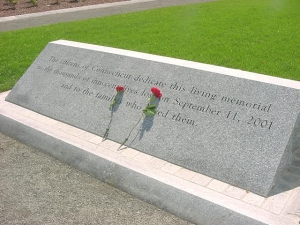
When the viewer faces the inscription on the state’s memorial stone they are oriented across the Sound to the site of the former World Trade Center in New York City, which had been visible from that scenic location. The inscription reads, "The citizens of Connecticut dedicate this living memorial to the thousands of innocent lives lost on September 11, 2001 and to the families who loved them."

9-11-Living-Memorial-2