Youth Face Substantial Challenges in Fairfield County, Report Reveals
/There are significant unmet needs among the children and youth of Fairfield County, with over 800 students dropping out of high school each year, 1 in 8 youth ages 16-24 unemployed and over 2,600 youth ages 16-19 neither employed nor in school, according to a new report by Connecticut Voices for Children. Youth well-being differs from town to town and city to city according to the report, commissioned by Fairfield County’s Community Foundation.
The outcome disparities “present a threat not only to the children, families and neighborhoods of Bridgeport, but also to Fairfield County,” the report concluded, noting that Bridgeport today educates as many students as Westport, Wilton, Weston, New Canaan, and Darien combined. The report indicates that Fairfield County’s future lives in its cities and depends very much on the success of its vulnerable children and youth.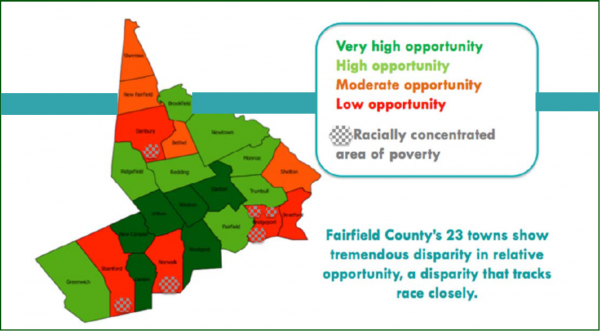
The purpose of the report is to inform and develop Fairfield County's Community Foundation’s Thrive by 25 Program, to help Fairfield County young people achieve self-sufficiency by age 25. The report points out that “Fairfield County’s 100,000 young people ages 16 to 24 face youth unemployment rates between 13.6 percent and 49.5 percent, one of the nation’s most expensive housing markets, and a shortage of living-wage entry jobs. When large numbers of young adults remain dependent on family or relocate for jobs, their futures are shortchanged and their communities decline.”
Looking across the towns of Fairfield County, large disparities in relative opportunity emerged in the study. Six “very high opportunity towns” stood out clearly among their peers, the report highlighted: Darien, Westport, New Canaan, Wilton, Weston, and Easton are among the wealthiest towns in the United States. Unsurprisingly, few children in those towns face the sort of barriers to opportunity children typically face in Bridgeport, Stratford, Norwalk, Stamford, and Danbury, the report said.
Five relatively “low opportunity towns” also stood out: on nearly every indicator they fell in the bottom third of Fairfield County’s 23 towns. “Even more disturbing,” the report emphasized, these “low opportunity towns” were home to racially concentrated areas of poverty: “not only is youth opportunity lower, but that lower opportunity affects mainly children of color,” the Voices report indicated.
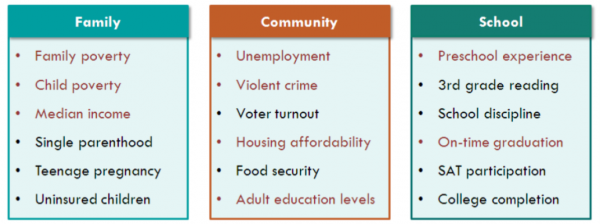
The 27 page report includes town-by-town breakdowns for each of Fairfield County’s 23 municipalities, including breakdowns of specific data for 20 distinct factors in the areas of Family, Community and School. The assessment includes the percentage of the population that includes families in poverty, unemployment, housing unaffordability, preschool experience, median income and on-time graduation from high school.
The report indicated that Danbury has the highest proportion of students learning English in Fairfield County (21 percent), and a rate of student arrest twice that of Bridgeport, Norwalk and Stamford. Over one-third of Danbury children live in households with income below 200 percent of the poverty level, which is $47,700 for a family of four. Among the other data revealed in the report:
- Bridgeport is the city in Fairfield County with the greatest need, with over 1,100 disconnected youth 400 annual high school dropouts and a youth unemployment rate of 17 percent.
- Shelton (13%) and Wilton (17%) have exceptionally high rate of chronic absenteeism – on par with cities like Norwalk (12%) and Stamford (15%).
- Redding performs exceptionally low on housing affordability compared to other high opportunity towns, with almost half of housing unaffordable (45 percent).
- Stamford’s teenage pregnancy rate (3 percent of total births) is lower than in many suburban towns.
The comparison between Bridgeport’s youth and their counterparts in Westport is striking. Bridgeport educates a student population of which nearly 40 percent never attended preschool and almost 80 percent of third graders failed to score proficient in reading, drawing from a property tax base less than one-sixth the size per pupil of Westport. In Westport, barely 5 percent of students miss preschool and only 17 percent of third graders fail to score proficient in reading. While over 400 students drop out of Bridgeport high schools each year and only 18 percent of Bridgeport students complete college within six years, Westport reports only 4 high school drop-outs per year and a 71 percent college completion rate.
 Connecticut Voices for Children is a research-based think tank that focuses on issues that affect child well-being, from educational opportunity to healthy child development to family economic security. Its mission is to ensure that all of Connecticut’s children have the opportunity to achieve their full potential.
To assess specific obstacles to youth opportunity in Fairfield County and to prepare the way for new solutions, Connecticut Voices for Children constructed a Youth Opportunity Index containing over two-dozen indicators from the U.S. Census Bureau, State Department of Education, Federal Bureau of Investigation, and others. Guided by existing research, the researchers, including Ellen Shemitz, J.D., Nicholas Defiesta, and Wade Gibson, J.D., compiled family, community, and school indicators for every town in Fairfield County.
The study also assessed three measures of the number of disconnected youth in each town: the annual number of high school dropouts, the number of youth, ages 16-19 neither employed nor in school, and youth unemployment (ages 16-24). For each indicator, they assessed towns’ standing relative to one another. They then looked across indicators and assessed how each town stacked up relative to others in Fairfield County. In addition, Fairfield County as a whole was compared with the broader State of Connecticut.







 In 2015, just over a dozen participating schools in Connecticut included North St School (Windsor Locks), Broadview Middle School (Danbury), Eastern Middle School (Greenwich), O.H. Platt High School (Meriden), Fairfield Woods Middle School (Fairfield), Washington Middle (Meriden), Northeast (Stamford), Schaghticoke Middle School (Warren), King Street Intermediate School (Danbury), Dag Hammarskjold Middle School (Wallingford), Orville H. Platt High School (Meriden ), Avon Middle (Avon), and Moran Middle School (Wallingford).

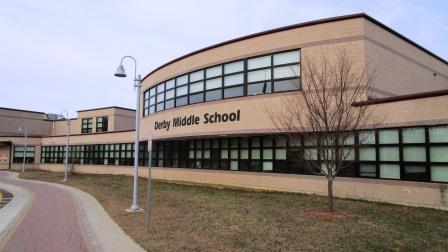 h a cranial facial syndrome and was socially isolated during her middle school years, the organization’s website explains. After Lili died at the age of 15 due to medical complications from her syndrome, a group of teens from the local community banded together to bring change to their local schools. They had not realized that they had been leaving Lili out from all the fun social get-togethers. Upon hearing about Lili's feelings of being left out, they were determined to never let anyone feel that way again. The initiative was born.



 The most recent fee data available from 2-1-1 Child Care estimates the statewide average cost of full-time child care in a licensed center-based day care setting is $211/week for 1 preschooler and $253/week for an infant, which adds up to $2,011 per month. This may be less than what many Connecticut families pay for child care each month, due to variations in cost and availability throughout the state, differences in family size, and other costs associated with child care that are not included—such as the cost of alternate care arrangements when the child care setting is closed


 The Center’s study found that over the past year, as states have started to restore funding for public higher education, tuition hikes have been much smaller than in recent years. Just seven states -- Louisiana, Colorado, Connecticut, Hawaii, Kansas, Virginia, and Mississippi -- raised tuition by more than $300, after inflation.