New Casey Foundation Initiative Aims to Improve Job Prospects for Young Adults in Hartford
/A total of up to $900,000 will be awarded over the next four years to a Hartford collaborative initiative to strengthen the next generation of workers and meet employer demand. The Annie E. Casey Foundation has announced plans to award $6 million in grants to increase job opportunities for young adults from low income families in Hartford and four other communities - Cleveland, Indianapolis, Philadelphia, and Seattle.
Hartford expects to receive up to $900,000 over the grant period for planning and implementation.
Through Generation Work, the Foundation aims to combine building relationships with businesses, factoring in their needs in the local economy, with youth development strategies to prepare young people for work, such as mentoring and on-the-job learning opportunities. Ultimately, the Casey Foundation hopes to help establish local networks of workforce development organizations that serve young job seekers and have strong connections with businesses.
The Hartford Generation Work initiative is led by United Way of Central and Northeastern Connecticut, working with five other community partners:
- Capital Workforce Partners,
- Hartford Foundation for Public Giving,
- Hartford Opportunity Youth Collaborative,
- Our Piece of the Pie, and
- Workforce Solutions Collaborative of Metro Hartford.
Hartford’s initiative will connect young adults, including those out-of-school or work or underemployed, with education, training and employment for careers in manufacturing and healthcare, officials said. The initiative also intends to improve coordination and collaboration among partners and youth initiatives.
“The strength of our future workforce is one of our nation’s greatest assets and is critical to our ability to compete globally,” said Allison Gerber, a senior associate who oversees the Casey Foundation’s investments in improving job opportunities for low-income individuals and families. “The next generation is eager to work, but we must create more avenues for young adults to develop the knowledge and experience they need to succeed in the job market.”
While the Great Recession hit many hard, teens and young adults have experienced the most drastic drop in employment, data show. Millions of young people — particularly young people of color, justice-system involved, or aging out of foster care and from low-income families — face obstacles to employment or education, and the percentage of young people ages 18 to 29 in the job market nationwide has steadily declined in recent years. At the same time, employers often struggle to find workers with the right set of skills for available positions, Foundation officials point out.



 The first TAP pathway—Biology—was approved by the Board of Regents last month, “after careful review by TAP's Framework Implementation and Review Committee (FIRC) and curriculum committees on all 17 CSCU campuses.” Additional pathways are slated to be determined beginning next month, with a total of 11 initially to be selected. Possible subject areas include history, chemistry, communication, criminology, English, math, political science, psychology, social work and sociology, according to the state Board of Regents
 The study also found that “the student demographics at community colleges appear to matter less than how the colleges serve students aiming to transfer. Regardless of whether they are rural or urban, or serving mostly lower or higher income students, community colleges can boost the transfer success of their students by looking to better performing schools to inform their practices.”


 Since entering the Connecticut market in the summer of 2014, the company has been aggressively growing its customer base in a competitive market while working diligently to grow and expand its network of doctors. Harvard Pilgrim Health Care announced recently that its Connecticut membership has grown to more than 24,000, exceeding expectations for 2015. It now serves more than 800 Connecticut businesses. Twenty-nine of the state’s 30 hospitals are now in-network.
 With more than 500 business leaders in attendance at an annual Economic Summit & Outlook last week, brought together by the Connecticut Business and Industry Association and MetroHartford Alliance, Schmitt spent some time touting a new model launched in the state of New Hampshire that he believes may be a glimpse into the direction the industry is moving. Harvard Pilgrim Health Care’s footprint in New England now covers “where 90 percent of New Englanders live,” in Massachusetts, Connecticut, Maine and New Hampshire.
 Launched

 nd compliance efforts, earned 3 points out of 4 for its combined heat and power policies and programs, 5.5 out of 7 points for state-led energy efficiency initiatives, and 1 point out of 2 for appliance standards.
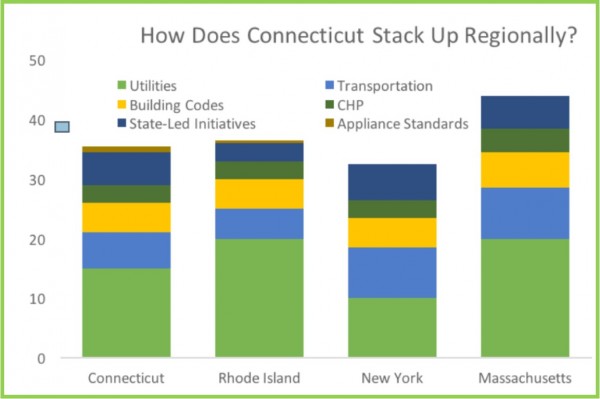 olar power in Connecticut has grown 221 percent per Capita since 2012, ranking the state 13th in the nation, the report points out. The top solar growth states in the nation, like Connecticut, have adopted renewable energy requirements, strong laws allowing solar customers to sell their excess power to the electric grid, and other policies encouraging growth of the industry, the report indicates. The industry is also adding jobs much faster than the overall economy, employing 1,600 people in Connecticut last year, according to
  ."
."
 Diane Brown is branch manager of the New Haven Free Public Library’s Stetson Branch. Known as the “urban librarian” to her patrons, Brown develops valuable programs and services to meet the needs of the underserved residents in a community with high rates of poverty, crime and low literacy levels. Under Brown’s leadership, the library has been transformed into a true community center. She brings residents together by hosting cultural and educational events such as an international “pop up” festival, art exhibits, lectures and health fairs, according to officials. She has been praised for facilitating an afterschool tutoring program for K-8 students and providing opportunities for children and their families to spend time together by establishing history and game nights.
 Elizabeth G. Rumery, library director for the Avery Point Campus Library at the University of Connecticut in Groton, has “transformed the library into a welcoming and dynamic place for students by modernizing the facility to meet the needs of 21st century learners.” Officials indicate that she worked with contractors and school administrators on renovating the library, with improvements including new media rooms and collaborative study spaces for students and faculty.
 The librarians join “an esteemed group of award recipients who are recognized as being catalysts for powerful individual and community change.” Only 80 librarians have received the national award since its inception in 2008, including six from Connecticut. In 2012, the recipients were Rachel Hyland, Tunxis Community College Library in Farmington, and Rae Anne Locke, Saugatuck Elementary "Secret Garden" Library in Westport. The 2011 winners included Jennifer O. Keohane, The Simsbury Public Library and Michelle Luhtala, New Canaan High School Library.
 The news came just weeks after it was announced that Laurencin is the recipient of the 2016 Founders Award, the highest honor of The Society For Biomaterials. He will be honored at the 2016 World Biomaterials Congress in Montreal, Canada on May 18, 2016.


 This summer, Shemitz was among those appointed to serve on the state’s Commission on Economic Competitiveness, created by the legislature amidst concerns in the state’s business community about the perceived lack of competitiveness. The Commission is considering steps to improve Connecticut’s employment and business climate including measures to support workforce development and family and economic security. Recommendations are anticipated for legislative action next year.