

Early Childhood Education Earns Strong Support in Both Political Parties, Poll Finds
/As the national political conventions get underway, advocates of early childhood education are pointing to the results of a new national poll to underscore widespread support that transcends political party. In the midst of a polarizing election cycle, 90 percent of voters – including 78 percent of Trump supporters and 97 percent of Clinton supporters – agree that Congress and the next president must make quality early childhood education more accessible and affordable to low- and middle-income families, according to the national survey.
The survey, conducted for the advocacy organization First Five Years, found that by a three-to-one margin, voters prefer the next president be someone who focuses on solutions to the country’s problems, and they’ve identified investment in early childhood education as an important solution.
Key voter groups want the federal government to help states and local communities improve access to quality early childhood education – incuding 85 percent of Hispanics, 79 percent of suburban women, 65 percent of moderate/liberal Republicans, and 58 percent of Republican women, according to the poll released by First Five Years Fund (FFYF).
“Early childhood education isn’t a partisan issue, and the poll demonstrates that Americans of all political stripes are united in their demands to make quality early childhood education more accessible and affordable,” said Kris Perry, Executive Director of the First Five Years Fund. “Candidates looking to connect with voters should be hearing loud and clear that Americans see a need for quality early learning, ranking it a top priority alongside education broadly and good-paying jobs.”
At Connecticut Voices for Children, a highly regarded research and advocacy organization in Connecticut, officials agreed that “early childhood is an issue where Democrats and Republicans can find common ground, where all candidates must devote time and attention, and ultimately where they should invest in the health and well-being of young children, families and the economy.”
In the national poll, over two-thirds of respondents believe children do not start kindergarten with the knowledge and skills they need, driven in part by a lack of affordable and successful early childhood education programs. Americans also want to rethink our education priorities, with the majority calling for more or equal investment in early education over college.
The poll also found that voters want America’s leaders to prioritize early education: 72 percent say that ages one to five are the most important for learning. In addition, a majority of Republicans, Democrats, and Independents want to invest in multiple education opportunities, including home visiting, early learning programs, and preschool services.
The poll was commissioned by the First Five Years Fund in conjunction with a bipartisan polling team of Public Opinion Strategies (R) and Hart Research (D). The sample was distributed proportionately throughout the country and is demographically representative of the electorate.
According to First Five Years, “Early childhood education for low-income children is one of the best ways to promote upward mobility that pays off for individuals and society. Every child needs effective early childhood education and development from birth to age five; research shows that low-income children are the least likely to get it. Those who experience quality early care and learning have better education, health, social and economic outcomes in life-increasing their productivity and reducing the need for spending later on.”
 Connecticut Voices for Children Executive Director Ellen Shemitz said the poll results indicate that there are potentially great rewards for leaders to work on this issue, and not many penalties. In addition, the results show the public’s willingness to devote money to this issue, and that people are looking to their elected leaders to make these investments, Shemitz pointed out.
Regarding Connecticut’s efforts to encourage and support early childhood education, officials at Connecticut Voices point out that “while we do invest in early childhood care and education more than many states, there is room for improvement to ensure both program quality and program access for children and families who need high-quality programming.”
The Connecticut Office of Early Childhood, established in 2014, recently urged public schools to focus on the attendance of kindergarten students, citing the importance of early childhood education for later academic success.
The Office’s website indicated that “study after study confirms the value of high-quality early childhood education for developing the cognitive, social and emotional skills that children need to succeed in kindergarten. But unless children attend these programs on a regular basis, they are not likely to benefit fully.”
 The site pointed out that “unless we pay attention to attendance even among young children, we are missing the opportunity to use early educational experiences to build an essential skill: showing up on time, every day to school. A growing body of research and practitioner experience shows that paying attention to attendance for our youngest children is essential.
According to the Early Childhood website, “studies have found that children who are chronically absent in preschool are five times more likely to miss more days of kindergarten. For the 2014-15 school year, 12 percent of CT’s kindergarteners were chronically absent, that is almost 550 kindergarteners who were regularly not in school. Additionally, children who are chronically absent in kindergarten and first grade are likely to have poor attendance 5 years later.”
Last month, Connecticut Early Childhood Commissioner Dr. Myra Jones-Taylor testified before the U.S. Senate Health, Education, Labor and Pensions Committee, urging Congress to allocate additional federal dollars to states for implementing key policy changes, first approved in 2014, to child care programs.
The Commissioner testified that the focus on quality, continuity of care, and basic health and safety are long overdue – and that focus should be celebrated. She pointed out, however, that the challenge for Connecticut and many other states is that the changes significantly increase the annual cost of care per child.


 Participating schools will be encouraged to take innovative approaches to teaching civics in the classroom and to consider involving extracurricular activities that promote civic and community engagement.


 Describing Hartford’s prominent manufacturing history, Hinz said “Hartford, CT, is a classic story in the history of American technology. If you have ever wondered why people refer to “Yankee ingenuity,” this is what they are talking about.” He adds, “In the mid and late 1800s, the United States overtakes Great Britain as the world’s foremost economic superpower, largely on the strength of its prowess in inventing and manufacturing new technologies. Hartford is at the center of that revolution.”
 The exhibit notes that by the 1850’s “Hartford became the center of production for a wide array of products—including firearms by Colt, Richard Gatling and John Browning; Weed sewing machines; Royal and Underwood typewriters; Columbia bicycles; and even Pope automobiles.”

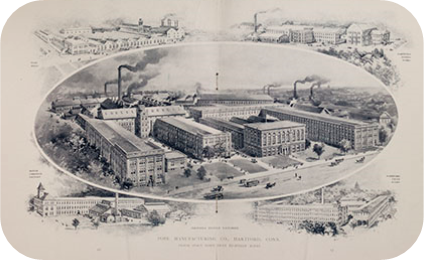 rode his high-wheeler from the station down Capitol Avenue to the Weed Sewing Machine Company.’”
 Jeanne Manzelli, a resident of Windsor, has a
 BFA in Sculpture from the Massachusetts College of Art and her MED in Art Education from the University of Massachusetts, Amherst. Her experience includes a 20 year career in design, manufacture, appraisal and sale of jewelry, two decades as mural artist working closely with interior designers as an industry professional, and 14 years teaching basic and advanced drawing, sculpture and 3D design as well as color theory at Tunxis Community College.




 A recent report in Business Insider indicated that one in three new businesses in the U.S. were started by an entrepreneur age 50 or older. Describing “running a business as the new retirement,” the news report cited an infographic in easylifecover that highlighted those aged 55-64 in the U.S. have actually had the highest rate of entrepreneurial activity in the last 10 years, noting that the founders of McDonald's, Coca Cola, and Kentucky Fried Chicken – among others - were all over 50 when they established their businesses.
 The interactive “Boot Camp” event at reSET – open to people of all ages with a special focus on the 50 and over –included short presentations from local resource organizations, networking opportunities and valuable information on the programs and tools available to potential business owners. Attendees were updated on the necessary steps and tools to launch a business, and had opportunities to talk one-on-one with local mentoring organizations, lenders, small business advisors and community leaders for advice and assistance.
 hand at the reSET event in mid-June were representatives of the Office of Secretary of State (where new businesses are registered),
 reSET serves all entrepreneurs, but specializes in social enterprise ― impact driven business with a double and sometimes triple bottom line. In addition to providing co-working space and accelerator and mentoring programs, reSET aims to inspire innovation and community collaboration, and to support entrepreneurs in creating market-based solutions to community challenges. The organization’s goal is to “meet entrepreneurs wherever they are in their trajectory and to help them take their businesses to the next level.”

 In recent years, the Connecticut program, coordinated by Connecticut’s Old State House with support from Connecticut Humanities, has grow in numbers and in the quality of the students’ work, organizers point out. This year, Connecticut History Day had 10,600 points of contact with Connecticut students, teachers, parents and history professionals, including workshops for 4,500 students—twice last year’s number.



 Lewis’ commitment and dedication impressed the judging panel.


 xpert guest lecturers from Connecticut companies will speak regarding subjects and crafts not included in the general curriculum. Officials indicate that upon successful completion of the DMCT, trainees will have completed a portfolio worthy project consistent with their selected track and representative of their work and learning. They will also receive a certificate of completion from the Connecticut Office of Film, Television & Digital Media for their selected track.
 The state’s Office of Film, Television and Digital Media supports and enhances Connecticut’s film, television and digital media industry. The film office is the statewide contact for motion picture, television and digital media production and serves as liaison between production companies, state agencies, municipalities, production facilities, local crew and vendors. The Office also administers the tax credit programs designed to incentivize the development of the industry here in Connecticut.


 To qualify for the Best Communities designation, school districts provided detailed information about funding, graduation requirements, music class participation, instruction time, facilities, support for the music program, and community music-making programs.





















