
Blockchain Gains a Foothold on Connecticut Campuses
/Blockchain is soon to arrive on Connecticut’s college campuses, with new initiatives imminent at Southern Connecticut State University, University of Saint Joseph, and the University of Connecticut’s Stamford campus.
A six-week boot camp for individuals who would like to widen their computer programming skills to include Blockchain – a cutting-edge form of encryption technology – has been developed at Southern Connecticut State University in New Haven. The SCSU Blockchain Academy launches on January 23 and runs though March 6.
Blockchain refers to the technology behind the development of secure digital databases that are accessible to the public, but cannot be altered by anyone other than the person posting the data. It is a shared, distributed ledger that improves the process of tracking and recording a transaction. Blockchain can be used for a variety of purposes, including financial transactions, supply chain management, luxury goods or anything of value. Bitcoin and other cryptocurrencies use this technology.
“Southern intends to become a leader in educating people about the ‘Internet of Value,’ which is the fastest growing market the world has ever seen,” said Colleen Bielitz, SCSU associate vice president for strategic initiatives and outreach. A promotional video posted by Southern (below) has already been seen more than one thousand times.
“Blockchain is going to be increasingly important to businesses, and during the next decade is expected to have a major impact on the economy and the world. The goal of this academy is to grow the community of decentralized application developers and to make New Haven a hub for Blockchain technology and innovation as companies look to take advantage of this growing market.”
 The University of Saint Joseph (USJ) announced last week that it has developed the Greater Hartford area’s first two-part certification program for future blockchain technologist, in collaboration with DappDevs, which is also collaborating with Southern and UConn.
President Rhona Free, Ph.D., remarked, “With this certificate program, USJ continues its commitment to providing educational programs aligned to our regional economy. The Greater Hartford community will benefit from this newly-created training program that offers skill development and career advancement in blockchain application development.”
The USJ pre-certificate program geared toward faculty, current college students, and college graduates in the Greater Hartford region, begins on Feb. 2, 2019, and runs over four weeks as one three-hour evening session per week. The full certification program is a six-week session that runs from March 5-April 11, as two three-hour sessions per week.
UConn’s Connecticut Information Technology Institute (CITI) is sponsoring the creation of a blockchain chapter in Stamford in order to facilitate the development of an education-based micro community designed to connect decentralized application developers. This community, in hand with Stamford’s established financial enterprises, will play a key role in further establishing Connecticut as a USA crypto capital, according to the university’s website. UConn is offering a two-day Blockchain Development course, with its partners, DappDevs and the Werth Institute.
UConn’s first-ever blockchain symposium was held in Stamford in August. The conference drew top scholars and Ph.D. students Stanford, Princeton, Virginia Tech, and from 10 nations, including England, Israel, Switzerland, China and Norway. State-run news agencies from Vietnam and China also covered the two-day event, called “Blockchain Technology & Organizations Research Symposium.”
These initiatives reflect that blockchain is increasingly taking academia by storm, not only in Connecticut but across the nation. This past summer Columbia University and Stanford University both launched blockchain research centers, following in the footsteps of the Massachusetts Institute of Technology's Digital Currency Initiative, which launched as part of the MIT Media Lab in 2015; MIT was among the first institutions to create such a program, according to industry publication Inside Higher Ed.
The Center for Blockchain Research at Stanford University launched in June. Miami University launches a course in blockchain technology for undergraduates in the Spring 2019 semester. Montclair State University’s center for continuing and professional education recently spearheaded the launch of three professional blockchain certificates -- one covering the basics, one for developers and one focusing on applications of blockchain in the financial sector.
https://youtu.be/_8X_wr1tCNI



 “Girl Scouts is one of our nation’s most powerful leadership training grounds for young women,” said Openshaw. “We’re thrilled to support Girl Scouts as it seeks to modernize and remain relevant for young women in the new global economy.”
 t have increased as much in comparison to other states, but isn’t the real question, ‘Why is it increasing at all?’” Luis Perez, president and CEO of
 The analysis, by the financial services website WalletHub, was based on 40 key indicators of livability, ranging from housing costs to school-system quality to restaurants per capita. The indicators were grouped into five categories – affordability, economic health, education & health, safety, and quality of life.



 The comprehensive assessment of Hartford’s ecosystem also noted that “Hartford’s [startup] founders claim to have the right ambition to go global,” concluding that “Hartford’s startups have more potential to strengthen Global Market Reach and Global Connectedness.” In a number of areas analyzed in the assessment, Hartford is seen as having potential to strengthen the local startup community, its reach beyond Hartford, and the demographic of startup teams.

 The 40-page report, developed by The Child Health and Development Institute of Connecticut (CHDI), a subsidiary of the Children’s Fund of Connecticut, in partnership with the national Center for School Mental Health at the University of Maryland, provides a framework for policymakers and school districts interested in improving outcomes by addressing the mental health and trauma needs of students. The report indicates that “in a typical classroom of 25 students, approximately five will meet criteria for a mental health disorder but most of them are not receiving appropriate mental health treatment or support. Among those who do access care, approximately 70 percent receive services through their schools.”
 “Approaching student mental health with a comprehensive lens that integrates health promotion, prevention, early intervention, and more intensive treatments leads to better school, student and community outcomes," said Dr. Sharon Hoover, Co-Director of the Center for School Mental Health at the University of Maryland and lead author of the report.



 The


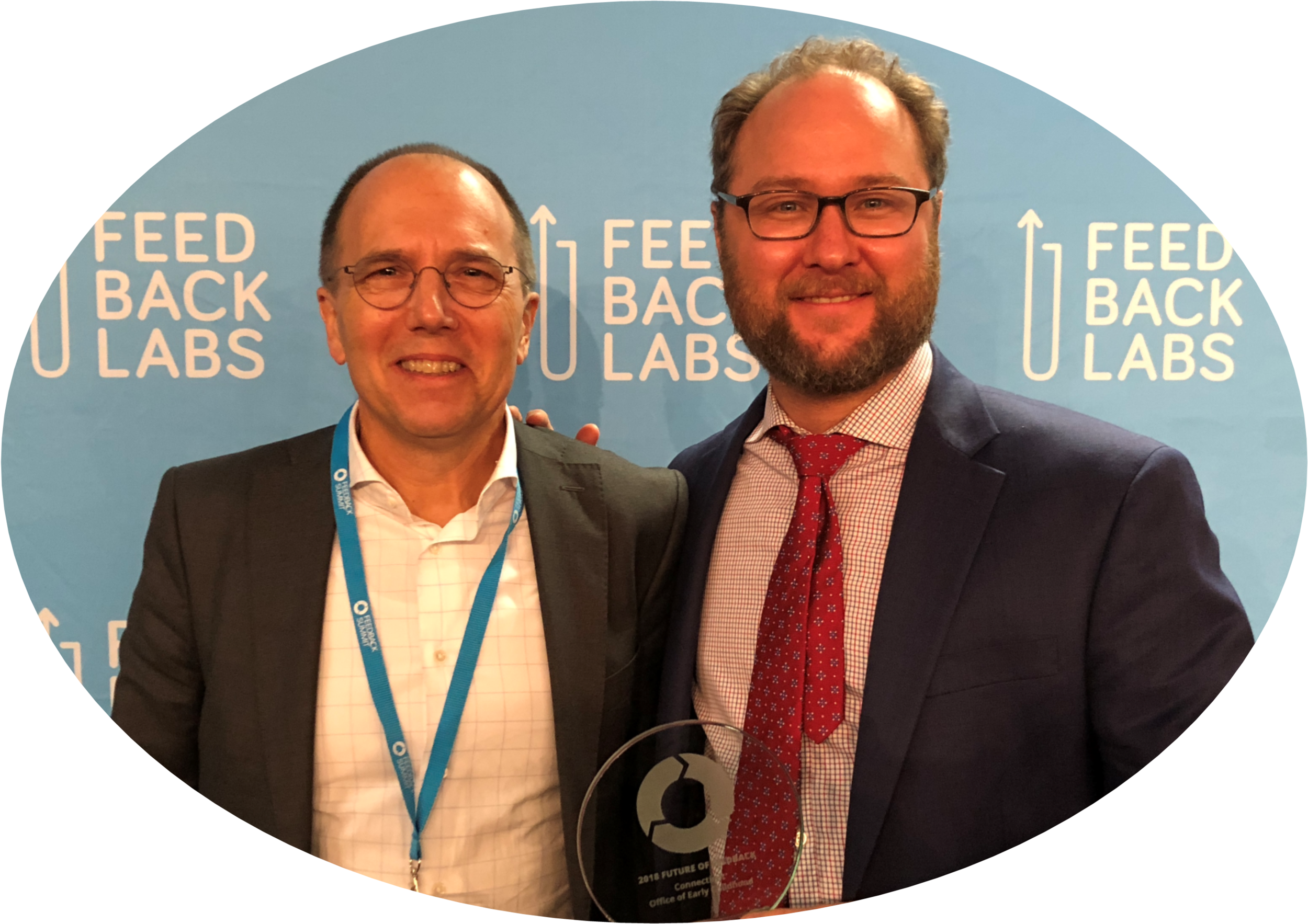 Among the 10 largest state agencies in Connecticut, OEC’s goal is to keep the state’s children safe, healthy, learning and thriving. Through its innovative feedback efforts, the agency is acting on evidence that engaging providers and parents in policymaking yields better results. Officials said that the agency combined data from 1,700 family surveys, another survey shared with all providers in the state, and 400 community and provider meetings in order to build a draft plan to transform the ECE system in the state, which serves 200,000 children.