CT is a Top-10 State in Energy Efficiency, Recent Growth of Solar Power Capacity
/An annual ranking from the American Council for an Energy-Efficient Economy (ACEEE) rated Connecticut among the top ten energy-efficient states in the country along with Massachusetts, California, Vermont, Rhode Island, Oregon, Maryland, Washington, and New York, with Minnesota and Illinois tied for 10th place.
Connecticut was noted for its financial incentives and energy efficiency investments. The state ranked 6th in the 2015 State Energy Efficiency Scorecard, the same position it held in 2014. The state also earned the same number of points as it did in 2014, totaling 35.5 points out of 50.
According to the report, “Connecticut’s leadership is committed to pursuing policies that encourage energy efficiency within the state, although processes like building code adoption have moved relatively slowly in recent years. Connecticut has put significant resources behind the launching of its green bank. While there are signs of early success, these projects will need to be closely tracked as other states look to Connecticut as an example. Connecticut will need to realize even higher levels of savings in the future in order to remain in the top tier and meet state energy savings targets.”
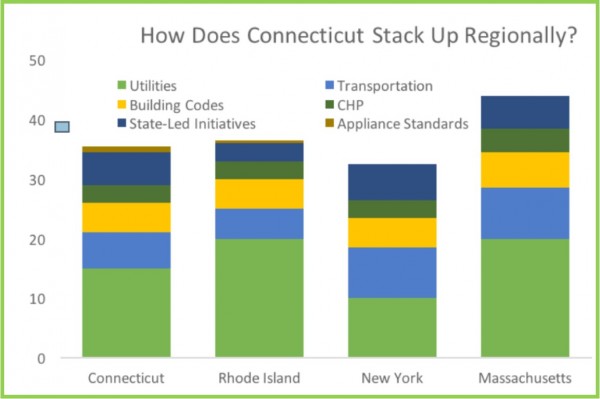
Connecticut earned 15 out of 20 points for its utility policies and programs, 6 points out of a possible 10 points for transportation policies, 5 points out of 7 for its building energy code stringency a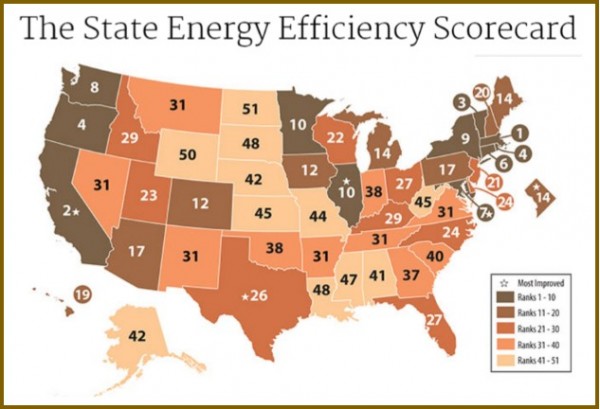 nd compliance efforts, earned 3 points out of 4 for its combined heat and power policies and programs, 5.5 out of 7 points for state-led energy efficiency initiatives, and 1 point out of 2 for appliance standards.
At the bottom of the list were Mississippi, South Dakota, Louisiana, Wyoming and North Dakota.
The ACEEE also developed a similar rating system for the nation’s largest cities, ranking the top 50. Leading the list were Boston, New York City, Washington, San Francisco, Seattle, Chicago, Minneapolis, Portland, Austin and Denver. The only Connecticut city to crack the top 50, Hartford, ranked at number 45. Connecticut’s Capitol City earned 23 points out of a possible 100, in an analysis that included local government operations, community-wide initiatives, building policies, energy & water utilities, and transportation.
The report noted that “policymakers, regulators, and citizens are increasingly recognizing that energy efficiency is a crucially important resource. States and localities are leading the way when it comes to implementing energy-efficient policies and programs.”
The American Council for an Energy-Efficient Economy (ACEEE), a nonprofit, 501(c)(3) organization, acts as a catalyst to advance energy efficiency policies, programs, technologies, investments, and behaviors. The organization believes that “the United States can harness the full potential of energy efficiency to achieve greater economic prosperity, energy security, and environmental protection for all its people.”
Another recent study, “Lighting the Way III: The Top States that Helped Drive America’s Solar Energy Boom in 2014,” by the research and policy arm of Environment Connecticut finds Connecticut ranks 10th nationally for solar power capacity per capita installed in 2014, with 13 watts of solar electric capacity per person installed last year. Nevada led all of the states in 2014, with 119 watts per capita, according to the study. Part of this success is credited to supportive state policymaking. The organization points out that “solar power has tripled in the U.S. in the last two years, with another American family or business going solar every four minutes. That’s in part because the price of solar has dropped more than 50 percent since 2011.”
They add that “research shows the cities and states with the most solar power aren’t necessarily the ones with the most sunshine; they also include states with smart pro-solar policies. States like Connecticut have outpaced sunnier locales like Florida because of policies that allow increasing numbers of homeowners, businesses, communities and utilities to go solar.”
 olar power in Connecticut has grown 221 percent per Capita since 2012, ranking the state 13th in the nation, the report points out. The top solar growth states in the nation, like Connecticut, have adopted renewable energy requirements, strong laws allowing solar customers to sell their excess power to the electric grid, and other policies encouraging growth of the industry, the report indicates. The industry is also adding jobs much faster than the overall economy, employing 1,600 people in Connecticut last year, according to www.solarstates.org
“Demand for solar power in Connecticut is growing exponentially,” said Bryan Garcia, President and CEO of the Connecticut Green Bank. “Consumers continue to demand solar power despite a 70 percent reduction in state incentives. In fact, increased private investment has enabled the market to offer lease and loan products that deliver immediate positive cash flow to consumers. This makes solar PV a cleaner, cheaper and more reliable alternative ."
."
Bipartisan legislation signed by Governor Malloy earlier this year lays a foundation for continued growth of solar power, and jobs, in Connecticut, Environment Connecticut points out, citing the stated goal of building enough residential solar systems to power over 40,000 homes in the state by 2022.


 The
The  Plans for the new Academic Science & Laboratory Building at Southern began back in 2007 with a comprehensive 10-year capital improvement plan, dubbed CSUS 2020, for upgrading the four institutions of the Connecticut State University System. Approved by the state legislature and signed into law by Gov. M. Jodi Rell, the plan was developed during the administration of Chancellor David G. Carter. It included upgrades and repairs to existing facilities, as well as construction of a new Visual & Performing Arts Center at Western Connecticut State University, which
 In
In 
 sustainable lifestyle beverate brand for teens and tweens. The company's goal is to inspire young people to realize the power of consumer choices to effect social and environmental change.
 The five awards judges - Sherrell Dorsey of Uber and Triple Pundit, Adam Dotson of Ironwood Capital, Claire Leonardi, an advisor to reSET's Social Enterprise Investment Fund and former CEO of Connnecticut Innovations, Anthony Price of LootScout and Paul Witinski of Ironwood Capital - narrowed down more than 100 applicants to 12 honorees. The People’s Choice winner was selected via more than 1,800 online votes.
 “I would like to congratulate all of the members of Stamford 2030 for joining together to make vital changes for our community," said Stamford Mayor David Martin. "The partners in Stamford 2030 have really stepped up for the success and sustainability of our city and the surrounding area. And they are not alone. For our part, the city is committed to improving storm resiliency and moving forward with the Energy Improvement District. We believe these efforts are tied to our economic development and ability to attract people to Stamford while conserving important natural resources, all necessary for sustained growth and prosperity.”






 A similar statewide mattress recycling program was adopted by the Rhode Island legislature in 2013 and is due to launch in 2016. To participate,

 Later this month, Bike Walk CT is offering the League of American Bicyclist-designed Traffic Skills 101 program, a comprehensive day long course to give cyclists the skills, knowledge and confidence to handle on-road cycling.
 For the first time in the history of the awards program, a state agency was also selected to receive an award. The CT Department of Transportation received a special award for Starting a Revolution: Integration of Land Use and Transit in recognition of the progressive nature of CTfastrak, the bus rapid transit system opened earlier this year. The awards jury that selected the winners gave the award because they felt the new busway represents a cultural shift in how Connecticut views transit, and wanted to acknowledge the future promise of transit oriented development that will hopefully result around the station locations.



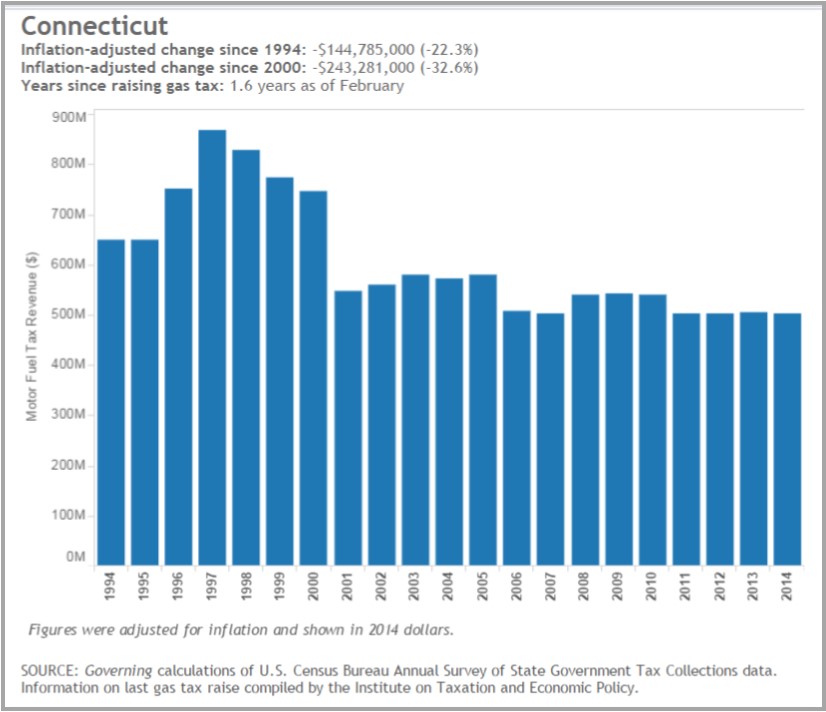 In Connecticut, the inflation-adjusted change is a reduction of in the value of the dollars provided by the tax of 32.6 percent since 2000 and 22.3 percent since 1994, according to the Governing analysis, using data from the U.S. Census Bureau and the Institute on Taxation and Economic Policy. Earlier this year, Governor Malloy announced a two-part transportation plan consisting of a