New Interactive Tool Brings Focus to Cuts in State Funding of Children's Programs
/If a picture is worth a thousand words, the impact of a series of interactive data visualization graphs must be, well, off the charts. For Connecticut Voices for Children, the new online, interactive visualization tool has been designed to help the public and policymakers see how funding for children's programming in Connecticut has fallen through the years. Coming on the brink of a new legislative session and an ever-tightening state budget, the hope is that more widespread understanding of past trends will forestall further cuts.
 The new interactive tool, on the Connecticut Voices for Children website, enables visitors to track spending across nearly 100 children’s programs over 25 years. Over the last two decades, spending on children’s programs has declined from 40% to 30% of the state budget, according to the advocacy organization. Had the state not changed its budgeting priorities, it would have invested about $1.5 billion more each year in children’s programs—enough, for instance, to be the first state to implement a universal early care and education system, Voices points out.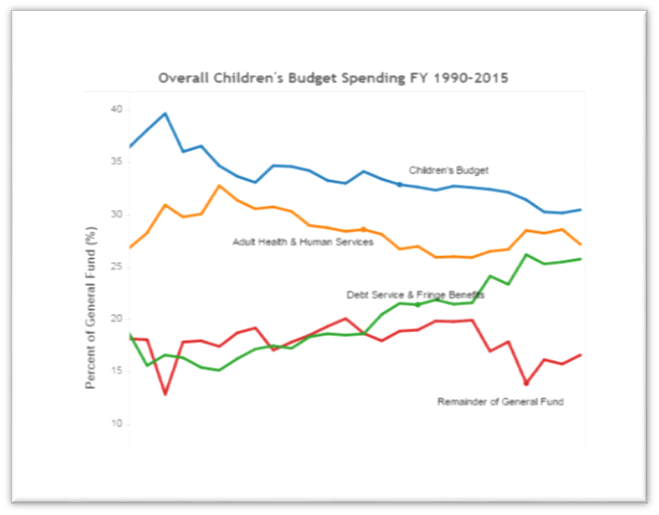
The new interactive tool, created by Connecticut Voices for Children, enables users to create their own graphs of state budget trends and then embed the charts in social media, blog posts, news articles, and reports. Users, for instance, can compare the dip in state support for K-12 education to the even steeper drop in support for higher education.
Detailed budget visualizations for Fiscal Years 1990 through 2015 are available for the following areas:
- The overall Children's Budget (at right)
- Early Care and Education
- K-12 Education investments
- Children's Health and Human Services
- Debt and Fringe Benefits
In producing this resource, Connecticut Voices for Children seeks to draw attention to what they describe as "Connecticut’s long-term disinvestment in young people – a trend that is particularly troubling in a state with an aging and shrinking workforce that will result in an increasing demand for well educated, career ready young adults."
Regarding K-12 education, for example, the website points out "K-12 Education has declined substantially as a share of the General Fund since the early 1990s, from about one fifth to one seventh in the most recent budget. This decline is seen most clearly in Educational Equalization Grants, the state's main contribution to local school districts. State support for K-12 education in Connecticut is among the lowest of any state in the union. In Connecticut, we leave the large majority of education expenses up to towns, which have no major revenue source except the property tax, thus contributing to the state's high and inequitable property taxes."
The information used in creating the graphs is official appropriations data from the Connecticut legislature's non-partisan Office of Fiscal Analysis.
Connecticut Voices for Children's mission is to promote the well-being of all of Connecticut's children and families by identifying and advocating for strategic public investments and wise public policies. Connecticut Voices advances its mission through high quality research and analysis, policy development, strategic communications, and establishment of a sustainable and powerful voice for children.
 nt and work closely with stakeholders in developing the conference, viewed as “an opportunity to look ahead to the issues that will help shape the landscape for older Americans for the next decade.”

 “Many preliminary competition events would need to take place outside of the main Olympic Park areas so events may occur as far away as Connecticut. This also is an opportunity for more people to get involved with the Olympic Spirit,” Garcia adds.


 An Olympic games in Boston would utilize existing sports venues of both professional teams and area colleges, which could reduce potential costs. Infrastructure improvements, such as in transportation, are already on the drawing board, and could accelerate with a Boston bid.



 epartment of State. He also writes foreign policy columns for the Boston Globe and Global Post and is a noted lecturer on U.S. foreign policy.
 nt George H.W. Bush to the National Security Council, a post he held until 1995, bridging the administrations of Bush and President Bill Clinton.
 “There was another exchange about the recent release of Mrs. Belaga's joint tax return, which showed that she and her husband, Myron, paid $110 in Federal income taxes last year because of losses incurred by an investment business being started by her husband. The couple reported total assets of $1.4 million.


 d met Ms. Toyen, who grew up in Avon, Connecticut, at their alma mater, Bentley College in Waltham, Mass., and had managed to pull off an elaborate proposal.
 .
.