CT is 5th Healthiest State in USA; MA Ranks 1st, New Data Shows

Connecticut is the fifth healthiest state in the nation, dropping from third a year ago, but remaining in the nation’s top 10, where it has been every year since 1993. Massachusetts, Hawaii, Vermont, Utah and Connecticut rank as the five healthiest states, while West Virginia, Alabama, Arkansas, Louisiana and Mississippi rank the least healthy.

The United Health Foundation ranked America's states based on a variety of health factors, such as rates of infectious diseases, obesity, physical inactivity, smoking and infant mortality, as well as air pollution levels and the availability of health care providers. The survey has been conducted annually for 28 years.
America’s Health Rankings was built upon the World Health Organization definition of health:“Health is a state of complete physical, mental, and social well-being and not merely the absence of disease or infirmity.”
The model reflects that determinants of health directly influence health outcomes. A health outcomes category and four categories of health determinants are included in the model: behaviors, community & environment, policy and clinical care.

This is the first time Massachusetts has been named the healthiest state, ending Hawaii's five-year ranking at number one. Connecticut’s highest ranking was second, in both 2006 and 2008.

By category, Connecticut ranked fourth in Behaviors, fourth in Clinical Care, sixth in Policy, tenth in Health Outcomes and 15th in Community & Environment.  Connecticut had the third lowest levels of infectious disease, fourth lowest prevalence of smoking and ninth lowest levels of obesity.

The Bay State won the honor in part due to having the lowest percentage of uninsured residents at just 2.7% of the population, plus a low prevalence of obesity and a high number of mental health providers.  Rhode Island moved from 14th to 11th; New York from 13th to 10th

This latest report shows that the nation's health overall is getting worse.  The nation's premature death rate -- the number of years of potential life lost before age 75 -- increased 3% since 2015.  That increase is driven in part by drug deaths, which increased 7% during that time, and cardiovascular deaths, which went up 2%.  Overall, the United States ranks 27th in terms of life expectancy in a comparison of 35 countries, according to the report. Long-term challenges remain — including infant mortality and low birthweight. Cardiovascular deaths and drug deaths also increased.

Connecticut’s strengths, according to the report, include the state’s low prevalence of smoking, low violent crime rate and low percentage of uninsured people.  The state’s greatest challenges include a high drug death rate, high levels of air pollution and a large disparity in health status by educational attainment.

The report also identified the following highlights:

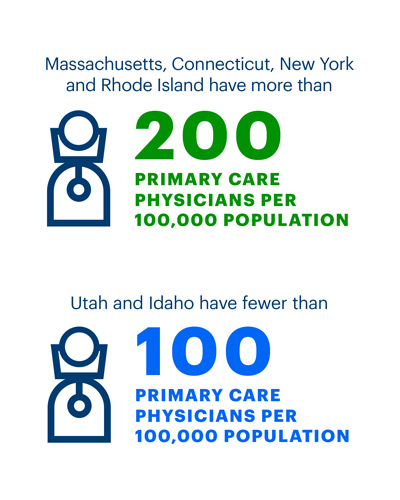
  • In the past year, primary care physicians increased 6%, from 197.8 to 209.4 per 100,000 population
  • In the past two years, children in poverty increased 33%, from 12.3% to 16.3% of children
  • In the past five years, cancer deaths decreased 3% ,from 179.0 to 173.7 deaths per 100,000 population
  • In the past three years, drug deaths increased 67%, from 11.0 to 18.4 deaths per 100,000 population
  • In the past five years, the percentage uninsured decreased 44%, from 9.9% to 5.5% of the population

The Worst Is Yet to Come: More Hurricanes Headed Our Way

Expect more hurricanes in Connecticut, New England and the New York metropolitan area. That’s the take-away from an article published by the scientific website Massive by a fourth-year PhD student at Oregon State University researching microbial ecology.  Michael Graw draws on a new study, led by climate scientists Andra Garner from Rutgers University’s Department of Marine and Coastal Sciences and David Pollard from Penn State’s Earth and Environmental Systems Institute, that found that “climate change might be having an additional, unexpected effect on hurricanes: they’re moving north, bound increasingly often for northern New England rather than the mid-Atlantic states.”

The article points out that “the connection between climate change and hurricanes has become hard for anyone to ignore.”

The research by Garner and Pollard, Graw points out, indicates that only eight hurricanes in the last century have made landfall on the New England coast.  That is in the process of changing.  He recalls that “Sandy infamously ravaged the Connecticut coastline and caused $360 million in damages,” adding that “with the effects of potential future storms amplified by sea level rise and even higher wind speeds, that destruction could increase sharply from the next major storm.”

Commenting on the article, Anna Robuck, a Ph.D. student at the Graduate School of Oceanography at the University of Rhode Island, points out that “New England climate is noticeably in flux; the Northeast U.S. has experienced a 70 percent increase in heavy precipitation events between 1958 and 2010.”  She warns that “public awareness regarding risks associated with extreme weather and climate change has yet to fully embrace the implications climatic shifts holds for the region."

Graw also points out that a research team led by the National Oceanic and Atmospheric Administration “looked at tropical storm tracks around the globe for the past 30 years, finding that tropical storms have slowly been shifting poleward in their respective hemispheres.”  He concludes that “this suggests that climate change is disrupting the balance of atmospheric pressure between land and ocean.”

The result of the shifts?  Increasing likelihood of New England-bound hurricanes.

A handful of hurricanes in the region are in the history books, but also still linger in many memories.  The Great Hurricane of 1938 is renowned for the damage it caused, and is often considered the worst hurricane in New England history.  Other notable hurricanes occurred in 1954, 1955, 1985, 1991, 2011 - and 2012.  That year’s Superstorm Sandy was the second-costliest hurricane in United States history, with New York, New Jersey and Connecticut absorbing the worst of the storm.

Two weeks ago, Governor Dannel P. Malloy and officials from across state government  highlighted the progress made over the last several years to strengthen resiliency and harden infrastructure from future potential storms, as severe weather has continued to severely impact our nation.  On the fifth anniversary of Superstorm Sandy, officials said that while the state has "made significant progress on these fronts, more needs to be done to combat the impact of climate change, which has resulted in an increase in the frequency and power of storms."

Six state agencies - Housing, Economic Development, Labor, Transportation, Energy and Environmental Protection, and Emergency Services and Public Protection have each taken steps to initiative or strengthen preparedness and responsiveness in the event of another major storm.

"As the state continues to rebuild, we are doing so with the understanding that another storm of this magnitude could hit Connecticut again. Which is why we continue upgrading our infrastructure as well as rehabilitating and building homes that are more resilient to this type of storm," said state Housing Commissioner Evonne Klein.  Added state Transportation Commissioner James P. Redeker:  “Hardening Connecticut’s infrastructure – particularly our rail infrastructure which serves tens of thousands of people every day – has been a priority at the DOT for years now."

Gov. Malloy emphasized that the state has "taken a number of steps that are strengthening our resilience against future storms, including creating the nation’s first microgrid program, investing millions to hardening infrastructure along our shoreline to protect from flooding, designating thousands of acres of forest along our shoreline as open space that serve as a coastal buffer against storm waters, and we’ve made significant investments to protect housing in flood-prone areas.”


https://youtu.be/59IzWNOzzD8

Longstanding Coverage of State Government to End; Drastic Reduction in Funding, Imposition of Content Limitations Cited

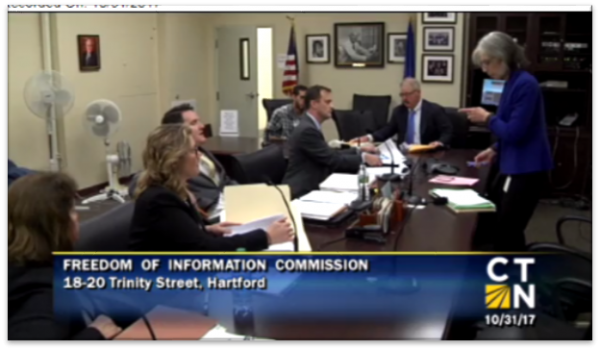
CT-N, which has provided coverage of State Senate and House sessions and all three branches of state government for nearly two decades, will cease operations on Friday, November 3, due to severe budget cuts and limitations on coverage being imposed by the legislature on the network’s operator, the Connecticut Public Affairs Network (CPAN). CPAN has operated the network, under a series of contracts with the legislature’s Joint Committee on Legislative Management (OLM), since March, 1999, and was among the first in the nation to provide comprehensive coverage of state government.

“CPAN was created with a nonpartisan, educational mission to run CT-N as a three- branches network, at arm’s length from the government,” CPAN Executive Director Paul Giguere wrote in a letter notifying the non-partisan OLM that CPAN would be ending coverage. “It was a mission and purpose once supported by the Leadership of the General Assembly. Even the state statute governing CT-N’s revenue intercept refers broadly to coverage of ‘state government deliberations and public policy events.’ The thinking has clearly changed.”

At least one of those contracts, covering November 2003 - October 2006, clearly delineates that CPAN’s operation of CT-N would provide coverage of “the legislature, events of public interest in the Executive and Judicial Branches and other events of statewide interest.”  That contract also indicates that “many of the executive branch events to be covered will be taking place at locations away from the Capitol Complex.”  A subsequent contract, which ran through last year, also stated that “CPAN retains full editorial discretion regarding day-to-day programming.”  CT-N broadcasts seven days a week, 24 hours a day.

CPAN’s most recent contact expired in September, was extended through October, and was on a day-by-day basis this week. The 33-person staff worked with an annual operating budget that was unexpectedly reduced by 65 percent in the budget approved by the legislature this week for the current fiscal year.  At the same time, the legislature sought reductions in coverage of state government outside the State Capitol, limitations on editorial content decisions, and cutbacks on public affairs programming.  Those changes, which were revealed in the RFP for a new five-year in April, drew sharp criticism at that time, which were renewed this week.
“For some time now, we have contended with encroachments on our editorial independence, despite our best efforts to be responsive to concerns while continually working to improve the CT-N service and over-delivering on every contract we have ever signed,” Giguere wrote.

The National Alliance of Public Affairs Networks (NAPAN), points out that while many variations exist in programming and operating models among state public affairs networks, a series of “Best Practices” can be drawn from “the most effective strategies used by highly regarded networks across the country.”

NAPAN points out that “citizens’ trust in all three branches of government is at all-time lows,” and “while the judicial, executive and legislative branches actively operate in states daily, the understanding of what and how decisions are being made at the highest levels go largely unreported and consequently unnoticed by the general public.”  CT-N coverage was available on television and on-line, both live and in archives that are easily accessible to the public.  CPAN also has provided educational materials for classroom teachers and the general public.

In his letter, Giguere, who brought the concept for such a network to the Connecticut legislature in the 1990’s and led its launch and development, said “the scope at which we would be obliged to operate CT-N would cease to provide any meaningful level of transparency:  even less so, if the few coverage decisions we would have the opportunity to make were controlled by the CGA (Connecticut General Assembly) to the extent that recent events convince us they would be.”  He continued:  “at best, CT-N would provide the façade of transparency, cloaked – at least temporarily – in the credibility and reputation that CPAN has spent 18 years building.  We will not abet that course of action by the CGA by participating in it.”

In recent days, CT-N has provided coverage of Gov. Malloy’s news conference announcing he had signed the state budget into law, a news briefing on state infrastructure and resiliency improvements since Super Storm Sandy, meetings of the Connecticut Board of Firearms Permit Examiners and the Governor’s Nonprofit Health & Human Services Cabinet, and a hearing by the legislature’s Judiciary Committee considering nominations of individuals to serve on the State Supreme Court and Appellate Court.

Earlier this year, Danbury State Rep. Bob Godfrey cited the role of CT-N in providing the public with access to government, noting that "The General Assembly itself has provided more public access to lawmaking through both our web site (www.cga.ct.gov) and the Connecticut Television Network (CT-N, at www.ct-n.com)."

-----

Five best practices for state public affairs networks are described on the NAPAN website:

1. Accessible to All: 24/7 programs on a dedicated channel across multiple platforms

A state public affairs network is most effective in connecting citizens to state government when it is available full-time to the maximum number of citizens possible, including a robust online presence with strong searchable streaming and on-demand content, accessibility enhancements such as closed captioning for the hearing impaired and a permanent archive of programming produced.

2. All Three Branches of State Government

A state public affairs network is most effective in connecting citizens to state government when it provides a nonpartisan, unbiased and unfiltered window on all official state business.

3. Operating at Arm’s Length

A state public affairs network is most effective in connecting citizens to state government when it is structured with an independent governing body using a set of agreed-upon operating guidelines to make programming and operational decisions free from political influence.

4. Citizen Engagement

A state public affairs network is most effective in connecting citizens to state government when it seeks to demystify the process of governing by providing additional information and context through on-screen graphics, online reference materials and links to other resources.

5. Programming Breadth

A state public affairs network is most effective in connecting citizens to state government when it provides a broad range of high-quality public affairs programming beyond gavel to gavel coverage of government proceedings, as well as official emergency information from appropriate state public safety agencies.


With Continued Funding in Doubt, Gov. Rell, Former Legislators to Reprise Campaign Finance Reforms

Former Governor M. Jodi Rell, who supported and signed Connecticut’s landmark campaign finance reforms into law just over a decade ago, will be the keynote speaker later this month at a day-long conference that will bring many of the key players in that debate together again.  The October 26 event at Central Connecticut State University (CCSU) comes the same week that the state legislature may be voting on a new state budget for the fiscal year that began on July 1, with the continued existence of public financing of state political campaigns – a core component of the reforms - in serious doubt. Among the panelists will be former Senate President Pro Tempore Don Williams, former House Speaker James Amann, former Senate Minority Leader John McKinney, and former House Minority leader Lawrence Cafero. They will be joined by former House member Tim O’Brien, who served on the Government Administration and elections Committee, and Senate Co-Chair of that committee, Sen. Michael McLachlan.

In addition to the legislators, key players in the debate including Karen Hobart Flynn, President and CEO of Common Cause, Jeffrey Garfield, former Executive Director of the Connecticut State Elections enforcement Commission Tom Swan, Executive Director of the Connecticut Citizen Action group, will be part of a second panel.

A week ago, in an op-ed published in Connecticut, Flynn criticized those who would now eliminate public funding of campaigns, known as the Citizens Election Program (CEP), which she described as “a remarkably successful alternative to the corrupt system that earned our state the unfortunate moniker ‘Corrupticut’ in 2004.”  A budget narrowly approved by the legislature and vetoed by Gov. Malloy late last month would have eliminated funding.  It has been estimated that $40 million would be disbursed to statewide office and legislative candidates in 2018, surpassing the $33.4 million distributed to qualifying candidates in 2014.  Recent studies suggest that the program has been effective in reducing special interest money in campaigns.

Flynn added that the law, passed in 2005, “allows candidates and officeholders to look out for the interests of all their constituents rather than being consumed with the needs of their major campaign contributors. It gives talented, motivated citizens who've never had the money or the connections traditionally required for success in politics a chance to seek and win public office with neither big money nor connections.  Now, nearly 80 percent of all candidates for legislative and state offices use the program.”  Qualifying candidates must raise $5,000 to $250,000 — depending whether they are seeking a statewide office or legislative seat — in $100 increments or less in order to receive a grant of public funds from the CEP.

Rell, in signing the plan into law at an Old State House ceremony flanked by legislators from both political parties in 2005, said "This is the bipartisan spirit that people want.  It takes special interests out of elections and is putting elections where they should be, in the hands of the people."

At the time, Connecticut was the first state to pass a public financing system that affects all statewide races including the legislature. The law took effect on Dec. 31, 2006.  Additional reforms were passed by the legislature in 2008, designed to strengthen the 2005 law by expanding the authority of the State Elections Enforcement Commission (SEEC) and enabling the state’s public financing system to operate more smoothly, Gov. Rell’s office said at the time.

The Oct. 26 program is coordinated by the Center for Public Policy and Social Research (CPPSR) at CCSU. The CPPSR has been designated a Connecticut Higher Education Center of Excellence, and is noted for offering innovative academic research and outreach programs which promote a greater understanding of the history, structure, processes, personnel and policies of State government. The center incorporates the Governor William A. O'Neill Endowed Chair in Public Policy and Practical Politics.

The program, "Campaign Finance Reform  in Connecticut," will be held in the Constitution Room of Memorial Hall on the CCSU campus in New Britain, from 8:30 to 1: 30.

Forum on Bankruptcy Planned as Budget Eludes State, Hartford Nears Decision

If the state legislature remains deadlocked on approval of a state budget and the level of municipal aid that would be sent to the City of Hartford, a public forum planned for next Thursday, October 19, may offer a sneak preview of what will come in the days after the headline “Hartford Declares Bankruptcy.” In a program organized by the City of Hartford with support from the Hartford Foundation for Public Giving, the front-burner topic will be “What Does Municipal Bankruptcy Mean and What Can We Learn From Other Cities.”  Insight will be offered by Kevyn Orr, former Emergency Manager for the City of Detroit; Don Graves, former Deputy Assistant to President Obama and Counselor to Vice President Biden; and Mayor James Diossa of Central Falls, Rhode Island.  Moderator for the forum will be Jay Williams, recently installed as President of the Hartford Foundation for Public Giving, and a former U.S. Assistant Secretary of Commerce for Economic Development, and Mayor of Youngstown, Ohio.

The purpose of filing Chapter 9 bankruptcy is to provide a financially distressed government body protection from its creditors while it reorganizes to make itself more fiscally stable.  Opinions differ on its impact and effectiveness.  In Connecticut history, the city of Bridgeport filed for bankruptcy in 1991, but the filing was withdrawn by a new administration after the incumbent Mayor was defeated.  Years later, action by the state legislature to take over fiscal management of Waterbury prevented a possible bankruptcy declaration.

The 90-minute program on October 19 will be held beginning at 8 a.m. at The Society Room on Pratt Street in downtown Hartford.  The conversation continues at a late-afternoon public forum, with the same panelists, at Hartford Public High School.  

Central Falls, the first city in Rhode Island history to declare bankruptcy, in 2011, came out of bankruptcy in a relatively short 13 months.  Described as one of the hardest hit communities in the great recession, with unemployment reaching 16 percent between 2010 and 2012, Central Falls was considered by 2015 as among communities in the state that, although still struggling, were on the rise.

On July 18, 2013, Detroit, Michigan, became the largest municipality in United States history to file for Chapter 9 bankruptcy.  Detroit’s highly visible bankruptcy is today credited by some observers as a key element in the city’s ability to rebound in more recent years, attracting new investment after shedding considerable liabilities through bankruptcy court.  It is even using its bankruptcy as a plus as it goes after Amazon’s second headquarters – a competition that Hartford also looks forward to entering.

Out of nearly 89,500 municipalities in the country, there were just 239 municipal bankruptcy filings between 1980 and 2010, according to the American Legislative Exchange Council.  That number picked up considerably in the aftermath of the recession, including Detroit, Central Falls, San Bernardino and Stockton, CA; and Jefferson County, AL.

Hartford Mayor Luke Bronin said earlier this month that Hartford would seek Chapter 9 protection if additional state aid was not forthcoming by November. The city is seeking at least $40 million more this year — on top of the $260 million the city is already due to receive -also now in doubt due to the state's budget stalemate.  The city, facing a $65 million deficit, is expected to run into cash-flow problems this fall, with shortfalls of $7 million in November and $39.2 million in December, according to published reports.

A week ago, in a newsletter to bond holders and other investors, Municipal Market Analytics noted some of the issues that a Chapter 9 petition could pose not only to Hartford, but to jurisdictions beyond the city’s borders, including steeper interest rates when towns in the region borrow for infrastructure projects, and a possible adverse impact on the state’s bond rating.  The report was speculative, but could have an impact on decisions made at the State Capitol in the coming weeks.

Connecticut's Top Teachers Lead Classrooms from Ashford to Westport

There will be an Awards Ceremony next month to honor Connecticut’s 2018 Teacher of the Year – Erin Berthold, who teaches at the Cook Hill School in Wallingford – along with Teacher of the Year nominees from throughout the state.  The ceremony is scheduled to take place in Hartford just days after Berthold’s application, representing Connecticut, is due at the National Teacher of the Year selection committee. Berthold’s selection was announced last week at her school.  She is the first Wallingford educator to be selected for the annual award.

“I’m beyond thrilled and surprised,” Berthold told the Meriden Record-Journal.  She is in her 11th year of teaching. “I never really thought I’d win an award for teaching. It’s my job, it’s what I do. Working with six-year-olds is the real reward of teaching.”

The teachers who were earned recognition as finalists in Connecticut, along with Berthold, included LeAnn Cassidy, Social Studies, Memorial Middle School, Regional School District 15; LeAnn Cassidy, Social Studies, Memorial Middle School, Regional School District 15; and Courtney Ruggiero, Social Studies, Bedford Middle School, Westport.  Their teaching will also be honored, along with a dozen semi-finalists.  It is the culmination of a process that touched school districts throughout Connecticut, as local districts shined a spotlight on outstanding teachers in their respective communities.

The process begins with the Commissioner of Education sending Teacher of the Year applications to every district superintendent in the spring, encouraging them to participate in the recognition program.  The Teacher of the Year Program seeks to recognize exemplary teachers and does not try to identify the “best” teacher in the state, according to the Teacher of the Year website.

District teams identify one exemplary teacher from within their teaching populations.  Each district nominee completes the state application in the ensuing months and submits it to the State Department of Education.  Applications are distributed to members of a reading committee, and the results are tabulated to identify approximately fifteen semi-finalists.

Semi-finalists are invited to an interview with the Selection Committee at which they present a prepared presentation and respond to several questions related to education issues and current trends.  Four finalists are chosen from among the semi-finalists.  A committee of 12-18 people then travels to each of the finalists’ schools to observe the teachers in action and to interview teams of parents, teachers, support staff, students, administrators, and Board members. 

Following the site visits, the selection committee travels to a neutral site where they deliberate and vote to determine who will emerge as the next Connecticut Teacher of the Year.  Once that selection is made, the announcement follows shortly thereafter, in early October.

The 2018 Connecticut Teacher of the Year semi-finalists teach in school districts all across the state are:

  • Katie Amenta, English, Berlin High School, Berlin
  • Rebecca Aubrey, World Languages, Ashford School, Ashford
  • Kevin Berean, Technology Education, Amity Middle School, Regional School District 5
  • Martha Curran, English Language Arts, Walter C. Polson Upper Middle School, Madison
  • Cheryl Gustafson, World Language, Somers High School, Somers
  • Brian Kelly, Music-Band, John Wallace Middle School, Newington
  • Kristen Keska, Social Studies, East Hampton High School, East Hampton
  • Yolanda Lee-Gorishti, Science, Crosby High School, Waterbury
  • Jeanne Malgioglio, English Language Arts, Madison Middle School, Trumbull
  • Candace Patten, Social Studies, Southington High School, Southington
  • Colleen Thompson, Music, Simsbury High School, Simsbury
  • Vincent Urbanowski, Mathematics, The Academy of Information Technology, Stamford

The Connecticut Teacher of the Year Program is made possible by contributions made to the Connecticut Teacher of the Year Council, a 501(c)(3) non-profit organization that provides recognition for exemplary teachers and excellence in teaching.

Berthold has taught at Cook Hill for three years and was previously a special education teacher at Yalesville School and Moses Y. Beach School in Wallingford, the Record-Journal reported. Earlier in her career, Berthold taught at Lincoln Middle School in Meriden and Woodhouse Academy in Milford.

The Connecticut Teacher of the Year and Teacher of the Year finalists serve as teacher-ambassadors for public education. They are appointed to various education advisory committees and become consultants to the Commissioner of Education. In addition, they present workshops; speak at education conferences and meetings; address student, civic, college and university, and governmental groups; and operate special programs in accordance with their interests and expertise throughout the coming year.

For Berthold, there is one additional assignment. The National Teacher of the Year application is due to the National Teacher of the Year office, Washington, DC on November 1.  Just two years ago, Connecticut’s Teacher of the Year, Jahana Hayes, a high school social studies teacher at John F. Kennedy High School in Waterbury, was also selected as National Teacher of the Year and was honored at a ceremony at the White House with President Barack Obama.

Lauren Danner, a General Science/Biology teacher and Science Department Leader at North Branford High School was Connecticut’s Teacher of the Year in 2017. Cara Quinn, a sixth-grade teacher at the Sunset Ridge School in East Hartford, was named the 2015 top teacher in Connecticut. In 2014, John Mastroianni, a music teacher at West Hartford’s Hall High School, was selected.


Photos:  (Above) Erin Berthold; (Below)  LeAnn Cassidy, Regional School District 15; Martha Curran, Madison; Courtney Ruggiero, Westport.

Concerns Raised That U.S. Census Count Changes, Funding Cutbacks May Hurt Connecticut

It occurs once every decade – the U.S. Census aims to count everyone in the United States, and is the foundation upon which a plethora of funding and policy decisions are based for much of the decade that follows.  The next nationwide census, in 2020, is already raising red flags, here in Connecticut and across the country. The Connecticut Council for Philanthropy is encouraging local participation in a national webinar about the role that philanthropy in ensuring a fair and accurate count in the U.S. Census in 2020.  The webinar, on October 30, 1:00 – 2:00 pm, is one of the early efforts to raise awareness of potential implications for the census if Congress, in an effort to keep costs in check, makes fiscal decisions that turn out to be penny wise and pound foolish – potentially jeopardizing levels of federal aid to communities and states, including Connecticut, that will last a decade.

"If you underfund the Census, you get an undercount," says Kenneth Prewitt, who directed the bureau during the 2000 Census. "And if you don't count people, they are politically invisible, in effect," he said earlier this year in Time magazine.

Announced plans by the U.S. Census Bureau, that it will be “introducing significant innovations to conduct the 2020 Census,” is spurring concerns even as the planning process is being refined and funding and operational decisions are being made.  The Bureau is focusing on “four key innovation areas… with cost reductions in mind.”  Among them is “re-engineering address canvassing,” a critical first stage in the census counting process.

Policy and administrative decisions, such as the changes outlined in the latest Census Bureau plan, will carry significant implications for census accuracy and outcomes, point out webinar organizers the United Philanthropy Forum and Funders' Committee for Civic Participation (FCCP). It is imperative, the organizations emphasize, that philanthropy take action now to support a fair and accurate count.  Speakers on the webinar will include:

  • Terri Ann Lowenthal, Census Consultant with Funders' Committee for Civic Participation's Funders Census Initiative 2020
  • Debbie McKeon, Senior Vice President of Member Services, Council of Michigan Foundations
  • Daranee Petsod, President of Grantmakers Concerned with Immigrants and Refugees (GCIR)

Officials point out that “Data from the census drive key decisions made by government, business, nonprofits and philanthropy. Unfortunately, the Census has historically missed disproportionate numbers of people of color, immigrants, young children and low-income and rural households.”

In a commentary article earlier this month in CT Mirror, Aparna Nathan and Mark Abraham of New Haven-based DataHaven raised concerns not only about the impact on nonprofit organizations from a less-than-accurate census, but about the across-the-board dangers of a census that does not provide an accurate count – particularly for Connecticut.

The culprit: underfunding. 

In 2012, according to Nathan and Abraham, Congress told the Census Bureau to spend no more for the 2020 Census than they spent on the 2010 Census, and even encouraged them to spend less. Carrying out the same operation as in 2010 would cost a projected $17.8 billion overall, but the 2020 Census Operational Plan aims for $12.5 billion.  Already, a number of dry-runs and field tests have been postponed or cancelled outright, potentially undercutting plans for the census, now littler more than two years away.

“An underfunded 2020 Census is likely to systematically undercount some of the state’s more vulnerable populations and undermine efforts to create a more equitable, opportunity-rich state,” they wrote.  “Since population distributions are used to draw voting districts and determine the number of representatives each state or neighborhood gets in our legislative bodies, undercounting hard-to-count groups means that their vote may count less and their voice might not be heard at the state level or in Congress.”

The U.S. Census Bureau’s 2020 Census Operational Plan, dubbed “A New Design for the 21st Century,” increases reliance on technology to determine its count, considered to be a most cost-effective approach.  But others say technology has its limits, especially among certain populations, and overreliance can lead to an incomplete and inaccurate count.

The document itself acknowledges that possibility, noting that “As the Census Bureau continues to evaluate the 2020 Census operational design, an analysis of the impact on the quality of the census results is required to ensure that innovations designed to reduce cost do not have an unacceptable impact on quality.”

Sizeable immigrant populations throughout much of the state, and refugee populations in Hartford and New Haven, might find themselves questioning the confidentiality and importance of the census, especially in the current climate of fear and anti-immigrant rhetoric, pointed out Terri Ann Lowenthal, a consultant and former congressional staffer who directed the House’s census oversight subcommittee and now lives in Stamford, Connecticut.

Because individuals in urban and immigrant communities tend to respond at lower rates to census inquiries received by mail, the more costly personal visits be census officials are necessary to obtain more accurate population and demographic counts.  If those visits are reduced in order to cut costs, the accuracy of the census itself is likely to diminish, observers say.  Connecticut, which does not have independent counts of its entire population, depends heavily on data derived from the U.S. Census for a host of policy and funding decisions.

Fred Carstensen, Professor of Finance and Economics at the University of Connecticut and director of the Center for Economic Analysis at the school, commented recently that “In the face of its fiscal/budget crisis, an accurate census and vastly improved understanding of demographics is crucial. But in all likelihood, Connecticut will fly blind--and lose significant federal dollars.”

The National Committee for Responsive Philanthropy recently pointed out that "Counting every person in the United States is an extraordinarily complex endeavor – it is the nation’s largest peacetime mobilization of personnel and resources. Even with careful planning, a perfect count is virtually impossible: Some people are missed, some are double-counted, and some do not respond fully. But, because the accuracy of the census directly affects our nation’s ability to ensure equal representation and equal access to public and private resources, achieving a fair and accurate census must be regarded as one of the most significant civil rights and social justice priorities facing the country."


Neighboring States Bring in Millions in Toll Revenue; CT Remains Toll Free

The Connecticut House of Representatives debated for nearly six hours the issue of reinstating tolls on Connecticut highways, but did not vote.  Connecticut remains a toll-free state, for residents and those driving through the state. How much money might the state receive in toll revenue if tolls were imposed?  The Office of Legislative Research, responding to a legislative inquiry, has surveyed neighboring states and issued a report this past week.

Toll revenue ranged from $20.4 million in FY 16 (Rhode Island) to $1.57 billion in calendar year 2016 (New Jersey), according to the legislature’s research office. In Massachusetts in FY2016, toll revenue was $395 million; in Maine $133.8 million in calendar year 2016; in New Hampshire a total of $130.7 million. 

The New York Thruway Authority and New Jersey Turnpike Authority each collect tolls on their respective highways, the Office of Legislative Research (OLR) report noted. In addition, the Port Authority of New York and New Jersey collects tolls on its bridges and tunnels connecting those two states (the George Washington, Goethals, and Bayonne bridges, the Outerbridge Crossing, and the Lincoln and Holland tunnels). In calendar year 2016, the Port Authority collected $1.86 billion in toll revenue.

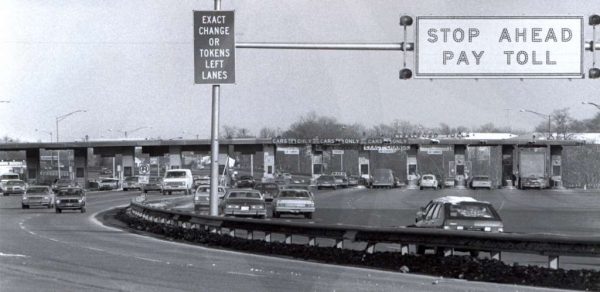
Tolls were eliminated by lawmakers more than three decades ago in 1983, following a horrific accident at the then-Stratford toll booths, in which six people were killed. The last Connecticut highway toll was paid at the Charter Oak Bridge in Hartford on April 28, 1989.

In their final year of operation in the mid-‘80’s, Connecticut Turnpike tolls brought the state $56.4 million, the Merritt and Wilbur Cross Parkways 11.3 million, and the three bridges in the Hartford area, $4.7 million, according to a previous OLR report issued in 2009.

Technology, however, has made traditional toll booths obsolete, and Massachusetts recently removed its toll booths, switching to an overhead electronic system – thus maintaining the revenue without extending the dangers and the highway back-ups inherent with the toll plazas.  Connecticut residents driving through Massachusetts on the MassPike have noticed the striking difference.

Despite projections of budget deficits in coming years, the legislature did not vote on imposing tolls as a means of raising revenue this year.    It was estimated that 30 percent of the tolls would be paid by out-of-state drivers and 70 percent by Connecticut residents.  Federal rules require that toll revenue from interstate highways must be used for maintenance or improvements on those highways.  The legislature’s Transportation Committee had voted 19-16 in favor of the tolls bill, which led to the House debate on the proposal.  It was pulled before a vote could be held.

The 2009 OLR Report also noted that according to annual data compiled by the Federal Highway Administration, in 2007 almost 32.5 percent of all the vehicle miles traveled (VMT) in Connecticut occurred on its Interstate highways. Nationally, only 24.4% percent of all VMT occurs on Interstate System. Connecticut's Interstate VMT percentage is higher than many other states, including, at the time, Massachusetts, New York, New Jersey, and Pennsylvania.

The most recent OLR Report did not estimate what Connecticut might earn in toll revenue; it merely reported on the most recent earnings of neighboring states that impose tolls on their major roadways.

Constitution Day in the Constitution State - Celebrate?

Constitution Day, celebrated this year on Sunday, is a national holiday to commemorate the signing of the U.S. Constitution on Sept. 17, 1787.  Connecticut is known as the Constitution State, but that designation has its roots more than a century earlier. Congress first established “Constitution Week” in 1956. It became a national holiday 44 years later when  Sen. Robert Byrd (D-W.V.) introduced an amendment to the omnibus spending bill that made the observance a national holiday, and to require that all schools receiving federal funding, as well as all federal agencies, to provide relevant programming to celebrate the Constitution.

Written in 1787, ratified in 1788, and in operation since 1789, the United States Constitution is the world's longest surviving written charter of government, according to the U.S. Senate website.   Its first three words –– "We the People" –– affirm that the government of the United States exists to serve its citizens.

The National Constitution Center (NCC) devotes space on its website to the question of whether the "constitution" celebrated by Connecticut really a constitution?

The site explains that although the Connecticut Compromise at the 1787 convention in Philadelphia was a critical part of the process of agreeing to and ratifying the U.S. Constitution, Connecticut celebrates – and its nickname is derived - from an event that happened in 1639.

On January 14, 1639 (in the old Julian calendar), the residents of three Connecticut towns - Wethersfield and Hartford - approved a list of rules for running local government called the Fundamental Orders. Most historians agree the Fundamental Orders are significant, but the state of Connecticut decided in 1959 to call itself the Constitution State based on the premise that the Fundamental Orders were the first constitution in North America.


The Fundamental Orders document has a structure that is similar to a constitution, the NCC explains. There is a preamble and a list of powers about local government, taxation and voting rights.

Prior to the legislature determining in 1959 that Connecticut would be known by the official nickname of the Constitution State, it was known as the Nutmeg State.  Before that, in the post-Revolutionary War era, Connecticut was known as the Provisions State.

Officially, the state is not known as the Land of Steady Habits, but that too is commonly used. A Dictionary of Americanisms on Historical Principles, published in1951, defines “Land of Steady Habits” as “1. Connecticut, applied in allusion to the strict morals of its inhabitants.”


“Museum Day Live” Event to Include 18 Connecticut Museums

Eighteen Connecticut museums in twelve communities will be participating in Museum Day Live! On September 23, offering free admission in a national initiative led by Smithsonian magazine and supported by Microsoft, to increase awareness of the assets that museums have to offer residents throughout the country. Museum Day Live! is described as “an annual celebration of boundless curiosity.” Participating museums and cultural institutions across the country provide entry to anyone presenting a Museum Day Live! ticket. Individuals can get tickets on-line to any of the participating museums, simply by indicating the museum they intend to visit.  A ticket specific to that museum is then downloaded, and recipients can either print the ticket or show it on their smart phones in many of the museums.

To get free admission, guests must present an official Museum Day Live! Ticket, which provides general admission for the ticketholder plus one guest.  It is not valid for special exhibits, parking, IMAX film screening or any other offer.

Across the country, there are nearly 1200 participating museums, including 457 museums in the Northeast, 188 across the South, 402 in the Mid-West and 136 in the Western U.S.

Participating museums in Connecticut include:

BRISTOL

DANBURY

Danbury Museum and Historical Society Authority

FAIRFIELD

Fairfield University Art Museum 

GREENWICH

Bruce Museum

HARTFORD

MASHANTUCKET

Mashantucket Pequot Museum & Research Center 

NEW HAVEN

NEW LONDONCustom House Maritime Museum

RIDGEFIELD

The Aldrich Contemporary Art Museum

TOLLAND

WEST HARTFORD

Art Museum, University of Saint Joseph 

WOODBURY

Glebe House Museum & Gertrude Jekyll Garden