Greater Hartford Residents Prefer Focus on Vibrant Communities Over Recruiting Businesses
/In a time of reduced resources and stark choices for policy makers, a survey of Greater Hartford residents suggests that investments aimed at creating vibrant communities, with the focus on local schools, transportation options, walkable, attractive physical environment is preferred to devoting greater resources to recruiting employers.
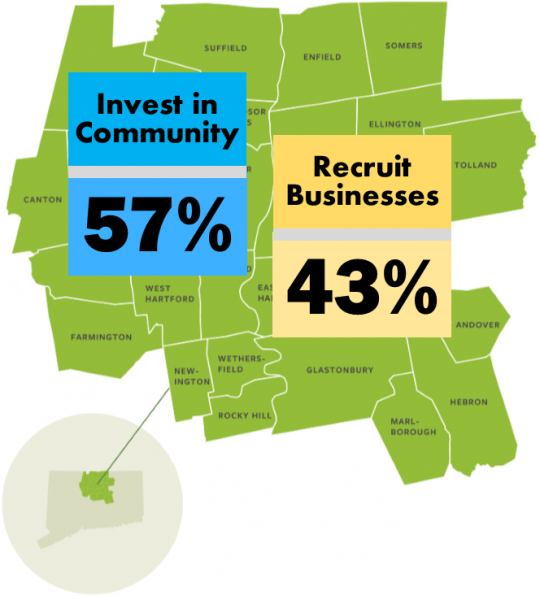
In a survey for the Hartford Foundation for Public Giving as part of the Metro Hartford Progress Points effort, and conducted by Inform CT, residents of Hartford and Tolland County, by 57 percent to 43 percent, said that investing in communities was a better approach than recruiting businesses.
The findings reaffirm one of the key goals in the new three-year strategic plan of HFPG, launched earlier this year, developing vibrant communities. The plan states that “All of our region’s residents should have the opportunity to live and contribute to strong, safe vibrant communities,” and calls for a “focus on people and places with the greatest need by engaging and supporting partners who promote meaningful civic engagement, safe affordable housing, quality health and mental health care and a rich diversity of cultural and other experiences to improve the quality of life.”
 The data from the survey reflect a difference of opinion among older residents of the region. Individuals over age 46 took the opposite view from younger residents, with a majority expressing a preference for spending skewed toward recruiting companies. The reversal was dramatic, with two-thirds of those age 36-45 preferring investing in communities, by a margin of 67%-33%, and individuals age 46-55 expressing a preference for resources to be aimed at recruiting companies, with two-thirds holding the opposite view, 63%-38%.
Across all age groups, a majority of homeowners preferred that the emphasis be on vibrant communities, 52%-48%, and an even larger majority of respondents who are not homeowners, 64%-36%, shared the same view.
The preference for policy to be targeted more towards assuring vibrant communities than recruiting companies was consistent across a majority of respondents of various education levels and among white, black and Hispanic residents of the region, according to the survey. A majority of survey respondents who are currently employed full-time, as well as those working part-time, and those unemployed all expressed a preference for investing in communities rather than recruiting companies.
The Greater Hartford survey results are not inconsistent with data gathered elsewhere. A March 2014 national survey by the American Planning Association (APA) found that Millennials and Baby Boomers want cities to focus less on recruiting new companies and more on investing in new transportation options, walkable communities, and making the area as attractive as possible. The national survey found that 65 percent of all respondents and 74 percent of millennials believe investing in schools, transportation choices and walkable areas is a better way to grow the economy than investing in recruiting companies to move to the area, according to the APA.
A 2013 study in Michigan, posing similar questions, brought similar results. In the statewide survey, 64 percent of Michigan citizens said they believed the most important thing state government can do for job creation is to “provide quality education, good roads and transportation, good public services like safety, water, fire, parks and libraries that create an environment in which people want to live, work and run a business.” This contrasts with 29 percent who said the most important thing state government can do is to “cut taxes for individuals and businesses.”
Earlier this month, at the annual Municipal Collaboration Summit organized by the Hartford Business Journal, one of the session’s was devoted to an exploration of “Building Vibrant Communities,” with observations from representatives of Connecticut Main Street Center, the Partnership for Strong Communities and the Connecticut Economic Resource Center.
The Hartford Foundation for Public Giving serves 29 towns, hundreds of nonprofits and more than 750,000 residents in the Greater Hartford region. As Greater Hartford’s community foundation, HFPG brings together members of the community to “share information, understand local problems and put resources behind effective solutions.”
Developed by a group of key regional stakeholders, Metro Hartford Progress Points is a periodic 'check-up' to build greater understanding about issues facing the Greater Hartford community. The second edition of Progress Points, released late last year, takes a deeper look at key issues impacting our communities and how they are connected, with a particular focus on access to better schools, better jobs and stronger neighborhoods. Along with the Hartford Foundation, partners include the Hispanic Health Council, MetroHartford Alliance, United Way of Central and Northeastern Connecticut, Urban League of Greater Hartford, Capitol Workforce Partners, Capitol Region Council of Governments, the Center for Urban and Global Studies at Trinity College and the City of Hartford.
The survey was conducted for the Foundation during the 4th quarter of 2015 by Inform CT.
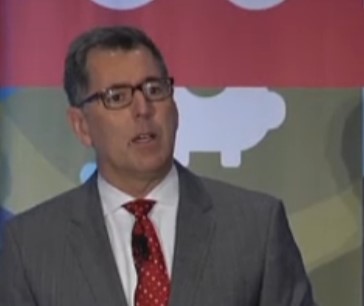 Since entering the Connecticut market in the summer of 2014, the company has been aggressively growing its customer base in a competitive market while working diligently to grow and expand its network of doctors. Harvard Pilgrim Health Care announced recently that its Connecticut membership has grown to more than 24,000, exceeding expectations for 2015. It now serves more than 800 Connecticut businesses. Twenty-nine of the state’s 30 hospitals are now in-network.
 With more than 500 business leaders in attendance at an annual Economic Summit & Outlook last week, brought together by the Connecticut Business and Industry Association and MetroHartford Alliance, Schmitt spent some time touting a new model launched in the state of New Hampshire that he believes may be a glimpse into the direction the industry is moving. Harvard Pilgrim Health Care’s footprint in New England now covers “where 90 percent of New Englanders live,” in Massachusetts, Connecticut, Maine and New Hampshire.
 Launched

 However, survey data appears inconsistent on whether the trends are good or bad.



 “Key and First Niagara are a powerful combination, driven by a shared commitment to the clients and to the communities we serve,” KeyCorp Chairman and CEO Beth Mooney said. “This transformational opportunity will bring compelling and complementary capabilities to our shared three million clients, while driving meaningful synergies and enhancing shareholder value. KeyBank and First Niagara both have values-based cultures and a long-term commitment to and experience with the region.”
 A survey to which 29 of the 60 black and Latino arts groups in the study replied showed that the median percentage of donations coming from individuals was 5%. The norm is about 60% for big mainstream arts organizations. “This is the most important single statistic in the study,” the report says. Minority arts organizations also trailed when it came to box office receipts and other earned revenue. Earned money accounted for 40% of their revenue, compared with 59% for the big mainstream groups.
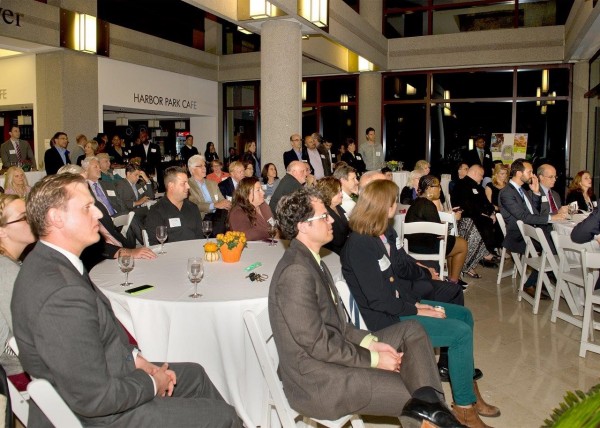 “I would like to congratulate all of the members of Stamford 2030 for joining together to make vital changes for our community," said Stamford Mayor David Martin. "The partners in Stamford 2030 have really stepped up for the success and sustainability of our city and the surrounding area. And they are not alone. For our part, the city is committed to improving storm resiliency and moving forward with the Energy Improvement District. We believe these efforts are tied to our economic development and ability to attract people to Stamford while conserving important natural resources, all necessary for sustained growth and prosperity.”


 When asked in the survey about factors that influence their giving, the biggest portion, 68 percent, said it is very important the charity has evidence that its programs are effective. The other factors, in addition to the 50 percent who favored low overhead spending: the charity gets good ratings from watchdogs, 54 percent; it works on a cause that has affected me or my loved ones, 39 percent; it only occasionally asks for money, 27 percent; and I know people who work there, 24 percent.