Survey Says: Hartford Is Among Nation’s Top Up-and-Coming Cities
/What do Milwaukee, Syracuse and Hartford have in common? They are all – believe it or not – the nation’s most notable “up-can-coming place to live,” according to a new national analysis of the top places to live in the U.S.
In calculating the second-annual ranking of the Best Places to Live in the U.S., which evaluates the 100 most populous metro areas in the country based on qualities that Americans care about most, U.S. News looked at affordability, employment opportunities and the overall quality of life in each place. Hartford’s ranking jumped from number 59 a year ago to number 31 this year, among the largest leaps of any city in the nation.
The leading reason cited by the publication is the increase in jobs.
"The Hartford region has seen some strong employment growth in a number of high-productivity sectors, including professional, technical services, education and health services," said Alissa DeJonge, vice president of research at the Connecticut Economic Resource Center.
The types of job opportunities that are available in the Hartford area tend to pay well, the publication points out, “with residents earning nearly $57,000 per year on average, which is significantly more than the average American's salary of $48,320 per year. United Technologies Corp. provides employment to residents in the manufacturing and engineering sectors, and the region is home to some of the country's largest financial institutions, including Aetna Inc. and the Hartford Financial Services Group.”
"Hartford is known as the 'insurance capital' of the U.S., a title substantiated with Connecticut ranking No. 1 in the U.S. for insurance employment per capita, with many of those employers located in the Hartford region," added Susan Winkler, executive director of Connecticut Insurance and Financial Services. "Connecticut is also home to the highest concentration of actuaries – many located in the Hartford region."
The U.S. News review also notes that the region features a diverse selection of restaurants and cultural attractions. Paul Pita, CEO and executive creative director of Hartford-based digital marketing firm The Pita Group, told U.S. News "Hartford is a great place to live because residents have access to what they need: great options for housing, great educational options and a wide variety of lifestyle options for food, arts, culture, entertainment and outdoor activities."
Syracuse moved from #53 to #28, and Milwaukee climbed from #72 to #47. The top 10 places to live in the U.S., according to the rankings, are Austin, Denver, San Jose, Washington D.C., Fayetteville, Seattle, Raleigh/Durham, Boston, Des Moines, Salt Lake City and Colorado Springs. Portland, Maine ranked #26 and Albany ranked #30, just ahead of Hartford. New Haven ranked #81 in the top 100.
The metro areas included in the rankings were evaluated by U.S. News using data from sources including the United States Census Bureau, the Federal Bureau of Investigation, the Department of Labor and U.S. News' own internal resources. This data was categorized into five indexes – Job Market (including salary and unemployment rates), Value Index (including cost of living), Quality of Life Index (including education, crime, commuting, and health care), Desirability Index, and Net Migration - and then evaluated using a methodology determined by Americans' preferences. The percent weighting for each index was determined by the answers to a public survey in which people from across the country voted for what they believed was the most important thing to consider when thinking about moving, according to U.S. News.
 As director of HEFN, she has managed its programming, outreach, and operations, promoting collaboration on shared goals among its members. Fortunato previously served as associate director of policy for Health Care for All in Boston, engaging in policy research, communications, and campaigns, and as a consultant for The Public Policy Institute, also in Boston.
 ry County Citizen's Advisory Board. A native of Connecticut, she and her family look forward to relocating here from their current home in Jacksonville, Florida.
 is named. Meléndez is not a candidate for the position. Linda J. Kelly announced her retirement as president of the Hartford Foundation for Public Giving, last March, effective next month, after 10 years leading the organization.
 Eligibility Requirements for Book Awards to be made in 2017:


 Unite For Sight's international eye care services with partner local eye clinics are provided year-round and are comprehensive, including examinations by local eye doctors, diagnosis and care for treatable conditions, education, and preventative care. The organization’s website indicates that Unite For Sight has provided eye care services to more than 2.1 million people worldwide, including more than 93,166 sight-restoring surgeries.
 The conference also includes Social Impact Labs, which provide an opportunity for selected speakers to present their new idea in the format of a 5-minute pitch. All of the presentations are ideas that are being developed, meaning that the ideas are in the brainstorming, early development, or early implementation stage. Following each presenter’s 5-minute pitch, there is a 15-minute period for discussion and coaching with two expert speakers, questions, answers, and feedback from the audience.


 Lewis’ commitment and dedication impressed the judging panel.

 “Wholesome Wave is thrilled by the innovations that USDA is supporting through the new FINI grants, which are taking the work of increasing affordable access to healthy food to even greater levels of impact,” said Michel Nischan, CEO & Founder of Wholesome Wave. “So many SNAP shoppers are working parents with limited time to source healthier food choices. Through the new Farm-to-Grocery model, our partners in Connecticut and Vermont will be able to expand affordable access to SNAP consumers in a way that allows them to find and purchase more healthy food from a variety of retailers.”

 The Foundation invested 30 percent of its grants in education from birth through high school, and new and renewed college scholarship, according to the report. Grants for family and social services received 20 percent; health – 11 percent; arts and culture – 11 percent; community and economic development – 19 percent, general – 5 percent and summer programs – 4 percent.
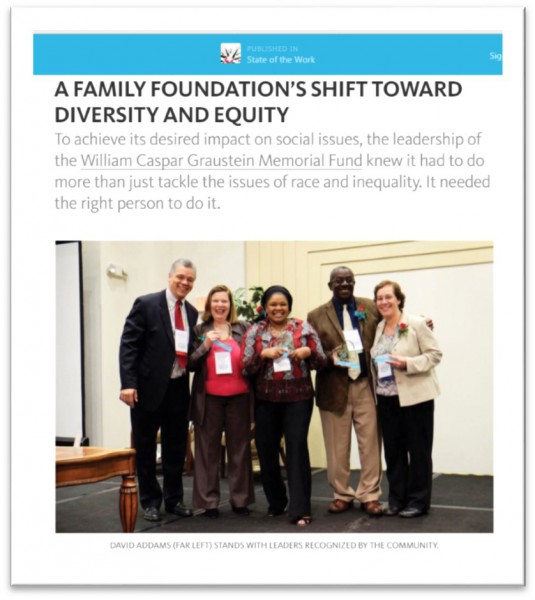 The D5 final report features stories about leaders in foundations and other philanthropic organizations taking meaningful action to advance DEI. “Storytelling is one of the most powerful ways to inspire action and change. We hope people working within foundations—whether they are a CEO, an HR manager or a program officer—draw on the important lessons from these stories, and apply them to their own unique situations,” said Kelly Brown, D5 Director. Kelly also cited statistics indicating that “when companies commit themselves to diverse leadership, they are more successful. Foundations and nonprofits,” she said, “have the opportunity to take a page from successful business playbooks.”